Home Watch Videos Wars

[🇧🇩] Jute Industry in Bangladesh

[🇧🇩] Jute Industry in Bangladesh
63
3K
More threads by Saif

G Bangladesh Defense

Massive plan afoot to grow jute in Khulna region

OUR CORRESPONDENT
Published :
May 27, 2025 08:31
Updated :
May 27, 2025 08:31

1748389291755.webp


KHULNA, May 26: Farmers have taken extensive plans to bring a vast tract of land into jute cultivation in Khulna region and grow the cash crop on a massive scale this season.

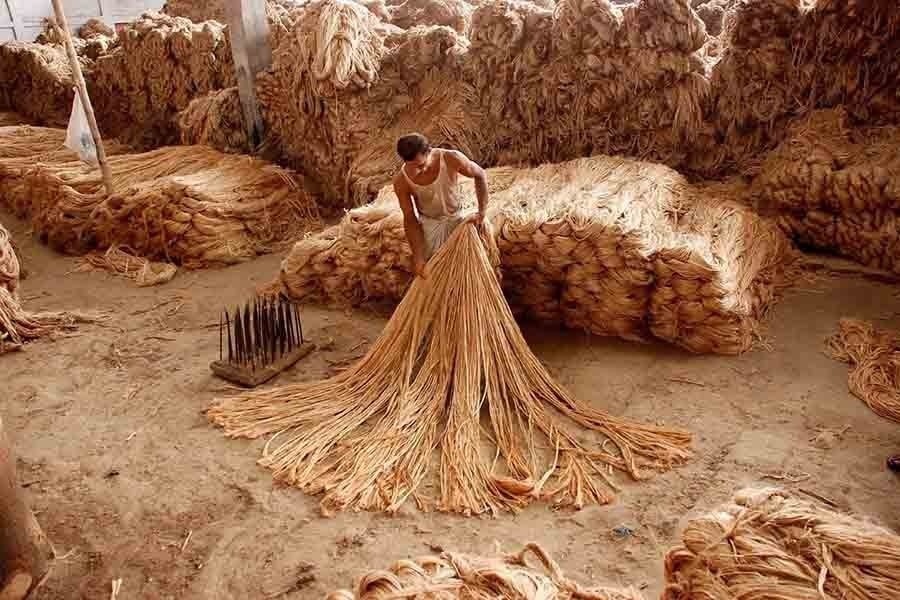
Jute is a cash crop which is known as 'golden fibre' in the country whose climate and soil are suitable for its production.

According to official sources, jute sowing began in Khulna region in the first week of April. In order to increase jute production, intensive cultivation is now underway.

They believe if weather is favourable, it will be possible to start harvesting jute in mid-July to the first week of September.

Farmers will be able to achieve the target, which will create interest among other farmers for jute production.

The huge jute production will play an important role in the country's economy.

According to sources from the Department of Agricultural Extension, Khulna region has set a target for jute cultivation and production in the current 2025-26 Kharip-1 season in order to increase jute production in this region.

Some 1,447 hectares of land will be brought into jute cultivation in Khulna district, 1,960 hectares in Bagerhat, 12,550 hectares in Satkhira and 23,900 hectares in Narail.

DAE sources the target has been fixed to grow jute on 38,078 hectares in Khulna region.

In the current Kharip-1 season, initiatives have been taken to achieve the target on 1,471 more hectares of land in Khulna region compared to last year's.

Shahbuddin, a farmer of Dighlia, said, "This year I have cultivated jute on 5 hectares of land. I have given water to the field."

Local upazila agricultural office provides overall assistance, he added.

Md Amirul Islam, deputy assistant agriculture officer of Kalia Upazila Agriculture Office, said jute has been cultivated on 150 hectares of land in different villages of Dhushati, Bil Bauch, and Baladanga blocks in my Salamabad Union.

Jute cultivation began in mid-April of this year, which has already been completed. After sowing, various works including weed control, thinning to increase the height of the trees, application of chemical fertilizers, and disease and insect control are underway.

Khulna's Dighalia Upazila Agriculture Officer Kishore Ahmed said that in order to increase jute production in Dighalia, 50 hectares of land have been brought into jute production. The upazila agriculture office is providing overall support for farmers to grow jute. Khulna Region DAE Additional Director Md Rafiqul Islam said that the target of jute cultivation and production has already been set for the current 2025-26 Kharip-1 season. The target of jute cultivation in the Khulna region has been set at 39857 hectares of land.

Against the production target, the cultivation in this region has already progressed by 38,078 hectares, which is 95.5 per cent.

This season, initiatives have been taken to achieve the target on 1,471 more hectares of land in Khulna region compared to last year's.​
 
Analyze

Analyze Post

Add your ideas here:
Highlight Cite Fact Check Respond

Jute growers eye bumper yield

OUR CORRESPONDENTS
Published :
Jun 05, 2025 14:46
Updated :
Jun 05, 2025 14:46

1749166511479.webp

A farmer taking care of his jute in village Beroil under Magura district - FE Photo

Jute farmers of Magura and Gopalganj districts are expecting a bumper production this year, as weather for growing the 'golden fibre' of Bangladesh is favourable.

Our Magura Correspondent says adequate rainfall and quality seeds have made Magura jute growers optimistic of achieving a bumper production.

In the meantime, jute plant has taken a hopeful height and fresh look.

According to sources at the Department of Agricultural Extension (DAE) in Magura said farmers have brought 34,370 hectares of land this season with an output target of 463,995 bales jute.

This season jute growers in the district are blessed with adequate rainfall, which is 175mm from April 1 to May 31.

Earlier, 5,600 jute growers in the district were provided with free seeds as incentive.

Ali Reza, a farmer of village Ghoramara under Magura Sadar Upazila, said, "I have brought my 2 bighas of land under jute cultivation. I am expecting 20 maunds of jute this season. I have got free seeds from the DAE as incentive.

Another farmer, Moinul Hossen, of village Kullia under Magura Sadar Upazila said, "This year I have brought my 3 bigha land under jute cultivation. Due to adequate rainfall I have no irrigation cost for my jute land."

Moreover, due to adequate rainfall my jute plants have taken fresh look making me optimistic to achieve a bumper production.

Mukter Hossen, a farmer of village Beroil under Magura Sadar Upazila, said if such weather prevails, we get adequate water in water body for jute rotting we shall be able to sell quality jute counting handsome profit.

He also said that the government should adopt proper policy right now to ensure fair price of jute.

Agriculturist Shushan Chowhan said jute farming has a positive impact on soil. The leaves fall from jute plant work to enhance fertility of soil.

When contacted, DAE additional deputy director Bishnupada Shaha said this year favorable weather is prevailing for jute cultivation. "We have provided growers with incentive and proper training. We are optimistic to see a bumper yield of jute this season."

Our Gopalganj Correspondent reports said the Gopalganj DAE has taken up the programme of jute cultivation on 24,859 hectares of land. Where probable production target at 16,15, 835 metrictons (MT) under five upazilas in the district, this current year.

According to the DAE, Khamarbari, Gopalganj official sources said Tosha 24,503 hectares, Masta jute 346 hectares & local 10 hectares, where about 1,29,270 farmers involved this farming, sources said.

Solayman Sikder (42), a jute farmer of village Tala under Suktail union of Sadar upazila, said he cultivated jute origin "Tosha" on 3 hectares of land this year, where expending cost about Tk 270,000 if the weather condition remains favorable. "But I will get 210 mounds of jute from it produce. Which market price is taka

735,000," he said.

Md. Mahbub, Sub-Assistant Agricultural Officer (SAAO) of Suktail union block No-9, Kuthibari under sadar upazila said, a total of 520 hectares of land have been brought under jute cultivation in the union. Which maximum origin is Tosha & about 800 farmers involved this farming. He more added, jute farmers in our areas are highly glad due to fair price of its & they are more interested on jute farming, SAAO Md. Mahabub said.

Tuku Molla (50), another jute farmer of village Bonbari under Suktail union of Sadar upazila, said he cultivated jute origin "Tosha" variety on 2 hectares of land this year & its growth condition is satisfactory. "I think if the weather condition remain unchanged but I will get 140 mounds of jute from my field, which current market price is taka 4,90,000. Where expending cost taka 1,80,000 only."

Mafroza Akter, Upazila Agriculture Officer (UAO), sadar told the FE that a total of 5,178 farmers of land have been brought under jute cultivation, this current year. She more added, jute is seasonal favorable cash crop for grows and they get a good economic support from its to sale the markets in crisis period (Rainy season). But jute is a financial helper crop for farmers in this region, UAO said.

Sakayot Sheikh, 45, a jute farmers of village Bonbari under Suktail union of sadar upazila, said he farming jute on one hectare of land origin "Tosha", but last year I got a good profit from this jute cultivation.

"I think this year I will get same profit from my jute farming too. Because my jute growth condition is satisfactory," he added.

Sanjoy Kumar Kundu, additional deputy director (ADD) crop, Khamarbari, Gopalganj, told the FE that constantly monitoring overall progress of jute farming and smoothly supply of agro inputs among the farmers to achieve a total success on jute cultivation.​
 
Analyze

Analyze Post

Add your ideas here:
Highlight Cite Fact Check Respond

Exports of jute and jute goods keep falling

FHM Humayan Kabir
Published :
Jul 05, 2025 00:50
Updated :
Jul 05, 2025 00:50

1751673767167.webp


Bangladesh's jute and jute goods sector has become pale as year-on-year exports have slipped from the billion-dollar club even after huge government investments for sectoral development, analysts say.

Local manufacturers and jute processors exported goods worth $820.16 million in the just-concluded fiscal year of 2024-25, the Export Promotion Bureau (EPB) data shows.

The export of what was once Bangladesh's golden fibre failed to return to the billion-USD-mark after the fall from that position in FY23.

The earnings from the shipments of jute and jute goods were an impressive $1.16 billion in FY21, which then started falling, official data shows.

In FY22, export earnings slipped to $1.13 billion and maintained a steep fall to $911.51 million in FY23, $855.23 million in FY24, and $820.16 million in FY25, the EPB statistics show.

Meanwhile, the government has invested hundreds of billions of takas every year for the jute sector's development through the Ministry of Textiles and Jute.

Currently, the agencies of the ministry are implementing 21 development projects under the Annual Development Programme (ADP) at a combined cost of Tk 3317.17 billion.

Except for jute sacks and bags, the shipments of jute and all jute goods declined in FY25 compared to the previous fiscal year.

According to the EPB, Bangladeshi jute and jute goods exporters shipped $148.48 million of raw jute in FY25, 7.94 per cent lower than $161.28 million in the previous fiscal year.

The shipments of the highest export earners - jute yarn and twine - dropped by 6.22 per cent to $461.83 million in the last fiscal year from $492.45 million in FY24.

Meanwhile, the shipments of jute bags and sacks showed a better performance in FY25 as exporters sent products worth $125.96 million, 18.51 per cent higher than $492.45 million in FY24.

Economists and jute exporters said the low rate of value addition and the smuggling of jute goods affect Bangladesh's shipments.

Besides, India's anti-dumping duty on Bangladesh's jute and jute products is one of the reasons behind the low foreign exchange earnings, they said.

India imposed anti-dumping duties on Bangladeshi jute products in 2017, citing unfair pricing and market distortion.

The move significantly affected Bangladesh's jute industry, reducing exports and affecting thousands of workers who rely on the sector.

India's Directorate General of Trade Remedies (DGTR) carried out a sunset review investigation and recommended an extension of the anti-dumping duty on the import of jute products from Bangladesh and Nepal in September 2021.

The finance ministry of India extended the levy on December 30, 2022.

Local jute goods maker Rejaul Karim Pintu told The Financial Express the global economic slowdown, coupled with shrinking worldwide demand for jute products, significantly impacted exports.

"Raw jute prices increased significantly in recent years. So, the cost of production increased, impacting export competitiveness," Mr Pintu, also the senior vice chairman of the Bangladesh Jute Goods Exporters Association (BJGEA), said.

Besides, India's anti-dumping duties on jute products from Bangladesh and the smuggling of raw jute into India are affecting export earnings, Mr Pintu, the owner of Bico Jute Fibre Ltd, said.

Economist Masrur Reaz, also the chairman and chief executive officer of Policy Exchange Bangladesh, said Bangladeshi producers have mainly failed to add value to jute and basic jute goods, which is why export earnings have not grown.

India's anti-dumping duty is also a reason behind the falling trend of the export of jute and jute goods, he added.
 
Analyze

Analyze Post

Add your ideas here:
Highlight Cite Fact Check Respond

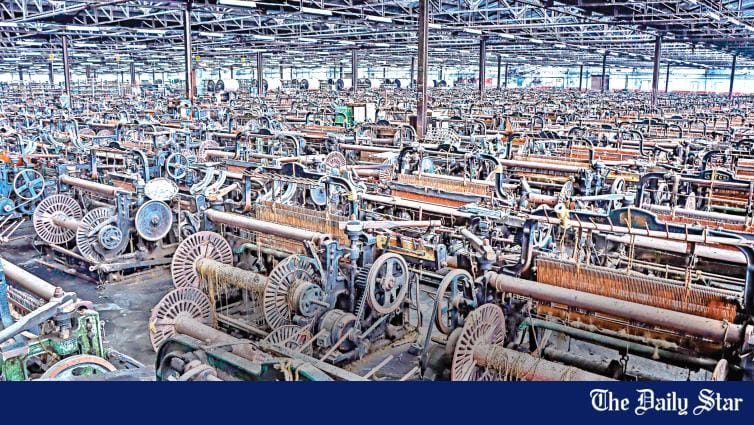
Lives on hold: Workers await reopening of closed jute mills
1752285091447.webp

Photos: Habibur Rahman

Working at jute mills was somewhat of a family tradition for Nasima Akter.

Her father, Abdul Mannan, migrated from Noakhali's Companiganj to Khulna in the pre-independence era and took a job at Crescent Jute Mills, one of the oldest in the region. Later, Nasima and her two brothers, Shahadat and Al Amin, would follow him into the same line of work, reporting to their factory gates for more than a decade.

The jobs brought security, dignity and stability for the family, till July 2020, when it all came crashing down.

That monsoon, the then Awami League-led government announced the sudden closure of 25 state-owned jute mills across the country, citing years of losses, excessive production costs, and inefficiencies that had made the operations unsustainable.

More than 50,000 workers were laid off, including Nasima and her brothers, in three categories -- permanent, temporary, and substitute workers in the jute mills.

At that time, the then government said closed factories would be modernised and reopened soon through various arrangements, including joint ventures, public-private partnerships or government-to-government partnerships.

Five years on, that revival remains partial and uneven.

1752285150083.webp


THE SOUND OF SILENCE

Despite all the hurdles, the laid-off workers still hope for a return to their old days. For them, it was not just a job, but also social security and respect.

"When the mill was running, local shopkeepers gave us groceries on credit because they knew we would pay them back when we got our wages. Now they don't trust us anymore. They know we can't pay," said Nasima.

Her brothers, who also lost their mill jobs, survive by hawking goods on the streets of Khulna city.

Tajul Islam, a former worker of Platinum Jute Mills, now earns his bread by working as a helper on public transport.

"Back when the mill was open, we had three proper meals a day. I could afford to feed my three children."

"Back then, when the morning siren blew, we'd line up to enter the mill. Work gave us respect, routine, and joy. Thursdays were payday, our happiest day of the week," he recalled.

1752285191854.webp


"Now, I work all day, and still, I can't afford the minimum expenses. I don't know when we'll see better days again," he added.

Md Khalilur Rahman, former Collective Bargaining Agent (CBA) leader of the closed Platinum Jute Mills, said that since mill closures in 2020, thousands of families have been pushed into extreme poverty.

"Children dropped out of school, medical care turned into a luxury, and despair became widespread. Hope alone cannot feed a family," said Rahman.

"The collapse of the jute industry has affected every layer of the city, from small vendors to transport workers to landlords," he said, "When the mills were running, life had sound and rhythm. Now, everything is quiet. Hundreds pull rickshaws to survive, and they are hoping that one day it will be open," he added.

1752285237088.webp


BROKEN PROMISES

The government plan was to reopen the mills within three months. That didn't happen.

Later, in April 2021, the Bangladesh Jute Mills Corporation (BJMC), which manages all government-owned jute factories and industries in Bangladesh, called upon interested investors to submit expressions of interest for leasing out 17 of the mills for a period of five to 20 years.

As of now, only 13 have been handed over to the private operators under lease.

In the Khulna-Jashore region, once the beating heart of the country's jute industry, nine mills were shuttered. Four have resumed limited production under private management, collectively employing just over 3,100 workers, a fraction of the 34,000 who once relied on those jobs.

"After I lost the job, even landlords started to act reluctant to rent houses to us. They are afraid we won't be able to pay the rent on time," said 49-year-old Nasima, who now works as a seasonal labourer.

"You'll see hundreds of 'To-Let' signs all over Khalishpur, but they won't rent to jute mill workers like us."

She was forced to leave her rented home in Noyabati, Khalishpur, and move to the city's Bastuhara area with her children, Hasib and Rahima. Her dreams of educating her kids faded quickly.

Her son, Hasib, took a job at a private power plant. Her daughter, Rahima, was married off early -- a choice made in desperation. A year later, Rahima returned home with a child in her arms. Her husband had left.

"I worked at the mill for 16 years," Nasima said. "But I was never made permanent. When it closed, they gave me Tk 114,000 as part of the golden handshake. That money doesn't last long."

1752285284699.webp
 
Analyze

Analyze Post

Add your ideas here:
Highlight Cite Fact Check Respond
BEATING HEART NOW SKIPS A PULSE

Of the nine mills in the southwestern belt, three mills -- Daulatpur Jute Mills, Khalishpur Jute Mills and Crescent Jute Mills -- have been leased out. Meanwhile, two others, Platinum Jute Mills and Star Jute Mills, are in the leasing process.

In the Khulna-Jashore region, Jessore Jute Industries (JJI), Carpeting Jute Mills and Eastern Jute Mills are currently in production.

Alim Jute Mills has remained closed due to legal disputes related to its lease.

Daulatpur Jute Mills was handed over to Fortune Group on September 4, 2023. On March 14, 2024, they launched a shoe manufacturing unit on a limited scale within the mill premises.

At its peak, the shoe factory had about 700 workers across two production units. The factory recently declared a lay-off, leaving around 450 workers unemployed.

Masum Billah, legal adviser to Fortune Group, told The Daily Star that the factory used to export 100 percent of its shoes. "Due to trade complications with India, exports and new orders have come to a halt. This forced us to lay off the shoe factory," he said.

1752285375250.webp


Currently, only 148 workers remain employed in the jute product section. But that unit, too, is under pressure due to the rising cost of raw jute and other operational challenges.

"We are producing just around one tonne of jute products daily. Over the last two years, our jute unit alone has suffered losses of nearly Tk 6 crore," Masum added.

However, Akij Group, which took over Jessore Jute Industries under lease in May 2023, has been producing jute goods. The monthly lease payment stands at Tk 15 lakh. Currently, around 2,000 workers are employed at the mill.

Abul Kalam, project head at the mill, said the group has installed new machinery, significantly increasing production.

The mill now produces between 65 and 70 tonnes of jute products daily, compared to a maximum of only 15 tonnes before its closure, he said.

Yet the number of jobs created is not enough to create opportunities for workers like Nasima.

1752285397818.webp


WHAT IS THE GOVT DOING?

Md Abdur Rouf, secretary at the Ministry of Textiles and Jute, told The Daily Star that efforts were underway to transfer the mills to the private sector.

"Today, (July 8) we finalised terms with four more mills," he said. "Many have already been leased out. Several mills began operations after taking leases but later withdrew. They cannot sustain the costs."

When asked why they were struggling or whether they wanted to diversify beyond jute, he replied, "We allowed and continue to allow them to venture into textiles beyond jute. These mills are very large in scale. They could utilise other sections of the premises for different purposes. Yet some lessees still terminated their agreements."

He added, "The jute mills are valuable resources. They must be utilised. That is only logical. The BJMC owns mills and factories across 13,000 acres of land. These sites are strategically important. They are being used in some form, and this must continue. Letting them sit idle is not an option."

"The BJMC or the government will not invest directly or run businesses here. They are stepping back from that. But there is no reason to leave these resources unused. The jute mills are resources," he said.

1752285443729.webp


In a visit to Daulatpur Jute Mills earlier this year, Textiles and Jute Adviser Sk Bashir Uddin said the conditions for leasing jute mills to the private sector would be relaxed, allowing for the establishment of other industries alongside jute-based industries.

He noted that the initiatives to reopen jute mills under government management have only led to the loss of thousands of crores of taka and produced nothing fruitful.

1752285465488.webp
 
Analyze

Analyze Post

Add your ideas here:
Highlight Cite Fact Check Respond

Posts you haven't read yet..

Members Online

Latest Posts

Back
 
G
O
 
H
O
M
E