[🇧🇩] Monitoring Bangladesh's Economy

[🇧🇩] Monitoring Bangladesh's Economy
1K
31K
More threads by Saif

G Bangladesh Defense

Reforms to secure economic future
Raihan Riaz 10 August, 2025, 00:00

1754876134123.webp


SINCE independence in 1971, Bangladesh has gone through several political transitions, many of which involved interim or caretaker governments. During these times, significant institutional reforms have often been introduced that tend to last beyond their immediate terms. The current government, now responsible for leading the country through a critical period, has a unique chance to implement foundational reforms that could transform Bangladesh’s economic and governance systems.

Bangladesh has made significant progress by reducing poverty, expanding education and becoming a manufacturing powerhouse. However, recent shocks such as the Covid outbreak, the war in Ukraine and domestic financial mismanagement have exposed serious vulnerabilities in the economy. Growth has slowed sharply, with revised data showing the economy having under-performed previous estimates. Capital flight, currency depreciation and depleted foreign exchange reserves have strained macroeconomic fundamentals. Inflation, meanwhile, remains persistently high, hitting lower- and middle-income households the hardest.

To its credit, the Bangladesh Bank has taken early steps to stabilise the economy. The steps include implementing a crawling peg exchange rate, tightening monetary policy, aligning banking regulations with international standards, launching an asset quality review and appointing independent boards in troubled banks. The reforms demonstrate intent, but they are only the beginning. For Bangladesh to emerge strong, the country must address core issue of its current crisis: governance.

A governance crisis, more than any external shock, has undermined institutions and diminished public trust. The government has pledged transparency and extensive public consultation and this promise must now translate into concrete action. The core of the governance reform agenda includes three key areas: public finance, the banking system and digital infrastructure.

Tackling public finance

EVERY year, Bangladesh loses about 7 per cent of its gross domestic product, about Tk 3.5 lakh crore, to tax exemption. While targeted tax incentives can help to achieve development goals, many exemptions are given arbitrarily, without proper process or transparency. As a result, the country has one of the highest tax exemption rates in the world, weakening public trust and government revenue.

One important reform is to transfer tax policy authority from the National Board of Revenue. In almost all democratic countries, tax decisions are a legislative task rather than an administrative one. This change would improve accountability in fiscal policy and ensure that exemptions are debated, justified and accessible for public scrutiny.

Equally important is separating tax policy from tax administration. This would clarify the mandate and reduce conflicts of interest within the revenue board. Reform is also urgently needed in the governance of public procurement. Disclosing beneficiaries and ownership of public contracts would help to prevent patronage and waste. Furthermore, operational independence for the Office of the Comptroller and Auditor General would enhance budget oversight.

In the area of social spending, Bangladesh is making progress by developing a unified, dynamic social registry. This will improve how social assistance is targeted, ensuring that support reaches the most vulnerable and is not diverted through political or bureaucratic interference.

Fixing financial system

ONE clear example of governance failure is in the banking industry. Years of lax regulation and political interference have allowed well-connected groups to secure large loans, many of which remain unpaid. This has led to a buildup of non-performing loans that now threatens the stability of the entire financial system.

To address this, the Bangladesh Bank needs to establish a robust bank resolution framework. This will enable the central bank to step in when banks fail, enforce capital adequacy rules and safeguard depositors. Regulatory authorities should also require banks to reveal the ultimate ownership of shareholders and borrowers, along with any links between them. Such transparency is vital for managing systemic risks and preventing insider lending practices.

Encouragingly, Bangladesh is now working with international partners to recover assets illegally transferred abroad. If the efforts continue, they could help to rebuild trust in the banking system. A transparent and well-regulated financial sector would also attract vital investments, reduce credit risk and increase private sector lending, especially to small and medium enterprises, which are essential for job creation.

Harnessing digital dividend

THE third frontier of governance reform lies in the digital realm. Bangladesh, home to one of the world’s largest populations of digital gig workers, is uniquely positioned to lead among developing countries in digital transformation. However, technology alone is not enough. For digital systems to be effective, they must be supported by strong governance, legal protections and user trust.

Reforms are already in progress to enhance the quality and independence of the statistical system, a vital step to ensure that policy decisions rely on accurate and timely data. This should be paired with the development of a digital public infrastructure: an interoperable system that integrates digital identity, mobile payment, data protection and consent-based data sharing. Such a framework would cut down on inefficiencies, prevent fraud in social programmes and make government services more user-friendly. Countries from Estonia to India have demonstrated that transparent digital systems can significantly improve service delivery and empower citizens. Bangladesh must keep pace.

Institutional integrity

BEYOND specific reforms, the success of this agenda relies on the credibility of institutions. Regulatory agencies such as the Anti-Corruption Commission and the judiciary must be empowered to function independently. Rules should apply equally to everyone, regardless of political or economic influence. Public consultation should go beyond rhetoric to become genuine, with meaningful channels for citizens to participate in shaping policies that impact their lives.

At the same time, whistleblowers, journalists and civil society actors must be protected. They are essential for holding institutions accountable and promoting transparency in the public sphere. The rule of law, impartial enforcement and institutional autonomy are not luxuries. They are the foundation of a just society.

A legacy moment

THE interim government is operating within a limited time frame, but within that constraint, there is an opportunity to initiate governance reform that elected governments can build on. Stabilising the economy is urgent. However, restoring trust in institutions is even more critical for long-term resilience. If Bangladesh can strengthen public financial management, reform its banking sector and develop a digital government rooted in trust and transparency, it will not only recover but also lead.

In this rare moment, reform is necessary. The choices made today will shape the future.

Raihan Riaz is a senior research associate (climate change and disaster risk reduction) at Network for Information, Response and Preparedness Activities on Disaster.​
 

Bangladesh sets $63.5b export target for FY26

FE ONLINE REPORT
Published :
Aug 12, 2025 13:23
Updated :
Aug 12, 2025 13:23

1755044594961.webp


The government has set a new export target of $63.5 billion for the current financial year (FY26), aiming for 16.5 per cent growth over the income achieved in the previous fiscal year (FY25).

Commerce Adviser Sk Bashir Uddin made the announcement at a press conference at his secretariat office on Tuesday, expressing optimism that the target can be achieved by the end of the fiscal year.

Bashir said all existing factors had been taken into account in setting the new export target while unveiling the external trade plan, which has drawn mixed reactions from economists.

The export target for the 2024-25 fiscal year was $57.5 billion, while actual earnings stood at $55 billion.

The commerce adviser reiterated his belief that the new target is attainable.

Commerce Secretary, senior officials, and representatives from trade bodies were also present at the press conference.​
 

Remittance: What has sparked off this sudden surge?

Shoaib Sammo Siddique
Published: 12 Aug 2025, 17: 02

1755047136534.webp


At a juncture when the country is sunk in a multi-dimensional crisis, a ray of hope suddenly has pierced through the dark clouds of the economy. The flow of remittances sent home by expatriates has taken on an unexpectedly encouraging trend. In June 2025 alone, expatriates sent a record 2.21 billion US dollars to the country. This is not just a number, but a rekindling of hope in an economy weighed down by crisis.

At the same time, foreign currency reserves have risen to 31.72 billion dollars (although, according to the IMF’s BPM6 calculation method, the figure is 24.99 billion). Over the past 11 months, reserves have increased by more than 11 billion dollars. This flow quietly signals that the wheels of the economy are beginning to turn again.

A troubled economic backdrop

Just a year ago, the situation was entirely different. Reserves had fallen below 20 billion dollars. Severe uncertainty had gripped the market. A dollar shortage, import bottlenecks, weaknesses in the banking sector, and a lack of investor confidence had shaken the very foundations of the economy. Inflation was hovering in double digits. Faced with an import shutdown, many industrial enterprises had suspended production. The government had struggled even to repay foreign loans and import food grains.

Against this backdrop, now that reserves are growing and remittances are setting records, the question arises: is this truly the beginning of a turnaround, or merely a temporary spell of relief?

Remittance surge

An analysis of explanations offered by economists reveals several factors behind the rise:

First, the exchange rate of the dollar has been kept stable for a prolonged period, holding between Tk 112 and Tk 113 in the market. With incentives added to legal channel transfers at rates competitive with hundi (informal remittance channels), expatriates now see the banking system as more profitable.

Second, the government’s anti-hundi operations, the law enforcement agencies’ vigilance against money laundering, and the central bank’s strict monitoring have narrowed the scope of illegal channels. As a result, migrant workers have become more inclined to send money through legal means.

Third, global employment opportunities have increased. Bangladeshi workers are being sent to new destinations such as the Middle East, Malaysia, South Korea, and Romania. With the government ensuring skilled worker training, language education, and contract-based deployment, both the quantity and quality of remittances have improved.

Fourth, certain reforms in the domestic banking system — such as improving transaction facilities in expatriate accounts and introducing remittance-based savings schemes — have encouraged people to use legal channels.

How this achievement spreads

Remittance plays a vital role in the country’s economy. When overseas workers send money to their families, this increases the country’s foreign currency reserves. This helps the government in various ways, such as, covering import costs, repaying loans, importing food and fuel, and ensuring dollar availability in the market.

As a result, banks can open more letters of credit (LCs), especially in the industrial and pharmaceutical sectors, which in turn boosts domestic production and services.

A renewed sense of confidence is growing among businesses because the supply of foreign currency has stabilised due to remittances. With the exchange rate holding steady, the prices of imported goods have come under control. Falling food prices are bringing relief to ordinary people’s daily lives. Reduced inflationary pressure is positively affecting economic stability and growth. Thus, remittances are not just about sending money; they are a major driver of the nation’s economic prosperity.

This new flow of remittances has brought relief and hope to the country’s economy. It must be ensured that this is not a short-lived phenomenon but becomes permanent
What the statistics say
Fiscal Year Total Remittance (Billion USD) June Income (Billion USD) Reserves at end of July (Billion USD)
2021–22 21.03 1.86 39.78
2022–23 21.61 1.97 23.53
2023–24 30.33 2.21 31.72

These figures show an annual growth of about USD 8.7 billion — the highest in the past decade.

Have we overcome the crisis?

Amid so much good news, one question keeps surfacing: Have we truly emerged from the crisis?

The answer is no. This brings us to the most crucial point that despite the rise in remittances, the major obstacles in the banking sector continue to be non-performing loans, defaulted debt and weak governance. Investor confidence has not returned, no new industries are emerging, and private sector growth is stagnant.

By the end of June, non-performing loans had risen to Tk 5,30,428 crore, that is 27.09% of total loans disbursed. In other words, more than a quarter of all loans in the banking sector are already in default.

Experts say the government now needs long-term structural reforms. Without making the banking sector accountable, freeing it from political interference, and ensuring transparency in the tax system, these gains will not be sustainable.

Another major concern is over-dependence on overseas income. If worker deployment slows down or the labour markets in migrant-hosting countries change, remittance flows could drop sharply, potentially triggering a renewed crisis.

Key ways to increase remittances

1. Improving facilities and services for migrant workers

Ensure round-the clock accessible services for expatriates, simplify banking and remittance procedures at any time, and confirm beneficiaries’ bank accounts to guarantee safe delivery of funds. Regulate recruiting agents to cut excessive costs. Introduce a ‘Remittance Card’ with point systems and pension benefits to encourage the use of legal channels.

2. Strengthening banking and mobile financial service (MFS) channels

Expand bank branches and remittance offices to remote areas. Enhance mobile financial services to enable fast and easy digital transfers. Introduce ‘Wage Earners MFS Accounts’ to strengthen oversight and ensure secure transactions for expatriates.

3. Strict law enforcement and awareness to curb hundi

Enforce tough laws and penalties against money laundering and illegal hundi networks. Identify and punish key hundi operators. Revoke licenses and seize funds where necessary. Provide alternative incentives to encourage expatriates to avoid hundi.

4. Country-specific solutions and stronger embassies

Adopt effective solutions tailored to each country’s specific context, as seen in Saudi Arabia and Italy. Increase embassy efficiency and staffing to deliver faster, smoother services. Reduce the difficulties faced by expatriates and expand consular assistance.

5. Adopting an effective incentive policy and boosting motivation

The current incentive rate is 2.5per cent down from 5 per cent previously. If it had been kept at least at 5 per cent, expatriates would have been even more encouraged to send remittances.

6. Ensuring worker safety and welfare

Guarantee the safety and protection of expatriate workers abroad. Strictly monitor the timely payment of wages. Strengthen safety and security measures for female workers in particular.

7. Simplifying and speeding up the remittance process

Make remittance transfers easier through the expansion of “open banking” and internet banking services. Provide transaction facilities in line with workers’ work schedules. Ensure that workers in remote areas have the opportunity to send remittances quickly via mobile or online channels.

8. Economic and political coordination and goodwill

Take firm steps to increase remittance flows through the sincerity of political leadership and coordinated efforts. Strengthen coordination with banks and financial institutions. Implement the government’s long-term structural reforms.

The current interim government’s strong monitoring of various remittance-related issues has brought positive changes to remittance flows. This improved, targeted management has brought a breeze of calm to the national economy, something we must all acknowledge.

This new flow of remittances has brought relief and hope to the country’s economy. It must be ensured that this is not a short-lived phenomenon but becomes permanent. For that, well-thought-out, sustainable, and realistic economic policies and reforms are essential.

If the government builds on this success with structural changes, maintains transparent governance, and prioritizes production-oriented investment, the dream of a new Bangladesh will be achievable. The hard-earned money of expatriates should not merely be savings, it should be a driving force for the economy. Now is the time to move beyond old mistrust and doubt. Through collective effort, we must build a Bangladesh filled with prosperity and confidence.

* Shoaib Sammo Siddique is a banker and economic analyst​
 

Bangladesh rake in over $1bn in remittances in first 12 days of August

bdnews24.com
Published :
Aug 14, 2025 00:14
Updated :
Aug 14, 2025 00:14

1755133527569.webp


Expatriates have sent in more than $1 billion in remittances in the first 12 days of August, marking a 46.20 percent increase compared with the same period last year.

Bangladesh Bank spokesperson Arief Hossain Khan shared the development on Wednesday.

In August, remittances totalled $1.05 billion until now, compared to $721 million during the same period last year.

In July this year, expatriates sent $2.47 billion through banking channels.

According to the central bank, remittances totalled $3.53 billion from Jul-Aug 12 of the current fiscal year, compared to $2.63 billion during the same duration last year, indicating a 34 percent increase.

Due to the rise in remittances, the dollar supply has increased in banks, and demand is also low due to the lack of pressure to pay for imports and outstanding bills.

In July this year, the dollar rate fell sharply due to reduced demand. In order to stabilise the rate, Bangladesh Bank purchased dollars from commercial banks in five auction rounds.

The governor, however, said the market will also be stabilised by buying dollars through auctions.
 

EXTERNAL SECTOR REBOUND SHOWS SIGNS OF ECONOMIC PICKUP
BoP reverses into $3.4 billion surplus


JUBAIR HASAN
Published :
Aug 14, 2025 00:34
Updated :
Aug 14, 2025 00:34

1755134744987.webp


Bangladesh sees its deficit balance of payments (BoP) reverse into around $3.4-billion surplus in fiscal year 3025 after three financial years, in early signs of much-needed economic rebound.

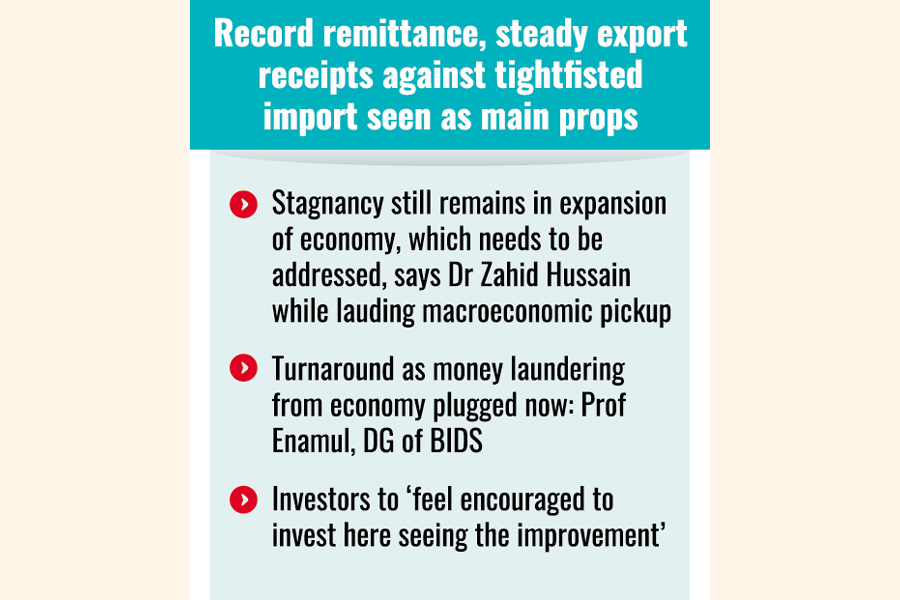
Officials and economists hail record remittance and steady growth in export receipts against import contraction for the turnaround in the BoP situation.

After the end of the last financial year (FY'25), the country's BoP registered a surplus of around $3.40 billion in an upswing from $4.30-billion deficit a year ago, according to July-June FY'25 balance sheet on payments released Wednesday by Bangladesh Bank (BB).

Last time the economy of $460 billion saw surplus in overall balance of $9.27 billion was during the covid-19 pandemic time in FY'21. Afterwards, the country's overall balance swerved into a negative territory covering the subsequent three consecutive years - ($6.65billion in FY'22, $8.22billion in FY'23 and $4.30billion in FY'24).

The major driving force significantly improving the BoP in FY'25 was remittance that grew around 27 per cent to $30.33 billion from previous year's count of $23.91 billion.

On the other hand, a steady growth in exports was also observed in the just-past fiscal year with the nation of over 170 billion population having bagged export receipts amounting to $43.96 billion in a year-on-year growth of 7.70 per cent from $40.81 billion.

In terms of import, according to the official data, the country bought in goods worth $64.35 billion in FY'25, which was 1.80-percent higher over previous fiscal's import figure of $63.24 billion.

However, the surplus in financial account got reduced slightly to $3.98 billion from $4.49 billion recorded in FY'24.

Contacted for his view of the macroeconomic upgrade, BB executive director (Grade-1) Dr Md. Ezazul Islam said with the surplus in overall balance, all three accounts - current account, financial account and overall balance-got into a positive territory after three years, which is a "good sign for the economy".

In fact, the central banker said, the overall balance of payments was a concerning part in recent years but it turned positive of $3.39 billion in FY'25.

"So, it's a gain of over $7.0 billion in just a year. The record inflow of remittance, steady growth in export earnings and assistance from multinational donor agencies like the IMF help achieve the turnaround in BoP," he told The Financial Express.

Dr Islam, who leads monetary policy department of the central bank, mentions that the regulator tightened the monetary-policy stance in recent months, which supports stability on the foreign-exchange market and stops forex bleeding from the reserves.

Talking to the FE, Director-General of Bangladesh Institute of Development Studies (BIDS) Prof A.K. Enamul Haque said the significant improvement in BoP is a sign that the interim government has been able to stop money laundering from the economy.

"It also gives a sign of economic rebound, especially on the external fronts, and I do firmly believe investors will feel encouraged to invest here seeing the improvement," the noted economist said.

Former lead economist in World Bank's Dhaka office Dr Zahid Hussain says this is good news that the BoP turns positive after three years. Apart from robust remittance and steady export growth, the decrease in undocumented outflows in errors and omissions (from $2.85 billion in FY'24 to $1.11 billion in FY'25) plays a significant role in the improvement in the BoP.

"But the concerning part is the investment-driven import is still weak. Whenever it picks up, the surplus will be under pressure," he notes.

The eminent economist opines that the interim government has done a lot better in stabilising the macroeconomic condition but the stagnancy still remains in expansion of the economy, which needs to be taken care of.

After the changeover in state power, he also says, the unofficial channel of remittance is stopped and the country starts enjoying a boom in remittance inflow. But the question arises what will happen once the political government takes charge of the economy.

"So, the central bank is required to intensify its surveillance on illegal hundi operations and possible moves of money laundering by any quarter in the future," the economist suggests.​
 

Remittance inflow rises by 28.6pc in first 13 days of August

Published :
Aug 14, 2025 19:34
Updated :
Aug 14, 2025 19:34

1755216804911.webp


Inflow of remittances witnessed a remarkable year-on-year growth of 28.6 per cent, reaching US$1,144 million in the first 13 days of August, according to the latest data of Bangladesh Bank (BB) issued today (Thursday).

Last year, in the same period, the country's remittance inflow was $889 million, BSS reports.

During the July 2025-August 13, 2025, of the current fiscal year, expatriates sent remittances of $3,622 million, which was only $2,803 million during the same period of the previous fiscal year.​
 

Securing Bangladesh's economic future

Sayeed Ibrahim Ahmed
Published :
Aug 18, 2025 01:01
Updated :
Aug 18, 2025 01:01

1755472536148.webp


Over the years of teaching in Bangladeshi universities, one alarming pattern kept repeating. A significant number of students pursuing their bachelor's degree or who are just weeks away from graduating do not have the basic skills required for the corporate world, namely, preparing a budget or understanding what an income statement is.

This wasn't just a classroom observation. Industry professionals echoed the same concern that fresh graduates lacked practical knowledge, fundamental skills, and workplace readiness.

Such complaints from the professionals reflect systemic challenges that threaten our competitive future. If we are to achieve sustainable growth over the next decade, diversify our economy, and uplift living standards, we must pivot strategically.

As we are going to celebrate the first anniversary of the youth-led July revolution, which sowed the seeds of reformations, it's time we addressed three critical areas: breaking free from export over-dependence, investing seriously in human capital, and maintaining the policy stability that economic transformation demands.

It would not be overstating things to say that Bangladesh's economy has ridden on the wave of prosperity of ready-made garments (RMG) for years, with the sector accounting for 82-85 per cent of our total exports.

Although this concentration made us fortunate, it created dangerous vulnerability as well. The recent reciprocal tariffs imposed by the US only further validate the fact that excessive dependence on this particular sector has put us in a difficult position, with a looming dent in the country's overall economy.

Although the United States has slashed its tariff rate to 20 per cent, a significant reduction from the previous 35 per cent, risks persist for exporters. This tariff level remains substantially higher than rates enjoyed by competitors with preferential trade agreements. Without diversifying export markets and improving competitiveness, growth in Bangladesh's exports might still face hurdles.

Taking all these factors into consideration, diversifying our export basket and taking effective measures accordingly is an urgent priority and probably the most feasible option.

Despite having huge export prospects, several sectors are largely untapped or unexplored. Our leathers, which currently have less than 0.5 per cent global market penetration, have undiscovered potential as Bangladesh is one of the major markets in South Asia when it comes to sourcing raw leather. The pharma industry, which has witnessed 4 per cent YoY export growth in FY 2024-25, promises to grow as regional demand rises and our manufacturing maturity.

Most promising is the Information and Technology (IT) sector. The global semiconductor market alone presents us with a trillion-dollar opportunity. Even capturing 2-5 per cent of this market would revolutionise our export earnings and technological status. Software programming, artificial intelligence, and digital services provide pathways to high-value exports that rely on brainpower, not just manufacturing capacity.

Our conventional industries must not be overlooked either. Our fisheries and agro-processing sector can be developed and upgraded with proper investment and strategic priority. The idea is to diversify our economic risk across different sectors so that the ups and downs of the global market of any one industry cannot bring our economy to its knees.

Shaping human capital

Bangladesh appears to have turned a blind eye to the demographic dividend it currently holds. Despite having a large youth population, a significant portion of our workforce remains unskilled or under-skilled. This missed opportunity not only limits individual potential but also restricts national growth prospects.

To change the scenario, we should prepare our youth to compete and contribute to the global workforce, considering the limited opportunities here and the growing needs for a skilled workforce globally, instead of focusing solely on the domestic job market.

Our neighbouring nations, namely Pakistan, India, and Sri Lanka, have successfully enabled millions of their citizens to establish careers in Western countries, particularly the United States and the United Kingdom, by equipping them with technological skills. Bangladesh must follow this trend through systematic skill development programs.

To achieve this, government subsidies for vocational education and technical training are essential. The emphasis should be on a modernised education system that aligns with market needs and strategic policymaker support. Countries like South Korea and Taiwan succeeded by coordinating education, targeted policies, and industry development. Bangladesh has similar opportunities in textiles technology, pharmaceuticals, and IT services, but requires an integrated approach where education, policy, and industry work hand-in-hand to create a competitive advantage.

This shift in focus must also be reflected in our migration strategy. At present, we are too reliant on unskilled labour migration to the Middle East and Southeast Asia. This path often compels families to exhaust their life savings for a limited economic return. In contrast, skilled workers earn significantly more, have higher savings rates, and remit substantially larger amounts of foreign exchange. By prioritising the export of skilled professionals, Bangladesh could add a substantial amount to its annual remittance earnings.

Whereas economic development is crucial, political stability forms the foundation for sustained growth. Policy stability attracts both foreign and domestic investment. The experience of the mobile manufacturing industry is very telling in this context. Tax concessions in the initial phases and the facilities of Export Processing Zones attracted investments, but subsequent policy flip-flops generated uncertainty, which was not in tune with long-term thinking.

Exchange rate volatility in the recent past is the cost of political unrest. Devaluation of the taka from 85-90 to over 135 per US dollar, then stabilising around 120, is a consequence of investor panic and capital flight. Foreign investors require stable frameworks for their long-term funds.

Stable government ensures policy stability, particularly in exchange rate management and monetary policy. To preserve the current regime of crawling pegs or to implement the system of freely floating rates, policy coherence strengthens investor confidence and allows long-term economic growth.

We are at a crossroads in 2025 from which the direction of sustainable growth can turn in either direction. The next decade can be the most decisive moment as it will determine whether we can just continue with a mono-export model or converge towards a resilient, multi-industry economy. The transformation entails collective pushes in education, industrialisation, skill development, and policy continuity.

As educators, we must shift the way we teach and what we teach students. As policymakers, the challenge is to remain consistent, open, and aligned with overall growth. And as our country, we must have faith in investing in human beings, and not just in buildings, because development begins there.

Let it be a decade of action, not just ambition.

Sayeed Ibrahim Ahmed is an experienced investment analyst, currently an Assistant Professor of Finance at American International University Bangladesh (AIUB).​
 

Remittance inflow rises by 25.6pc in 17 days of August

BSS
Published :
Aug 18, 2025 18:05
Updated :
Aug 18, 2025 18:30

1755559755311.webp


Inflow of remittances witnessed a year-on-year growth of 25.6 per cent (pc), reaching US$1,424 million in the first 17 days of August, according to the latest data of Bangladesh Bank (BB) issued.

Last year, during the same period, the country’s remittance inflow was $1,134 million.

During the July 2025 to August 17, 2025, of the current fiscal year, expatriates sent remittances of $3,902 million, which was only $3047 million during the same period of the previous fiscal year.​
 

Latest Posts

Back