Home Watch Videos Wars Login

[🇧🇩] Monitoring Bangladesh's Economy

[🇧🇩] Monitoring Bangladesh's Economy
955
25K
More threads by Saif

G Bangladesh Defense

Bangladesh could be a regional trade hub
Says Canadian trade representative

1716937383998.webp

Paul J Thoppil

Bangladesh could become a regional hub for trade and investment in the wake of ongoing geopolitical tensions and growing focus on the Indo-Pacific region, according to Paul J Thoppil, Canada's trade representative for the Indo-Pacific.

However, the country would need to sign Foreign Investment Protection Agreements (FIPAs) in order to encourage foreign direct investment (FDI) to this end, he said.

A FIPA is an international treaty between two countries that imposes rules on how foreign investors from either side can be treated while doing business with the other, thereby protecting their interests.
Most countries have taken advantage of the huge low-cost labour force in China, Thoppil said.

"But given geopolitical tensions, a lot of foreign multinationals are considering adopting a combined China Plus One policy," he added.

China Plus One refers to a global business strategy where companies avoid investing only in China and opt for a more diverse portfolio featuring a variety of ASEAN countries.

Bangladesh has the opportunity to benefit from this strategy amid the changing global supply chain thanks to its low-cost and educated labour force, Thoppil said.

"I would like Bangladesh to leverage this attribute as demonstrated in the country's garments sector to increase trade and investment with Canada and other parts of the North American market," he added.
Thoppil made these comments in an exclusive interview with The Daily Star on May 21 during a three-day visit to Dhaka, where he held meetings with top government officials to promote bilateral trade and investment.

He said he observed vibrancy in the economy, confidence in the private sector, good infrastructure and a youthful population.

In fact, Bangladesh's economic progress in the past two decades has been so fast that it was not well observed by the outside world, he said.

"I think we should send the Canadian private sector a signal that Bangladesh is a fantastic place for investment as it could be a hub for exports to India, China and neighbouring countries," he said.

To read the rest of the news, please click on the link above.

 
Analyze

Analyze Post

Add your ideas here:
Highlight Cite Fact Check Respond
  • Love (+3)
Reactions: Bilal9

Taxes on basic consumer commodities being halved
Inexorable inflation control dominates new budget's fiscal measures
DOULOT AKTER MALA

1716938926734.png


Taxes on numerous basic consumer commodities are getting cut to half as the government is set to bank on fiscal measures to combat high food inflation, sources say.

Existing tax on procurement of rice, wheat, potatoes, onions, garlic, green peas, gram, lentils, garlic, turmeric, dry chili, pulses, maize, coarse flour, flour, salt, edible oils, sugar, black pepper, cinnamon, nuts, clove, cassia leave, dates, cardamom, and all types of fruits would be cut to 1.0 per cent from the existing 2.0 per cent in the budget for the next fiscal, to be placed in parliament on June 6.

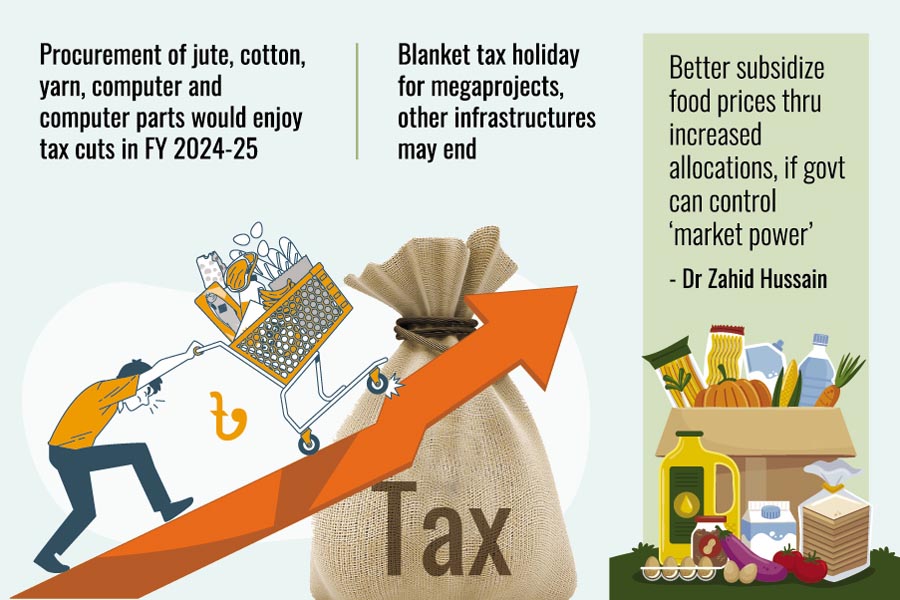
Also, procurement of jute, cotton, yarn, computer and computer parts would enjoy tax cuts in FY 2024-25.

Official sources have said the tax-cut decision has been made following instructions of the prime minister to combat food inflation through fiscal measure in the upcoming budget.

According to Bangladesh Bureau of Statistics (BBS), cost of food in Bangladesh increased 10.22 percent in April 2024 over the same month in the previous year.

Food inflation in the country averaged 6.83 per cent in 2024 over the past year, reaching an all-time high of 12.56 percent in October 2023, against a record low of 3.77 percent in February 2016.

Currently, banks or financial institutions deduct the tax on those commodities procured through letter of credit (LC) or other modes of financing agreement on paid or loan amount.

Former lead economist at World Bank, Bangladesh, Dr Zahid Hussain, however, finds the effort to tame food inflation through tax cuts not justified.

He rather suggests trying subsidizing food prices through increasing allocations, if the government could control 'market power'.

On tax cut he says, "The government has to address the need for mobilizing domestic revenue for social-safety net, higher allocation to education and health."

Meanwhile, blanket tax holiday for megaprojects and other physical infrastructures may also end in the current fiscal year.

To read the rest of the news, please click on the link above.
 
Analyze

Analyze Post

Add your ideas here:
Highlight Cite Fact Check Respond
  • Love (+3)
Reactions: Bilal9

Dollar crisis deepens economic woes in Bangladesh
Mostafizur Rahman 29 May, 2024, 23:59

1717026372274.webp

A file photo shows a man counting US dollar notes at a currency exchange house in the capital Dhaka. | New Age photo

The persistent dollar crisis in Bangladesh has exacerbated various economic issues, including inflation, rising business costs, an energy crisis, and mounting government foreign debt payments.

Bankers say that commercial banks in the country are having difficulty opening Letters of Credit because their holdings of foreign currency are evaporating rapidly.

In April, foreign currency reserves held by commercial banks fell to a 14-month low of $5,047 million, down from $5,439 million in March and $5,559 million in December 2023. This is the lowest level since January 2023, when reserves were $4,849 million.

Against the backdrop, banks received little support from the central bank, whose own foreign reserves are also dwindling, making it harder for banks to open LCs for importing essential products.

Many import payments have been delayed or renegotiated due to the dollar shortage, leaving banks desperate to acquire the necessary foreign currencies.

The country's foreign currency reserves, according to International Monetary Fund guidelines, dropped to $18.2 billion in May 2024 from $48 billion in August 2021.

To mitigate the depletion, the government has secured a $4.7 billion loan deal from the IMF.

On May 8, the central bank devalued the local currency from Tk 110 to Tk 117 per US dollar.

However, many banks are selling dollars at Tk 120–123 for opening LCs. This devaluation follows a series of declines from Tk 94.7 in July 2022 and Tk 84.8 in July 2021.

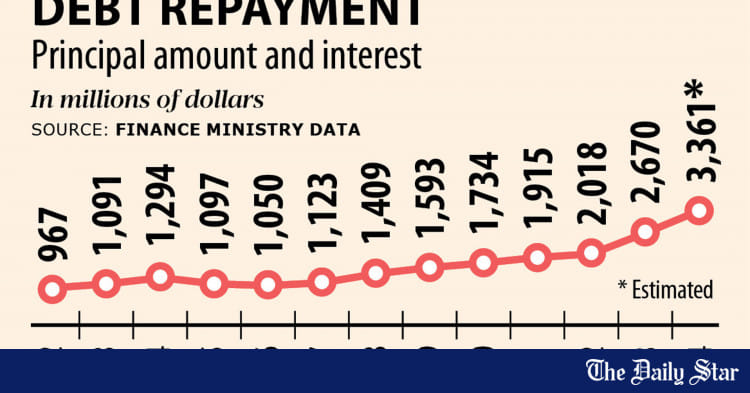
Bangladesh, like many other countries, has foreign debt denominated in US dollars. As the taka depreciates, it will take more taka to repay the same amount of foreign debt in dollars.

It can lead to higher debt repayment obligations for the government and businesses, putting further strain on their finances, economists said.

Mohammad Hatem, executive president of the Bangladesh Knitwear Manufacturers and Exporters Association (BKMEA), said that the persistent dollar crisis has forced banks to decline opening LCs.

As a result, the import of raw materials has been delayed or obstructed, significantly reducing business production.

He added that hampered imports have led to reduced production and increased product prices due to supply constraints.

To read the rest of the news, please click on the link above.
 
Analyze

Analyze Post

Add your ideas here:
Highlight Cite Fact Check Respond
  • Like (+1)
Reactions: Bilal9

Budget deficit to remain high in next fiscal year also
Taming inflation, higher expenditure contradictory, say economists
FHM HUMAYAN KABIR

1717027386918.webp


Budget deficit in the next fiscal year is likely to be Tk 2.50 trillion as the government frames a slightly expansionary budget amid ongoing elevated inflationary pressure, officials said, although inflation control remains its high priority.

The government is likely to frame a Tk 7.969-trillion national budget for the fiscal 2024-25 with one-third of the outlay constituting a gap between income and expenditure targets.

Economists find such massive deficit amid the ongoing economic slowdown contradictory to government priority of inflation control in the upcoming fiscal year.

Bangladesh passes through a higher trajectory of inflation for over a year, which is still close to double-digit figure on a point-to-point basis.

In the last month of April, the inflation rate was recorded at 9.74 per cent in the Bangladesh Bureau of Statistics (BBS) data.

Ministry of Finance (MoF) officials say since the country's better economic growth will have to be kept continuing, they opted for a higher-expenditure target than the one in the current FY2024.

"We know that we need borrowing to bankroll the deficit budget, but we have planned to keep the economy growing," a senior official told the FE correspondent.

"At the same time, we are going to lay top priority on controlling inflation in the next national budget," he added.

According to the MoF officials, the government is likely to set a target of pegging inflation within 6.5 per cent in FY2025.

They hope to keep the budget deficit within 5.0 per cent of the targeted GDP or gross domestic product.

Meanwhile, the government kept the budget deficit at Tk 2.61 trillion, or 5.2 per cent of the GDP, in the outgoing budget worth Tk 7.62 trillion.

Noted economist Dr Debapriya Bhattacharya told the FE that the contractionary monetary policy and higher budget deficit do not fit in this moment properly.

"When you will prepare a budget with higher deficit, then you will definitely go for borrowing. You may go to local banks or to the foreign lenders to bankroll the deficit budget. If you go for local borrowing, there will be a crowding-out effect," he says about the budget arithmetic.

And then the credit flow to the investors will be lower and investment will be slower further.

To read the rest of the news, please click on the link above.
 
Analyze

Analyze Post

Add your ideas here:
Highlight Cite Fact Check Respond
  • Sad (0)
Reactions: Bilal9

Time to exploit the potential of local partners and products

1717111485596.webp

Photo: Prabir Das

A successful political regime is expected to maintain formal and informal arrangements through which the government, private actors and non-government organisations (NGOs) cooperate to formulate and carry out key policy decisions. In a pluralistic society, power is not supposed to be concentrated on a single development actor, but should be spread between these three major actors so that a developmental balance is maintained and each can judge the performance of the others.

All three development actors have their respective circle of influence and are capable of reaching out to the household level through a variety of goods and services. While the Bangladesh government provides electricity, education and basic health directly to the people, NGOs provide micro-credit, income-generating activities and social awareness, and the private sector supplies consumer goods and services. Often the work of these development actors overlaps—e.g. the government funds micro-credit programmes and builds houses for the poor families, and NGOs are involved in education and health services, and have been running banks and industries. The private sector is also involved in social welfare activities and education sector. In fact, thousands of schools and most of the universities and medical colleges in Bangladesh are in the private sector.

Over the last two years, high inflation rates have affected the quality of life of the middle class and lower income groups. Economic inequality has risen in the country over the last two decades. The country built up high foreign exchange reserves as a result of positive balance of payment for several years. The forex reserves averaged $24.91 billion between 2008 and 2024, reaching as high as $48 billion in August 2021. But the situation has deteriorated in recent years and forex reserves slipped to $18.61 billion on May 21, 2024, because of higher import payments caused by the rise in prices in the international market, slow growth of foreign remittance and the taka's depreciation against international currencies. Economists made various recommendations to increase the country's foreign currency reserves: diversify export items; increase competitiveness of Bangladeshi products in the international market; use modern technology; encourage flow of foreign remittance through the official channel; and limit foreign borrowing.

To read the rest of the news, please click on the link above.

 
Analyze

Analyze Post

Add your ideas here:
Highlight Cite Fact Check Respond

Members Online

No members online now.

Latest Posts

Back
 
G
O
 
H
O
M
E