New Tweets

[🇧🇩] Monitoring Bangladesh's Economy

G Bangladesh Defense
[🇧🇩] Monitoring Bangladesh's Economy
1K
28K
More threads by Saif


Monetary policy likely in last week of January

Bangladesh Bank will soon announce its monetary policy for the second half of the ongoing fiscal year (2024-25) with the aim of addressing several economic challenges plaguing the country.

Sources at the central bank confirmed that the next monetary policy is being formulated, and that Governor Ahsan H Mansur will likely declare it by the last week of January.

This will be the first monetary policy announced by Mansur since he became governor of Bangladesh Bank following the political changeover on August 5.

As part of its efforts, the central bank has invited all interested individuals and institutions to send their suggestions, opinions, and feedback regarding potential policy measures by January 15.

Additionally, the monetary policy department of Bangladesh Bank will hold meetings with internal and external stakeholders as well as economists from January 12.

As part of its efforts, the central bank has invited all interested individuals and institutions to send their suggestions and feedback

But beforehand, the monetary policy department will hold a meeting with its executive directors and other senior officials at the central bank headquarters that same day to take their suggestions.

The department will then hold a discussion with the country's leading research organisations on January 14 on potential policy measures.

The organisations include the Bangladesh Institute of Development Studies, Policy Research Institute of Bangladesh and South Asian Network on Economic Modelling.

The Institute for Inclusive Finance and Development, Centre for Policy Dialogue, Research and Policy Integration for Development, reputed economists, bankers, businesspeople, and journalists will also attend the event at Lakeshore Hotel in Gulshan, Dhaka.

The central bank committee forming the monetary policy will ultimately summarise the observations from various quarters regarding its goals and format, including measures for regulating currency and lending rates, before finalising it on January 20.

Then on January 22, the board of directors of Bangladesh Bank will approve the policy and set a date for announcing it to the public.

Inflation in Bangladesh has been hovering above 9 percent since March 2023, with the central bank's existing contractionary monetary policy yet to cool consumer prices.

Bangladesh Bank has hiked the policy rate several times to 10 percent since then. The policy rate is the interest rate at which commercial banks borrow from the central bank.

But in December of the just concluded calendar year, inflation had eased slightly to 10.89 percent from 11.38 percent the previous month, according to the Bangladesh Bureau of Statistics (BBS).

Other than inflationary pressure, the overall economy has been facing uncertainties ever since the fall of the Awami League government on August 5, as reflected in private sector credit growth.

In November last year, private sector credit growth fell to a three-and-a-half-year low of 7.66 percent, with the previous lowest being 7.55 percent in May 2021.

The volume of defaulted loans reached a gargantuan Tk 2,84,977 crore as of September last year, with some banks becoming unable to provide fresh loans amid a subsequent liquidity crunch.

However, the foreign exchange market has shown some flexibility as of late thanks to the recent uptick in incoming remittance.

Mustafa K Mujeri, executive director of the Institute for Inclusive Finance and Development, said hiking the policy rate to 10 percent has had no impact on alleviating the inflationary pressure.

"So, it would not be wise to raise the policy rate any further," he added.

Mujeri, also a former chief economist of Bangladesh Bank, said the central bank has one weapon for addressing inflation, which was the policy rate.

But increasing it now will only turn detrimental for the economy instead of tackling inflation, he added, citing how deposit and lending rates have risen for changes in the policy rate.

Mujeri suggested that other than augmenting its tight monetary stance, Bangladesh Bank has to find out the reasons for inflation in order to take effective measures to reduce it.​
 
Analyze

Analyze Post

Add your ideas here:
Highlight Cite Respond

It's high time to remove hurdles to FDI
MIR MOSTAFIZUR RAHAMAN
Published :
Jan 08, 2025 21:50
Updated :
Jan 08, 2025 21:50

1736383626617.webp


Foreign Direct Investment (FDI) plays a pivotal role in the economic growth of any country. For Bangladesh, achieving its ambitious development goals hinges significantly on attracting substantial FDI. However, despite the country's economic potential and strategic geographic location, a multitude of challenges continues to discourage foreign investors.

Recently, economists and experts while discussing these issues at an event, identified critical barriers to FDI. These range from regulatory ambiguity and weak policy enforcement to inefficiencies of an overly centralised governmental apparatus. As the interim government takes charge and embarks on a series of reforms, this juncture presents an opportune moment to address these challenges and transform Bangladesh into an investor-friendly destination.

One of the foremost impediments to FDI is the country's complex and ambiguous regulatory framework. The business landscape in Bangladesh is often marred by overlapping jurisdictions, unclear guidelines, and inconsistent policy enforcement. Investors are frequently left grappling with uncertainty, which undermines their confidence in the system.

Moreover, weak regulatory service delivery and lack of accountability further exacerbate the problem. Foreign investors are often subjected to lengthy bureaucratic procedures, which not only delay projects but also increase operational costs. This creates a perception of risk that outweighs the potential benefits of investing in the country.

Bangladesh's regulatory environment is a labyrinthine network involving 23 government agencies tasked with catering to investor needs. Aspiring investors are required to secure up to 150 approvals, registrations, certificates, or clearances. Such an intricate system not only consumes time but also creates opportunities for corruption and inefficiency.

The interim government has already recognised the urgency of addressing these challenges. Its recent initiatives, including reshuffling the judiciary, civil administration, and security forces, reflect a commitment to improving governance and combating corruption. However, structural reforms must extend beyond these measures to make a tangible impact on FDI inflows.

A priority task should be the simplification and digitalisation of regulatory processes. The government must establish a one-stop service platform where investors can access all necessary approvals and information under one roof. By reducing bureaucratic red tape, the country can significantly enhance its ease of doing business.

To attract foreign investment, Bangladesh needs to demonstrate its commitment to transparency and accountability. Establishing clear policies, ensuring consistent enforcement, and fostering a culture of integrity within regulatory bodies will go a long way in building investor trust. Anti-corruption measures must also be strengthened, with a focus on ensuring that laws are applied uniformly and fairly.

Physical and digital infrastructure also plays a crucial role in attracting FDI. Despite progress in some areas, Bangladesh still lags behind in terms of transportation, energy, and connectivity. Investments in these sectors will not only improve the business environment but also enhance the country's competitiveness on the global stage.

As the interim government spearheads reform initiatives, it is imperative to adopt a holistic and coordinated approach. This is a rare opportunity to overhaul entrenched inefficiencies and establish a foundation for sustainable growth. Addressing the challenges outlined above will not only attract FDI but also create a ripple effect, fostering innovation, creating jobs, and enhancing the overall quality of life for citizens.

The path to becoming a preferred investment destination is not without obstacles. Yet, with decisive action, Bangladesh can overcome these challenges and unlock its full potential. The time for reform is now, and the onus lies on the government to create an environment where the promise of growth outweighs the perceived risks.

By addressing the root causes of regulatory inefficiencies and ensuring a transparent, stable, and investor-friendly environment, Bangladesh can turn its FDI aspirations into reality. This is not just about attracting capital; it is about securing the nation's future as a competitive player in the global economy.​
 
Analyze

Analyze Post

Add your ideas here:
Highlight Cite Respond

Interest rate on savings certificates to be raised

1736465846143.webp


The interim government is set to increase the interest rates against various savings certificates to upwards of 12 percent as it looks to provide some relief to the fixed income group squeezed by the elevated inflation.

At present, the interest rates provided against the four savings certificates under the Department of National Savings ranged from 11.04 percent to 11.76 percent.

The savings instruments are: the five-year Bangladesh savings certificate, the three monthly profit-bearing Sanchayapatra, the five-year family savings certificate and the five-year pensioners' savings certificate.

The government will introduce the new system for the savings certificates which will be linked to the government's treasury bond interest rates.

The new system will be effective from January 1, said a finance ministry official, adding that the official notification would come soon.

The chief adviser has approved the new system and the relevant documents have been sent to the Internal Resources Division of the finance ministry for issuing the notification.

According to the proposal, the interest rates against savings certificates will be fixed following the weighted average interest rates of the five-year and two-year treasury bonds.

The interest rates against the treasury bonds will be reviewed every six months and the savings certificates' interest rates will be re-fixed.

Besides, in case of re-fixing the interest rates against savings certificates, a premium of at most 50 basis points will be added to the weighted average treasury bond interest rates.

There are three types of interest ceilings for the four savings certificates at present.

As per the new system, the interest rate against the five-year Bangladesh savings certificate will be 12.4 percent for up to Tk 7.5 lakh. For savings of Tk 7.5 lakh and above, the interest rate will be 12.37 percent.

At present, a beneficiary gets 11.28 percent interest for up to Tk 15 lakh after the maturity period, 10.30 percent for between Tk 15 lakh and Tk 30 lakh, and 9.3 percent for more than Tk 30 lakh.

In the case of the three monthly profit-bearing Sanchayapatra, the new interest rate will be 12.3 percent to 12.25 percent. Under the existing system, the interest rates are 11.04 to 9 percent.

In the case of the family savings certificate, the new interest rates will be from 12.5 to 12.37 percent while the existing interest rates are 11.5 to 9.5 percent.

Also, the interest rates against the pensioners' scheme will be 12.55 to 12.37 percent under the new system. At present, it is 11.76 to 9.75 percent.

Meanwhile, interest rates against the other savings instruments -- the wage earners bond, the US dollar investment bond and the US dollar premium bond -- will remain unchanged.​
 
Analyze

Analyze Post

Add your ideas here:
Highlight Cite Respond

Banks see rising deposits for higher interest rates

1736466001911.webp


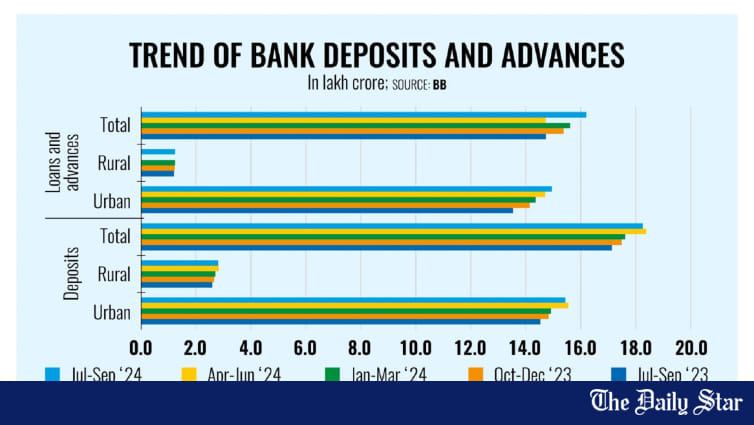
Bank deposits grew in the third quarter of 2024 as many people were encouraged by rising interest rates to park their money at commercial lenders.

In the July-September period of the previous calendar year, bank deposits rose 7 percent year-on-year to Tk 18.25 lakh crore, with bank branches in rural areas registering higher deposit growth compared to their urban counterparts.

The significant hike in interest rates was a key driver behind the growth in bank deposits, said Syed Mahbubur Rahman, managing director and chief executive of Mutual Trust Bank PLC.

Besides, banks have carried out a lot of campaigns to attract depositors, he added while informing that they expect the uptrend of deposits to continue.

The weighted average interest rates on deposits rose to 5.88 percent in the July-September quarter last year from 4.55 percent during the same period of the previous year, according to data of the Bangladesh Bank.

But when comparing the April-June quarter, bank deposits declined by 0.73 percent year-on-year due to widespread unrest centring a mass movement that ousted the Awami League government on August 5.

Overall bank deposits stood at Tk 18.38 lakh crore by the end of last June.

Private commercial banks, including Islamic banks, constitute 68 percent of the total deposits at present.

However, the central bank data shows their deposits shrank 0.33 percent to Tk 12.58 lakh crore by the end of last September from Tk 12.62 lakh crore three months prior.

The crisis ridden Islamic banks recorded the steepest decline in deposits during the July-September period. Meanwhile, state banks closely followed even though both public and private banks saw deposit growth for about one year since the end of September 2023

On the other hand, loans and advances maintained an uptick for four quarters ending with the July-September period of 2024.

Loans and advances increased by 10 percent year-on-year to Tk 16.19 lakh crore by the end of September last year.

Between June and September of 2024, loans and advances to bank borrowers grew by 1.43 percent mainly in urban areas.​
 
Analyze

Analyze Post

Add your ideas here:
Highlight Cite Respond

What makes Bangladesh's economy more troubled to progress?

1736466717075.webp

Visual: Salman Sakib Shahryar

If there is any element of truth in the saying, "Morning shows the day," the interim government has failed to show a bright morning in terms of stabilising the economy. The two economic vices—inflation and unemployment—were at the root of the student-led mass uprising in July-August 2024, yet both reign supreme even after five months of the interim government's inception. And there is no certainty that the economic aspects won't deteriorate further, suggesting that the government should now think seriously about holding an inclusive election at its earliest capacity.

That was not the deal when the interim government took office on August 8 last year. Massive corruption and an authoritarian rule masquerading the façade of democracy contributed to the drastic ouster of the Awami League regime. In that backdrop, almost all political parties and the public demanded the sequencing of reforms first before holding an election. As time passed by, many, if not all, influential political parties are demanding the election first before delivering reform in the economy. The question of how far a non-elected government can go for time-consuming reforms within its limited capacity has become the talk of the town in recent days. And that very political landscape has made the economy more troubled than ever before.

The economy is not heading in the right direction because of two things: i) inherited mismanagement from the previous regime; and ii) conflicting priorities and intrinsic bumpiness of the interim government. The government seems to be engaged in unnecessary political debates by indulging untimely sociopolitical issues related to the constitution and history. This is unwarranted, particularly when the priority should be to curb inflation and to reduce unemployment.

Although the Bangladesh Bank governor expects the inflation rate to drop to around seven percent by June this year, the rising price of the US dollar doesn't lend credence to it. The indomitable practice of localised extortions and organised syndication are sending the prices of necessary commodities beyond the reach of the extreme poor and lower-middle class that occupy a lion's share of the population.

A minimum level of macroeconomic stability will be hard to achieve if the interim government keeps its attention on political confusion, noneconomic diplomacy, racial discontent, and a huge vagueness about its own strategic intent. Simply a market-based exchange rate or interest rate doesn't create macro stability when the rulers have a nebulous roadmap to follow. Printing Tk 22,500 crore to resuscitate the drowned banks seems necessary at the time, but it will refuel inflation despite the parallel mop-up attempts, which are inadequate.

As the Bangladesh Bank data on LC settlements suggest, imports of consumer goods fell by 13.4 percent during the July-November period of 2024 over its corresponding period of 2023, suggesting a further pressure on inflation due to the supply shortage. At the same time, a decline in imports for capital machinery by 21.9 percent will invariably hurt the country's productive capacity and growth potential. A decrease in the imports of intermediate goods by 15.4 percent over the same period will dampen industrial production, which already suffers from labour unrest, layoffs, and sporadic closures.

These factors will largely contribute to the weakening of GDP that is expected to see four percent growth this fiscal year, as per the World Bank forecast. Bangladesh heads to an untimely stagflation, which has tormented many economies in the 1970s in the wake of the oil shocks. A Phillips curve, which exhibits a typical trade-off between unemployment and inflation, disappears during stagflation when both stagnancy and inflation force the toiling mass to walk through a tightrope. Stagflation makes the economy nosedive and induces youth frustration to erupt, the primary symptoms of which are looming. The student force seems to remain hugely unsettled in the education sector, damaging the quality of human capital for the future.

Despite these negative signals, one piece of good news is that remittances in December 2024 made a record inflow of $2.64 billion. There are three reasons behind it: i) a fair value for the dollar that reached up to Tk 126 per dollar; ii) continuation of the 2.5 percent incentive in addition to the fair dollar price made the hundi channel less attractive; and iii) Bangladeshis tend to send more money during the dry season, which is good for marriages, festivities, construction of buildings, and purchases of durable commodities. However, this trend may fall again when the central bank switches back to capping the dollar price at Tk 123.

Remittances alone aren't enough to ensure a good growth in foreign exchange reserves. A fall in imports will impede growth in exports. Although forex reserves slightly edged up to around $21.4 billion on the last day of 2024, its growth will be eroded if foreign direct investments (FDIs) don't pick up. FDIs in FY2024 declined by 8.8 percent, and the trend has even worsened during the interim regime. FDIs in the July-October period of FY2025 saw a collapse by 19.8 percent, suggesting that the foreign capitalists are not considering Bangladesh right now as a hotspot for investment. FDIs don't flow in unless domestic private investment shows an uptick, and here lies a problem with the interim government's capability for creating a credible business environment.

If the government is passionate about reforms, why did it deliver the contract of ground-handling of the third terminal of Dhaka airport to a branded inefficient company, Biman, whose stories of corruption are rampant? Why would it keep the Financial Institutions Division (FID), which made default loans worse? Why would it jump into non-productive expenses for buying weapons from China and Pakistan right now? This decision can wait for an elected government. There are other priorities which the interim government has not only failed to address, but it has also confused the economy, which is facing terrible headwinds, with its poor managerial leadership.

Dr Birupaksha Paul is professor of economics at the State University of New York at Cortland in the US. His recent book is 'Sangkatkaler Orthoniti.'​
 
Analyze

Analyze Post

Add your ideas here:
Highlight Cite Respond

Forex reserve drops to $20b
Staff Correspondent 09 January, 2025, 23:12

1736468807348.webp

New Age file photo

Bangladesh’s gross foreign exchange reserve, calculated as per the International Monetary Fund’s guidelines, has dropped to $20 billion, following a $1.67-billion payment to the Asian Clearing Union against import bills for November and December of 2024.

According to Bangladesh Bank data, the reserve fell to this level on Thursday, shortly after standing at over $21.6 billion in the previous day.

The payment is made in every two months.

However, according to conventional valuation by the Bangladesh Bank, the foreign exchange reserve dropped to $24.9 billion.

The Asian Clearing Union is a payment settlement forum whereby the participants settle payments for intra-regional transactions through the participating central banks on a net multilateral basis.

Payment obligations of transactions among Bangladesh, Bhutan, India, Iran, the Maldives, Myanmar, Nepal, Pakistan and Sri Lanka are settled through the ACU payment system.

However, high overdue and current import payments have hindered reserve growth even though remittance inflows and export earnings rise.

Banks have had to use dollars for these payments, keeping the reserve volume from building up further.

The BB stopped selling dollars directly from its reserve to banks and instead has sourced dollars from the interbank market to meet government obligations.

This means that banks must cover all import payments with their own foreign currency, preventing reserve accumulation.

BB officials said that remittance inflows surged after political changes on August 5, 2024, reaching $13.77 billion in July-December of the 2024-25 financial year, compared with those of $10.9 billion in the same period of the past year.

The BB sold about $34 billion from its reserve in the past three financial years, which contributed most to the reserve depletion. The reserve was $48 billion in August 2021.

The Bangladesh Bank adheres to the IMF’s Balance of Payments and International Investment Position Manual, 6th edition (BPM6), for calculating both the gross international reserve and the net international reserve.

The Bangladeshi taka weakened against the US dollar, reaching Tk 123 for a dollar, driven by a dollar shortage and pressures on banks to settle import payments.

The exchange rate per dollar was Tk 84.81 in June 2021, Tk 93.45 in June 2022 and Tk 106 in June 2023.

This ongoing dollar crisis has significantly impacted banks’ ability to settle import payments and open letters of credit, creating challenges for businesses.​
 
Analyze

Analyze Post

Add your ideas here:
Highlight Cite Respond

I don’t have Aladdin’s lamp to fix market: Sheikh Bashir
Special Correspondent
Dhaka
Published: 09 Jan 2025, 21: 31

1736470792659.webp

Sheikh Bashir Uddin Prothom Alo

Commerce adviser Sheikh Bashir Uddin described the recent hike in rice prices as a temporary issue but indicated that it would take some time to stabilise the market.

“I don’t have Aladdin’s lamp so that I would switch it on and the market would be fixed from tomorrow in the aftermath,” he said while speaking to the media after a meeting with a Turkish delegation at the secretariat on Thursday.

Addressing the price hike, the commerce adviser said, “Our data indicates no shortage in rice stocks. However, we have liberalised rice imports to address the irregularities that we noticed in the rice market.”

He further explained that those hoarding rice would have no choice but to release their stocks once imports begin. It would help normalise the market.

A journalist brought up allegations that billions of taka are being withdrawn from the market, inviting sufferings to the masses. In response, Sheikh Bashir Uddin said, “There is no scope to deny it. This situation seems temporary to me.”

Detailing government initiatives, the adviser noted that import duties on rice were reduced from 63 per cent to 3 per cent. Besides, under a food ministry initiative, hundreds of thousands of tonnes of rice are being imported from Myanmar, Pakistan, and India.

“The Aman harvest is underway, and Boro rice will arrive by April. We expect the market to stabilise in the meantime,” he added.

Asked if any new syndicate is manipulating the market, Sheikh Bashir Uddin responded, “If you identify the syndicate, it would make our job easier.”

Besides, the adviser mentioned that the authorities had canceled 3.7 million family cards issued by the Trading Corporation of Bangladesh (TCB) due to overwhelming corruption in the selection process. He, however, insisted that no actual beneficiaries were affected by the decision.​
 
Analyze

Analyze Post

Add your ideas here:
Highlight Cite Respond

A looming fiscal crisis for Bangladesh
High debt and weak revenue demand clear policy thinking

1736551867422.webp

VISUAL: STAR

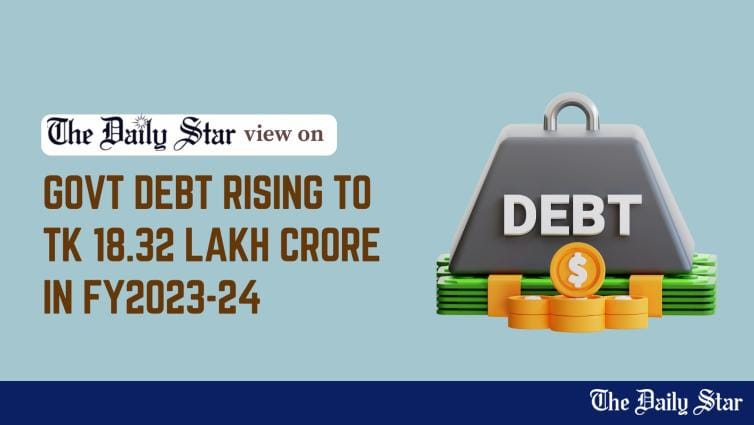
The government debt increasing by 13.3 percent last fiscal year to a record Tk 18.3 lakh crore is concerning, particularly given its low revenue mobilisation. Here, it has to be said that the former Awami League government is primarily at fault. When it returned to power in 2009, the country's total debt was just $33.66 billion. At the time of its ousting from power on August 5, 2024, the AL government left behind a national burden of $156 billion in local and foreign loans. Aside from wasteful expenditure and mammoth corruption, its failure to improve revenue growth means that Bangladesh's debt-GDP ratio now stands at 36.3 percent. While this is still within the safe limit per the IMF standards, it remains concerning when considered alongside the country's weak revenue earnings and dwindling dollar reserves, economists warn.

The most pressing issue now is the liquidity shortage in both local and foreign currencies. On the one hand, revenue collection remains weak, while interest payments have risen sharply. On the other hand, Bangladesh is receiving fewer foreign loans, creating challenges for meeting interest payments and settling outstanding bills. The recently submitted white paper on the economy already highlighted these risks. It also projected that by the end of June 2025, the total debt could rise to 41.3 percent of GDP.

According to the debt bulletin report, government expenditure on interest payments increased by 21 percent in the last fiscal year, reaching Tk 1.1 lakh crore, which accounts for one-sixth of the national budget. This indicates that a significant portion of the government's expenses is already allocated to paying interest on its debt, thereby reducing its fiscal flexibility. This constraint may worsen in the future as tighter monetary policies, necessitated by high inflation, drive up interest rates on treasury bills and bonds.

Meanwhile, Bangladesh's per capita foreign debt has more than doubled over the past eight years. The government may be compelled to take on more loans in order to clear foreign arrears to ensure the continued supply of power and fertilisers. While this approach may offer a short-term solution, the government must ultimately prioritise increasing revenue collection, as it is the only sustainable long-term solution to the debt servicing challenge. In this context, it is disappointing that the interim government has recently increased VAT and supplementary duties on nearly 100 goods and services, despite concerns that these measures could further fuel inflation.

Instead, the government should focus on addressing tax evasion, which remains a significant issue. The previous government also erred in neglecting this problem and relying on indirect taxes, which are inherently regressive. We urge the interim government to reconsider its policy approach and emphasise progressive taxation as a means to manage the growing debt burden.​
 
Analyze

Analyze Post

Add your ideas here:
Highlight Cite Respond

Posts you haven't read yet..

Members Online

Latest Posts

Back
PKDefense - Recommended Toggle