[🇧🇩] Monitoring Bangladesh's Economy

[🇧🇩] Monitoring Bangladesh's Economy
1K
32K
More threads by Saif

G Bangladesh Defense

Businesses’ 2025 wish list is long, but political stability tops all

1735780901707.webp


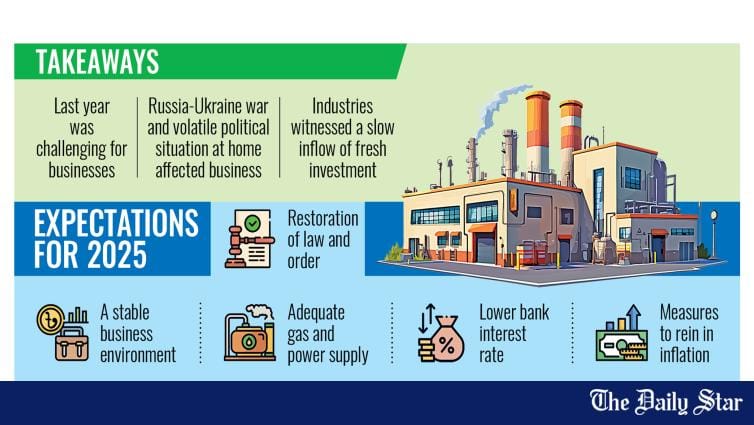
Businesses hope for the year 2025 to bring about stability as normalcy has started to be restored in businesses following turbulent times both at home and abroad.

Local businesses have been severely affected from some internal and external issues over the last few years.

The year 2024 was a challenging year for businesses and the firms do not want a recurrence of the untoward incidents of the outgoing year as their trade was severely affected.

For instance, for a time the country's economy struggled to recover from the severe fallouts of the Covid-19 pandemic, Russia-Ukraine war, high global inflationary pressure and dollar shortage.

Last year the local businesses had to cope with a political upheaval in the months of July and August, and labour unrest in September and October and the subsequent deterioration of law and order.

All those factors severely affected business such as import, export, investment and transportation and shipment of goods.

Meanwhile, the ailing and corruption-riddled banking sector has been struggling to brighten its image and to increase liquidity to regain customers' confidence. The dollar shortage in the banking sector also impacted the prices of imported commodities.

Businesses want stability in the banking sector and an end to the liquidity crisis so that they can conduct transactions smoothly. They also want an existing gas and power crisis to be addressed in the new year.

The inflow of investment or expansion plans for existing capacities was also affected because of the unhealthy business environment in 2024.

Despite the massive political turmoil in 2024, it is believed that the year would end on a positive note, said KM Rezaul Hasanat, chairman of Viyellatex Group and president of Bangladesh Independent Power Producers' Association.

"The reason—significant remittance growth and textile and apparel exports still in the positive. Domestic market is struggling a little but by the end of the financial year, it will catch up," he said.

"The year 2025 for business, as well as the economic prospects, depends on the political situation," he said.

"If the political situation improves, then law and order, issues like power and energy crisis and other facilities will improve automatically," Hasanat said.

"By the way, I am expecting the Trump business policy to help our foreign direct investment and businesses indirectly. Again, the business potential in 2025 is very good if the country can ensure political stability," he added.

Almost every entrepreneur is worried about inflation, high bank interest rate, and low production capacity for low gas pressure in industrial units, said Anwar Ul Alam Chowdhury, chairman of Evince Group and president of the Bangladesh Chamber of Industries.

At the same time, businesspeople have lost confidence in the deterioration of law and order, he said.

An uncertainty is also prevailing in the political arena, which may affect businesses. If adequate investment does not come about, employment will also be affected, he added.

"We are expecting that all those challenges will be addressed in the new year and business confidence will also be restored," he said.

Hopefully the business environment and economic stability will be restored through reductions in inflation and bank interest rates, said Kamran T Rahman, chairman and managing director of The Kapna Tea Co.

The US dollar shortage is also expected to be resolved in the new year through some positive measures, said Rahman, also president of the Metropolitan Chamber of Commerce and Industry, over the phone.

Overall, everything is expected to be positive in the new year, he said.

The views were echoed by Faruque Hassan, managing director of Giant Group and former president of the Bangladesh Garment Manufacturers and Exporters Association.

The outgoing year could have been much better. Hardly any new investment came about in the garment sector because of the deterioration in the business environment, he said.

Demand for garment items has been rebounding with the revival of the global economy, said Hassan.

Bangladesh has the potential to export more if the country is politically stable. It is expected that the year 2025 will be positive for business, he also said.

Fresh investment or expansion of existing capacities may come about once the political situation reaches stability, he said.

In the new year, the garment sector may witness the arrival of new products, establishment of new factories and replacement of old machinery, said Hassan.

This is because international clothing retailers and brands are coming back to Bangladesh with large volumes of work orders, he said.

The inflow of new investment or capacity expansion is largely dependent on stable law and order, he said.

"However, I predict that the year 2025 will go well as normalcy is being restored gradually, and the global economic situation is rebounding," added Hassan.

Corruption, bribery, and thefts should also be curbed to make the environment more business friendly, said the former BGMEA president.

Abdul Hai Sarker, chairman of Bangladesh Association of Banks (BAB) said the new year's projection is very good, but the law and order needs to be restored soon.

For instance, the business of garments waste (jhoot) is controlled by the local musclemen and the factory owners are not capable of controlling them because of the poor law and order.

Establishing supremacy on local jhoot business by the local influential people is one of the major causes of poor law and order situation in the industrial zones.

The private sector needs to be engaged more with the policy formulation as the private sector entrepreneurs are the final executors because of the nature of the country's economy, Sarker also said.

"Freedom of doing business is still absent here," the BAB chairman also said.​
 

LOOKING BACK 2024: Exports follow RMG-dependent, low diversification patterns
Moinul Haque 01 January, 2025, 23:39

1735782744991.webp

New Age file photo

Bangladesh’s export sector in 2024 has reflected a mixed bag of performance, marked by fluctuations, but the sector has largely followed its traditional patterns — heavy dependency on the readymade garment sector and very limited diversification.

Breaking stagnancy, the exports gained momentum in October and November, though the year overall has shown little in terms of any ground-breaking shifts or significant transformation in the export landscape.

Bangladesh readymade garment industry has been a remarkable success, but the other sectors have failed to achieve any significant growth.

This heavy reliance on the RMG has left Bangladesh’s export portfolio imbalanced, making the economy vulnerable to sector-specific shocks and global market fluctuations.

Citing examples from the other countries, experts said that exports from Bangladesh and Vietnam were roughly the same in value, at about $2 billion in 1990.

However, by now Bangladesh’s annual exports have grown to about $40 billion, while Vietnam’s exports have surged to $270 billion.

Economists said that after independence, several sectors, including pharmaceuticals, jute and jute goods, leather and leather products and light engineering made significant strides in meeting local demand.

However, these industries have struggled to become globally competitive.

The pharmaceutical sector now meets approximately 98 per cent of the local demand, yet its share in the $600 billion global market remains minimal.

Similarly, while the private-sector jute industry has developed, its annual exports have stagnated at $1 billion for several years.

The leather and leather goods industry also satisfies a substantial portion of domestic demand, but like jute, its annual export value has remained steady at about $1 billion for more than five years.

‘The country’s export performance gained momentum in October and November, but remained within a traditional pattern, without any notable or encouraging changes,’ Zahid Hussain, former lead economist of the World Bank’s Dhaka office, told New Age.

Although export earnings picked up in the last quarter of 2024, the country made no progress in diversifying its products to reduce reliance on the RMG sector, he said.

Zahid said that the gas crisis had hindered the country’s export performance throughout the year, while recent political instability and labour unrest had resulted in new uncertainties for the export sector.

‘Export diversification has not been happening in the country due primarily to limitations in the trade policies, as the existing policies have made the domestic market more profitable than the export market,’ the economist said.

According to Export Promotion Bureau data, the country’s export earnings for the financial year 2023-24 reached $44.47 billion, reflecting a 4.22-per cent decline.

Of the total, the readymade garment sector accounted for $36.14 billion, or 81.3 per cent, the data showed.

The EPB data also showed that Bangladesh’s RMG exports in January-November of 2024 increased by 6.23 per cent to $34.71 billion compared with those of $32.68 billion in the same period of 2024.

According to a recent Asian Development Bank report, export concentration for Bangladesh has emerged as a major and long-standing challenge, as the success of RMG exports has not been replicated in the other sectors.

The report mentioned that Bangladesh’s exports were predominantly composed of knitwear (44.6 per cent) and woven garments (37.2 per cent), while the other significant products included home textiles 3.3 per cent, footwear 2.3 per cent, jute products 1.9 per cent and fish 1 per cent.

‘This overwhelming dependence on one particular export product means that the Bangladesh export basket is among the world’s least diversified,’ said the ADB report released in July 2024.

Research and Policy Integration for Development chairman Mohammad Abdur Razzaque recently said that anti-export bias in the trade policy regime was the key challenge for promoting export diversification.

He emphasised the need for addressing policy-induced anti-export bias through tariff rationalisation and the implementation of the National Tariff Policy 2023.

To enhance overall export competitiveness, he outlined key strategies, including sustaining macroeconomic stability, strengthening infrastructure and trade logistics, prioritising skill development, attracting more foreign direct investment, improving product quality and standards and enhancing labour and environmental compliance.

Bangladesh Chamber of Industries president Anwar-Ul-Alam Chowdhury Parvez said that country’s export sector had been struggling with crisis of gas, deteriorated law and order situation, labour unrest and growing bank interest rate.

He said that following the ouster of the Awami League government through a student-led mass uprising in August, the law and order situation was yet to be normal, which had hurt the confidence of global buyers.

At the same time, Vietnam and the other competitors of Bangladesh gained the confidence of buyers and secured a significant share of export orders, Parvez said.

Parvez, also a former president of the Bangladesh Garment Manufacturers and Exporters Association, said that in 2024, the country’s manufacturing sector faced a severe gas crisis, high inflation, soaring bank interest rates, rising dollar prices, political instability and labour unrests.

‘Now we are looking towards 2025 for better prospects. Hopefully, the government will prioritise the sustainability of the industry to maintain employment and create new jobs in the new year,’ he said.

Centre for Policy Dialogue distinguished fellow Mustafizur Rahman said that the country’s exports had turned around in recent months, driven largely by the performance of traditional RMG products.

He emphasised that Bangladesh now needs to pursue export diversification both within and beyond the RMG sector.

Mustafiz said that alongside product diversification, Bangladesh should tap the potential of regional markets like India and China.

While India imports $670 billion and China $2,600 billion annually, Bangladesh is missing these opportunities due to a lack of diverse products, he said.

The economist said that the triangulation of investment, connectivity and trade should be prioritised for Bangladesh to improve its competitive edge on the global market.

‘With the LDC graduation approaching in 2026, we must gradually shift from a preference-driven competitiveness model to one that is driven by skills and productivity,’ Mustafiz said.

Zahid Hussain said that in 2025 many multinational companies would shift from China to US-friendly countries due to the friend shoring policy of Donald Trump, the newly elected president of the US.

Most of the companies are making preparations to shift their investments to Vietnam, Indonesia and the Philippines, he said.

Zahid said that Bangladesh could have grabbed the investments relocating from China if the investment climate had been more favourable in the country.

‘If the country can improve its investment climate, 2025 could be a year of attracting foreign investments. The influx of FDI would bring new technologies, fostering diversification across sectors,’ the economist added.​
 

Private sector investment remains sluggish
The trend may continue despite rising reserves, remittance, export earnings, say economists

1735971196978.webp


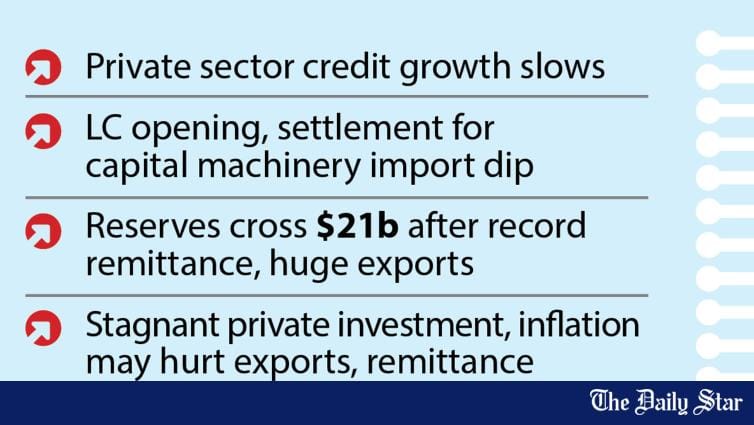
Foreign exchange reserves are showing encouraging signs of stability due to record remittance inflows and rising exports, but private sector investment remains a concern for the government.

Economists attribute this sluggish investment to ongoing political uncertainty and increasing business costs, predicting this trend may persist for another year.

While the central bank's forex management policy is expected to stabilise exports and remittances, sustained improvement hinges on boosting private sector investment and controlling inflation.

Key indicators of private sector investment include private sector credit and capital machinery imports.

Latest data published by the Bangladesh Bank on Thursday showed private sector credit grew 9.86 percent year-on-year in August and then 7.66 percent in November last year.

It fell by 9.20 percent in September and 8.30 percent in October. The private sector credit growth target in the central bank's monetary policy of July was 9.8 percent for December.

During the July-November period of the ongoing fiscal year, letter of credit (LC) settlement for capital machinery import declined by 21.90 percent, compared with that of the same period of the previous fiscal year.

During this period, LC opening for capital machinery import dipped by 26.45 percent, according to central bank data.

Import of intermediate goods also decreased by 15.38 percent and LC opening for these goods saw an 11.52 percent decline.

Zahid Hussain, former lead economist of the World Bank's Dhaka office, identified political uncertainty as one of the main reasons behind such a lack of activity in private investment.

"To what direction the country's politics will be headed is likely to be determined this year. In this context, 2025 is a critical year," he said.

Hussain said there are discussions about the interim government's reform initiatives. Meanwhile, students, along with different political parties, have emerged as a force in the country's politics.

However, there is uncertainty regarding the nature of the future political government and how it will maintain checks and balances, he said.

Businesspersons are unlikely to make new investment decisions until these issues are resolved, he added.

Hussain also said many argue that high interest rates are a factor affecting private investment.

"However, even when interest rates were low, private investment didn't pick up significantly. So, it's difficult to point this out as a reason behind sluggish investment," he said.

Hussain further said liquidity shortage in the banks and the distressed banking system could be blamed for the lack of private investment.

Prof Selim Raihan, executive director of South Asian Network on Economic Modeling (Sanem), also said slow private investment can be attributed to political uncertainty.

He said private investment has been low for the past few years, but the political changeover and uncertainty came as additional challenges. "This situation is not favourable for fresh investment," he said.

Prof Raihan said many businesspersons, who maintained close relations with the previous government, have either ceased operations or are going through a difficult situation after the fall of the Awami League regime.

This has also impacted fresh investment that they would have made for business expansion, he said.

The cost of business increased because of continued high inflation and interest rates, Prof Raihan said. Investors, especially small and medium-sized entrepreneurs, are finding it difficult to take loans from banks and invest, he said.

"So, they are not making any investments at this moment and might have adopted a wait-and-see policy," he added.

He also said it is crucial for the government to prioritise controlling inflation and removing the barriers to "doing business" in the private sector as much as possible.

Prof Raihan was a member of the white paper panel, formed by the interim government, to produce a report on the state of the country's economy.

He said that during their work on the white paper, many local and foreign businessmen informed them that the National Board of Revenue and Bangladesh Bank, through their rules and regulations, created obstacles to investment.

WILL RESERVES REMAIN STABLE?

The country's forex reserves have crossed $21 billion for the first time since the interim government took charge in August. The reserves stood at $21.36 billion on December 31.

It was possible mainly because of high remittance inflow, as Bangladeshis abroad broke previous records by sending $26.9 billion last year -- a 23 percent year-on-year rise.

Monthly remittance inflow rose to a record $2.63 billion in December, up 33 percent from a year earlier.

Bangladesh's exports also hit $50 billion in 2024, an 8.3 percent year-on-year increase.

In December alone, exporters earned $4.62 billion, an 18 percent increase compared to the same month in the previous year.

Development partners, including the World Bank and Asian Development Bank, provided more than $1 billion in budget support in December, contributing to the boost in forex reserves.

Zahid Hussain said uncertainty over reserve management is going away because of the central bank's current foreign currency policy.

As a result, a kind of stability might return to the country's macroeconomy, especially the external sector, he said.

Hussain said the overseas laundering of money, especially funds earned through corruption, stopped after the interim government took charge.

Besides, because of stable exchange rates, both forex reserves and remittance inflow have increased, and such growth could be a new normal, he said.

Prof Raihan said remittance and export earnings are promising signs for the country's economy. However, such growth will not continue if the country's private investment does not improve and the government fails to control inflation.​
 

Record-high remittance a testimony to the patriotic spirit of expatriates
We must reciprocate their contributions and sacrifices

1736037804701.webp

VISUAL: STAR

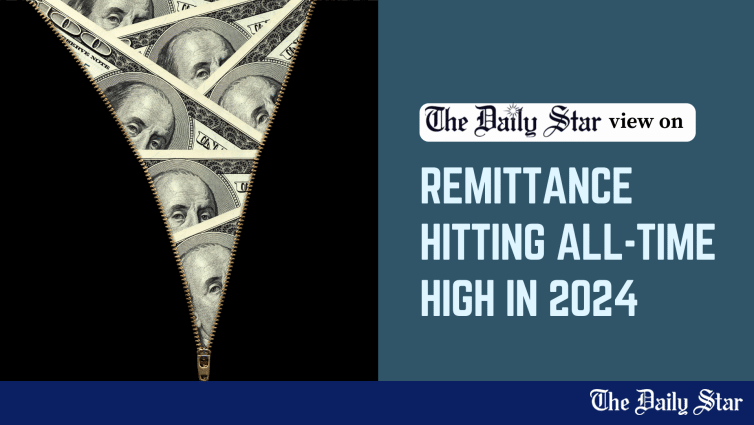
Bangladesh's embattled economy can breathe a little sigh of relief thanks to expatriate Bangladeshis who, according to a report, sent home a record $26.9 billion in 2024—a 23 percent increase year-on-year. This not only bolsters our strained dollar reserves but also serves as a reminder of the crucial role expatriates, including migrant workers, play in our economy.

Following the autocratic Awami League government's fall on August 5, remittance inflows have experienced a significant surge, with over $2 billion coming into the country every month since. In December alone, a record $2.63 billion was received, marking a 33 percent increase compared to the previous year. Evidently, expatriates are acutely aware of developments in Bangladesh and are actively seeking ways to support their homeland. During the July uprising, many expatriates vowed to refrain from sending remittances through official channels in protest against the brutal crackdown on demonstrators, reflecting their deep sense of responsibility to the nation.

One cannot, however, help but ask whether the country has reciprocated their sacrifices and contributions over the years. The answer—if we just consider the plight of migrant workers—is a resounding no. The hardships migrant workers continue to endure, including paying exorbitantly high fees to go abroad, remain a shameful testament. Furthermore, the limited state recognition they receive as well as inadequate support from our missions abroad, especially during times of crisis, are long-standing issues. And despite years of promises, provisions enabling expatriates to vote from abroad remain absent, highlighting the neglect they have faced from successive governments. This last bit, one hopes, will at least change under the interim government, paving the way for expatriates to finally vote in elections.

More broadly, however, we urge the interim government and future administrations to provide substantive support to our expatriates and migrant workers instead of offering empty gestures like in the past.

The surge in remittances can be attributed to various steps taken by the interim government, such as narrowing the exchange rate gap between formal and informal markets. The reduction in money laundering from Bangladesh and the rise in remittances have also strengthened our external sector and boosted the foreign exchange reserves. We hope the authorities will continue to prioritise policies that promote remittances, better serve our expatriates, and improve other economic factors as a result.​
 

Salvaging business and employment

1736038077634.webp


Despite some episodic spikes here and there, the economy of Bangladesh is still struggling, and the government isn't sure what the top priority should be. Businesses are under pressure as inflation rises beyond 9 percent and GDP growth slows to 5.2 percent in FY24 with further downward trend.

As we know, family-run and promoter-led firms dominate the Bangladesh economy, especially in the textile, export and manufacturing industries. Nearly 4 million people work in the readymade garment industry alone. Many company leaders/owners have been put behind bars or are absconding due to recent upheavals, which have interrupted operations and made decision-making more time-consuming. Further degradation will cause closures, pay reductions, and rapid layoffs.

In response to similar problems, nations like Vietnam and India offered financial aid and tax breaks to save domestic companies. But Bangladesh rather eliminated incentives and reportedly raising taxes, which may make recovery far more challenging.

What's at stake if large companies fail?

The collapse of large companies would shock Bangladesh's job market. Over 80 percent of formal occupations are directly or indirectly related to these companies. Layoffs will cause families to experience immediate financial instability and income loss.

Not only the manufacturing industry but also transporters, raw material suppliers, port personnel, and logistics providers would all see a sharp drop in business, which would result in a large number of job losses. The loss of jobs in the unorganised sector, which is heavily reliant on the spending power of those in corporate occupations, would make poverty worse.

The economy as a whole will suffer from a deteriorating labour market. As incomes decline, consumer spending will also decline, which will force more businesses to shut down or scale back operations. There will be more protests and strikes, which will lead to higher unemployment rates and more instability in society. Similar periods of political and economic instability have been experienced by nations like Pakistan and Sri Lanka as a result of delayed interventions. Bangladesh is unable to afford to take the same path.

What the government must do now

Large companies and promoters need immediate breathing space to survive. The government must step in with low-interest loans, deferred taxes, and grace periods for repayments. Vietnam saved thousands of businesses this way. Bangladesh must act similarly to prevent layoffs and closures. Investment incentives must also be restored to attract capital and revive confidence in economic zones that are now stagnant.

The workforce needs skill development badly. Mismatched skills keep 40 percent of graduates unemployed. The 'Skill India' mission trained millions and increased employment. Bangladesh must duplicate such initiatives to prepare its workers.

Reviving clothing export orders necessitates careful attention. Simplifying trade regulations, offering export incentives, and lowering transportation costs can all help. Vietnam invested $1.2 billion in textiles to compete; Bangladesh must do the same or risk falling behind.

Equally important is simplifying regulations. Endless red tape slows corporate growth and hiring. To grow and stabilise employment, the government must streamline processes.

A last chance to act

Bangladesh's large companies don't just create jobs -- they sustain entire ecosystems. If these companies collapse, millions of jobs will vanish, poverty rates will spike, and social unrest will escalate. Countries like Vietnam and India acted fast to prevent such outcomes with bold interventions. Bangladesh, however, risks falling further behind if it continues to delay action.

The time for hesitation is over. The government must step up with financial support, regulatory reforms, and investment incentives to protect jobs and stabilise corporations. Employment must be prioritised to prevent economic disaster and ensure Bangladesh's long-term recovery. Reconstituting boards or temporarily releasing funds to ailing banks would not help. Business continuity, including corporate and large loan restructuring for distressed companies, is key here. Policy makers need to think beyond and act sensibly.

The author is chairman of Financial Excellence Ltd​
 

December export bodes well for future
FE
Published :
Jan 04, 2025 21:59
Updated :
Jan 04, 2025 21:59

1736040770827.webp


Despite socio-political instability centring the July-August mass upsurge, the country's export earnings during the July-December period of the current fiscal year surpassed that of the corresponding period of the previous fiscal. This is seen as a silver lining in the horizon given the current pressure on the country's forex reserves. Quoting Export Promotion Bureau's data released on Thursday last, this paper reported that based on a steady 17.72 per cent growth in December, Bangladesh's export earnings during the first half of the current fiscal reached $24.53 billion compared to $21.74b earned during the same period of the last fiscal year. As usual, apparels fetched the largest part of the export proceeds. Naturally, given the trend in export proceeds in the first half of the current fiscal year, it can be assumed that the total export earnings could have been even more had there been no hindrances created by the volatile political situation.

The export performance in December this fiscal year deserves special mention for certain reasons. The December export earnings exceeded those of all other months under discussion both in FY 2023-24 and FY2024-25. This indicates that the extent of uncertainties emerged following the political changeover in July-August has been decreasing since the assumption of power by the Interim Government. This underscores the need for maintaining stability in an economy to perform better. All stakeholders should therefore make utmost efforts to restore stability in the country.

Despite the success achieved in export earnings, the problem as usual lies with absolute dependence on a single sector --- export of readymade garments. According to the FE report, out of the total earnings in last December, some 81 per cent came from RMG export while the rest 19 per cent was fetched by non-RMG goods. Needless to say, this overwhelming dependence on a single sector due to lack of export diversification and market expansion is by no means a healthy sign for the country's export business. Though some other exportable items posted increased earnings during the period under review, their contribution in the overall export is quite insignificant. This once again underscores the dire necessity of export diversification.

A handful of internal and external factors have played an important role in putting the country's export earnings onto a positive trajectory during the first half of the current fiscal year. Bangladesh is already a familiar name in the global market of readymade garments. Branding of the products has further strengthened its image as a producer of quality apparels. This and such other measures like product diversification, value addition and improvement in workplace safety have contributed to increasing earnings. These factors are also indicative of a better future for Bangladesh's RMG products as demonstrated by sustained buyer confidence and diversion of orders to Bangladesh as a result of the Sino-US trade war. Compliant factories are also enjoying better flow of work orders. What is needed is to sustain this positive trend and strengthen it further. However, efforts must be made to overcome the overwhelming dependence on a single sector. Bangladesh should make the best possible use of duty-free facilities offered by different countries for its products through diversification of the export basket and horizontal and vertical expansion of the markets.​
 

Adjusting the trade policy in 2025
Asjadul Kibria
Published :
Jan 04, 2025 21:58
Updated :
Jan 04, 2025 21:58

1736040864264.webp


Every year presents a unique mix of challenges and opportunities, and 2025 is no different. For Bangladesh, it brings a host of challenges on the political and economic fronts, but also significant opportunities to propel the nation to new heights. The country is currently grappling with high inflation and financial sector turmoil. The autocratic regime of Sheikh Hasina, which was forced to step down on August 5 of last year due to a mass uprising led by students and youths, has left a legacy of economic distortion. The interim government is working diligently to rectify this, and while progress is not yet at the desired level, there is still a clear potential for growth in the near future.

Nevertheless, one apparent silver lining on the economic front is modest growth in external trade. The country's export of goods registered 6.80 per cent growth last year over the previous year. Official statistics showed that total export receipts stood at US$47.24 billion in 2024, which was $44.23 billion in 2023. Goods import, however, remained stagnant last year. Statistics available from Bangladesh Bank showed that imports of goods in the first 10 months of last year stood at $56.05 billion, which was $55.78 billion in 2023. The complete data on the annual imports of goods is yet to be available.

Interestingly, exports in goods in the second half of 2024 increased by 8 per cent to $24.53 billion against $22.71 billion in the first half of the same year. The first two months of the second half were marked by the anti-discrimination movement that led to the mass uprising and, finally, the fall of the Hasina regime. During the period, the country faced a series of unrest and violence that heavily disrupted the factory activities and movement of goods. Though normalcy returned in the next months, unrest in the ready-made garment (RMG) industry was hampering production. Statistics available from the Export Promotion Bureau (EPB) showed that exports of RMG increased by 13 per cent in the second half (July-December) of the last year over the same period of the previous year. What explains the surge in exports?

The movement of the exchange rate may be a significant factor in the surge of exports. The local currency against the US dollar depreciated by 1.67 per cent during July-November of the last year compared to the depreciation of 1.94 per cent in the same period of 2023. While this modest depreciation alone is insufficient to boost a double-digit growth of RMG exports, it may still have contributed positivelu. Another reason for the surge in exports may be strong output recovery during the last quarter of 2024 and higher delivery. RMG exports jumped by around 18 per cent in December last over the same month of 2023, indicating a potential impact of the exchange rate on exports.

1736040894497.webp


The sluggish import of goods last year is mainly due to lower demand. Some big importers reduced their activities in the last half of 2024, slowing the overall import. The continuation of restrictive policy to discourage non-essential and luxury imports to ease pressure on foreign exchange reserves also contributed to slowing the flow of imports.

During the July-October period of last year, imports of food grains declined by 7.60 per cent in value terms. This decline, while seemingly significant, may not have a major impact on the overall food supply due to the country's surplus production. Imports of consumer goods dropped slightly by one per cent, while capital goods declined by 14 per cent during the period under review. Imports of intermediate goods, however, increased by 6.20 per cent. The overall imports in July-October posted a modest growth of 2 per cent, indicating the continuation of sluggishness. Once the import data for the last two months is available, it will be possible to get the entire picture of the annual import.

Besides the domestic factors, global geo-economic and geo-political development will also affect the country's exports and imports. As the whole world is waiting for the United States (US) President Donald Trump's tariff hike, it will be a key determinant for many countries to adjust their own trade policies. Trump, who will officially take charge of the Oval Office on January 20, is ready to increase tariffs on imports from China, Canada and Mexico by 25 per cent on average and the rest of the world by at least 10 per cent. His tariff hike will encourage many other countries to do so. This potential increase in tariffs could pose challenges for Bangladesh's exports, particularly to the US, and may necessitate a review of the country's trade policy. Moreover, the Russia-Ukraine war, coupled with Middle-East conflicts, has already made the future course of global trade costly and uncertain.

Given this complex global backdrop, it's clear that Bangladesh must urgently adjust its trade policy to bolster external trade. This adjustment is not just a future consideration, but a pressing need, especially as the country is on track to graduate from the Least Developed Country (LDC) status by the end of 2026.

So far, the trade in goods is the core focus of the country's trade policy, although the trade in services has also become critical. So, the scenario of trade in services also requires a quick review. Statistics available from Bangladesh Bank showed that export receipts in services trade increased by only 2 per cent in the first 10 months of the last year to $5.29 billion from $5.18 billion in 2023. At the same time, payments for services import stood at $9.14 billion in the January-October period of 2024, which was $8.09 billion in the same period of 2023. The 14 per cent jump in the imports of services reflects the sector's needs. In the year 2025, the country's trade policy adjustment needs to put more focus on trade in services.​
 

The good, the bad and the missing
Anis Chowdhury
Published :
Jan 04, 2025 21:51
Updated :
Jan 04, 2025 21:51

1736041059745.webp


About 400 pages long report by a panel of eminent economists, led by Dr. Debapriya Bhattacharya, was submitted on November 30 after about four months of deliberations. It contains 23 chapters, placed under five (5) broad themes - macroeconomy, structural, social, institutional, and reforms & policies. The White Paper is supposed to unearth the extent of damage that the fallen regime of Sheikh Hasina has done to the economy, highlight the challenges that the Interim Government faces and outline strategies and policies for building an inclusive, vibrant and sustainable economy.

The eminent panel acknowledges at the outset its limitations "in terms of the scope and depth of analysis… largely due to paucity of time and resources available". Yet the authors of the White Paper hope that it "would serve as a good resource for the Commissions, committees and task forces set up by the government to look into specific economic reform related issues".

Undoubtedly, the draft White Paper deserves heightened attention and critical evaluation. This note focuses mainly on macroeconomic issues. It will be followed by critical examination of some key sectoral chapters, e.g., health and education.

THE GOOD: The draft White Paper "is the culmination of an intense and inclusive consultative process". The panel conducted 20 policy consultations, 14 technical consultations, and three public hearings in different regions of the country. The panel itself met 18 times to consider various issues raised at these consultations and to discuss initial drafts.

The draft White Paper has covered a wide range of issues. The authors of various chapters have made sincere attempts within a limited time period to dig into malpractices and corruption during the 15-year rule of the autocratic Hasina regime. They have largely succeeded in assessing the damages to the economy through the destruction of every institution of the country that enabled the cronies of the unaccountable regime to plunder and siphon off billions of dollars out of the country.

The draft White Paper has provided a long list of malpractices through which wide-spread corruption became deep-rooted. Cost inflated mega infrastructure projects funded by aid and borrowing - both domestic and external - and capture of banks have been the two main vehicles for plundering. The cronies of the regime have used various instruments, including trade mis-invoicing, for illicit transfers of plundered wealth out of the country.

Data manipulations largely succeeded in creating a smoke-screen of a 'high-performing' economy in order to present the kleptocratic regime's rule by loot as acceptable. Thus, the expert panel's probing reveals that the depth of wounds is "much deeper than is generally suspected". The expert panel gathered and examined a large number of documents and information from various sources to derive its conclusion.

THE BAD: The draft White Paper suffers from analytical weakness. This is partly due to conceptual confusions. For example, money laundering and illicit transfer of funds are used inter-changeably. Although there are some links between money laundering and illicit transfer of funds, they are not the same activity.

The United Nations Office on Drugs and Crime defines money laundering as "the conversion or transfer of property, knowing that such property is derived from any offense(s), for the purpose of concealing or disguising the illicit origin of the property or of assisting any person who is involved in such offense(s) to evade the legal consequences of his actions".

In simple terms, money laundering means whitening the black money which could be ill-gotten; but not paying tax (tax evasion) also makes money black even though its earning may not be from any illegal activity. Laundered or whitened money comes back to the original owner and may not leave the country or may not remain out of the country, even if it is laundered through overseas vehicles. The fallen kleptocratic regimes often provided various incentives to its cronies to whiten (launder) black money.

On the other hand, illicit transfer of funds refers to illegal movements or transfers of money or capital from one country to another. However, sources of such funds may not be illegal (e.g., corruption, smuggling); but their transfer may be illegal, such as trade mis-invoicing or the use of 'hundi' system that lacks proper security measures and formal documentation..

Complications arise when illicit transfers of fund also involve ill-gotten money - the worst case scenario as has been demonstrated in Bangladesh. The billions of dollars that were taken out of the country were mostly obtained through corruption and theft of public funds. This stolen money remained out of the country - whitened or not.

THE MISSING: The missing is most glaring in Chapter V on debt. It avoided some hard questions, such as the behaviour of international financial institutions (IFIs) - the World Bank, Asian Development Bank (ADB) and the International Monetary Fund (IMF). Why did they continue to provide life-lines to a corrupt regime that clung to power by brutally suppressing people's democratic rights and unprecedented election manipulations? Why did they legitimise the regime's concocted growth and development narratives? Have they followed United Nations principles of responsible lending when they pushed loans?

Eager to push loans, the World Bank headlined, "Bangladesh has an inspiring story of growth and development, aspiring to be an upper middle-income country by 2031". Expressing the Bank's desire to be a partner in the country's development, its Country Director, Abdoulaye Seck lauded the Hasina regime and termed the country as a true global champion on various fronts like attaining GDP growth, reducing the poverty rate, women's empowerment and adapting to climate change.

The Awami League was quick in capitalising on such praises. For example, it posted on X, "Asian Development Bank praises #Bangladesh's economic growth". Sheikh Hasina's Finance Minister Mustafa Kamal claimed, "the IMF opened its heart and described Bangladesh's achievements as outstanding".

Bangladesh's external debt is largely (about 52 per cent) owed to the international financial institutions (IFIs)- the largest lender being the ADB, accounting for nearly 40 per cent of the total IFI financing. The expert panel has rightly noted the optimistic bias of the IMF-World Bank's debt sustainability and raised alarm about the debt outlook. However, the expert panel should have asked to what extent the loans pushed by the IFIs were used to benefit the people and estimated the extent of 'odious' debt.

The same questions should have been raised about bilateral lenders, accounting for about 34 per cent of Bangladesh's external debt. Of the total bilateral debt, Japan's share stands at about 42 per cent, Russia accounts for 25 per cent and China for 21 per cent. Many of the projects financed through Russian, Chinese and Indian finance are dubious - not only a source of mega corruption, but also lacking financial viability.

Dealing with odious loans is critical for debt sustainability. It is also a moral issue - should the people of the country be responsible for repaying the loans that did not benefit them? Unfortunately, the draft White Paper is silent about odious debt.

Anis Chowdhury, Emeritus Professor, Western Sydney University. He held senior positions in the United Nations at the Department of Economic and Social Affairs (UN-DESA, New York) and Economic and Social Commission for Asia and the Pacific (UN-ESCAP, Bangkok).​
 

Latest Posts

Back