[🇧🇩] Monitoring Bangladesh's Economy

[🇧🇩] Monitoring Bangladesh's Economy
1K
37K
More threads by Saif

G Bangladesh Defense

Govt to borrow 20pc higher from savings tools, 8pc more from banks

Possible failure of overrated revenue-target could lead to even overshooting of borrowing targets: Finance officials

Syful Islam

Published :
Jun 08, 2026 00:22
Updated :
Jun 08, 2026 00:22

With an upscale new budget coming in few days now, the government targets borrowing 8.0-percent higher from the banking sector and 20-percent bigger from savings schemes to finance deficit amid unpromising revenue-earning prospects, officials say.

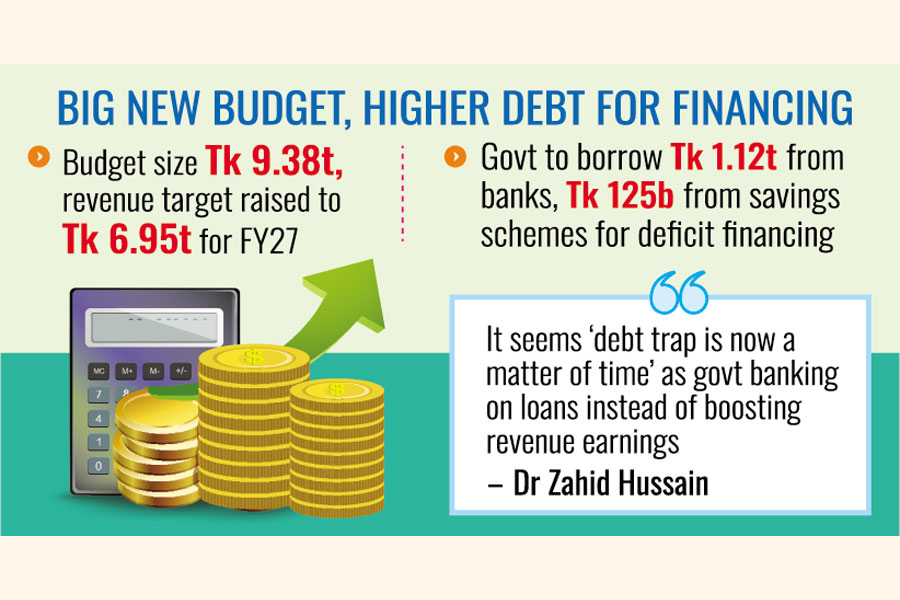
According to Finance Division sources, in the next fiscal year, the government plans to borrow some Tk 1.12 trillion from banks compared to current year's budgetary target of Tk 1.04 trillion.

Data show that until May 10, the government had actually borrowed Tk 1.95 trillion from the banking sector to meet its needs.

Also, the government is targeting to borrow some Tk 150 billion from the national savings schemes to help finance the Tk 9.38-trillion largest-ever fiscal budget in Bangladesh.

In the outgoing fiscal year, the government had targeted borrowing Tk 125 billion from national savings schemes. However, due to selling pressure from the buyers, the government's net selling of savings instruments fell into negative territory by Tk 5.55 billion until February last.

Officials say that as the government is making a large-size budget without confirming adequate sources of earnings, it will have no option but to raise dependence on the banking sector to meet its financial needs.

In the next year's budget, the government is setting a target of collecting Tk 6.95 trillion as revenues, compared to its highest revenue collection in the recent past amounting to Tk 4.09 trillion.

The finance officials say the National Board of Revenue (NBR) alone is going to be given a target to collect Tk 6.04 trillion, higher by Tk 2.43 trillion than its previous records in revenue mobilisation.

So, they say, as revenue collection will fall short of its target and foreign fund flow is not promising in the coming year, government's net bank borrowings will mount in the next fiscal year, surpassing the target.


Dr Zahid Hussain, a former lead economist at the World Bank's Dhaka office, says it seems that "debt trap is now a matter of time" as the government is increasingly depending on loans instead of enhancing revenue earnings.

"The money the government is borrowing from the banks is being used for meeting its operational needs instead of using them in productive sectors," the economist notes.

Thus, he adds, the government's debt burden is increasing day by day.

Because, he says, the government will have to return the money with interest.

Mr Hussain also makes a point that high government borrowing from banking sector lessens fund flow for private-sector investment, thus lowering employment growth that ultimately impacts overall economic growth in the country.​
 

How CEOs view country's economic prospects

FE

Published :
Jun 08, 2026 23:40
Updated :
Jun 08, 2026 23:40

1780962058143.webp


The cautious optimism expressed by company chief executive officers (CEOs) across a broad spectrum of business and industries highlights both positive developments and the uncertainty about the required pace of technological transformation for the future. A survey, in fact the 29th edition of CEO Survey, carried out by the PricewaterhouseCoopers (PwC) Bangladesh finds that the company chiefs are quite optimistic about the medium-term prospects of economic growth but not confident enough about long-term technological transition. They duly recognise that technological transformation is the key driver of robust business and economic growth. That one in five CEOs claims that adoption of artificial intelligence (AI) is propelling business and contributing to revenue growth while one in four of them discloses that it is reducing operational costs confirms the medium-term brighter outlook of economy.

However, the company chiefs are not sure of the sustainability of these medium-term gains. This is because they think that the pace of technological transformation is not up to the mark. In fact, AI is going through a rapid development process and controversy surrounding this phenomenon shows no sign of coming to an end soon. True, the algorithm-based AI can process inputs at a phenomenal speed but that cannot be a panacea for all ills prevailing in business and industries. At the centre of data processing lies automation which essentially means dispensability of manual work. Yet it must be admitted that automation has not yet reached the level where it can replace human inputs in terms of decision making. Sorting out information and data is not all, there is a need for a human brain to use them as conveniently as possible. On that count, use of automation should be limited to a level where it can assist the managements of companies and industries to arrive at decisions on diversification of products, expansion of business and exploring newer markets.

With virtually no research base, it is hardly surprising for Bangladesh to lag behind countries like USA and China where AI competition is fierce. Google, OpenAI and Nvidia are locked in the fiercest AI competition. Other companies such as Microsoft, Anthropic, Meta and Amazon are no pushovers in this respect. OpenAI's ChatGPT has got an upper hand over Google's Gemini. Countries like Bangladesh should embark on research on AI in order to expedite development of sector-specific digital systems or AI suitable for domestic use.

The fact that 20 per cent of CEOs in this country have applied AI to a large and very large extent is a testimony to their effort at remaining updated in this regard. Close to one in five CEOs have reported extensive use of AI in demand generation and strategic decision-making and this places the country ahead of some Southeast Asian peers. So there is nothing to rue over. Future viability of business and industries will depend on how the fruits of 4th Industrial Revolution (4IR) are shared following their suitability for specific countries. The shared knowledge has to be discreetly and meticulously used for speeding up production and economic growth. There is no point lamenting over a lack of a uniform application of AI in all productive areas. It is not too late to join the bandwagon of AI-assisted business and manufacturing entities.​
 

How should Bangladesh's economy grow in the second half of 2020s?

Nawshad Ahmed

1780964768266.webp

FILE VISUAL: ANWAR SOHEL

Despite a low average annual GDP growth of around five percent and persistently high inflation (averaging eight to nine percent) in the first half of the 2020s, if key economic reforms are properly executed, Bangladesh can still target a stronger performance in the upcoming years.

As is now clear, the growth performance during the first half of this decade has not been as promising as it could have been post the pandemic. We missed the opportunity due to several factors. Besides severe mismanagement of private sector bank loans and macroeconomic instability, the Bangladesh Bank also failed to maintain adequate foreign exchange reserves, resulting in devaluation of the taka and increased import prices affecting both investment and consumption expenditure. Non-performing loans (NPL) shot up during the first half of the 2020s as the central bank’s governance faltered and real private investment nosedived. Market confidence in the sector also withered in the face of uncertainty and corruption. Per the data released recently by the central bank, the total NPL in the banking sector reached Tk 588,704 crore, as high as 32.26 percent of the total disbursed loans amounting to Tk 1,824,668 crore.

The main growth drivers in the country have been expanding the service sector, agriculture, manufacturing, and exports. Growth follows a process—from investment, employment, consumption, savings, and then to higher levels of investment. However, this process needs to be effective as the Bangladesh Bank’s operational efficiency is critical in ensuring investment. Employment depends on investor confidence, which in turn is dependent on a variety of factors such as availability of capital, availability of reasonably priced fuel and electricity, level of education and training of human resources, transport and communication infrastructure, effective macroeconomic management, tax rates and structures, human security, urban facilities, external shock management, political stability, forward and backward linkages, investment-friendly commercial and legal systems, profitability, and insurance regime. So, there are a host of critical factors that should all be favourable to ensure a high rate of private investment. These are mainly supply-side factors, and if any of these factors are not in favour of investors, it can alter the decision to invest. For example, in recent years, due to chronic natural gas and electricity shortages, some factory owners were forced to switch to costly alternative power sources like diesel and LPG, while others suspended operations, leading to significant job losses.

Last month, the central bank announced a Tk 60,000 crore stimulus package to revive ailing private sector manufacturing and service industries, thereby generating over 25 lakh jobs. This fund, if successfully handled, is likely to spur GDP growth. In the face of stagnant private sector investment from the last five years, a subsidised credit opportunity such as this will be conducive to energising the private sector. However, targeting only private sector entities is unlikely to fully yield the desired results. All the factors mentioned above also need to be carefully considered and necessary reform undertaken to effectively facilitate private investment.

It has been found in the experiences of many countries that education and health expenditure in the national budget play a very significant role in the achievement of higher growth rates by equipping the youth for productive employment. Unfortunately, public spending on health and education is very low in Bangladesh. When modern technology is introduced in higher education and when affordable healthcare is delivered, labour productivity rises. In the short term, however, technical and vocational education must be prioritised. A portion of the just announced stimulus package may be made available to this end. It is essential to invest in human capital development in order to reap the benefits of our demographic dividend.

While it is important to prioritise export-oriented sectors, it is even more crucial to focus on diversification of production in an effort to move some emphasis away from readymade garments, which currently account for over 80 percent of total exports out of Bangladesh. Our export potential lies mainly in labour-intensive industries such as leather and footwear, light engineering, furniture, food processing, jute products, pharmaceuticals, electronics, rubber, and porcelain items. The country also has a comparative advantage in these areas as these industries have the potential to absorb the existing supply of low-cost labour. A faster rate of urbanisation, spurred by rural-to-urban migration, is an opportunity that should be utilised to enhance the benefits of urban agglomeration. Converting urban informal sector workers to productive labour will have a positive impact on GDP growth, arresting the slowdown of the rate of poverty reduction and boosting exports. The importance of increasing export earnings cannot be overstated, since nearly $30 billion might be necessary for debt servicing (principal and interest) in FY2025-26 alone. We cannot afford to fall into a debt trap.

Investors are considered the pillars of an economy. They are capable of creating jobs, paying taxes, indirectly boosting savings, and ensuring growth. By building on the structural and financial reforms initiated in the 1980s and carried forward through the 2010s, Bangladesh Bank’s new stimulus package could empower a new generation of entrepreneurs to absorb excess labour. Although resisted initially, those reforms ultimately helped transform the economy through policies that promoted deregulation, market competition, and export-led growth, and proved beneficial in the long run as the rates of savings, investment, productivity, and trade rose while the poverty rate fell. Indeed, the average GDP growth increased from 3.8 percent in the 1980s, to 4.7 percent in the 1990s, to 5.6 percent in the 2000s, and to 6.4 percent in the 2010s. For higher GDP growth, what we need is an environment conducive to private investment such as market-determined interest rate fixation, independence of the Bangladesh Bank in policymaking, a favourable rate of tariff to encourage local industries to remain globally competitive, and for bank lending to follow strict government regulations.

Dr Nawshad Ahmed, a retired UN official, is an economist and urban planner.​
 

Latest Posts

Back