[🇧🇩] Monitoring Bangladesh's Economy

[🇧🇩] Monitoring Bangladesh's Economy
1K
37K
More threads by Saif

G Bangladesh Defense

Govt to borrow 20pc higher from savings tools, 8pc more from banks

Possible failure of overrated revenue-target could lead to even overshooting of borrowing targets: Finance officials

Syful Islam

Published :
Jun 08, 2026 00:22
Updated :
Jun 08, 2026 00:22

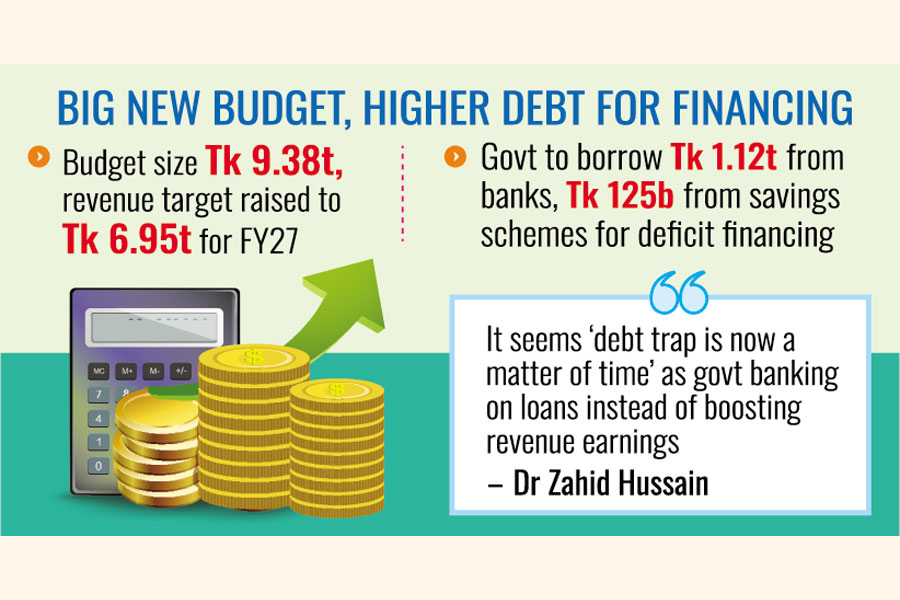
With an upscale new budget coming in few days now, the government targets borrowing 8.0-percent higher from the banking sector and 20-percent bigger from savings schemes to finance deficit amid unpromising revenue-earning prospects, officials say.

According to Finance Division sources, in the next fiscal year, the government plans to borrow some Tk 1.12 trillion from banks compared to current year's budgetary target of Tk 1.04 trillion.

Data show that until May 10, the government had actually borrowed Tk 1.95 trillion from the banking sector to meet its needs.

Also, the government is targeting to borrow some Tk 150 billion from the national savings schemes to help finance the Tk 9.38-trillion largest-ever fiscal budget in Bangladesh.

In the outgoing fiscal year, the government had targeted borrowing Tk 125 billion from national savings schemes. However, due to selling pressure from the buyers, the government's net selling of savings instruments fell into negative territory by Tk 5.55 billion until February last.

Officials say that as the government is making a large-size budget without confirming adequate sources of earnings, it will have no option but to raise dependence on the banking sector to meet its financial needs.

In the next year's budget, the government is setting a target of collecting Tk 6.95 trillion as revenues, compared to its highest revenue collection in the recent past amounting to Tk 4.09 trillion.

The finance officials say the National Board of Revenue (NBR) alone is going to be given a target to collect Tk 6.04 trillion, higher by Tk 2.43 trillion than its previous records in revenue mobilisation.

So, they say, as revenue collection will fall short of its target and foreign fund flow is not promising in the coming year, government's net bank borrowings will mount in the next fiscal year, surpassing the target.


Dr Zahid Hussain, a former lead economist at the World Bank's Dhaka office, says it seems that "debt trap is now a matter of time" as the government is increasingly depending on loans instead of enhancing revenue earnings.

"The money the government is borrowing from the banks is being used for meeting its operational needs instead of using them in productive sectors," the economist notes.

Thus, he adds, the government's debt burden is increasing day by day.

Because, he says, the government will have to return the money with interest.

Mr Hussain also makes a point that high government borrowing from banking sector lessens fund flow for private-sector investment, thus lowering employment growth that ultimately impacts overall economic growth in the country.​
 

How CEOs view country's economic prospects

FE

Published :
Jun 08, 2026 23:40
Updated :
Jun 08, 2026 23:40

1780962058143.webp


The cautious optimism expressed by company chief executive officers (CEOs) across a broad spectrum of business and industries highlights both positive developments and the uncertainty about the required pace of technological transformation for the future. A survey, in fact the 29th edition of CEO Survey, carried out by the PricewaterhouseCoopers (PwC) Bangladesh finds that the company chiefs are quite optimistic about the medium-term prospects of economic growth but not confident enough about long-term technological transition. They duly recognise that technological transformation is the key driver of robust business and economic growth. That one in five CEOs claims that adoption of artificial intelligence (AI) is propelling business and contributing to revenue growth while one in four of them discloses that it is reducing operational costs confirms the medium-term brighter outlook of economy.

However, the company chiefs are not sure of the sustainability of these medium-term gains. This is because they think that the pace of technological transformation is not up to the mark. In fact, AI is going through a rapid development process and controversy surrounding this phenomenon shows no sign of coming to an end soon. True, the algorithm-based AI can process inputs at a phenomenal speed but that cannot be a panacea for all ills prevailing in business and industries. At the centre of data processing lies automation which essentially means dispensability of manual work. Yet it must be admitted that automation has not yet reached the level where it can replace human inputs in terms of decision making. Sorting out information and data is not all, there is a need for a human brain to use them as conveniently as possible. On that count, use of automation should be limited to a level where it can assist the managements of companies and industries to arrive at decisions on diversification of products, expansion of business and exploring newer markets.

With virtually no research base, it is hardly surprising for Bangladesh to lag behind countries like USA and China where AI competition is fierce. Google, OpenAI and Nvidia are locked in the fiercest AI competition. Other companies such as Microsoft, Anthropic, Meta and Amazon are no pushovers in this respect. OpenAI's ChatGPT has got an upper hand over Google's Gemini. Countries like Bangladesh should embark on research on AI in order to expedite development of sector-specific digital systems or AI suitable for domestic use.

The fact that 20 per cent of CEOs in this country have applied AI to a large and very large extent is a testimony to their effort at remaining updated in this regard. Close to one in five CEOs have reported extensive use of AI in demand generation and strategic decision-making and this places the country ahead of some Southeast Asian peers. So there is nothing to rue over. Future viability of business and industries will depend on how the fruits of 4th Industrial Revolution (4IR) are shared following their suitability for specific countries. The shared knowledge has to be discreetly and meticulously used for speeding up production and economic growth. There is no point lamenting over a lack of a uniform application of AI in all productive areas. It is not too late to join the bandwagon of AI-assisted business and manufacturing entities.​
 

How should Bangladesh's economy grow in the second half of 2020s?

Nawshad Ahmed

1780964768266.webp

FILE VISUAL: ANWAR SOHEL

Despite a low average annual GDP growth of around five percent and persistently high inflation (averaging eight to nine percent) in the first half of the 2020s, if key economic reforms are properly executed, Bangladesh can still target a stronger performance in the upcoming years.

As is now clear, the growth performance during the first half of this decade has not been as promising as it could have been post the pandemic. We missed the opportunity due to several factors. Besides severe mismanagement of private sector bank loans and macroeconomic instability, the Bangladesh Bank also failed to maintain adequate foreign exchange reserves, resulting in devaluation of the taka and increased import prices affecting both investment and consumption expenditure. Non-performing loans (NPL) shot up during the first half of the 2020s as the central bank’s governance faltered and real private investment nosedived. Market confidence in the sector also withered in the face of uncertainty and corruption. Per the data released recently by the central bank, the total NPL in the banking sector reached Tk 588,704 crore, as high as 32.26 percent of the total disbursed loans amounting to Tk 1,824,668 crore.

The main growth drivers in the country have been expanding the service sector, agriculture, manufacturing, and exports. Growth follows a process—from investment, employment, consumption, savings, and then to higher levels of investment. However, this process needs to be effective as the Bangladesh Bank’s operational efficiency is critical in ensuring investment. Employment depends on investor confidence, which in turn is dependent on a variety of factors such as availability of capital, availability of reasonably priced fuel and electricity, level of education and training of human resources, transport and communication infrastructure, effective macroeconomic management, tax rates and structures, human security, urban facilities, external shock management, political stability, forward and backward linkages, investment-friendly commercial and legal systems, profitability, and insurance regime. So, there are a host of critical factors that should all be favourable to ensure a high rate of private investment. These are mainly supply-side factors, and if any of these factors are not in favour of investors, it can alter the decision to invest. For example, in recent years, due to chronic natural gas and electricity shortages, some factory owners were forced to switch to costly alternative power sources like diesel and LPG, while others suspended operations, leading to significant job losses.

Last month, the central bank announced a Tk 60,000 crore stimulus package to revive ailing private sector manufacturing and service industries, thereby generating over 25 lakh jobs. This fund, if successfully handled, is likely to spur GDP growth. In the face of stagnant private sector investment from the last five years, a subsidised credit opportunity such as this will be conducive to energising the private sector. However, targeting only private sector entities is unlikely to fully yield the desired results. All the factors mentioned above also need to be carefully considered and necessary reform undertaken to effectively facilitate private investment.

It has been found in the experiences of many countries that education and health expenditure in the national budget play a very significant role in the achievement of higher growth rates by equipping the youth for productive employment. Unfortunately, public spending on health and education is very low in Bangladesh. When modern technology is introduced in higher education and when affordable healthcare is delivered, labour productivity rises. In the short term, however, technical and vocational education must be prioritised. A portion of the just announced stimulus package may be made available to this end. It is essential to invest in human capital development in order to reap the benefits of our demographic dividend.

While it is important to prioritise export-oriented sectors, it is even more crucial to focus on diversification of production in an effort to move some emphasis away from readymade garments, which currently account for over 80 percent of total exports out of Bangladesh. Our export potential lies mainly in labour-intensive industries such as leather and footwear, light engineering, furniture, food processing, jute products, pharmaceuticals, electronics, rubber, and porcelain items. The country also has a comparative advantage in these areas as these industries have the potential to absorb the existing supply of low-cost labour. A faster rate of urbanisation, spurred by rural-to-urban migration, is an opportunity that should be utilised to enhance the benefits of urban agglomeration. Converting urban informal sector workers to productive labour will have a positive impact on GDP growth, arresting the slowdown of the rate of poverty reduction and boosting exports. The importance of increasing export earnings cannot be overstated, since nearly $30 billion might be necessary for debt servicing (principal and interest) in FY2025-26 alone. We cannot afford to fall into a debt trap.

Investors are considered the pillars of an economy. They are capable of creating jobs, paying taxes, indirectly boosting savings, and ensuring growth. By building on the structural and financial reforms initiated in the 1980s and carried forward through the 2010s, Bangladesh Bank’s new stimulus package could empower a new generation of entrepreneurs to absorb excess labour. Although resisted initially, those reforms ultimately helped transform the economy through policies that promoted deregulation, market competition, and export-led growth, and proved beneficial in the long run as the rates of savings, investment, productivity, and trade rose while the poverty rate fell. Indeed, the average GDP growth increased from 3.8 percent in the 1980s, to 4.7 percent in the 1990s, to 5.6 percent in the 2000s, and to 6.4 percent in the 2010s. For higher GDP growth, what we need is an environment conducive to private investment such as market-determined interest rate fixation, independence of the Bangladesh Bank in policymaking, a favourable rate of tariff to encourage local industries to remain globally competitive, and for bank lending to follow strict government regulations.

Dr Nawshad Ahmed, a retired UN official, is an economist and urban planner.​
 

Bangladesh's capital market must not remain an untapped growth engine

M Kabir Hassan

1781071921171.webp

VISUAL: SALMAN SAKIB SHAHRYAR

Bangladesh’s capital market remains one of the weakest components in its financial architecture. After independence, formal trading on the Dhaka Stock Exchange (DSE) started in 1976. Five decades on, it has funded only a tiny fraction of national investment. A recent Bonik Barta report stated that, as of March 2026, the total issued capital on the country’s capital market stood at Tk 103,258 crore, compared to the gross fixed capital formation (GFCF) of a little over $138 billion. This means market capitalisation stands at just 6.22 percent of GDP. In practical terms, the stock market has funded barely six percent of the country’s investment needs.

This is not simply a stock market problem but a structural financing failure. Successful Asian economies have capital markets that serve as second engines of long-term finance through equity, corporate bonds, mutual funds, and securitised instruments. In Bangladesh, that engine remains stalled. Banks have become the default financier of almost everything, including long-term industrial projects far better suited to equity or bond markets.

As a result, there is a dangerous maturity mismatch between short- and medium-term deposits collected by banks and term loans provided for projects that may take 10-15 years to generate stable returns. Per the Bangladesh Bank data, industrial credit stood at Tk 764,117 crore in December 2025. Tk 423,587 crore of that credit was extended in term loans—more than seven times the amount raised through equity over the last five decades. When these projects fail or rates rise, the stress falls directly on bank balance sheets.

Further evidence of the cost of this imbalance can be seen in the banking sector’s non-performing loan (NPL) crisis. The total defaulted loans stood at just over Tk 544,831 crore in December 2025. A recent column in The Daily Star reveals that the reported NPL ratio dropped to 30.60 percent in December 2025 from 35.73 percent in September 2025 largely because of relaxed rescheduling rather than genuine recovery. This indicates delayed financial fragility, not health.

An equally important factor is that a deeper capital market would reduce pressure on the banking system. Equity financing carries no scheduled repayment obligations for debtors. Corporate bonds can match project maturities. Sukuk can mobilise Shariah-compliant savings for productive investments. A balanced mix of bank loans, equity, and bonds will lower capital costs, distribute risk, and lessen the systemic burden placed upon banks. A serious policy consideration may be a 60-40 financing split between banks and capital markets for large-scale projects.

With the announcement of the next national budget around the corner and with a newly constituted Bangladesh Securities and Exchange Commission (BSEC) in place, there is an opportunity to set an agenda for expanding market capitalisation.

Why has the market failed to mature?

There are several reasons behind that. First, investor confidence has collapsed. Companies that offered more than Tk 11,000 crore through initial public offers (IPOs) over the past 15 years included some who later became distressed, misused proceeds, or faced allegations of price manipulation. When investors believe insider shareholders are able to sell their shares at higher prices than they could obtain through an IPO, and when actions are rarely taken against those who commit violations, investors withdraw or act as speculators.

Second, Bangladesh is currently experiencing the longest IPO drought in decades. Per a report by The Business Standard, no company has gone public in the country since approval was granted to Techno Drugs in March 2024. A stock market cannot support serious investors if listings don’t continue to occur regularly. It becomes illiquid, narrow, and vulnerable.

Third, Bangladesh’s corporate culture remains dominated by family-controlled firms that resist diluting ownership and acceptance of scrutiny by minority shareholders. Disclosure requirements, independent directors, and accountability to minority shareholders are all required to list stocks. As long as banks remain accessible and require fewer disclosures, strong private companies will avoid listing their shares on the stock exchange.

Fourth, the market is too shallow. Only 16 listed corporate bonds exist as of April 2026, as indicated by CEIC data. Bonik Barta reports that among the 645 securities traded on the DSE, only 360 are companies, with 32 having suspended production and 38 classified as going-concern doubtful. Foreign investors have also primarily left the country. Net portfolio flows have been negative consistently in recent years.

The reform agenda is clear. Credibility must be established in the enforcement process. The reconstituted BSEC must clearly prosecute manipulation, misuse of IPO proceeds, insider trading, and fraudulent disclosure. Without credibility in enforcement processes, investor confidence will never return.

Rules governing IPOs must allow productive refinancing of bank debt. Currently, rules restrict using IPO proceeds to retire bank loans. If firms can use equity to replace 12-14 percent of bank debt, both the firm’s balance sheet and banking system stress will strengthen. Companies should be allowed to deleverage. However, only legitimate companies should benefit from this option; weak ones should not be permitted to use this option as a loophole.

Bangladesh must build a real corporate bond and Sukuk market. Tax parity must exist between bank deposits and other sources of funding for this purpose. Reliable secondary markets, credible credit ratings, and benchmark sovereign yield curves are also necessary to develop these markets. Commercial bank deposits alone cannot sustainably finance infrastructure and industrial expansion.

The promoter behaviour must shift due to meaningful differences between taxes paid by listed companies versus unlisted companies. Stronger governance and disclosure requirements must apply to larger unlisted companies, and benami structures must be actively discouraged.

Large-scale projects above a defined threshold must include a capital market component—either equity, corporate bonds or Sukuk. Patient capital can be provided by pension funds, insurers, mutual funds and the Universal Pension Scheme, but only if the capital market is transparent, liquid and trustworthy.

Bangladesh’s capital market crisis is a development crisis, not a narrow issue related to stock prices. The economy cannot finance its next phase of industrialisation through an overstressed banking system alone. After five decades of operation, the stock market still funds only a small fraction of national investment. The question now is whether the authorities have political will to make the capital market a true engine of growth.

Dr M Kabir Hassan is professor and Moffett chair in finance at the University of New Orleans in the US, recipient of the 2016 IDB Prize in Islamic banking and finance, and a member of the AAOIFI Ethics and Governance Board.​
 

Bangladesh now half a trillion dollar economy

GDP growth rebounds to 4.14pc from 3.49pc a year ago: BBS
FHM Humayan Kabir

Published :
Jun 11, 2026 09:01
Updated :
Jun 11, 2026 09:01

1781157774203.webp


Bangladesh is now a half-trillion-dollar economy, as its gross domestic product (GDP) has crossed USD 500 billion mark.

It has achieved this unique feat in the outgoing fiscal year (FY) 2025-26, marking a significant step towards its ambition of becoming a $1.0-trillion economy by 2034.

At the same time, the country's gross domestic product (GDP) growth at constant prices expanded by 4.14 per cent, recovering from the low 3.49 per cent recorded in FY2024-25, according to Bangladesh Bureau of Statistics (BBS) data unveiled on Wednesday.

Per capita gross national income (GNI) has also crossed the $3,000 mark, with the BBS estimating average income at $3,020 in FY2025-26.

Provisional data released by the BBS revealed that the total size of the economy at current prices surged to $501.067 billion (Tk 61.202 trillion) in FY2025-26.

This marks a substantial leap from the $456 billion economy recorded in FY2024-25.

Meanwhile, the estimated economic growth of 4.14 per cent is well below the government's GDP growth target of 5.5 per cent for the current fiscal year.

Earlier, several multilateral development partners, including the International Monetary Fund (IMF), projected Bangladesh's GDP growth at 4.7 per cent, while the World Bank forecast 3.9 per cent and the Asian Development Bank (ADB) 4.0 per cent.

According to the BBS, the breakthrough into the $500-billion-plus club comes as a major boost to national economic ambitions, supported by stronger growth in the agriculture and services sectors.

The BBS showed that although GDP growth in the industrial sector slowed in FY2025-26 compared with FY2024-25, growth in the agriculture and services sectors improved in the latest estimates.

According to the official data, GDP growth in the agriculture sector was estimated at 2.78 per cent, 0.36 percentage points higher than the 2.42 per cent recorded in the previous fiscal year.

Similarly, the services sector achieved GDP growth of 4.59 per cent in FY2025-26, up from 4.35 per cent in FY2024-25.

On the other hand, GDP growth in the industrial sector slowed to 2.86 per cent, 0.85 percentage points lower than the 3.71 per cent recorded in FY2024-25, the BBS data showed.

The milestone provides a critical foundation for the government's key election pledge of transforming Bangladesh into a $1.0-trillion economy.

While the ultimate goal is to reach the trillion-dollar mark, crossing the halfway point ahead of the next decade validates the nation's long-term macroeconomic expansion plans.

Top policy strategists note that reaching $501 billion establishes the financial momentum needed to achieve future industrial and digital development goals.

A senior General Economics Division (GED) official told The Financial Express that economic growth and sectoral performance, driven largely by robust domestic production and consumer activity, helped the economy expand by 4.14 per cent in FY2025-26.

This outpaced the 3.49 per cent growth rate recorded in the previous fiscal year, signalling a steady post-inflation recovery.

The industrial and manufacturing sectors faced global headwinds, with growth slowing to 2.86 per cent due to subdued export demand.

Reflecting the expanding economy, citizens also experienced a notable increase in income levels.

Bangladesh's per capita income climbed to $3,020 in FY2025-26, reinforcing the country's position as a rising middle-income economy in South Asia.

BBS officials indicated that final data validation would be completed by the end of the fiscal year on June 30.

With the half-trillion-dollar milestone firmly secured, the focus now shifts to implementing structural reforms to unlock the next half-trillion dollars over the coming years.

Policy Exchange Bangladesh Chairman Dr M Masrur Reaz told the FE that the achievement was indeed good news for Bangladesh.

He said the government should not become complacent but instead focus on attracting more private investment and creating jobs.

Given higher inflationary pressures, sluggish investment growth, weak employment opportunities and external shocks, the government needs innovative policies and reforms to attract private-sector investment, boost exports and generate employment, Dr Reaz added.​
 

Bangladesh per capita income rises to USD 3,020

BSS

1781158829215.webp

Logo of Bangladesh Bureau of Statistics (BBS)

Bangladesh’s per capita income has increased to USD 3,020 in the provisional estimates for fiscal year (FY) 2025-26, up from USD 2,769 in the previous fiscal year, according to the latest data released by the Bangladesh Bureau of Statistics (BBS) today.

The provisional estimates also show that the country''s economy expanded by 4.14 per cent at constant prices during FY26, improving from the 3.49 per cent growth recorded in the final accounts of FY25.

According to the BBS data, the size of the economy at current market prices is estimated at Tk 61,202,094 million, compared with Tk 55,15,0262 million in the previous fiscal year.

Per capita GDP also increased significantly to Tk 350,098 (USD 2,866) in FY26 from Tk 317,100 (USD 2,625) a year earlier.

Sector-wise performance indicates that the services sector remained the main driver of economic growth, posting an estimated growth rate of 4.59 per cent, up from 4.35 per cent in FY25.

The agriculture sector registered a growth rate of 2.78 per cent, slightly higher than the 2.42 percent recorded in the previous fiscal year, reflecting continued resilience in farm production and related activities.

The industrial sector, however, grew by 2.86 per cent, lower than the 3.71 per cent growth achieved in FY25.

The provisional estimates also show a modest decline in investment and savings indicators. The investment-to-GDP ratio is estimated at 27.93 per cent in FY26, compared with 28.54 per cent in the previous fiscal year.
Similarly, domestic savings declined slightly to 21.38 per cent of GDP from 21.98 per cent, while national savings fell to 26.93 per cent from 27.67 per cent.

The estimates were prepared on the basis of a projected population of 174.81 million. The calculations used an average exchange rate of Tk 122.14 per US dollar, based on the average exchange rate during the first nine months of FY26, as reported by the Bangladesh Bank.

The latest provisional figures indicate continued expansion of Bangladesh's economy, with rising per capita income and a larger GDP despite slower industrial growth and a slight moderation in investment and savings ratios.​
 

Latest Posts

Back