Home Watch Videos Wars Movies Login

[🇧🇩] Monitoring Bangladesh's Economy

[🇧🇩] Monitoring Bangladesh's Economy
1K
41K
More threads by Saif

G Bangladesh Defense

Inflation eases further to 8.32pc in July

1786489984382.webp


Bangladesh’s headline inflation fell to 8.32 percent in July 2026 from 9.16 percent in June, mainly driven by a significant decline in food inflation, according to data released by the Bangladesh Bureau of Statistics (BBS).

The latest BBS data show that food inflation dropped to 7.16 percent in July, from 8.60 percent in June, while non-food inflation eased to 9.28 percent from 9.61 percent during the period.

The July inflation rate was also lower than the 9.42 percent recorded in May 2026, indicating a continued moderation in overall price pressure over the past two months.

On a month-on-month basis, however, the general price index increased by 1.44 percent in July, compared to a 0.34 percent rise in June. Food prices rose by 2.57 percent during the month, while non-food prices increased by 0.53 percent.

The inflation situation was slightly higher in rural areas than in urban areas in July.

Rural inflation stood at 8.36 percent, with food inflation at 7.14 percent and non-food inflation at 9.53 percent.

In urban areas, headline inflation was 8.24 percent, while food and non-food inflation stood at 7.21 percent and 8.90 percent respectively.

The 12-month moving average inflation also declined to 8.66 percent in the period from August 2025 to July 2026, compared to 9.77 percent in the corresponding previous 12-month period.

Meanwhile, the Wage Rate Index increased by 8.22 percent year-on-year in July, slightly up from 8.18 percent in June. Wage growth in agriculture stood at 8.24 percent, while it was 8.15 percent in industry and 8.39 percent in the services sector.

The BBS publishes the monthly Consumer Price Index and inflation data based on a 2021-22 reference year. The CPI covers national, rural and urban consumer groups.​
 
Analyze

Analyze Post

Add your ideas here:
Highlight Cite Respond

Tax-GDP ratio edges up despite weak economic activity
NBR running at its traditional pace, reform needed immediately, says CPD director

1786576401787.webp


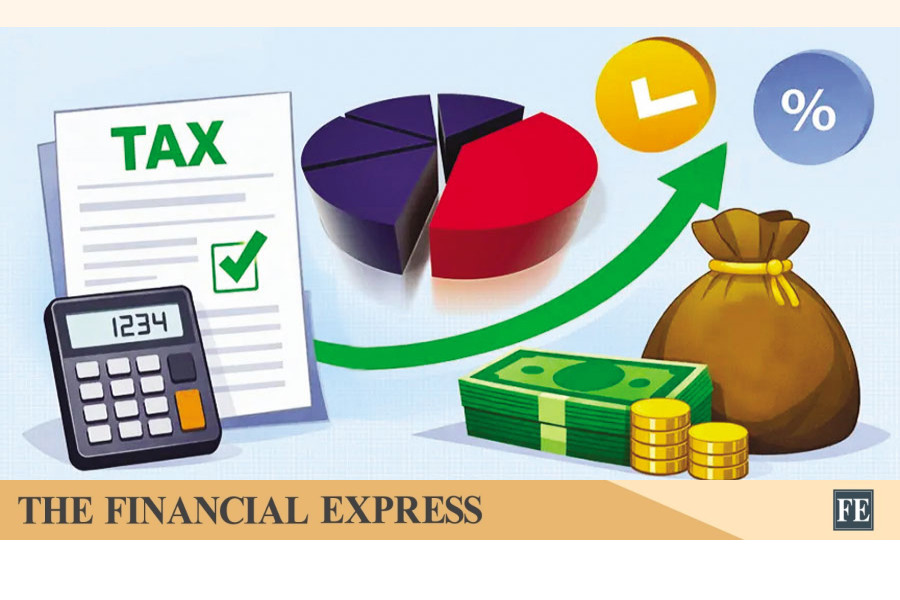
Bangladesh managed to stem the downturn in its tax-to-GDP ratio last fiscal year with the proportion having edged up by 0.08-percentage point notwithstanding sluggish investment and economic activity, and waning purchasing power of both individuals and businesses.

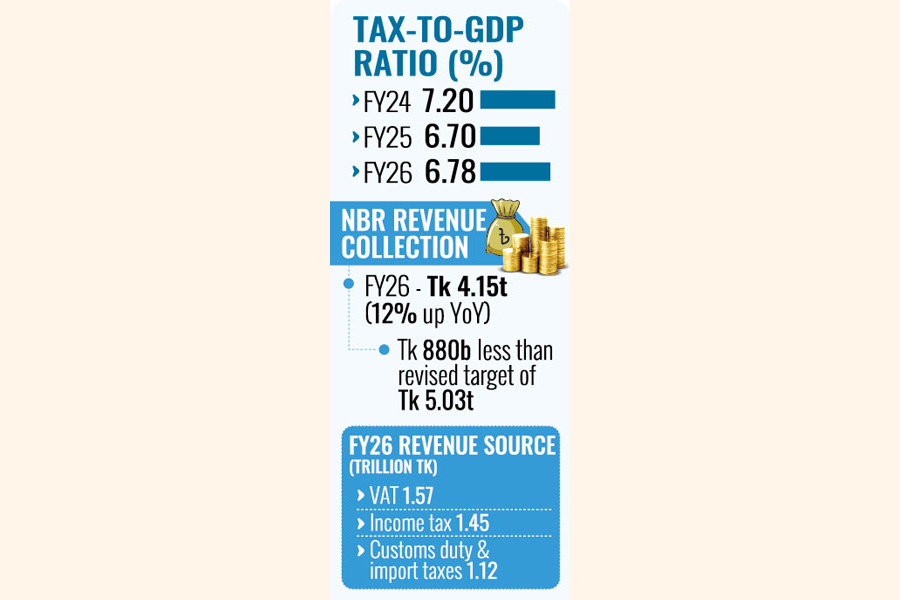
As per the provisional revenue-mobilisation data from the National Board of Revenue (NBR), the tax-to-GDP ratio stood at 6.78 per cent in FY2025-26, compared to 6.70 per cent a year earlier.

However, the ratio slipped last year from 7.20 per cent in FY24.

The calculation is based only on the NBR's provisional tax-collection figures. The ratio may change once data on non-tax revenue and revenue collected by agencies other than the NBR are incorporated.

The NBR accounts for nearly 90 per cent of Bangladesh's domestic revenue mobilisation meant for financing the national budget.

It collected Tk 4.15 trillion in revenue in FY2025-26, registering a Tk 880-billion shortfall against its revised target of Tk 5.03 trillion.

The shortfall against the original target of Tk 4.99 trillion stood at Tk 840 billion.

Officials say repeated setting of "unrealistic revenue targets" is putting pressure on tax officials and demoralising them when they fail to get to the goals.

A senior NBR official has said revenue mobilisation largely depends on economic activity, particularly development expenditure under the Annual Development Programme (ADP).

But the latest ADP-implementation data show Bangladesh recorded one of its lowest implementation rates last year-only 67.52 per cent of the annual allocation spent.

"Unless overall economic activity normalises, revenue collection will not pick up to the expected level," the NBR official told The Financial Express.

Senior Research Director of the Centre for Policy Dialogue (CPD) Towfiqul Islam Khan thinks higher international prices of commodities, including fuels, helped generate additional revenue during the year.

He also points to disruption during the final quarter of FY2024-25 amid protests within the NBR over the proposed bifurcation of the revenue authority.

"However, the process or any systematic changes are missing, and the NBR is running at its traditional pace, posing challenges to meeting revenue targets in the future too," he says.

Administrative loopholes must be addressed, he suggests, adding that it is unrealistic to expect comprehensive reform within a year, but the government needs to start the process immediately.

He also suggests the government reduce expenditure and prioritise spending, given the country's persistently low tax-to-GDP ratio.

Economists say the marginal increase in the ratio is not significant, particularly as the appetite for domestic revenue is increasing amid a decline in foreign funding sources.

According to provisional NBR data, revenue collection increased by around Tk 450 billion from the previous fiscal year despite continued economic challenges.

Overall revenue collection grew by 12 per cent in FY2025-26.

The NBR, however, once again missed its revenue target, continuing a pattern seen in previous years.

Officials say weak development expenditure had a significant impact on domestic revenue mobilisation as a substantial portion of tax revenue comes from source taxes generated through government development activities.

At the same time, private-sector investment remained subdued, reflecting weak demand for credits and a cautious business environment.

Of the total NBR collection last fiscal year, VAT generated Tk 1.57 trillion, income tax Tk 1.45 trillion, and customs duty and import taxes Tk 1.12 trillion.

The modest improvement in the tax-to-GDP ratio, therefore, offers little comfort to policymakers, economists say, as Bangladesh's fiscal needs to continue to rise while the capacity to mobilise domestic resources remains constrained.

Immediate-past NBR chairman Abdur Rahman Khan said it was challenging to mobilise higher revenue last year than the previous one amid economic hurdles.

"The government should consider providing sufficient budget and logistics for revenue mobilisation so that taxmen can work smoothly," he suggests.​
 
Analyze

Analyze Post

Add your ideas here:
Highlight Cite Respond

Dhaka tops district remittance inflows
Staff Correspondent 13 August, 2026, 00:25

1786578881519.webp

New Age file photo

Dhaka topped all districts in workers’ remittance inflows in financial year 2025-26, receiving $13,470.42 million, followed by Chattogram with $3,274.40 million and Cumilla with $2,082.73 million.

The three districts together accounted for more than half of the country’s total remittance inflows during the fiscal year, according to Bangladesh Bank data.

Beyond the top three, several other districts also recorded substantial remittance inflows.

Sylhet received $1,580.94 million, followed by Noakhali with $1,075.75 million, Feni with $995.49 million, Brahmanbaria with $915.57 million, Chandpur with $790.64 million, Moulvibazar with $564.71 million, Narayanganj with $551.28 million, Lakshmipur with $533.79 million, Gazipur with $479.46 million and Habiganj with $401.14 million.

At the divisional level, Dhaka topped the list with $18,481.21 million, accounting for 52 per cent of the national total.

Chattogram division followed with $9,962.85 million, or 28 per cent, while Sylhet division received $2,924.46 million, or 8 per cent.

Khulna division recorded $1,388.86 million and Rajshahi division $1,120.48 million, ranking fourth and fifth respectively.

Bangladesh received $35,589.39 million in workers’ remittances in FY2025-26, up from $30,328.81 million in FY25. The increase was $5,260.57 million, or 17.35 per cent.

Remittance inflows fell 18.11 per cent month-on-month to $2,819.03 million in June 2026 from $3,442.58 million in May.

However, the June inflow was virtually unchanged from the $2,822.53 million received in June 2025.

The data was compiled by the Statistics Department of Bangladesh Bank based on daily reports submitted by all scheduled banks operating in the country.​
 
Analyze

Analyze Post

Add your ideas here:
Highlight Cite Respond

Gross forex reserves rise to $37.11b

1786662213540.webp


Bangladesh's foreign exchange reserves stood at US$37.11 billion (gross), according to the latest data released by Bangladesh Bank (BB) today (Thursday).

The country's gross foreign exchange reserves reached US$37.11 billion, while reserves calculated under the IMF's BPM6 methodology stood at US$32.31 billion, BSS reports.​
 
Analyze

Analyze Post

Add your ideas here:
Highlight Cite Respond

Can July drop in inflation be sustained?

1786750258526.webp


The report that point-to-point inflation fell to 8.32 per cent in July from 9.16 per cent in June is no doubt worth noting. According to the Bangladesh Bureau of Statistics (BBS), this is the lowest headline rate in eight months. Food inflation dropped to 7.16 per cent from 8.60 per cent, while non-food inflation eased to 9.28 per cent from 9.61 per cent. The 12-month moving average, too, declined marginally to 8.66 per cent. Evidently, any respite from the relentlessly rising living costs is welcome, especially when high inflation has for years eroded the purchasing power of the common people. But the latest rate still remains above the government's 7.5 per cent target for FY2026-27. So, one improved monthly figure, however encouraging on paper, cannot be treated as evidence that the battle against high prices has been won.

In fact, the experience of regular visitors to the kitchen market does not square convincingly with the statistically found decline. Prices of vegetables, fishes and other daily essentials appeared as volatile as ever during July, with an increase in one item often cancelling relief from another. True, lower inflation does not mean lower prices; it means only that prices are rising more slowly. Also, individual commodities carry different weights in the consumer price index (CPI), and a rise in a lower-weight item may have limited impact on the headline rate. But such statistical explanations are of little help to low-income consumers if the necessaries they buy every day continue to strain their budgets. The national Wage Rate Index rose by 8.22 per cent in July, yet it remained below headline inflation, leaving real-wage growth negative for the 53rd consecutive month. Small wonder that an inflation decline not felt in the kitchen market would sound abstract to families forced to cut expenditure on nutrition, healthcare and education to make ends meet.

There is also the question of official data's credibility. During the last autocratic Awami regime, economic indicators including GDP growth, export earnings and inflation rate used to be manipulated to suit the regime's preferred development narrative. The state statistical agency thus suffered a serious loss of public trust. Unlike in that period, one would like to trust the BBS-provided headline inflation rate, particularly under the present popularly elected BNP government, which has pledged transparent and accountable governance. The incumbent Finance and Planning Minister Amir Khasru Mahmud Chowdhury on Wednesday firmly dismissed allegations of doctoring of inflation data, saying that government needs credible data for sound policymaking. Public faith in economic data, however, cannot be restored merely with the change of government; it has to be earned through transparency, professional independence and close correspondence between official figures and realities on the ground.

Against this backdrop, policymakers should welcome the July decline without becoming complacent. Seasonal supply, subdued demand, fiscal steps and tight monetary policy might have aided the easing. Also, the impact of the Bangladesh Bank's August 2 policy-rate cut to 9.5 per cent on future prices bears watching. At the same time, the government has to address the structural causes of food inflation. A study by a local policy think tank identified supply shortages, traders' collusion and hoarding among the frequent causes of high food prices, while Bangladesh's logistics costs remained at 16 per cent of GDP against a global benchmark of 10 per cent. That is concerning. Strict market monitoring, curbs on extortion and investment in storage, cold chains, etc., are imperative. Timely import and duty decisions should prevent artificial shortages without harming local growers. Targeted open-market sales and social protection must continue until real wages recover. The government must ensure that the decline shown in inflation statistics becomes credible in the kitchen market and meaningful in the lives of low-income consumers.​
 
Analyze

Analyze Post

Add your ideas here:
Highlight Cite Respond

How not to improve tax collection

1786750492571.webp


The electronic return submission portal for individual taxpayers opened last month for the 2026-27 tax year, and the National Board of Revenue has sweetened the deal with a small incentive. Anyone filing between July 1 and September 30 will receive a rebate of 5.0 per cent on payable tax, subject to a maximum of Tk 25,000. It is fair to say that encouraging taxpayers to file before the last minute builds a healthy administrative culture. That part deserves no quarrel. But this welcome administrative improvement cannot hide the much larger problems confronting tax collection, which are likely to become increasingly apparent in the months ahead.

Revenue picture emerged from the just ended 2025-26 fiscal year offers an early preview of what is to come. The National Board of Revenue closed the year with a shortfall of Tk 875 billion, having gathered Tk 4.15 trillion against a target of Tk 5.03 trillion. One might expect such a wide miss to prompt a recalibration of expectations. Instead, the bar has been set even higher. For 2026-27, the revenue board has been assigned a monumental target of Tk 6.04 trillion that demands growth of more than 45 per cent over what was actually collected the year before. No such jump exists anywhere in the history of revenue administration in this country, neither during periods of strong economic expansion, nor under any government of any political colour. The target, in other words, has no foundation in lived experience. It rests on the assumption that the very apparatus which missed its mark by Tk 875 billion will somehow deliver an extra 45 per cent within 12 months, and it asks the wider economy to behave as though that assumption were reasonable. It is clearly not.

To reach anywhere near that target, the government cannot simply collect more from the people already paying tax. The net itself must widen and every gap through which money leaks must be sealed. But here is where the Finance Bill 2026 does something deeply counterproductive. Rather than widening the net, it dismantles the very mechanisms that made collection possible in this overwhelmingly informal, cash-driven economy. Minimum tax and final tax liability provisions were blunt instruments, no doubt, and businesses had legitimate grievances about them. But those provisions existed as practical safeguards against underreporting precisely because the tax administration lacked the capacity to verify actual incomes. Removing them without replacing with anything equally effective is a serious miscalculation. It is akin to taking away the crutches from a patient before the leg has healed.

Consider what happens with savings certificate interest. Under the old regime, tax deducted at source on that interest was final. Now that income falls into regular taxable earnings, and since the first Tk 350,000 of income carries zero tax liability, millions of small savers will discover that the tax already cut from their interest is refundable. The government will hand back money it had already collected, and it will do so on a massive scale because savings certificates attract an enormous pool of risk-averse investors. A provision that could very well have been retained as a minimum tax to extract extra revenue from wealthy investors has instead been turned into a refund factory. The same logic applies to contractors and subcontractors engaged in public works. For years, many of them reported income in a way that matched the tax amount already deducted at source by government agencies. With the minimum tax floor gone, a significant number of them will simply report lower profits or outright losses and claim back what was already withheld. This will create an even larger hole in revenue.

Meanwhile, the decision to raise turnover tax from 0.6 per cent to 1.0 per cent is creating its own set of problems at the ground level. On paper, taking one taka out of every hundred in sales sounds trivial. In practice, this tax applies to gross turnover regardless of whether the business made a profit or suffered a loss. A trader with annual sales of Tk 5.0 million and a modest profit margin may ultimately earn very little after meeting rent, salaries, electricity bills and other operating expenses. In a highly competitive market, profit margins are notoriously thin. The net profit might even be negative as well. Under the new turnover tax rate, however, business would have to pay Tk 50,000 simply because sales took place. For a shop running at a loss, that payment must come out of capital or by selling assets. That is not taxation of income. That is a levy on the act of doing business, and it treats a struggling trader the same way it treats a profitable one.

While intended to increase collections, this has produced two predictable responses in the market, neither of which helps the exchequer. The first is genuine panic among traders of all sizes. Business owners see the turnover tax as punitive, especially in competitive markets where margins are thin and volumes are high. The second response is more damaging. Faced with an automatic turnover tax calculation under the online return system, many traders are simply changing how they report their income. Instead of declaring business earnings, they are showing income from other sources or understating their sales. These taxpayers think that it is better to understate now and take the chance that the file never gets audited or reopened. Indeed, only a tiny fraction of returns ever face scrutiny. Policymakers should have anticipated that a tax policy while making accurate reporting feel dangerous will not create a culture of compliance.

The turnover tax hike has also pushed business away from the banking system. Since credits in bank accounts can be traced and treated as turnover, the incentive to deal in cash has grown stronger. One arm of policy is trying to formalise the economy while another is giving traders every reason to stay informal. This contradiction would be amusing if it were not so costly.

Revenue targets cannot be met simply by raising tax rates and expecting automatic compliance. Nor can they be achieved by discarding instruments that have already proven effective for tax collection. If anything, such changes are more likely to make the revenue collection harder than easier.​
 
Analyze

Analyze Post

Add your ideas here:
Highlight Cite Respond

Bangladesh’s FDI puzzle: Why human capital, not red tape, is the real constraint

M.G. Quibria

Bangladesh and Vietnam started from strikingly similar places. Both emerged from war and partition in the 1970s. Both turned to export-oriented growth in the 1980s. Both built their early industrial strategies around cheap, disciplined labour and access to Western markets. Four decades later, the gap between them is stark: in 2024, according to UNCTAD data, Vietnam attracted $20.17 billion in foreign direct investment, while Bangladesh drew just $1.27 billion — a fifteen-to-twenty-fold difference in a single year. The gap has only widened since: Vietnam’s Ministry of Planning and Investment reported inflows climbing to $27.62 billion in 2025, while Bangladesh remains stuck below the $2 billion mark.

Bangladesh has cheap labour, a large domestic market, and a giant neighbour, India, next door. Yet it remains largely on the sidelines of global capital flows. The reasons are structural, and the most important one — a workforce that lacks the skills to attract anything beyond low-value manufacturing — is also the hardest to fix.

An export success built without foreign capital
Bangladesh’s garment industry accounts for more than 80 percent of its exports, but foreign multinationals barely own any of it. The industry traces back to a single 1978 joint venture between a Bangladeshi entrepreneur and the South Korean conglomerate Daewoo, which trained about 130 Bangladeshi workers in garment production and export logistics. Within a year, most of those trained workers had left to start their own competing firms. As garment manufacturing requires relatively modest capital and no advanced technology, these new firms stayed locally owned. Today, only about 5 percent of Bangladesh’s textile and garment factories are foreign-owned.

Vietnam’s electronics sector is the mirror image. Vietnam allowed full foreign ownership starting in 1987 and aggressively courted anchor investors like Samsung, whose Vietnam operations grew from a $670 million plant in 2008 into a $17–18 billion investment within a decade and now account for more than a quarter of Vietnam’s total exports. Foreign firms control the overwhelming majority of Vietnam’s high-tech exports, and even after fifteen years, domestic Vietnamese firms have largely failed to break into the core supply chain.


1786752310098.webp

Garment workers operate sewing machines at a factory in Bangladesh, reflecting the labour-intensive manufacturing that continues to dominate the country's exports. File Photo: Star

Bangladesh’s export success, in other words, is a domestic capitalism story. Vietnam’s is a foreign investment story. Only one of these produces the kind of deep, technology-intensive FDI that reshapes an economy’s long-run trajectory — and the reason comes down largely to what each country’s workforce can actually do.

The central constraint: Human capital
This is the factor that most explains why Bangladesh and Vietnam diverged, and it is not a policy problem that a quick reform can solve.

According to the World Bank, only about 4 percent of Bangladesh’s workforce has education beyond the secondary level, and national assessments find that only a quarter to a little under half of students in grades five through eight actually master basic literacy, numeracy, and English. Vietnam, by contrast, has a 96 percent literacy rate, and tertiary enrolment rose from just 3 percent in 1995 to roughly 30 percent by 2019 — a tenfold increase in one generation, the product of a government that made mass literacy a founding national priority as early as 1945.

But literacy is only the floor. The more precise and more damning measure is what economists call economic complexity: whether a society possesses the specialised, often tacit knowledge — engineering expertise, quality control, supply-chain coordination, technical management — needed to produce sophisticated goods; and whether all those different specialists can actually work together smoothly so that their separate pieces of know-how add up to a finished, working product. Harvard’s Growth Lab, which tracks this through its Economic Complexity Index, names Bangladesh explicitly as a country that has failed to diversify its know-how and faces low growth prospects, while identifying Vietnam as one of the developing economies making the fastest strides in complexity — and the Growth Lab projects Vietnam to lead the world in per capita growth over the coming decade.

This complexity gap shows up concretely, not just statistically. Bangladesh’s technical and vocational training system suffers from a persistent mismatch between what is taught and what employers need. As one recent TVET graduate put it, the curriculum leaned heavily on rote memorisation, leaving little room for the hands-on skills employers actually wanted. Vietnam has its own skills shortages, but it faces a different kind of problem: universities are pushing hard into fields like semiconductor engineering and artificial intelligence. And shortages there largely reflect an economy generating sophisticated jobs faster than the education system can churn out graduates. One country is struggling to make its training relevant, while the other is trying to keep up with a fast-moving, increasingly complex economy.

Not all FDI is interchangeable. Investment researchers distinguish ‘efficiency-seeking’ FDI, which chases low costs and needs only modest skills, from higher-value FDI that requires a genuinely skilled, technologically absorptive workforce. Garment factories fall into the first category; semiconductor and electronics plants fall into the second. A country’s human capital — in this fuller, complexity-inclusive sense — effectively sets a ceiling on which category of investment it can attract, regardless of tax incentives or labour costs.

This matters because not all FDI is interchangeable. Investment researchers distinguish ‘efficiency-seeking’ FDI, which chases low costs and needs only modest skills, from higher-value FDI that requires a genuinely skilled, technologically absorptive workforce. Garment factories fall into the first category; semiconductor and electronics plants fall into the second. A country’s human capital — in this fuller, complexity-inclusive sense — effectively sets a ceiling on which category of investment it can attract, regardless of tax incentives or labour costs.

This is also, paradoxically, why Bangladesh succeeded in garments in the first place. Sewing is a skill transferable within months — which is exactly why Daewoo’s trained workers could walk out and become competitors almost immediately. The same low-skill barrier that allowed Bangladesh’s industry to become domestically owned so quickly is now the barrier that keeps the country locked into low-value manufacturing. It is unable to attract the kind of investment that pushed Vietnam into higher-value production. Closing this gap is not a matter of a few reform initiatives; it requires the kind of sustained, multi-decade investment in education quality that Vietnam made starting from its founding, not something a government can build within a single budget cycle.

A compounding factor: Ease of doing business
A second, more fixable gap involves the basic mechanics of running a business. In the last globally comparable rankings, Bangladesh ranked 168th out of 190 countries on the World Bank’s Ease of Doing Business Index; Vietnam ranked 70th. The successor B-READY index and Transparency International’s corruption rankings tell a similar story — Bangladesh trails specifically on public services, contract enforcement, and corruption.

This matters more for countries like Bangladesh and Vietnam than for advanced economies. For the United States or Japan, other advantages — market size, technology, deep capital markets — are large enough that regulatory friction barely factors into an investment decision. But in many areas, Bangladesh and Vietnam are often competing for the same type of investment — a garment factory that could plausibly land in either country, or in Cambodia or Pakistan. In that competition, contract enforcement speed and bureaucratic friction become the actual tiebreakers. Setting up a food-processing factory in Bangladesh currently requires a dozen separate approvals from national and local agencies — a level of friction with real, measurable consequences for where investment goes.

1786752380060.webp

Vocational training students work on an automobile engine during a practical session, highlighting the skills Bangladesh needs to attract higher-value investment. Photo: Orchid Chakma

A third factor: Proximity to capital, not just proximity to markets

Geography is often treated as a fixed advantage or disadvantage, but what matters is not simply how close a country sits to a large neighbour — it is whether that neighbour has surplus capital looking for somewhere to go. Research on outward investment from Asia’s capital-surplus economies finds that this capital is unusually sensitive to distance, flowing disproportionately to nearby, lower-income destinations rather than spreading globally in the way Western investment does. The mechanism is straightforward: a Japanese or Korean firm investing nearby can draw on decades of accumulated regional supply-chain knowledge and existing trading relationships in a way it cannot when investing somewhere distant and unfamiliar.

Vietnam sits inside exactly the neighbourhood where this matters. Its largest investors — Singapore, Japan, South Korea, China, Hong Kong — are precisely the economies that have spent decades running current account surpluses and exporting those savings into nearby, low-cost production platforms. Vietnam is not just conveniently located near component suppliers; it is conveniently located near the capital itself.

Bangladesh’s geography does not offer the same advantage. India, its one truly close large neighbour, is not a capital-surplus economy — it is a net capital importer competing for the same global FDI pool that Bangladesh is chasing, not a source of outward-seeking savings. The one plausible capital-surplus region within reach, via the Indian Ocean and a large diaspora of migrant workers, is the Gulf, whose sovereign wealth funds now manage trillions of dollars. But that capital overwhelmingly bypasses developing Asia, flowing instead towards the United States, Europe, and larger Asian economies. Bangladesh’s geography, in short, places it near a market but not near a reservoir of investable capital — a distinction that matters more than raw physical proximity alone.

What Bangladesh is doing — and what it can and cannot fix

Of these three factors, only two are within Bangladesh’s control. Geography and the location of the world’s capital-surplus economies are fixed; human capital and the business environment are not, and Bangladesh is making a real effort on the latter. The Bangladesh Investment Development Authority has expanded a digital One-Stop Service platform to consolidate approvals, and proposed reforms include a ‘negative list’ model that would let most sectors proceed through simple digital registration, along with legal protections shielding investment terms from political interference. Ninety-seven special economic zones have been approved, and extended tax holidays now apply to automated manufacturing, AI infrastructure, and green energy. The urgency is real: Bangladesh graduates from Least Developed Country status in November 2029, phasing out trade preferences that have long supported the garment sector.

Bangladesh’s experience is a useful corrective to a common assumption in development economics and among international development finance institutions: that improving the ease of doing business is the master key to attracting foreign investment. The data show that it matters — but it is necessary, not sufficient. A country can streamline every permit and still find itself competing only for the same low-value investment it has always attracted if its workforce cannot accomplish more.
These reforms target exactly the components that the empirical literature identifies as significant for FDI in developing economies — contract enforcement, tax administration, and permitting speed. If implemented well, they should meaningfully improve Bangladesh’s business environment and increase its competitiveness within the categories of investment it already attracts: garments, light manufacturing, and domestic-market-oriented services.

But this is precisely the limit of what institutional reform can do. Streamlined permitting and digital registration address friction — they make it easier to do the kind of business Bangladesh already does. They do nothing to address the structural constraint of a workforce that cannot staff more sophisticated industries. A frictionless approval process still cannot conjure up a semiconductor-ready labour force. Until Bangladesh makes the kind of sustained, decades-long investment in education quality that transformed Vietnam’s workforce, the country’s underlying human capital gap will keep it competing only for the same category of low-value manufacturing it has always attracted — no matter how efficient its bureaucracy becomes. Ease-of-doing-business reform can raise the ceiling on how much of that investment Bangladesh captures. It cannot raise the ceiling on what kind of investment it can attract.

The broader lesson

Bangladesh’s experience is a useful corrective to a common assumption in development economics and among international development finance institutions: that improving the ease of doing business is the master key to attracting foreign investment. The data show that it matters — but it is necessary, not sufficient. A country can streamline every permit and still find itself competing only for the same low-value investment it has always attracted if its workforce cannot accomplish more.

Vietnam’s transformation rested on a foundation Bangladesh has yet to build: a sustained national commitment to education dating back to its founding, paired with policies that let multinational investors make decade-long bets on a workforce capable of executing them — all reinforced by the accident of sitting next to Asia’s capital-surplus economies rather than a capital-importing one. Bangladesh’s current reforms are addressing the parts of the problem that respond to legislation and digitisation. The deeper structural constraints — human capital most of all, with geography close behind — will keep shaping the country’s FDI trajectory for a long time to come, unless education becomes the subject of the same sustained national priority that Vietnam gave it two generations ago.

Dr M.G. Quibria is an economist and public policy commentator whose work explores trade, development, governance, and democratic change in Bangladesh and beyond.​
 
Analyze

Analyze Post

Add your ideas here:
Highlight Cite Respond

Latest Posts

Back
 
G
O
 
H
O
M
E