Donate ☕
201 Military Defense Forums
[🇧🇩] - Save the Rivers/Forests/Hills-----Save the Environment | Page 10 | PKDefense
Home Login Forums Wars Watch Videos
Serious discussion on defense, geopolitics, and global security.

[🇧🇩] Save the Rivers/Forests/Hills-----Save the Environment

Reply (Scroll)
Press space to scroll through posts
G Bangladesh Defense
[🇧🇩] Save the Rivers/Forests/Hills-----Save the Environment
523
13K
More threads by Saif

Stop disturbing the Sundarbans!​

Restrain traffic of ships through the forest

1711232731282.webp


It is deeply concerning that on top of projects, megaprojects, illegal occupations and deforestation ravaging the Sundarbans, traffic of ships through the forest has increased dramatically in recent years. A recent report sheds light on how ships, discharging harmful fumes and sound pollution, and often carrying toxic materials through the forest, have nearly doubled in a decade—from 357 trips monthly in 2012 to 837 trips in 2022, and 701 trips monthly so far this year.

Under the first Protocol on Inland Water Transit and Trade between Bangladesh and India, signed in 1972, lighter cargo vessels can operate between the two countries using the waterways mostly through the Sundarbans. A major route for these ships goes through at least 100 km of the river system inside the mangrove forest, which takes around eight hours for the vessels to travel. While any motor vehicle, including boats and ships, is strictly prohibited from operating through the forest after sunset till sunrise, ships continue to operate 24/7 unrestrained. The customs station in Angtihara, the entry point to the forest on this route, only logs the trips of the ships and does not monitor if any laws have been broken. While the customs and immigration in India close off at night, our customs office continues to operate throughout the night.
By allowing these activities, we are now destroying the Sundarbans from the inside. The toxic fumes and loud sounds greatly impact wildlife habitats and breeding environments. The propellers disrupt the marine ecosystem, and the waves cause severe erosions. For instance, the width of rivers on this route has increased from 20-30 metres to 50-60 metres. Most of the ships on this route contain fly ash, coal, and stones from India for our riverside cement factories. In the last seven years, at least 15 such ships have capsized inside the forest, spilling these harmful materials directly into the river.

Bangladesh has now become a land of lost forestlands and dead ecosystems. We have irredeemably destroyed a number of forests and major sources of biodiversity throughout this delta, and even in the hill tracts. The Sundarbans is the last hope for any unique and great population of wildlife to survive. The government must ensure that any activity harming this forest is halted immediately, and look for an alternative route for maritime trade with India as well as consider moving major power plants and factories from the area.​
 
Analyze

Analyze Post

Add your ideas here:
Highlight Cite Fact Check Respond

Cyclones now last longer
Experts say this causes more rain

1716851151331.webp

Man Versus nature... Braving the ferocity of Cyclone Remal, social workers give it their all trying to protect an embankment on the Kapotakkho river in Khulna's Koyra upazila yesterday afternoon. PHOTO: HABIBUR RAHMAN

Remal was part of a new trend of cyclones that take their time before making landfall, are slow-moving, and cause significant downpours, flooding coastal areas and cities.

Even though Remal started battering the Bangladesh coast since Sunday afternoon, its effects on the country's weather will remain until at least this afternoon, said the Bangladesh Meteorological Department.

This means the storm will be hovering over Bangladesh for at least 45 hours. Cyclone Aila in 2009 hung around for 34 hours before disappearing.

Meteorologists and experts said a trend is being seen in the cyclones that hit Bangladesh. They are sluggish, long-lasting and tend to inundate more areas.

To read the rest of the news, please click on the link above.
 
Analyze

Analyze Post

Add your ideas here:
Highlight Cite Fact Check Respond
How the Sundarbans repeatedly saves Bangladesh from cyclones

 
Analyze

Analyze Post

Add your ideas here:
Highlight Cite Fact Check Respond

40 Sundarbans animals found dead, 17 rescued hurt
Rashad Ahamad 29 May, 2024, 00:23

1716938460327.webp

A man holds an injured fawn at Katka sanctuary in Sundarbans on Tuesday as cyclone Remal takes a toll on the mangrove forest. | Focus Bangla photo

The forest department officials on Tuesday said that so far they found 39 dead deer and a pig in the Sundarbans after the severe cyclone Remal that hit the forest on Sunday.

Primarily they have estimated infrastructural damage of Tk 6.27 crore in the forest while the total damage, including animals and plants, could not be calculated yet.

Officials said that the cyclone with over 100-kilometre per hour speed hit the forest hard on Sunday after noon with 8-10 feet high tidal surge inundating all 80 freshwater ponds in the forest.

The tidal saline water drained out after 48-hours stay in the forest which the officials estimated the record longest stay of salt water in the mangrove forest in the recorded history of 17 years.

They feared a huge impact on animals this time after cyclone Sidr in 2007.

'We could not calculate total damage of the forest yet. Forest officials could not enter into the forest as the Bay of Bengal still very rough,' said Mihir Kumar Doe, Khulna circle conservator of forest.

They feared more losses of flora and fauna in the forest because of the unusual duration of flooding and crisis of freshwater.

Officials estimated that they would need at least four more days to assess the situation.

Officials feared that they were going to count the worst damage in the Sundarbans in terms of its wildlife.

Saltwater entered into the world's largest mangrove forest around 12:30pm on Sunday and drained out around 11:30am on Tuesday.

They said that usually saline water drained out from the forest within three-four hours in the past cyclones.

Wild animals turned vulnerable for the long-time stay of saline water at a high level in the forest, they said.

Sundarbans is the house of huge diversity that shelters 40 species of mammals, 260 species of birds and 35 species of reptiles. Royal Bengal Tiger is the signature animal of the rainforest.

Mihir Kumar Doe said that there are only eight shelters for animals in the forest which is very insufficient.

Mihir said that due to the tidal surge, all the 80 ponds which are the sources of freshwater for wild-animals in the forest were inundated.

'No freshwater source now exists from where animals can drink,' said Mihir.

To read the rest of the news, please click on the link above.
 
Analyze

Analyze Post

Add your ideas here:
Highlight Cite Fact Check Respond

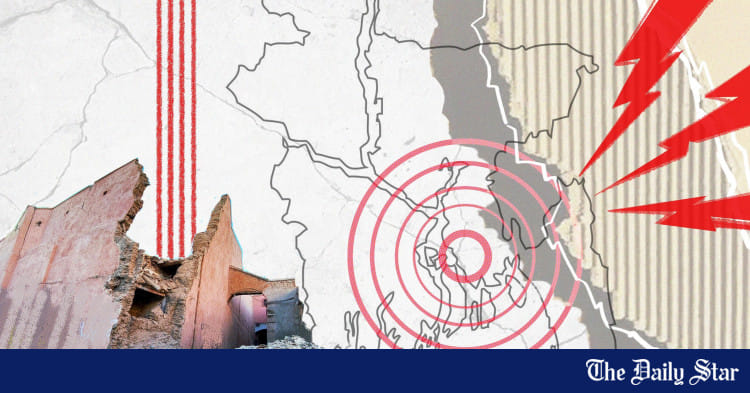
Is Bangladesh prepared for a major earthquake?

1717110642848.webp


A 5.5 magnitude earthquake on the Richter scale rattled Bangladesh on the evening of May 29, sending tremors through major cities like Dhaka, Sylhet, and Chattogram according to Bangladesh Meteorological Department. The epicentre was located roughly 439 km east in neighbouring Myanmar.

Bangladesh, a nation teeming with life, sits precariously on a geological fault line. While tremors are frequent, a powerful earthquake looms large, threatening to unleash catastrophic destruction. Are we ready to face this inevitable reality? The answer, unfortunately, is a resounding no. Despite an established vulnerability, our preparedness remains woefully inadequate.

Bangladesh's geological formation and tectonic arrangement are intricate, with the Bengal Basin being a dynamic deltaic depositional complex. The country is situated at the confluence of Indian, East Asian, and Burmese tectonic plates, with the Eurasian plate currently moving north at a speed of 2 cm per year above the Indian plate, while the Indian plate is currently moving northeast at a speed of about 6 cm per year. Along the boundary between Meghalaya and Bangladesh, there is also the 300 km Dauki fault, the 150 km long Madhupur fault, and the 300 km long Surma basin fault. Bangladesh has 13 earthquake-prone areas spread across the Bogura, Tripura, Shilong Plateau, Dauki, and Assam fault zones. Extreme risk zones include Chattogram, Chittagong Hill Tracts, and Jaintiapur of Sylhet. These areas are 100 km away from Dhaka, but a magnitude 7-8 earthquake could cause a large-scale disaster in the capital, as revealed in a study by Dhaka University and Columbia University, USA.

Over the past 485 years, Bangladesh has experienced 52 earthquakes of mild, moderate, and severe intensities within its territory, with 17 of them occurring in the last year alone, according to the earthquake observation centre of the geology department at Dhaka University. In the last12 years, eight earthquakes have been recorded in Dhaka and the surrounding areas. On February 6, 2023, a 7.8-magnitude earthquake in Turkey caused over 50,000 deaths, significant damage to around 230,000 buildings, and a financial loss of $100 billion. Unplanned urbanisation, poor construction materials, insufficient inspection processes, and illegal construction were the primary causes of the destruction. These factors are also prevalent in urban development and building construction practices in Bangladesh.​

To read the rest of the news, please click on the link above.
 
Analyze

Analyze Post

Add your ideas here:
Highlight Cite Fact Check Respond

Earth: Our only home, our responsibility

1717284948271.png

Photo : REUTERS

The fragile beauty of Earth is a poetic reminder of the intricate balance that sustains all life on our planet. From the expansive oceans to the verdant forests and majestic mountains, every facet of our natural world contributes harmoniously to the symphony of existence. The intricate ecosystems brimming with a diverse array of flora and fauna underscore the resilience and interconnectedness of all living organisms.

However, the swift pace of human activities, which are causing deforestation, pollution, and climate change, poses a severe threat to Earth's delicate beauty. It is crucial for us to acknowledge that our actions have profound consequences on this planet, and to assume responsibility for preserving and safeguarding this irreplaceable home for future generations.

Environmental conservation transcends mere moral obligation; it is an essential prerequisite for the survival of our planet and its inhabitants. The well-being of humanity is directly linked to the health of our ecosystems, encompassing clean air, water, and fertile soil for agriculture. Through the preservation of biodiversity and protection of natural habitats, we ensure that the delicate balance within our ecosystem remains undisturbed, enhancing resilience against environmental perils such as climate change.

Moreover, environmental conservation plays a pivotal role in securing the ability of future generations to flourish on Earth. By taking proactive measures to curb pollution, conserve resources, and mitigate habitat destruction now, we are investing in a sustainable future for all life forms on this planet. Each individual endeavour towards environmental conservation contributes significantly towards fostering a more symbiotic relationship between humankind and the natural world—one that prioritises reverence for the environment and ensures enduring prosperity for all living entities.

Amid mounting evidence showcasing the undeniable impacts of climate change, we must acknowledge the urgency surrounding this global crisis. Rising sea levels, extreme weather phenomena, and ecological shifts are no longer distant anticipations but tangible realities confronting us today. The accelerated pace at which environmental degradation is unfolding necessitates immediate action from individuals, communities, and nations alike.

To read the rest of the news, please click on the link above.

 
Analyze

Analyze Post

Add your ideas here:
Highlight Cite Fact Check Respond
⤵︎

Latest Posts

Latest Posts