New Tweets

[🇧🇩] Save the Rivers/Forests/Hills-----Save the Environment

G Bangladesh Defense
[🇧🇩] Save the Rivers/Forests/Hills-----Save the Environment
533
15K
More threads by Saif


Bangladesh should prioritise self-reliant climate plans: Experts
FE Online Report
Published :
Dec 05, 2024 21:28
Updated :
Dec 05, 2024 21:28

1733449443087.webp


Experts and civil society representatives Thursday emphasised the need for Bangladesh to adopt self-reliant climate plans to combat climate change effectively.

At a press conference titled “COP 29 Outcome: Bangladesh Should Focus on Self-Reliant Climate Planning” at Dhaka Reporters’ Unity, they criticised global pledges, such as the $300 billion annual commitment, as inadequate for vulnerable nations like Bangladesh.

Several civil society organisations jointly organised the conference.

Md Abul Hasan from COAST Foundation, in his keynote, said that COP 29 failed to address key demands, including bridging mitigation-adaptation financing gaps and recognising non-economic losses under Loss and Damage Financing (LDF).

He proposed focusing on independent climate strategies, revising climate plans with local resources and participatory approaches and avoiding overly ambitious NDC revisions before COP 30 in 2025.

Rezaul Karim Chowdhury from EquityBD criticised loan-dependent climate strategies, such as the Delta Plan 2030, urging the government to prioritise indigenous knowledge and self-sufficient solutions.

He also stressed the need for reducing reliance on inadequate global support and focus on sustainable, locally driven initiatives.​
 
Analyze

Analyze Post

Add your ideas here:
Highlight Cite Respond

A new vision for social protection in the face of climate change

1733552560264.webp

VISUAL: SHAIKH SULTANA JAHAN BADHON

Bangladesh is witnessing a marked increase in the frequency and intensity of climatic events, leading to substantial losses in lives, assets, and livelihoods. A recent report by The Daily Star highlighted that the country endured 15 climatic events between May 2023 and September 2024. These included four cyclones, nine floods, several episodes of heavy rainfall, and extreme temperature events like heat waves and cold waves. In response to these escalating challenges, advancing adaptive social protection (ASP) has emerged as an urgent priority, complementing ongoing climate mitigation and adaptation efforts to address the growing impacts of climate change.

ASP enhances the resilience of climate-vulnerable households by strengthening three capacities: preparing for, coping with, and adapting to climatic and other shocks. Its development is driven by several complementary factors: i) the proven success of social protection measures, particularly cash transfers, in reducing poverty and building resilience; ii) the shared objective of resilience-building across social protection, disaster risk management (DRM), and climate adaptation; iii) the increasing use of cash transfers in disaster response over the past two decades; and iv) the potential to leverage social protection mechanisms, such as beneficiary registries and digital payment systems, for rapid cash delivery to disaster-affected individuals.

Despite their complementarities, social protection, DRM and climate adaptation have distinct objectives. Social protection primarily focuses on poverty reduction, with resilience-building as a secondary outcome. However, its reliance on poverty-based indicators for beneficiary selection often excludes climate-vulnerable households who fall outside these criteria. In contrast, DRM prioritises resilience through interventions such as infrastructure development, preparedness, and disaster response. After a shock, DRM aims to restore livelihoods and help communities "bounce back" to their pre-shock state. Climate adaptation takes a broader approach, enabling communities to "bounce forward" by addressing climate vulnerabilities and fostering sustainable development through strategies like improving economic conditions, promoting human capital, and facilitating migration to safer areas. ASP leverages the complementarities among these approaches while addressing their gaps to establish a comprehensive framework for addressing the impact of climate change.

Since adopting the National Social Protection Strategy (NSSS) in 2015, Bangladesh has established a life cycle-based social protection system that addresses risks faced at different stages of life, including pregnancy, early childhood, school age, disability, and old age. Key programmes under this framework include the Mother and Child Benefit Programme (MCBP), the Primary Education Stipend Programme (PESP), the Disability Allowance programme, the Widow Allowance programme, and the Old Age Allowance Programme (OAA). These are complemented by several DRM-related schemes such as Vulnerable Group Feeding (VGF), the Employment Generation Programme for the Poor (EGPP), Food for Work, Work for Money, Test Relief, and Gratuitous Relief. Both life cycle and DRM-related programmes are well-developed, featuring extensive coverage, substantial funding, digital beneficiary registries, and mobile-based payment systems, strongly positioning Bangladesh for a transition to ASP.


Bangladesh may explore the following pathways to establish a robust ASP framework.

1733552618407.webp


First, implement universal coverage for life cycle programmes in climate-vulnerable areas. Providing ongoing and long-term cash transfers to vulnerable groups (e.g. children, persons with disabilities, widows, and the elderly) would significantly enhance their resilience. Currently, over 70 percent of deserving poor people are excluded from social protection due to a flawed selection process based on proxy poverty indicators such as housing conditions and visible assets. International evidence shows that these methods exclude 29-96 percent of eligible poor. Transitioning to universal coverage would ensure that no climate-vulnerable individual is left behind. Given the already high programme coverage, expanding to universal access in climate-vulnerable areas would be both strategic and affordable.

Second, strengthen coping and adaptive capacity through top-up cash (or in-kind) transfers. Top-up cash or in-kind transfers can be provided to beneficiaries of life cycle programmes in anticipation of or following climate shocks, using existing beneficiary lists and mobile banking-based payment systems. Funds for these top-ups can be sourced from DRM-related programmes and climate adaptation funds, without burdening social protection budget and fostering synergy among these approaches.

Third, support other vulnerable households by the DRM-related programmes. DRM schemes would deliver cash or in-kind assistance to households not covered by life cycle programmes, in anticipation of or after climate shocks.

Fourth, invest in sustainable livelihoods and graduation programmes. Climate funds can support livelihood development and graduation programmes to enhance economic resilience and adaptive capacity to enable vulnerable households to "bounce forward."

Fifth, establish institutional arrangements for ASP. Effective implementation of ASP requires robust institutional frameworks, including revised policies, updated operational guidelines, and formal agreements on financing, collaboration, and coordination mechanisms among relevant ministries and agencies.

While full-scale ASP implementation will take several years, Bangladesh is well-positioned to embark on this transformative journey. By pursuing these pathways, the country can strengthen the resilience of most vulnerable populations, enhance adaptive capacity, and establish itself as a global leader in ASP.

Fazley Elahi Mahmud is a social protection specialist, and international consultant on social protection.
 
Analyze

Analyze Post

Add your ideas here:
Highlight Cite Respond

Jamal Khan canal: A deathtrap lies waiting

1734221442508.webp

Photo: Arun Bikash Dey

Watching two kids playing on the bank of Jamal Khan canal in the port city shouldn't ring any alarm bell to anyone.

However, knowing that at least 11 people have died falling into canals in the city in the last seven years may change one's perspective.

The sight of the kids playing oblivious of the dangers becomes more alarming knowing the canal in the Hem Sen Lane area was left in a risky and unprotected state since April.

Locals say a fatal accident may occur at any time.

Yet the authorities concerned seem to bother very little to prevent accidents as canals and drains in many areas have been left open and unprotected for months.

According to locals, three buildings in the Hem Sen Lane area were built occupying the land of the Jamal Khan canal.

The Chattogram Development Authority (CDA) started an eviction drive to reclaim the canal land in the last week of January and eventually dismantled the illegal portion.

The CDA's drive is part of the mega project being implemented for addressing waterlogging in the port city.

However, locals say work in the Jamal Khan canal stopped in April.

"The CDA authorities dismantled the illegal portion of the building on the bank of the canals and postponed the work in April leaving the canal in a risky and unprotected state," said Prabir Barua, a local at Hem Sen Lane area.

"The place becomes more risky at night," said Shampa Bhattacharjee, another local, adding, "In the dark of night, anyone may fall into the canal while walking along the bank."

She said the local minor boys play here and there, adding, they are most vulnerable to accidents.

Contacted, Lt Col Ferdous Ahmed, project director of the CDA mega project, said the work in the area stopped due to some complications.

"We have to change the initial design for this area because many high-rise buildings have already been built there and none want to leave space for the canal," he said, adding that they usually do not leave any project incomplete.

Asked about the risk of accidents, he said CDA would make a fence along the bank of the canal soon.

A total of 11 people were killed and many others were injured falling into unprotected canals and drains in Chattogram since 2017.

The body of seven-year-old boy Jashim Uddin was recovered from Nasir Khal of Agrabad area in the port city on June 9.

A three-year-old baby Ojaifa was killed after falling down into an unprotected drain in the Sadarghat Nalapara area on April 9.

On December 7, 2021, a minor boy fell down into the open canal at Sholashahar Railway Station area. The body of the boy named Kamal Uddin (10) was recovered three days after he went missing.

Sheherin Mahmud Sadia (19), a student of the Computer Science Department at International Islamic University, Chattogram, died after falling into a drain at the Agrabad intersection of the city on September 27, 2021. After her death, a bamboo fence was first made to guard the drain and later replaced by a brick wall blocking the footpath.

On April 15, 2022, divers of the fire service rescued a woman from the Osmania canal in the Kalurghat area of the city.

On June 30, 2021, three people went missing after an auto rickshaw fell into a canal in the Chashma Hill area of Sholashahar. The bodies of driver Sultan (35) and passenger Khadija Begum (65) were later recovered. Both the canals are still left unprotected.

On June 9, 2018, a child named Al Amin fell into a drain in the Amin Jute Mill area of the city. Shilbrata Barua, a retired government official hailing from Hathazari upazila in Chattogram, slipped and fell into a drain while going to attend a wedding ceremony at a community centre in Bakalia on July 3, 2017.​
 
Analyze

Analyze Post

Add your ideas here:
Highlight Cite Respond

A treasure under threat of encroachment
Around 250 acres of Lawachhara National Park remain occupied

1734221693588.webp

Photo: Star

The Lawachhara National Park has long been the victim of continuous encroachment over the years. According to local environmentalists, approximately 250 acres of the park is currently occupied, mostly by various local influential figures.

At the heart of the problem lies the fact that no proper boundary was ever established for the park. Without a comprehensive survey, the process of demarcation cannot be initiated. In the 28 years since the forest was first declared a national park, no survey has been conducted and as such there is no established boundary.

Adding to the woes, the Forest Department is rarely engaged in efforts to recover occupied land within the park.

The park, rich in diverse flora and fauna, is home to various endangered and rare species of wildlife, making it a popular destination for environmentalists, wild animal lovers, and tourists. Located in Kamalganj upazila of Moulvibazar, Lawachhara National Park spans 1,250 hectares and was designated as a national park in 1996.

The park is home to 167 species of trees, 246 species of birds, 20 species of mammals, 59 species of reptiles, and 22 species of amphibians.

Surrounding the park are villages and privately owned land. This is where some some landowners have encroached onto the forest land -- planting seasonal fruit trees and even constructing homes.

The village of Baghmara, for instance, is located about three kilometres from the park. The park is currently engaged in a legal dispute that involves hundreds of residents living across 155 acres of forest land.

1734221731207.webp

Photo: Star

Shahidul Islam, Sreemangal Range Officer of the Wildlife Management and Nature Conservation Department, said, "There are public land right next to the park. However, without a survey I cannot even place a marker because the boundaries are undefined. A survey would clarify the park's borders."

On a positive note, recent efforts by the Wildlife Management and Nature Conservation Department successfully recovered six acres of land from two locations, both deep inside the park, thus needing no disputes over the boundary.

On September 22, one acre was reclaimed from an individual named Jamshed Mia in the Battali area.

Then, on September 15, around five acres were recovered from former agriculture minister Abdus Shaheed, near the National Park's student dormitory -- an attempt that had previously failed in 2018.

The Forest Department believes that further land remains under the control of various individuals, complicating additional recovery efforts.

On November 3, local Awami League leader Zenar Ahmed reportedly occupied approximately 4 acres of the Lawachhara forest.

Despite efforts to contact Zenar Ahmed, he could not be reached.

Md Shah Alam from Sreemangal upazila, claimed to have leased the land from Zenar Ahmed.

He said, "I have cultivated lemons here under a 5-year lease from Zenar Ahmed. I paid Tk 1,20,000 in advance for 2 years. The remainder will be paid as I sell the lemons, according to our lease agreement. I'm just a poor man trying to support my family through this work, and I never expected to be in this situation."

Jamil Mohammad Khan, Assistant Conservator of Forests for the Wildlife and Nature Conservation Department, said, "We have successfully recovered about 4 acres of forest land. However, we did not encounter anyone during the operation, and no one came forward to claim the land."

Nurul Muhaimin Milton, general secretary of Bangladesh Poribesh Sangbadik Samitee in Moulvibazar, said local environmental activists are calling for the forest department to reclaim the land, highlighting that 250 acres are still occupied by various parties, including a resort that should be prioritised for recovery. But the forest department has stayed silent regarding the whole issue.

According to the Wildlife Management and Nature Conservation Department, the Sylhet Divisional Office has communicated with higher authorities and the Directorate of Survey regarding the need for a survey, but no initiatives have been launched yet.

Jahangir Alam, the Sylhet Divisional Forest Officer, said, "There has never been a survey of Lawachhara. The situation remains unchanged, and conflicts have arisen over certain areas. Many occupants lack proper documentation. We only reclaim land once we are fairly certain it belongs to us. A survey is crucial, and I will continue to advocate for one. Without a survey, we cannot ascertain how much land is under illegal possession."​
 
Analyze

Analyze Post

Add your ideas here:
Highlight Cite Respond

Unabated encroachment continues

1734222668883.webp

A section of local people have continued encroachment on Basugi Khal in Barguna’s Amtali upazila. Photo: Star

An important canal in Bagruna's Amtali upazila headquarters has become badly polluted and almost dead due to mindless filling and continuous encroachments.

The century-old canal, locally known as Basugi Khal, flows through different areas of Amtali town and falls into the Payra river.

Besides, the canal, which splits into two branches at the heart of the town, flows through Basugi, Nayavanguli, Manikjhuri and New Bazar areas is also connected with another canal called Chawra Khal.

During a recent visit to the upazila headquarters this correspondent saw different structures, including dwelling houses and shops, are constructed after filling of the canal at different places, which threatens the town dwellers with environment pollution and water-logging.

Locals said a group of local influential people have continued to grab Basugi Khal (canal) at different places of the town although it plays a vital role in the lives of the residents of nearby villages.

Nearly two acres of the canal land, starting from the iron bridge area, have been completely occupied by more than 50 people, including Mosharof Howlader and Rubel Howlader, locals alleged.

One Saiful Islam has built an ice mill by occupying a portion of the canal land, while on the opposite side Mosharef, Razzak Mridha and Nurul Islam erected at least eight to ten shops and earning a handsome amount from those.

Meanwhile, at least 20 to 25 people including Harun Hawladar, Kalam Hawladar and many others have built more than 100 structures in between Amtali Upazila Health Complex and Kamal Talukdar's house and enjoying benefits.

Local farmers said alongside encroachments, the water of the canal has been badly polluted as fish traders, who sits along the banks of the canal, often throw various types of waste materials into the canal.

Gafur Pada, a local farmer, said due to continuous encroachment normal water flows of the important canal has been severely disrupted, resulting in flooding during the monsoon.

Another farmer Shamim Chaprasi said they cannot cultivate any crops including paddy in their land as the canal needs to be cleared first to maintain its natural flow.

Amtali Upazila Assistant Commissioner (Land) Tarek Hasan said they will conduct eviction drives to free the canal as early as possible.​
 
Analyze

Analyze Post

Add your ideas here:
Highlight Cite Respond

We must have breathable air
Urgent steps must be taken to address the air quality emergency

1734306472294.webp


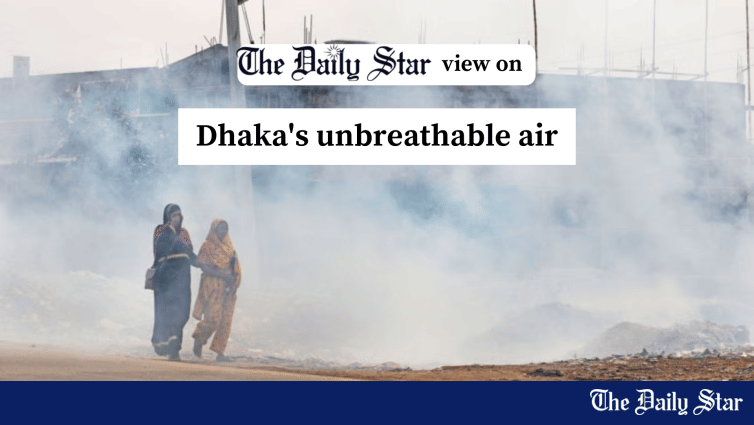
Physicians and health workers at Dhaka Shishu Hospital are struggling with a surge of child patients suffering from pneumonia. All the hospital beds are full and each day hundreds of children are treated as outdoor patients. Adults with breathing related problems are also suffering. Doctors say that air pollution is one of the main contributing factors behind cold-related diseases. As we know, Dhaka's air pollution has reached unbearable levels, recently ranking as the second highest in the world, prompting a government advisory for people to wear masks outdoors and for individuals with respiratory issues, allergies, or other vulnerabilities to avoid going out unless absolutely necessary.

According to the World Health Organization (WHO), air pollution kills an estimated seven million people worldwide every year, mainly due to increased mortality from stroke, heart disease, chronic obstructive pulmonary disease, lung cancer, and acute respiratory infections. Over the last decade, the air quality in Dhaka, as well as in towns and villages near toxic smoke-emitting industries, has deteriorated significantly. Air pollution worsens during the colder months, with a persistent smog that lingers, unlike the monsoon months when rain temporarily alleviates the issue. However, the air quality remains poor throughout the year, causing chronic respiratory problems, particularly among children and the elderly, who are more vulnerable.

Unfortunately, little has been done over the years to mitigate the factors contributing to air pollution. Dust is a major nuisance for Dhaka residents, caused by year-long infrastructure and real estate development projects. This unregulated construction has led to unprecedented levels of airborne dust. Additionally, unfit vehicles spewing noxious fumes into the air worsen the situation, especially during daily traffic gridlocks, trapping people, including children, in clouds of poisonous gases. Brick kilns, which have proliferated on the outskirts of cities, further contribute to air pollution, affecting nearby residents.

The current interim government, along with future administrations, must take responsibility for controlling or eliminating the factors that have made our air almost unbreathable. Measures include banning unfit vehicles, enforcing public safety rules during construction, and prohibiting developers from leaving piles of dust on the streets. Air quality must be monitored regularly, particularly in high-pollution areas. Implementing low-emission zones, such as pedestrian-only streets and public spaces, creating more cycling and rickshaw lanes, and facilitating pedestrian-friendly areas are additional ways to improve air quality.

In the long term, Bangladesh must phase out fossil fuels and adopt renewable energy sources. Preserving existing greenery, planting more trees, and encouraging rooftop gardening will also contribute to making the air more breathable.​
 
Analyze

Analyze Post

Add your ideas here:
Highlight Cite Respond

Stop disturbing the Sundarbans!​

Restrain traffic of ships through the forest

View attachment 4379

It is deeply concerning that on top of projects, megaprojects, illegal occupations and deforestation ravaging the Sundarbans, traffic of ships through the forest has increased dramatically in recent years. A recent report sheds light on how ships, discharging harmful fumes and sound pollution, and often carrying toxic materials through the forest, have nearly doubled in a decade—from 357 trips monthly in 2012 to 837 trips in 2022, and 701 trips monthly so far this year.

Under the first Protocol on Inland Water Transit and Trade between Bangladesh and India, signed in 1972, lighter cargo vessels can operate between the two countries using the waterways mostly through the Sundarbans. A major route for these ships goes through at least 100 km of the river system inside the mangrove forest, which takes around eight hours for the vessels to travel. While any motor vehicle, including boats and ships, is strictly prohibited from operating through the forest after sunset till sunrise, ships continue to operate 24/7 unrestrained. The customs station in Angtihara, the entry point to the forest on this route, only logs the trips of the ships and does not monitor if any laws have been broken. While the customs and immigration in India close off at night, our customs office continues to operate throughout the night.
By allowing these activities, we are now destroying the Sundarbans from the inside. The toxic fumes and loud sounds greatly impact wildlife habitats and breeding environments. The propellers disrupt the marine ecosystem, and the waves cause severe erosions. For instance, the width of rivers on this route has increased from 20-30 metres to 50-60 metres. Most of the ships on this route contain fly ash, coal, and stones from India for our riverside cement factories. In the last seven years, at least 15 such ships have capsized inside the forest, spilling these harmful materials directly into the river.

Bangladesh has now become a land of lost forestlands and dead ecosystems. We have irredeemably destroyed a number of forests and major sources of biodiversity throughout this delta, and even in the hill tracts. The Sundarbans is the last hope for any unique and great population of wildlife to survive. The government must ensure that any activity harming this forest is halted immediately, and look for an alternative route for maritime trade with India as well as consider moving major power plants and factories from the area.​
This is not the issue with only you guys. We are already facing terrible environmental challenges, including floods and recent fog breakdown in Pakistan.

This environment is just too much toxic to breath. Alas!
 
Analyze

Analyze Post

Add your ideas here:
Highlight Cite Respond
  • Imran (+5)
Reactions: Dogun18
This is not the issue with only you guys. We are already facing terrible environmental challenges, including floods and recent fog breakdown in Pakistan.

This environment is just too much toxic to breath. Alas!
Blame Trump for the climate change. He is going to torpedo the climate change deal in January. He is such a m*ron.
 
Analyze

Analyze Post

Add your ideas here:
Highlight Cite Respond

Latest Posts

Back
PKDefense - Recommended Toggle