โ˜• Support Us โ˜•
[๐Ÿ‡ง๐Ÿ‡ฉ] - Student Revolution: Lessons from Bangladesh | Page 11 | PKDefense

[๐Ÿ‡ง๐Ÿ‡ฉ] Student Revolution: Lessons from Bangladesh

Reply (Scroll)
Press space to scroll through posts
G Bangladesh Defense
[๐Ÿ‡ง๐Ÿ‡ฉ] Student Revolution: Lessons from Bangladesh
120
4K
More threads by Saif


JULY UPRISING PROCLAMATION: Political parties suggest draft committee
Staff Correspondent 17 January, 2025, 00:09

1737069974169.png

Chief adviser Muhammad Yunus holds a meeting regarding the formulation of the July proclamation with leaders of different political parties at the Foreign Service Academy in Dhaka on Thursday. | Focus Bangla photo

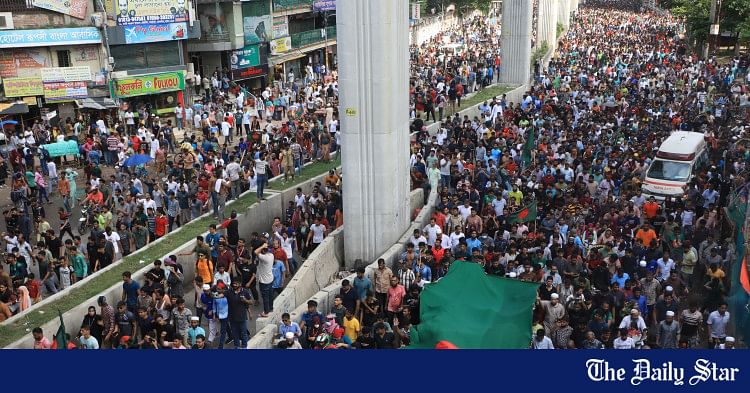
Political parties on Thursday urged the interim government to form a committee to prepare the text of the July uprising proclamation on the basis of a consensus through detailed discussion with all anti-fascist forces.

At a meeting with the chief adviser Professor Muhammad Yunus, leaders of the political parties also proposed that the government, based on the consensus, would have to decide whether it would be a proclamation or declaration and what would be its legal significance.

The government held the meeting with political parties at the Foreign Service Academy in the capital on the draft of the July uprising proclamation.

Most of the political parties and forces in favour of the July uprising, including the Bangladesh Nationalist Party, the Bangladesh Jaamat-e-Islami, the Ganatantra Mancha and the Nagorik Committee, joined the meeting.

Leaders from 14 political parties, including the Communist Party of Bangladesh, Bangladesher Samajtantrik Dal and the 12-party alliance, skipped the meeting, citing reasons such as inadequate time, lack of proper preparations, and issues with the invitation process.

Chief adviser Professor Muhammad Yunus told the meeting that the interim government would take the nation forward through unity.

He said, โ€˜...because the government was born amid unity; it was created through unity. When we work alone and see no one is beside us, we feel a bit weak. And when you all sit together, we get courage in mind that we remain united. We were born amid unity and unity is our strength.โ€™

Yunus said that the government was rejuvenated through unity.

He recalled a moment when the student leaders of the July revolution approached him, expressing their intention to make a declarationโ€”the July Proclamation.

โ€˜I tried to understand what kind of proclamation they were planning. I told them it wouldnโ€™t happen as they envisioned it,โ€™ the chief adviser said.

He advised the students to involve all stakeholders of the July revolution in the process of the preparation of the proclamation.

The chief adviser highlighted that the purpose of the meeting was to finalise the July Proclamation with collective agreement. He stated that if a consensus could not be achieved, there would be no need to announce it.

Following the meeting, BNP standing committee member Salahuddin Ahmed said that they questioned the necessity of announcing the July proclamation five months after the mass uprising.

โ€˜If there is any necessity, we must first determine the political, historical, and legal significance of the declaration so that no division can arise among the anti-fascist forces while preparing the proclamation,โ€™ he said.

If a political document becomes a historical one, the BNP certainly respects that document, Salahuddin said.

The BNP leader said that he discussed at the meeting the significant challenge of moving the nation forward through unity among the anti-fascist forces.

Jaamat secretary general Mia Golam Parwar said that they agreed about the July Proclamation and the document should be prepared based on the opinions from all the parties.

The meeting did not reach a decision on the proclamation, but it resolved to hold further discussions on the issue.

Golam Parwar stated that his party had received a draft of the proclamation from the government but they could not thoroughly review the text due to time constraints.

The meeting discussed forming a committee to prepare an initial version of the proclamation, he said.

All parties will then provide their input on the draft and ultimately, a final version will be prepared, incorporating the chronology of Bangladeshโ€™s history, the Jammat leader said.

Ganosamhati Andolan chief coordinator Zonayed Saki said that they discussed the possibility of the announcement of a declaration that would reflect the aspirations of the people and uphold the spirit of the July uprising.

The government will have to determine the nature of the announcement, whether it would be a proclamation or a declaration, and what would be its legal aspects, he said.

Saki said that the meeting decided to form a committee and the committee would prepare a declaration through discussions with all the anti-fascist forces.

At a briefing after the meeting, law adviser Asif Nazrul said that as per the discussion of the meeting further meetings on the July uprising proclamation would take place and a committee might be formed to take the work forward.

He said that all the parties agreed on the formulation of the July Uprising Proclamation and the parties suggested that in essence, everyoneโ€™s contribution should be mentioned in the declaration and it should be clarified what the political or legal nature of the declaration will be.

Asif Nazrul said that more emphasis was placed on formulating the declaration through unanimous agreement, achieved by engaging in discussions with political forces, students and the public supporting the July uprising.

โ€˜As much time as necessary can be taken for this process. However, there should be no unnecessary delays or time wastage. Everyone has agreed that such a declaration should be crafted through more intensive discussions, ensuring a consensus,โ€™ he said.

Responding to a question Asif Nazrul said that no distance was created with political parties regarding the July proclamation rather there were merely differing opinions on how this should be done.

โ€˜We see no signs of disagreement; instead, everyone has expressed that this declaration should reflect collective ownership,โ€™ he added.

Earlier on December 30, the government announced that they would prepare the July Uprising Proclamation with a consensus as the Students Against Discrimination decided to announce a proclamation of the uprising at Central Shaheed Minar in Dhaka on December 31.

Following the government announcement the student leaders turned their programme to โ€˜March for Unityโ€™ and demanded July proclamation from the government by January 15.​
 

UN fact-finding report on July-August uprising by mid-February: Volker Tรผrk
He assures full support while meeting Yunus on sidelines of WEF

1737612812829.png

Photo: Collected

UN High Commissioner for Human Rights Volker Tรผrk yesterday announced that the UN fact-finding mission report on the atrocities during the July-August uprising is in its final stages and will be released by mid-February.

The high commissioner made these remarks during a meeting with Chief Adviser Professor Muhammad Yunus on the sidelines of the World Economic Forum annual meeting in Davos, Switzerland, as reported by the press wing of the Chief Adviser's Office.

Volker Tรผrk mentioned that the report would be shared with the Bangladesh side before its publication from the UN Human Rights Office in Geneva.

Yunus expressed gratitude to the UN rights office for investigating the crimes committed during the student-led uprising. He also said that reports from six major independent commissions would be released around the same time, which could serve as complementary sources of information.

During the meeting, Yunus sought Tรผrk's support in resolving the worsening Rohingya crisis, highlighted by the recent influx of tens of thousands of refugees from Myanmar.

Tรผrk assured his full support, noting ongoing discussions with stakeholders, including UN Special Envoy on Myanmar Julie Bishop.

Yunus suggested the creation of a UN-overseen safe zone in Myanmar's Rakhine State to prevent further Rohingya displacement. He also referred to the upcoming high-level conference on the Rohingya crisis, emphasising its role in drawing global attention to one of the worst humanitarian crises.

Tรผrk agreed on the importance of the conference in restoring the international community's focus on the Rohingya issue.

The meeting was attended by Lamiya Morshed, SDG Coordinator of the Bangladesh Government, and Tareq Ariful Islam, Bangladesh's Permanent Ambassador to Geneva.​
 

July Uprising Exhibition: โ€˜Such event should be organised for next generation tooโ€™
Staff Correspondent
Dhaka
Published: 26 Jan 2025, 23: 11

1737937591325.png

People visit the July Uprising Exhibition at the National Art Gallery of the Bangladesh Shilpakala Academy in the capitalโ€™s Segun Bagicha on 26 January 2025. Prothom Alo organised the event, which will end on 31 January.DIpu Malakar

Expatriate Sajjad Hossain, from Sandwaip, Chattogram, was seen standing in the โ€˜Shaeed Cornerโ€™ set up with regular usable items of the martyrs at the July Uprising Exhibition.

He returned home from Portugal in June last year but he was unaware of many big events of the student moment as he was staying home. Eventfully, he learned everything.

Asked on his experience at the exhibition, Sajjad Hossain said he visited the event after learning about it online. โ€œI now regret that I should have brought my family too. Everyone could have learned many things. Many memorable things of the martyrs are giving me goosebumps. Prothom Alo tried to present the event as much as they could.โ€

Sadia Hasan, from the capitalโ€™s Dhamondi, studies A Level. She said, โ€œI learned the entire history in a brief as all important and informative events have been included here. Those who are at a young age, I mean such exhibitions should be held for the next generation too. They should learn how students waged the movement by giving their lives.โ€

Prothom Alo organised the July Uprising Exhibition at the National Art Gallery of the Bangladesh Shilpakala Academy in the capitalโ€™s Segun Bagicha to highlight the events of the July 2024 mass uprising.

The event featuring other arrangements will end on 31 January.

Four students of Mohammadpur Central Colleges were seen looking curiously at various photos at the event.

Asked how they feel, one of them Omar Rafi said, โ€œI saw many pictures taken before 5 August in big frames and it is a different feeling. The lesson of this movement is what students can do if they want. Visiting here, I have felt that time again.โ€

Wishing anonymity, a female student said, โ€œI thank the organisers for presenting the movement in such a way.โ€

The โ€˜Sotto Totthe July (July in true information)โ€™ part of the exhibition includes newspapers and reports; the โ€œCamerai Bidroho (Revolt in camera)โ€™ and โ€œJuly-Jagorn (July uprising)โ€™ parts features photography; the โ€˜Roktakto Smarok (Blood souvenir) part displays lethal bullets, rubber bullets, grenade pins, tear shell canisters used by police during the movement; the โ€˜Abu Sayed: Andolon O Shilper Protik (Abu Sayed: Movement and symbol of art) part features artworks on Abu Sayed by artist Shaeed Kabir, painting equipment and video on artwork makings.

Besides, online reports, interviews and videos published in Prothom Alo during the movement were being screened in two rooms.

Ahamadullah, a senior teacher, was looking at everything at the event. He told Prothom Alo, โ€œIt feels good that the timeframe of July-August has been presented well but more pictures on torture of students could be added. Perhaps, those images are not included as they are sensitive.โ€

Russian citizen Kasparov visited the exhibition in the afternoon. He said, โ€œWe mainly came to learn the culture and history of other countries. This movement was a part of your lives and we learned about it too.โ€​
 

Sarjis Alam injured in car accident

1738795605579.png


Sarjis Alam, chief organiser of Jatiya Nagorik Committee, was injured in a private car accident in Dhaka University area last night.

The accident took place in front of the British Council on Fuller Road on Dhaka University campus around 9:15pm. Later, he was taken to Dhaka Medical College Hospital (DMCH) for treatment.

Shuvo Howlader, a student of Amar Ekushey Hall of Dhaka University, brought Sarjis Alam to the hospital.

He told Prothom Alo that Sarjis Alam was driving a private car towards Bangla Motor through the Dhaka University campus. As the car approached the British Council, a child suddenly ran into its path. In an attempt to stop abruptly, the car braked hard and crashed into the road divider.

Sarjis had a cut next to his left eye. There was also a minor head injury. He was taken home after first aid.

Inspector Md Faruk, in charge of the Dhaka Medical College Hospital Police Outpost, said Sarjis received primary treatment at DMCH. The doctor said his injuries were not serious.​
 

Protesters call off demo near home adviserโ€™s residence

1738881839097.png

Photo: Screengrab from Facebook Live

Protesters called off the demo near home adviser's residence early today after assurances from the government.

Earlier, demonstrators marched towards the home adviser's residence with the intent to besiege it, protesting his alleged inaction in preventing attacks on students in Noakhali's Hatiya.

Around 12:30am, the protesters, led by Abdul Hannan Masud, chief organiser of Students Against Discrimination, left Rupayan Tower in Banglamotor for the Lt Gen (retd) Jahangir Alam Chowdhury's residence, breached police barricade and took position near Minto Road.

On Facebook live, he was seen protesting at Banglamotor with a group.

1738881887092.png

Photo: Screengrab from Facebook Live

Around 2:45am, Youth and Sports Advisers Asif Mahmud went to the spot to reassure the protesters.

Addressing the crowd, he said, "Law enforcement is better now that what it was previously. We are trying to improve law and order situation in the country. We request you to help us and law enforcers in maintaining peace."

He said he will discuss today's incident in Hatiya with the home adviser. Following this, the protesters left the spot.

Earlier last night, Masud made three Facebook posts starting from 11:00pm, calling students to join him at the protest.

In his first post, he said former MP Mohammad Ali's men have fired at students from his residence at his hometown in Hatiya.

In his second post, Masud wrote, "I am heading to the home affairs adviser's residence and will stay there from 12:30am. They will sleep while Awami League's thugs open fire on students. Those who want to join me, come."

Referring to home adviser's inaction, he said Mohammad Ali's den, full of arms, is right beside the Navy camp in Hatiya.​
 

Some forces of mass uprising now engaging in extortion: Nahid

1738969388801.png

Nahid Islam

Though the uprising initially united diverse groups with a shared goal of reform, many are now prioritising their own interests over the national interest, Information Adviser Nahid Islam today.

Nahid, a key leader of the anti-discrimination student movement during the mass uprising, gave an exclusive interview to BSS on the completion of six months of the interim government.

Talking about the current political scenario, Nahid commented on the division among the forces of the mass uprising.

Expressing frustration, he said this fragmentation had hindered progress on critical issues, particularly in terms of political unity.

"The unity that once existed has been diluted," he said, acknowledging that this lack of cohesion poses a significant challenge to the government's reform efforts.

"I do not believe unity has been entirely lost. We are continuing to engage in discussions to resolve disagreements and avoid returning to the divisive practices of the past.

"There are elements within the political sphere who are still involved in extortion, and some of the individuals who participated in the uprising are now engaged in such activities," he said.

The issue of reform versus elections has also been a contentious subject, with opposition parties, particularly the BNP calling for early elections, Nahid said adding that the government does not view reform and elections as mutually exclusive but rather as complementary objectives.

Commenting on media freedom, Islam categorically said the government has not interfered with the media's right to freely criticise its policies.

"So far, no pressure has been given on the media for criticising the government," Nahid said.

However, he pointed out that when the government supports the concept of free media, it has asked the press to be mindful when reporting on sensitive issues like banned student organisations and individuals involved in criminal activities.

Nahid, also the posts and telecommunication adviser, acknowledged that some media outlets had become targets of social pressure and protests, but he stressed that law enforcement agencies and the government has intervened to ensure their safety.

Despite these challenges, Nahid emphasised the government's unwavering commitment to fostering a free and open media environment.

"The government encourages constructive criticism and has already implemented changes based on media feedback. We welcome logical criticism, and we will continue to make adjustments to our policies," he said.

He also said that the role of the media has sometimes been compromised by political alignments in the past, with some outlets failing to maintain objectivity.

Nahid urged journalists to clarify the pressures they have faced, which, in his view, would help rebuild trust among the people.

He said the interim government is committed to fulfil people's aspirations despite different types of challenges coming up, including economic and political.

"Amidst the evolving political landscape and as a part of the mass uprising, the government remains dedicated in maintaining stability, fostering unity, and addressing pressing concerns," he told BSS.

He said, "We are committed to overcoming political challenges and creating a future that aligns with the people's wishes."

The government's journey in the last six months has been tough as it had to face both internal and external conspiracies. It had to manage more than 100 movements while facing continued political pressure and dealing with economic hardships and the broken state structure, Nahid said.

Despite obstacles, Nahid expressed confidence that with continued dialogue, cooperation, and political goodwill, the six-month-old government, could achieve the change the nation so desperately seeks.

"The road ahead will not be smooth, but with the right support, the interim government hopes to lay the foundation for a more stable and prosperous future for the country," added Nahid, also the posts and telecommunication adviser.

Nahid said a major public concern has been the government's handling of economic issues like rising prices of essentials, improving law and order, and ensuring trial of murderers.

"When we took over, the administration was in disarray. The bureaucracy and law enforcement agencies were in a state of chaos, and we had to rebuild those. It was not an easy task.

"The previous administration's practices, particularly the widespread extortion and corruption, had created long-standing problems that will not disappear overnight," Nahid said.

"The reform commissions are working to bring necessary changes to the electoral and governance systems. These reforms must be implemented before elections... Otherwise, the mistakes of the past will be repeated," he said.​
 

We must eliminate criminals from Bangladesh: Sarjis

Sarjis Alam, a key coordinator of Anti-Discrimination Student Movement, today called for a crackdown on terrorism in the country.

He emphasised that the "Clean Bangladesh Operation" should not be a brief arrest campaign.

Within the next few days, we want to see all criminals, who occasionally surface on social media and other places, behind bars," Sarjis said while addressing a rally in Gazipur.

The rally was held on Rajbari Road in Gazipur city this afternoon to protest the attack on leaders and activists of the organisation last night.

Fifteen people were injured in Gazipur yesterday when locals confronted a group of protesters who tried to vandalise the ancestral home of former Liberation War Affairs Minister AKM Mozammel Haque.

He demanded arrest of those involved in last night's attack.

"The home ministry has already informed us that 16 individuals have been arrested. We are awaiting a press briefing from the ministry on the overall situation today. We no longer believe in promises; we want to see implementation. We will remain here, monitoring the administration's actions until our demands are met and the terrorists are imprisoned," Sarjis declared.

Sarjis also said if someone tries to lay a hand on any of their comrades anywhere, the entire Bangladesh will wake up again.

"If they break our barrier of patience, you will see a new revolution in Bangladesh," he said.​
 

เฆ—เฆพเฆœเง€เฆชเงเฆฐเง‡ เฆฌเงˆเฆทเฆฎเงเฆฏเฆฌเฆฟเฆฐเง‹เฆงเง€ เฆ›เฆพเฆคเงเฆฐเฆฆเง‡เฆฐ เฆธเฆฎเฆพเฆฌเง‡เฆถ เฆฅเง‡เฆ•เง‡ เฆ†เฆ“เงŸเฆพเฆฎเง€ เฆฒเง€เฆ— เฆจเง‡เฆคเฆพเฆฆเง‡เฆฐ เฆธเฆฎเงเฆชเฆคเงเฆคเฆฟ เฆœเฆฌเงเฆฆ เฆ•เฆฐเฆพเฆฐ เฆฆเฆพเฆฌเฆฟ


A revolution betrayed?
10 February, 2025, 00:00

The stakes are high, and the world is watching. The interim government has the opportunity to set an example for other nations struggling against authoritarianism, writes HM Nazmul Alam

SIX months ago, Bangladesh witnessed a historic transition โ€” the fall of the Awami Leagueโ€™s 16-year autocratic rule through the July revolution of 2024 and the formation of an interim government. The expectations from this government were immense, shaped by the sacrifices of the people who braved bullets, repression, and state-sponsored violence to restore democracy. However, as we cross the six-month mark, the pressing question remains: has this government met the aspirations of the people, or are we witnessing another cycle of stagnation and betrayal?

To understand this moment, we must look at history, literature, and even modern pop culture. Just as George Orwellโ€™s Animal Farm warned that revolutions often replace one ruling class with another, we must ask: Is Bangladesh heading towards a similar fate? Are the promises of justice, reform, and change being diluted under the weight of bureaucracy, internal compromises, and self-interest? The answers to these questions will determine whether the July revolution will be remembered as a turning point or a tragic repetition of history.

One of the primary demands of the mass uprising was the exemplary punishment of those responsible for the genocide, crimes against humanity, enforced disappearances, murders, and widespread corruption of the past 16 years. Yet, six months later, the trial process remains sluggish. The absence of meaningful legal proceedings against the perpetrators raises a critical question: Is justice being deliberately delayed?

History offers stark warnings. After the fall of Nazi Germany, the Nuremberg Trials swiftly ensured that those responsible faced justice. In contrast, after the fall of Saddam Husseinโ€™s Baโ€™ath Party, Iraq struggled with delayed and inconsistent justice, leading to further instability. Bangladesh must decide whether it wishes to follow the path of decisive justice or risk letting impunity embolden those waiting to sabotage the democratic transition.

Moreover, justice must not be selective. There are concerns that some individuals with political connections are escaping scrutiny while only a few scapegoats are being prosecuted. The people of Bangladesh deserve a transparent and fair judicial process, not a compromised version of justice that shields powerful elites. The interim government must ensure that justice is blind and that no one, regardless of their political or economic influence, is above the law.

Hundreds of top Awami League leaders have reportedly fled the country, while many of their accomplices continue to thrive under the interim government. This situation echoes the post-revolutionary chaos seen in series like Narcos: Mexico, where drug lords slipped through the cracks due to corruption within the very institutions meant to capture them. Similarly, are elements within our state apparatus facilitating the escape of the very criminals the people fought to hold accountable?

The interim government must address these allegations immediately. If the revolution was meant to cleanse the system, why do we see the same players being promoted instead of purged? This contradiction not only weakens faith in the interim government but also raises suspicions of an inside game. The people of Bangladesh did not risk their lives for a mere reshuffling of power; they demanded a complete overhaul of the system.

A disturbing trend over the last six months is the deterioration of law and order. The interim government, instead of restoring stability, appears either incapable or unwilling to counter growing unrest. The phenomenon of vigilante justice, unchecked criminal activity, and an overall sense of lawlessness remind us of Gotham City in The Dark Knight Rises, where chaos prevails when institutions fail.

One must ask: Who benefits from this lawlessness? Is it a deliberate attempt by elements of the old regime to discredit the interim government? Or is it a consequence of administrative incompetence? Whatever the case, the interim administration must act decisively before anarchy becomes the new normal. The government must prioritise rebuilding trust in law enforcement agencies and ensuring that they are free from political interference.

One of the most frustrating aspects of the interim governmentโ€™s tenure is the unchecked rise in commodity prices, VAT increases, and economic uncertainty. The fall of the oligarchic syndicates should have led to economic relief, but instead, the cost of living continues to soar. The middle and lower classes, who were the backbone of the revolution, are now bearing the brunt of this economic crisis.

In The Hunger Games, the overthrow of President Snow was supposed to bring freedom, but District 13โ€™s leadership failed to deliver the prosperity people expected. Bangladesh is at a similar crossroads. If economic hardship continues, public disillusionment could lead to dangerous consequences, including a rejection of the very government that promised change.

The government must take bold measures to regulate market syndicates, curb inflation, and ensure fair wages. The suffering of the middle and lower classes must be addressed before frustration boils over into widespread unrest. Economic reforms must be prioritised to ensure that the benefits of the revolution are felt by all, not just a privileged few.

Despite the sacrifices made during the mass uprising, a complete list of martyrs and proper rehabilitation for the injured remain unfulfilled. Revolutions, when successful, honour their heroes. The United States built memorials for fallen soldiers after its independence. France honoured its revolutionaries. Why, then, is Bangladesh failing to recognise and support those who bled for democracy?

A government born from a peopleโ€™s movement cannot afford to forget its roots. The lack of progress in acknowledging and compensating the victims of state brutality risks alienating those who fought for change, turning revolutionaries into disillusioned sceptics. The interim government must ensure that the sacrifices of the people are not in vain and that their contributions are remembered and honoured.

The interim government must ensure that justice is ensured in all cases and that propaganda does not replace due process. The people of Bangladesh deserve transparency and accountability, not a government that manipulates the truth to serve its own interests. The media, civil society, and the international community must play a proactive role in holding the interim government accountable. The revolution was fought for democracy, not for another form of authoritarianism disguised as a transitional government.

What we have gained so far is a government that is not a dictatorship, but what we have not gained is meaningful justice, economic relief, or institutional reforms. If the interim government does not act decisively in the next six months, the very revolution that brought it to power could turn against it. The people did not risk their lives for a mere change in leadership; they demanded systemic change.

If the interim government fails to uphold democratic values, enforce justice, and ease the economic burden, it will become just another chapter in the cycle of betrayal. The people of Bangladesh deserve more than that. The time for hesitation is over โ€” the time for action is now. The July revolution was a beacon of hope for millions; it must not be allowed to fade into another tale of unfulfilled promises and broken dreams.

The stakes are high, and the world is watching. Bangladesh has the opportunity to set an example for other nations struggling against authoritarianism. But to do so, it must ensure that the revolution is not betrayed from within. The people of Bangladesh did not risk their lives for a mere change in leadership; they demanded systemic change. The interim government must deliver on that promise or risk being remembered as another failed experiment in the long struggle for democracy.

HM Nazmul Alam is a lecturer in English and modern languages at the International University of Business, Agriculture and Technology.​
 

July uprising: Disputes over credit now out on social media

The July uprising activists have lately been embroiled in a virtual battle over credit for their achievements, amid disputes about the member secretary position in a political party they are about to launch.

Former Islami Chhatra Shibir leaders have taken to Facebook to claim they were "major stakeholders" in the uprising that led to the ouster of the Sheikh Hasina regime on August 5 last year.

However, leaders of the now-dissolved Ganatantrik Chhatra Shakti maintain that Shibir leaders and activists participated like everyone else.

Many former and current Shibir leaders described on Facebook how they provided shelter to coordinators of the anti-discrimination student movement; coordinated domestic and international communications; planned the protests; and mobilised activists on the ground.

In response, Abdul Kader, a former coordinator of Students Against Discrimination, wrote that the coordinators were the ones who formulated the nine-point demand, and Shibir merely disseminated it.

Asif Mahmud, a key organiser of the July uprising and adviser to the ministries of youth and sports, and local government, also weighed in.

"... Do not distort the history of the July uprising. We will not tolerate any lies about the July uprising, which was achieved through the blood of this generation. Even if I remain silent on everything else, I cannot remain silent on this. Stop the dirty game of hijacking history," he wrote.

Amid tussles on social media over the issue, Shibir President Jahidul Islam in a statement said, "It is essential to know the true history. Those trying to disrupt national unity by taking credit and creating opportunities for third parties will not be forgiven by future generations."

Md Abu Shadik Kayem, who was the president of Shibir's Dhaka University unit during the uprising and also a key coordinator of the Students Against Discrimination, wrote, "Instead of focusing on important tasks, the current bickering over who will be at the centre of power is akin to mocking the martyrs."

Chhatra Shakti, a student organisation formed in October 2023, and Shibir, which was not active publicly, worked as the coordinators of the Students Against Discrimination platform that spearheaded the uprising.

Another platform called the Jatiya Nagorik Committee was formed on September 8 last year, comprising leaders and activists from various organisations that were involved in the movement.

The 188-member central committee of the Nagorik Committee includes leaders from Chhatra Shakti, at least three former presidents of Shibir's Dhaka University unit, representatives from Qawmi madrasa-based organisations, Chhatra Odhikar Parishad, the AB Party, Chhatra Union, and Chhatra Federation.

Students Against Discrimination and its civic platform the Nagorik Committee are expected to announce a new political party by the end of this month.

The citizens' platform, meanwhile, is split into at least three groups over the top posts of the new party's convening committee, said insiders.

Adviser Nahid Islam is almost certain to be the convener of the new party while discord has surfaced over the member secretary post.

Sources within the Nagorik Committee say that Adviser Mahfuj Alam wants Nagorik Committee Convener Nasiruddin Patwary to be in the top leadership of the new party.

On the other hand, the former Shibir activists on the platform want Ali Ahsan Zonaed, former president of Shibir's DU unit and member of Nagorik Committee's executive body, into the second-in-command position of the new party.

Sources said that the key policymakers are mulling creating a senior joint convener and senior member secretary post to accommodate former Shibir leaders and avoid a potential split.​
 

Members Online

No members online now.

Latest Posts

Latest Posts