โ˜• Support Us โ˜•
[๐Ÿ‡ง๐Ÿ‡ฉ] - Trump's Victory/Tariff/ Bangladesh | Page 14 | PKDefense

[๐Ÿ‡ง๐Ÿ‡ฉ] Trump's Victory/Tariff/ Bangladesh

Reply (Scroll)
Press space to scroll through posts
G Bangladesh Defense
[๐Ÿ‡ง๐Ÿ‡ฉ] Trump's Victory/Tariff/ Bangladesh
205
6K
More threads by Saif


US sends list of items, seeking zero duty

1752454497922.png

Photo: Collected

The US has demanded zero duty facility for a large number of its products from Bangladesh.

Commerce Secretary Mahbubur Rahman said the United States Trade Representative (USTR) sent a list of these products to him yesterday via email.

He spoke to The Daily Star over the phone last night upon his return from the US after participating in the talks in Washington, DC. Commerce Adviser Sk Bashir Uddin also returned to Dhaka after the talks with the chief trade negotiation body of the American government.

"Both the countries have agreed on almost all the issues, except a few things during the negotiations with the USTR in Washington, DC," he said.

Speaking about the products for which the US demanded the zero duty facility, Mahbubur could not specify a number immediately but said the list is "very long".

He said Bangladesh has already been providing zero duty benefit to many American goods over many years. For instance, the import of cotton, wheat, soybean seeds and oil and other agricultural products from the US is free of duty.

But adding more products to the list does not solely depend on the commerce ministry, so a meeting will be held next Saturday to take the opinions of the other ministries, Mahbubur said.

Later, Bangladesh will hold another important meeting with the US to finalise the tariff rate before the 35 percent announced by Trump takes effect on August 1.

During the talks in the US, Bangladesh requested tariff rates between 10 percent and 20 percent. The next meeting is also scheduled to take place in Washington, DC.

After Trump announced reciprocal tariffs on April 2, Bangladesh offered zero duty facility for many American goods and also promised to increase import volume of products such as aircraft, LNG, cotton, wheat, soybean and other agricultural products.

The US is the single largest export destination for Bangladesh, which shipped goods worth more than $8 billion to the US and imported $2 billion American products last year.

FRAMEWORK DEAL

Power and Energy Adviser Fouzul Kabir Khan yesterday said that before engaging in further talks on tariff and non-tariff issues, the US is first looking to sign a framework agreement with Bangladesh, which would include a range of matters, including its security concerns.

The adviser said the tariff talks with the US extended beyond the scope of trade negotiations.

"Not just tariffs, there have been discussions on non-tariff barriers as well. They [the US] are prioritising their national security," Fouzul told reporters at a press conference on NBR reforms at the energy ministry.

According to him, the US was assessing how Bangladesh interacts bilaterally with other countries. "A framework is being worked out in this regard, and​
 

Second round of tariff talks with US โ€˜encouragingโ€™: Sk Bashir

Published :
Jul 14, 2025 21:05
Updated :
Jul 14, 2025 21:05

1752534103704.png


Commerce Adviser Sk Bashir Uddin on Monday described the second round of tariff policy discussions between Bangladesh and the United States as โ€˜encouragingโ€™.

โ€œWe returned from the US yesterday (Sunday) after concluding the second round of talks. Today, we briefed our stakeholders on various aspects of the discussions,โ€ he told reporters following a meeting at the Ministry of Commerce.

Sk Bashir shared insights into the draft Reciprocal Tariff Agreement currently under negotiation between the two countries and confirmed that preparations are already underway for the third round of discussions, reports UNB.

โ€œWe are preparing to visit the United States again this month. Weโ€™re hopeful of a positive outcome,โ€ he said.

Referring to the latest round of talks held in Washington, the adviser said, โ€œThe discussions were quite engaging and overall encouraging. I also had a meeting with the US Secretary of Commerce. We interacted with 35 to 40 people directly involved in the negotiations from their side. A number of useful suggestions came out of those engagements. Weโ€™re optimistic that through this dialogue, the US will agree to a rational tariff rate for our exports.โ€

He said Bangladesh has maintained a strong presence in the US market for nearly a decade.

โ€œWe have been doing business in the US since 2015, paying tariffs. Our enterprises rely on their own capabilities. As long as thereโ€™s no discriminatory treatment, our businesses will continue to perform successfully,โ€ Sk Bashir said.

When asked what Bangladesh considers a โ€˜rational tariff rateโ€™, he responded simply, โ€˜zeroโ€™.​
 

US tariff challenge and BD's exports

Syed Fattahul Alim
Published :
Jul 14, 2025 23:11
Updated :
Jul 14, 2025 23:11

1752535119047.png


Industry leaders in the Readymade Garment (RMG) sector should have been elated by the fact that in the last financial year (FY2024-25), export of their products to the USA registered a sharp rise by 14 per cent compared to the previous fiscal (FY24). But at the moment, they may not be in the mood to rejoice at the latest development. The reason is, the tariff talks with the USA, the single biggest market for Bangladeshi woven garment products, have not produced any positive results so far. Notably, the Trump administration, in addition to the existing 15 per cent, has imposed another 35 per cent as reciprocal tariff on Bangladesh's exports to the USA. Now it is also demanding a 40 per cent local value addition to our RMG products to qualify for 'Made-in-Bangladesh' label. But this condition, if not relaxed, is going to deal a heavy blow to the woven garment's export to the US market. Bangladesh's trade delegation in Washington, D.C. has been holding negotiations with the Office of the US Trade Representative (USTR) seeking relaxation of the Rules of Origin (RoO) requirement related to the condition of 40 per cent local value addition. The problem with this particular requirement is that 70 per cent of the fabric for the woven sector is imported from China. Obviously, that is a big issue for Washington, as it is at the moment in a trade war with China. The Trump administration's policy is to reduce global value chain's reliance on Chinese raw materials. According to the Export Promotion Bureau (EPB), in the fiscal year 2024-25, Bangladesh exported RMG products worth USD7.54 billion to the US market. It marked a substantial volume of apparel goods shipment to that country. So, it is not hard to understand the challenge Bangladesh is now faced with. And of that US bound apparel goods, woven garment was the dominant component. To reduce Bangladesh's dependence on China-origin fabric for its woven sector, domestic capacity is required to be developed for meeting the US's condition of local value addition. Since developing the necessary backward linkages to produce the fabric (for woven garment) domestically, Bangladesh would be hard put to meet USTR's RoO requirements. Since Bangladesh-US tariff talks have also their geopolitical dimensions, the team conducting the negotiations led by commerce adviser Sk Bashiruddin may require additional diplomatic support.

It is worthwhile to note here that according to a Bloomberg report, India, which is also holding tariff talks with the USA might win a below 20 per cent reduction in the proposed tariff, which will be lower than what Vietnam has secured (20 per cent tariff) from the USA. In that case, Bangladesh risks losing its competitive edge vis-a-vis its regional competitors.

Unless the tariff is reduced, or the RoO is relaxed, the high US tariffs on Bangladesh-origin RMG products will make those very expensive leading US retailers to look for alternative sources like India or Pakistan whose products would be cheaper due lower rate of US tariff imposed on them. According to industry insiders, some importers of our RMG products in the USA, have already put their purchase orders on hold. Suppliers to the Walmart, too, are learnt to have suspended some orders from Bangladeshi manufacturers. These are definitely not a good omen for Bangladesh's exports to the US market. Meanwhile, some quarters including the international media have been portraying a bleak future for Bangladesh's RMG sector. There are also reports of how the garment workers are now in fear of losing their jobs.

No doubt US market is important for Bangladesh. But that is not the end of the world.

In the circumstances, Bangladesh should continue its tariff negotiations with the USA. At the same time, the search should be on to look for alternative markets for Bangladesh's RMG exports. It is also time the country intensified its efforts to further widen and diversify its export basket.​
 

Bangladesh to further negotiate US tariff: Commerce secretary
Special Correspondent Dhaka
Updated: 14 Jul 2025, 18: 27

1752537837023.png

Commerce adviser Sk Bashir Uddin also attended a meeting with the countryโ€™s business leaders and economists at the commerce ministry on Monday. Collected

Commerce secretary Mahbubur Rahman said that Bangladesh has sought time from the US to negotiate the tariff issue further.

He made these remarks while addressing a press briefing at the conference room of the commerce ministry on Monday.

The briefing was organised on his recent official visit to Washington, DC, for three-day negotiations on Bangladesh-US tariff.

The commerce secretary in his welcome speech said, "We have return to Bangladesh from the US on Sunday after the negotiations on tariff. We have sought time for negotiations for the 3rd phase and we are still exchanging views through e-mail."

Mahbubur Rahman said, "We have held a meeting with business leaders and economists. We have got advice from them. We hope we will be able to reach a positive decision by 1 August."

"We know that US tariff will have a negative impact on our export. So We are working with utmost priority," he added.

Commerce adviser Sk Bashir Uddin also attended the meeting with the countryโ€™s business leaders and economists.

Mahmud Hasan Khan Babu, president of Bangladesh Garment Manufacturers and Exporters Association (BGMEA); Mohammad Hatem, president of Bangladesh Knitwear Manufacturers and Exporters Association (BKMEA); Anwar-ul Alam Chowdhury Parvez, president of Bangladesh Chamber of Industries; Syed Nasim Manzur, managing director of Apex Footwear; Selim Raihan, executive director of South Asian Network on Economic Modelling (SANEM); M Masrur Reaz, chairman of Policy Exchange Bangladesh; and Mohammad Abdur Razzaque, chairman of RAPID, were present at the meeting. Besides additional secretary Nazneen Kauser Chowdhury was also present.

Earlier, the second round of tariff negotiations between Bangladesh and the US concluded in Washington DC on 11 July 2025, with several issues still unresolved.

On 8 July, US President Donald Trump announced a 35 per cent reciprocal tariff on Bangladeshi goods, which is set to come into effect from 1 August, sparking concern among Bangladeshi exporters with active trade links to the US.

Data from National Board of Revenue (NBR) shows 2,377 companies exported 1-100 per cent of their products to the US during the 2024โ€“25 fiscal.

Among them, 801 companies sent more than 50 per cent of their total exports to the US, making them particularly vulnerable due to their overreliance on a single market.

US total goods trade with Bangladesh was an estimated $10.6 billion in 2024. US goods exports to Bangladesh in 2024 were $2.2 billion, down 1.5 per cent ($34.0 million) from 2023.

US goods imports from Bangladesh totalled $8.4 billion in 2024, up 1.1 per cent ($89.3 million) from 2023. The US goods trade deficit with Bangladesh was $6.2 billion in 2024, a 2 per cent increase ($123.2 million) over 2023, according to the Office of the United States Trade Representative (USTR).

For Bangladesh, export of ready-made garments to US alone accounted USD 7.59 billion in last fiscal.​
 

BNP pledges support to government on US tariff challenges, business leaders warn of market losses

Published :
Jul 15, 2025 22:10
Updated :
Jul 15, 2025 22:10

1752622844788.png


Senior BNP leader Amir Khosru Mahmud Chowdhury on Tuesday said that his party will offer coordinated cooperation to the government on US tariff and security issues, to help address the tariffs imposed by the United States.

Chowdhury made the remarks during a briefing to journalists at a hotel in Banani, following an exchange of views with business leaders concerning the US tariffs, UNB reports.

The BNP Standing Committee member emphasized that the livelihoods of 15- 16 lakh people are linked to exports to the US market, so the tariff issue is a serious matter for Bangladesh.

Khosru said business leaders fear that the recent US tariff impositions will severely impact Bangladesh's trade and commerce.

Therefore, the BNP is prepared to cooperate with the government in the ongoing tariff discussions with the United States, aiming to achieve a pragmatic solution for Bangladesh.

In response to a question, Amir Khosru pointed out that India and Vietnam are Bangladesh's direct competitors in the international garment export market.

If Bangladesh fails to reach a solution regarding the tariffs, these competitor countries will gain a significant advantage in exporting to the US, causing great concern among local exporters.

He warned that Bangladesh cannot afford to bear the risk of millions of job losses, the closure of industrial factories, and thousands of backward linkage industries due to unresolved tariff issues.

BGMEA President Mahmud Hasan Khan, BKMEA President Mohammad Hatem, former President of FBCCI AK Azad, Chairman of Apex Tannery Ltd

Syed Nasim Monzur, Chairman of Bangladesh Chamber of Industries (B I) Anwar-ul-Alam Chowdhury Parvez, Chairman of Prank RFL Group Ahsan Khan Chowdhury, among others joined in the meeting.​
 

Facing an uphill battle over Trump tariffs

Wasi Ahmed
Published :
Jul 15, 2025 22:56
Updated :
Jul 15, 2025 22:56

1752623140523.png


In the light of the latest US tariff salvo on Bangladesh exports, questions are being raised over what Bangladesh can realistically offer to lower the steep duties imposed by the Trump administration. Although US officials have said that negotiation channels remain open for discussions on reciprocal tariff parity, prospects of a significant turnaround appear slim, under the circumstances.

Following the imposition of a 37 per cent reciprocal tariff on April 3, Bangladesh proposed to lower import duties on a range of US-origin products. However, the move evidently fell short of meeting the Trump administration's expectations. A subsequent revision of the proposed sectoral tariff to 35 per cent also failed to shift the dynamics. For Bangladeshi exporters, who already face around 15 per cent tariff when shipping to the US -- the country's largest export destination-the newly announced 35 per cent surcharge would take the total duty to 50-51 per cent, effective from August.

Finance Adviser Dr. Salehuddin Ahmed, speaking to the press following the announcement, stated that the proposed 35 per cent tariff was not yet final and that a resolution could still be achieved through direct bilateral negotiations. Meanwhile, the Commerce Adviser, who led a small delegation for talks with the USTR earlier this week, informed the media yesterday that some time had been secured from the U.S. side to work towards a mutually acceptable position. It remains to be seen what strategic options Bangladesh has at its disposal to steer the situation in its favour.

What has complicated matters is the comparative advantage granted to Vietnam -- a key competitor in the garment sector -- which has secured a flat 20 per cent tariff on its exports to the US. This gives Vietnam a pronounced edge over Bangladesh in the American market. The trade imbalance between Bangladesh and the US currently stands at approximately $6.2 billion, while Vietnam's trade surplus with the US is a staggering $125 billion. Yet, Washington has agreed to a favourable deal with Hanoi. One likely reason is the US-Vietnam agreement that pairs the 20 per cent tariff on garments with zero-duty access for American goods into Vietnam. Additionally, while transshipment of Chinese goods through Vietnam would attract a 40 per cent tariff, this still undercuts the rates Bangladesh might face if negotiations collapse.

Other countries such as Indonesia and South Africa also appear to have struck more favourable terms than Bangladesh. Among the 14 countries listed in the latest US tariff announcements, only four are in a weaker position. Some observers argue that Bangladesh government squandered the three-month window following the initial April announcement to negotiate a better outcome. Professor Mustafizur Rahman, distinguished fellow at the Centre for Policy Dialogue (CPD), has voiced disappointment, noting that although Bangladesh was the first to begin discussions with the USTR, the outcome has been disappointing. He pointed out that negotiations have only managed a 2-percentage point reduction in the additional tariff -- an outcome that could severely damage export competitiveness.

This raises a critical question: what, if anything, can Bangladesh offer to further reduce the tariff to a more reasonable level? If, as speculated, the US is seeking to increase its exports of aircraft, cotton, food grains, LNG, and military hardware to Bangladesh in a bid to bridge the trade gap, is Dhaka prepared to respond affirmatively or take steps in that direction?

In 2024, Bangladesh exported about $8.4 billion worth of goods to the US, of which $7.34 billion came from the readymade garment sector. On the other hand, US exports to Bangladesh stood at just $2.2 billion, leaving a trade gap of $6.2 billion. Would a pledge from Bangladesh to import more American goods suffice? Could the government consider granting zero-tariff access to US exports across the board?

The Vietnam deal is attractive on paper. But the fact remains Vietnam cannot meet the total demand for garments in the US. Bangladesh, unlike Vietnam, has pursued negotiations under a multilateral framework, hoping to secure lower duties based on WTO's Most Favoured Nation (MFN) principles. However, the US appears more inclined towards bilateral deals that blend trade considerations with strategic partnerships.

If the worst-case scenario unfolds and Bangladesh is subjected to an effective tariff rate exceeding 50 per cent, many suppliers -- who currently export between 40 and 80 per cent of their output to the US -- could be pushed to the brink. With profit margins in the apparel industry already wafer-thin and operational costs steadily rising, such a tariff hike would make it increasingly difficult for many exporters to sustain their businesses. At the current 15 per cent rate, the apparel sector already pays over $1.0 billion annually in tariffs. A hike to more than 50 per cent could result in significantly higher losses -- not just for Bangladeshi exporters, but also for US brands and consumers. Higher costs at the retail end could trigger inflationary pressures and supply chain disruptions.

It is important to recognise that this is not just a trade negotiation -- it is entangled with geopolitics. The limited political engagement between Dhaka and Washington may be working against Bangladesh's interests. Without closer ties to the Trump administration's core political constituencies, trade negotiations alone may not suffice. Bangladesh must urgently recalibrate its strategy. This includes leveraging US-based lobby groups, engaging American retailers, and reaching out to sourcing associations who rely on Bangladeshi goods. Business diplomacy needs to work in tandem with traditional diplomacy to navigate this complex situation.

At a time when global trade dynamics are shifting and geopolitical alliances are reshaping trade policies, Bangladesh cannot afford to be reactive. The stakes are high, and the time to act decisively is now.​
 

Trumpโ€™s tariff
Bangladeshโ€™s 801 export-oriented enterprises at high risk


Masud MiladChattogram
Published: 09 Jul 2025, 12: 27

1752626588380.png

Containers at Chittagong Port Prothom Alo file photo

More than 800 Bangladeshi export-oriented enterprises may face a significant amount of risk following the United Statesโ€™ announcement of reciprocal tariffs on goods produced in Bangladesh. Exporters warn that unless the additional tariffs are negotiated and reduced, exports to the US could face serious setbacks.

US President Donald Trump on Monday announced a 35 per cent reciprocal tariff on Bangladeshi goods, which is set to come into effect from 1 August. This declaration has sparked concern among more than 2,000 Bangladeshi exporters with active trade links to the US.

Many of those firms also export to other countries. However, a number of them rely solely on the US market for their shipments.

An analysis of data from the National Board of Revenue (NBR) reveals that as many as 2,377 companies exported 1-100 per cent of their products to the US during the 2024โ€“25 fiscal year. Among them, 801 companies sent more than 50 per cent of their total exports to the US, making them particularly vulnerable due to their overreliance on a single market.

Collectively, those 801 companies exported USD 6.62 billion (662 crore) worth of goods globally last fiscal year. Of which USD 5.05 billion (505 crore), or 58 per cent, of Bangladeshโ€™s total exports went to the US.

Bangladeshi goods are already subject to tariffs 10โ€“15 per cent higher than those from competing countries. This effectively means we are going to lose the US market. Buyers from the US are also already worried.

Mohammad Abdus Salam, managing director of Chattogram-based Asian & DAF Group
In total, Bangladesh exported goods worth USD 8.76 billion (876 crore) to the United States in the last fiscal year, including USD 7.59 billion (759 crore) in ready-made garments alone.

Garment sector faces the greatest threat

Chattogram-based Fortune Apparels, located in Nasirabad, exported garments worth USD 33.7 million (3.37 crore) last fiscal year, all of that was to the United States. Fortune Apparels is a sister concern of the Asian & DAF Group.

Speaking to Prothom Alo, Mohammad Abdus Salam, managing director of the group, said Bangladeshi goods are already subject to tariffs 10โ€“15 per cent higher than those from competing countries. This effectively means we are going to lose the US market. Buyers from the US are also already worried. โ€œIf the tariffs arenโ€™t reduced, they will move their sourcing elsewhere.โ€

Fortune Apparels is one of 168 companies that export exclusively to the US. If the new tariff takes effect, these firms could face existential threats, industry leaders warn.

Even companies that export the majority of their products to the US are also in a precarious position. One such firm is Independent Apparels, also based in Nasirabad of Chattogram. In the last fiscal year, 89 per cent of its exports were destined for the US.

Aside from garments, Bangladesh exports footwear, headgear, tents, bags, furniture, and food products to the US. Of the exporting companies, 176 were entirely dependent on the US market last fiscal year.

Speaking about this, Independent Apparels Ltd. managing director SM Abu Tayeb said, โ€œWeโ€™ve been working with US buyers for nearly three decades. Retail giants like Walmart have put their trust in us. But if we must pay an additional 35 per cent on top of the existing 15 per cent tariff, totalling 50 per cent, then US buyers will no longer be interested in sourcing from Bangladesh. Weโ€™re looking to the 9 July bilateral meeting with the US (for a solution).โ€

BGMEA (Bangladesh Garment Manufacturers and Exporters Association) first vice-president Selim Rahman observed that there could be risks in the alternative markets to the US.

He noted, โ€œEnterprises heavily dependent on US exports are at serious risk. If exports to the US are disrupted, everyone will flock to alternative markets. This situation will make the alternative markets highly competitive. Exporters wonโ€™t receive fair prices.โ€

Other sectors also under threat

Aside from garments, Bangladesh exports footwear, headgear, tents, bags, furniture, and food products to the US. Of the exporting companies, 176 were entirely dependent on the US market last fiscal year. Among 703 exporters, 319 companies sent more than 50 per cent of their goods exclusively to the US.

Masud Agro Processing Food Products Ltd., located in Karnaphuli, Chattogram, is one such company. Its managing director Ashraf Hossain said, โ€œWeโ€™ve been exporting frozen food and other items to the US for 13 years. When reciprocal tariffs were first announced three months ago, our US buyers temporarily suspended orders. Now, Trumpโ€™s latest declaration has reignited that uncertainty.โ€

Bangladeshโ€™s exports to the US had been steadily increasing in recent years. Economists and researchers now warn that reciprocal tariffs could halt that momentum.

However, they also emphasised that there is still room for negotiation. If Bangladesh can engage in effective diplomacy and reduce the additional tariffs, especially in comparison to competitor countries, it may not only preserve but also expand its presence in the US market.

On the other hand, they maintained, if Bangladeshi products continue to face higher tariffs than those from rival exporters, the country could gradually lose access to the US market. This may have far-reaching implications for the national economy.​
 

Strategies we can employ in tariff talks with the US

1752628670578.png

Since the US has imposed only 20 percent tariffs on Vietnamese goods, naturally, Bangladesh may lose a large part of the US RMG market to Vietnam. VISUAL: MAHIYA TABASSUM

The United States has announced that as of August 1, 2025, it will impose an additional tariff of 35 percent on goods imported from Bangladesh. The US President Donald Trump has communicated this decision in a letter to the chief adviser of the interim government, Prof Muhammad Yunus. This happened while the Bangladesh-US tariff negotiations were still on. The letter hinted that if Bangladesh further opens up its markets to US goods and services by removing tariff and non-tariff barriers, the US may reconsider some of the issues raised in the letter. The recently announced tariff rate of 35 percent is lower than the originally announced 37 percent. However, given that the existing average tariff for Bangladesh is already 15 percent, with a 35 percent increase, the effective tariff rate for Bangladesh will be 50 percent.

Such a high US tariff on products from Bangladesh will significantly impact the Bangladesh economy. The US is the single largest market for goods exported from Bangladesh. During the 2024-25 fiscal year, Bangladesh exported $8.4 billion worth of goods to the US market, which represents 18 percent of the total Bangladeshi goods exports. About 2,377 manufacturing houses were associated with export to the US market. The US announcement of a tariff increase may put more than 800 exporting units under serious existential risk. It is feared that the announced tariff increase by the US may adversely impact Bangladesh's macroeconomy significantly.

In Bangladesh, more than 87 percent of the goods exports are RMG, and about 1,821 manufacturing units export these goods. It is a major source of foreign exchange earnings for the country. Bangladesh has been earning more than $4 billion from RMG exports every year since 2000. The sector employs more than four million workers, 80 percent of whom are women. Therefore, with the announced tariff hikes, foreign exchange earnings from RMG exports may go down. It may also lead to job cuts in the RMG sector, as some of the production units will face closures. It goes without saying that the smaller factories will bear the brunt of the adverse impacts of the tariff hikes, and the female workers may be the worst victims of factory closure. The latter will have wider socio-economic and cultural dimensions.

In global RMG exports, Bangladesh holds the second position, next to China. But Vietnam has already emerged as a strong competitor of Bangladesh in RMG exports. Since the US has imposed only 20 percent tariffs on Vietnamese goods, naturally, Bangladesh may lose a large part of the US RMG market to Vietnam.

This raises several questions. For example, the issue of higher tariff rates has been talked about since last April. What could Bangladesh have done to lower the tariff rate to the level of that of Vietnam? Did we not understand the importance of the issue, or did we not have enough preparations to tackle it? Also, did we fail to foresee that such things could happen?

Different quarters have diverse views on these questions, from which five strands of thought can be synthesised. One, the government did not approach the problem with the importance or with the level of consideration this multidimensional issue deserves. There was also a lack of strategic thinking. Many observed that government officials were engaged in the process in isolated manners, and coordinated efforts were absent. Two, the private sector was allegedly kept in the dark and was not included in the process of negotiations. Similarly, lobbyists, who often play a critical part in such negotiations, were not employed. Three, many experts have expressed concerns about whether Bangladesh has fully realised the political dimensions of the tariff issue and its importance in the tariff war. For example, the US has been putting additional pressure on countries that have huge Chinese investments in their territories or have stronger ties with China. Perhaps this factor has worked against Bangladesh in realising additional benefits from the US.

However, there is still time for further negotiations, and if that opportunity is used efficiently and effectively, some additional benefits may be realised in the context of the increased US tariffs. Some points are important in that respect.

First, Bangladesh must understand the US position. For example, we must realise that the new US administration will no longer accept the structure of the World Trade Organization (WTO) and respect the accepted rules and regulations of international trade. Therefore, to raise those issues in trade negotiations with the US is meaningless. Bangladesh must assess what the real outlook and motives of the US are and formulate its trade negotiations strategy accordingly.

Second, since the US has been talking about reducing its trade deficits, Bangladesh may explore which US products we can potentially import in higher quantities. The country has already put some proposals in that respect, which may be re-evaluated. The mutual negotiations must also focus on the potential tariff benefits that Bangladesh may get if it provides some trade benefits to the US. Lobbyists may be employed to move this agenda forward.

Third, we must realise that the US has started the tariff war with a political agenda. We must find out that, in the context of that agenda, what considerations and outlook the US holds for Bangladesh. Those issues must be brought to the discussion table, as politics plays a role along with trade benefits. Both Cambodia and Vietnam have used it to get tariff exemptions.

Fourth, in trade negotiations, the importance of alliances with other countries can hardly be overemphasised. Negotiations may be bilateral, but positions taken must be collective.

Finally, more Bangladeshis, who have expertise in international negotiations and are familiar with the processes of trade deals, should be brought to the negotiation table. Such discussions and negotiations have a particular verbal and body language. Familiarity with those and using them in the Bangladesh-US tariff and trade negotiations is essential. Efficient and effective use of these trade negotiation strategies is likely to help Bangladesh realise additional benefits in tariff talks with the US.

Selim Jahan is former director of the Human Development Report Office under the United Nations Development Programme (UNDP) and lead author of the Human Development Report​
 

US tariff hike to shake entire economy, not just exports
Entrepreneurs, economists tell The Daily Star roundtable

1752629107198.png


In the long term, establishing supply chains outside China could be good for Bangladesh and will create opportunities in garment and textile supply chain. But in the short term, it's a real challenge โ€” Kihak Sung Chairman of Youngone.

A steep 35 percent tariff on Bangladeshi garment exports to the United States would affect far more than the country's $8 billion annual shipments, according to economists and business leaders.

Rather, they said at a roundtable yesterday that the fallout would ripple through the entire economy, from fabric and accessories suppliers to banks and insurers.

1752629141624.png


We must meet the USTR's requirements. This is not merely a misunder- standing, it's about proactive engagement. As long as we keep discussions open, we can find solutions โ€” AK Azad Chairman Ha-Meem Group.

"Here, our stakes are far higher than the headline $8 billion export figure from Bangladesh to the US," said AK Azad, chairman and CEO of Ha-Meem Group, which exports clothing to America.

Referring to ongoing negotiations with the Trump administration and the looming deadline of August 1, when the new rates are expected to take effect, he said, "If we lose, the entire ecosystem will be affected โ€” fabric suppliers, textile mills, spinning mills, accessories manufacturers, banks, insurance companies โ€” the whole economy."

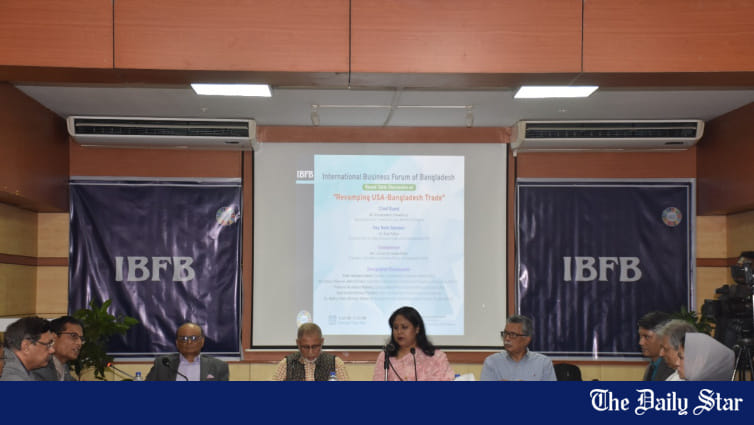
The roundtable was organised by The Daily Star at its auditorium in the capital.

Other industry leaders expressed similar concerns at the programme. Several said that the higher duties could also affect Bangladesh's position in other markets, such as Europe and Australia, by increasing competition and pushing down prices.

Rubana Huq, a former president of the Bangladesh Garment Manufacturers and Exporters Association (BGMEA), echoed Azad's concern, saying the impact would not be confined to shipments bound for the US, Bangladesh's single largest export destination.

"It is not an exaggeration, it's a serious possibility. The GDP could drop by at least 1 percent if things proceed as they are now," she commented.

Until recently, Bangladesh had been paying around 16 percent duty on garments entering the US. That changed in early April, when the US announced a reciprocal tariff of 37 percent. The effect was paused for 90 days, while the revised rate of 35 percent was announced in early July.

This is scheduled to come into effect on August 1. The rate is still much higher than the 20 percent Bangladesh had hoped for.

Huq said uncertainty over the new tariff has already disrupted trade, with US buyers rushing to place orders before the rate takes effect.

"In the first five months alone, exports to the US reached $3.38 billion, due largely to this frontloading trend. Buyers are nervous; they simply don't know what's coming," she said.

"This is not just about big business. It is about millions of workers. It is about real lives. Respecting the NDA shouldn't come at the cost of losing jobs, shrinking investment, or undermining the very sector that drives our economy," said the former BGMEA president.

The discussion was moderated by Arun Devnath, deputy editor of The Daily Star.

1752629218694.png


If the new tariff is slightly higher but still ensures a level playing field, that is acceptable. But ideally, we want it to be at least 10 percent lower than our competitors to remain competitive โ€” Mahmud Hasan Khan , President of BGMEA.

At the event, Mahmud Hasan Khan, president of the BGMEA, said, "If the new tariff is slightly higher but still ensures a level playing field, that is acceptable. But ideally, we want it to be at least 10 percent lower than our competitors to remain competitive."

"Factories that export 40 percent or more to the US may face severe losses, and some may shut down entirely. This would lead to massive worker displacement and significant economic challenges," he said.

He added that while some factories may shift focus to Canada, Japan or Australia, doing so could flood those markets and trigger price drops.

1752629254254.png


If the US market shrinks, that will be a challenging thing for us. Other market will also feel the pressure. The price pressure is going to be huge-โ€” MA Razzaque Chairman of RAPID.

Mohammad Abdur Razzaque, chairman of the local think tank Research and Policy Integration for Development (RAPID), pointed out that the overall effect would be contraction of the US market.

"Most exporting countries are going to see tariffs being imposed, so overall tariffs in the US market will increase, and that is going to reduce the US market size. That's quite natural," he said.

He cited US trade data showing that the country imported $84 billion worth of garments last year.

"If, on average, 20 percent tariffs are imposed on major suppliers, including Bangladesh, then the US market could shrink by $16 billion," he commented.

A smaller US market would intensify competition elsewhere, especially in Europe, where Bangladesh has a strong presence. "Price pressure is going to be huge," Razzaque added.

1752629324226.png


We are being told to be patient โ€” and yes, patience might work in theory. But for our small and medium factories, it is a matter of survival-โ€” Fazlul Hoque Managing, director of Plummy Fashions.

Fazlul Hoque, managing director of Plummy Fashions Ltd, a knitwear exporter, said nearly 900 factories currently export to the US. If large exporters lose business, they would target the EU to make up for lost volume, disrupting the market for everyone.

"We are being told to be patient. And yes, patience might work in theory. But for small and medium factories, it is a matter of survival."

Hoque said, "Six months might be manageable for big factories, but for smaller ones that depend heavily on the US, it could be a death sentence."

Hoque, a former president of the Bangladesh Knitwear Manufacturers and Exporters Association (BKMEA), called for a unified taskforce to assess the post-tariff situation and devise a response.

He said, "If, on August 1, we find ourselves facing the full global duty structure from the US, it will clearly place Bangladesh at a disadvantage. Even if we are currently on par with our competitors, an increase in duties for the rest of the world will inevitably reduce the overall market size in the US. As a result, Bangladesh is likely to lose market share there."

"We need to identify solutions and strategies to face these immediate challenges. Of course, there are mid-term and long-term issues, but the priority now is ensuring that all suppliers can survive and continue competing in the export market," added Hoque.

Azad of Ha-Meem Group argued that relying on World Trade Organization (WTO) rules will not help. "First, we have to win this negotiation. If we lose compared to India, Pakistan, and neighbouring countries, we will lose our business."

He urged the government to act before the deadline. "If duties are imposed โ€” 50 percent or even 35 percent on top of existing tariffs โ€” customers will not continue to buy from Bangladesh," he added.

Brands, Azad said, had made it clear they would not raise retail prices or absorb additional costs.

Azad also cited difficulties with sourcing yarn locally and fulfilling conditions set by the US Trade Representative. "We must satisfy the USTR's requirements. This is not merely a misunderstanding; it is about proactive engagement. As long as we engage informally and keep discussions open, we can find solutions."

1752629368916.png


We need a decisive deal before August 1. If we lose $8 billion in business, that could mean loss of 800,000 to one million jobs -- with devastating social consequences-โ€” Lutfe M Ayub Chairman of Fountain Garments.

Lutfe M Ayub, chairman of Fountain Garments Manufacturing Ltd, said his company sends half of its production to the US and the rest to the EU. Buyers, including Walmart and other major brands, are in "wait and see" mode.

"This waiting period could cost us several idle months, a difficult situation for our factories," he mentioned.

"If we lose $8 billion in business, that could mean 10 lakh jobs lost, with devastating social consequences."

"We need to act for our security, our economy, and our future. The government and private sector must work hand in hand to secure a deal that protects our economy and our people," he added.

"Yesterday, I requested the BGMEA president to engage with major American retailers and brands. Those brands have invested heavily in Bangladesh and cannot easily shift production to countries like India or Cambodia," Ayub said.

He warned that if things go wrong, he might be among the first to shut shop.

1752629402953.png


Bangladesh should have a team of experts in place including negotiators and practitioners from both public and private sectors-โ€” Iftekhar Ahmed Chowdhury, Former adviser of caretaker govt.

Former foreign affairs adviser Iftekhar Ahmed Chowdhury called for an expert team of negotiators drawn from both the public and private sectors.

He cautioned against overreacting to the China factor. "China is emerging as a powerful actor in its own right. We must not create a situation whereby we attract Chinese retaliation and thereby jump from the frying pan into the fire."


1752629431854.png


1752629456488.png


In the first five months alone, exports to the US reached $3.38 billion, largely due to the frontloading trend. Buyers are nervousโ€”they simply do not know whatโ€™s coming.Rubana Huq, Former president of BGMEA.

Chowdhury said Pakistan had managed to balance competing interests, and Bangladesh should do the same.

"We should reduce single-country dependency while spreading procurement and production across multiple locations."

"All in all, it is obvious that we in Bangladesh have a hill to climb. It is also obvious that waiting will not make it any smaller," he added.

M Masrur Reaz, chairman of local think tank Policy Exchange Bangladesh, said the country had little time but should still focus on damage control, recovery, and realignment.

"We have to work in crisis mode, in emergency mode. Because this is an existential issue for our economy."

Offering tariff concessions to the US may not work, said the economist, since imports are private sector-driven. Instead, Bangladesh should explore strategic partnerships based on broader US interests, such as in energy, agriculture, and aviation.

"The US oil and gas lobby is extremely powerful. Bangladesh needs gas. Can we strike better exploration deals? The US agri-lobby is perhaps more influential than the auto or healthcare lobby. They have an interest in cotton, wheat, and soybeans โ€” all of which Bangladesh can absorb more of as our economy evolves."

"We may be hoping for 20 percent, but we may end up at 35 percent or even 40 percent. With Trump as the final decision-maker, anything is possible," added the economist.

Kihak Sung, chairman of Youngone Corporation, urged Bangladesh's business community to act together and diversify markets beyond traditional destinations.

"Many companies in Bangladesh still rely heavily on raw materials and components imported from China. In the long term, establishing supply chains outside China could be good for Bangladesh. But in the short term, it is a real challenge," he said.

He appealed to trade negotiators to push for a grace period. "If they could negotiate an implementation period of at least six months, it would help companies still dependent on Chinese fabrics and components to do alternative sourcing," he commented.​
 

US tariff package bound with non-tariff strings
Ministries preparing coordinated response


FE REPORT
Published :
Jul 17, 2025 00:04
Updated :
Jul 17, 2025 00:04

1752709831751.png


Government ministries are preparing coordinated response to resolve the deadlock related to bumped-up US tariffs on Bangladeshi exports as the deal offered by Washington is tied with some conditions beyond trade realms, sources say.

The government will finalise its decision on the critical conditions for reducing tariff rates on eliciting opinions from relevant ministries as a decisive third round of negotiations with the United States Trade Representative (USTR) is ahead.

Commerce Secretary Mahbubur Rahman apprised journalists Wednesday of the process of preparation following an inter-ministerial meeting -- as businesses in Bangladesh, especially the export-centric apparel industry, remained on tenterhooks.

He said, "In our ongoing discussions with the United States on the tariff issue, various ministries are involved. Hence, we are gathering their opinions. Once we have them, a final proposal will be prepared and sent for further discussions with the US side."

Regarding the third round of negotiations, the Commerce Secretary mentions that the US has not yet provided a specific date. "We are in communication with them about when the next course of action will begin."

The top trade official mentions that Bangladesh is importing many items, including food-grains, and each product is subject to separate regulations. "We are currently evaluating these."

Following the three-day second round of discussions with the US, the Ministry of Commerce held inter-ministerial meetings after returning to the country last Sunday.

As part of this painstaking process, the inter-ministerial meeting held at 11am Wednesday drew representatives from 11 ministries, including Finance, Agriculture, Food, Environment, and Energy. Officials from the National Board of Revenue (NBR) and Bangladesh Trade and Tariff Commission also attended the meeting with Commerce Adviser Sheikh Bashir Uddin in the chair.

Sources say the US conditions binding reducing in steep tariffs -- lastly set at 35 per cent -- were reviewed, and relevant ministries were asked to provide their comments.

Similar meetings will be held with other ministries concerned, too, as the US-set dos for Bangladesh reportedly overreach trade relations.

And these tags are cloaked in a 'Nondisclosure Agreement' reached by the two governments.

Bangladesh's representatives will have to provide feedback on the US conditions during the third round of talks. Before that, a final decision will be submitted to Chief Adviser of the post-uprising interim government Dr Muhammad Yunus.

After Wednesday's meeting, Commerce Secretary Mahbubur Rahman said, "This is a process. We need to gather opinions from different ministries as many issues are involved."

He adds, "These meetings will continue. After consolidating feedback from the ministries, we will finalise a proposal and proceed with further discussions."

Asked whether a date has been confirmed for the third-round negotiations with the US, the Secretary said, "They have not given a specific time yet. We are maintaining communication."

Asked about the specific issues discussed in the meeting, he said, "We import several products from the US, including food items. Various laws and regulations apply in this regard, and we have sought clarification from the relevant ministries."

"This is a global issue," he continues. "We are following the same procedures that countries around the world follow."

It is also understood that while there is broad consensus on trade-related matters, several non-trade issues remain unresolved in the negotiations between Bangladesh and the US. However, when asked if any such issues were discussed in Wednesday's meeting, the Commerce Secretary parried the query.
 

Members Online

No members online now.

Latest Posts

Latest Posts