Bangladesh Defense
Saif
Senior Member
- Joined
- Jan 24, 2024
- Messages
- 20,971
- Likes
- 9,685
- Nation

- Residence
- Axis Group

How Trump's economic policies will impact South Asia
Bangladesh will encounter various challenges and opportunities during Trump's second term.
How Trump's economic policies will impact South Asia

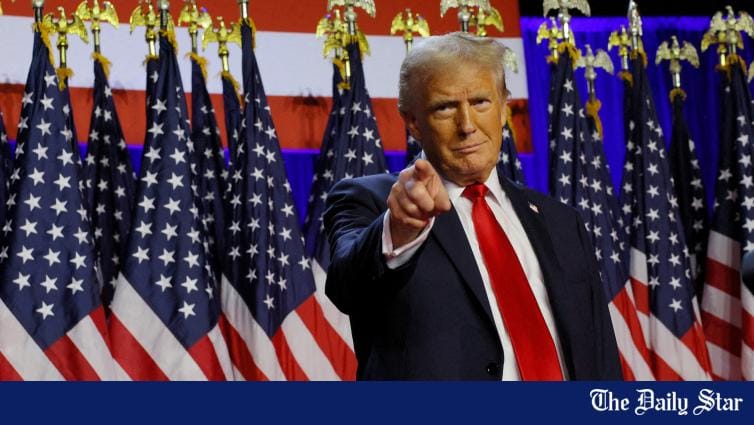
Trump 2.0 administration would likely focus on economic nationalism, prioritising US interests with potential tax cuts for individuals and corporations to spur growth. FILE PHOTO: REUTERS
As Donald Trump prepares to be inaugurated as the 47th president of the United States on January 20, marking the start of his second term, this occasion highlights essential democratic traditions and carries significant implications for his economic policies that will resonate globally. Joseph Liow Chin Yong, dean of the College of Humanities, Arts, and Social Sciences at Nanyang Technological University (NTU) in Singapore, told the Time magazine after the election that Trump would be "more prepared" in 2025. His anticipated economic policies, driven by an "America First" agenda, are set to transform not only the financial landscape in the US, but also that across South Asia, a region home to nearly two billion people and with vast opportunities and substantial challenges.
Trump, branding himself as a "tariff man," centres his economic platform on trade levies. A Trump 2.0 administration would likely focus on economic nationalism, prioritising US interests with potential tax cuts for individuals and corporations to spur growth, possibly making parts of the Tax Cuts and Jobs Act of 2017 permanent. He intends to reduce regulations in energy, finance, and healthcare to lower compliance costs and boost economic activity. Maintaining a protectionist trade approach, he aims to renegotiate agreements, impose tariffs on imports—especially from China—and foster domestic manufacturing. In his 2024 campaign, he proposed at least 60 percent tariffs on Chinese imports and 10-20 percent on global imports. He has threatened tariffs on companies like John Deere for considering offshoring, and could levy 100 percent tariffs on the BRICS nations if they create a trade currency. Further tariff threats are expected as Trump views them as vital to diplomatic leverage. Advisers' proposals may enable the president to impose "reciprocal tariffs" matching those of other nations.
Infrastructure spending may be prioritised, with plans for significant investment in transportation, energy, and technology to create jobs. Policies aimed at energy independence would support fossil fuel production and relax environmental regulations. Economic initiatives could align with immigration reform, limiting immigration to safeguard jobs while seeking skilled labour for growth. Trump may advocate for domestic manufacturing through subsidies or tax breaks, and assist small businesses by enhancing access to capital and easing regulatory burdens. Additionally, he may pursue healthcare reforms to reduce costs and boost competition, including efforts to repeal the Affordable Care Act. Overall, these strategies would prioritise national security by protecting US industries and jobs from foreign competition.
How Trumponomics 2.0 could impact South Asia
Washington's South Asia policy will align with its Indo-Pacific vision initially established during Trump 1.0. His foreign policy could significantly influence the region's security and economy, with India playing a key role due to its contributions to the Indo-Pacific. A second Trump presidency might reshape the current dynamics of South Asian geopolitics and economics. Trump opposes rerouting US-China trade through third countries, with Oxford Economics predicting that his tariffs could decrease US imports by three percent and exports by eight percent, impacting "non-China Asia." The ongoing US-China trade tensions could drive a restructuring of global supply chains, potentially shifting 20 percent of manufacturing away from China by 2025. During the previous administration, countries like Malaysia, Vietnam, and Thailand benefited from the trade war as factories relocated there to establish new supply chains. However, the competition for low-cost manufacturing remains fierce, particularly with Vietnam attracting foreign direct investment (FDI) at a much higher rate—$36.6 billion in 2023—compared to Bangladesh ($3 billion). India has a robust infrastructure to appeal to export-oriented manufacturers, but regional trade partnerships face challenges.
An "America First" agenda under the Trump administration could impose tariffs detrimental to export-reliant economies like Bangladesh and India. A five percent tariff increase on Bangladeshi exports, valued at $9.74 billion (2022), could result in a $487 million annual loss. Additionally, tighter immigration policies may reduce remittances—a crucial income source for South Asia. In 2023, Bangladesh received $2.6 billion in remittances from the US, making up 15 percent of its total inflows.
Trump aims to implement strict measures on immigration, including ending the Deferred Action for Childhood Arrivals (DACA) programme and the Public Charge Policy. This could strip protective status from over half a million DACA recipients and amplify fears among immigrant families about accessing essential services like healthcare. Stricter immigration policies may also reduce the flow of skilled labour and remittances, affecting various South Asian countries. Additionally, educational exchanges might suffer, as over 200,000 South Asian students currently studying in the US could choose more welcoming countries like those in Europe, Canada or Australia. Lastly, India's rising influence in the QUAD bolsters its strategic role but may marginalise smaller economies that overlook regional cooperation through bodies like SAARC or ASEAN.
Challenges and opportunities for Bangladesh
Bangladesh will encounter various challenges and opportunities during Trump's second term. The ready-made garment (RMG) sector, which comprised 84.7 percent of total merchandise exports in FY23 (ERD, 2024), offers low added value compared to the overall product value. To ascend the global value chain, Bangladesh must focus on creating more sophisticated products and enhancing backward and forward linkages. Although product diversification has occurred, areas such as design, branding, sales, and after-sales services remain largely unaddressed. Strengthening backward linkages is crucial for increasing domestic value addition. Moreover, diversifying the export base is essential to mitigate vulnerabilities associated with tariff hikes. Promising sectors like ICT, pharmaceuticals and agro-processing, which showed significant growth in 2023, offer viable alternatives to reduce economic risks.
Other serious needs include infrastructure development, in which Bangladesh is ranked 88th out of 139 countries regarding logistics performance (2023), far from Vietnam's 43rd and India's 38th positions. In the current realignment of global supply chains, how Bangladesh will be able to attract FDI to its industrial zones is a challenge that needs consideration, along with the rationalisation of regulations. Migration and remittances remain critical, with $2.6 billion received from the US in 2023; exploring partnerships with countries like Canada, the UK, and Australia that have friendlier immigration policies could bring relief.
It is also important that in the education sector, much effort should be invested in strengthening local institutions and building international academic collaborations as a hedge against the risk of more stringent visa policies by the US, given that over 9,000 Bangladeshi students pursue higher education there every year. Finally, when India is increasingly strengthening its role within QUAD, Bangladesh will have to go further in regional cooperation through SAARC and ASEAN, forging partnerships with other countries like Vietnam and Indonesia for its protection of economic and strategic interests.
For South Asia and Bangladesh to navigate the challenges posed by Trump's policy agenda, proactive measures are essential. The region must lead efforts to foster cooperation in response to shifting global dynamics, while Bangladesh should focus on diversifying exports, attracting foreign investment, and improving infrastructure. Innovative strategies are necessary to promote a fair migration agenda, ensuring equitable benefits from labour migration for countries of origin and destination, employers, and all workers—both nationals and migrants. Strengthening ties with new destination countries and enhancing domestic educational opportunities are vital steps to mitigate risks and leverage emerging opportunities for sustainable growth in an evolving world.
Dr Md Abdul Latif, a global ambassador and ADB-JSP scholar, is additional director at the Bangladesh Institute of Governance and Management (BIGM).
Shirin Sultana is research associate at the Bangladesh Institute of Governance and Management (BIGM).
Trump 2.0 administration would likely focus on economic nationalism, prioritising US interests with potential tax cuts for individuals and corporations to spur growth. FILE PHOTO: REUTERS
As Donald Trump prepares to be inaugurated as the 47th president of the United States on January 20, marking the start of his second term, this occasion highlights essential democratic traditions and carries significant implications for his economic policies that will resonate globally. Joseph Liow Chin Yong, dean of the College of Humanities, Arts, and Social Sciences at Nanyang Technological University (NTU) in Singapore, told the Time magazine after the election that Trump would be "more prepared" in 2025. His anticipated economic policies, driven by an "America First" agenda, are set to transform not only the financial landscape in the US, but also that across South Asia, a region home to nearly two billion people and with vast opportunities and substantial challenges.
Trump, branding himself as a "tariff man," centres his economic platform on trade levies. A Trump 2.0 administration would likely focus on economic nationalism, prioritising US interests with potential tax cuts for individuals and corporations to spur growth, possibly making parts of the Tax Cuts and Jobs Act of 2017 permanent. He intends to reduce regulations in energy, finance, and healthcare to lower compliance costs and boost economic activity. Maintaining a protectionist trade approach, he aims to renegotiate agreements, impose tariffs on imports—especially from China—and foster domestic manufacturing. In his 2024 campaign, he proposed at least 60 percent tariffs on Chinese imports and 10-20 percent on global imports. He has threatened tariffs on companies like John Deere for considering offshoring, and could levy 100 percent tariffs on the BRICS nations if they create a trade currency. Further tariff threats are expected as Trump views them as vital to diplomatic leverage. Advisers' proposals may enable the president to impose "reciprocal tariffs" matching those of other nations.
Infrastructure spending may be prioritised, with plans for significant investment in transportation, energy, and technology to create jobs. Policies aimed at energy independence would support fossil fuel production and relax environmental regulations. Economic initiatives could align with immigration reform, limiting immigration to safeguard jobs while seeking skilled labour for growth. Trump may advocate for domestic manufacturing through subsidies or tax breaks, and assist small businesses by enhancing access to capital and easing regulatory burdens. Additionally, he may pursue healthcare reforms to reduce costs and boost competition, including efforts to repeal the Affordable Care Act. Overall, these strategies would prioritise national security by protecting US industries and jobs from foreign competition.
How Trumponomics 2.0 could impact South Asia
Washington's South Asia policy will align with its Indo-Pacific vision initially established during Trump 1.0. His foreign policy could significantly influence the region's security and economy, with India playing a key role due to its contributions to the Indo-Pacific. A second Trump presidency might reshape the current dynamics of South Asian geopolitics and economics. Trump opposes rerouting US-China trade through third countries, with Oxford Economics predicting that his tariffs could decrease US imports by three percent and exports by eight percent, impacting "non-China Asia." The ongoing US-China trade tensions could drive a restructuring of global supply chains, potentially shifting 20 percent of manufacturing away from China by 2025. During the previous administration, countries like Malaysia, Vietnam, and Thailand benefited from the trade war as factories relocated there to establish new supply chains. However, the competition for low-cost manufacturing remains fierce, particularly with Vietnam attracting foreign direct investment (FDI) at a much higher rate—$36.6 billion in 2023—compared to Bangladesh ($3 billion). India has a robust infrastructure to appeal to export-oriented manufacturers, but regional trade partnerships face challenges.
An "America First" agenda under the Trump administration could impose tariffs detrimental to export-reliant economies like Bangladesh and India. A five percent tariff increase on Bangladeshi exports, valued at $9.74 billion (2022), could result in a $487 million annual loss. Additionally, tighter immigration policies may reduce remittances—a crucial income source for South Asia. In 2023, Bangladesh received $2.6 billion in remittances from the US, making up 15 percent of its total inflows.
Trump aims to implement strict measures on immigration, including ending the Deferred Action for Childhood Arrivals (DACA) programme and the Public Charge Policy. This could strip protective status from over half a million DACA recipients and amplify fears among immigrant families about accessing essential services like healthcare. Stricter immigration policies may also reduce the flow of skilled labour and remittances, affecting various South Asian countries. Additionally, educational exchanges might suffer, as over 200,000 South Asian students currently studying in the US could choose more welcoming countries like those in Europe, Canada or Australia. Lastly, India's rising influence in the QUAD bolsters its strategic role but may marginalise smaller economies that overlook regional cooperation through bodies like SAARC or ASEAN.
Challenges and opportunities for Bangladesh
Bangladesh will encounter various challenges and opportunities during Trump's second term. The ready-made garment (RMG) sector, which comprised 84.7 percent of total merchandise exports in FY23 (ERD, 2024), offers low added value compared to the overall product value. To ascend the global value chain, Bangladesh must focus on creating more sophisticated products and enhancing backward and forward linkages. Although product diversification has occurred, areas such as design, branding, sales, and after-sales services remain largely unaddressed. Strengthening backward linkages is crucial for increasing domestic value addition. Moreover, diversifying the export base is essential to mitigate vulnerabilities associated with tariff hikes. Promising sectors like ICT, pharmaceuticals and agro-processing, which showed significant growth in 2023, offer viable alternatives to reduce economic risks.
Other serious needs include infrastructure development, in which Bangladesh is ranked 88th out of 139 countries regarding logistics performance (2023), far from Vietnam's 43rd and India's 38th positions. In the current realignment of global supply chains, how Bangladesh will be able to attract FDI to its industrial zones is a challenge that needs consideration, along with the rationalisation of regulations. Migration and remittances remain critical, with $2.6 billion received from the US in 2023; exploring partnerships with countries like Canada, the UK, and Australia that have friendlier immigration policies could bring relief.
It is also important that in the education sector, much effort should be invested in strengthening local institutions and building international academic collaborations as a hedge against the risk of more stringent visa policies by the US, given that over 9,000 Bangladeshi students pursue higher education there every year. Finally, when India is increasingly strengthening its role within QUAD, Bangladesh will have to go further in regional cooperation through SAARC and ASEAN, forging partnerships with other countries like Vietnam and Indonesia for its protection of economic and strategic interests.
For South Asia and Bangladesh to navigate the challenges posed by Trump's policy agenda, proactive measures are essential. The region must lead efforts to foster cooperation in response to shifting global dynamics, while Bangladesh should focus on diversifying exports, attracting foreign investment, and improving infrastructure. Innovative strategies are necessary to promote a fair migration agenda, ensuring equitable benefits from labour migration for countries of origin and destination, employers, and all workers—both nationals and migrants. Strengthening ties with new destination countries and enhancing domestic educational opportunities are vital steps to mitigate risks and leverage emerging opportunities for sustainable growth in an evolving world.
Dr Md Abdul Latif, a global ambassador and ADB-JSP scholar, is additional director at the Bangladesh Institute of Governance and Management (BIGM).
Shirin Sultana is research associate at the Bangladesh Institute of Governance and Management (BIGM).