[🇧🇩] LDC Graduation For Bangladesh

[🇧🇩] LDC Graduation For Bangladesh
90
3K
More threads by Saif

G Bangladesh Defense

Bangladesh cannot unilaterally defer its LDC graduation timeframe: Dr. Zahid
BSS
Published :
Feb 01, 2025 18:36
Updated :
Feb 01, 2025 18:36

1738455425224.webp


Former lead economist of the World Bank Bangladesh Office Dr. Zahid Hussain has said Bangladesh cannot unilaterally defer its LDC graduation timeframe.

“The United Nations Committee for Development Policy (UN-CDP) had recommended Bangladesh’s graduation from the LDCs in 2021. This recommendation, while not automatically enforcing graduation, is seen as largely mandatory since the UN General Assembly tends to follow the CDP's recommendations,” he said.

Zahid Hussain said this in a recent interview with the national news agency at his residence while sharing his insights on the country's graduation from the Least Developed Countries (LDCs) category.

Dr. Hussain noted that several countries that faced setbacks during the graduation process were granted an extended preparatory period before graduation.

This provides them with additional time to address any concerns or challenges identified. Bangladesh has already got a two-year extension.

Addressing reservations from the business community about Bangladesh’s LDC graduation slated for 2026, Dr. Hussain clarified that once a country qualifies for graduation, the responsibility falls on them to ensure that all concerns are adequately addressed.

As Bangladesh prepares for its graduation in 2026, it is imperative for the country to address the concerns of the business community and ensure a smooth transition.

The renowned economist shared these perspectives providing a comprehensive view of the challenges and opportunities that lie ahead for Bangladesh from LDC graduation.

Elaborating on the matter, Dr. Zahid said, “Now, I think there is limited scope for deferring the country’s graduation through changing data and statistics. There is also less scope for bringing down the statistics below the threshold level on per capita income, human development, and vulnerability indices,” he said.

Bangladesh is the first country recommended for graduation by meeting all three criteria, Dr Zahid said adding “We’ll have to accept that we’ll graduate and acting on tackling the possible impact on our competitiveness. We should be prepared.”

In the last Ministerial Conference of the World Trade Organization (WTO) held in Abu Dhabi, the ministers decided to allow the continuation of the LDC trade benefits to the graduating LDCs for three more years.

The European Union (EU) will continue the LDC trade benefits for Bangladesh up to 2029, offering a three-year grace period to the graduating LDCs.

A few other countries like Canada, the UK, and Australia will also continue the LDC trade benefit for Bangladesh even after the graduation.

When asked about the ‘middle-income trap’ that many are apprehending Bangladesh is already in, Dr. Zahid said if political stability and structural economic reforms are not ensured, then nothing will get us out of the trap.

“We’ll have to bring about necessary changes in three areas in particular- in export diversification, investment and skill development. We’ve a big opportunity ahead of us which is the new economic policy of US President Donald Trump,” Dr Zahid said.

Under this circumstance, the multinational companies which have businesses in China are searching for alternate places to relocate their businesses ...like Vietnam, Indonesia and the Philippines, he noted.

Dr. Zahid said many are also talking about Bangladesh on the global stage...but Bangladesh is still not fully ready in terms of investment climate like addressing complexities in getting visas, readiness of the economic zones, and complexities of business regulation, money repatriation, and so on.

“If we can become fully ready, then there could be a quantum jump in FDI and thus the door of immense opportunities would be opened,” he hoped.

As Bangladesh approaches this crucial transition, Dr Zahid said the government’s proactive stance on economic zones is a laudable step. Instead of an ambitious plan to establish 100 economic zones, the focus has shifted to creating five well-equipped zones urgently.

“This strategic move aims to provide the necessary facilities and regulatory reforms to foster a ‘plug-and-play’ environment for investors,” he added.

Dr Zahid observed that by streamlining business regulations and ensuring the readiness of these special economic zones (SEZs), Bangladesh can hope to attract significant foreign direct investment (FDI) and boost the country's economic prospects.

Dr. Zahid acknowledged the issues raised by the business community about their concerns over current business environment. The state of the financial sector and the inconsistent supply of gas and electricity are two major factors contributing to low business confidence to some extent, he said.

The former World Bank lead economist further highlighted the challenges related to the supply of LNG. The government faces difficulties in maintaining sustainable supply while selling LNG below the buying price, he said.

In the new Monetary Policy Statement (MPS), Dr Zahid said some forward guidance is likely to come in which way the central bank would run its policy and programs.

“With the unveiling of the FY26 budget in June this year, he said, all will be able to know in which way the economic policy and management will move forward and then the cloud in the sky will clear.”

Asked whether the government’s economic reforms agenda is getting less importance than other reform agendas, he said the government certainly has the realization that they would have to carry out economic reforms and there is no doubt in this regard.

“But, despite having strong will, they often couldn’t translate those into actions as the initiatives should have to come from the administration itself and from the concerned ministries,” he said.​
 

Diversification can meet post-LDC challenges

Published :
Feb 13, 2025 23:47
Updated :
Feb 13, 2025 23:47

1739493886816.webp


The government's initiative to speed up export diversification in preparation for post-LDC challenges is a complex task requiring both persistent efforts and innovative approaches. A FE report says the relevant authorities are developing a strategy to maintain the competitiveness of four major export products-excluding ready-made garments (RMG)-after Bangladesh graduates from its Least Developed Country (LDC) status in 2026. These include leather and leather goods, jute goods, agricultural and agro-processed products, and pharmaceuticals. Upon graduation, Bangladesh will no longer be permitted to provide export subsidies under the World Trade Organisation (WTO) regulations. In anticipation of this transition, the government has been gradually phasing out cash incentives to mitigate the impact of subsidy withdrawal. Currently, leather and leather goods sector benefits from a 10 per cent cash incentive, jute products receive 10 per cent, agricultural and agro-processed goods enjoy 10 per cent, and pharmaceutical products receive 6.0 per cent. Last year, the government reduced cash incentives for nearly all sectors, signalling the gradual elimination of these benefits. However, a complete withdrawal of subsidies will significantly impact competitiveness of industries here, necessitating strategic interventions to sustain export growth.

Export diversification is a package comprising scores of issues from product development, adaptation, quality assurance, market demand analysis, compliance fulfilment, competitive pricing and so on. So, when it comes to diversification of exportable products, it must not be seen as a remedy readily available. It has to be worked on, in a planned manner taking into account all relevant factors as a package. In the past, the Export Promotion Bureau undertook many foreign-aided export diversification projects. However, as many of the projects approached the aforementioned package only partially, the outcome was far from satisfactory.

The reason why diversification figures so prominently is because of its many tangible benefits. Diversification of export composition protects a country from the risk of an unpredictable declining trend in international prices of exportable commodities that, in turn, leads to unstable export earnings. Export diversification could, therefore, help stabilise export earnings in the long run. Diversification provides the opportunities to extend investment risks over a wider portfolio of the economic sector which eventually increases income. It can also be seen as an input factor that has the effect of increasing the productivity of other factors of production. Furthermore, economic growth and structural change depend upon the type of products that are being traded. Thus export diversification allows an economy to achieve some of its macroeconomic objectives namely sustainable economic growth, satisfactory balance of payment situation, employment, and redistribution of income.

The four selected sectors are well-chosen given their strong growth potential and market demand. However, two additional sectors, light engineering and plastics, also warrant consideration. These have demonstrated remarkable potential and could further contribute to export diversification efforts. As the government develops its strategic framework, it is crucial to engage all stakeholders, including industry representatives, exporters, and policymakers, in order to build a comprehensive and consensus-driven approach to remain competitive in the post-LDC era.​
 
relevant authorities are developing a strategy to maintain the competitiveness of four major export products-excluding ready-made garments (RMG)-after Bangladesh graduates from its Least Developed Country (LDC) status in 2026. These include leather and leather goods, jute goods, agricultural and agro-processed products, and pharmaceuticals.

The four selected sectors are well-chosen given their strong growth potential and market demand. However, two additional sectors, light engineering and plastics, also warrant consideration. These have demonstrated remarkable potential and could further contribute to export diversification efforts.

Light Engineering and Plastics (as well as Pharma) are going to need strong investment encouragement policy regimes in absence of export subsidies, which are banned by WTO rules and which Bangladesh govt. has been providing so far, which helped.

Letting Pakistani light-engineering investors to invest in Bangladesh will also be wonderful as that sector is very well-developed there. These guys have made a science out of value-added products out of ship-scrap alone (motorcycle parts and lathes among other thousand things) and their involvement in Bangladesh will be a Godsend. We should also encourage stainless steel surgery implement makers as well as sports good folks from Pakistan to set up shop to supply locally in Bangladesh to help import substitution. These companies are based in the Sialkot area.

In particular I refer to API manufacturing (for basic Pharma Ingredients) and plastic pellets manufacturing (as well as mold-making expertise) for plastic molders locally in Bangladesh. These and other backward integration encouragement steps need to be taken immediately, to foster competitive advantage for exports.

Look how many Pharma API companies Indian entrepreneurs invested in (I'm sure India Govt. subsidized some of this. Ours efforts are quite poor in comparison.

 
Last edited:

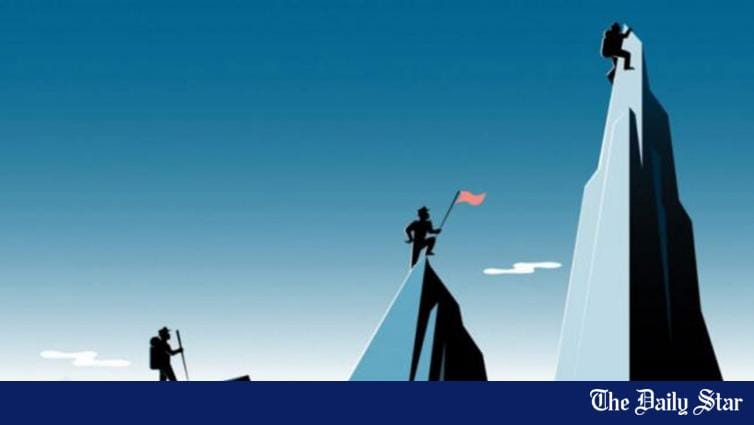
Life after LDC graduation
Are we prepared to seize the new global opportunities?


1739749575963.webp

VISUAL: SHAIKH SULTANA JAHAN BADHON

As Bangladesh prepares to graduate from the Least Developed Country (LDC) category in November 2026, a pressing question looms: should the new government reconsider its strategy for this monumental transition?

It is important to recognise that this graduation is a collective leap forward for its people and businesses, who will be at the forefront of both the challenges and opportunities that come with this transition.

Bangladesh presents a sui generis case for two primary reasons. First, it is the largest LDC to graduate, with a population of 171 million. Second, according to a WTO study on the "Trade Impacts of LDC Graduation," 90 percent of the graduation-related trade losses would be incurred by Bangladesh alone. It is estimated that graduation will result in a 14.28 percent decline in Bangladesh's exports.

Bangladesh is set to graduate at a pivotal moment marked by unprecedented global and domestic instabilities. Serious questions are now being raised about the veracity of the development narrative upheld by the past regime of nearly two decades, which relied on questionable public statistics.

As critics argue that the decision to pursue LDC graduation was, to a large extent, politically motivated, and as part of the business community voices its resistance to this move, it is critical to qualitatively assess Bangladesh's preparedness for sustainable LDC graduation. It must be taken into account that, for countless entrepreneurs, this is not merely a policy shift but a direct threat to the survival of their businesses, livelihoods, and the health of their communities.

Bangladesh should urgently establish a structured consultative mechanism to engage all key stakeholders—businesses, civil society, and experts—in deliberating the best course of action: whether to delay LDC graduation by a few more years after 2026 or to embrace it now.

If the consultative mechanism determines that Bangladesh should proceed with graduation, as generating "real" statistics within the stipulated time is practically challenging, the existing transition strategy, which began nearly a decade ago, can be revisited. A National Committee was formed in 2021 to assess the impacts and draft an action plan. The committee's recommendations are currently under government review for final approval.

The recommendations of that committee should be highlighted, as they rightly suggest strategically navigating Bangladesh's evolving status to capitalise on current and future opportunities. The approach is threefold. First, as an LDC, Bangladesh should actively advocate for the implementation of existing LDC-specific policy flexibilities. Second, Bangladesh must proactively push for the creation of multilateral rules to support sustainable graduation. Third, assuming its new status as a developing country, Bangladesh must prepare and act upon forward-looking strategies to seize emerging global opportunities.

By now, Bangladesh has made significant progress on the first two counts. Notably, it has played a leading role at the WTO, representing the LDC Group and ensuring that concerns surrounding LDC graduation receive due attention. In 2020, the LDC Group tabled a proposal requesting a 12-year extension of all LDC-specific trade support measures after graduation.

After intense discussions, WTO members partially adopted a few elements of this proposal by: i) encouraging preference-granting countries to provide "a smooth and sustainable transition period" for the withdrawal of preferences; ii) extending LDC-specific technical assistance for three years after graduation; and iii) maintaining the peace clause for dispute settlement for three years after graduation.

While these developments are steps in the right direction, they fall short of the original 12-year request, reflecting the systemic reluctance of some developed countries, particularly the US, to prolong LDC-specific flexibilities. As a result, Bangladesh must prepare for the reality of losing access to LDC-related benefits.

Bangladesh's priority must now be building domestic institutions, strengthening negotiation capacity, and leveraging new economic opportunities. LDC graduation presents a chance for Bangladesh to rethink its development model and position itself as a competitive, sustainable, and digitally driven economy.

Trade will remain the cornerstone of Bangladesh's integration into the global economy. To translate these opportunities into tangible benefits, Bangladesh must immediately implement a set of strategic action plans.

First, LDC graduation could make Bangladesh more attractive to foreign investors. However, this requires significant domestic legal and regulatory reforms. Outdated regulations, infrastructure gaps, and bureaucratic inefficiencies must be addressed to create a conducive investment climate. The demand for dedicated commercial courts continues to grow. The government must not only establish these courts in Dhaka and Chattogram as initially planned but also prioritise their creation in at least six divisional headquarters, followed by an expansion into every district.

Second, Bangladesh's strategic location in the Asia-Pacific region offers immense potential for regional integration and connectivity. This region is growing rapidly and is home to over 200 regional and free trade agreements (FTA). Deeper economic integration with regional economies can diversify Bangladesh's exports and enhance economic resilience. Bangladesh should actively pursue FTAs with key trading partners.

Third, LDC graduation should be viewed as an opportunity to embrace sustainable industrialisation. Bangladesh should capitalise on its comparative green advantages, such as eco-friendly jute products and renewable energy. A roadmap for green economic transformation must be developed to align with global sustainability goals and standards.

Fourth, Bangladesh holds immense potential in digital trade, particularly in digitally delivered services. The country has already emerged as a leader in freelance digital services. To scale up, Bangladesh must develop a regulatory framework that enables and facilitates cross-border e-commerce. To pursue this, the domestic e-commerce sector must be strengthened by developing a trust-based business model that follows global best practices.

Fifth, SMEs are vital contributors to GDP and employment. To mitigate the negative impacts of graduation, particularly in cross-border trade, targeted policies must be developed. These should include granting SMEs greater access to Export Processing Zones (EPZs), thereby facilitating their smoother integration into global supply chains and boosting their competitiveness on the international stage.

It is crucial to assess whether the existing reform commissions have adequately addressed these priorities. The proposed consultative mechanism should design and implement targeted measures to fully capitalise on the opportunities presented by LDC graduation.

Muhammad Omar Faruque is a researcher in law.

Mohammed Abu Saleh is an international trade lawyer, who formerly worked with the WTO Secretariat in Geneva, Switzerland.​
 

Deferring LDC graduation not an option
Economist says

1740354515471.webp


Deferment of Bangladesh's country status graduation should not be even up for discussion as inclusion in the least developed country category is voluntary while upgrading to the developing country grouping is mandatory, said a noted economist yesterday.

Many are arguing in favour of the deferment, but the smart move for the country would be to start taking preparations for a smooth transition, said Mustafizur Rahman, distinguished fellow of the Centre for Policy Dialogue (CPD).

He was addressing a discussion on "Restoring stability in economic and political landscape" at an 8th SANEM Economists' Conference 2025 organised by the South Asian Network on Economic Modeling (SANEM) at BRAC Centre Inn in Dhaka.

No other peer country is demanding a deferment and while a country needs to meet two out of three criteria to be eligible for the graduation, Bangladesh has qualified in all three, said Rahman.

Even Nepal, which is scheduled to graduate with Bangladesh in November 2026, is not demanding a deferment,
he said.

Leaders of different countries attending the ministerial conference of World Trade Organization (WTO) in Abu Dhabi last year did not show interest in extending the transition period, he said.

Bhutan has already graduated and if Bangladesh defers the graduation, it will be left with war-torn Afghanistan as the only two least developed countries (LDCs) in South Asia, said Rahman.

After the graduation, Bangladesh will become ineligible for almost all trade benefits, such as zero duty access, and strictly abide by the Trade Related Aspects of Intellectual Property Rights (TRIPs), said Rahman.

Moreover, Bangladeshi exporters will face duties of over 10 percent in many countries, he said.

However, some countries such as those under the European Union, Canada and the UK will continue to provide the facilities for a grace period of three years, he said.

Yet many businesses want the government to provide export incentives till the end of the grace period in 2029, he said.

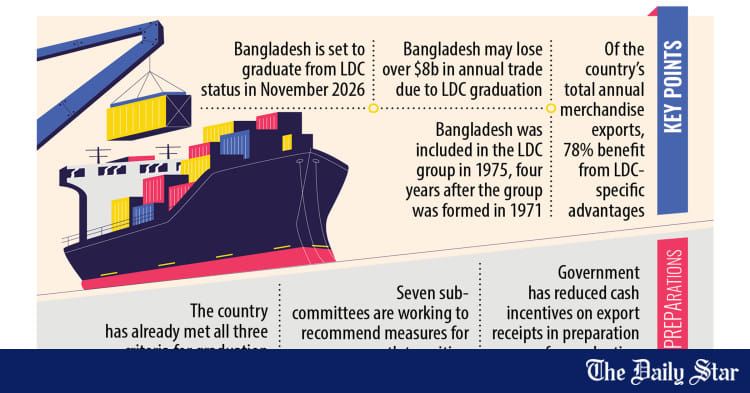
Seven sub-committees are working on providing recommendations to the government for a smooth graduation, said Rahman.

Of the total losses of advantages that the 12 graduating LDC are enjoying now, nearly 90 percent will befall Bangladesh as it avails the highest trade benefits among all the LDCs, he said.

While Bangladesh requested the United Nation for inclusion in the LDC group in 1972, Zimbabwe, which was then struggling, refused to accept the LDC status, Rahman said.

He suggested increasing direct tax collections, as there was a possibility of a fall in revenue from indirect taxes in the form of import duties.

Bangladesh should also focus more on countries in the Global South, South East and the Association of Southeast Asian Nations (Asean) as only 11 percent of its annual exports are destined for those countries, he said.

China imports $2,800 billion worth of goods and India over $730 billion in a year. But Bangladesh accounts for less than one percent of China's imports while exports to India stand at less than $2 billion, said Rahman.

Bangladesh should also hold negotiations for signing free trade agreements, comprehensive economic partnership agreements and other trade deals for retaining the preferential trade benefits, he said.

While Bangladesh will face duties following the graduation, Vietnam will enjoy zero-duty in many countries as it has already signed trade deals, he said.

On a positive note, Bangladesh and Japan are currently engaged in the process of signing an economic partnership agreement, the economist said.

Bangladesh should focus on avoiding anything that threatens economic stability. For instance, one mega project with an original allocation of Tk 1,800 crore had ended up costing Tk 18,000 crore, he said.

Moreover, Bangladesh will have to pay $6 billion annually in debt repayments from 2026 when the grace period for the largest project on loan, the $14 billion Rooppur nuclear power plant project, will come to an end, he said.

Nearly, 77 percent of illicit financial outflow was through trade such as mispricing—over invoicing and under invoicing. But the fact remains that trade related mispricing is a major issue, and it has to be addressed, he said.

Zahid Hussain, former lead economist of World Bank's Dhaka office, said Bangladesh was already in the middle-income trap.

The export to GDP ratio and investment are declining, but inflation is rising. The volume of bank loan rescheduling is also increasing while the central bank's foreign currency reserves are at a low level, Hussain said.

The discontinuation of a loan programme by International Monetary Fund (IMF) for Bangladesh will have consequences, he said.

It will affect budgetary support provided by World Bank to Bangladesh, he said.

Moreover, Asian Development Bank, Asian Infrastructure Investment Bank and others will ask about the challenges of Bangladesh, he said.

KAS Murshid, former director general of the Bangladesh Institute of Development Studies, said in order to attain macroeconomic stability, Bangladesh really needs to lay emphasis on agriculture as it ensures the smooth flow of essentials.

Sharmind Neelormi, a professor at the Department of Economics at Jahangirnagar University, pointed out that environmental assessments were not conducted for the construction of a 29.73-kilometre road through hoars in Kishoreganj and for Savar Tannery Industrial Estate in Dhaka.

Rumana Haque, a professor of economics at the University of Dhaka, said investment in the health sector needs to be increased to ensure a productive workforce.

At the same time, the reasons need to be unearthed on why the health sector cannot spend the money allocated in the national budget, although there is a chronic shortage of health personnel, she said.

Moreover, the situation is dire when it comes to treating mental health patients, she added.

Selim Raihan, executive director of the SANEM, moderated the discussion.​
 

Delay of LDC graduation sought
Staff Correspondent 10 March, 2025, 21:43

The country’s private sector businesses have urged for deferring Bangladesh’s LDC graduation for at least 2 to 3 years, considering the prevailing global and local economic challenges, including a shortage of energy, high inflation, high interest rates and complexities in obtaining credit from banks.

They were speaking at a focus group discussion on ‘Implementation of the STS for Smooth Transition from LDC Status’ jointly organised by the Support to Sustainable Graduation Project, the Economic Relations Division and the Dhaka Chamber of Commerce and Industry on Monday in the capital Dhaka, according to a DCCI press release.

DCCI president Taskeen Ahmed presented a keynote paper and said that GDP growth in the first quarter of the current financial year was only 1.8 percent, while the manufacturing sector’s growth was only 1.43 percent.

He said that Bangladesh’s economy was still facing various challenges and amid these challenges, Bangladesh would be graduating from a least developed country to a developing on in 2026.

Regarding the ‘Smooth Transition Strategy,’ he recommended developing a roadmap to stabilise the economy, creating a real-time monitoring and evaluation platform, signing free trade agreement with key partners and aligning trade, industrial and investment policies.

He also urged the signing of FTA with new export destinations and implementing policies for export diversification.

Speaking as chief guest, ERD secretary Md Shahriar Kader Siddiky said that they needed to build capacity at all levels to deal with the impact of the loss of trade benefits in the post-LDC era.

In this regard, he said, a committee will be formed with representatives of trade organisations to determine the private sector’s needs and find solutions.

Commerce secretary Mahbubur Rahman said that proper planning and implementation from the beginning were lacking to meet the challenges of LDC graduation, but based on the private sector’s opinion, more attention should be paid to a sustainable LDC graduation process.

He called upon the private sector to focus on product diversification in the RMG sector and on its promising packaging area.

Rizwan Rahman, former DCCI president, said that the country’s businessmen were not yet ready for the LDC graduation, so the government should make a decision in consultation with the private sector.

Manwar Hossain, chairman of Anwar Group of Industries, said that until the country’s exports surpassed its import figures, it could be said that it was not ready for graduation in the real sense.

Bangladesh Knitwear Manufacturers and Exporters Association president Mohammad Hatem said that the private sector needed time to prepare for graduation.

Government officials, business leaders and other stakeholders also spoke at the event.​
 

Govt wants to delay graduation from LDC
Staff Correspondent
Dhaka
Published: 11 Mar 2025, 19: 26

1741742125731.webp

Anisuzzaman Chowdhury

Bangladesh is scheduled to graduate from the status of least developed country on 24 November 2026. However, the interim government is working on delaying it further.

However, it is not like that the government can defer the graduation if it wants. So the interim government will appeal to the Committee for Development Policy (CDP) of the United Nations in this regard.

Special assistant to the chief adviser Anisuzzaman Chowdhury said this during a briefing at the secretariat Tuesday. Before that, Anisuzzman met finance adviser Salehuddin Ahmed at his office. He was appointed on Monday. He has been assigned at the finance ministry.

Anisuzzaman Chowdhury said the work on developing a complete outline for reconsidering Bangladesh’s graduation from LDC has begun.

A committee headed by chief adviser’s principal secretary M Siraj Uddin Mia has been formed in this regard. The ERD and FID secretaries are members of this committee.

Anisuzzaman Chowdhury said, “We are on the verge of graduating from LDC on the basis of false information. So we need to work on that. Our dependency on foreign countries has been surging since 2010. Local sources of income have declined. The tax-GDP rate has declined to less than 7 per cent. If we need to take more loans, then we will be in a crisis.”

Asked whether the indicators for graduation from LDC were fake or not, he said, “Let’s assume that everything was right. But what are our preparations? Some 85 per cent of the market facilities we get come from the readymade garment sector. We have to diversify our exports. We have been saying since 2018 that we will be graduating from LDC. But the dependency on the RMG sector has not been reduced even a bit after seven years. Why is that?”

Asked whether the graduation from LDC be postponed, the special assistant to the chief adviser said, “We have not reached the decision as yet. We have to sit with the business persons and owners of RMG industries. It’s not possible to confirm anything right now.”

“The things are not completely in Bangladesh’s hands. But we can appeal to reconsider the graduation with proper reasons and a credible outline. We are going to do that,” he added.

Economic Relations Department (ERD) secretary Shahriar Quader Siddique, Financial Institution Department (FID) secretary Nazma Mobarek, two additional secretaries of the Finance Division Munshi Abdul Ahad and Mohammad Abu Yusuf were present at the briefing.​
 

CA confirms scheduled LDC graduation

1741912068328.webp


Professor Muhammad Yunus, chief adviser of the interim government, yesterday instructed his cabinet colleagues to prepare for Bangladesh's status graduation from a least developed country (LDC) to a developing nation in November 2026, effectively doing away with all speculation.

Many, including a section of economists and businesspeople, were in favour of a deferment by a couple of years.

They reasoned that the economy needed time to cope with the severe fallout of the pandemic, the Russia-Ukraine war, and high global inflationary pressure over the last few years. Even some cabinet members had spoken out on several occasions recently about their doubts.

Shafiqul Alam, the chief adviser's press secretary, yesterday said the interim government had decided to keep to the schedule for availing the United Nations status graduation.

"The government has taken into consideration opinions from experts on whether the process would impact industries and settled on going for it," he said at a briefing at the Foreign Service Academy.

If any detrimental impact is identified, preparations will be made to overcome it, he said.

Besides, he said, benefits provided to Bangladesh for being an LDC would prevail for three years past the graduation.

"I think we have the ability to show our global competitiveness," Alam added.

Replying to a question, the press secretary said the pharmaceutical industry would also face no disruption in availing intellectual property rights.

Bangladesh has met all three preconditions for graduation, thanks to its economic development since the country attained independence in 1971.

The country was listed in the LDC grouping in 1975 to avail different benefits, such as zero-tariff and quota access to different countries, as the economy was on the verge of collapse following the Liberation War.

Such benefits have enabled Bangladesh to currently stand out as the second-largest garment exporter after China.

Bangladesh will lose trade worth over $8 billion annually due to the withdrawal of post-LDC preferential trade benefits, for which the country would have to pay at least 12 percent duty on goods shipments.

Currently, 78 percent of the country's exports avail LDC benefits in 38 countries.

The European Union has already assured that it will continue the LDC trade benefits for Bangladesh for three more years, up to 2029, as a grace period meant to enable a smooth transition.

The UK, Canada, and Australia have given similar commitments, except for some conditions.

Moreover, the World Trade Organization has also decided to grant the same grace period following Bangladesh's appeal for 12 years.​
 

Latest Posts

Back