Home Watch Videos Wars Movies Login

[🇧🇩] LDC Graduation For Bangladesh

Latest Posts Countries Wars Q&A

[🇧🇩] LDC Graduation For Bangladesh
73
2K
More threads by Saif

G Bangladesh Defense

Post-LDC challenges and the future of Bangladesh's exports
Bangladesh export future after LDC graduation

1744939994856.webp

FILE VISUAL: SHAIKH SULTANA JAHAN BADHON

As Bangladesh approaches its graduation from the Least Developed Country (LDC) category, the anticipated challenges of losing preferential trade benefits are already manifesting. The United States has recently imposed a 37 percent reciprocal tariff on imports from Bangladesh, which is a significant blow to the latter's exports. Though the tariff's execution has been temporarily put on hold, if not resolved in time, this sudden increase threatens to erode the country's competitiveness in its largest export destination.

Concurrently, India has withdrawn the transshipment facility that previously allowed Bangladeshi exports to third countries via Indian ports and airports. This decision, which the Indian authorities claim is aimed at alleviating congestion and costs in India's own export channels, is expected to disrupt Bangladesh's export logistics, particularly affecting shipments to some countries. These developments underscore the urgent need for Bangladesh to diversify its export portfolio, invest in infrastructure development, revisit the trade architecture, and engage in strategic trade negotiations to mitigate the impacts of its LDC graduation.

The path ahead is becoming clearer, and more complicated. While diversification has long been a talking point, it is now a matter of survival. Relying on the export of ready-made garment (RMG) products alone is no longer an option. Bangladesh must invest in building up sectors that have already shown early signs of promise. Pharmaceuticals, ICT, and agro-processing are no longer fringe players. They are contenders, capable of anchoring the next chapter of the country's export story. Take pharmaceuticals, for instance. The world's appetite for generic medicine continues to grow, and Bangladesh has both the factories and the know-how to meet that demand. The transition from the LDC status could actually open the door for producing patented drugs, a game-changer if handled right.

But shifting what we sell is only half the equation. Where we sell must change too. For years, Bangladesh's export playbook has read like a short list: the European Union, the US, Canada—dependable, but limited. The world is bigger than that. Africa, South America, the Middle East and even some large economies in Asia are waking up as consumer markets. These are regions with rising demand, growing populations, and very few Bangladeshi products on their shelves. Cracking these markets will not be easy. It will mean understanding local tastes, building smarter logistics, and pricing with precision. But the opportunity is real, and the timing has never been better.

The other force reshaping competitiveness is less visible but equally powerful: technology. Automation, artificial intelligence, and real-time data have changed how factories run and decisions are made. In Bangladesh, these tools have been met with some hesitation, and understandably so. Fear of job losses is not unfounded. But the truth is, technology can enhance jobs as much as it replaces them. A sewing machine operator can become a line technician. A production supervisor can become a systems analyst. What is needed is training—not just any training, but programmes that are fast, focused, and aligned with the real industry needs. If done right, automation does not hollow out the workforce; rather it strengthens it.

None of this will matter, though, if the product gets stuck at port. Bangladesh has an infrastructure problem, which has been dragging down competitiveness for years. Roads get clogged too easily, customs clearances move too slowly, and ports often lag behind demand. The result is cost: exporters lose both money and time. According to the World Bank, logistics eat up nearly one-fifth of export costs in Bangladesh. That is double what many of our competitors face. Fixing this will take more than patchwork solutions. It will require a systemic overhaul—faster customs, smarter ports, and better roads—because the supply chain has to move as fast as the market it serves.

As the world grows more demanding, compliance is no longer a choice. It is the ticket to staying in the game. Product safety, labour rights, and environmental responsibility are the new benchmarks. Global buyers want transparency, certifications, traceability, and proof that what they are sourcing is ethical. This means companies must invest in more than just machines. They must invest in processes that show compliance and in people who can manage it. The government must play a part in this as well. Streamlined standards, quicker approvals, and constant engagement with exporters will make the difference between staying competitive and falling behind.

Trade diplomacy, once a quiet background act, now needs a front-row seat. The era of simply receiving trade perks is ending. Bangladesh must learn to negotiate on its own terms. It will not be easy, but the playbook is out there. Vietnam, with its network of deals stretching from Europe to Asia, has shown what is possible when trade is treated as strategy. Bangladesh has the size, the location, and the market to cut its own deals; what it needs now is the will to execute.

Sustainability, once seen as a luxury, is fast becoming a business requirement. Major retailers are making it clear: green practices are no longer treated as an add-on. And Bangladesh, surprisingly, is already ahead of the curve. The country is home to the largest number of certified green RMG factories in the world, which gives us a competitive edge. The next step is to scale that success and make it visible to the global consumer. Sustainability should not just be part of the story. It should be THE story.

The choices Bangladesh makes in the next few years will define the next few decades. Graduation from the LDC status is not the end of the journey, but the beginning of a harder one. A journey that will test the depth of strategy, the speed of execution, and the strength of collective will. But as history has shown, Bangladesh has never lacked resolve. The real question now is whether it can turn that resolve into reinvention.

Mamun Rashid, an economic analyst, is chairman at Financial Excellence Ltd and founding managing partner of PwC Bangladesh.​
 
Analyze

Analyze Post

Add your ideas here:
Highlight Cite Respond

Govt urged to move to defer country's graduation from LDC as it lacks readiness
Published :
Apr 23, 2025 22:24
Updated :
Apr 23, 2025 22:24

1745451852647.webp


Speakers from a diverse coalition of national and international stakeholders have urged the government to move a request to defer the country's graduation from the Least Developed Country (LDC) category, currently scheduled on 24 November 2026.

They made the call at a roundtable on "Bangladesh's LDC Graduation: Between Readiness and Reality," organised by the Change Initiative, a think tank, at a hotel in the city on Wednesday, UNB reports.

They cited those significant economic headwinds amid recent political turmoil and potential severe negative impacts if graduates with insufficient preparedness.

Estiaque Bari, head of research, Change Initiative in his keynote presentation underscored that Bangladesh’s upcoming LDC graduation is likely to impact 71.5% of its exports, with projected tariff hikes of 8.7% in the EU, 9.1% in the UK, and up to 15.8% in Japan for key sectors like footwear and garments.

“As Bangladesh prepares to graduate, with 81% of its exports dependent on the RMG sector and tariffs set to rise across key markets and product segments in the absence of critical trade agreements, the risks extend far beyond just the loss of trade and financial preferences”, he said.

Amir Khasru Mahmud Chowdhury, member, National Standing Committee of BNP, said "Bangladesh stands at an inflection point, but the foundation of its development narrative is hollow—manipulated figures, collapsed financial institutions, and a dangerously narrow export base.

“LDC graduation cannot be built on broken systems... True transition demands... people’s representation in decision-making. Without democratic legitimacy, no milestone is meaningful,” he added.

Zonayed Saki, chief coordinator, Ganosamhati Andolan, aligned with the perspective, “Graduation is inevitable-but the real question is: is today the right time? LDC status is not a matter of ego, it’s a matter of readiness.

Sadia Farzana Dina, joint chief coordinator of National Citizen Party said that without reliable data, institutional reform, and a national dialogue, rushing this transition could threaten our economic survival.

"The consensus emerging from this critical dialogue is clear: proceeding with LDC graduation in 2026, under the current circumstances, poses unacceptable risks to Bangladesh's economic stability and development gains," said M. Zakir Hossain Khan, chief executive of Change Initiative.

“LDC graduation is neither a badge of prestige nor a policy formality-it is a deeply political and structural shift”, he observed.

Professor Mushtaq Khan of SOAS, University of London, commented, “LDC status is not a formality-it’s a negotiated privilege tied to global protections. Bangladesh is on track to graduate, but without critical homework.

“We’re exiting while our banking system remains broken, our power sector contracts are riddled with corruption, and our export competitiveness is hollow beyond garments”, he said.

Representing the international business community, Nuria Lopez, Chairperson, European Union Chamber of Commerce in Bangladesh, stressed the human cost and the imperative for government action: “Without an extension, 2.5 million unskilled workers risk being left behind as green industries rise. Bangladesh must set aside ego and prioritize workforce upskilling, productivity, and investment in R&D to ensure a just transition”.​
 
Analyze

Analyze Post

Add your ideas here:
Highlight Cite Respond

Economist warns of danger
'India will benefit from Bangladesh’s premature graduation’ from LDC status


Staff Correspondent Dhaka
Published: 23 Apr 2025, 21: 35

1745453584162.webp

Guests attend a roundtable discussion titled "Bangladesh’s Graduation from Least Developed Country (LDC) Status: Preparations and Realities" held today, Wednesday at a hotel in the capital. Photo: Prothom Alo

Economist Mushtaq Khan expressed concerns over Bangladesh’s lack of preparation for graduating from the United Nations' list of Least Developed Countries (LDCs).

He believes if Bangladesh graduates from LDC status, it will lose tariff-free trade benefits, face higher interest rates on foreign loans, and domestic industries will be exposed to intense competition, potentially leading to the shutdown of many factories.

Mushtaq Khan, a professor at the School of Oriental and African Studies (SOAS), University of London, shared these views at a roundtable discussion titled “Bangladesh’s Graduation from Least Developed Country Status: Preparations and Realities,” organized by the organisation Change Initiative at a hotel in Dhaka's Gulshan area today, Wednesday.

Politicians, economists, academics, researchers, and government officials attended the event.

Mushtaq Khan also said competitor countries want Bangladesh to graduate from LDC status, as it benefits them. One of the main beneficiaries would be India. If Bangladesh loses its trade privileges, India stands to gain the most.

He warned that if Bangladesh applies to the United Nations to delay its graduation, competitor countries might oppose it. They will desire that the application of Bangladesh is not considered.

At the event, Change Initiative’s Head of Research, Ishtiaq Bari, presented an overview of Bangladesh’s graduation process. He noted that Bangladesh has met all three criteria for LDC graduation and is scheduled to officially graduate on 24 November 2026.

In some regions, Bangladesh will continue to receive tariff-free access until 2029, and patent-related exemptions for pharmaceutical production will last until 2033.

In his presentation, Ishtiaq Bari noted that no country can unilaterally delay its graduation. To do so, a country must submit a request to the UN Committee for Development Policy (CDP) with strong supporting arguments. The CDP will then evaluate the request and a final decision will be made by the UN General Assembly.

After the July mass uprising, the interim government initially considered delaying the graduation but later withdrew from that plan. On 13 March, the Advisory Council decided to proceed with the graduation as scheduled.
As an LDC, Bangladesh currently enjoys duty-free export privileges in markets like Europe, access to low-interest foreign loans, and the ability to impose higher tariffs on imported goods. Graduation would mean losing these benefits and facing more competition from imported products with lower tariffs.

Mushtaq Khan asked, "Can Bangladeshi producers compete with products from China and India? Are the country’s electronics, processed food, and pharmaceutical industries ready? Is Bangladesh overall ready?"
He said, "I don’t see the evidence."

He highlighted a major concern regarding apparel exports to the European market: automatic tariff imposition. If a country’s exports exceed a certain threshold of the EU’s total imports for a particular product, tariffs are automatically applied. Bangladesh’s apparel exports have already crossed that threshold. Even though the EU has granted Bangladesh tariff-free access for three more years, this automatic tariff mechanism could reduce competitiveness.

Mushtaq also noted that a major European buyer has expressed concern over Bangladesh’s premature graduation.

He mentioned that Bangladesh might still be able to request a few extra years before graduating, by presenting three evidence-based arguments to the UN Economic and Social Council (ECOSOC):

Premature graduation could increase poverty in Bangladesh, which is a concern ECOSOC takes seriously.

Ongoing instability in global trade caused by US President Trump’s trade wars makes graduation risky.

Fifteen and a half years of authoritarian rule have severely damaged Bangladesh’s institutions and economy, requiring more time for recovery.

Mushtaq suggested Bangladesh engage with other countries like Nepal and Bhutan, which are also interested in delaying graduation. If Bangladesh makes the request alone, competitors like India might block it—especially since relations with India are currently not favourable.

He proposed that Bangladesh form a coalition with like-minded countries and approach the United Nations together, increasing the chances of securing a delay.

BNP standing committee member Amir Khasru Mahmud Chowdhury was present as a special guest. He questioned the economic data compiled under the ousted Awami League government, which has been used to justify LDC graduation. He mentioned issues like the troubled financial and banking sectors, and lack of export diversification.

Amir Khasru said that the graduation decision should reflect the will of the people. Over the past 15 years, Bangladesh lacked democracy, but now hopes for a return. A future elected government should make the final decision, following debates in parliament.

He emphasised the need to initiate efforts to delay graduation and allow the people’s representatives to debate and decide.

Cynthia Mela, Country Director of the French development agency AFD, Ayub Bhuiyan, General Secretary of the Press Club, AKM Sohel, additional secretary of the Economic Relations Division, Nuria Lopez, Chairperson of the EU Chamber of Commerce in Bangladesh, Mohammad Asaduzzaman, Co-founder of Dhaka Institute of Research and Analytics and Md Zakir Hossain Khan, CEO of Change Initiative, among others, spoke at the event.​
 
Analyze

Analyze Post

Add your ideas here:
Highlight Cite Respond

LDC graduation: Bilateral partnership agreements can mitigate loss of preferential access
T I M Nurul Kabir
Published :
Apr 30, 2025 00:06
Updated :
Apr 30, 2025 00:06

1745970579274.webp


Graduation from Least Developed Country (LDC) status to a developing nation is a new milestone in the development journey of Bangladesh. Upcoming graduation in November 2026 is a testimony of the strides that Bangladesh has made over the decades in improving income levels, reducing poverty and fostering human development. While exit from the LDC group is an obvious recognition of progress and economic maturity, graduation nonetheless poses a new set of challenges, especially for the export-oriented sectors.

As LDC, Bangladesh has been enjoying 'zero tariff benefits' under the Generalised Scheme of Preferences (GSP) of the European Union. 'Everything But Arms' (EBA) initiative was introduced in 2001, as per which almost all products, except arms and ammunition, originating from LDCs got duty-free and quota-free access to the EU market. Graduation from LDC will mark the end of trade benefits under the EBA regime for Bangladesh.

Bangladesh enjoys zero-duty benefits in developed and developing countries under the World Trade Organisation (WTO) declaration approving duty exemptions for all goods originating in LDCs. The US government did not fully comply with the declaration, and so garment exporters in Bangladesh have faced a 15.62 per cent duty on apparel exports to the US.

1745970609931.webp


Bangladesh receives preferential treatment in 38 countries. Of the total merchandise shipped from Bangladesh annually, 73 per cent is LDC-induced. Around 84 per cent exports from Bangladesh comprises readymade garments (RMG).

The EU and the UK combined account for almost 60 per cent of merchandise exports from Bangladesh and more than 90 per cent of those export earnings come from RMG industry. Except for the US, which accounts for approximately 16 per cent of the exports, Bangladesh enjoys duty free market access in all major export destinations including Australia, Canada, India, Japan and China;.

Apart from direct trade benefits, Bangladesh enjoys Special and Differential Treatment (SDT), which includes Trade Related Intellectual Property Rights (TRIPS). Under the TRIPS agreement Bangladesh enjoys free access to numerous Intellectual Property Rights (IPRs). The TRIPS allows pharmaceutical companies in Bangladesh to manufacture patented drugs without paying royalty fees. Nullification of TRIPS after LDC graduation would affect the pharmaceutical industry adversely and put significant burdens on exporting industries reliant on the TRIPS agreement.

Once Bangladesh graduates from LDC category, local exporters may face an 11.5 per cent duty in major export destinations in the EU. On the other hand, duty imposed on exports in some emerging markets could be as high as 20 per cent in India and 18 percent in Japan. It is estimated that increased tariffs could result in decrease in exports ranging from 5.5 per cent to as high as 14 per cent. The loss of preferential market access, especially for the garments sector, will be a major challenge for Bangladesh after LDC graduation.

LDC graduation will also bring restriction on providing subsidies to bolster the export sector. So far, Bangladesh has been implementing extensive export subsidy programme to support the apparel and other export industries. According to the WTO rules, developing and developed nations are not allowed to provide direct cash subsidies on export receipts.

The WTO Ministerial Conference took the decision in 2024 to give preferential access facilities to graduating LDCs for three more years. The EU, the UK and some countries such as Canada and Australia have already agreed to continue duty-free access benefits for Bangladesh up to 2029. Trade relationship with Japan, China, South Korea and the South Asian countries will, however, depend on bilateral negotiations.

Graduating from the LDC group does not necessarily imply loss of preferential treatment. Developing Countries Trading Scheme of the UK would continue to provide improved market access after graduation to developing economy. Proactive engagements with the EU may pave the way to secure similar preferences.

An extension of the regular GSP, the GSP+ scheme is a special incentive arrangement for 'vulnerable developing countries'. The GSP+ scheme for Sustainable Development and Good Governance grants full removal of tariffs on over 66 per cent of EU tariff lines. To qualify for the GSP+ scheme, Bangladesh has to fulfill the 'vulnerability' criteria set by the European Union and ratify 27 international conventions. Moreover, Bangladesh is unlikely to qualify for being a large supplier to the EU, as under the GSP+ scheme an exporting country's share in total EU import should not exceed 7.4 per cent.

It is important for Bangladesh to maintain economic strength and resilience, which has been made obvious by the fact that Bangladesh has outperformed all previously graduated LDCs by fulfilling all three criteria of graduation: gross national income (GNI) per capita, human assets index (HAI), and economic and environmental vulnerability index (EVI). Fulfilling any two of the criteria would suffice for graduation from LDC.

To overcome the challenges arising from loss of preferential market access, Bangladesh needs to engage in proactive negotiations with major trading partners to sign Free Trade Agreements (FTAs), Economic Partnership Agreements (EPAs), Comprehensive Economic Partnership Agreements (CEPAs) and Preferential Trade Agreements (PTAs).

Bangladesh signed its first bilateral PTA with Bhutan in December 2020. Engagements for penning agreements with 13 major trade partners are ongoing, including China, India, Japan, and the US.

The first session of formal negotiation with Japan to sign a trade deal allowing manufacturers to retain duty-free export benefits after LDC graduation was held in Dhaka in May 2024. Both sides have set the goal to conclude the negotiations for signing EPA by December 2025. Japan is Bangladesh's 12th largest trading partner in exports and seventh-largest in imports.

Bangladesh and South Korea have begun negotiations to accelerate trade and investment growth through bilateral EPA. Both countries announced the commencement of these negotiations by signing a memorandum of understanding (MoU) in November 2024. The Republic of Korea was the first country to set up an exclusive foreign Export Processing Zone (KEPZ) in Bangladesh and is till date one of the top sources of Foreign Direct Investment (FDI). Bilateral trade between Bangladesh and Korea registered US$ 2.3 billion in 2023.

India is the largest neighbour and the second biggest trade partner of Bangladesh in Asia. Bilateral talks to initiate negotiations on a CEPA between Bangladesh and India have been underway, with the goal to enhance economic relations, streamline trade processes, and promote investment between the two countries.

It is also crucial for Bangladesh to forge strategic regional and global partnerships to maintain growth as a developing economy. Strengthening economic partnerships with emerging economies and exploring new markets in Asia, Africa, and Latin America would widen up opportunities of growth as well as mitigate the risks associated with overreliance on developed markets in EU and the US.

Overreliance on the RMG sector makes Bangladesh economy vulnerable in face of tariffs and external shocks. Bangladesh has to prepare cautiously to navigate transition to developing economy and accelerate its economic diplomacy engagements to mitigate the impact of lost preferential access. It is imperative for Bangladesh to take up pragmatic steps to protect its dominant industry and speed up efforts for economic diversification.

T I M Nurul Kabir, Executive Director, Foreign Investors Chamber of Commerce and Industries (FICCI) is an analyst on Business, Technology and Policy.​
 
Analyze

Analyze Post

Add your ideas here:
Highlight Cite Respond

Bangladesh lags behind Ldc-graduating peers in public spending and revenue mobilisation efforts

1746925690154.webp


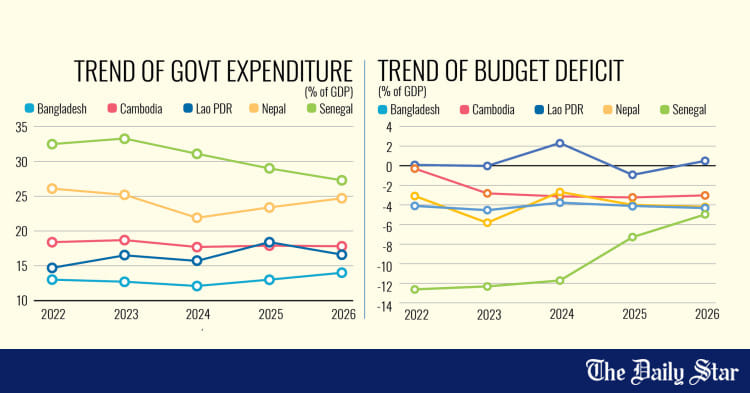
Bangladesh's fiscal deficit is projected to remain above 4 percent of GDP through 2026, as revenue growth continues to fall short of expanding public expenditure.

Despite rising development needs, the country allocates a significantly smaller share of its economic output to public spending than its South and Southeast Asian peers. In 2025, Bangladesh's public expenditure stood at just 13.0 percent of GDP, compared to 23.4 percent in Nepal, 18.4 percent in Lao PDR, and 17.9 percent in Cambodia. The trend is expected to persist in 2026, with Bangladesh projected to spend 14.0 percent of GDP.

1746925717348.webp


At the same time, Bangladesh's revenue mobilisation remains among the weakest in the region. Government revenue is forecast to rise to only 9.8 percent of GDP by 2026, well below levels seen in countries with comparable or even lower income levels.

Public debt is rising gradually but remains modest relative to regional norms. Bangladesh's debt-to-GDP ratio is expected to reach 40.7 percent in 2026, up from 37.9 percent in 2022. Economists view the trajectory as broadly sustainable, though they caution that further borrowing capacity may depend on tangible improvements in tax collection and the efficiency of public investment.​
 
Analyze

Analyze Post

Add your ideas here:
Highlight Cite Respond

Govt for swift, coordinated action for LDC graduation
Bangladesh Sangbad Sangstha . Dhaka 11 May, 2025, 22:43

1747010427933.webp

Muhammad Yunus

Chief adviser Muhammad Yunus on Sunday called for urgent and coordinated action from all relevant agencies to ensure Bangladesh’s smooth and timely graduation from least developed country status.

He made the call during a high-level meeting with LDC Graduation Committee at the state guest house Jamuna, where progress on key deliverables was reviewed.

‘This whole thing is about coordination,’ the chief adviser said.

‘We already have the attention and support of investors, funders and development partners. Now, we must build on the efforts already underway and intensify our collective action to move forward with speed and purpose,’ he said.

Emphasising the importance of institutional readiness, Yunus called upon all stakeholders to move in unison.

‘We need a team that functions like firefighters. When the whistle blows, they must respond-fast, efficiently, and without delay and stay at the problem until it is solved,’ he said.

The chief adviser further assured that the Chief Adviser’s Office would take an active role in overseeing the process.

‘The highest office of the government will personally monitor the implementation of all graduation-related initiatives,’ he added.

During the meeting, the LDC Graduation Committee identified five priority actions that must be completed on an urgent basis.

The actions are: making National Single Window fully operational with participation from all relevant agencies; implementation of National Tariff Policy, 2023 through a clear action plan; execution of key measures under National Logistics Policy, 2024, including infrastructure projects; operational readiness of Effluent Treatment Plant at Savar Tannery Village; and full-scale operation of Active Pharmaceutical Ingredient Park in Gajaria, Munshiganj.

‘These aren’t just routine tasks-we need to see them as key steps, each one helps clear the way for our graduation and builds a stronger, fairer economy for everyone’, the chief adviser added.

Finance adviser Salehuddin Ahmed, chief adviser’s special assistant Anisuzzaman Chowdhury and special envoy for international affairs Lutfey Siddiqi attended the meeting, alongside members of the LDC Graduation Committee and policy advisers.​
 
Analyze

Analyze Post

Add your ideas here:
Highlight Cite Respond

Budget should draw clear roadmap for smooth LDC GRADUATION
Says FICCI President Zaved Akhter in an interview with The Daily Star

1747011702694.webp

Zaved Akhter

The upcoming national budget must outline a comprehensive roadmap to prepare for the country's graduation from the least developed country (LDC) club in 2026, prioritising tariff rationalisation, tax reform, and sustainable fiscal policies, according to a leading business leader.

"As Bangladesh approaches LDC graduation, the budget must demonstrate our readiness through tariff rationalisation and tax reforms," said Zaved Akhter, president of the Foreign Investors' Chamber of Commerce and Industry (FICCI).

In an interview with The Daily Star, Zaved emphasised fiscal measures that support compliant labour practices, sustainable business models, and alignment with environmental, social, and governance (ESG) standards -- key considerations for the post-LDC landscape.

First and foremost, he said that Bangladesh's tax system must be simplified by introducing a unified national value-added tax (VAT) rate.

"Our tax structure is complex, with multiple VAT rates across sectors. We need to simplify it by adopting a single national VAT rate, akin to the goods and services tax (GST) model used in other countries," said the FICCI president.

The existing system, fragmented by varying rates, creates confusion and compliance issues, according to the business leader. The question now, he said, is how effectively this transition can be implemented.
1747011737280.webp

"We cannot impose a unified VAT nationwide overnight. Instead, we should pilot it in a specific region, assess its impact on revenue collection, and then gradually expand to other areas and sectors," suggested Zaved, who is also the chairman and managing director of Unilever Bangladesh Ltd.

He advocated for reducing reliance on indirect taxes by broadening the direct tax base.

"We need to focus on expanding the tax net to capture more taxpayers, instead of over-relying on regulatory and supplementary duties," he said.

Zaved also called for transforming customs from a revenue-centric body to a facilitative agency.

"There's a misconception that customs only exist for revenue collection. It must also act as a facilitator," he said, adding, "We need an integrated digital information network that connects all tax departments."

Currently, these departments rarely communicate, hindering effective revenue collection, he commented.

"Better coordination with other government agencies could unlock significant revenue potential. If such interconnection is enabled, different government verticals could synchronise their services," Zaved said.

On the National Board of Revenue's (NBR) push towards cashless transactions, he said, "We talk about a cashless society, yet the infrastructure is far from ready. So how can we realistically transition to it?"

Sharing a personal experience, the Unilever Bangladesh chairman said, "Despite all the talk of a 'cashless market', when I pay VAT to the government, it can't be done digitally. I have to withdraw cash and pay the relevant officials. Why can't it go through the system directly?"

Therefore, he urged the authorities to raise the Tk 36 lakh cap on annual cash transactions to qualify for the reduced 25 percent corporate tax rate.

"We are hopeful that the NBR will introduce a forward-thinking, investor-friendly revenue policy -- one that curbs leakages while encouraging a competitive tax environment," he said.

'POLICY CONSISTENCY A MUST FOR ATTRACTING FDIs'

Foreign direct investment (FDI) in Bangladesh has remained persistently low, hovering below 1 percent of gross domestic product (GDP).

"We're even trailing behind Pakistan in attracting FDI," Zaved said.

But Bangladesh holds huge potential to draw foreign investment in sectors such as leather and agricultural processing, from farm-level operations to the full supply chain.

"To tap into this potential, policy consistency is crucial. One of our biggest weaknesses is the frequent and abrupt policy shifts," he said.

The business leader cited a recent example of an incentive scheme for electronics products that was withdrawn without prior notice last year.

"I understand the government had its reasons, but you can't just pull an incentive mid-flight. Investors might have already set up factories based on that incentive. At the very least, you should announce a future termination date rather than a retroactive withdrawal," he said.

Reflecting on the recent Bangladesh Investment Summit, Zaved said, "The summit helped restore some credibility for Bangladesh. It sent a positive signal that the country remains on track despite recent political changes."

'REFORM TO RETAIN INVESTORS'

The FICCI president identified two major reforms to increase investment. First, the separation of the NBR's policy and administrative functions, a process that is already underway.

Secondly, he sought the consolidation of investment facilitation agencies.

At present, investors navigate multiple agencies, such as Bangladesh Export Processing Zones Authority (Bepza), Bangladesh Investment Development Authority (Bida), Bangladesh Economic Zones Authority (Beza), Hi-Tech Park Authority, which he said "creates unnecessary confusion".

Zaved urged the government to set up a single investment authority to simplify the services.

"Investors shouldn't be running between 141 departments to get approvals. We need a genuine one-stop service that handles everything from licences to utilities -- like a relationship manager in banking," he said.

"If Bangladesh remains complicated while other countries simplify their systems, we'll keep losing out," he added.​
 
Analyze

Analyze Post

Add your ideas here:
Highlight Cite Respond

ICCB for strong SMEs to overcome LDCs challenges
Bangladesh Sangbad Sangstha . Dhaka 12 May, 2025, 22:59

1747096116192.webp


International Chamber of Commerce Bangladesh (ICC-B) on Monday laid emphasis on strengthening SMEs to overcome challenges Bangladesh will face after its graduation from Least Developed Countries.

‘SMEs are the backbone of any economy for its growth, development and employment generation. With the graduation to middle income country in 2026, Bangladesh will be facing tight competition from its competitors. Strengthening the SMEs will make immense contributions in the entire supply chain process,’ said ICCB vice-president A K Azad.

He said this while inaugurating a workshop on ‘Find and pursue the right standards for your business: A Hands-on workshop with the SME Toolkit in collaboration with the Asian Development Bank’s (ADB) Trade and Supply Chain Finance Program (TSCFP) and International Trade Centre (ITC)’ in the city, said a press release.

ICCB secretary general Ataur Rahman moderated the session while ITC associate programme officer Dang Tuan Ducand and software engineer Niklas Anders ANDERSSON delivered their presentations on different topics during the workshop.

Azad said Bangladesh also has to be compliance and ensure sustainability for export growth.

As such today’s workshop has been organized to engage textile, apparel, and footwear manufacturers in the pilot testing of the ITC or ADB Sustainability Standards Navigation Toolkit, he added.

He said the Toolkit has developed to help SMEs enhance their awareness of sustainability standards, assess their readiness for certification, and receive actionable recommendations for sustainable practices and compliance for export.

Azad thanked ADB TSCFP and ITC for taking the initiative in developing the toolkit and ensure that ICC Bangladesh will continue to organize workshops for strengthening the capacity of the SMEs to increase their exports.

About 40 participants from SMEs including apparels, textiles & leather industries and other corporate houses attended the workshop.​
 
Analyze

Analyze Post

Add your ideas here:
Highlight Cite Respond

Members Online

Latest Posts

Back
 
G
O
 
H
O
M
E