New Tweets

[🇧🇩] Banking System in Bangladesh

G Bangladesh Defense
[🇧🇩] Banking System in Bangladesh
299
10K
More threads by Saif


Banking sector needs drastic reforms to restore trust: BB governor
UNB
Published :
Nov 16, 2024 21:54
Updated :
Nov 16, 2024 21:54

1731804807728.webp


Bangladesh Bank (BB) Governor Dr Ahsan H Mansur has said that the banking sector requires drastic reforms, describing it as the backbone of the financial sector.

Speaking as the chief guest at the 'Mastercard Excellence Awards 2024' held at a hotel on Saturday evening, the governor acknowledged past irregularities in the sector and the central bank's shortcomings in regulatory affairs.

He, however, assured that drastic reforms would be implemented to ensure fairness and restore trust. "Irregularities happened in banks for a long period with state sponsors. It will take time to restore trust in our banking system domestically and globally," Dr Mansur said.

He said that banking sector reforms alone would not be enough and highlighted the need for other state organs and political commitment to achieve a robust financial system.

Dr Mansur dismissed fears of Bangladesh facing a crisis like Sri Lanka's, affirming that there are no severe risks in the banking sector at present. "The government is confident in restoring good governance in the financial sector," he added.

Trishita Maula, Acting Deputy Chief of Mission at the US Embassy in Dhaka, attended the event. CEOs of several leading banks, fintech companies, and merchants were also present.

The Mastercard Excellence Awards 2024 recognised 26 organisations for their contributions to building a sustainable digital economy and advancing financial inclusion.

Mastercard, which began its operations in Bangladesh in 1991 and became the first global payments operator to establish a local presence in 2013, continues to play a pivotal role in strengthening the country's digital ecosystem.

Over the years, the company has collaborated with government and private stakeholders to transform the payments industry with its world-class products and solutions.

Syed Mohammad Kamal, Country Manager for Bangladesh at Mastercard, said, "Mastercard remains committed to digital innovation and fostering inclusive growth in the country. The company is pleased to collaborate with leading banks, fintechs, and merchants as partners."​
 
Analyze

Analyze Post

Add your ideas here:
Highlight Cite Respond
  • Like (+1)
Reactions: Bilal9

Default loans soar to Tk 2.85 trillion, actual scenario emerges
Staff Correspondent
Dhaka
Updated: 17 Nov 2024, 20: 00

1731893589143.webp


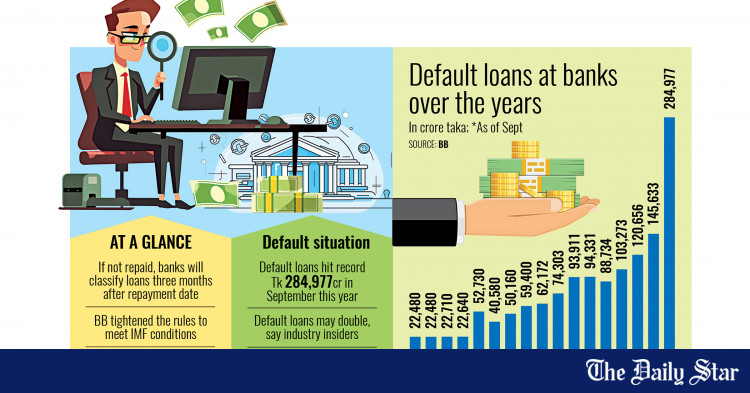
The volume of defaulted loans increased to Tk 284,977 crore (about Tk 2.85 trillion) at the end of September, with a humongous rise of bad loans by Tk 735.86 billion in the banking sector in three months.

This is the first time the information of defaulted loans became available since the fall of the government on 5 August, revealing the actual amount of the bad loans.

The money that was taken out from banks during the regime of Sheikh Hasina-led government of Bangladesh Awami League (AL) until it was ousted in the face of a student-people uprising, is now being identified as defaulted loans.

As a result, nearly 17 per cent of the loans disbursed by the banks in the country have become defaulted, which was 12.56 per cent at the end of June.

According to the Bangladesh Bank (BB), the amount of defaulted loans at that time was just over Tk 2.11 trillion.

When the Bangladesh Awami League formed the government in 2009, the amount of defaulted loans in the country was Tk 224.81 billion. Since then the bad loan has seen a steep rise in the last 15 and a half years.

The economists, for a long time, have been alleging that under the state patronage, a huge amount of the money has been looted from the banks in the name of defaulted loans and laundered abroad.

Even different types of initiatives were taken so that the banks could disburse a huge amount of money as loans to the influential people and show the amount less in the banks’ ledger books.

The central bank, the Bangladesh Bank, however, has shifted its stance from that policy.

According to the regulatory body, the role of private banks was more than the state-owned banks in the rise of defaulted loans from June to September.

The bad loans increased by Tk 236.28 billion at the state-owned banks against the amount of Tk 498.85 billion at private banks in the three months.

The six Islamic banks that were under the control of the controversial S Alam Group have started revealing the actual state of their financial conditions following the fall of the government.

Besides, former prime minister Sheikh Hasina’s adviser Salman F Rahman’s Beximco Group, Bashundhara Group and S Alam and a few other large business conglomerates have become defaulted, leading to exacerbating the situation.

The people related to the banking sector, however, think the actual amount of defaulted loans is far more than the amount published.

They pointed out that the central bank could not count the loans written off and on the list of stay orders due to the court order.

Top officials of the central bank think the actual scenario would be revealed more in the coming days due to the steps the interim government has taken for reforming the banking sector.​
 
Analyze

Analyze Post

Add your ideas here:
Highlight Cite Respond
  • Like (+1)
Reactions: Bilal9

No bank will be closed
Salehuddin says

1732063895359.webp


Although some banks are going through a crisis, no bank will be shut down, Finance Adviser Salehuddin Ahmed said as he urged depositors not to panic.

He made the remarks while addressing a press conference at the Secretariat yesterday, reiterating the stance that Bangladesh Bank Governor Ahsan H Mansur had taken the prior day.

"Some banks are crawling while others such as Islami Bank have recovered already. But I want to assure depositors that no bank will be shut down," Ahmed said during a media briefing to mark 100 days of the interim government.

The banking sector in Bangladesh has been facing a series of crises in recent years, marked by rising non-performing loans (NPLs), liquidity shortages, and governance challenges.

The banking sector has been facing a series of crises in recent years, marked by rising NPLs, liquidity shortages, and governance challenges

Bad loans hit a record Tk 284,977 crore at the end of September, fuelled by weak enforcement of regulations, political interference, and inadequate credit risk assessment during the regime of the recently ousted Awami League-led government.

Some private Shariah-based banks and a few state-owned banks were at the centre of controversy, becoming embroiled in massive loan irregularities that were often linked to companies and borrowers with affiliations to the previous government.

This eroded public confidence and created operational challenges, including cash shortages.

Highlighting various irregularities under the past government's watch, Ahmed said policies taken at that time were not bad, but they were not implemented properly.

However, after taking charge, the interim government has assumed the responsibility to salvage the banking sector and efforts are being made to this end, the finance adviser said.

For example, ailing banks are getting liquidity support from the inter-bank money market, he said.

"Depositors kept their hard-earned money in banks so efforts will continue in order to ensure that deposits are unaffected," he added.

Ahmed also said various reforms to the banking sector have been initiated, adding that laws are being amended and that reforms would be made to the central bank as well.

He stressed that the job of the central bank is only to supervise, inspect and audit.

"I heard audit reports were previously sent to the central bank governor and deputy governor for approval. And if those reports impacted any influential person, then they would be scrapped. That should not happen. Measures should be taken according to the findings of the audit report."

Ahmed also urged businessmen to move ahead without fear.

He said that some people are saying that businessmen are fearful but added that honest entrepreneurs should not be afraid. Those involved in irregularities have reason to be scared although many have already fled the country, he added.

During the briefing, the finance adviser also addressed the impact on small investors in the stock market, acknowledging their losses from investments in poor performers. Compensation measures are being considered, according to Ahmed.

Finance Secretary Md Khairuzzaman Mozumder, Financial Institutions Division Secretary Nazma Mobarek, Economic Relations Division Secretary Md Shahriar Kader Siddiky and National Board of Revenue Chairman Md Abdur Rahman Khan were present at the press conference.​
 
Analyze

Analyze Post

Add your ideas here:
Highlight Cite Respond
  • Love (+3)
Reactions: Bilal9

Helping banking sector stand on its feet
Published :
Nov 19, 2024 22:28
Updated :
Nov 19, 2024 22:28

1732066432250.webp


Disbursement of loans bending rules to businesses enjoying political favour during the previous regime had been behind stiff rise in non-performing loans (NPLs) or bad debts in the banking sector. Though substantial amounts of funds were thus siphoned from the banks using fictitious names of borrowers and relaxing banking rules for the purpose, those were shown as regular. Now, the amounts so robbed have added to the existing NPLs. However, the exact amount of those NPLs could not be known during the previous regime due to massive data manipulation and under-reporting by the Bangladesh Bank (BB) authority of that time as well as the management of those looted banks for obvious reasons.

Now that the present BB authority is transparent about figures and has started using international standards in counting defaulted loans, the total NPLs figures, unsurprisingly, have registered a sharp rise. To be more specific, now loans are being classified as NPLs three months (the grace period) after those become overdue, whereas, earlier, the grace period was six months. As the September data of the BB showed, the NPLs have surged to a staggering sum of Tk2.85 trillion. Notably, this is a rise by about 96 per cent recorded on September30, 2024 over what it was at the end of December 2023 at Tk1.55 trillion.

Obviously, observers including experts have expressed grave concern about this alarming rise in default loans warning of its deleterious impact not only on the banking sector, but also on the entire economy. Evidently, the situation calls for carrying out a comprehensive audit of all the loans advanced so far by both the state-owned and private commercial banks to uncover the exact amount of NPLs and losses sustained by the banking sector. Also, efforts should be on to find out those who benefited from the defaulting loans and bring them to justice. If necessary, arrangements may be made to hire reputed international firms to perform the audit to assess the exact position of the NPLs and the losses thus suffered by the banks.

At the same time, to recover the losses, legal measures should be taken to confiscate property of the fraudulent bank defaulters. However, while taking such penal measures against wilful loan defaulters, care should be taken not to punish genuine businesses who failed to repay their loans in time due to the losses made during the floods followed by political upheaval and other issues born of various uncertainties including high inflation. Since a significant portion of this defaulted loan money has been taken outside the country through laundering, to retrieve those lost bank assets from foreign lands, the government should seek cooperation of the governments of the destination countries. In this regard, the chief adviser of the incumbent interim government, Dr Muhammad Yunus, might well use his enormous goodwill and influence at the international level to bring back the money lying in foreign banks and offshore accounts.

The good news is that multilateral lending agencies and financiers like the International Monetary Fund (IMF), the World Bank (WB) and the governments of the USA and the UK have already given word to help Bangladesh recover its money thus stolen and taken illegally abroad by fraudulent businesses and loan defaulters. Hopefully, with the reputed financial experts running the affairs, the interim government should be able to bring down NPLs to a tolerable level and recover a substantial portion of losses the banking sector incurred even within the limited time it has in its hands.​
 
Analyze

Analyze Post

Add your ideas here:
Highlight Cite Respond
  • Like (+1)
Reactions: Bilal9

BB asks banks to rebuild image

1732579268725.webp

Photo: Star/File

Bangladesh Bank yesterday asked banks to find a way to rebuild the image of the country's banking sector in the international arena as Moody's recently downgraded Bangladesh's long-term ratings to B2 from B1.

The ratings agency also changed the outlook of Bangladesh to negative from stable and downgraded Bangladesh's banking sector to "very weak" from "weak".

The central bank's instruction came during a meeting between Bangladesh Bank Governor Ahsan H Mansur and the Association of Bankers, Bangladesh (ABB), a platform of the top officials of banks, at the central bank headquarters.

Selim RF Hussain, chairman of the ABB and managing director of BRAC Bank, Syed Mahbubur Rahman, managing director of Mutual Trust Bank, Sohail RK Hussain, managing director of Bank Asia, and Ali Reza Iftekhar, managing director of Eastern Bank, were present.

The meeting discussed the overall situation of the banking sector alongside the Moody's ratings, which the bankers said would lead to further difficulties in their international trade.

Correspondent banks impose higher confirmation charges and reduce credit lines due to such types of ratings, they said.

Urging for working to brighten the country's image, Mansur recommended first settling overdue letter of credit (LC) payments, reasoning that it damages the image at the international stage and pushes up import costs.

The overdue LC payments stands at $400 million so far, with state-run banks accounting for the biggest amount, central bank officials told The Daily Star on condition of anonymity.

The meeting also discussed the liquidity situation in the banking sector, especially in some banks, said Husne Ara Shikha, executive director and spokesperson of the central bank.

She said the BB governor asked the lenders that were financially sound to find a way to mitigate the crisis.​
 
Analyze

Analyze Post

Add your ideas here:
Highlight Cite Respond
  • Like (+1)
Reactions: Bilal9

Why is the banking sector crisis so deep-rooted?
Banking sector crisis

1732666422176.webp

FILE ILLUSTRATION: BIPLOB CHAKROBORTY

The crisis that Bangladesh's banking sector is facing now is not simply a bundle of problems exclusive to banking, monetary, financial, accounting or managerial aspects. The sector is a victim of political extortion and rent-seeking cultures. The irregularities of the other five institutions of the past regime are mainly attributable to what the banking sector faces now. These institutions include: i) the finance ministry; ii) capital market; iii) parliament and bank-related lawmakers; iv) top-level bank borrowers and bank directors; and finally v) the financial judiciary.

The moral hazards such as taking big-ticket loans and not paying them back were not confined to the banking sector alone. This culture of extracting people's money has been an integral component of big companies, ardently endorsed by corrupt politicians in power. Thus, the crisis in the banking sector is deep-rooted. The amount of defaulted loans as a share of total outstanding loans reached 12.56 percent in June 2024 from 8.96 percent in June 2022. At the end of September, the amount of defaulted loans escalated to almost Tk 2.85 lakh crore, which is 16.93 percent of the total outstanding loans. In December 2023, the International Monetary Fund (IMF) estimated the non-performing loan (NPL) share to be 25 percent of outstanding loans.

The turbulent July-September quarter saw an unprecedented increase of nearly Tk 74,000 crore in defaulted loans, vindicating that the sector is really in a crisis no matter if the government downplays it or not. The crisis was man-made since the default culture was largely wilful, indulged by the past regime for the monetary benefits of the corrupted politicians and laundering tycoons who received blanket endorsement for all their wrongdoings.

The share of defaulted loans rose from nine percent to 13 percent within the last two years when GDP growth was around six percent on average, suggesting that the default culture was largely wilful. Alarmingly, the default ratio that was shown in data is the tip of the iceberg, because the definition of default was perversely loosened by the past finance minister in 2019-2024 and the two central bank governors during the same period to revitalise the energy of the bank looters. That made the crisis worse.

The defaulters were allowed to adjust even as low as five percent of the defaulted loans to get rid of the "stigma" of default. The past Awami League regime allowed multiple loose definitions to let some notorious tycoons participate in the national election and make faulty laws in their favour. There is another way to see that the default culture was wilful and evidently not a macroeconomy-wide issue. The high variation in the NPL ratios based on various ownerships unveils the story of how the state-owned banks were subject to a higher degree of looting, while private or foreign banks were able to maintain much lower NPL ratios.

A Bangladesh Bank report shows that at the end of June 2021, the NPL ratios were 3.9 percent and 5.4 percent in foreign banks and private banks, respectively, while the number was as high as 20.6 percent in state-owned banks. The numbers are much higher than what we see here since these ratios were calculated under the loose definitions of default. One thing is clear: the looting was religiously state-sponsored and passionately orchestrated by the politicians in power. And that's why the crisis is hard to reverse.

Corrupt politicians indulged three groups of culprits—tax dodgers, loan defaulters, and money launderers—who formed the devil's triangle of cronyism, and often belonged to the same group of looters deeply connected with the previous regime. If you can show loss in your income statements by the wicked art of accounting, you can be excused as loan defaulters and you can avoid paying taxes. However, you don't want to keep the fund inside the country, and that's why both tax dodgers and loan defaulters turn out to be money launderers at the same time.

The current Bangladesh Bank governor, Dr Ahsan H Mansur, said last month that $17 billion have been laundered out of the country over the 15-plus years of Awami League regime; only one Chattogram family is alleged to have laundered $10 billion alone. He also said Tk 4 lakh crore is now the de facto defaulted loans that form 25 percent of the total advances. And Tk 2 lakh crore has gone to only a handful of families. This group of mafias plundered Bangladesh's banking sector to dump it into an incurable crisis. Much to people's frustration, some of them became members of parliament and even ministers, while some were made ministerial-level advisers to the former prime minister. The parliament turned into a haven of financial hooligans. The crisis will never end if people see the return of the same political practice of cultivating the tycoons' support in exchange for letting them plunder the banking sector.

More family-based banks were allowed to mushroom in the name of enhancing competition, while a Chattogram-based family was encouraged to eclipse as high as seven banks single-handedly under the service of the intelligence agencies whenever needed. Any allegation or court case against that family was made "unwarranted" by influencing the judiciary. Most default cases fell in the quagmire of judicial tardiness for years, worsening the fate of loan recovery.

Thus, the regime-sponsored immorality to protect or pamper the financial gangsters not only eroded the future of the banking sector, but also made the wound too difficult to recover. Since the crisis in the banking industry is not simply its intrinsic problem, we need to correct those five institutions or related laws before we can expect a healthy recovery of the sector. Reforms must address these areas before energising the sector to move ahead swimmingly.

The writing draws heavily from the keynote speech at the BDI International Conference on Bangladesh held at the University of California, Berkeley on November 8-9, 2024.

Dr Birupaksha Paul is professor of economics at the State University of New York at Cortland in the US.​
 
Analyze

Analyze Post

Add your ideas here:
Highlight Cite Respond
  • Like (+1)
Reactions: Bilal9

BB tightens loan classification rules to meet IMF conditions
Bankers fear this may double default loans next year

1732752123065.webp


Payment failure for three months or 90 days after the due date will now lead to classification of loans regardless of type, according to new rules announced by the central bank yesterday, aligning with international best practices prescribed by the International Monetary Fund (IMF).

The new rules will be effective from April next year, replacing current different non-performing loan (NPL) labelling tenures for different types of bank loans.

This stokes fears about a surge in toxic loans within the banking sector, which stood at a record Tk 284,977 crore at the end of September this year.

While approving the ongoing $4.7 billion loan package for Bangladesh in January last year, multilateral lender IMF set several targets, including reworking loan classification rules.

The Bangladesh Bank (BB) issued a detailed circular yesterday regarding the loan classification.

As per the new rules, a loan will be classified as substandard when the overdue tenure is three to six months. It will be classified as doubtful when the overdue tenure is six to 12 months.

When the overdue tenure is 12 months and above, loans will be classified as bad and loss.

Currently, a loan is classified as substandard when the overdue tenure is three to nine months. It turns doubtful when the overdue tenure is nine to 12 months.

Under the new rules, the overdue tenure for bad and loss category remains the same as now -- which is 12 months and above.

The cottage, micro, small and medium enterprises (CMSME) currently enjoy different loan classification tenures, which have been revoked under the new rules.

CMSME loans are classified as sub-standard when the overdue tenure is six to 18 months. Those turn doubtful when the overdue tenure is 18 to 30 months. When the overdue tenure is 30 months and above, those loans are labelled as bad and loss.

In the new rules, there is no change in provisioning against loans.

Banks now have to keep 1 to 5 percent as a provision against general category loans. This provisioning rises to 20 percent against sub-standard loans, 50 percent against doubtful loans and 100 percent against bad loans.

In the notification, the central bank said a strong financial sector is necessary to support the growing economy in Bangladesh.

According to the BB, timely steps are necessary to reduce the rate of classified loans for financial stability. The government and the Bangladesh Bank have taken various initiatives to reform the banking sector.

As part of those steps, the BB said the instructions have been issued in light of international best practices.

The loan classification and provisioning policy was first introduced in 1989 under the financial sector reform programme in Bangladesh.

Later, various changes were made to the policy to align it with international best practices and methods. Two major changes were brought in 1998 and 2006.

However, the latest major revision of the loan policy was made in 2012, central bank officials said.

Loans disbursed through irregularities to Awami League-affiliated businesses turned sour at an alarming pace after the ouster of the Sheikh Hasina-led government on August 5.

Between July and September, bad loans soared 34.8 percent or by a staggering Tk 73,586 crore, according to BB data.

Bangladesh now has the highest ratio of defaulted loans in South Asia, with nearly 17 percent of the total disbursed loans having gone bad.

Bankers said bad loans will increase further in the upcoming days thanks to the tightening loan classification rules.

"Bad loans will surpass Tk 300,000 crore by December," said Mohammed Nurul Amin, a former chairman of the Association of Bankers Bangladesh (ABB), the forum of bank managing directors and chief executives.

"If the loan classification rules are tightened, this number will jump," said Amin, the chairman of Global Islami Bank.

A World Bank (WB) team is now in talks with the central bank to support banking sector reforms. They urged the BB to implement the international standard loan classification rules immediately.​
 
Analyze

Analyze Post

Add your ideas here:
Highlight Cite Respond
  • Love (+3)
Reactions: Bilal9

A welcome step that needs proper implementation
29 November, 2024, 00:00

THE Bangladesh Bank tightening loan classification rules by shortening the period of overdue loans to become non-performing to six months from nine months is welcome. The rules aligned with international practices, issued in a circular on November 27, would give a clearer picture of non-performing and bad loans in the banking sector. The rules are likely to help the authorities regulate the banking sector more efficiently and to address distressed assets, including non-performing loans, more effectively. They will, as the circular says, come into effect on April 1, 2025. According to the new rules, loans overdue for three to six months will be classified as substandard, the first step of non-performing loans, while loans will be classified as doubtful if they remain overdue for six months to a year. The period now is nine months to a year. Loans overdue for more than a year will be classified as bad loans. This classification had, in fact, previously been in use but was altered by the previous government to obscure the extent of defaulted loans. The reduction in the period might, as economists say, see an increase in non-performing loans and pose challenges to some businesses but will help to discipline the banking sector in the long run.

Bangladesh Bank data show that the amount of defaulted loans increased to Tk 2,84,977 crore in September, about 17 per cent of the total bank loans of Tk 16.82 lakh crore. This is the highest ratio of defaulted loans in South Asia. The previous government, which offered irrational concessions one after another to defaulters, showed a lower figure of defaulted loans. Once the new rules come into effect, the figure is likely to increase, but it will also put regulatory authorities in a better position to address the issue that has crippled the banking sector. The new rules are also likely to help banks address provision shortfall, which increased to Tk 55,378 crore in September from Tk 31,549 crore in June. Keeping to the new rules, banks must maintain provisions against their general category loans at a rate of 1 per cent and 5 per cent of the loan balance for special mention accounts, a category newly introduced. Loans that remain overdue for two to three months will be categorised in special mention accounts. Banks are also required to maintain 20 per cent provision for loans in the substandard category, 50 per cent for loans in the doubtful category and 100 per cent for loans in the bad or loss category.

All this appears to be a positive step towards disciplining the banking sector, on the edge of collapse for a decade and a half because of political influence, manipulation and lack of democratic governance. The government and the central bank should, therefore, enforce and implement the steps to ensure transparency, accountability and sound management practices in the banking sector.​
 
Analyze

Analyze Post

Add your ideas here:
Highlight Cite Respond
  • Like (+1)
Reactions: Bilal9

Posts you haven't read yet..

Members Online

Latest Posts

Back
PKDefense - Recommended Toggle