New Tweets

[🇧🇩] July uprising

G Bangladesh Defense
[🇧🇩] July uprising
73
2K
More threads by Saif


Investigation-5
July uprising: Most of the deceased were working-class people

Ahmadul Hassan Dhaka
Updated: 20 Jul 2025, 12: 04

1753059211866.webp


The majority of the deceased killed in July uprising were working-class people. At least 284 individuals from the labouring classes were martyred in the uprising.

Day labourers, rickshaw pullers, rickshaw-van drivers, CNG auto-rickshaw drivers, truck drivers and their helpers, shop workers, restaurant employees, and garment factory workers — both from formal and informal sectors — lost their lives during the uprising.

Out of the 844 names listed in the government’s official gazette of martyrs, Prothom Alo gathered specific information on 810 individuals. The newspaper interviewed the families of every one of them.

Based on family accounts and a breakdown by profession and age, the analysis shows that after labourers, students comprised the second-largest group of victims — 269 in total.

A significant number of these students were under the age of 18. School, college, and madrasah students, many of them minors, were at the forefront of the movement. According to Prothom Alo’s investigation, at least 133 children were killed during the uprising.

After labourers and students, the next highest number of deaths occurred among small and medium business owners — at least 120 lost their lives. They were followed by private sector employees, numbering 108.

Students led the uprising. But as the movement for equity and justice spread, people from nearly every class and profession joined in. This trend is also reflected in the government’s list of martyrs.

Prothom Alo’s analysis shows that 35 per cent of those martyred were working-class people. Besides, 33 per cent were students while 15 per cent were small or medium business owners, and 13 per cent were private sector employees.

Most of the killed were under 35

Among those killed during the July uprising, 79 per cent were under the age of 35 — that is 638 individuals. Notably, 17 per cent of the victims were children under 18. The majority died from live ammunition, though some were hacked, beaten, or burned to death.

Ages ranged from a 4-year-old child to a 70-year-old adult. In demographic terms, people between 15 and 64 years of age are typically considered “economically active.” Among the 810 martyrs Prothom Alo documented, 767 fell into this age group — meaning 95 per cent of the dead were working-age individuals.

The movement that sparked the July uprising was driven in part by demands for employment. Unemployment, inequality, and social injustice were core grievances. That so many working-age individuals joined spontaneously and lost their lives underscores the deep impact of these systemic issues. The scale of this loss is devastating for any country.

Large number of labourers joined the uprising

Many of the working-class people killed during the uprising were the sole breadwinners in their families. Their deaths have left their loved ones devastated.

Prothom Alo’s analysis indicates that Dhaka’s Jatrabari, Uttara, Mirpur, Mohammadpur, and Rampura areas witnessed the highest casualties — at least 324 people died in these five neighbourhoods. These areas are also home to large working-class populations. Particularly in Jatrabari, Mohammadpur, and parts of Mirpur, where fierce resistance took place, working-class people played a central role.

One such victim was Rajib Hossain, a CNG driver shot dead in Jatrabari on 19 July last year. His father, Tofazzal Hossain, told Prothom Alo on Wednesday that Rajib had lived in a rented flat with his wife and two children. Since his death, the family has been in crisis. They had to leave Dhaka and move to Damudya in Shariatpur, where his wife’s family lives.

Other areas like Savar, Gazipur, and Narayanganj — densely populated with formal and informal sector workers, including garment laborers — also saw high death tolls. According to the investigation, at least 65 people died in Savar, 36 in Gazipur, and 34 in Narayanganj. Many were working-class individuals.

Most deaths occurred in 5 areas of Dhaka

Syed Sultan Uddin Ahmed, head of the Labour Reform Commission, told Prothom Alo that many labourers were killed while simply going to work. He said, “When a working-class person dies, the entire family falls into crisis.”

Labourers have long suffered systemic inequality, he added. Many could not accept the brutal killing of students, which pushed them to join the protests. The Labour Reform Commission has submitted several recommendations to the interim government for ensuring protection for the families of slain labourers, and for addressing structural inequality and improving workers’ living standards. These recommendations must now be implemented.

33pc of the victims were students

Among the dead were 269 students, including Abu Sayed and Mir Mahfuzur Rahman Mughda. The student deaths account for 33 per cent of all those martyred. The list includes students from public and private universities, schools, colleges, and madrasahs. One of them was 16-year-old Abdullah Al Mahin.

Mahin, a student of the National Institute of Engineering and Technology, was shot dead on 4 August in front of the Rajuk Commercial Complex in Azampur, Uttara. His mother, Samira Jahan, told Prothom Alo on Wednesday (16 July), “He told me, ‘What’s the point of studying if I don’t get a job because of discrimination?’ He said he would fight inequality even if it cost him his life. And he really did die.”

Another protester in Uttara was Sheikh Shihabuddin, a student of a polytechnic institute. Speaking to Prothom Alo, he said he joined the movement for two reasons: his belief in the demand to eliminate discrimination in employment and society, and the emotional trauma of seeing fellow students shot and injured. He recounted how indiscriminate gunfire tore through Uttara and how he helped carry wounded students to the hospital.

Youths faced the bullets

The July uprising was youth-led. Even in the face of police and military gunfire, they refused to abandon the streets.

A report published in February by the UN Office of the High Commissioner for Human Rights found that the Sheikh Hasina government employed systematic and increasingly brutal measures to crush the protests. Between 15 July and 5 August, more than 1,400 people may have been killed. The report stated that 66 per cent of the victims were shot by rifles, 12 per cent by shotguns, and 2 per cent by handguns.

Dhaka University professor of Population Sciences, Mohammad Mainul Islam, told Prothom Alo, “The youth who participated in the uprising became symbols of courage. One of the most striking aspects of this movement was the death of more than a hundred children and adolescents. Their sacrifice in the face of injustice and inequality will never be forgotten.”

[This report was prepared with assistance from Prothom Alo correspondents Md Mamun, Jannatul Naeem, Abriti Ahmed, and district correspondents.]​
 
Analyze

Analyze Post

Add your ideas here:
Highlight Cite Respond

July uprising: Extraordinary powers of the ordinary people
How thousands joined and aided protesters

1753323624058.webp


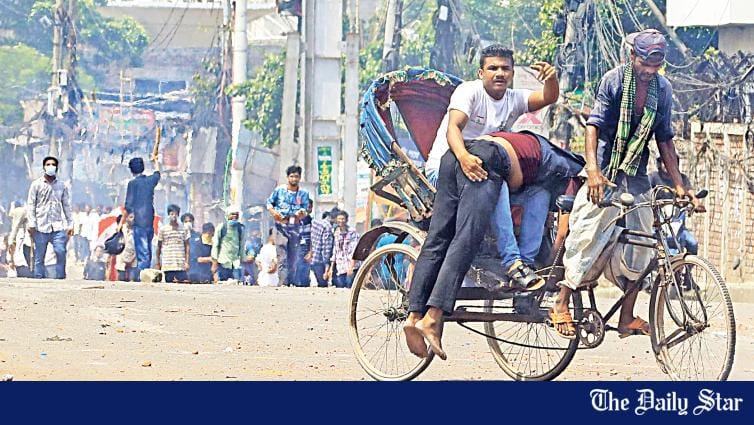
When bullets tore through a protester's head near a poultry shop in North Badda on July 19, Waliullah rushed to rescue him.

"I was on my way back from Friday prayers," he said. "He was bleeding from the skull. A few of us took him to a local clinic, then to Dhaka Medical."

The protester didn't survive. Waliullah, a garment worker, didn't even know his name.

But within days, police summoned him. "After that, my family never let me step outside again … But I wasn't the only one who tried to help. Friends, neighbours, strangers -- we were all drawn in."

The protests were loud, defiant, and spreading fast. But behind them was a quieter resistance.

Garment workers marched after shifts, homemakers handed out saline, retired officers guarded buildings while students hid inside. Elsewhere, teachers, imams, rickshaw-pullers and shopkeepers formed a silent safety net, keeping the movement alive in whichever way they could.

Sumaiya, a college student from Cumilla who once shrieked at thunder, found herself on the frontlines by August 2, 2024. "I wasn't that aware of the quota system…. But when I saw my friends' siblings return wounded, something in me changed."

Her father, Mamunur Rahman Chowdhury, 57, was too ill to join but helped in his own way -- sitting outside their Mirpur-10 home handing water to protesters.

"When I heard my timid daughter leading chants, I didn't stop her. This was everyone's movement."

As East West and Brac University students joined in, Rampura became one of the bloodiest flashpoints.

Fashion designer Safia Sathi, who lives in the area, recalled sounds of tear gas, stun grenades, and gunfire. "From my window, I saw helicopters dropping things on unarmed protesters."

When 17-year-old Shamudra, a boy from her neighbourhood, was shot dead, Safia couldn't stay in. On July 18, she and her friends stepped out with water, bread, and biscuits. "It was the least we could do."

Suyel Haque, a student from Khilkhet, joined when the movement was still about quota reform. As it escalated, he ended up on the frontlines in Rampura and Uttara.

"On July 18, a civilian offered help near Jamuna Future Park. The next day, a group brought food, bottled water, masks, saline, even toothpaste. Police threw sound grenades, but those people stayed."

He remembered bottles and biscuits tossed from balconies.

When Chhatra League attacked, the owner of the Vivo Mobile showroom in the area opened his store and gave them Wi-Fi.

In Bhasantek, Café Mama Hotel owner MA Hossain couldn't join protests but still acted. "From July 18 to 20, I sent about 90 boxes of food to students."

He was later arrested, taken to Bhasantek Police Station, and accused of aiding protesters. "I had to pay Tk 3 lakh to get out," he said. Later, plainclothes DB officers picked him up again. "I had to use every contact I had."

But protesters like Mosharraf Sardar didn't forget. "For three days straight, we got food from Café Mama Hotel. The staff brought it to Hope International School by CNG."

In Chattogram, Bahaddarhat and New Market intersection turned into epicentres on July 16.

Mizanur Rahman, a businessman from Riazuddin Bazar, recalled, "They were firing at unarmed students. So, we gave the children over 100 cricket stumps to defend themselves."

By the month's end, Mizan and other small traders were supplying water and tiffin cakes. "We communicated with the protesters and delivered the food in secret."

Protesters at Barishal University still remember 35-year-old Eliza Begum, a widowed mother of two.

Living in Kornokathi village, opposite the campus, she acted without hesitation. "When we heard the protesting students were going hungry, we couldn't sit idle. On July 18, we cooked rice, lentils, curry and fed it to them. In the evening, we cooked khichuri."

Student Rabiul Islam said Eliza and others became lifelines. "Despite lockdowns and fear, they eased our suffering."

"No one told us to help," Eliza said. "We just thought of their pain. After all, we all have children too."

Nazrul Islam, 48, a tea-stall owner in Savar, provided water, bananas and dry food. "From July 19 to August 5, I helped because I wanted a better country -- one where I could vote freely."

His shop was later attacked by AL activists, who accused him of assisting protesters.

Civilians also became medics and stretcher-bearers, with no training or safety.

On July 18, as Dhanmondi-27 turned into a battleground, two young doctors converted their Satmasjid Road garage into a makeshift clinic.

Dr Worthy Jukhrif and Dr Hritisha Aktar Mitheen treated over 100 people in two days. Neighbours brought antiseptics, orsaline, water, and biscuits.

Worthy, a private hospital doctor and health show presenter, saw students huddled below her balcony. "I rushed down. Others, like Dr Mitheen, were already there."

She vividly remembers a 10-year-old with pellets all over his body. "I treated him, sent him home. Hours later, he returned with another pellet in his forehead. Other protesters later showed me a video of him, lifeless on the street. I still can't forget that child."

Mitheen, now pursuing her post-grad, said, "Humanity is what I acted upon. I couldn't hold back."

Neighbour Khurshid Jahan said, "While the doctors treated wounds, we brought water, first aid, clothes."

But soon, their building was under surveillance. Drones flew overhead. Phones were traced. "…I was nervous. But my duty was to humanity," Mitheen said.

Worthy added, "Blood carries no political identity. The students' gratitude made it all worthwhile."

Associate Professor Akhlima Akhtar of Government Nazrul College couldn't stay silent when students were attacked.

She rushed downstairs when one was cornered. "They called him a terrorist. I asked, 'Does he have a weapon? What makes him a terrorist?' Then they turned on me…"

"I don't know any party. I recognise students. A teacher's duty is to protect them."

After Abu Sayed was killed in Rangpur, her grief deepened. "If I had been there, maybe I could've saved him."

Imam Saeed Mohammad Hasan Al-Azhari of Shahjahanpur Railway Jam-e-Masjid, said, "Islam teaches us to stand against injustice. When police tortured students, how could I stay quiet?"

On July 16, he condemned the crackdown from the mosque. By August 3, he was marching with them in Chattogram.

"I got anonymous calls, death threats. My father was warned I'd be 'taken care of'. Mosque authorities were told to bar me."

Unflinching, he said, "A just imam must stand with the oppressed. And justice isn't seasonal."

A year later, the memories remain.

"I still think of that boy I carried to Dhaka Medical," said Waliullah. "He died. But I can't forget his face."

Akhlima still teaches, still faces scrutiny. "Even now, I tell my students -- don't fight with violence. But never surrender your conscience."

And for many like Safia, the reason for stepping up was simple -- "We just didn't want to see anyone else die."

Nazrul, the tea-stall owner, was subdued a year on. "I hoped for a better country. It wasn't good before. But it's not good now either. I just want a country where we can vote, freely and fairly."

(Our correspondents from Savar, Barishal and Chattogram contributed to this story)​
 
Analyze

Analyze Post

Add your ideas here:
Highlight Cite Respond
How organisational strategy made the July uprising possible

ANUPAM DEBASHIS ROY
Published :
Jul 24, 2025 23:29
Updated :
Jul 24, 2025 23:29

1753402468449.webp

Sketchs of Abu Bakar Mojumdar, Asif Mahmud, Sarjess Alam, Nahid Islam, Hasnat Abdullah and Nusrat Tabassum. The six coordinators of Anti-Discrimination Student Movement who were taken into DB custody in July last year.

A year since the July uprising, an old theory has found new life in public discourse—the “meticulous design” thesis. In a recent Facebook post, one of the key organisers of the 2024 uprising, now serving as an advisor on information, Mahfuz Alam, claimed that even if partially, the uprising unfolded according to a deliberate and well-orchestrated plan.

I cannot entirely agree with Mahfuz Alam’s assessment. Yet I do believe that the students were not acting on impulse; they had, in fact, been preparing and organising for quite some time. That is the argument I want to explore here.

In the social sciences, there is a long-standing criticism of “centralised planning”—one that suggests social and economic phenomena cannot be fully executed as premeditated designs. Friedrich Hayek’s reflections come to mind here. He once remarked “The curious task of economics is to demonstrate to men how little they really know about what they imagine they can design.”

Although I strongly disagree with Hayek’s vision of the “night-watchman state,” I partially agree with his argument about the limitations of planning.

There may well be prior plans in place, but in practice, the context is so fluid and unpredictable that such plans often collapse or require drastic adaptation. In any uprising, it is nearly impossible to predefine the precise timing of decisions. Movements—especially when confronting the state—operate under conditions that resemble a game theory scenario, where each side’s choices heavily depend on the actions of the other.

The brilliance of the student leadership lay in how they navigated this game. Like masters of strategy, they consistently outwitted the state. One incident stands out: when DB Harun (then Additional Commissioner of the Dhaka Metropolitan Police) detained frontline student leaders and coerced them into announcing the withdrawal of the protest, the remaining organisers—those not yet detained—swiftly responded by calling for the continuation of the movement. That counter-move not only saved the momentum but also reasserted control over the movement’s trajectory.

This wasn’t an isolated episode. We saw something similar during the 2018 road safety protests, where a group of students was paraded before the media to declare the end of the movement. But July was different—this time, the organisers had a secret weapon: organisation.

Because of this organisational backbone, when the front ranks were neutralised, the second tier of leadership could step forward and continue the mobilisation. If there is any merit to the “meticulous design” thesis, it lies precisely in this structural preparedness.

But this organisational capacity did not emerge overnight. It was the product of sustained political cultivation—particularly rooted in the 2018 quota reform and road safety movements. It was during these struggles that students came to realise that lasting change is not possible without a clear political project and the habits of political engagement.

Since then, slowly but steadily, a culture of discussion, self-education, and organisation began to take shape—deeply political in character. We might cite examples such as Swachintan at Jahangirnagar University or the “Gurubar Adda” at Dhaka University. Across campuses, friendships and alliances were formed through shared protest and resistance.

It was from this milieu that a new student organisation—Gonotantrik Chhatra Shakti (Democratic Student Power)—emerged, particularly in response to the limitations of the earlier Gonodhikar Parishad (Council for Public Rights), itself born from the quota protests.

Many of the front-liners of the July Uprising came up through ChhatroShokti. But in the face of a growing movement, they built something larger still: a new confederation called Boishommobirodhi Chhatro Andolon (Anti-Discrimination Student Movement).

This strategic shift reflects a key lesson from academic literature as well. Mancur Olson’s theory, for instance, explains that the most effective strategy for collective action often lies in federating smaller units into a broader front. That is exactly what July’s organisers did.

The confederation brought together not only Chhatra Shakti but also a wide array of students aligned—openly or discreetly—with both leftist and centrist political traditions. Importantly, however, this front positioned itself not as “apolitical,” but as politically independent.

This distinction matters. They never claimed to be neutral. Rather, they always had a political project—one that revolved around removing the Hasina government. If that could not be achieved through the quota issue, then it would be pursued via some other avenue.

Seen in that light, the quota reform movement was not the destination but the entry point—a gateway to a broader anti-Hasina mobilisation. And many among the students had been waiting and preparing for such a gateway, envisioning 2026 as the focal point for their ambitions.

Fate, however, offered them an opportunity earlier than anticipated—and they did not miss it.

Even so, throughout the uprising, organisers made a calculated effort to identify themselves as politically independent. This was not accidental. It was a strategic move to prevent the government from branding them as operatives of BNP or Jamaat, which would have given the state pretext for a brutal crackdown.

They deployed what I call “strategic apoliticism”—not the absence of politics, but a temporary decision to underplay their political identities in order to protect the movement.

Of course, after the uprising, many student leaders publicly acknowledged their political affiliations and began arguing over credit. But during the uprising itself, most of them maintained that silence for the sake of the movement.

It’s important to underscore this: while outwardly appearing non-partisan, this was at its core a profoundly political movement. That political project is now partially embodied in the emergence of the National Citizens’ Party (NCP). But the goals of these organisers always went beyond electoral politics. They aspired toward revolution—a full transformation of the political order.

They held revolutionary desire, shared revolutionary consensus, and constructed a revolutionary alliance. And indeed, they encountered a revolutionary moment. But under pressure from multiple sides, they eventually chose not a revolutionary resolution, but a middle path.

And that middle path, in hindsight, sometimes looks less like balance and more like mediocrity.

Crucially, one major engine behind the uprising was a mass of genuinely non-partisan individuals—students and citizens who may not have supported any political party but had become deeply disillusioned with Awami League’s rule. Some had even supported the regime before, but the pile-up of corpses changed their minds.

Whether NCP can attract these voters remains an open question. Many of July’s organisers are now within NCP, but a substantial section of that mobilisation is conspicuously absent. After the uprising, many activists returned home. These are people uninterested in joining a party or pursuing a share in power.

Back in 2018, I wrote about this demographic and called them the “Third Force” in Bangladeshi politics. Today, the question is: who can earn their trust? Sadly, I fear NCP may already have lost a large share of this constituency.

The confederal structure that powered the July uprising has now been replaced by a more centralised model of politics. Former allies—including many on the left—have been sidelined. Central control is slowly becoming visible. The result is a weakening of organisational power.

No matter how large the crowds may be at NCP’s rallies or road marches, without rebuilding this organisational base, the party will not endure. At the very least, in honour of July’s legacy, NCP should seek to rebuild a broad coalition among its surrounding factions, parties, and alliances. That is the only path to institutional strength.

If NCP hopes to become the rightful heir to July, it must begin by learning from July itself.

Anupam Debashis Roy is Editor-in-Chief of Muktipotro and a DPhil researcher at the University of Oxford.​
 
Analyze

Analyze Post

Add your ideas here:
Highlight Cite Respond

Recognising roles of July movement actors

Tanim Asjad
Published :
Jul 25, 2025 22:36
Updated :
Jul 25, 2025 22:36

1753488627155.webp


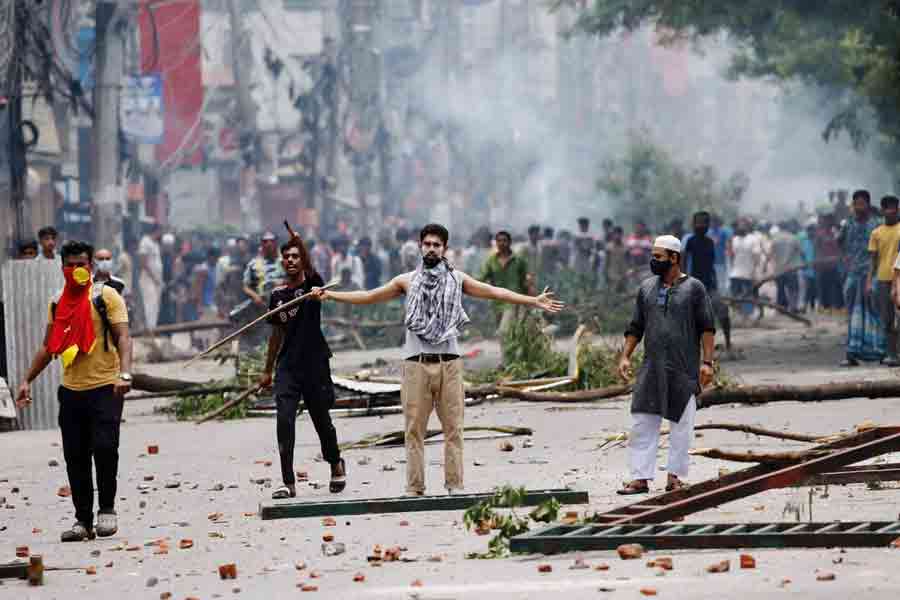
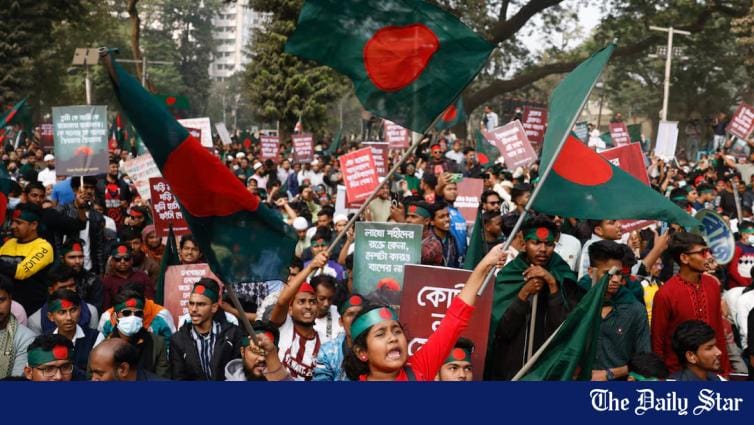
A demonstrator gestures as protesters clash with Border Guard Bangladesh (BGB) and the police outside the state-owned Bangladesh Television as violence erupts across the country after anti-quota protests by students, in Dhaka, Bangladesh, July 19, 2024. Photo : REUTERS/Mohammad Ponir Hossain/Files

Around 34 years after the fall of the autocratic regime of Ershad, the country has witnessed another mass uprising against the authoritarian regime of Sheikh Hasina in the last year. Although the two events are not entirely comparable due to differences in intensity and complexity of the dynamics, some similarities are also present.

Ershad seized power in 1981 through a military coup, removing a democratically elected government while serving as the country's army chief. In the next nine years, protests and movements against his autocratic regime continued despite military restrictions and oppression. During this period, mockery of the parliamentary system occurred in the context of two parliamentary elections, and non-functional parliaments coexisted alongside a centralised power structure, with all authority concentrated in the hands of President Ershad. The students first ignited the anti-Ershad movement. Leading political parties, the Bangladesh Nationalist Party (BNP) and the Bangladesh Awami League (BAL), gradually came to the streets and shaped the movement. Hasina-led BAL, however, joined the third parliament election in 1986. Before disclosing the party's decision to participate in the election, Hasina publicly declared that those who would take part in any election under Ershad were 'national traitors'. She did not hesitate to disown her own words within a few days. BNP leader Khaleda Zia was insistent on her strong stance on not participating in any election under Ershad. Both parties, however, abstained from participating in the 1988 parliamentary election, as the movement against the Ershad regime intensified.

The final blow against the regime came in 1990 as all the student organisations joined hands. Their unified position was a crucial turning point of the movement and helped the political parties move ahead. Ershad finally stepped down on December 6, 1990, handing over power to the country's first caretaker government. Bangladesh embarked on the path of democracy after a nine-year struggle.

Similar to the movement against Ershad, students led the movement against Hasina in 2024, where the role of political parties was limited. The intensity of repression by her regime was so brutal that it has no match with Ershad's. During the July mass uprising, around 1,400 people were killed in 36 days, whereas more than 20,000 people were injured, and around 11,700 people were detained and tortured.

Although Hasina-led Awami League assumed power in 2009 following a landslide victory in the eighth parliamentary election on December 29, 2008, in the years that followed, she gradually eroded the integrity of the election process. In the next three parliamentary elections, she and her party took whatever measures were necessary to stay in power, thereby depriving the masses of the opportunity to cast their votes. Despite being a big beneficiary of democracy, she gradually turned herself into a cruel authoritarian. Her party and its affiliated organisations, especially the Bangladesh Chattra League (BCL), became monsters. Though many development works were completed to boost the economic growth during the 15 years of the regime, corruption and plundering of national resources by Hasina loyalists reached a new high, widening socio-economic discrimination further. All these prepared the ground for a mass uprising in July last, which forced her to step down and flee, seeking refuge in India.

As students of public universities led the mass uprising and faced the most intimidation, they were later backed by the students of private universities. Breaking the misconception that students at the private universities are self-centred and maintain a safe distance from any socio-political activity, they exposed their sensitivity to the rightful causes. As students from the different private universities started to come on the streets in solidarity with their peers at public universities, it gave the movement a new momentum. The anger and protests later spread across schools and colleges. Another force of the movement was students of madrashas in the country. They also played a critical role in making the movement more people-oriented. Finally, the remarkable role of the female students and youths must be mentioned.

As the country reminisces about the fateful days of the July mass uprising, it is also time to objectively evaluate and acknowledge the role of the various groups that joined the movement. The unity, demonstrated by the participants, especially students and youths from different spheres of society, was instrumental in making the uprising a success.​
 
Analyze

Analyze Post

Add your ideas here:
Highlight Cite Respond

The July that rocked Bangladesh

1753495547487.webp

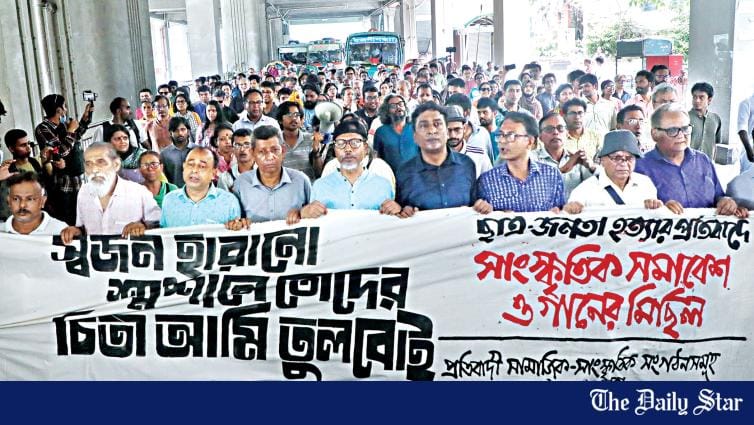
Members of various cultural and social organisations brought out a procession from in front of the Jatiya Press Club on the morning of July 26, 2024, emanding fair and impartial investigations -- under the United Nations -- into the violence and killings linked to the quota reform protests. FILE PHOTO

As Bangladesh reeled from days of unrest, the government intensified its crackdown. By 6:00pm on July 26, 2024, at least 738 more people had been arrested in the capital and several other districts in connection with the ongoing violence. This brought the total number of arrests over the past seven days to over 5,522, including many leaders of the BNP and Jamaat-e-Islami.

The Dhaka Metropolitan Police (DMP) alone detained 2,357 individuals in 209 cases filed at various police stations, citing allegations of violence, vandalism, and arson targeting government establishments and other institutions. Of these, 148 were arrested on July 26.

Google News LinkFor all latest news, follow The Daily Star's Google News channel.
Among the most notable detentions were three key organisers of the quota reform protests -- Nahid Islam, Asif Mahmud, and Abu Baker Majumder -- who were picked up by police from a city hospital where two of them were receiving treatment.

Junaed Alam Sharker, additional deputy commissioner of the Detective Branch of DMP, claimed the three had sought police protection and were taken into DB custody. "We will interrogate them about the incidents that took place in the last two days," he said.

Tragically, four more individuals who had suffered bullet wounds during the previous week died at hospitals in Dhaka within the 48 hours leading up to July 26, 2024. The deceased were identified as Imtiaz Ahmed Dalim, 20, a student of Southeast University; Mainuddin, 25, a madrasa student; Sohel Rana, 20; and Yeasin, 17.

Meanwhile, international voices of concern grew louder. United Nations experts issued a statement urging the Bangladesh government to ensure accountability for human rights violations, immediately halt the violent crackdown on protesters and political opponents, and fully restore access to the internet and social media platforms.

Then-prime minister Sheikh Hasina, during a visit to Dhaka Medical College Hospital around 4:30pm, condemned the recent violence and called for strict punishment for those responsible. She reiterated her appeal to the public to help identify those responsible for the attacks, calling the acts "heinous."

In a counter-statement, BNP Secretary General Mirza Fakhrul Islam Alamgir called for national unity among all democratic political and socio-cultural organisations to demand the resignation of the government. "At this critical moment of the nation, the aim of the unity will be restoration of democracy and voting rights," he stated.

Public outcry also took shape in other forms. Around 11:00am, a group of cultural and social organisations held a protest rally in front of the Jatiya Press Club, demanding an impartial UN -led investigation into the deaths, false cases, and indiscriminate arrests. They gathered under the banner "Protesting Cultural and Social Organisation."

From abroad, fifty academics under the banner of Bangladeshi Communication Scholars in North America (BCSNA) issued a statement expressing deep concern over the crackdown. They declared solidarity with the student protesters and demanded justice for the deaths of unarmed civilians. The group also called for an end to ongoing legal harassment and repression.

Adding to the chorus of concern, the Committee to Protect Journalists (CPJ) called on the Bangladeshi authorities to investigate the killings of three journalists and the ongoing attacks on reporters covering the protests.

As the day came to a close, Bangladesh remained locked in crisis -- its streets tense, its hospitals full, and its institutions under siege. While the state hardened its stance, voices from home and abroad continued to demand truth, accountability, and justice.​
 
Analyze

Analyze Post

Add your ideas here:
Highlight Cite Respond

Battle for the last word on the July uprising

1753495797400.webp

There are writers, intellectuals, and commentators in and out of Bangladesh who served as willing partners in Hasina’s crimes by backing her government intellectually. File photo: Orchid Changma

In early 2024, I attended a dinner with my family in Brookfield, in the US state of Wisconsin. It was hosted by a family very close to us. At dinner, I had a long conversation with two American men. At one point, we briefly discussed the situation in Bangladesh. One of them congratulated me on my country's "economic development and upward mobility."

For a while, I was bewildered. How could someone commend the putative economic growth of Bangladesh while its people were living in fear under Sheikh Hasina's mafia-style autocracy? Then I realised that the man was a victim of what Columbia Professor Gayatri Chakravorty Spivak calls "epistemic violence," or violence in the form of misinformation and disinformation. This violence is "inflicted through thought, speech, and writing rather than actual physical harm."

Let me explain this in the context of Hasina's 15-and-a-half-year despotic rule.

Bangladeshis under Hasina's regime suffered on two levels: physical and epistemic/cognitive/perceptual. The first one is direct and visible, and its effects are immediate; the second one is indirect and apparently invisible but much more vicious and pernicious with lasting consequences.

After coming to power in early 2009, Hasina emerged as cruelty incarnate. Her rule was marked by crackdowns on those whom she considered threats to the survival of her government and to her policies that compromised Bangladesh's interests. Initially, her political opponents, but later people of all walks of life, including primary and secondary schoolchildren, became targets of her murderous frenzy. She let loose different branches of security forces as well as her party men to bludgeon and sometimes even kill people. Enforced disappearances became a rampant and systematic state practice in Bangladesh. An unknown number of "Aynaghars" or secret torture centres were set up to confine surviving victims of enforced disappearances in conditions comparable to burial chambers.

This sad saga of oppression reached its peak during the last few weeks of her time in power. Security forces, aided and abetted by Awami League hooligans, raided houses in different areas in Dhaka and other major cities in what came to be known as (night-time) block raids. They intruded on residential areas to round up innocent students or anyone who looked like students.

Images of school-going children picked from their homes and dormitories, handcuffed and herded like felons, shocked the whole nation. In the run-up to Hasina's flight to India, roughly 1,400 people (mostly students) were killed by gunshots fired from the ground and helicopters in just a few weeks. Hundreds more young Bangladeshis suffered life-changing injuries, many of whom were denied medical care during the movement.

What I have described above are instances of physical violence, which are marked by dead bodies, scars, bruises, and survivors and bereaved family members. Therefore, this violence is visible. But Hasina was backed not only by perpetrators of physical violence but also by those of epistemic violence.

There are writers, intellectuals, and commentators in and out of Bangladesh who served as willing partners in Hasina's crimes by backing her government intellectually. They wrote newspaper, magazine and journal articles and other documents to create a positive perception of Hasina's rule. They told the world that Bangladesh developed economically and infrastructurally under the Hasina government. Some of them coined the term "Hasinomics" to describe the "development model" of Bangladesh and to present the country as a "development miracle" under Hasina. Various megaprojects, like flyovers and bridges, were often used as evidence to support such claims.

But those writers hardly mentioned the mega-corruption related to those development projects. They said nothing about the plundering of the country's commercial banks and the syphoning off of crores of taka to other countries, let alone gross human rights violations, on Hasina's watch.

During the July uprising in 2024, young people of Bangladesh stood up to Hasina's oppression. They sacrificed their limbs and lives for the nation and the hope of a better future. Exhibiting extreme courage in the face of intense brutality, they defeated the perpetrators of physical violence and ended Hasina's oppressive regime.

But that did not mark the defeat of the perpetrators of epistemic violence who provided moral justification for what Ali Riaz calls Hasina's "personalistic autocracy." They are still active in the information battle to control the narrative, as they have continued writing and producing various textual artefacts. While Bangladeshis observe the anniversary of July uprising as a mark of their newfound liberation, actors of epistemic violence frame it as a "crisis" and "uncertain future" of Bangladesh.

Essays like Ankita Mukherjee's "Bangladesh Crisis and Challenges for India" (2025) and Sujit Dutta's "The Bangladesh Upheaval and an Uncertain Future" (2024) may confuse readers who are not sufficiently familiar with Hasina's rule and its aftermath. Previously, such writers formed a "development discourse," and now they are on a mission to trigger a "crisis discourse," all to spew propaganda directed at the global audience.

Against this backdrop, I have a message for the veterans of the July uprising. If they think that winning the battle on August 5, 2024 heralded ultimate victory, they will be mistaken.

Articles, books, dictionaries, encyclopaedia entries, documentaries, etc will describe and characterise Hasina's rule and record the events surrounding the July uprising. If our warriors do not participate in this intellectual endeavour to present the real story, perpetrators of epistemic violence will have a monopoly on the narrative and distort the entire phenomenon.

Given that the July uprising was spearheaded by students, I am hopeful that they will be active in different spheres of knowledge and information production. They can chronicle the uprising and shape its narrative, and thus make sure that posterity will receive an accurate account of the related events. However, they must undertake this project now before it is too late. The true version of the events must constitute the "last word" on the July uprising.

Dr Md Mahmudul Hasan is professor in the Department of English Language and Literature at the International Islamic University Malaysia.​
 
Analyze

Analyze Post

Add your ideas here:
Highlight Cite Respond

July uprising: How do you measure the success of a year?

1753583058511.webp

A year since the spectacular July uprising, it is more urgent than ever to find a path forward based on core principles, not hatred. FILE PHOTO: REUTERS

When you are a nation so wounded to the core, rebuilding is never easy. A year ago, when the authoritarian regime fell, one thing was clear: a long, painful, uncertain road was ahead of us. We knew that all kinds of players, many of them with questionable intentions, would be shooting their shots. We knew that servants of the old regime would change colours and try to blend in, and this includes some editors, who dedicated years to singing the most exalted praises of the dictator, suddenly trying to rebrand themselves as the voice of democracy. We knew that many would be subtly trying to undermine the efforts of the new caretaker government by creating as much chaos and confusion as possible, no longer bold enough to yell their "Jitbe abar nouka" slogans without fear or embarrassment.

It was an overwhelming situation, a dizzying moment in history that called for celebration while staring down the daunting prospect of rebuilding the country after more than 15 years of ruthless plunder at the hands of a psychopath and her cronies. A year on, while detractors will ceaselessly claim the caretaker government to be a failure, a tremendous amount has been achieved, but the main anxieties have not gone away.

Because while a coalition of forces was needed to bring down the tyrant, not all of those elements had democracy and rule by consensus at heart, and it is becoming clearer and clearer that my enemy's enemy is not necessarily my friend. A year since the spectacular July uprising, it is more urgent than ever to find a path forward based on core principles, not hatred. Antipathy towards the former regime is a powerful force, and certainly many of us have been traumatised by it and filled with a need for revenge, but this trauma can never be a political principle. Hurt people hurt people, and we need to break the cycle while making sure justice is done.

I also believe that we need to get out of unhelpful patterns of governing with emotion, constantly glorifying blood and martyrdom. We have been doing those things since our liberation, and it has gotten us nowhere good. Politics must focus on people and their lives, in the here and now.

There are, right now, predictably deafening cries demanding election, as though election alone will save democracy. Let's not forget that while the national election to put a new government in power is an important aspect of democracy, it is not the only one. We don't just elect someone and hand over the keys to do as they please, nor should a government which was technically unelected, as is the case with the interim government, be called fascist simply because of how they came to power. We need to look at each of their actions and hold them accountable.

Demanding a hurried election just so the next cohort of wannabe fascist kleptocrats can take power and start plundering right away is certainly not the way to go.In an ideal world, things would be calm and boring, and we would not have needed an uprising or an interim government or widespread reforms. But the Bangladesh we live in, sadly, is far from boring, and our extraordinary times have necessitated a government for the moment that can handle a crisis perhaps without equal on Earth today. A dictatorship of more than 15 years has destroyed our institutions, due process, and political culture so deeply, so thoroughly, that it is naïve to suppose that one more election will fix everything if the ecosystem is not first healed.

Let's not forget: Sheikh Hasina and the Awami League initially came to power through the ballot box. Once they had power, they took a torch to all institutions that might have kept them in check and built suffocating monuments to their own glory. Elections, then, are not a one-stop "on" button for democracy. True democracy is the tireless process of free, fair institutions that hold power accountable at every step of the way. An election commission that is free from the influence of dirty money, a free judiciary, a clean parliament where the opposition party is not just window dressing but an actual thorn in the side of the ruling party every single day, and perhaps most crucially, a free media that can speak truth to power—these are the necessities of democracy. But all of this is a tall order, because, as I said, we are wounded to the core.

Still, perhaps it is naïve of me, but I do believe much progress has been made, though it may be tempting to see the downside. How do you measure a year? More specifically, how do you measure what has been achieved in the past year? Many of the positive changes are palpable. For one, the media can breathe again. I have spoken to several editors, and they have told me about how, finally, the true job of the media is being reclaimed. For years, some newspapers came out only for an audience of one; they hoped the former prime minister would read their headlines and editorials and be pleased. Often, the ownership of media houses was corrupt and in bed with the government. There are owners and publishers who got fat off government contracts and goodwill, while honest, hardworking journalists wrote their pieces with a boot on their necks and went home overworked and exhausted, looking over their shoulders. Now, there is a much greater variety of critical discourse.

The fact that people can and do openly critique aspects of the Yunus government is testament to a greater openness. Imagine doing the same sort of thing pre-July. Before long, you would get a threatening phone call from a powerful quarter telling you to cease and desist … or worse. A lot has been done towards fixing the financial sector, though a lot of stolen money remains to be brought back. There has been some improvement in Bangladesh's image on the global platform, but there is still a long way to go.

One thing we absolutely need to accomplish, as soon as possible, is bringing our fugitive former prime minister, Sheikh Hasina, to book. Not driven by bloodlust, but for justice, so that a wounded nation may achieve closure, build back better, and move forward. This is easier said than done, but it is something the chief adviser must treat as a priority in order to avoid losing the public's faith. It's been a year already, and people can only be so patient.

Abak Hussain is a journalist, currently serving as contributing editor at MW Bangladesh. He is a former editor of the Editorial and Op-Ed pages at Dhaka Tribune.​
 
Analyze

Analyze Post

Add your ideas here:
Highlight Cite Respond

July: when sky broke open
by Akhtar Sobhan Masroor 26 July, 2025, 00:00

1753665382753.webp


THE July uprising in Bangladesh marked a dramatic rupture in the political landscape. At first glance, it signalled a resounding victory: the collapse of a long-entrenched fascist regime. Yet beneath the euphoria lies a more complex and unsettling reality — one that demands sober reflection.

Evaluating an uprising is never straightforward. What some hail as triumph, others interpret as disaster. Success, after all, depends on one’s political and ideological vantage point. What is seen as a victory by one group may be perceived as a catastrophe by another. The July uprising is no exception — it has become a contested event, with interpretations shaped by ideology, power and narrative interests.

What, then, should be the criteria for judging such an event? Key indicators include the intent and aspirations of the masses, the alignment of post-uprising governance with those aspirations, and whether tangible political, social and economic reforms have followed. On all three counts, the current outcomes remain deeply troubling.

There is often a wide gap between what people expect during an uprising and what they actually receive. Every uprising contains an elusive, impossible reality. The July uprising is no exception. It shattered the existing Awami fascist order and created a new situation — a moment when everything seemed possible. Yet the politics and objectives of the uprising were frighteningly undefined. It was not guided by any clear program or roadmap. It created a moment in which all rules were broken and the ‘impossible’ became possible.

From our historical experience, we know that the people’s hopes in 1971 were not fulfilled in post-war Bangladesh; the 1990 student uprising was hijacked by the ruling class. Yet, we do not say that the Liberation War, the 1969 movement, or the 1990 uprising were mistakes. Thus, we must remember the distinction between the July student uprising and the subsequent period of power and governance. Otherwise, we risk falling prey to the aggressive Awami narrative of regime change and conspiracy theories involving American interference.

The core slogans of the movement — opposing inequality and restoring democracy — remain unrealised. Violence and political division continue unchecked. Peace has not prevailed. And most glaringly, the governance that followed has deceived the very spirit of the uprising. Muhammad Yunus, installed in power after the uprising, had no real connection to the struggle itself. Since assuming office, his policies have failed to address inequality or social justice. His budget included no measures for the poor or vulnerable. Extreme poverty has risen from 7.7 per cent to 9.3 per cent, pushing nearly three million more people into destitution. Income inequality has widened — today, the richest 5 per cent households hold 30 per cent of national wealth while the bottom 5 per cent households hold only 0.37 per cent.

Empty slogans have replaced real reform. Workers demanding overdue wages have been gunned down. Indigenous communities face attacks. More than a hundred religious shrines have been destroyed. Violence against women has increased. The government denies sectarian violence, fosters mob rule and sells out national security under the guise of trade deals. The country is being pushed towards religious fascism.

The ruling elite have responded not with transformation, but with paper reforms — token gestures such as commission reports on labour and women’s rights that gather dust on bureaucratic shelves. No steps have been taken to implement universal minimum wages, digital registration or worker protections. These issues don’t require constitutional change — only political will, which is entirely absent.

Even more alarming is how the political force that emerged from the uprising — the NCP — has doomed itself. Lacking a clear vision, it forged alliances with the religious right and squandered the movement’s gains. It has failed to articulate a positive, inclusive politics. It remains silent on workers, healthcare, education and indigenous rights — and has even opposed women’s equal rights. In every respect, it has abandoned the dream of change.

The tragedy is that Bangladesh’s youth — energised by the uprising — were unable to rise as an alternative political force. With mainstream politics consumed by elite power struggles and constitutional formalities, even sections of the left have allied themselves with the bourgeoisie.

The July uprising’s greatest strength — its openness and lack of pre-defined ideology — was also its downfall. That openness enabled unity across society against an authoritarian regime. But in the absence of political structure and direction, the post-uprising period became rudderless. Without politics and organisation, student groups lost control of unfolding events — and with that, the trust of the people.

Today, Bangladesh faces a deeper crisis than governance alone: it faces a vacuum of political vision. The system is built on exploitative capitalism and late fascism. It cannot be reformed from within. Bourgeois reforms will not suffice. Only the complete dismantling of the current state apparatus and the construction of an egalitarian, democratic society can offer a way forward.

The real crisis lies not only in the state but in the absence of an organised political force capable of confronting it. For that transformation to occur, however, the necessary political party and programme remain missing.

The July uprising brought down a fascist regime — but real change will depend on the mobilisation of the people, especially the working class. The moment of rupture must be carried forward by a new politics — one rooted in equality, justice, and democratic participation.

Let the spirit of July — its defiance of fascism and inequality — live on. And let us prepare for the long, unfinished journey ahead.

Dr Akhtar Sobhan Masroor is a writer and former student leader of the 1990 mass uprising.​
 
Analyze

Analyze Post

Add your ideas here:
Highlight Cite Respond

Latest Posts

Back
PKDefense - Recommended Toggle