[🇧🇩] Monitoring Bangladesh's Economy

[🇧🇩] Monitoring Bangladesh's Economy
1K
33K
More threads by Saif

G Bangladesh Defense

Budget through layperson's lens
by Abdul Bayes 12 May, 2024, 00:00

1715470289511.webp

| New Age/Mehedi Haque

THE finance ministry is busy preparing the national budget for the 2024–25 financial year. In tandem, pre-budget discussions are held with stakeholders, with the finance minister presiding over. In fact, such discussions have been a regular exercise for a long time to capture different perceptions about the economy. The preparation of the national budget in any country has always been challenging amidst what economists call 'limited resources and unlimited wants'. But the preparation for the forthcoming budget is going to be more challenging than the preparation of the earlier ones, especially the ones prepared before the Covid outbreak, as the realities on the ground have reversed by 180 degrees.

A sense of optimistism in resource allocation once prevailed as global trade and investment conditions remained favourable. However, internal and external economic conditions have dramatically deteriorated since the Covid outbreak. The wounds have been worsened by the Russia-Ukraine war and the threat of disruption in the supply chain, especially of oil and essential food items, and the Iran-Israeli conflicts could cause a catastrophic condition.

On the domestic front, soothing signs of macroeconomic stability are seemingly things of the past. Various constraints have creeped up to thwart macroeconomic stability. These are, among others, an inflation rate running on an average at 10 per cent for two consecutive years, the foreign exchange reserve running down fast, constraining imports and, thus, growth, an increasing exchange rate, one of the lowest tax-to-GDP ratio for a prolonged period, massive capital flight, rampant corruption and massive loan default. The associated misconceived monetary and fiscal policies just went on to aggravate the situation. All of these adverse factors put the economy under a great pressure, particularly in terms of the mismatch between the demand for and the supply of resources. The drivers of these deviations are well documented and there is no need for elaborate discussions now.

Against this backdrop, it would, however, be wise to go for a contractionary budget, slashing the size of the budget by, say, 5–6 per cent. This would be in sharp contrast with pre-Covid budgets rising by 10–15 per cent in a row for a decade. Of course, a cut in budget size would adversely affect the economic growth rate for a year, but the tradeoff is very much needed to rein in inflation and reduce pressure on the foreign exchange reserve. It is needless to say that a firm political commitment is needed to economise on the use of scarce resources.

To mention a few, the so-called 'political projects' should not be patronised at all, wasteful projects should be set aside and financially viable large-scale projects should be prioritised. Of course, these measures are suggested until the economy cools down. In other words, instead of focusing on achieving a higher gross domestic product growth rate, the priority should be to restore macroeconomic stability. Again, economist Ahsan Mansur argues, 'In the current situation, it would not be right to borrow too much from the domestic banking system and the needs of the private sector must be considered. The interest rate on Treasury bills has already gone up to 11 per cent due to the government's heavy borrowing. It may increase further. But this interest rate should not be 18 or 19 per cent by any means.'

By and large, we are of the view that the next budget should focus on controlling consumer goods price spiral, expanding social safety net programmes and provide more allocation for education and health sectors. We also expect that the subsidy syndrome that has prevailed for ages should come under serious scrutiny and be reflected in the budget speech. Why should the 40-year-old apparel sector need subsidy while nascent industries are crying for for meagre assistance from the exchequer? Why should 12 per cent of export earnings be allowed to be retained abroad even now? It is our view that, first, only the agricultural sector and small and medium industries should be sheltered by subsidy and, second, tax rebates should be reduced after rationalisation.

Given political commitments, domestic resource mobilisation could be beefed up by relying more on direct taxes, expanding the tax net and introducing automation in tax collection. Indirect taxes and distorting trade taxes should be avoided as far as possible. Mohammad Farashuddin, an eminent economist, estimates that out of 8.7 million highly solvent people, only 900,000 people pay taxes. The economist also showed tax collection from 25 million people with per capita income of $5,000, if ensured and spanned over a period, it could provide for a significant increase in tax-GDP ratio.

Likewise, the arrest of capital flight a year of $700 crores, if addressed with earnest and commitment, could improve the fragile foreign exchange reserve situation. We can possibly mention many other sources of resource generation such as privatising the loss-making public-sector enterprises, the persuasion of a truly shared austerity measures with lesser allocation for unproductive sectors and economising on revenue expenses of ministries.

The banking sector doldrums and the associated solutions should claim a lot of attention from the finance minister as the sector is in shambles. Is merger of bad banks with good ones a solution? Without a revolution in the governance of the banking sector, with political interference, without putting criminals to justice? Would it not sound like old wine in a new bottle?

Keeping drastic institutional reforms at bay, a routine work of allocating resources covering revenue and development budget might fail to pull the economy out of the crisis. A zero-tolerance to loan default, tax evasion, corruption and capital flight warrant firm political commitment and wisdom where words will not count, but deeds will. A government is known by the commitment it keeps.

Abdul Bayes, a former professor of economics and vice-chancellor, Jahangirnagar University, is now an adjunct faculty at East West University.​
 

Are foreign investors shying away from Bangladesh?
ASJADUL KIBRIA
Published :
May 11, 2024 22:23
Updated :
May 11, 2024 22:23

1715470777906.webp


When the then finance minister presented the national budget for the current fiscal year in parliament in June last year, he had taken into consideration at least six points while making proposals regarding duties and taxes at import stages. One of the points was improving the country's position in terms of foreign investment. He also mentioned that 100 economic zones (EZs) were being established to ensure environment-friendly industrialisation and to 'enhance domestic and foreign investment along with youth employment.' In his speech, the minister also underscored the importance of foreign investment.

The issue of foreign direct investment (FDI) needs some explanation. Mentioning it in the annual budget speech is consistent with the country's medium-term development plan. A key strategic focus of the 8th Five-Year Plan (8FYP) is to accelerate FDI flows into Bangladesh through 'a massive drive to improve the investment climate and strengthen the capabilities of BIDA to do policy-based research, advocacy and deliver speedy and efficient services to foreign investors.' According to the plan document, some one-fourth of the projected 9.1-percent increase in private investment will come from FDI by the end of fiscal year 2024-25 (FY25), the terminal year of the planning period. It also set a goal to increase the FDI-GDP ratio to 3 per cent in FY25 from 0.54 per cent in FY20.

Nevertheless, available statistics showed that the country has yet to attract adequate foreign direct investment (FDI). In the last calendar year, the net inflow of FDI declined by 13.80 per cent, according to the latest statistics of Bangladesh Bank. It also showed that the net inflow of FDI decreased to $3.0 billion in 2023 from $3.48 billion in 2022.

Net FDI declined by 7 per cent to $3.20 billion in FY23 from $3.44 billion in FY22. As FY24 is yet to end, it will take some more months to get the data on the total volume of FDI in the current fiscal year. Net FDI in the first half (H1) of the current fiscal year, however, dropped by 14 per cent to $1.56 billion from $1.80 billion in the same period of FY23. So, it is unlikely that the annual inflow of FDI in the current fiscal year, which ends on June next, will cross the last fiscal's amount. Instead, there is a high chance of it falling below the FY23 as overall economic trend is sluggish in the current fiscal year.

Despite the government's efforts to attract foreign investors by relaxing rules and regulations, the annual FDI inflow data for the last calendar year suggests that the country is not yet seen as an attractive investment destination. This underscores the need to address several barriers that hinder the improvement of the investment climate. These include regulatory uncertainty, trade logistics and infrastructure inefficiencies, labour productivity and skill development, and a challenging business taxation environment.

Last year, the Foreign Investors' Chamber of Commerce & Industry (FICCI), representing more than 200 foreign companies operating in the country, prepared and published a comprehensive paper focusing on the challenges and opportunities of FDI in the country. The paper outlined a series of barriers and also presented a set of recommendations to overcome these. Thus, the challenges and barriers to attracting more FDI are well known.

It is also well known that developing countries like Bangladesh require more institutional frameworks to encourage investors to remain in the country. Inconsistent institutional and legal frameworks may lead to a lack of confidence in the domestic economy, leading foreign investors to divest, withdraw, or reduce their investments.

The central bank's annual statistics also showed that the gross inflow of FDI was $3.97 billion last year due to a decline of around 18 per cent from $4.83 billion in 2022. The amount of disinvestment was $1.34 billion in 2022, down to $0.96 billion last year. Disinvestment includes capital repatriation, reverse investments, loans given to parent firms and repayments of intra-company loans to parent firms. The amount of net FDI is derived after deducting the amount of divestment from gross FDI,

For FDI, disinvestment is not an unusual thing. Nevertheless, the ratio of disinvestment in terms of gross FDI has increased for the last couple of years. In 2017 and 2018, the ratio was 20 per cent, which jumped to 28 per cent in 2019. It moderated in the next two years to 24 per cent and 25 per cent and again increased to 28 per cent in 2022. The disinvestment to gross FDI ratio in the last year stood at 24.30 per cent. As disinvestment is almost one-fourth of the gross FDI for the last half-decade, it needs some examination.

Again, economic zones (EZs) have attracted a tiny amount of FDI in the last two years. In 2022, the EZs received a net FDI worth $2.47 million, which increased to $8.2 million in the previous year. So far, only six government-owned EZs are in operation, although in total, 68 EZs got approval. In addition, 29 EZs have also got permission for setting up by private investors. Yet, only five EZs are in operation. Currently, around 50 factories are operating in 11 government and private EZs. So far, the proposed amount of FDI stood around $1.40 billion in these EZs. Thus, the high expectation that EZs will draw a big chunk of FDI within a decade will take more time to be realised. The crisis and instability in the country's foreign exchange market during the last two years may also discourage potential foreign investors. And there is no quick fix to attract a higher amount of foreign investment within a year or two.​
 

Reserves fall below $19 billion, first time in 11 months
$1.63 billion of ACU payment was settled today

1715554390969.webp


Bangladesh's foreign exchange reserves fell below the $19 billion-mark for the first time in 11 months.

It hit $18.26 billion today after the central bank settled $1.63 billion worth of import bills of two months through the Asian Clearing Union (ACU), an arrangement for settling transactions, Bangladesh Bank Spokesperson Md Mezbaul Haque told The Daily Star.

The country's gross foreign exchange reserves were at $19.82 billion on May 8, as per the calculation method of the International Monetary Fund (IMF).

Bangladesh Bank began calculating forex reserves according to the method of the IMF in July 2023.

On July 13 last year, foreign exchange reserves were $23.56 billion.

However, Bangladesh Bank says, according to its calculation, the forex reserves now stands at $23.71 billion after the ACU payment, down from $25.27 billion on May 8.​
 

A catch-all tax dragnet likely in new budget
Finance minister-NBR meet agrees on IMF cues
DOULOT AKTER MALA
Published :
May 13, 2024 00:03
Updated :
May 13, 2024 00:03

1715556754544.webp


Zero-rated import taxing is no more as a catch-all tax dragnet is being set in the upcoming budget to spare none, nor even the special- privilege-enjoying lawmakers, sources say.

A provision of nominal taxes is envisaged to replace the complete waiver, as part of a latest plan to enhance Bangladesh's low tax-GDP ratio.

In the first place, the National Board of Revenue (NBR) may withdraw the duty-free benefit on import of cars by the lawmakers in the next fiscal year.

The government revenue authority, on the other hand, is considering slashing corporate-tax rate by 2.5 per cent by tagging some conditions for availing the benefit in the FY 2024-25.

Sources in the NBR said the proposals were placed in a meeting Sunday with Finance Minister Abul Hassan Mahmood Ali and State Minister for Finance Waseqa Ayesha Khan, at the pinnacle of budget-making process.

Officials said the proposals received "positive nod" from the finance minister and might be finalised in a meeting with Prime Minister Sheikh Hasina, scheduled for tomorrow (May 14).

As per the Customs Act, a number of capital machinery, agriculture inputs and some raw materials for manufacturing sector are entitled for zero-duty import.

In the meeting with the NBR, held at its office, the minister instructed framing fiscal measures with sights on "current economic perspectives and in a business-friendly manner" so as to strike a balance between government vision and recommendations of the International Monetary Fund (IMF).

"Make a cautious move on phasing out tax exemptions considering survival of the local industries," the finance minister was quoted as saying in his direction.

The minister also suggested keeping the tax benefit for Information and Communications Technology (ICT) in a modified form for next year.

The tax benefit for ICT sector is destined to expire on June 30, 2024.

Income Tax, VAT and Customs wings of the NBR placed their budget proposals in separate meetings with Mr Mahmood.

The customs wing proposed to phase out tax benefit from import of finished goods and cut a bunch of tariff protections to encourage domestic industries to export their goods.

Tax officials said take it as an "uphill task to frame fiscal measures balancing two aspects -- increasing tax-GDP ratio and focus on business-friendly taxation.

As per the IMF prescribed target, the NBR will have to raise its tax-GDP ratio, currently 7.9 per cent, by 0.5 percentage point in the next FY.

NBR officials said they have to phase out the tax breaks from the industries that became self-reliant with the fiscal incentives and developed capacity to pay taxes.

On imposing a nominal tax replacing zero rate, the officials said industries "will have to develop tax- payment culture by starting to pay a nominal amount of taxes".

Currently, Customs have six base rates as Customs Duty (CD) such as 0, 1, 5, 10, 15, 25 per cent. As per graduation criteria for Bangladesh to be a middle-income country by 2026, the customs will have to cut down the highest slab by 5.0 percentage points to 20 per cent.

It will also have to cut back on the minimum value of import goods as per Trade Facilitation Agreement (TFA) of the World Trade Organisation.

Currently, a Member of Parliament is entitled to duty-free benefit on import of one car in his/her tenure. The provision was introduced during the Ershad rule, on May 24, 1987.

Almost all MPS availed the duty-free benefit earlier to import luxury cars, which raised controversies on alleged handing over the car to a third party earlier.​
 

Make budget tight, control inflation
PM asks finance ministry

1715641772587.webp


Prime Minister Sheikh Hasina yesterday directed the finance ministry to formulate a contractionary budget for the upcoming fiscal year to control inflation.

During a meeting with officials from the finance ministry, Bangladesh Bank, and the National Board of Revenue (NBR) at the Gono Bhaban, PM Hasina mentioned that developed countries like the United States and Japan increased their policy interest rates to curb inflation and suggested similar measures in Bangladesh.

She asked for prioritising pledges made in the government's election manifesto while preparing the next budget and directed the continuation of the existing austerity measures for different ministries and divisions.

The PM also directed the NBR to broaden its tax net rather than putting pressure on taxpayers and to take various measures to increase revenue collection.

She discouraged the import of luxury items and expressed dissatisfaction over the import of items like plastic flowers.

Hasina asked the finance ministry to consider increasing the number of beneficiaries of social safety net programmes.

According to meeting sources, finance ministry officials assured the premier that pressure on the country's foreign currency reserves would ease and inflation would fall starting in December.

The meeting saw a presentation on the next budget prepared by the finance ministry.

According to the presentation, the government plans to design a Tk 7,96,900 crore outlay in the new budget with a focus on tight spending as economic headwinds are expected to persist.

The draft budget is 4.6 percent bigger than the original budget for the current fiscal year.

The next Annual Development Programme (ADP) allocation will be Tk 2,65,000 crore, an increase of 0.76 percent.

Finance Minister AH Mahmood Ali, State Minister for Finance Waseqa Ayesha Khan, Finance Secretary Khairuzzaman Mozumder, Bangladesh Bank Governor Abdur Rouf Talukder, and NBR Chairman Abu Hena Md Rahmatul Muneem attended the meeting.​
 

Rooppur, Matarbari, metros to get highest ADP allocation

1715814587748.webp


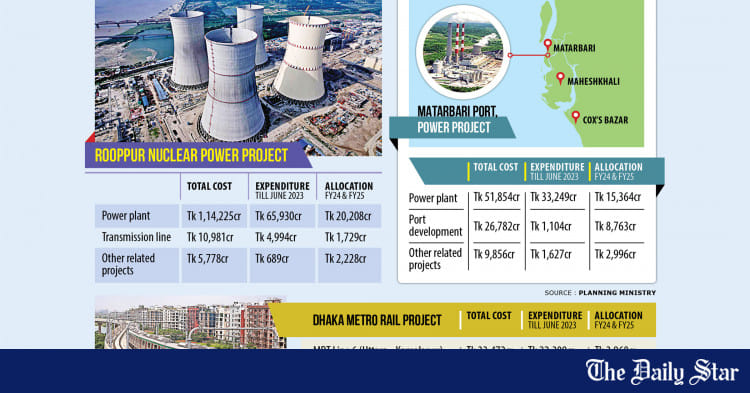
The government is set to increase budget allocation for quick completion of the Rooppur nuclear and Matarbari coal-fired power plant projects.

Several metro rail projects are also going to get more funds.

The Tk 2,65,000 crore Annual Development Programme (ADP) will be placed at today's National Economic Council meeting where allocations will be finalised.

Planning ministry officials say the aforesaid projects may get Tk 34,043 crore, which is 12.84 percent of the ADP.

Six projects related to Rooppur Nuclear Power Plant are the top recipients of funds. The projects will get a total Tk 12,544 crore, up from the current fiscal year's Tk 11,621 crore.

The 2,400MW power plant, worth Tk 1,14,225 crore, is the biggest ever development project in Bangladesh. As of December last year Tk 68,248 crore has been spent. In the 2023-24 fiscal year, it got Tk 9,706 crore, while in the 2024-25 fiscal year it will get Tk 10,502 crore.

The government hopes to see it generate power by March 2025 or sooner.

Six transmission lines from the plant are being set up. Four of the lines are almost 90 percent complete, according to Power Grid Company of Bangladesh.

When the lines are set, a unit of the plant will start operation, officials said.

Setting up of lines across the Padma, which saw 40 percent progress, will be done by October, said Delwar Hossain, the project director.

There are five projects -- totaling Tk 88,492 crore -- related to the power plant in Matarbari, Cox's Bazar. In 2024-25, the projects will get Tk 14,962 crore, up from Tk 12,161 crore in 2023-24.

A unit of Matarbari 1200MW Ultra Super Critical Coal Fired Power Plant was formally inaugurated in November last year and it has been generating power without hiccups. The other unit is set to begin operation by July.

An official of the power division said a substation needed for the plant is being built.

Project Director Abul Kalam Azad told The Daily Star that the work related to power transmission will hopefully be complete by June.

"The existing lines are able to supply up to 900MW. When the work is done, it will be able to handle 1,200MW," he said.

As per the proposed ADP, construction of the power plant will get Tk 6,105 crore. The power transmission system costs Tk 1,024 crore, and Tk 656 crore of it has been spent.

Three projects related to Matarbari port are worth Tk 35,614 crore. In the next fiscal year, they will get Tk 8,758 crore, up from Tk 2,666 crore in 2023-24.

Three metro rail projects worth Tk 1,28,687 crore, are going to get Tk 6,537 crore.

The Uttara-Motijheel part of MRT line 6 is complete, and the ADP proposes Tk 1,975 crore to build the part from Motijheel to Kamalapur.

Two other metro rail projects -- MRT Line 1 (Airport-Purbachal-Kamalapur) and MRT Line 5 (Hemayatpur-Bhatara) -- are making progress. The initial activities are done. The main construction work will begin in the upcoming fiscal year.

The MRT-1 would cost Tk 53,977 crore, and MRT-5 Tk 41,238 crore. The proposed ADP allocates Tk 3,594 crore and Tk 968 crore for them respectively.​
 

Next budget will be challenging than previous years: Debapriya
High inflation, rising pressure on external account to slow down economy, the economist said

1715899166202.webp


Preparing national budget for the next fiscal year will be more challenging than any previous years as the Bangladesh economy is passing through a tough time and the geopolitical developments are influencing the economy, Debapriya Bhattacharya, a distinguished fellow at the Center for Policy Dialogue (CPD), said today.

The economy is reeling from high inflation and rising pressure on the external account, he said, adding that economic activities are slowing down too.

"Under the circumstances, ensuring macroeconomic stability should be the topmost priority. It is like diabetes. If we cannot control it, it affects the rest of the organs of the body."

The economist made the comments at a discussion on the budget for 2024-25 fiscal year.

Private television channel NTV organised the programme at Pan Pacific Sonargaon Dhaka this evening.

Steps to control inflation will get priority in the upcoming national budget, Waseqa Ayesha Khan, state minister for finance, said at the event.

Along with this, there will be a system to ensure social security, she said, adding the fiscal measures will be designed to attain the commitments made in the Awami League's manifesto declared before the election.

She said the upcoming budget will incorporate the measures to reduce unemployment.

Mashiur Rahman, economic affairs adviser to the prime minister, said they will take measures to ensure socio-economic progress.

Moderated by Mahbubul Alam, president of the Federation of Bangladesh Chambers of Commerce and Industry; Saleh Uddin Ahmed, former governor of Bangladesh Bank; Mohammad Hatem, executive president of Bangladesh Knitwear Manufacturers and Exporters Association, and Zaidi Sattar, chairman of the Policy Research Institute of Bangladesh, also spoke at the occasion.​
 

Bangladesh expands offshore banking in hunt for forex

1715986887234.webp


Offshore banking is increasingly becoming a key window for banks in Bangladesh to facilitate investments and international trade by attracting deposits in foreign currencies.

Industry people say offshore banking can even play a crucial role in mitigating the persisting foreign currency crisis in the country by extending liquidity support and stabilising the local currency.

"Deposits of offshore banking will be a major source for US dollars," said Mashrur Arefin, managing director and chief executive officer of City Bank, which has stepped up efforts to draw foreign deposits through offshore banking operations (OBOs).

It started its journey in 1985 as the central bank created financing opportunities for factories at the export processing zones – the estates set up to drive the country's export earnings – by providing banking service to importers, exporters, and financial institutions.

The segment received more attention in recent years, particularly after Bangladesh began to feel the pinch following a sharp depletion of foreign currency reserves.

In March this year, parliament passed the Offshore Banking Act 2024 to give a much-needed boost to the country's desperate efforts to improve the US dollar supply, which has squeezed in the past two years owing to higher outflows compared to inflows.

The BB has relaxed rules and policies to allow both Bangladeshis and foreign nationals to avail the service. It has permitted domestic commercial banks' OBOs to offer an interest or profit rate markup over a benchmark rate for term deposits in foreign currencies to eligible customers.

The customers include individuals and entities residing outside the country, non-resident Bangladeshis, persons of Bangladesh origin, foreign nationals, companies registered and operating abroad, and external institutional investors.

The central bank has allowed domestic banking units to receive funds from OBOs up to 40 percent of their regulatory capital to settle payment obligations.

OBOs can be executed in five currencies: the US dollar, the British pound, the euro, the yen, and the yuan.

Currently, about 40 banks have offshore units. At the end of September, the total outstanding loans of OBUs stood at Tk 83,826 crore.

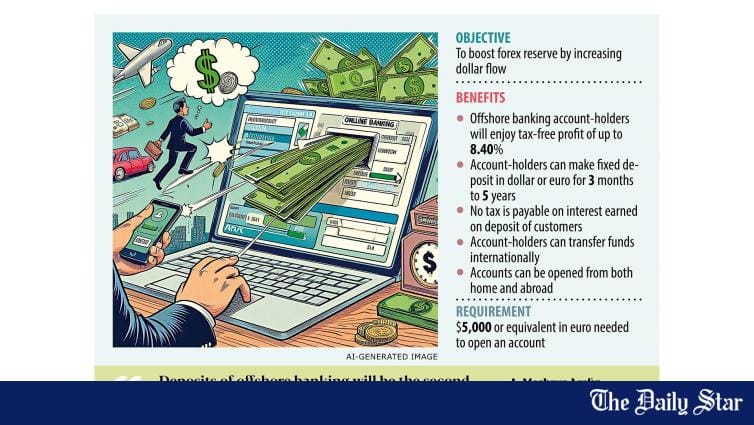
Investors enjoy tax-free profit of up to 8.40 percent on fixed deposits in the USD or the euro for terms ranging from three months to five years. They are also able to transfer funds internationally without any restriction along with profit.

"The offshore banking system has become a new avenue for the dollar supply apart from exports and remittance. Offshore banks' fixed deposits can be used to cover the cost of imports," Arefin said, adding that the dollars obtained through OBOs are sold on the interbank foreign exchange market.

Currently, City Bank has deposits amounting to $23 million under its offshore banking unit. "Our target is to raise it to $1 billion," the noted banker said.

There are two ways to open offshore banking accounts: one is for those residing in Bangladesh and the other is for those who live abroad.

Any representative of expatriates, such as family members and relatives, or partner of a foreign investor residing in Bangladesh can open accounts. Similarly, expatriates and foreign investors can do the same.

"We call it international bank accounts. City Bank mobilised $29 lakh through the accounts opened from abroad," Arefin said.

City Bank is providing the facility to open dollar accounts for offshore deposits at its 175 branches.

Mohammad Ali, managing director and CEO of Pubali Bank, said the offshore banking has a huge potential in Bangladesh.

"Our reserves are small. If we can promote it properly, every bank can mobilise billions of dollars through the offshore banking."

Pubali Bank is developing software and a mobile app so that anyone can open accounts and do banking from abroad.

"We hope to complete all procedures by next two months."

Mohammad Ali said if Bangladeshi expatriates deposit money at OBOs, import obligations can be met with the funds as well as from remittance and export earnings.

"Then, the forex reserves will go up automatically."

Speaking about the prospect of offshore banking, both Arefin and Mohammad Ali gave the example of Mauritius, an Indian ocean island nation with only about 1.3 million population.

"This country has a balance of $800 billion under offshore banking," Arefin said.

"We have a huge economy with 17 crore population. If more people are informed about the advantages of this banking relationship, there is a possibility of bringing $50 billion under OBOs."​
 

Latest Posts

Back