Home Watch Videos Wars Movies Login

[🇧🇩] Monitoring Bangladesh's Economy

[🇧🇩] Monitoring Bangladesh's Economy
1K
43K
More threads by Saif

G Bangladesh Defense

Dollar and reserves offer relief, investment remains sluggish

1787181350225.webp
 
Analyze

Analyze Post

Add your ideas here:
Highlight Cite Respond

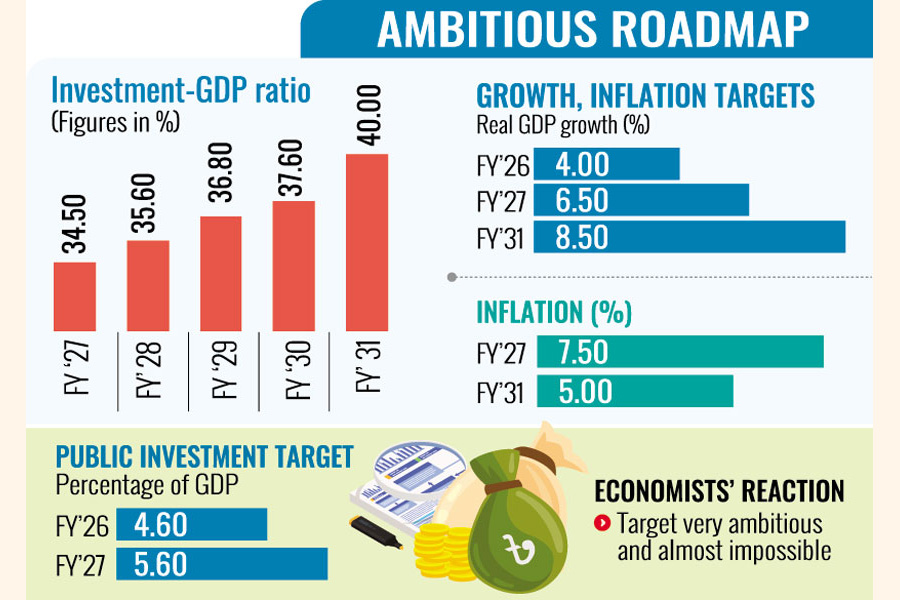
Govt targets lofty 34.5pc investment-GDP ratio for FY27


1787353646038.webp


Bangladesh wants to expand its investment-to-GDP ratio by 6.57 percentage points within a year as it has set the aspiration in the newly approved five-year development strategy and framework, analysts say.

Economists have termed this "over-ambitious", saying the target is almost impossible to achieve.

Prime Minister Tarique Rahman formally unveiled the cover of the "Five-Year Strategic Framework for Reform and Development-FYSFRD (July 2026 to June 2031)" alongside its complementary Strategic Action Matrix on Wednesday.

Several economic targets, including the investment-to-GDP ratio increase goal, were set there.

Moving decisively away from traditional and rigid bureaucratic planning models, the General Economics Division (GED) under the Planning Commission prepared the dynamic economic blueprint, designed to guide the nation "from fragility to prosperity".

According to the framework's indicator, the government wants to raise the investment-to-GDP ratio to 34.5 per cent within the current fiscal year.

The Bangladesh Bureau of Statistics (BBS) data shows the ratio reduced to 27.93 per cent in FY26 from 28.54 per cent in FY25.

In addition, the government wants to grow the ratio to 40 per cent in FY31.

According to the target, the ratio would reach 35.6 per cent in FY28, 36.8 per cent in FY29, and 37.6 per cent in FY30.

Amid the ongoing austerity and low expenditure capacity of the government, the strategy paper has set a target to increase public investment by one percentage point to 5.6 per cent of GDP within this year from 4.6 per cent estimated in FY26.

It says, "Prudent macroeconomic policies, appropriate supply side measures, and political stability are expected to stabilise the macroeconomic imbalances and reduce vulnerabilities in the near term."

Consequently, real GDP growth is expected to rise from the recent 4.0 per cent to 6.5 per cent in FY27, while CPI inflation is expected to ease to 7.5 per cent, it also says.

Economic growth is projected to accelerate thereafter, reaching 8.5 per cent by the beginning of the next decade, while inflation is projected to decline to 5.0 per cent by FY31, adds the paper.

The GED claims the macroeconomic and sectoral growth projections are made using the dynamic CGE model.

The industry sector's contribution to growth has been steadily declining in recent years owing to the shocks and mismanagement described above, the paper says.

"This is projected to reverse in the acceleration phase of the strategy. Further, a stylised production function estimate finds that capital's contribution to economic growth has also become negative as private investment has ground to a halt because of economic disruptions."

As the economy stabilises and then accelerates, growth is projected to rely more on employment and total factor productivity than had been the case in the past, it adds.

Professor Mustafizur Rahman, a distinguished fellow of the Centre for Policy Dialogue (CPD), tells the FE that he thinks the target is very ambitious and impossible to achieve.

"Bangladesh's business climate is traditionally very poor. Besides, the energy crisis has been added in recent months. So it is really difficult to achieve the target within a year."

Policy Exchange Bangladesh Chairman Dr Masrur Reaz says since the Bangladesh investment climate has not improved and lots of changes have been added in recent times, it is almost impossible to push the investment-to-GDP ratio up to 34.5 per cent.

The government should be realistic in its target and take immediate action to improve the business climate as well as tap more local and foreign investments, he adds.

According to the GED's five-year development strategy, the economic roadmap will be deployed across three strict, sequential operational phases.

The first two years will be treated as "Economic Recovery", where immediate policy prioritisation is directed at stabilising macroeconomic indicators, curbing inflationary pressures, resolving acute banking sector liquidity issues, and aggressively rebuilding depleted foreign exchange reserves.

In the third year, "Restoration & Transition" will be conducted, accelerating institutional banking reforms, modernising trade logistics, and jumpstarting private sector investments.

In the fourth and fifth years, the government would go for "Reconstruction & Acceleration", which will be the final phase and aimed at high-velocity, tech-led growth, absolute poverty reduction, and massive FDI penetration.​
 
Analyze

Analyze Post

Add your ideas here:
Highlight Cite Respond

Govt plans launching $2.0b equity fund in Hong Kong


1787526517858.webp

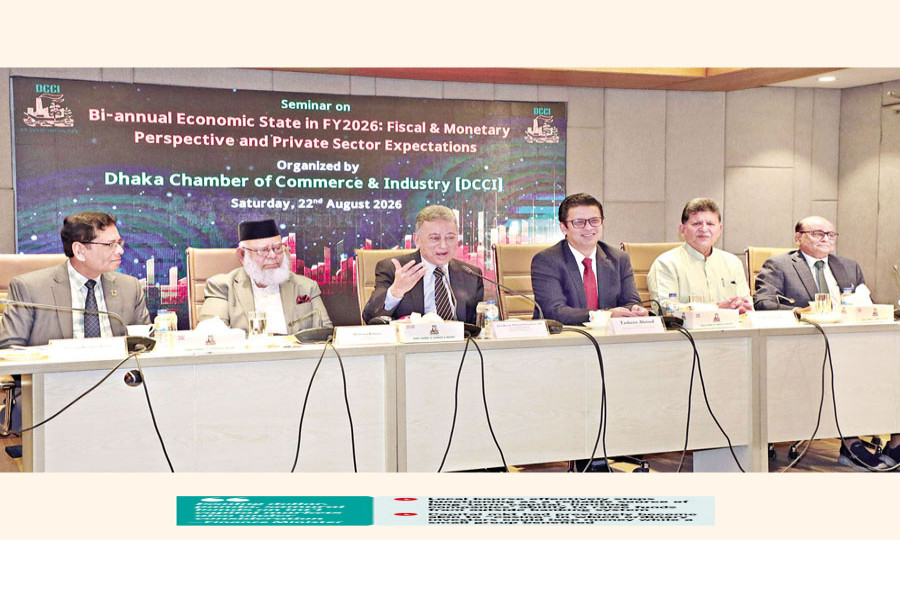
Finance and Planning Minister Amir Khosru Mahmud Chowdhury speaks as the chief guest at a seminar titled 'Biannual Economic State in FY2026: Fiscal & Monetary Perspective and Private-Sector Expectations', organised by the Dhaka Chamber of Commerce and Industry in the city on Saturday. ICC Bangladesh President Mahbubur Rahman was present as a special guest. — FE Photo

Bangladesh plans to launch a US$2.0-billion fund in Hong Kong for equity investment in the country's businesses and projects to diversify financing and reduce reliance on conventional borrowing.

Finance and Planning Minister Amir Khosru Mahmud Chowdhury unveiled the plan on Saturday, explaining that the proposed Bangladesh-dedicated fund would provide equity rather than loans, meaning it would not create a direct debt obligation for the government.

"We are going to have a dedicated fund for Bangladesh in Hong Kong. It will be a $2.0 billion worth of Bangladesh-dedicated fund. This is equity and not a loan," he said at a seminar organised by Dhaka Chamber of Commerce and Industry (DCCI) in Dhaka.

The seminar, titled 'Biannual Economic State in FY2026: Fiscal & Monetary Perspective and Private-Sector Expectations', brought together policymakers, economists, bankers and business leaders.

The proposed fund is part of a broader effort to widen Bangladesh's access to international capital as the government seeks to ease pressure on domestic-financing sources and create more room for private-sector borrowing.

Mr. Khosru said Bangladesh was also considering issuing dollar, panda and samurai bonds to tap different international capital markets.

"We want to go for dollar bonds. We will go for panda bonds and samurai bonds," he said.

The government has already reduced its reliance on bank borrowing to some extent, but the shift would take time, he told his business audience.

"We have already brought down bank borrowing somewhat. But, the process will take time. We are moving in that direction."

The finance minister said reviving Bangladesh's capital market is central to the government's strategy to develop alternative sources of finance.

He said the market has effectively stopped functioning as a reliable source of long-term capital for an extended period, limiting companies' ability to raise funds outside the banking system.

"As there was virtually no functioning capital market in Bangladesh for quite some time, we are trying to revive it as one of the alternative sources of financing."

The government has overhauled the regulatory leadership of the Bangladesh Securities and Exchange Commission, appointing a chairman and four commissioners through what Mr. Khosru described as a transparent selection process.

He said investor confidence was beginning to return, although the market has not yet fully recovered.

"I won't say that the capital market has recovered completely, but confidence is coming back. The market is gaining ground and moving upward."

He said restoring investor confidence alone, however, would not be sufficient. Companies must also believe that the market is credible enough to raise capital through listings.

"Good companies will come for listing only when they have confidence in the market."

Mr. Khosru criticised the previous state of the market, saying that it had become akin to a "casino" in which ordinary investors could lose money while a small group of participants benefited.

The government was seeking to replace that culture with greater transparency, professionalism and institutional governance, he said.

Mr. Khosru said the government did not intend to increase the tax burden on existing taxpayers but wanted to expand the tax base.

"When we talk about increasing taxes, we are not talking about increasing taxes on those who are already paying. We are trying to expand the network."

Automation of tax administration would be important in achieving that goal. Reducing direct interaction between taxpayers and tax officials could improve transparency and limit opportunities for corruption, he said.

The minister also said the government was working to remove regulatory barriers and planned to establish a committee and dedicated website through which businesses could report obstacles to deregulation.

Customs and port procedures would be made more time-bound to reduce business costs and speed up import clearance.

"We are not leaving anything open-ended. Every decision of this government is time-bound," he said.

The government was also reviewing the work of the Bangladesh Bureau of Statistics to improve the credibility of economic data.

Mr. Khosru admitted that the government faced a difficult energy situation and that electricity and gas shortages could not be resolved immediately.

Negotiations were under way for two or more floating storage and regasification units, while efforts were also being made to increase gas reserves.

He noted the government had inherited energy reserves equivalent to only about 15-17 days but had increased them to roughly one month, with a longer-term target of three months.

"The energy crisis will improve slowly. It will improve, but slowly," he said.

The government has introduced measures for businesses affected by circumstances beyond their control, including rescheduling facilities, grace periods and exit option.

He also referred to a Tk600 -billion financing package for small and midsize enterprises, saying that lending would be based on eligibility rather than political influence.

"Those who fulfil the criteria will receive the loans. There will be no political influence in giving loans," he said.

The government also wants to bring artisans, cottage industries, sports, entertainment, theatre, music and other creative activities into the mainstream economy under its concept of "democratisation of the economy".

Support would include credits, skills development, design, branding and marketing, including access to global online marketplaces.

Mr. Khosru said raising the tax-to-GDP ratio is necessary to create fiscal space for welfare, infrastructure, business support and subsidies.

He also said the government had managed to turn around the economy despite inheriting difficult conditions.

"Bangladesh has been unfortunate that whenever the BNP comes to power, it inherits the country at a time when the economy is in a devastated condition," he said.

ICC Bangladesh President Mahbubur Rahman, who was special guest at the event, said inflation remained above the desired level and called for stronger private-sector confidence, competitiveness and a predictable investment environment.

Mr. Rahman said that as Bangladesh enters fiscal year 2027, the economy remains resilient despite the slower growth, persistent inflation, weak private investment, banking-sector stress and global uncertainty.

DCCI President Taskeen Ahmed, in his keynote presentation, said global economic growth in 2026 was projected at 3.1 per cent amid trade barriers, the Middle East crisis, supply-chain disruptions, higher energy prices and rising transport costs.

These pressures were weighing on investment, business and trade.

He highlighted budget measures, including digitising company registration to complete the process within 48 hours, extending bonded-warehouse facilities for the leather, footwear and home-textile sectors, providing duty-free benefits to 10 new sectors, expanding tax automation and speeding up customs procedures.

PPRC Executive Chairman and BRAC Chairman Hossain Zillur Rahman said the economy was at a critical juncture.

He proposed an "Economic Reform Acceleration Unit" to monitor implementation of economic reforms.

PRI Chairman Zaidi Sattar said Bangladesh faced a significant gap between policy formulation and implementation.

He also criticised restrictive import policies and high tariffs, saying they contributed to higher domestic prices and inflation.

He urges the government to formulate and implement strategies within the remaining timeframe before Bangladesh's graduation from least-developed-country status.

CPD distinguished Fellow Mustafizur Rahman said a "revolution" in tax collection was needed to finance the Annual Development Programme and questioned the likelihood of meeting the revenue target in the national budget.

He also called for monetary-policy reforms and greater caution in taking foreign loans and managing debt repayments.

BIDS Director-General Dr. A K Enamul Haque said prolonged high inflation was particularly concerning for a remittance-dependent economy amid global uncertainty.

He called for greater banking-sector liquidity and a more business-friendly environment.

Dr. Haque said that the inflation globally so far predicted that will not be contained on many grounds including supply -chain bottlenecks.

Transcom Group CEO Simeen Rahman said budget measures had yet to restore the desired momentum in private-sector activity, with small and medium-sized enterprises among the hardest hit.

She urges improvements in ports, customs and logistics.

Mutual Trust Bank Managing Director and CEO Syed Mahbubur Rahman called for closer coordination between monetary and fiscal policies, greater tax digitisation and investment in skilled workers.

DCCI President Taskeen Ahmed delivered the welcome remarks, former DCCI presidents including Abul Kasem Khan and Rizwan Rahman also spoke, among others.

DCCI senior vice-president Razeev H Chowdhury, vice-president Md Salem Sulaiman, board members and public- and private-sector representatives attended the seminar.​
 
Analyze

Analyze Post

Add your ideas here:
Highlight Cite Respond

Remittance inflow reaches $2.14 billion in 22 days of August


1787526635009.webp


Expatriate Bangladeshis sent home $2.148 billion in remittances during the first 22 days of August, marking a 25.6 percent year-on-year increase, according to the latest Bangladesh Bank data.

Between August 1 and August 22 of the current fiscal year (FY 2026-27), total remittance inflows registered a 25.6 percent growth compared to $1.711 billion received during the corresponding period of the previous fiscal year (FY 2025-26).

During the three-day period from August 20 to August 22, the country received $117 million in foreign remittances.

Cumulative remittance inflows from July 1 to August 22 for FY 2026-27 reached $5.006 billion, reflecting a 19.5 percent yearly growth over the $4.188 billion recorded during the same timeframe in FY 2025-26.

Central bank statistics show a steady upward momentum in official remittance channels as formal banking networks continue to draw strong expatriate inflows.​
 
Analyze

Analyze Post

Add your ideas here:
Highlight Cite Respond

Invest Bangladesh begins operations as the country's apex investment agency

Staff Correspondent 23 August, 2026, 12:11

1787529399016.webp

Chy Ashik Mahmud Bin Harun.

Invest Bangladesh began operations on Sunday, the first working day after publication of the gazette notification under the Invest Bangladesh Act, 2026, formally merging three investment bodies into a single apex authority.

Formed by merging the Bangladesh Investment Development Authority, the Bangladesh Economic Zones Authority and the Public-Private Partnership Authority, Invest Bangladesh will now operate under the Prime Minister’s Office as the country’s apex investment promotion agency.

It also unveiled its new brand identity on the day, marking the transition to a single national investment platform.

The new authority will bring investment facilitation, policy coordination, economic zone development and public-private partnership functions under one institution, giving domestic and international investors a single point of access to opportunities across the country, officials said.

The BEZA and the PPPA were established in 2010 while the BIDA was formed in 2016 under the PMO to attract investment and accelerate industrialisation.

As per the broader plan, government merged the three entities to make Invest Bangladesh as single point of access, providing investors with a more coordinated, seamless and accountable experience throughout their investment journey.

Officials also said that the merger responded to a longstanding investor demand for a simpler, more coordinated way to engage with the government on investment services and policy.

Meanwhile, the government has appointed Chowdhury Ashik Mahmud Bin Harun as chairman of the Invest Bangladesh for a one-year term on a contractual basis, according to a notification issued by the public administration ministry on Thursday.

‘This is more than an institutional merger. It is about organising the government more effectively around the investor,’ said Ashik.

By uniting the capabilities, the new agency aims to provide clearer accountability and more coordinated support across the investment journey, he added, saying that they would continue to respect the heritage while forging new chapters as a bigger and stronger team.

The Invest Bangladesh Act, 2026 will provide the legal basis for a more integrated investment system.

Among its key provisions, the act will bring economic zones, free-trade zones and other declared industrial areas under an integrated framework, set defined procedures and timelines for licences, approvals and government services, and establish clearer approval frameworks for public-private partnerships, including simpler routes for smaller projects.

It will also allow for underused government land, facilities, shares and rights to be used productively. It provides a single digital platform for investment and business services.

Invest Bangladesh will continue to operate BanglaBiz, the government’s single digital platform for investment services, giving investors online, time-bound access to business licences and permits.

Officials said that existing investor services would continue uninterrupted under the new authority, with the merger designed as an institutional integration to create a single front office rather than disrupt ongoing services.

Economic zones will remain a priority for facilitation because of the efficiencies they offer in utilities and transport access.

However, the new authority will also support projects outside economic zones, including on unused state assets, depending on investor needs.

On staffing, regular officers and employees of the BIDA, BEZA and PPPA will be absorbed into the Invest Bangladesh in equivalent positions, with continuity of service and existing benefits protected.

At the same time, consultants, outsourced personnel and daily-wage workers will continue under their existing contracts.

However, the full organisational structure of the new authority, including its wings and teams, will be developed in phases, officials said.

With the government’s 180-day investment action plan nearing its end, the agency said that it would publish a progress report on delivery against the commitments made in March before the period concludes.​
 
Analyze

Analyze Post

Add your ideas here:
Highlight Cite Respond

Latest Posts

Back
 
G
O
 
H
O
M
E