โ˜• Support Us โ˜•
[๐Ÿ‡ง๐Ÿ‡ฉ] - Press Freedom in Bangladesh | Page 2 | PKDefense

[๐Ÿ‡ง๐Ÿ‡ฉ] Press Freedom in Bangladesh

Reply (Scroll)
Press space to scroll through posts
G Bangladesh Defense
[๐Ÿ‡ง๐Ÿ‡ฉ] Press Freedom in Bangladesh
47
2K
More threads by Saif


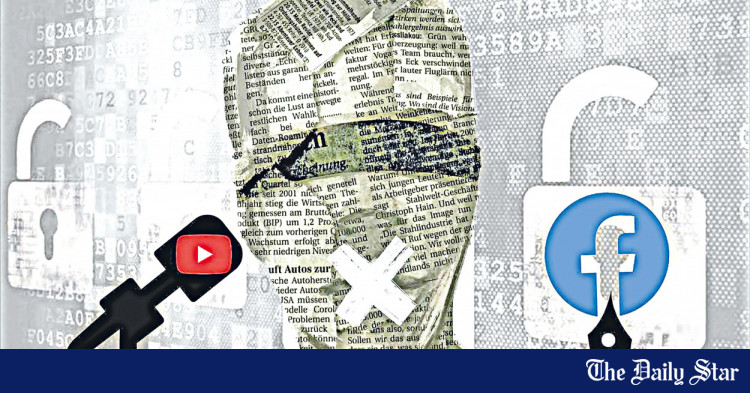
Has the media gotten out of the grip of (self-)censorship?

1732840608115.png

File Illustration: Biplob Chakroborty

In Bangladesh, the stories citizens read are often shaped not by journalistic choice alone but by an invisible forceโ€”censorship. Whether imposed directly by government actions or adopted defensively by journalists, this practice casts a long shadow over press freedom. Its roots lie in the country's legal and political framework, where repressive laws and political pressures compel journalists to avoid sensitive issues that might provoke legal repercussions or retaliation. This dynamic creates a delicate dance between journalists and the government, in which the former treads carefully so as not to cross the invisible line.

Since the regime change on August 5, 2024, there has been a surge in legal cases and intimidation against media outlets, amplifying fears and deepening the grip of self-censorship. Despite Dr Muhammad Yunus's stated commitment to press freedom, actions like the cancellation of press credentials and the incarceration of journalists send troubling signals, leaving media freedom in Bangladesh at a perilous crossroads.

The constitution of Bangladesh promises freedom of thought, conscience, and expression, alongside press rights under Articles 39(1) and 39(2), with caveats of "reasonable restrictions" for national security, public order, and moralityโ€”vague terms often misused by authorities to limit dissent and critical journalism. In addition to the constitution, the Press Council Act of 1974 supports press freedom and upholds journalistic integrity. Yet, the effectiveness of this Act is limited, and it lacks the enforcement muscle to shield journalists from legal and extra-legal threats.

For years, successive governments in Bangladesh have wielded repressive laws to penalise speech deemed, in their broad understanding, to be false, offensive, defamatory, or disruptive to law and order. Among the earliest and most contentious of these laws is the Special Powers Act of 1974, which established far-reaching state censorship by criminalising vaguely defined "prejudicial" content. This Act, and others like it, have been routinely exploited to silence dissenting voices and restrict the media's ability to report freely. Its impact is particularly alarming for two reasons: the government's expansive interpretation of what qualifies as "prejudicial" and the troubling conflation of legitimate criticism with threats to national security. These dynamics have allowed the Act to become a powerful tool for suppressing opposing views, undermining the free exchange of ideas that a vibrant democracy requires.

Subsequent laws, including the Information and Communication Technology (ICT) Act, the Digital Security Act (DSA), and the Cyber Security Act (CSA), have continued this trend. Notorious provisions like Section 57 of the ICT Act penalised digital content deemed defamatory or religiously offensive with harsh sentences, fostering a culture of fear. Subsequently, the DSA of 2018 was enacted in response to public outcry over the ICT Act, while the CSA of 2023 followed as a reaction to international criticism of the DSA. Each of these laws has drawn criticism for pulling similar language from Section 57 of the ICT Act and repackaging it to retain authoritarian control over freedom of expression under broad pretexts like defamation, "negative propaganda," or hurting religious sentiments. Hundreds of arrests were made under this never-ending cycle of repressive laws, leading to accusations that the DSA (and then CSA) was used to silence dissent and discourage investigative journalism.

Since the fall of the past regime, the sacking of journalists for reportedly being linked with the previous government, without concrete criminal charges having been brought against them, is unsettling to say the least. Most recently, the government rescinded the press accreditation of numerous journalists, effectively restricting their access to government secretariats. Previously, the ICT Adviser Nahid Islam had, on several occasions, suggested that journalists could be prosecuted and punished due to their possible nexus with the erstwhile regime. The press secretary, Shafiqul Alam, gave a similar vague message. The cancellation of press passes and the administration's statement against journalists sends an ambiguous message: while the government maintains that it supports press freedom and expresses its willingness to repeal the draconian laws, its words and actions may pressure the media to cautiously choose its contents and stories.

It is important to mention that journalists are held to high professional and ethical standards and must uphold truth and accuracy in news reporting. The current legal framework, such as the 1993 Journalists' Code of Conduct, provides a grievance procedure if journalists breach their duties. The Code prohibits maliciously distorting or slanting news in commentary and headlines, requiring clear and fair presentation without bias. Newspapers are also expected to resist and expose crime and corruption. If any newspaper, news agency, editor, or journalist breaches journalistic ethics and codes of conduct, the Press Council, under Section 12(1) of the Press Council Act of 1974, may investigate complaints and warn, admonish, and rebuke the concerned parties after giving them an opportunity to be heard. There are legal recourse available in the existing Press Council Act and the Journalists' Code of Conduct.

The persecution of journalists without any specific allegations have attracted criticism from local and international quarters, raising alarms over the actual extent of media freedom in the country. Antoine Bernard of Reporters Without Borders called on the government to "stop the current legal harassment of more than 130 journalists" who have been charged with trumped-up crimes, as well as the arrest of some journalists without prior investigations. The Committee to Protect Journalists called for guaranteeing the procedural rights of incarcerated journalists.

The interim government's stated objective to right past wrongs and implement reform seems to be out of step with the continued plight of the media landscape in Bangladesh. The gap between the government's declared goals and the actual circumstances raises serious concerns about the current state and future trends of media independence. It may also thwart the goals of the Public Media Reform Commission, which is currently undertaking the job of furthering press freedom in Bangladesh.

Protests in July and August have flagged one of the most severe failures of the media in maintaining neutrality in times of crisis, yet similar patterns of media restrictions persist. If Bangladesh is to break out of this cycle where news outlets act primarily as a mouthpiece for the government, changes must extend beyond cosmetic promises. The interim government now has an opportunity and a corresponding responsibility to show real commitment to freedom of the press, which it can do by letting the Media Reform Commission work independently and by taking tangible steps that create an atmosphere where journalists can work without fear of retribution.

Failing to pursue these fundamental reforms at this critical moment would perpetuate the past practice of media suppression and drastically reduce public expectations of meaningful democratic change. The stakes are particularly high, given Bangladesh's history of political volatility and the critical role a free press must play in guaranteeing governmental accountability and fostering robust public debate.

Sangita Gazi is a postdoctoral research scholar at The Wharton School, University of Pennsylvania.​
 

There should be no interference in press freedom: Zonayed Saki
Staff Correspondent
Chattogram
Published: 29 Nov 2024, 23: 03

1732930444307.png

Ganosamhati Andolan chief coordinator Zonayed Saki addresses as the chief guest at a mass dialogue at CRB Ground in Chattogram on 29 November 2024Prothom Alo

Ganosamhati Andolan chief coordinator Zonayed Saki on Friday said there should be no interference in the press freedom, peopleโ€™s thinking, conscience and right to opinion.

โ€œThere should be no interference in the freedom of press, peopleโ€™s thinking, conscience and right to opinion. Criticise the newspaper, everyone has that right. But attacking the newspaper office or something like that creates a perception around the world as if there is no press freedom in this country. This wonโ€™t bode well for us,โ€ warned Zonayed Saki.

He was speaking as the chief guest at a mass dialogue at CRB Ground in Chattogram in the afternoon.

Chattogram unit of Ganosamhati Andolan organised the dialogue titled โ€œMass dialogue to establish a new political settlement for democratic transformation of the stateโ€.

Over 500 leaders and activists of the party from Chattogram, Feni and other districts and upazilas attended the event.

Speaking about the killing of a lawyer in Chattogram, Saki said, โ€œSaiful Islam was killed in a planned way. The Awami League and ISKCON men under the banner of ISKCON killed him. The banner of ISKCON was used so that the blame goes to the people of the Hindu community and the Muslims carry out attacks out of grievances, and they could send the photographs to the US.โ€

He stated, โ€œWe saw acclaimed media like Reuters carried a report that said the lawyer of Chinmoy Das has been killed. This is their plan. The image of Bangladesh is being presented to the western countries in such a way that the Hindus, Buddhists, Christians and other communities are not safe here.โ€

Expressing that staying in India, Sheikh Hasina has been conspiring to destroy Bangladesh, Zonayed Saki said, โ€œYou have thwarted their plot. You did not let any attack be carried out in Chattogram. As no attack is being carried out, the Awami League activists themselves are attacking the people of Hindu community now. I have heard there was an attempt to carry out an attack even today (Friday). That is why we need to forge a united measure to prevent those. Those who would attack the people of Hindu community are aides of the fascist and agents of local and foreign plotters. They want to destroy the uprising in Bangladesh and this government.โ€

Zonayed Saki contends there could be such elements within the government too, since many of their aides are still there hiding in various departments. They have to be identified and brought to book.

Mentioning the people as the centre of power, the Ganosamhati Andolan chief coordinator said there should be laws to ensure accountability of the peopleโ€™s representatives to the people. For this there has to be the constitution and laws. Article 70 of the existing constitution has to be amended. Only the government will not appoint people in the constitutional posts. Instead, the governing party, the opposition and the judiciary will appoint their representatives, so that no partisan person could be appointed there. The judiciary must be made independent.

Indicating the government, Zonayed Saki said, โ€œMaybe the interim government could not perform up to the peopleโ€™s expected level as of now, we are criticising the government for that. Despite that, this interim government has been trying to carry out its responsibilities aligning with the interests of the people. We will criticise them and at the same time help them. A democratic constitution, reforms of the state and its laws and democratic elections are required for a new political settlement.โ€

He called on everyone to be united to form such a democratic force.

The dialogue was chaired by Ganosamhati Andolanโ€™s Chattogram district unit coordinator Hasan Maruf.

Other speakers at the event also put emphasis on unity to work so that no autocratic force could usurp power in the new Bangladesh achieved through a mass-uprising.​
 

Environment for free expression must: Matiur Rahman


1733272009713.png

Photo: Collected

Prothom Alo Editor Matiur Rahman today said many reforms have to be made in the administration.

Matiur made the remarks as a guest speaker at an award ceremony held in honour of the late Professor Sitara Parveen of the Department of Mass Communication and Journalism at Dhaka University.

And to be successful in state affairs, there should be an open democratic environment and free expression throughout the society, he added.

There must be more open discussions on all important state issues.

"We have to work for journalism with courage from an independent and non-partisan position," Matiur said.

The event took place at the Professor Muzaffar Ahmed Chowdhury Auditorium in the Faculty of Social Sciences.

DU Vice-Chancellor Prof Dr Niaz Ahmed Khan paid glowing tribute to the memory of Prof Dr Sitara Parvin.

A total of 10 meritorious students of the Department of Mass Communication and Journalism of DU were recognised with the Prof Sitara Parvin Award for their outstanding results in BSS (Hons) final examination of 2022.

Prof Dr Sitara Parvin, daughter of former President Justice Shahabuddin Ahmed and wife of retired Journalism Prof Dr Ahaduzzaman Mohammad Ali, died in a tragic road accident on June 23, 2005 in the US.​
 

Reduce VAT on newsprint, ensure press freedom
Noab urges Media Reform Commission

1733876563001.png


Members of Newspaper Owners' Association of Bangladesh (Noab) yesterday met the Media Reform Commission and spoke for press freedom, independent journalism, and reduction of VAT on newsprint.

During a views-exchange meeting with the commission, they demanded the necessary reforms in the Bangladesh Press Council and Department of Films and Publications (DFP) and underscored the necessity of lessening politicisation in newspaper ownership.

Kamal Ahmed, chief of the commission, stressed that the media should be free from any political influence so that they can work for the interest of the people.

He underlined the need for media free from political influence given the grievance expressed over the failure and controversial role of many media during the July-August uprising.

The meeting was held at the office of Noab President AK Azad.

"We don't have the environment for independent media due to the existing legal framework for the media," said a press release of the commission, quoting Mahfuz Anam, The Daily Star editor and publisher, as saying.

Prothom Alo Editor and Publisher Matiur Rahman said the newspaper industry became sick in this digital era. Besides, circulation of newspapers and the income from advertisement dropped sharply due to the Covid-19 pandemic.

Mentioning that the previous governments tried to control the media, he said, "No governments in the past allowed media freedom and journalists could not work independently."

However, the previous government considered newspapers as its enemy, he said.

New Age Publisher Shahidullah Khan questioned the necessity of the enlistment of media outlets. He said the Press Council should be modernised and kept free from any influence of the executive.

Urging the commission to be careful so that no vested quarters can misguide them, Bonik Barta Editor and Publisher Dewan Hanif Mahmud criticised filing of cases against editors and journalists and the revocation of accreditation cards of journalists.

AK Azad, also the publisher of daily Samakal, said they, as publishers, had to face threats and incur financial loss. Except for the newspaper industry, all other industries got incentives during the Covid-19 pandemic, he said.

He also hoped that the Media Reform Commission would place specific recommendations for the independence of editors.

During the meeting, Kamal said there is no way that the commission would be influenced by any vested quarters, and that they would submit recommendations based on the opinions of stakeholders.

He added that the commission would seek opinions from all stakeholders to prepare guidelines for the state-run Bangladesh Betar, BTV, and Bangladesh Sangbad Sangstha (BSS).

Daily Sangbad Editor Altamash Kabir and daily Financial Herald Publisher Masrur Reza also spoke at the meeting attended by other members of the commission.​
 

Student protesters entered Somoy TV ownerโ€™s offices, journos sacked

1735088615678.png


A gang of Bangladesh student protesters entered the offices of the investor of a television station, accusing it of "propaganda", protesters said yesterday, with at least five journalists subsequently fired.

The students had taken part in the August revolution that toppled prime minister Sheikh Hasina, whose tenure was marked as one of the worst periods for media freedom.

Hasnat Abdullah, convener of the Anti-Discrimination Students Movement, led around 15 to 20 students on December 17 to the offices of City Group, which invests in Somoy Television.

"Somoy Television was spreading propaganda, twisting my comments, and accommodating the views of a fallen political party," Hasnat told AFP.

"We are staunch supporters of press freedom, but the press must remain unbiased," Hasnat said, adding that he saw no issue in making demands -- but rejecting reports that the students had handed over a list of those they wanted to be fired.

The managing director of the business conglomerate that funds the television station did not respond to repeated requests for comment.

The incident has intensified fear among journalists in the wake of the revolution.

One journalist, Omar Faroque, who had been a senior editor of the television station, said he was among the five who received a termination letter without reason.

"The television authorities requested a few of us to step down for the greater good of the station," Faroque told AFP.

"We demanded an explanation for the decision, but the authorities refused to provide any."

Chief Adviser Prof Muhammad Yunus has repeatedly insisted he wants media freedom.

CA's Press Secretary Shafiqul Alam sought to distance the government, saying that if someone "takes any action, the responsibility lies with them".

Press watchdogs say many journalists -- seen by critics as having supported Hasina when she was in power -- face police investigations in apparent retaliation for their past work.

At least four journalists were imprisoned, and scores are facing legal cases across the country.

Hasina and her government were frequently accused of exerting undue pressure on the handful of independent media outlets, including shutting down newspapers and TV channels and imprisoning journalists.

After Hasina's government fell, several TV channels, including Somoy TV, came under attack for their alleged allegiance to her Awami League.

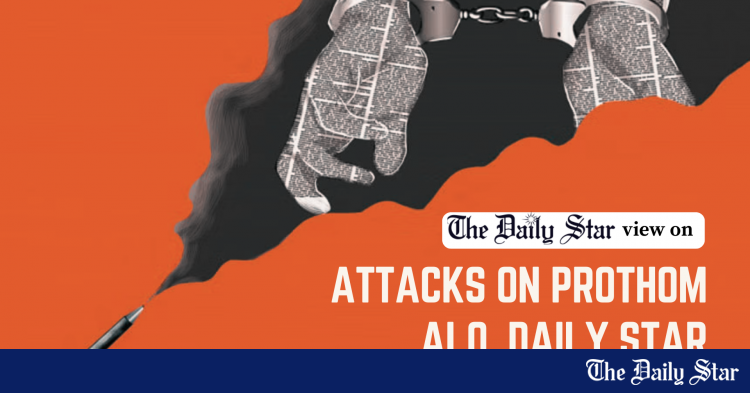
In November, protesters besieged the offices of Prothom Alo, the largest Bangla-language newspaper, and threatened to shut it down, as well as The Daily Star.

Press freedom in Bangladesh has long been under threat.

Bangladesh ranks 165 out of 180 countries in press freedom, according to Reporters Without Borders.​
 

Proper reforms will strengthen the media
Proposed changes by media commission to address journalist vulnerabilities

1735088942101.png

VISUAL: STAR

We welcome the long-overdue official conversation on legislating protection for journalists in Bangladesh. The chief of the Media Reform Commission recently announced plans to recommend a new law to safeguard journalists, as well as amending 32 existing laws that hinder press freedom. Such initiatives are critical if we want a media industry that can truly serve as the fourth pillar of democracy, holding those in power accountable.

At a recent dialogue in Dhaka, the commission chief also underscored the importance of financial security for journalists, advocating for a minimum floor wage applicable nationwide. This statement coincides with the unveiling of findings from a Broadcast Journalist Center (BJC) survey that revealed that over half of the country's TV channels are failing to pay their employees on time, while at least 20 percent owe workers several months' salaries. The survey also found that less than 25 percent of channels provide provident funds, and only 10 percent offer gratuities. Similar challenges plague many print outlets as well. Alarmingly, especially outside Dhaka, journalists often have to juggle multiple rolesโ€”as reporters, ad procurers, and salespeopleโ€”leaving them vulnerable to corruption and exploitation.

Physical security remains another major concern. Reports of journalists facing attacksโ€”sometimes fatalโ€”while pursuing their work are far too frequent. We cannot forget the tragic death of Golam Rabbani Nadeem, district correspondent of Banglanews24.com and Ekattor TV, who was beaten to death after reporting on a local upazila parishad chairman's activities in Jamalpur. Equally haunting is the unresolved case of journalist couple Sagar Sarowar and Meherun Runi, who were murdered in their home 12 years ago, with justice still eluding their families.

In addition to these risks, journalists also face job insecurity. According to the BJC survey, at least 150 TV journalists lost their jobs this year alone. Expecting journalists to uphold high standards under such conditions is not only unrealistic, but also inhumane. This is why we applaud the Media Reform Commission's initiative to address these systemic issues. Reforms must ensure that the press is free from government interference and undue influence from powerful entities. Introducing a uniform code of conduct, aligned with international best practices, could help promote ethical and high-quality journalism.

Such measures are crucial to fostering a media landscape capable of holding power to account. We eagerly await substantive reforms that will enable journalists to thrive professionally and contribute to a more transparent, accountable society. Independent, fact-based journalism benefits everyoneโ€”and its sustainability depends on the authorities' commitment to ensuring journalists' well-being.​
 

Four journos of a newspaper injured in attack

1735169851277.png


Four journalists, including the editor and managing editor of the Janabani newspaper, were injured in an attack by criminals near their office in the capital's Banglamotor area yesterday afternoon.

The incident took place around 4:30pm when the journalists were on their way to the office.

The injured include Shafiqul Islam, editor and publisher of Janabani, Managing Editor Raju Ahmed Shah, Special Correspondent Bashir Hossain Khan, and online editor Ataur Hossain.

According to Bashir Hossain, a group of 20-22 men ambushed them.

"At first, we could not comprehend the situation. It appeared to be a pre-planned attack. We did not recognise any of them," he said.

He further mentioned that earlier a person named Ramzan had come to the Janabani office and threatened the staff.

The attackers reportedly first inquired about their names before launching the assault. "The way they came at us suggested that someone had directed them to attack us," Bashir added.

The journalists were taken to the emergency department of Dhaka Medical College Hospital around 6:00pm. They received treatment for their injuries and were later discharged.​
 

Suspension of accreditation cards a threat to free press
Says Editorsโ€™ Council

1735521755774.png


The Editors' Council, in a statement yesterday, strongly condemned the suspension of journalists' accreditation cards and access to the Secretariat, stating that such an order poses a threat and obstacle to independent journalism.

On Friday, the Ministry of Home Affairs issued an order through a press release, which stated that the decision was made in the wake of security concerns arising from a fire incident at the Secretariat.

The order said that journalists' access to the Secretariat via accreditation cards has been suspended until further notice.

The next day, the Chief Adviser's Press Wing expressed regret over the restriction of journalists' access. In a statement, it said that, considering the security of the Secretariat, the administrative hub, journalists' entry using the current accreditation cards had been limited along with all other non-government passes.

The government also announced plans to review the existing press accreditation cards soon, it added.

Yesterday, a press note from the Department of Information stated that the Ministry of Information and Broadcasting is reassessing the accreditation cards.

The note further mentioned that permanent and temporary accreditation cards/passes will be reissued soon, and temporary passes for journalists will be provided starting today.

While welcoming the initiative to reassess and review the accreditation cards, the Editors' Council said that there is room for collaboration, if necessary, to identify unprofessional journalists.

However, it emphasised that imposing a blanket restriction on journalists' access is perceived globally as an attack on independent journalism, the statement said.

"Such tendencies were also evident during the fascist rule of the Awami League. When financial irregularities were rampant, journalists' access to regulatory institutions like Bangladesh Bank was restricted. During that time, journalists' stance on such activities was clear and unequivocal, as seen during the pre-uprising era leading to the downfall of the Sheikh Hasina government on August 5," the statement said.

The statement further added that after the interim government took office, demands arose for the reform or repeal of the Cyber Security Act.

On November 7, the interim government made a policy decision to repeal the act, and subsequently, on December 24, the advisory council of the interim government approved the draft of the Cyber Protection Ordinance, 2024.

"The new ordinance retains the same powers for the police as before, particularly outlined in Sections 35 and 36. Notably, the repealed Cyber Security Act also granted similar powers to the police, which was one of the major concerns raised by the Editors' Council regarding the misuse of police authority under the law," the statement read.

The Editors' Council said that the unwarranted cancellation of journalists' accreditation cards and access to the Secretariat is unjustified.

Moreover, it noted that the unilateral adoption of the ordinance without consultation with relevant stakeholders is disappointing and reflects an authoritarian mindset.

"Alongside protesting the cancellation of access, the council called for appropriate steps to address the concerns raised about the provisions in the draft Cyber Protection Ordinance, 2024, based on the opinions of all relevant stakeholders," it stated.​
 

CAโ€™s Press Wing sits with journalist groups
UNB
Published :
Dec 30, 2024 20:53
Updated :
Dec 30, 2024 20:53

1735606057555.png


The Chief Adviserโ€™s Press Wing on Monday held a meeting with the leaders of Bangladesh Federal Union of Journalists, Dhaka Union of Journalists, Dhaka Reportersโ€™ Unity and Bangladesh Secretariat Reporters Forum (BSRF).

โ€œWe told them we regret the inconvenience caused by the decision to limit entry of journalists at the Secretariat,โ€ Press Secretary Shafiqul Alam said after the meeting.

They appreciated the governmentโ€™s decision to quickly issue temporary entry passes to more than 200 journalists, he said.

โ€œWeโ€™ve assured them the government would come up with more journalist-friendly and efficient accreditation cards for journalists,โ€ Alam said.

No journalists will be affected by the new move, he said.

Leaders of all four groups who joined the meeting agreed to submit their proposals to improve accreditation cards and entry system for the Secretariat, Alam said.

โ€œWe believe in freedom of press and free flow of information. We also wonโ€™t compromise an inch on the question of national security,โ€ Alam said.​
 

Challenges to media freedom in post-Hasina Bangladesh

1736552159167.png

FILE VISUAL: ANWAR SOHEL

After the student-led mass uprising in July-August 2024, a lot of expectations emerged within society, which was normal. The media sector is no exception. During Sheikh Hasina's 15-plus years of hybrid regime, standard journalism practices declined drastically due to certain actions of a group of pro-Awami League journalists. It would be more appropriate to call them activists of the regime. The press wing of the ousted prime minister and a particular intelligence branch exerted a kind of pressure on our media outlets. That's why, after the Awami League's fall in August, people expected major changes in this sector. However, these expectations, under the interim government led by Prof Muhammad Yunus, have already experienced setbacks for many reasons. It is unfortunate that professional journalists who played a pivotal role in ousting Hasina are now facing unfortunate situations.

After the massive fire at the secretariat on December 26, another controversial decision related to journalism was made. Due to security concerns, the interim government suspended accreditation cards for journalists, including visitor and other passes. Barring others from the secretariat may be necessary, but restricting journalists from performing their daily duties is not acceptable. Although the press wing of the chief adviser clarified the issue and a temporary pass-issuance process was put in place, this decision ultimately did not bode well for media freedom. The Editors' Council and other journalists'-rights-based organisations issued statements saying that such decisions are a threat and an obstacle to independent journalism. By observing the situation closely, I can assume that this particular decision did not help journalism at all. However, I strongly agree with the authorities that many unprofessional journalists are holding accreditation cards for purposes other than journalism. These should be cancelled as early as possible.

Another burning and unfortunate issue is the firing of five senior journalists from Somoy TV. No doubt, this media outlet was one of the notorious propaganda machines of Sheikh Hasina. It systematically spread the regime's disinformation. On the other hand, this channel also targeted individuals who were critical of the ousted fascist regime. That said, firing journalists through "mob justice" is not acceptable. The information ministry and the press wing of the chief adviser failed to address this issue. This was undoubtedly done through the misconduct of student leaders. The press wing and the government should have taken proper action against it, but they did nothing. It has already become an international issue, which does not align with the reputation of Prof Yunus at all.

Yes, we are well aware that different media outlets under Sheikh Hasina became almost party propaganda cells. However, after her fall, intervening in TV channels and newspapers is not acceptable either. Alongside the spin doctors of these outlets, many professional journalists have also lost their jobs in recent months. These decisions were made under pressure and without following due process. A journalist of ATN Bangla is one of them; as far as I know, he had supported the students' movement. Yet, the ATN Bangla authorities fired him. The government did nothing in these journalists' aid. At the very least, it could have issued a strong statement against this malpractice.

Though Sheikh Hasina has fled, and her press and intelligence wings have been dissolved, has the sense of fairness in free journalism disappeared? Not at all. Senior journalist and editor of the daily Manab Zamin, Matiur Rahman Chowdhury, pointed out this issue during a public discussion. I think pressure groupsโ€”including some anti-discrimination student activists, government members, powerful political parties, and othersโ€”are already acting against media freedom.

I want to conclude with the example of journalist Khaled Muhiuddin, a renowned journalist who faced severe backlash on social media mainly for criticising student leaders. He also became a target after inviting a leader of Bangladesh Chhatra League, student wing of the Awami League, as a guest on his show. Hasnat Abdullah, convener of the anti-discrimination student movement, and Sarjis Alam, secretary of the July Shaheed Smrity Foundation, said Khaled Muhiuddin was "betraying the blood of the martyrs" by promoting Chhatra League. Though the proposed show was not conducted supposedly due to legal reasons, this issue has certainly cast a shadow over media freedom.

According to a report published by Reporters Without Borders (RSF) in May last year, Bangladesh ranks 165th out of 180 countries in the Press Freedom Index. Moreover, RSF identified Bangladesh as one of the most dangerous countries for journalists in their 2024 round-up report.

We don't want Bangladesh to be labelled as a dangerous country for journalism. We don't want further degradation of press freedom, and we don't want to lose the sense of fairness in professional journalism again. Hopefully, the interim government will take prompt and necessary steps in this regard. A new Bangladesh certainly deserves it.

Rahat Minhaz is assistant professor of mass communication and journalism at Jagannath University.​
 

Members Online

Latest Posts

Latest Posts