Donate ☕
201 Military Defense Forums
[🇧🇩] - Press Freedom in Bangladesh | Page 5 | PKDefense
Home Login Forums Wars Movies Watch Videos
Serious discussion on defense, geopolitics, and global security.

[🇧🇩] Press Freedom in Bangladesh

Reply (Scroll)
Press space to scroll through posts
G Bangladesh Defense
[🇧🇩] Press Freedom in Bangladesh
51
2K
More threads by Saif

External forces must not interfere with the media

1731455631596.webp


Dr Iftekharuzzaman, executive director of Transparency International Bangladesh (TIB), talks about the current state of press freedom in the country, recent attempts by certain groups to suppress some media outlets, and the potential way out of the situation with Naznin Tithi of The Daily Star.

Why is the media still unable to operate freely following the political change in the country, despite repeated commitments from the interim government to ensure press freedom?

Let's remember the background of the anti-discrimination movement, which initially began as a quota reform movement seeking justice in public sector recruitment. The underlying factors behind this movement, however, were multi-dimensional and deeply rooted in institutionalised discrimination across all aspects of life and society, shaped by years of authoritarian rule. The student-led movement was soon joined by the broader public, rallying under the main slogan against all forms of discrimination. On August 5, the authoritarian regime fell. But this does not necessarily mean that we have achieved a discrimination-free Bangladesh, nor can we expect the deep-rooted discriminatory structures and practices to be transformed in the short term.

The people's dream for a "new Bangladesh" includes restructuring the state and establishing a new social and political order, with a clear stance against all forms of discrimination. While the government, the movement itself, and other stakeholders are clearly committed to realising this vision, what we are observing post-August 5 is that various groups, considering themselves victors—whether as direct participants, supporters, or opportunists—do not all share the same understanding or vision of a discrimination-free society. This divergence is now manifesting in different ways.

What reforms does the media need in Bangladesh?

The diversity of our society—in terms of gender, religion, culture, ethnicity, etc—is under severe stress as some groups feel newly entitled to impose parochial agendas. Using labels like "collaborators" or "co-opted beneficiaries" of the previous authoritarian regime, these forces now consider themselves empowered—sometimes excessively so—to impose their own agendas, which are not necessarily aligned with the anti-discrimination movement's spirit.

The media has become one of the targets of these groups, which are now trying to impose their own interpretations of media freedom onto others. Certain sections of the media that have played a very supportive role in the whole movement, advocated for a diverse and inclusive society, and have been consistent with the anti-discriminatory spirit are now being selectively targeted. Media freedom is being subjected to campaigns by forces whose basic conceptualisation, indoctrination, and ways of imposing agendas are discriminatory at their core, which is deeply troubling.

Nevertheless, we cannot ignore the factors that contributed to the transformation of an originally democratically elected regime in 2008 into a draconian authoritarian one. It was designed to monopolise political and governance space and to capture state and non-state institutions to create a superstructure perceived to maintain power indefinitely, without accountability. This setup enabled abuse of power, corruption, and the criminalisation of politics with impunity. It is also a fact that the media was among the institutions targeted for capture and control. As a result, some segments of the media struggled to navigate state-sponsored controls and conspiracies while striving for independence and professionalism, though often at the cost of reluctant self-censorship. On the other hand, many media outlets allowed themselves to be co-opted, benefiting from and even becoming components of the authoritarian superstructure. While no one should condone such collaborators or facilitators of the previous regime, indiscriminately victimising the entire media or launching targeted attacks on select outlets for what occurred under authoritarian rule is unacceptable.

How would you explain the recent attempts by certain groups to silence the media or the mob mentality directed against journalists and specific media outlets? What role has the government played in stopping this?

The interim government has repeatedly stated its commitment to a free press. When the chief adviser met with newspaper editors, he encouraged them to be critical and objective in identifying the government's failures. From the government's side, we have not seen anything detrimental to media freedom, except for the recent indiscriminate cancellation of accreditation of a large number of journalists.

When agitations took place against some of the leading media houses, the government provided them support and resisted such moves. However, certain groups who find themselves to be over-empowered—who may or may not have participated in the movement—continue to act as if it is their time to impose their own agenda to target media that is not in their liking for their own reason. While the government has successfully prevented worse outcomes, there is no guarantee that these forces have been fully controlled or managed to the extent that such indoctrinated groups won't strike back. So, the government must be vigilant to safeguard media freedom. History is replete with examples that failure to ensure free media can only be self-defeating.

Mob justice is the manifestation or a weapon these forces are using. And the media has obviously become one of the targets. However, this is not the first time that it has been used. Mob justice has taken place in other contexts as well since August 5. This is also not unusual in the context of such a huge popular uprising against a deep-rooted authoritarian regime. Many people would consider it normal because people have deep-rooted sentiments against the former regime. People have strong emotions against those who are in any manner considered to be associated with or part of the authoritarian regime and those who facilitated the ruthless killings, tortures, all kinds of discrimination and violation of fundamental rights. Mob justice is the outburst of that emotion of people against such grievances. But there is a limit to it and the government must strategically address and manage it in due process through effective communication.

Incidentally, the two most prominent media houses in the country, which are under attack now, were directly victimised in the worst possible way by the authoritarian regime. They were blacklisted from any government programmes or press conferences and deprived of government advertisements. It is no secret that they were consistent targets of manipulation, harassment, and intimidation by the intelligence agencies, the main powerbase of the previous regime. Both houses had to endure a series of politically motivated cases due to their role as free media. Their fate symbolised the criminalisation of free media driven by a hunger for power. Despite this, they survived the challenging situation without compromising their commitment to upholding the spirit of a free press. Whether they are targeted in the "new Bangladesh" because of their alleged "linkage" with India or the previous regime, or for upholding the spirit of a free press, is anyone's guess.

1731455742654.webp

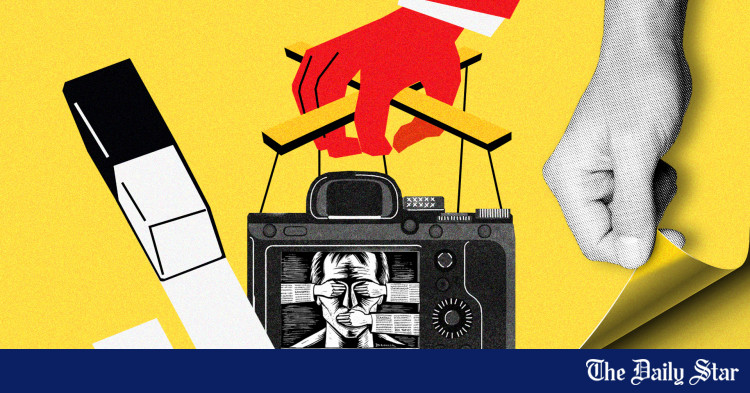
VISUAL: ANWAR SOHEL

The interim government has announced plans to repeal the Cyber Security Act (CSA). How do you view this development?

It was the right decision and an expected one. There was widespread demand for this from the public, and the civil society and the media played a role in advocating for its repeal. Here, I would like to mention a number of things that should be done. The government should immediately undertake a comprehensive programme of duly compensating the victims of this draconian law and their families and rehabilitate them professionally, psychologically, and socially. Secondly, they should withdraw all the ongoing cases, although there is a legal issue in that. But if the government is willing, there can be ways of addressing the issue. Thirdly, in the present global context, there is no other option but to have a Cyber Security Act. But while drafting the new cyber security law, they should be able to take the right lessons from the DSA and the CSA. It has to be drafted through a fully participatory process, involving all stakeholders, including experts and professionals on cyber security. Plus, whoever is drafting this law must remember that it is not meant to control or dictate terms of freedom of expression or media freedom on cyber platforms—the Internet system, social media, and other digital platforms. The purpose of this law should be restricted to ensuring the safety and security of users on the Internet and the digital sphere. But any form of control of free expression, dissent, free speech, or free media should be outside the new law's scope.

Also, the names such as the Cyber Security Act or the Digital Security Act should not be used anymore. These names have created an atmosphere of intimidation, a sense of insecurity in society. The new law can be called something like the Internet Safety Act. Finally, since the government is the largest user and worst possible abuser of the Internet and digital system as per track record, to avoid conflict of interest, the authority to be created to oversee the implementation of this new law must be an independent body outside the control of the government.

The government has established a media reform commission. What types of media reforms are needed in this changed political climate and how can the media in Bangladesh regain public trust?

First of all, media as a fourth estate must be committed to upholding the fundamental principles of media ethics and integrity. The media as an institution cannot and does not need to be controlled by external forces. But in Bangladesh, we have seen that the media has been subjected to government control motivated by partisan political bias or influence for which draconian laws and state institutions including intelligence agencies were used. One of the tools used against media was divide and rule and cooption. As a result, while a few media houses may have their own integrity and ethical standards and practices, there has always been a lack of efforts on part of the media as a sector to develop and uphold the basic principles of independent and ethical journalism, or professional integrity among media personnel. I think now the media houses should try to sit together in the spirit of a new Bangladesh. They should themselves create a media code of ethics, ethics structures and implementation roadmaps. There must be mechanisms for the media to self-regulate and work transparently and accountably, maintaining professional integrity without external influence, political or otherwise. There has to be some serious system of sectoral oversight rather than anything coming from outside.

Secondly, like anywhere else in the world, media houses here are also essentially business entities. That's part of the reality. Nevertheless, there are good global practices. The capacity of the investors to differentiate between business interests and media freedom is very important. To instil this ideal into the media houses, their investors and media leaders, relevant professionals and experts should come together to make their own policies. However, no matter how much we talk about media reforms, unless and until there is a paradigm shift in the culture and practices of our politics and bureaucracy, which remain hostage to a media control mindset, changes will not happen.

Thirdly, media organisations must ensure that journalists and reporters are properly compensated and protected, with adequate job security and safety from all risks associated with the discharge of their professional duties. Many journalists are underpaid or irregularly paid, which must change for the media to maintain integrity.

Media, unlike most other institutions, have to be accountable to its constituency—the readers and viewers—every day, and in fact, every moment. Therefore, to survive credibly it must develop its own inbuilt system of ethics and integrity. No freedom is unlimited or unaccountable, but in the case of media, the limit to freedom and the process of accountability must be defined and ensured by the media itself within its constitutional mandate.​
 
Analyze

Analyze Post

Add your ideas here:
Highlight Cite Fact Check Respond
  • Like (+1)
Reactions: Bilal9

‘Now is the time to pursue stories without fear’

Shafiqul says country seeing unprecedented media freedom

Bangladesh is experiencing "unprecedented media freedom" as it transitions to democracy, said Chief Adviser's Press Secretary Shafiqul Alam yesterday.

Speaking at the launch of the "Development Media Forum" by Oxfam at a city hotel, he said, "We haven't used security agencies, administrative orders, or repressive laws to muzzle people's voices over the last five months."

Encouraging journalists to ask tough questions, Shafiqul said, "You can criticise me, the panel of advisers, and the chief adviser. You have that freedom."

Highlighting the role of the media, he said, "For democracy to be institutionalised, media freedom is crucial. Now is the time for journalists to pursue any stories without fear."

Shafiqul criticised unchecked development projects, both public and private, for harming the environment and marginalised communities.

"Powerful lobby groups harm nature in the name of job creation. Is it development?" he asked.

Press Institute Bangladesh Director General Faruk Wasif said it is time to question whether inequalities have increased under the Awami League in the name of development.

"The so-called development narrative of past years failed to ensure freedom, serving instead to establish authoritarianism," he said.

Swedish Ambassador Nicolas Weeks highlighted the challenge of misinformation but pledged Sweden's support for good journalism in Bangladesh.

"Media can promote social justice and be the voice of the underrepresented," he added.

Oxfam Bangladesh Country Director Ashish Damle said the organisation aims to enhance knowledge sharing and bridge local and global perspectives for better reporting on key issues, including climate change, gender equality, and social justice.

The event featured journalists, development practitioners, and diplomats discussing the media's role in fostering sustainable development and public debate.​
 
Analyze

Analyze Post

Add your ideas here:
Highlight Cite Fact Check Respond
  • Like (+1)
Reactions: Bilal9

Hasina regime silenced media
Shafiqul Alam says previous govt used state agencies to muzzle press

1737152367788.webp

VISUAL: ANWAR SOHEL

Chief Adviser's Press Secretary Shafiqul Alam yesterday said steps must be taken to ensure that no one can directly interfere with the media in the future like it was done during the ousted Sheikh Hasina government.

He said, "Over the past 15 years, intelligence agencies also played a role in silencing newspapers. Journalists would lose their jobs if they received certain phone calls, and news reports had to be removed..."

Shafiqul Alam made these remarks at a discussion titled "Media Reform Proposals: Citizens' Perspectives".

The event was organised by a group named "We Want a Fascism-Free Media" at the Dhaka Reporters' Unity in the capital's Segunbagicha.

Shafiqul said, "The previous government had the capability to control the media. A single phone call from DGFI, NSI, DB, or a minister was enough. I have heard many stories about how they controlled the media."

Advising to compile writings by columnists who defended fascist rule, he said, "Do not spread hatred against anyone. Punishing someone is not our objective. Conduct research; we aim to expose those who crafted the narratives."

Shafiqul said the previous government even justified murder as acceptable through its narratives. He emphasised the need for collective efforts to prevent the seeds of fascism from being sown again in Bangladesh.

He also said, "Ensuring the application of copyright law is crucial. All journalists must speak out strongly on this issue."

"You spend two months working on a report, and in just one minute, another news outlet -- or even a hundred outlets -- steals it. You take a great photo, and a major newspaper publishes it without permission. If you produce a quality report, a hundred outlets steal it. Those who engage in such theft should be shut down."

Akbar Hossain Majumder, press minister at the Bangladesh High Commission in the UK; Plabon Tariq, the group's spokesperson; Uttara University teacher Mahbub Alam, and lawyer Mollah Md Faruque Kaiser also spoke at the event.

Joynal Abedin Shishir, convener of the group, moderated the discussion.

The event concluded with the presentation of 13 proposals aimed at reforming the media.​
 
Analyze

Analyze Post

Add your ideas here:
Highlight Cite Fact Check Respond
  • Like (+1)
Reactions: Bilal9

Effective press council to be formed: Kamal Ahmed
RANGPUR CORRESPONDENT
Published :
Jan 19, 2025 22:32
Updated :
Jan 20, 2025 00:20

1737332644468.png


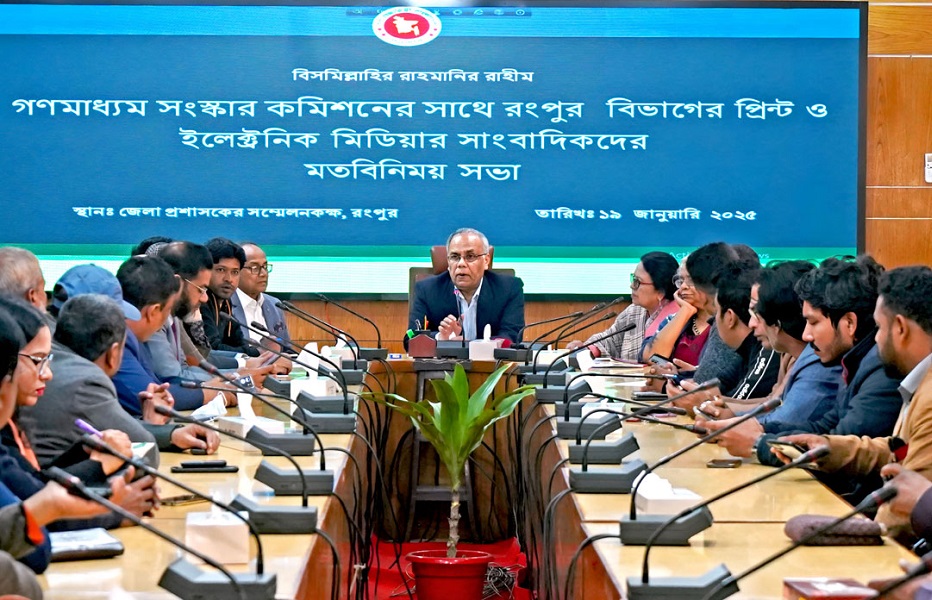
Media Reform Commission chief Kamal Ahmed said the commission has been formed to make the media independent and strong. The commission will recommend the formulation of suitable policies so that the media can play their role properly.

Those who will survive in the journalism competition by following the rules and regulations properly will be acceptable, he added.

Mr Kamal was speaking at a view exchange meeting with journalists of Rangpur division at the conference room of Rangpur district administration on Sunday afternoon.

The head of the media reform commission said normal development of mass media is not possible without healthy competition. "There is a tendency to use the media for personal and business interests or political influence in the country. There should be a minimum salary guarantee for the country's media workers," he said.

"If journalists do not have financial security, they will not have the mentality to work independently," he said.

In the meeting, the participants presented various proposals for media reform.

The proposals include:
  • Formation of a media commission​
  • Establishment of branch offices of PIB at the divisional level to enhance the skills of journalists​
  • Bridging the gap between capital-based journalists and journalists in rural areas​
  • Compelling all media to follow the guidelines of the Wage Board​
  • Recognition of the profession of journalism​
  • Keeping journalists free from partisan influence​
  • Establishing control over online media​
  • Repealing of laws gagging journalists​
  • Determination of minimum educational qualifications for journalists​
  • Eliminating party influence on DFP enlistment​
  • Providing a unique identification number to journalists​
  • Bringing journalists under social security​
  • Ensuring equality of opportunity for all​
  • Elimination of discrimination in advertising, etc.​
Commission members Shamsul Haque Zahid, Prof Gitiara Nasreen, Begum Kamrunnesa Hasan, Mostafa Sabuj and Abdullah Al Mamun and its deputy secretary Kazi Ziaul Baset, among others, were present at the view exchange meeting.

Around 120 journalists from online, electronic and print media from eight districts and upazilas of Rangpur division joined the meeting.​
 
Analyze

Analyze Post

Add your ideas here:
Highlight Cite Fact Check Respond
  • Like (+1)
Reactions: Bilal9

MRC aims to build independent, strong, objective media: Kamal Ahmed
BSS
Published :
Jan 21, 2025 21:04
Updated :
Jan 21, 2025 21:04

1737506640178.webp


Media Reform Commission (MRC) Chief Kamal Ahmed said on Tuesday that the main objective of the commission is to build an independent, strong and objective media.

He made the remark while exchanging views with journalists from print and electronic media in Rajshahi division at the conference room of the office of the Deputy Commissioner of Rajshahi.

Kamal Ahmed said the commission is working to meet the expectations of the people by overcoming the anger and crisis of trust arisen in the media during the regime of fascist Awami League government due to the inability of doing impartial and independent journalism.

Stressing the need of identifying the weaknesses of the media to meet the people’s expectations, he said they are trying to identify the weaknesses by conducting public opinion surveys based on the opinions of the field level journalists, editors and readers.

In addition, he said, they are also trying to figure out the weaknesses of the media hearing the opinions of newspaper owners and others involved with the media industry.

Referring to compliance with the code of conduct in doing objective journalism, he said that if the code of conduct and principles are followed, it is possible to do objective and impartial journalism alongside removing other obstacles.

Regarding the issue of disclosing the assets of newspaper or television owners, he said that newspaper owners and editors should publish annual financial statement.

When everyone is being held accountable in all cases, why newspaper owners or editors should be exempted from it, he added.

Kamal Ahmed said that the commission will work on bringing them under accountability as well.

Agreeing with the issue of providing assistance to the families of journalists who died during the movement while performing their professional duties, he said that the issue of compensation for the dead and injured is an important question.

“We have to take this into consideration,” he said, adding, they should be brought under assistance through the July Foundation.

He advised the government to be more aware in this regard.

He also said that the issues of withdrawing cases should be considered with priority basis as they have been faced harassment cases, served jail terms and remained unemployed.

Media Reform Commission members Professor Dr Gitiara Nasreen, Shamsul Haque Zahid, Kamrunnesa Hasan, Jimmy Amir, Deputy Information Officer of Rajshahi Regional Information Office Md. Touhiduzzaman, Deputy Regional Director of Bangladesh Betar Rajshahi Mohammad Jahangir Alam, editors of various daily and online newspapers, publishers and journalist leaders of various districts, among others, also joined the meeting.​
 
Analyze

Analyze Post

Add your ideas here:
Highlight Cite Fact Check Respond
  • Like (+1)
Reactions: Bilal9

Media reform should address sectoral male bias
27 January, 2025, 00:00

WOMEN’S rights activists and media scholars consider developing a gender-sensitive reporting strategy and an effective system to monitor journalistic practices in print, broadcast and digital media as a priority agenda for media sector reforms. They have expressed their concern at a roundtable discussion on gender-sensitive reporting and said that the majority of media outlets do not have a gender policy. The policy vacuum results in biased and sensationalised reporting. Considering the biased representation of women, their concerns are not misplaced. Victim-blaming is not uncommon in reporting on issues of gender-based violence and gender inequality. Despite a legal bar on disclosing the identity of rape victims, the media have disclosed the identity of victims on a number of occasions. Sensationalised and objectified representation of women for profiteering has also been a concern. The media reforms commission, formed in November 2024, with plans to revitalise the tradition of public interest journalism and strengthen media freedom should, therefore, make gender policy a priority concern.

In addition to patriarchal bias in reporting, there are other concerns. In recent times, the media sector has seen a significant growth, with 45 television channels, 25 FM radio stations, 32 community radio stations, 1,248 daily newspapers and more than 100 online news portals. Women, however, account for only 4 per cent of the work force and they seldom have access to leadership and decision-making. Studies have showed how patriarchal bias in human resource management and labour policy, particularly reluctance at granting maternity leave or ensuring child care, led to a high drop-out rate among women journalists. Except for a few print media houses, the sector does not comply with the High Court order that has asked all employers to set up anti-sexual harassment cells in offices. It has been reported how unresolved cases of sexual harassment have compelled women to leave their profession. The gender-based wage gap has also been reported. Professional associations for journalists have also failed to ensure women’s representation and rarely addressed issues of gender discrimination. It is, therefore, not an overstatement that the media landscape is male-dominated.

Media reforms should, therefore, include an outlined policy to ensure gender-sensitive reporting and increased women’s participation. In doing so, the government should review the licensing process so that no new media house is given a license without a gender policy and an anti-sexual harassment cell. The Press Institute of Bangladesh and other similar agencies can play a role in providing appropriate training in gender issues and developing a mechanism to prevent sensationalised reporting for profiteering interests. Professional associations of journalists should abandon their male bias and consider fighting patriarchy in the sector and society.​
 
Analyze

Analyze Post

Add your ideas here:
Highlight Cite Fact Check Respond
  • Like (+1)
Reactions: Bilal9

Members Online

⤵︎

Latest Posts

Latest Posts