Donate ☕
201 Military Defense Forums
[🇧🇩] - Press Freedom in Bangladesh | Page 8 | PKDefense
Home Login Forums Wars Movies Watch Videos
Serious discussion on defense, geopolitics, and global security.

[🇧🇩] Press Freedom in Bangladesh

Reply (Scroll)
Press space to scroll through posts
G Bangladesh Defense
[🇧🇩] Press Freedom in Bangladesh
51
2K
More threads by Saif

External forces must not interfere with the media

1731455631596.webp


Dr Iftekharuzzaman, executive director of Transparency International Bangladesh (TIB), talks about the current state of press freedom in the country, recent attempts by certain groups to suppress some media outlets, and the potential way out of the situation with Naznin Tithi of The Daily Star.

Why is the media still unable to operate freely following the political change in the country, despite repeated commitments from the interim government to ensure press freedom?

Let's remember the background of the anti-discrimination movement, which initially began as a quota reform movement seeking justice in public sector recruitment. The underlying factors behind this movement, however, were multi-dimensional and deeply rooted in institutionalised discrimination across all aspects of life and society, shaped by years of authoritarian rule. The student-led movement was soon joined by the broader public, rallying under the main slogan against all forms of discrimination. On August 5, the authoritarian regime fell. But this does not necessarily mean that we have achieved a discrimination-free Bangladesh, nor can we expect the deep-rooted discriminatory structures and practices to be transformed in the short term.

The people's dream for a "new Bangladesh" includes restructuring the state and establishing a new social and political order, with a clear stance against all forms of discrimination. While the government, the movement itself, and other stakeholders are clearly committed to realising this vision, what we are observing post-August 5 is that various groups, considering themselves victors—whether as direct participants, supporters, or opportunists—do not all share the same understanding or vision of a discrimination-free society. This divergence is now manifesting in different ways.

What reforms does the media need in Bangladesh?

The diversity of our society—in terms of gender, religion, culture, ethnicity, etc—is under severe stress as some groups feel newly entitled to impose parochial agendas. Using labels like "collaborators" or "co-opted beneficiaries" of the previous authoritarian regime, these forces now consider themselves empowered—sometimes excessively so—to impose their own agendas, which are not necessarily aligned with the anti-discrimination movement's spirit.

The media has become one of the targets of these groups, which are now trying to impose their own interpretations of media freedom onto others. Certain sections of the media that have played a very supportive role in the whole movement, advocated for a diverse and inclusive society, and have been consistent with the anti-discriminatory spirit are now being selectively targeted. Media freedom is being subjected to campaigns by forces whose basic conceptualisation, indoctrination, and ways of imposing agendas are discriminatory at their core, which is deeply troubling.

Nevertheless, we cannot ignore the factors that contributed to the transformation of an originally democratically elected regime in 2008 into a draconian authoritarian one. It was designed to monopolise political and governance space and to capture state and non-state institutions to create a superstructure perceived to maintain power indefinitely, without accountability. This setup enabled abuse of power, corruption, and the criminalisation of politics with impunity. It is also a fact that the media was among the institutions targeted for capture and control. As a result, some segments of the media struggled to navigate state-sponsored controls and conspiracies while striving for independence and professionalism, though often at the cost of reluctant self-censorship. On the other hand, many media outlets allowed themselves to be co-opted, benefiting from and even becoming components of the authoritarian superstructure. While no one should condone such collaborators or facilitators of the previous regime, indiscriminately victimising the entire media or launching targeted attacks on select outlets for what occurred under authoritarian rule is unacceptable.

How would you explain the recent attempts by certain groups to silence the media or the mob mentality directed against journalists and specific media outlets? What role has the government played in stopping this?

The interim government has repeatedly stated its commitment to a free press. When the chief adviser met with newspaper editors, he encouraged them to be critical and objective in identifying the government's failures. From the government's side, we have not seen anything detrimental to media freedom, except for the recent indiscriminate cancellation of accreditation of a large number of journalists.

When agitations took place against some of the leading media houses, the government provided them support and resisted such moves. However, certain groups who find themselves to be over-empowered—who may or may not have participated in the movement—continue to act as if it is their time to impose their own agenda to target media that is not in their liking for their own reason. While the government has successfully prevented worse outcomes, there is no guarantee that these forces have been fully controlled or managed to the extent that such indoctrinated groups won't strike back. So, the government must be vigilant to safeguard media freedom. History is replete with examples that failure to ensure free media can only be self-defeating.

Mob justice is the manifestation or a weapon these forces are using. And the media has obviously become one of the targets. However, this is not the first time that it has been used. Mob justice has taken place in other contexts as well since August 5. This is also not unusual in the context of such a huge popular uprising against a deep-rooted authoritarian regime. Many people would consider it normal because people have deep-rooted sentiments against the former regime. People have strong emotions against those who are in any manner considered to be associated with or part of the authoritarian regime and those who facilitated the ruthless killings, tortures, all kinds of discrimination and violation of fundamental rights. Mob justice is the outburst of that emotion of people against such grievances. But there is a limit to it and the government must strategically address and manage it in due process through effective communication.

Incidentally, the two most prominent media houses in the country, which are under attack now, were directly victimised in the worst possible way by the authoritarian regime. They were blacklisted from any government programmes or press conferences and deprived of government advertisements. It is no secret that they were consistent targets of manipulation, harassment, and intimidation by the intelligence agencies, the main powerbase of the previous regime. Both houses had to endure a series of politically motivated cases due to their role as free media. Their fate symbolised the criminalisation of free media driven by a hunger for power. Despite this, they survived the challenging situation without compromising their commitment to upholding the spirit of a free press. Whether they are targeted in the "new Bangladesh" because of their alleged "linkage" with India or the previous regime, or for upholding the spirit of a free press, is anyone's guess.

1731455742654.webp

VISUAL: ANWAR SOHEL

The interim government has announced plans to repeal the Cyber Security Act (CSA). How do you view this development?

It was the right decision and an expected one. There was widespread demand for this from the public, and the civil society and the media played a role in advocating for its repeal. Here, I would like to mention a number of things that should be done. The government should immediately undertake a comprehensive programme of duly compensating the victims of this draconian law and their families and rehabilitate them professionally, psychologically, and socially. Secondly, they should withdraw all the ongoing cases, although there is a legal issue in that. But if the government is willing, there can be ways of addressing the issue. Thirdly, in the present global context, there is no other option but to have a Cyber Security Act. But while drafting the new cyber security law, they should be able to take the right lessons from the DSA and the CSA. It has to be drafted through a fully participatory process, involving all stakeholders, including experts and professionals on cyber security. Plus, whoever is drafting this law must remember that it is not meant to control or dictate terms of freedom of expression or media freedom on cyber platforms—the Internet system, social media, and other digital platforms. The purpose of this law should be restricted to ensuring the safety and security of users on the Internet and the digital sphere. But any form of control of free expression, dissent, free speech, or free media should be outside the new law's scope.

Also, the names such as the Cyber Security Act or the Digital Security Act should not be used anymore. These names have created an atmosphere of intimidation, a sense of insecurity in society. The new law can be called something like the Internet Safety Act. Finally, since the government is the largest user and worst possible abuser of the Internet and digital system as per track record, to avoid conflict of interest, the authority to be created to oversee the implementation of this new law must be an independent body outside the control of the government.

The government has established a media reform commission. What types of media reforms are needed in this changed political climate and how can the media in Bangladesh regain public trust?

First of all, media as a fourth estate must be committed to upholding the fundamental principles of media ethics and integrity. The media as an institution cannot and does not need to be controlled by external forces. But in Bangladesh, we have seen that the media has been subjected to government control motivated by partisan political bias or influence for which draconian laws and state institutions including intelligence agencies were used. One of the tools used against media was divide and rule and cooption. As a result, while a few media houses may have their own integrity and ethical standards and practices, there has always been a lack of efforts on part of the media as a sector to develop and uphold the basic principles of independent and ethical journalism, or professional integrity among media personnel. I think now the media houses should try to sit together in the spirit of a new Bangladesh. They should themselves create a media code of ethics, ethics structures and implementation roadmaps. There must be mechanisms for the media to self-regulate and work transparently and accountably, maintaining professional integrity without external influence, political or otherwise. There has to be some serious system of sectoral oversight rather than anything coming from outside.

Secondly, like anywhere else in the world, media houses here are also essentially business entities. That's part of the reality. Nevertheless, there are good global practices. The capacity of the investors to differentiate between business interests and media freedom is very important. To instil this ideal into the media houses, their investors and media leaders, relevant professionals and experts should come together to make their own policies. However, no matter how much we talk about media reforms, unless and until there is a paradigm shift in the culture and practices of our politics and bureaucracy, which remain hostage to a media control mindset, changes will not happen.

Thirdly, media organisations must ensure that journalists and reporters are properly compensated and protected, with adequate job security and safety from all risks associated with the discharge of their professional duties. Many journalists are underpaid or irregularly paid, which must change for the media to maintain integrity.

Media, unlike most other institutions, have to be accountable to its constituency—the readers and viewers—every day, and in fact, every moment. Therefore, to survive credibly it must develop its own inbuilt system of ethics and integrity. No freedom is unlimited or unaccountable, but in the case of media, the limit to freedom and the process of accountability must be defined and ensured by the media itself within its constitutional mandate.​
 
Analyze

Analyze Post

Add your ideas here:
Highlight Cite Fact Check Respond
  • Like (+1)
Reactions: Bilal9

Basic salary of a journo should be at least Tk 30,000-40,000: Shafiqul Alam
Chief Adviser’s Press Secretary says media houses which cannot pay that much should shut operations

View attachment 15396
Shafiqul Alam

The news organisations who are paying employees less than Tk 30,000-Tk 40,000 as basic salary should be closed, said Chief Adviser's Press Secretary Shafiqul Alam yesterday.

"Journalists should have a minimum basic salary between Tk 30,000 and Tk 40,000. It can't be less. Whoever pays below it should shut their business," he said at a discussion organised by Multimedia Reporters Association at the National Press Club.

He said journalism has become a bloodsucking industry in Bangladesh. There are many instances that the media owners don't pay journalists properly for years.

"There should be a new movement to increase the salaries of journalists," he said.

"Those who do journalism should be given intellectual property rights and rightly evaluated," he said.

Shafiqul Alam said there was no real media freedom in Bangladesh during the regime of Sheikh Hasina and many journalists played fearless journalism.

"If there are fearless journalists in Bangladesh, they are multimedia journalists and photojournalists. Their contribution to this movement is memorable, but they don't get due recognition," he said.

Those who are very close to the owners or the editors get good salaries, and most other journalists don't get a fair salary. In some cases, it is even between Tk 5,000 and Tk 10,000 a month, he said.

"In the cases of journalists in the countryside, they get very small amount of salary. You are using their videos and earning out of them, but not paying even Tk 500 to them," he said.

Shafiqul Alam said journalists do hazardous job. A few journalists were martyred during the July uprising and a few dozens were injured. They are considered conscience of the society but are not paid properly.

Many of the owners paying poorly to the journalists speak aloud as civil society members Dhaka, which he said, is an irony.

Journalists come to the profession for their passion, but the owners exploit that, he said.

He advocated a movement anew, and blamed the journalist unions for failure, saying that RMG workers are not as educated as journalists are, but they are far better in union activism. They fight for their minimum wage, which is great.

"We are considered conscience of the society, but for decades we remain victims of injustice. Yet, we are not raising our voice for our rights."​

I like this, it will attract better qualified and educated people to the Journalist profession by raising competition.

Remember that guy in CTG - Komol Dey, who couldn't even pronounce Bangla properly, and was screaming all the time. He became a meme of sorts in Bangladesh media.
 
Analyze

Analyze Post

Add your ideas here:
Highlight Cite Fact Check Respond
  • Like (+1)
Reactions: Saif

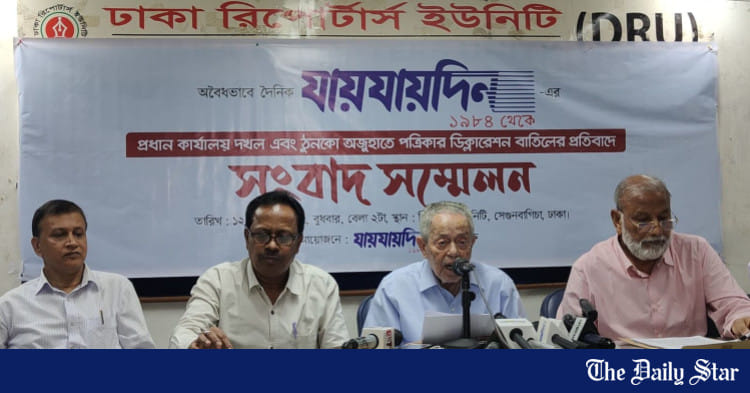
Protests erupt as ‘JaiJai Din’ declaration revoked

1741827599123.webp

Photo: UNB

The declaration of the daily 'JaiJai Din' has been revoked following an application by its former editor Shafik Rehman, sparking protests from the newspaper's current management and journalists.

Speaking at a press conference today at Dhaka Reporters' Unity, Kazi Rukunuddin Ahmed, acting editor of the newspaper, along with the current owners and journalists, protested against the illegal occupation of the newspaper's main office and the unjust cancellation of its declaration.

In his written statement, Kazi Rukunuddin said, "A malicious group, with Shafik Rehman in the forefront, has illegally seized the main office and the printing press. They have resorted to lies and deception to continue their conspiracy to seize 'JaiJai Din' from its current owner, Sayed Hossain Chowdhury. We attempted to resolve the matter quietly, keeping in mind the respect for this senior journalist. However, this group is trying to influence the law and the court, constantly distorting truth and fabricated lies."

He also stated, "After the 'JaiJai Din' office and press in Tejgaon Industrial Area were seized, the newspaper continued to print from another press following proper procedures, informing the DC office about the change. Despite this, the DC office, after receiving Shafik Rehman's application, revoked the newspaper's declaration under baseless pretenses."

Kazi Rukunuddin said, "The government has repeatedly emphasised media freedom, yet an influential group has manipulated the system to revoke the declaration of a legally operating media outlet."​
 
Analyze

Analyze Post

Add your ideas here:
Highlight Cite Fact Check Respond

Bangladesh advances 16 notches in a year on press freedom index: Mahfuj Alam
BSS
Published :
May 02, 2025 23:04
Updated :
May 02, 2025 23:04

1746232235316.webp


Information and Broadcasting Adviser Md Mahfuj Alam today said that Bangladesh has advanced 16 notches in the World Press Freedom Index (WPFI) in a year due to the absence of government interference in the media.

He said this while responding to Bangladesh's position in the WPFI published on the website of Reporters Without Borders (RSF), according to a press release signed by Public Relations Officer (PRO) of the Ministry of Information and Broadcasting Md Mamun Or Rashid on Friday.

Referring to the interim government's initiatives to establish media freedom, the adviser said that all media outlets in the country, including Bangladesh Betar and Bangladesh Television, are now free from government influence.

The government is not interfering in any media organisation by making telephone calls, he added.

The government has already taken several initiatives to free and strengthen the country's media, he said, adding that Bangladesh's 16-place advancement in the WPFI proves that the government is working to free and strengthen the country's media.

Mahfuj Alam said that several reform activities will be undertaken very soon as per the recommendations of the Media Reform Commission.

The adviser expressed the hope that Bangladesh will move a few steps further in the WPFI next year and the rights of the country's journalists and media professionals will be protected.

Bangladesh has been ranked 149th out of 180 countries in the WPFI-2025, published on the website of the Paris-based organisation RSF on the occasion of World Press Freedom Day on May 3.

Bangladesh’s rank was 165th in the index last year.

Neighbouring India is staying two places below Bangladesh’s position in the index this year, securing 151st place.

When the Awami League government took office in 2009, Bangladesh’s position was 121st in the index.

During the Awami League's rule, Bangladesh has slipped 44 places in the index in the last 15 years.​
 
Analyze

Analyze Post

Add your ideas here:
Highlight Cite Fact Check Respond

Govt wants healthy competition among newspapers: Info Adviser
FE Online Desk
Published :
May 08, 2025 21:27
Updated :
May 08, 2025 21:27

1746752171648.webp


Information and Broadcasting Adviser Md. Mahfuz Alam said the government encourages healthy competition among newspapers and wants to see the industry thrive through ethical practices.

“The government wants to see healthy competition among newspapers. Certain negative practices still exist in the industry, and these must come to an end,” he told a view-exchange meeting with the Newspaper Owners’ Association of Bangladesh (NOAB) at the ministry’s conference room on Thursday.

The adviser said, “We have already begun implementing the recommendations of the Media Reform Commission. We seek cooperation of all stakeholders to implement these reforms.”

The adviser expressed concern over persisting negative trends in the print media sector, urging all stakeholders to shun such practices, reports BSS.

During the meeting, NOAB President A.K. Azad said that over the past 12-13 years, both the circulation and advertising revenue of print newspapers have significantly declined.

“Over the past 12 to 13 years, both newspaper circulation and advertising revenue have significantly declined. Despite being a service industry, newspapers are burdened with a 27.5% corporate tax. We propose reducing it to 10% to help the sector survive,” he said.

Azad also stressed the need for restructuring the Wage Board and proposed the formation of the board through a search committee to ensure transparency and fairness.

Prothom Alo Editor Matiur Rahman praised the Media Reform Commission’s report and emphasized the urgency of implementing its actionable recommendations.

Commenting on government-media relations, the editor said the current government is not attempting to intimidate the press.

In the meeting, NOAB proposed the establishment of a permanent Media Commission to oversee long-term reforms and stability in the sector.

Editors from leading national dailies, including Daily Star Mahfuz Anam, The Daily Sangbad Altaf Mas Kabir, The Financial Express Shamsul Haque Zahid and The Daily Karatoa editor Mozammel Haque, were present at the discussion.​
 
Analyze

Analyze Post

Add your ideas here:
Highlight Cite Fact Check Respond

Media reform and journalism

Tanim Asjad
Published :
Jul 11, 2025 23:36
Updated :
Jul 11, 2025 23:36

1752279825370.webp


One of the most significant outcomes of the student-led mass uprising in July last year has been the substantial improvement in the media space, providing a much-needed breathing space for the mass media and opening the window of professional journalism to a large extent. While the freedom of the press is not yet fully guaranteed since the fall of the Hasina regime on August 5 last year, the situation has undeniably improved. It has become significantly easier to express opinions or raise questions on various issues, marking a positive step forward in the journey towards press freedom.

During the 15 years of the autocratic regime of Hasina, it had become gradually difficult for the Press to work independently and professionally. The regime systematically imposed various barriers to curb freedom of the Press, which drove the mass media to adopt self-censorship for their survival. Although the ousted regime allowed a large number of new newspapers and television channels in the name of media freedom, most of these were assigned to support the regime's actions and misdeeds. The rise of pro-regime mass media, backed by the state, has become a significant obstacle to a free Press.

The pro-Hasina media appeared as a big tool to suppress the truth and the misdeeds of the autocratic regime, which included human rights abuses, corruption, and political repression, and counter the other media that have tried to do journalism as professionally as possible. In this process, a good number of senior and leading journalists appeared as hard-loyalists of Hasina and political activists of the Bangladesh Awami League, the party in power at that time. Thus, they have contributed to distorting the media and undermining the values and ethics of journalism.

Now, in a changed environment, it is also not easy to bring the mass media into order and restore the ethical practice of journalism. To achieve this, the Yunus-led interim government formed the Media Reform Commission in November last and the commission submitted a comprehensive report in March, this year. The commission conducted a wide range of consultations with various stakeholders and reviewed proposals presented by different parties. The commission also examined some of the best practices in other countries and attempted to align the relevant recommendations with them. Through a comprehensive review, the report assesses the current state of the newspaper and electronic media in the country, identifies various flaws and problems within the industry, and ultimately provides a set of recommendations to enhance the overall condition of the press.

Now, the implementation of the recommendations is subject to scrutiny first. It is also understandable that the government can't implement all the recommendations. Some of the suggestions may be implemented immediately or within a short time. Again, some are subject to implementation in the medium and long run. Additionally, some will never be implemented. The interim government may move to implement the recommendations that can be implemented immediately and also initiate the process of implementing some others. Before starting the implementation, the government needs to bring the media houses on board, which is also not an easy task.

Furthermore, it is crucial to note that the country's journalist unions, associations, and organisations have yet to comprehensively review or discuss the commission report. This lack of thorough review and knowledge-based debate among media people is contributing to some misunderstandings about the reform proposals. It is imperative that these organisations, along with those working in the media or interested in journalism, come forward to review the report. Their active involvement is essential for a successful and comprehensive reform of the media landscape.

If journalists lack interest in reforming the media or are content with the status quo, they will be compelled to compromise their professionalism further. Ethical values of journalism will also be damaged to a greater extent. Though any reform is a painful process, in the greater interest of the mass media, some measures are necessary as recommended by the commission. From restricting cross-ownership to abolishing repressive laws, all these measures may bear fruit in the long run, provided that media personnel feel a unified sense of urgency to move forward. Differences of opinion regarding the acceptance and implementation of the various recommendations already exist, and this is not a problem. The core challenge is the start of the reform, which involves implementing only a few of the recommendations in the first phase.​
 
Analyze

Analyze Post

Add your ideas here:
Highlight Cite Fact Check Respond

Members Online

⤵︎

Latest Posts

Latest Posts