New Tweets

[🇧🇩] Press Freedom in Bangladesh

G Bangladesh Defense
[🇧🇩] Press Freedom in Bangladesh
58
3K
More threads by Saif


Fallen govt destroyed journalism in Bangladesh: Kader Gani Chowdhury
UNB
Published :
Mar 04, 2025 22:19
Updated :
Mar 04, 2025 22:19

1741142007881.webp


Bangladesh Federal Union of Journalists (BFUJ) Secretary General Kader Gani Chowdhury on Tuesday said that the fallen government, i.e. the one led by the Awami League till August 5 last year, has severely damaged journalism in Bangladesh.

He said that a certain group of subservient journalists had been created to write false narratives, which has eroded public trust in the media.

"Trust in the media must be restored through truthful journalism. The media is considered the fourth pillar of the state, highlighting its significance and role. It serves as a vigilant guardian by exposing inconsistencies in governance and administration while standing alongside the people's struggles. However, in Bangladesh today, this is hardly happening," he said while exchanging views with journalists at the Khulna Press Club.

He emphasised that journalism faces many challenges, with the greatest being the battle to uphold truth against falsehood, adding, "Risks in journalism will always exist. Overcoming fear is a journalist's duty. However, unethical and yellow journalism is tarnishing the profession's dignity."

Kader Gani further said, "We must remember that the media acts as the state's watchdog. It is not an adversary of the government, administration, or people, but rather a monitor in the public interest."

He mentioned that a bold and robust media is essential for establishing a strong governance system. Even if the other three pillars of the state weaken, a strong fourth pillar can keep the state people-oriented, he added.

The discussion was attended by BFUJ Assistant Secretary General Ehteshamul Haque Shaon, HM Alanuddin, Rashidul Islam, Abdur Razzak Rana, Metropolitan Journalists' Union Khulna President Anisuzzaman, General Secretary Himalaya, and others.​
 
Analyze

Analyze Post

Add your ideas here:
Highlight Cite Respond
  • Like (+1)
Reactions: Bilal9

Article 19 urges govt to protect journalists, amend repressive laws

1741654046030.webp


Article 19 has called for the government to protect and offer legal support for journalists as well as review and amend repressive laws to ensure the freedom of expression, media freedom, and the safety of journalists.

It also suggested that the government guarantees adequate salaries and benefits for journalists, as these adversely affect the journalists' professional standards.

Article 19, an international human rights organisation, made the recommendations to the Bangladesh Media Reform Commission on February 23, 2025, highlighting necessary legal and policy reforms.

In a statement issued yesterday, Article 19 said Bangladesh's media landscape, though diverse, faces significant challenges due to the lack of legal protections for journalists, media ownership influenced by political affiliations, and high levels of self-censorship.

It called on the interim government to review and amend repressive laws in accordance with the International Covenant on Civil and Political Rights (ICCPR).

The laws that require review and amendments include the Code of Criminal Procedure 1898; The Bangladesh Television Authority Act 2001, the Telegraph Act 1885 and the Wireless Telegraph Act 1933, the Official Secrets Act 1923, the Censorship of Films Act 1963, the Right to Information Act 2009; the Cyber Security Act 2023, the Printing Presses and Publications (Declaration and Registration) Act 1973.

It also suggested amending the Penal Code 1860, the Information and Communication Technology (ICT) Act 2006, Draft Data Protection Act 2025, draft National Artificial Intelligence Policy 2024, the Post Office Act 1869, the Foreign Relations Act 1932, the Special Powers Act 1974, the Prohibition of Indecent Advertisement Act 1963, the Code of Civil Procedure 1909, the Contempt of Court Act 2013 and the Press Council Act 1974.

These acts grant authorities the power to ban or close newspapers and other publications on grounds of defamation, sedition, acts against sovereignty and decency, among others, provide authorities with strict control over TV broadcasting, grant control over the flow of information, put restrictions on journalists – especially those working on public interest issues and even allows surveillance of online activities, and strict control on what information and opinions can be published online

The rights body said journalists' professional standards are being adversely affected by inadequate salaries and benefits.

"It is essential for the government to coordinate with media owners to establish a fair salary structure, secure working conditions, healthcare, retirement benefits, and workplace safety to encourage journalists to work responsibly."

Article 19 said it is crucial that the government create effective mechanisms for legal action against attacks and threats to journalists, as well as to stop false and harassing lawsuits, so they can continue their work independently and without fear.

It called for the government to initiate a national action plan to ensure the safety of female journalists in Bangladesh, in line with the United Nations Security Council Resolution 1325 on Women, Peace, and Security.

"The government must ensure the free flow of information by avoiding internet shutdowns, content blocking, and filtering, so that citizens' right to internet freedom and access to information is protected."

Article 19 has urged the government to act on these recommendations and foster a media environment that upholds democracy, transparency, and human rights.​
 
Analyze

Analyze Post

Add your ideas here:
Highlight Cite Respond
  • Like (+1)
Reactions: Bilal9

Basic salary of a journo should be at least Tk 30,000-40,000: Shafiqul Alam
Chief Adviser’s Press Secretary says media houses which cannot pay that much should shut operations

1741824984389.webp

Shafiqul Alam

The news organisations who are paying employees less than Tk 30,000-Tk 40,000 as basic salary should be closed, said Chief Adviser's Press Secretary Shafiqul Alam yesterday.

"Journalists should have a minimum basic salary between Tk 30,000 and Tk 40,000. It can't be less. Whoever pays below it should shut their business," he said at a discussion organised by Multimedia Reporters Association at the National Press Club.

He said journalism has become a bloodsucking industry in Bangladesh. There are many instances that the media owners don't pay journalists properly for years.

"There should be a new movement to increase the salaries of journalists," he said.

"Those who do journalism should be given intellectual property rights and rightly evaluated," he said.

Shafiqul Alam said there was no real media freedom in Bangladesh during the regime of Sheikh Hasina and many journalists played fearless journalism.

"If there are fearless journalists in Bangladesh, they are multimedia journalists and photojournalists. Their contribution to this movement is memorable, but they don't get due recognition," he said.

Those who are very close to the owners or the editors get good salaries, and most other journalists don't get a fair salary. In some cases, it is even between Tk 5,000 and Tk 10,000 a month, he said.

"In the cases of journalists in the countryside, they get very small amount of salary. You are using their videos and earning out of them, but not paying even Tk 500 to them," he said.

Shafiqul Alam said journalists do hazardous job. A few journalists were martyred during the July uprising and a few dozens were injured. They are considered conscience of the society but are not paid properly.

Many of the owners paying poorly to the journalists speak aloud as civil society members Dhaka, which he said, is an irony.

Journalists come to the profession for their passion, but the owners exploit that, he said.

He advocated a movement anew, and blamed the journalist unions for failure, saying that RMG workers are not as educated as journalists are, but they are far better in union activism. They fight for their minimum wage, which is great.

"We are considered conscience of the society, but for decades we remain victims of injustice. Yet, we are not raising our voice for our rights."​
 
Analyze

Analyze Post

Add your ideas here:
Highlight Cite Respond
  • Like (+1)
Reactions: Bilal9

Basic salary of a journo should be at least Tk 30,000-40,000: Shafiqul Alam
Chief Adviser’s Press Secretary says media houses which cannot pay that much should shut operations

View attachment 15396
Shafiqul Alam

The news organisations who are paying employees less than Tk 30,000-Tk 40,000 as basic salary should be closed, said Chief Adviser's Press Secretary Shafiqul Alam yesterday.

"Journalists should have a minimum basic salary between Tk 30,000 and Tk 40,000. It can't be less. Whoever pays below it should shut their business," he said at a discussion organised by Multimedia Reporters Association at the National Press Club.

He said journalism has become a bloodsucking industry in Bangladesh. There are many instances that the media owners don't pay journalists properly for years.

"There should be a new movement to increase the salaries of journalists," he said.

"Those who do journalism should be given intellectual property rights and rightly evaluated," he said.

Shafiqul Alam said there was no real media freedom in Bangladesh during the regime of Sheikh Hasina and many journalists played fearless journalism.

"If there are fearless journalists in Bangladesh, they are multimedia journalists and photojournalists. Their contribution to this movement is memorable, but they don't get due recognition," he said.

Those who are very close to the owners or the editors get good salaries, and most other journalists don't get a fair salary. In some cases, it is even between Tk 5,000 and Tk 10,000 a month, he said.

"In the cases of journalists in the countryside, they get very small amount of salary. You are using their videos and earning out of them, but not paying even Tk 500 to them," he said.

Shafiqul Alam said journalists do hazardous job. A few journalists were martyred during the July uprising and a few dozens were injured. They are considered conscience of the society but are not paid properly.

Many of the owners paying poorly to the journalists speak aloud as civil society members Dhaka, which he said, is an irony.

Journalists come to the profession for their passion, but the owners exploit that, he said.

He advocated a movement anew, and blamed the journalist unions for failure, saying that RMG workers are not as educated as journalists are, but they are far better in union activism. They fight for their minimum wage, which is great.

"We are considered conscience of the society, but for decades we remain victims of injustice. Yet, we are not raising our voice for our rights."​

I like this, it will attract better qualified and educated people to the Journalist profession by raising competition.

Remember that guy in CTG - Komol Dey, who couldn't even pronounce Bangla properly, and was screaming all the time. He became a meme of sorts in Bangladesh media.
 
Analyze

Analyze Post

Add your ideas here:
Highlight Cite Respond
  • Like (+1)
Reactions: Saif

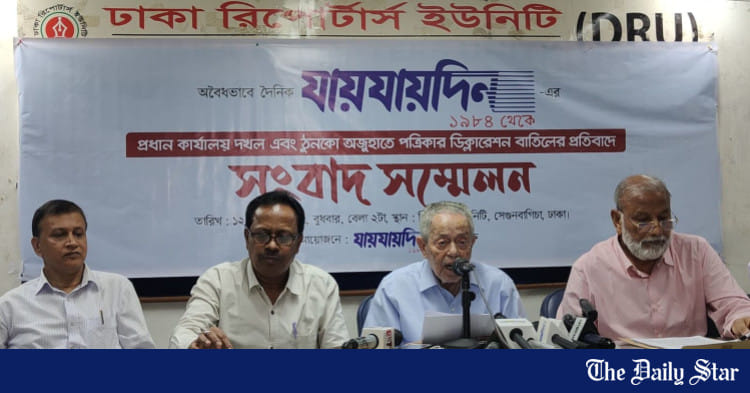
Protests erupt as ‘JaiJai Din’ declaration revoked

1741827599123.webp

Photo: UNB

The declaration of the daily 'JaiJai Din' has been revoked following an application by its former editor Shafik Rehman, sparking protests from the newspaper's current management and journalists.

Speaking at a press conference today at Dhaka Reporters' Unity, Kazi Rukunuddin Ahmed, acting editor of the newspaper, along with the current owners and journalists, protested against the illegal occupation of the newspaper's main office and the unjust cancellation of its declaration.

In his written statement, Kazi Rukunuddin said, "A malicious group, with Shafik Rehman in the forefront, has illegally seized the main office and the printing press. They have resorted to lies and deception to continue their conspiracy to seize 'JaiJai Din' from its current owner, Sayed Hossain Chowdhury. We attempted to resolve the matter quietly, keeping in mind the respect for this senior journalist. However, this group is trying to influence the law and the court, constantly distorting truth and fabricated lies."

He also stated, "After the 'JaiJai Din' office and press in Tejgaon Industrial Area were seized, the newspaper continued to print from another press following proper procedures, informing the DC office about the change. Despite this, the DC office, after receiving Shafik Rehman's application, revoked the newspaper's declaration under baseless pretenses."

Kazi Rukunuddin said, "The government has repeatedly emphasised media freedom, yet an influential group has manipulated the system to revoke the declaration of a legally operating media outlet."​
 
Analyze

Analyze Post

Add your ideas here:
Highlight Cite Respond

Bangladesh advances 16 notches in a year on press freedom index: Mahfuj Alam
BSS
Published :
May 02, 2025 23:04
Updated :
May 02, 2025 23:04

1746232235316.webp


Information and Broadcasting Adviser Md Mahfuj Alam today said that Bangladesh has advanced 16 notches in the World Press Freedom Index (WPFI) in a year due to the absence of government interference in the media.

He said this while responding to Bangladesh's position in the WPFI published on the website of Reporters Without Borders (RSF), according to a press release signed by Public Relations Officer (PRO) of the Ministry of Information and Broadcasting Md Mamun Or Rashid on Friday.

Referring to the interim government's initiatives to establish media freedom, the adviser said that all media outlets in the country, including Bangladesh Betar and Bangladesh Television, are now free from government influence.

The government is not interfering in any media organisation by making telephone calls, he added.

The government has already taken several initiatives to free and strengthen the country's media, he said, adding that Bangladesh's 16-place advancement in the WPFI proves that the government is working to free and strengthen the country's media.

Mahfuj Alam said that several reform activities will be undertaken very soon as per the recommendations of the Media Reform Commission.

The adviser expressed the hope that Bangladesh will move a few steps further in the WPFI next year and the rights of the country's journalists and media professionals will be protected.

Bangladesh has been ranked 149th out of 180 countries in the WPFI-2025, published on the website of the Paris-based organisation RSF on the occasion of World Press Freedom Day on May 3.

Bangladesh’s rank was 165th in the index last year.

Neighbouring India is staying two places below Bangladesh’s position in the index this year, securing 151st place.

When the Awami League government took office in 2009, Bangladesh’s position was 121st in the index.

During the Awami League's rule, Bangladesh has slipped 44 places in the index in the last 15 years.​
 
Analyze

Analyze Post

Add your ideas here:
Highlight Cite Respond

Govt wants healthy competition among newspapers: Info Adviser
FE Online Desk
Published :
May 08, 2025 21:27
Updated :
May 08, 2025 21:27

1746752171648.webp


Information and Broadcasting Adviser Md. Mahfuz Alam said the government encourages healthy competition among newspapers and wants to see the industry thrive through ethical practices.

“The government wants to see healthy competition among newspapers. Certain negative practices still exist in the industry, and these must come to an end,” he told a view-exchange meeting with the Newspaper Owners’ Association of Bangladesh (NOAB) at the ministry’s conference room on Thursday.

The adviser said, “We have already begun implementing the recommendations of the Media Reform Commission. We seek cooperation of all stakeholders to implement these reforms.”

The adviser expressed concern over persisting negative trends in the print media sector, urging all stakeholders to shun such practices, reports BSS.

During the meeting, NOAB President A.K. Azad said that over the past 12-13 years, both the circulation and advertising revenue of print newspapers have significantly declined.

“Over the past 12 to 13 years, both newspaper circulation and advertising revenue have significantly declined. Despite being a service industry, newspapers are burdened with a 27.5% corporate tax. We propose reducing it to 10% to help the sector survive,” he said.

Azad also stressed the need for restructuring the Wage Board and proposed the formation of the board through a search committee to ensure transparency and fairness.

Prothom Alo Editor Matiur Rahman praised the Media Reform Commission’s report and emphasized the urgency of implementing its actionable recommendations.

Commenting on government-media relations, the editor said the current government is not attempting to intimidate the press.

In the meeting, NOAB proposed the establishment of a permanent Media Commission to oversee long-term reforms and stability in the sector.

Editors from leading national dailies, including Daily Star Mahfuz Anam, The Daily Sangbad Altaf Mas Kabir, The Financial Express Shamsul Haque Zahid and The Daily Karatoa editor Mozammel Haque, were present at the discussion.​
 
Analyze

Analyze Post

Add your ideas here:
Highlight Cite Respond

Media reform and journalism

Tanim Asjad
Published :
Jul 11, 2025 23:36
Updated :
Jul 11, 2025 23:36

1752279825370.webp


One of the most significant outcomes of the student-led mass uprising in July last year has been the substantial improvement in the media space, providing a much-needed breathing space for the mass media and opening the window of professional journalism to a large extent. While the freedom of the press is not yet fully guaranteed since the fall of the Hasina regime on August 5 last year, the situation has undeniably improved. It has become significantly easier to express opinions or raise questions on various issues, marking a positive step forward in the journey towards press freedom.

During the 15 years of the autocratic regime of Hasina, it had become gradually difficult for the Press to work independently and professionally. The regime systematically imposed various barriers to curb freedom of the Press, which drove the mass media to adopt self-censorship for their survival. Although the ousted regime allowed a large number of new newspapers and television channels in the name of media freedom, most of these were assigned to support the regime's actions and misdeeds. The rise of pro-regime mass media, backed by the state, has become a significant obstacle to a free Press.

The pro-Hasina media appeared as a big tool to suppress the truth and the misdeeds of the autocratic regime, which included human rights abuses, corruption, and political repression, and counter the other media that have tried to do journalism as professionally as possible. In this process, a good number of senior and leading journalists appeared as hard-loyalists of Hasina and political activists of the Bangladesh Awami League, the party in power at that time. Thus, they have contributed to distorting the media and undermining the values and ethics of journalism.

Now, in a changed environment, it is also not easy to bring the mass media into order and restore the ethical practice of journalism. To achieve this, the Yunus-led interim government formed the Media Reform Commission in November last and the commission submitted a comprehensive report in March, this year. The commission conducted a wide range of consultations with various stakeholders and reviewed proposals presented by different parties. The commission also examined some of the best practices in other countries and attempted to align the relevant recommendations with them. Through a comprehensive review, the report assesses the current state of the newspaper and electronic media in the country, identifies various flaws and problems within the industry, and ultimately provides a set of recommendations to enhance the overall condition of the press.

Now, the implementation of the recommendations is subject to scrutiny first. It is also understandable that the government can't implement all the recommendations. Some of the suggestions may be implemented immediately or within a short time. Again, some are subject to implementation in the medium and long run. Additionally, some will never be implemented. The interim government may move to implement the recommendations that can be implemented immediately and also initiate the process of implementing some others. Before starting the implementation, the government needs to bring the media houses on board, which is also not an easy task.

Furthermore, it is crucial to note that the country's journalist unions, associations, and organisations have yet to comprehensively review or discuss the commission report. This lack of thorough review and knowledge-based debate among media people is contributing to some misunderstandings about the reform proposals. It is imperative that these organisations, along with those working in the media or interested in journalism, come forward to review the report. Their active involvement is essential for a successful and comprehensive reform of the media landscape.

If journalists lack interest in reforming the media or are content with the status quo, they will be compelled to compromise their professionalism further. Ethical values of journalism will also be damaged to a greater extent. Though any reform is a painful process, in the greater interest of the mass media, some measures are necessary as recommended by the commission. From restricting cross-ownership to abolishing repressive laws, all these measures may bear fruit in the long run, provided that media personnel feel a unified sense of urgency to move forward. Differences of opinion regarding the acceptance and implementation of the various recommendations already exist, and this is not a problem. The core challenge is the start of the reform, which involves implementing only a few of the recommendations in the first phase.​
 
Analyze

Analyze Post

Add your ideas here:
Highlight Cite Respond

Posts you haven't read yet..

Members Online

Latest Posts

Back
PKDefense - Recommended Toggle