Home Login Watch Videos Wars

[🇧🇩] Textile & RMG Industry of Bangladesh

[🇧🇩] Textile & RMG Industry of Bangladesh
427
17K
More threads by Saif

G Bangladesh Defense

EU supply chain law is both a threat and an opportunity

1714950545148.webp

Photo: REUTERS

Recently, the European Parliament approved the Corporate Sustainability Due Diligence Directive (CSDDD), moving it one step closer to formal adoption by the European Union. The CSDDD, once adopted, will create a legal liability for companies in relation to environmental and human rights violations within their global supply chains.

There has been a huge discussion about the CSDDD in Western media, with concerns raised that it has been significantly watered down from the initial proposal. But what is this directive/legislation, and how will it impact Bangladesh's garment manufacturers?

The CSDDD actually represents a significant regulatory initiative by the EU to promote sustainable business practices across various industries, including the garment sector. At its core, it mandates that large companies operating within the EU take active steps to identify, prevent, mitigate, and account for the adverse impacts of their operations on human rights and the environment. It is built on the principle that businesses should be proactive in their sustainability efforts, rather than reactive or merely compliant with existing norms.

The regulation covers a number of areas. In terms of due diligence requirements, it means that companies are required to conduct due diligence processes to assess and address the risks associated with their business operations and their entire supply chain. It also means looking into how their products are made, where materials are sourced, and the working conditions in factories, among other factors. All have obvious implications for manufacturers, particularly with regard to the rights of garment workers, which are a contentious issue throughout Asia.

Transparency is also a crucial aspect of the CSDDD. The new regulations mandate that companies must regularly report on their due diligence activities, findings, and the measures they take to mitigate negative impacts. The reporting ensures that stakeholders, including consumers and investors, are well-informed about the company's sustainability practices.

The key here is that, to ensure greater transparency, fashion brands will have to further engage with suppliers. Will this mean more audits and questionnaires for manufacturers? This seems to be a distinct possibility.

Stakeholder engagement is another key aspect of the CSDDD. Engaging with potentially affected groups and other stakeholders is essential under the new rules. This includes dialogue with local communities, workers, and NGOs to gain insights into the real-world impacts of business operations. If a company identifies that it has caused or contributed to adverse impacts, it must provide or cooperate in remediation. This could involve compensating communities for environmental damage or improving working conditions in factories. Previously, the issue of remediation had been left for the supply chains to sort out. To this extent, it will be interesting how the issue of remediation plays out under the CSDDD.

In Bangladesh, the garment industry is already heavily scrutinised for its environmental and social impacts, ranging from excessive water usage and pollution to labour rights abuses in the supply chains. Given that, I assume the CSDDD could significantly impact garment manufacturers in several ways.

The first of these is supply chain scrutiny. Manufacturers will need to have a thorough understanding of their entire supply chain—from raw material sourcing to the final product. This includes ensuring that all parts of the supply chain adhere to environmental standards and respect workers' rights. For instance, manufacturers might need to switch to suppliers who use sustainable materials or enforce fair labour practices.

The potential for increased costs is another issue. Implementing comprehensive due diligence processes can be costly. Garment manufacturers might face higher operational costs as they invest in better supply chain management systems, conduct audits, and potentially pay higher prices for sustainably sourced materials. These costs could also affect pricing strategies and profit margins.

On the other hand, adhering to the CSDDD could provide a competitive advantage for some suppliers. Consumers are increasingly conscious of the environmental and social impacts of their purchases. Companies that demonstrate genuine commitment to sustainability may attract more customers and build stronger brand loyalty. This could be an opportunity for some suppliers, and we are already seeing this as brands put more effort into supporting progressive, responsible garment manufacturers.

The directive may also spur innovation in the industry. Manufacturers might invest in new technologies and processes that reduce environmental impacts, such as water recycling systems or energy-efficient production techniques. This can not only help comply with the CSDDD but also improve overall efficiency and cost-effectiveness.

Moving forward, for garment manufacturers in Bangladesh, compliance with the CSDDD is going to be essential for accessing the European market—our largest market alongside the US. Non-compliance can result in legal risks, including fines and restrictions on market access. Therefore, it's crucial for the manufacturers to align their practices with the directive to avoid such risks. We cannot afford to get this wrong.

While the transition may be challenging and costly, the long-term benefits of building a sustainable operation could outweigh these initial investments—not just in profitability, but also in contributing positively to society and the environment.

Mostafiz Uddin is the managing director of Denim Expert Limited. He is also the founder and CEO of Bangladesh Denim Expo and Bangladesh Apparel Exchange (BAE).​
 
Analyze

Analyze Post

Add your ideas here:
Highlight Cite Fact Check Respond

Garment exports to US continue to decline
American retailers cut back on imports from all over the world

1715038492254.webp


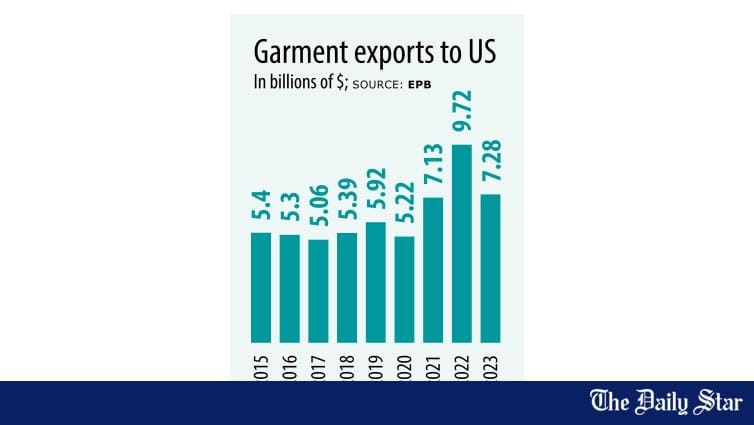
Garment exports to the US, Bangladesh's single largest export destination, continued to decline over the past few months as American retailers and brands cut back on imports of apparel from all over the world.

In the January-March period of the current year, garment shipments to American markets declined by 17.68 percent to $1.75 billion, according to data from the Office of Textiles and Apparel (OTEXA), a body under the American Commerce Department.

In the January-February period, garment exports to the US declined by 19.24 percent to $1.18 billion, according to the data.

The collective shipment of textiles and garments slipped 17.37 percent to $1.81 billion in the January-March period of the current year, the data also showed.

Garment exports to the US have been declining over the past several months as American retailers and brands are importing less garments despite a gradual improvement in inflationary pressure to adjust with higher exports of garments in previous years.

For instance, garment exports from Bangladesh to the US rose more than 53 percent after the Covid-19 pandemic as retailers and brands imported more to meet pent-up demand in 2022.

But garment exports did not increase at same pace last year as American retailers and brands had plenty of old stock of unsold clothing items.

Retail sales began to revive in November last year during the beginning of the festive season while sales peaked in December last year during Christmas. The demand for apparel has been slowly reviving since then, with exports gradually approaching positive territory.

Moreover, many garment factories in Bangladesh have faced long closures due to the wage hike movement, which stretched from September to December last year. Production at many factories was disrupted severely as workers agitated, demanding a wage hike.

AK Azad, managing director of Ha-Meem Group, which exports 95 percent of its garment products to the US, said the demand for the apparel among low-end consumers in the US did not fully recover.

This especially affected Bangladesh because the country mainly exports low-end garment items to the US, Azad added.

Moreover, the interest rate in US banks is still high, which means consumers are busy making interest payments against loans, such as ones taken to purchase houses, he added.

Furthermore, the gas and power crisis in the garment industry has been severely affecting lead times.

As a result, manufacturers cannot ship goods as per commitments to buyers, said Mohammad Hatem, executive president of the Bangladesh Knitwear Manufacturers and Exporters Association (BKMEA).

The lack of a deep-sea port in the country has also been affecting lead times, Hatem added.

The National Retail Federation (NRF), the largest retailers' platform in the US, said retail sales grew at a steady pace in March.

"As inflation for goods levels off, March's data demonstrates steady spending by value-focused consumers who continue to benefit from a strong labour market and real wage gains," said NRF President and CEO Matthew Shay.

"In this highly competitive market, retailers are having to keep prices as low as possible to meet the demand of consumers looking to stretch their family budgets," Matthew added.

Total retail sales, excluding automobiles and gasoline, were up 0.36 percent seasonally adjusted month-on-month and up 2.72 percent unadjusted year-on-year in March, according to Retail Monitor.

That compared with increases of 0.4 percent month-on-month and 2.7 percent year-on-year in February, based on the first 28 days in February.​
 
Analyze

Analyze Post

Add your ideas here:
Highlight Cite Fact Check Respond

Denim exports in blues as inflation forces buyers to tighten belt
Top exporters see recovery signs as int'l expo focuses on sustainability
MONIRA MUNNI
Published :
May 07, 2024 02:48
Updated :
May 07, 2024 02:48


1715040958064.webp


The country's dominance of the global denim market -- built on its position as the top supplier to the United States and the European Union -- was challenged last year by a decline in shipments to both regions, show data.

For the fall, local denim-makers point the finger at a sluggish demand in the global market and high production costs at home.

According to the Bangladesh Garment Manufacturers and Exporters Association (BGMEA), denim exports to the US and EU bloc saw negative growth of 31.07 per cent and 23.42 per cent respectively in 2023.

Denim exports to the US market fetched Bangladesh $649.96 million in 2023 calendar year -- down from $942.96 million in 2022, according to OTEXA, a body under the US Department of Commerce.

Bangladesh has held the top denim supplier position in the US market since 2020, displacing Mexico.

OTEXA data also shows a decrease in total US denim apparel imports from the world last year -- down 23.97 per cent to $3.16 billion from $4.16 billion in 2022.

Once the leading exporter, China fell to fifth place in the US market in 2023 with $312.47 million in exports. Pakistan and Vietnam ranked third and fourth, respectively, with $374.56 million and $336.31 million.

According to BGMEA data, Bangladesh's denim exports to the EU also declined last year, fetching $1.20 billion compared to $1.57 billion in 2022.

Turkey and Pakistan followed Bangladesh in the EU market, with both countries experiencing negative growth exceeding 12 per cent. Bangladesh has maintained its top position in the EU market since 2017, according to BGMEA.

For the decline in denim shipments to both the US and EU, exporters blame a sluggish demand caused by the economic slowdown triggered by the Russia-Ukraine war and the resulting high inflation.

This, they say, forced Western consumers to prioritise essential goods, while rising production costs due mainly to the local energy crisis were also contributing factors.

Anwar-ul-Alam Chowdhury Parvez, managing director of Argon Denims Ltd, said consumers are focusing on meeting basic needs due to the economic climate, with fashion taking a back seat.

"This has led to a decrease in international demand for denim, not just for Bangladesh but for other exporting countries as well," he said. "On the other hand, sales of functional wear and activewear are increasing."

According to Mr Parvez, the situation is unlikely to improve unless global demand picks up.

Rising energy costs and central bank policies were also cited by denim-makers as factors contributing to a decline in local production.

Optimism as innovation in focus at denim expo

Referring to positive buyer projections, exporters at an international denim expo in Dhaka expressed optimism for an upturn in orders from September onwards.

The two-day Bangladesh Denim Expo, held at the International Convention City Bashundhara (ICCB) in Dhaka, features over 60 exhibitors from 11 countries showcasing their latest innovations.

Organised by the Bangladesh Apparel Exchange, the event began on Monday. Manufacturers are displaying a wide range of products, from sustainable fabrics to cutting-edge designs, highlighting the diversity of the denim industry.

The show's theme, "Reimagine", reflects the industry's focus on continuous innovation and the integration of digitalisation. Organisers believe this approach can reshape the denim landscape and leverage the power of technology.

Shovon Islam, managing director of Sparrow Apparels Ltd, a company exporting value-added denim, told the Financial Express that Bangladesh controls 9-10 per cent of the global denim market, worth $85 billion, with annual exports of $8 billion.

High buyer inventory in 2021 and 2022, due to lower consumer demand during the pandemic, led to weaker sales in 2023, he said. However, he was optimistic for an upturn in orders from September onwards for the next season, based on positive buyer projections.

Mr Islam added that global demand has been on an upward trend since the beginning of 2024. Buyers are booking capacity as their inventory levels have depleted.

He also said that some orders are shifting from Egypt due to war and safety concerns.

Mr Islam, who moderated a session at the expo, told the FE that Bangladesh is adapting to changing fashion trends by producing high value-added denim goods.

Shams Mahmud, managing director of Shasha Garments Ltd, said, "Inflation and historically high interest rates set by the Federal Reserve are still impacting the US market."

"This has led to a decrease in disposable income, affecting demand for denim, particularly entry-level high street products which are price-sensitive," Mr Mahmud added.

However, he too expressed optimism for the future. "We are seeing new orders coming in and are hopeful that demand will pick up and exports will rebound in the near future."

The Bangladesh Textile Mills Association estimates that over 40 local mills currently produce denim fabrics.​
 
Analyze

Analyze Post

Add your ideas here:
Highlight Cite Fact Check Respond

Five strategies for garment exporters to navigate geopolitical risks

1715641595361.webp

Geopolitical risks are just intrinsic to the global business landscape. FILE PHOTO: STAR

Geopolitical tensions are on the rise in apparel sourcing hubs, with major implications for Bangladesh. For instance, the trend of "friendshoring," whereby apparel manufacturing and sourcing shift to countries that are geopolitical allies, is coming under scrutiny due to increasing political tensions. A recent report produced earlier this year, by risk intelligence firm Verisk Maplecroft, underlines that.

Maplecroft looked at trends over five years across 40 emerging markets, including major manufacturing hubs like Bangladesh, Indonesia, Mexico, Thailand, and Turkey and assessed risks related to civil unrest, government instability, and exposure to conflict and terrorism. It suggests "civil unrest" as a "primary threat to manufacturing," with more than three-quarters of the assessed emerging markets experiencing an increase in civil unrest over the past five years. Alarmingly, Bangladesh ranks seventh highest on political risk related to civil unrest, according to the report.

While Bangladesh has established itself as the world's second-largest exporter of ready-made garments, protests for higher wages in 2023 resulted in at least four deaths and significant disruption to the apparel sector. This unrest has continued into 2024, despite the agreement on a new minimum wage, with reports of garment factories terminating workers who participated in the protests.

Bangladesh is not alone on these issues. The report details how other key apparel manufacturing hubs like Mexico, Turkey, Thailand, and Indonesia also face political risks.

So, what is driving this unrest? Economic inequality is identified as the primary driver of civil unrest, with global, regional and national issues contributing to instability. Maplecroft's report predicts that political risks in garment hubs are unlikely to decrease in 2024. This could have been the same in Bangladesh had we not been able to resolve issues related to the minimum wage increase.

There are other risk issues at play as well. Disruptions in crucial logistics routes, such as the Red Sea and Suez Canal, are posing further challenges to global apparel supply chains. Recent conflicts and attacks on cargo ships in these maritime routes have prompted companies like AP Moller-Maersk to suspend transits. This would potentially cause delays in stock delivery.

The report also raises concerns over the deepening divide between powerful nations, particularly the US and China. Sanctions and counter sanctions between these countries pose risks to global supply chains. Their actions are much more complex beyond numbers and are something which industry leaders in Bangladesh need to keep an eye on.

As apparel entrepreneurs seek to diversify their supply chains after the pandemic, the report emphasises the importance of tracking political risks and conducting "scenario analysis" to mitigate potential disruptions.

But how can garment manufacturers mitigate against geopolitical tensions in an ever-changing and uncertain world? How can they reduce their exposure to the impacts of trade disputes, political unrest, geopolitical dynamics and other developments which are beyond their control? I can suggest five effective strategies for Bangladeshi export-oriented manufacturing companies in this context.

First, geopolitical tensions can disrupt the flow of goods and raw materials, leading to supply chain bottlenecks and production delays as well as increased costs for raw materials. To counteract this risk, garment manufacturers or companies should diversify their supply chains across multiple regions and suppliers. By reducing dependence on a single source or location and conducting thorough risk assessments and developing contingency plans for alternative sourcing, businesses can minimise the impact of geopolitical disruptions.

A second tactic is to continuously monitor regulatory changes. Geopolitical dynamics often manifest in the form of regulatory shifts and trade policies including changes in tariffs, sanctions and export controls. Moreover, maintaining open channels of communication with government agencies and industry associations enables businesses to stay informed and proactively address compliance issues.

Third, in these unstable times, building strong-trustful relationships with customers, suppliers and local partners is crucial. Garment manufacturing export companies should prioritise long-term partnerships based on mutual respect, transparency, and shared values. By cultivating a network of trusted allies, businesses can navigate geopolitical uncertainties more effectively and leverage collective expertise to mitigate risks.

Fourth, on a practical level, political risk insurance (PRI) can provide financial protection against losses stemming from geopolitical events such as expropriation, political violence, and currency devaluation. Export-oriented manufacturing companies can secure comprehensive PRI coverage tailored to their specific operations and markets. Working with reputable insurers and leveraging PRI solutions can safeguard against potential disruptions and provide peace of mind in uncertain environments.

Finally, it stands to reason that an overreliance on a single market increases vulnerability to geopolitical shocks and economic downturns. To mitigate this risk, export-oriented manufacturing companies should diversify their market exposure across regions and customer segments. This will diversify revenue streams and reduce dependence on any single geopolitical entity. While this would demand stepping into unknown space by undertaking deeper research into any new market (economy), demography or consumers' behavioural pattern and preferences, an interested company should walk that uncharted path even making social or cultural investments in a new destination (society).

In my experience, these risks are just intrinsic to the global business landscape. As much as geopolitics may paralyse export-oriented manufacturers from Bangladesh, mere criticism won't help us. By undertaking pro-active or strategic steps like diversifying supply chains, monitoring regulatory changes, fostering partnerships, enhancing political risk insurance, and diversifying market exposure, I believe, Bangladeshi garment makers can navigate geopolitical uncertainties with foresight, resilience, and agility.

Mostafiz Uddin is the managing director of Denim Expert Limited. He is also the founder and CEO of Bangladesh Denim Expo and Bangladesh Apparel Exchange (BAE).​
 
Analyze

Analyze Post

Add your ideas here:
Highlight Cite Fact Check Respond

BGMEA for continuation of gas supply to new factories outside EZs
Staff Correspondent 13 May, 2024, 22:47

1715643269861.webp


The country's apparel makers on Monday demanded that the government should reconsider its decision to withhold gas and electricity connections from industries located outside economic zones.

Bangladesh Garment Manufacturers and Exporters Association president SM Mannan Kochi made the demand at a meeting with textiles and jute minister Jahangir Kabir Nanok held at the Secretariat in the capital Dhaka on the day.

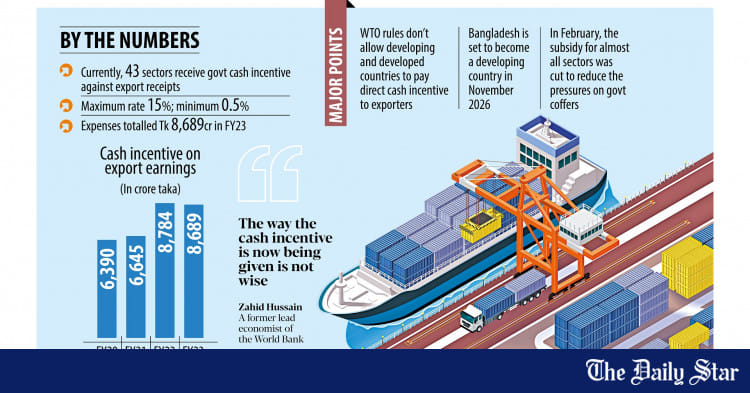
The BGMEA president also demanded continuation of cash incentive against readymade garment exports until 2026.

Recently, the Bangladesh Bank has issued a circular stating that the new industrial establishments would not get electricity and gas connections if they are constructed in places other than the economic zones or government designated industrial areas.

Kochi said that no fresh investment would take place in the apparel sector due to the circular as only 3 economic zones out of proposed 100 started its operations in the country.

The BGMEA president informed the textile minister about the non-cooperation from customs and the National Board of Revenue and demanded that harassment-free environment be ensured.

Kochi also requested the government to reduce tax at source to 0.5 per cent from existing 1.0 per cent.

Jahangir Kabir Nanok assured BGMEA leaders that he would raise the issue of the NBR and customs in the next cabinet meeting.

He termed the NBR and customs' issue as 'big problem' for business and said that his ministry received such complaints from some other sectors.

The minister also assured that he would try to ease the decision of the government over the utility connections to the new industry outside the economic zones.​
 
Analyze

Analyze Post

Add your ideas here:
Highlight Cite Fact Check Respond

Members Online

Latest Posts

Back
PKDefense
G
O
 
H
O
M
E