Bangladesh Defense
Saif
Senior Member
- Jan 24, 2024
- 20,779
- 9,685
- Nation

- Residence
- Axis Group


RMG export to US down 17pc in January-March
Bangladesh's garment exports to the US, the country's largest export destination, fell by over 17 per cent year-on-year to $1.75 billion in January-March, according to the Office of Textiles and Apparel (OTEXA), a body under the American Commerce Department. The slump is evident in both the value
RMG export to US down 17pc in January-March
MONIRA MUNNI
Published :
May 04, 2024 23:58
Updated :
May 04, 2024 23:58

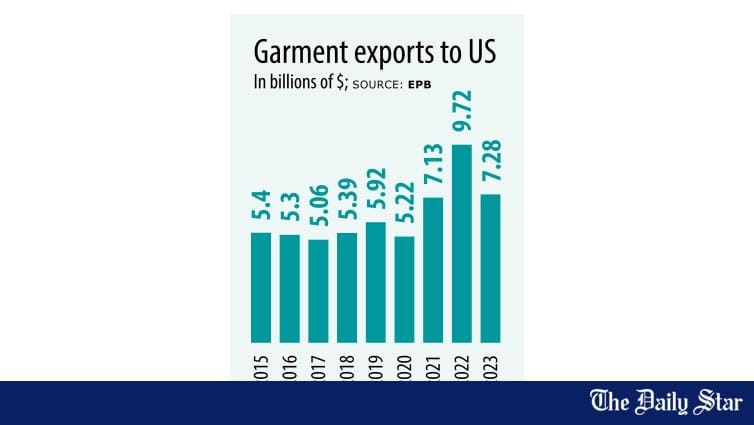
Bangladesh's garment exports to the US, the country's largest export destination, fell by over 17 per cent year-on-year to $1.75 billion in January-March, according to the Office of Textiles and Apparel (OTEXA), a body under the American Commerce Department.
The slump is evident in both the value and volume of exports.
US import figures show Bangladesh's key ready-made garment competitors China and Vietnam outperformed Bangladesh in the first quarter.
Exporters list a number of domestic issues like long lead times, inconsistent energy supplies and an overall high cost of doing business for their loss of export share in the US market.
These same factors, they say, give China and Vietnam an advantage in the American market.
US apparel imports from Bangladesh totaled $1.75 billion in January-March this year, compared to $2.13 billion in the same period of 2023, show OTEXA figures released on May 02.
In Q1, the country shipped 11.92 per cent fewer garments, which is 586.09 million square metres, compared to the previous year's 665.42 million square metres.
In contrast, though China's apparel exports to the US saw a slight decline in value, they did experience volume growth.
However, overall US apparel imports fell by 7.14 per cent to $18.07 billion in the first quarter of 2024, down from $19.46 billion in the same period of 2023.
Mohammad Hatem, executive president of the Bangladesh Knitwear Manufacturers and Exporters Association (BKMEA), said buyers are now placing orders with shorter lead times due to various factors. This situation puts China and Vietnam, with their shorter lead times and more consistent energy supplies, in a more advantageous position.
Exporters are struggling to meet lead times for current work orders due to a severe gas crisis, he told The Financial Express on Saturday.
He added that meeting production timelines is difficult as they require 15-20 days to obtain fabric due to gas and electricity shortages. Bangladesh also cannot receive all materials efficiently due to the lack of a deep-sea port, further delaying import and export activities.
The BKMEA leader said high production costs due to rising gas prices, recent wage hikes and anticipated electricity rate increases are eroding their competitiveness.
"In many cases, we can't receive the work orders as buyers offer prices below the production costs," he noted.
SM Mannan Kochi, president of the Bangladesh Garment Manufacturers and Exporters Association (BGMEA), said price is the key factor.
"Buyers are offering lower rates while production costs are steadily increasing," commented Mr Kochi, calling for measures to reduce costs and ensure fair apparel pricing to remain competitive.
Abdullah Hil Rakib, managing director of Team Group and also BGMEA vice president, attributed the decline to the Red Sea crisis.
OTEXA data shows China's apparel exports to the US in the first three months of 2024 reached $3.44 billion, marking a 0.71 per cent decline.
China saw a 9.79 per cent increase in volume, exporting 1.92 billion square metres of apparel during the first quarter.
Vietnam's apparel exports to the US in January-March 2024 increased by 0.91 per cent to $3.39 billion. US apparel imports from Vietnam also increased by 11.54 per cent, reaching 1.08 billion square metres.
The US's RMG imports from Cambodia rose by 11.13 per cent to $807.87 million in January-March compared to the same period in 2023. India's RMG exports to the US market declined by 8.79 per cent to $1.21 billion compared to $1.33 billion in the same period of 2023.
US RMG imports from Indonesia decreased by 14.16 per cent to $1.02 billion in the first three months of 2024, compared to $1.19 billion in the same period of 2023.
MONIRA MUNNI
Published :
May 04, 2024 23:58
Updated :
May 04, 2024 23:58
Bangladesh's garment exports to the US, the country's largest export destination, fell by over 17 per cent year-on-year to $1.75 billion in January-March, according to the Office of Textiles and Apparel (OTEXA), a body under the American Commerce Department.
The slump is evident in both the value and volume of exports.
US import figures show Bangladesh's key ready-made garment competitors China and Vietnam outperformed Bangladesh in the first quarter.
Exporters list a number of domestic issues like long lead times, inconsistent energy supplies and an overall high cost of doing business for their loss of export share in the US market.
These same factors, they say, give China and Vietnam an advantage in the American market.
US apparel imports from Bangladesh totaled $1.75 billion in January-March this year, compared to $2.13 billion in the same period of 2023, show OTEXA figures released on May 02.
In Q1, the country shipped 11.92 per cent fewer garments, which is 586.09 million square metres, compared to the previous year's 665.42 million square metres.
In contrast, though China's apparel exports to the US saw a slight decline in value, they did experience volume growth.
However, overall US apparel imports fell by 7.14 per cent to $18.07 billion in the first quarter of 2024, down from $19.46 billion in the same period of 2023.
Mohammad Hatem, executive president of the Bangladesh Knitwear Manufacturers and Exporters Association (BKMEA), said buyers are now placing orders with shorter lead times due to various factors. This situation puts China and Vietnam, with their shorter lead times and more consistent energy supplies, in a more advantageous position.
Exporters are struggling to meet lead times for current work orders due to a severe gas crisis, he told The Financial Express on Saturday.
He added that meeting production timelines is difficult as they require 15-20 days to obtain fabric due to gas and electricity shortages. Bangladesh also cannot receive all materials efficiently due to the lack of a deep-sea port, further delaying import and export activities.
The BKMEA leader said high production costs due to rising gas prices, recent wage hikes and anticipated electricity rate increases are eroding their competitiveness.
"In many cases, we can't receive the work orders as buyers offer prices below the production costs," he noted.
SM Mannan Kochi, president of the Bangladesh Garment Manufacturers and Exporters Association (BGMEA), said price is the key factor.
"Buyers are offering lower rates while production costs are steadily increasing," commented Mr Kochi, calling for measures to reduce costs and ensure fair apparel pricing to remain competitive.
Abdullah Hil Rakib, managing director of Team Group and also BGMEA vice president, attributed the decline to the Red Sea crisis.
OTEXA data shows China's apparel exports to the US in the first three months of 2024 reached $3.44 billion, marking a 0.71 per cent decline.
China saw a 9.79 per cent increase in volume, exporting 1.92 billion square metres of apparel during the first quarter.
Vietnam's apparel exports to the US in January-March 2024 increased by 0.91 per cent to $3.39 billion. US apparel imports from Vietnam also increased by 11.54 per cent, reaching 1.08 billion square metres.
The US's RMG imports from Cambodia rose by 11.13 per cent to $807.87 million in January-March compared to the same period in 2023. India's RMG exports to the US market declined by 8.79 per cent to $1.21 billion compared to $1.33 billion in the same period of 2023.
US RMG imports from Indonesia decreased by 14.16 per cent to $1.02 billion in the first three months of 2024, compared to $1.19 billion in the same period of 2023.