Home Watch Videos Wars Movies Login

[🇧🇩] Monitoring Bangladesh's Economy

[🇧🇩] Monitoring Bangladesh's Economy
1K
43K
More threads by Saif

G Bangladesh Defense

Automation critical for reforming NBR
1787698765757.webp


No wonder the country's tax regulator, the National Board of Revenue (NBR), could not so far set an enviable track record of performance. The reasons include red tape and graft. To this end, automation is being strongly suggested as a way of dealing with the issues. Understandably, as reported, the parliamentary committee on the Ministry of Finance has rightly called for expediting the process of NBR automation to help curb corruption, reduce harassment and raise government revenue. The observation that merely identifying or punishing corrupt officials would not be enough is particularly important. In fact, corruption is sustained by opaque procedures, discretionary powers, endless movement of files and the helpless dependence of taxpayers on individual officers. So long as the process creates opportunities for bargaining over assessments, refunds, clearances and audits, replacing one dishonest official with another will hardly clean up the system. What is necessary is to remove the source of the malpractice by redesigning the procedure itself.

The urgency becomes clearer when the state of domestic revenue mobilisation is considered. Bangladesh's tax-to-GDP ratio is reportedly around 6.8 per cent, one of the lowest among comparable economies, while the government has to finance growing commitments involving health, education, infrastructure, social protection and debt servicing. Notably, the NBR collected about Tk 4.15 trillion against a target of Tk 5.03 trillion in FY26. Yet the revenue target for the current fiscal year has been set at Tk 6.04 trillion. Also, continued dependence on indirect taxes falls disproportionately on ordinary consumers and leaves the government without adequate fiscal space during major economic or natural emergencies. So, any ambitious revenue target cannot be achieved by exerting more pressure on the limited number of compliant taxpayers. The tax net has to be widened and leakages in this regard duly plugged. In this connection, the NBR's plans for integrated taxpayer profiles, third-party data matching, electronic audit selection, automated refunds and faceless assessments are steps in the right direction.

Automation, however, should not mean simply transferring an old, cumbersome paper procedure to a computer. The entire chain from registration and return submission to payment, assessment, appeal, refund and clearance needs end-to-end integration across the income tax, VAT and customs wings. Every decision should leave a time-stamped digital trail. Cases should be allocated through transparent risk criteria and any manual override should be recorded and independently reviewed. That would reduce the physical encounters in which bribes are demanded, speed up services and save businesses from repeated visits to tax offices. At the same time, taxpayers must have access to clear notices, online tracking, help desks and an effective grievance mechanism. Otherwise, an unresponsive portal may become another form of red-tapism. Data protection, cybersecurity and limits on officials' access are equally essential, since a vast tax database without adequate safeguards could expose citizens to new kinds of abuse.

But technology by itself cannot reform an organisation, the structure, incentives and working culture of which remain unchanged. The proposed organisational restructuring of tax administration should, therefore, clearly separate tax policymaking from revenue management, remove overlapping authority and make officers accountable for service quality as well as collection. The NBR will also require trained personnel in information technology, data analytics, forensic accounting and risk-based auditing, backed by a strong internal integrity framework. Implementation should follow a public, time-bound roadmap, with measurable targets for online services, reduced disposal time, fewer physical visits, automated refunds and expansion of the active taxpayer base. Independent audits and periodic disclosure of performance would help ensure that automation does not become another expensive project captured by vested interests. Therefore, the government must treat end-to-end NBR automation not as another information-technology project, but as a structural reform to remove the very processes through which corruption, harassment and revenue leakage thrive. Given the fiscal pressures confronting the country, completing that reform can no longer wait.​
 
Analyze

Analyze Post

Add your ideas here:
Highlight Cite Respond

Bangladesh growth strategy at bay


1787699052689.webp


With increase in gross domestic product (GDP), also known as gross development product, as the goal of macroeconomic policy, investment becomes the essential instrument to achieve the goal. In popular parlance, investment is the engine of growth. A lay person with a curious bent of mind may want to know how much of investment will increase GDP by 1 (one) per cent? Economists have a way of finding this by looking at investment as a percentage of GDP, known as investment-GDP ratio, and incremental capital output ratio (ICOR) at a particular time. ICOR is the number of capital units required to produce one unit of output. More intensive is the use of labour as against capital or more inefficient is the use of capital, higher is ICOR. By this metric, industrially developed countries are using more capital intensive production methods with efficiency has lower ICOR than a labour intensive country using capital less efficiently. ICOR = Change in Capital / Change in Output. In other words, ICOR = Investment (% of GDP) / Growth Rate of GDP. Thus, if the investment-GDP ratio is 24 per cent and GDP growth rate 6 per cent, then according to the formula, ICOR will be 6 per cent.

This has roughly been the relationship historically used used for Bangladesh. Let us suppose Bangladesh’s investment- GDP ratio rises from 24 to 25 per cent. That is a 1 percentage -point increase in investment, not a 1 per cent increase in investment. With an ICOR of 4 ( four), 1 ( one) percentage-point increase in investment divided by 4 unit of ICOR will yield 0.25 increase in GDP. Bangladesh’s GDP growth has been estimated by the World Bank at 1 percentage-point increase in private investment/GDP yielding 0.28 percentage point higher GDP growth, with a one year lag. Its estimate for public investment was about 0.33 percentage point GDP increase. Using an ICOR of 4 the following estimate can be arrived at for GDP growth associated with investment/GDP ratio: (1) 20 per cent investment/ GDP = 5 per cent GDP growth; (2) 24 per cent investment/ GDP = 6 per cent GDP; (3) 28 per cent investment / GDP = 7 per cent GDP; (4) 32 per cent investment/ GDP = 8 per cent GDP; (5) 36 per cent investment/ GDP = 9 per cent GDP growth. This is not a forecast, it merely shows the mechanical ICOR relationship. Bangladesh’s Eighth Five Year Plan (8FYP) assumed that raising investment from 32 per cent of GDP to about 37 per cent would help achieve its 8.51 per cent growth target, recognising that the ICOR would rise as Bangladesh became more capital intensive. ICOR would also rise if investment is of poor quality and productivity is poor, reducing the growth obtained from each additional unit of investment.

The crucial questions are: (a) How much Bangladesh is investing as percentage of GDP? (b) How much additional GDP is Bangladesh getting from each taka of investment? If investment is rising but the ICOR is also rising, more investment can produce little additional growth. There is enough evidence that Bangladesh’s capital efficiency has deteriorated over time. For FY 2025, gross investment was about 28.2 per cent of GDP, while real GDP growth was only 3.7 per cent. From this, the ICOR can be calculated as follows: Investment/GDP of 28.2 per cent divided by GDP growth rate of 3.7 per cent yields an ICOR of 7.6.

Bangladesh’s total investment is currently around 28-29 per cent of GDP, with private investment about 23 per cent and public investment around 5-5.5 per cent. With ICOR of 4, the investment-GDP of 28 per cent would yield 7 per cent increase in GDP. But the ICOR estimated for FY2025 being 7.7, increase in GDP will be less than 4 per cent.

So, the growth strategy of Bangladesh has to focus both on increasing investment-GDP ratio and a lower ICOR achieved through efficient use of resources. Regarding the first, there is a policy choice between public and private sector investments or a mix of the two. In either case there are implications for sources of investment and sectors of investment with variation of ICOR in operation between the two.

Bangladesh started with a public sector-led growth strategy with almost all industries and businesses brought under the public sector in a centrally planned economy. After the regime change in 1975, there was a gradual shift towards market economy that allowed a private sector to grow. But investment by private sector grew at a slow pace as can be seen from the figures for investment-GDP ratio at different years since the regime change: (1) 1975: 5.5 per cent; (2) 1976: 8.7 per cent; (3) 1978: 11.0 per cent; (4) 1981: 14 per cent. The breakthrough in private sector investment came after 2000 when it reached 23 per cent of GDP. Economic liberalisation, denationalisation, privatisation and promotion of private sector both by the government and multilateral and bilateral institutions (proselytisers of Washington Consensus) led to a private sector-led development strategy that has continued to date. But the growth of private sector has not been linear and steady. During 2000-2022 period there has been a remarkable plateau in private sector investment. The investment-GDP ratio hovered between 22 to 24 per cent during the period under review. For reasons to be discussed below, private sector investment has not crossed above 24 per cent of GDP since 2022. Meanwhile, public investment increased substantially. The World Bank has shown public investment rising from 4.7 per cent of GDP in 2010 to 6.9 per cent in 2015. Later estimates put the figure around 7-8 per cent of GDP. The IMF’s data shows that private investment was 24.5 per cent of GDP in 2019 but only 22.4 per cent by 2024, while public sector investment was around 7-8 per cent of GDP.

If expansion of public sector investment was financed by public revenue earnings the expansion would not impinge on the growth of private sector investment. But government has resorted to borrowing, particularly from commercial banks, year to year, to meet its revenue shortfalls. This has crowded out private sector borrowing. On top of shortages of loan-able funds from banks, private sector borrowings have been hamstrung by high rates of interests. According to Bangladesh Bank statistics, private sector credit growth in November 2025 was 6.5 per cent which came down to 4.75 per cent in April, 2026, an all time record low. As a result of this lacklustre performance, the new monetary policy of Bangladesh Bank has reduced the target of private sector credit growth to 6.8.per cent in the current fiscal year. The central bank has also revised the estimate for private sector investment to 21.2 per cent of GDP. This is close to the provision made in the current budget for private sector investment at 21.04 per cent. In contrast, public sector investment has been increased to 13 per cent, an increase over past year. Applying a realistic ICOR these investment figures for the two sectors of the economy give less than expected increase in GDP.

These monetary obstacles have been compounded by disruptions and shortages of gas and power supply and policy uncertainty. An example of the latter has been the cancellation of payment guarantee by the interim government to financiers, local and foreign, for supply of solar energy equipments which not only deprived private sector of investment with borrowed money but also blocked augmentation of power supply through renewable energy. The Interim government’s failure to protect many running industries after 5 August 2024 not only stopped production of import substituting industries but also undermined confidence of private sector entrepreneurs.

During Awami League rule (2008-2024) though the government’s own planning documents (Perspective Plan) recognised that private investment was indispensable for accelerated growth, the government’s implementation increasingly concentrated political and financial attention on large (mega) public projects. With inadequate revenue income earnings government relied increasingly on bank borrowing, leaving little monetary space for the private sector. The government did not rescind its commitment to private sector-led growth strategy but its policy decisions on public sector projects one after another served to squeeze the private sector. The IMF reported that in FY23 credit to government grew 15.7 per cent while the same to private sector grew only 9.1 per cent. This was in stark contrast to an average private-credit growth of 15.4 per cent during FY14-FY19. IMF’s more recent data make the shift even clearer. According to its findings, net credit to government increased rapidly, while private sector credit expanded much more slowly. According to its 2025 Article IV data, government credit growth reached 48.5 per cent in one year, followed by growth above 20 per cent in subsequent years, whereas private-sector credit growth was generally only 6-12 per cent. This finding is consistent with a progressive displacement of private borrowers by the public sector in the banking system. In fact, private investment was already stuck around 23-25 per cent of GDP for many years starting from 2014. The IMF figures in this respect show private investment at 24.0 per cent of GDP in 2014, 23.7 per cent in 2015, 24.5 per cent in 2016, 23.6 per cent in 2017, 23.3 per cent in 2018, and 24.0 per cent in 2019.

The mismatch of strategy produced a rather paradoxical situation. The explicit strategy was intended to work like this: public investment in mega projects (Padma bridge, highways, ports, power, metro-rail and economic zones) would lower infrastructure costs leading to greater private investment and finally end up with higher total investment and GDP. But the financing strategy increasingly produced another effect: large public projects, large government borrowing, increasing share of bank credit sequestered by public sector, low private sector credit, failure of private sector to grow as expected in formal strategy adopted in five-year plans. The tension within the strategy made itself manifest in unbalanced development of the two sectors. The next question is even more revealing: how much of the government’s bank borrowing went into productive capital formation; and how much was spent on salaries, subsidies, interest payments and other recurrent non- development expenditures? To the extent this took place, investment in public sector contributed lesser to GDP than suggested by the size of investment. If corruption is factored in, public sector expenditures for development projects contributed even less to GDP. Corruption can also be added to capital expenditures to show a high ICOR, more units of capital invested for lesser amount of output. This is the strongest argument against hijacking of private sector-led growth strategy by predatory public sector.

Of course, there are other factors inhibiting growth of private sector investments other than the financing side. Among these the major ones are: high and uncertain cost of finance, unreliable gas and power supply, foreign-exchange uncertainty, bureaucratic and regulatory obstacles, weak rule of law and contract enforcement, high cost of industrial land, poor transport and logistics, lack of skilled labour, weak competition, policy instability, tax and customs complexity, political uncertainty etc. These are structural problems which far outweigh the lack of entrepreneurial spirit and private sector confidence. The World Bank’s latest assessment describes the problem faced by private sector as a combination of weak finance, regulatory costs, unreliable infrastructures, uncertain utilities, inadequate competition and weak governance.

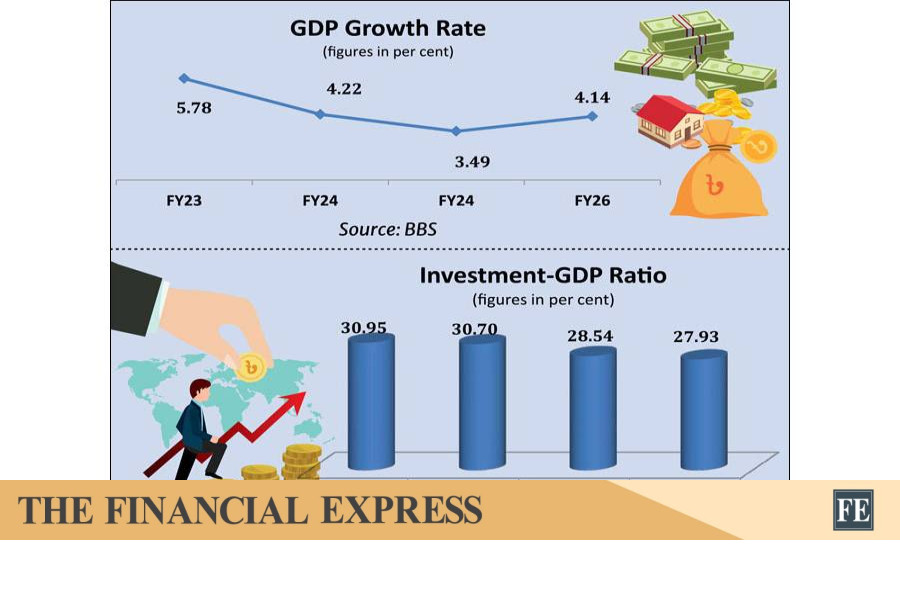
The present government formed by BNP in February, 2026 has inherited an economy that was almost gasping for breath. The interim government that preceded it for over a year did little to try to keep the collapsing economy on an even keel. Rather it made the future of the economy hostage to America’s trade hegemony by signing an unfair trade agreement. Besides, the undisclosed clauses in the bilateral agreement may have compromised the security interests of Bangladesh which may spill over into economic concerns. To be more specific on the state of the economy before the present government took over some salient facts can be mentioned which apart from highlighting the present predicament facing policy makers point to the setbacks suffered by the private sector growth strategy. The GDP growth rate which was 4.22 per cent in FY24 came down to 3.49 per cent in FY25. The investment-GDP ratio that was 30.70 per cent fell to 28.54 per cent during the same period. Industrial growth shrank to.3.71 per cent while agriculture slowed to 2.42 per cent and services to 4.35 per cent. Total investment fell from 30.70 per cent of GDP to 28.54 per cent in FY25. More importantly, private investment fell from 23.96 per cent to 22.48 per cent, its lowest level in five years. More significant is the deterioration in unemployment situation brought about by the political upheaval. Bangladesh Bureau of Statistics (BBS) puts unemployment rate at 4.48 per cent, compared with 4.15 per cent in 2023, with about 2.61 million people unemployed at the end of 2024. As regards, closing down of industries, a broad government survey found that nearly 245 factories closed between August 2024 and July 2025, affecting about 100,000 workers.

The BNP government, after coming to power, has taken vigorous measures for economic recovery, particularly to promote private sector growth. At its advice, the Bangladesh Bank has opened a Tk 40 billion refinance scheme for closed or struggling factories. Under this scheme commercial banks will lend to closed and struggling industries and Bangladesh Bank will provide refinance support to the banks. So the present government has opted to a policy of providing support to private sector rather than becoming investor or producer itself.

The BNP government’s commitment to private sector has also become clear from its policy towards the state owned enterprises. It has declared its intention to re-open the closed sugar, jute and silk industries to restore productive capacity and employment. But more importantly, the government has decided to sell or lease out 44 closed or loss-making or partly operational state-owned factories to private sector. The government is also considering several models in this respect : joint ventures with private sector, PPP (public-private partnership) and outright sale. Domestic and foreign investors have been invited to submit their proposals.

In the budget for 2026-27, the BNP government has explicitly targeted an ‘investment- led’ economy with 6.5 per cent growth target and employment creation as major objectives. The FY27 budget contains tax incentives and duty concessions intended to reduce the cost of investment. The budget has also proposed greater participation of private sector in infrastructure sectors.

The policy direction of the BNP government is clearly pro-private- sector but the actual evidence that private investment has already recovered is still limited because the government has been in office only since February, 2026. The real test will be whether the BNP government can push private investment-GDP ratio back above 24 per cent and eventually toward 28-30 per cent in the near future. If it can do that without simultaneously expanding government borrowing and crowding out private credit, Bangladesh could genuinely move toward a private-sector-led growth strategy. The BNP government’s success will ultimately be judged not by the size of its budget or number of government projects, but by whether private investment rises, private-sector credit expands, industrial increases and employment grows.​
 
Analyze

Analyze Post

Add your ideas here:
Highlight Cite Respond

Economy shows signs of gradual stabilisation

MCCI says, warns of persisting structural challenges

Star Business Report

1787701339846.webp


Bangladesh’s economy showed signs of gradual stabilisation during the April-June quarter of FY26, although overall economic activity remained subdued, said the Metropolitan Chamber of Commerce and Industry (MCCI) in its review.

“Inflation remained the major concern,” the MCCI said in the review released yesterday.

The leading trade body said the country’s economic growth for FY26 was provisionally estimated at 4.14 percent, up from 3.49 percent in FY25. Inflation, however, remained elevated, continuing to put pressure on household purchasing power and the cost of living.

The external sector performed relatively well, supported by strong remittance inflows and improved foreign exchange reserves.

Remittances remained robust during the quarter, while reserves strengthened significantly by the end of June, providing greater stability for the balance of payments and the foreign exchange market, the MCCI said.

Yet, there were some challenges.

“Export growth remained weak despite a rebound in June, while private investment, credit growth and domestic demand were constrained by high interest rates and economic uncertainty. The banking sector also remained under pressure, alongside fiscal constraints and elevated inflation,” it said.

“Overall, the quarter reflected a transition from macroeconomic adjustment towards gradual recovery, with improved external sector resilience being a key positive development,” said the MCCI.

The trade body said data on the sectoral performance of the economy was yet to be available.

Third-quarter (January-March) data for FY26 released by the Bangladesh Bureau of Statistics (BBS) showed that the industrial sector suffered a 0.28 percent contraction during the period as businesses remained cautious about fresh investment amid tight liquidity, elevated borrowing costs and persistent macroeconomic uncertainties.

Within the sector, the manufacturing sub-sector registered negative growth of 0.34 percent in the same period, against 1.13 percent in the previous quarter, according to the BBS.

The MCCI said merchandise export earnings rebounded strongly in June 2026, the last month of the fiscal year, rising by 25 percent year-on-year to $4.19 billion from $3.35 billion.

However, total export earnings for FY26 stood at $48.38 billion, a marginal increase of 0.17 percent from $48.30 billion in FY25, falling short of the government’s target of $55 billion by 12 percent, largely due to weak global demand, high energy costs and inflationary pressures.

The inflow of remittances in FY26 reached a record $35.59 billion, a 17 percent rise over the previous fiscal year.

The trade body, citing experts, said Bangladeshi expatriate workers sent increased amounts of money home through official channels, while the banking regulator’s steps to ease money transfers and monitor informal channels also helped.

On the investment climate, the MCCI, citing Balance of Payments data from Bangladesh Bank, said net inflows of foreign direct investment (FDI) in FY26 decreased by 15 percent year-on-year to $1.46 billion from $1.72 billion a year ago.

It said FDI inflows in Bangladesh is low compared with that in many other countries at a similar level of development, even though the low labour costs available here are generally believed to be attractive to foreign investors.

The MCCI said foreign investors hesitate to make fresh investments in the country because of underdeveloped infrastructure, a shortage of energy and weak transmission infrastructure, a lack of consistency in policy and regulatory frameworks, a scarcity of industrial land, corruption, and non-transparent and uneven application of rules and regulations.

“The government needs to address these impediments to attract more FDI to the country to ensure the country’s economic development.”

Outlook

For the current quarter, the chamber, representing large companies, said exports, imports and remittances may increase. Foreign exchange reserves may decrease between July and September due to import payments to Asian Clearing Union (ACU) member countries.

Inflation, however, is likely to go down in September of FY27 after a spike in August, it said, projecting an 8.65 percent increase in consumer prices on a point-to-point basis this month and an 8.45 percent increase in September.

“After the general election, the economy is trying to overcome the difficulties due to the present political uncertainty and conflicting world scenario. Therefore, the performance of the selected economic indicators is mixed,” it said.

Going forward, the MCCI said sustaining price stability, strengthening the financial sector, promoting private investment and exports, and maintaining external-sector stability will be critical for achieving stronger and more inclusive economic growth.

“The policy priority going forward is therefore to consolidate external sector stability while bringing inflation down and creating conditions for stronger private investment and sustainable growth.”​
 
Analyze

Analyze Post

Add your ideas here:
Highlight Cite Respond

Where is the economy heading?
1788044725206.webp


More than six months after the new government assumed office, it is logical to review the country's socio-economic progress. Several trade bodies, think tanks and media have already shed light on the performance of the BNP government, led by Tarique Rahman, in these areas. Besides identifying the areas of success, pointing out the failures and drawbacks is also important. The exercise is not new; rather, every democratic government has to undergo periodic reviews by various stakeholders as part of ensuring the government's accountability to the people. Quarterly, half-yearly, and annual reviews of the economy are regular practices in most countries. Even governments in many countries conduct exercises to evaluate their performance and present their actions to the public.

For a new government, the first 100 days or the first six months are generally considered a honeymoon period, when it is in a celebratory mood as it adjusts its administration. During this time, citizens also allow the government to set its workforces and take various steps with errors and omissions to some extent. It is also the time when a democratically elected government enjoys its highest level of popularity. Criticism of government actions is also generally mild at this time. Moreover, the period provides the government with an additional advantage to take tough measures in the greater interests of the nation. Once the honeymoon period is over, the government enters into a phase of strong criticism and rigorous review of its performance.

The BNP government assumed power on February 17 this year following its landslide victory in the February 12 general election in Bangladesh. Tarique Rahman, the elder son of the late president Ziaur Rahman and the late prime minister Khaleda Zia, became the country's 11th prime minister, for a five-year term. So, his government has completed six months in power on August 17 and is now in its seventh month. Six months is not sufficient time to correct the economy's course, and no rational critic expects it. It, however, does not mean that there would be no critical review of the period despite the fact that the autocratic regime of Sheikh Hasina had brought the economy to its knees.

Some issues have already emerged as serious threats to the country's economic growth in the last six months. So far, the government has yet to address these challenges properly.

The first issue of concern is high inflation. Though several domestic and external factors have been contributing to the persistence of high inflation, the government appears clueless about how to tame it. As a result, the average rate of inflation is still above 8 per cent, eroding people's real incomes. Though headline inflation dropped to 8.32 per cent in July 2026, marking its lowest level in the last eight months, it is still high. The Wage Rate Index (WRI), which comprises three broad sectors -- agriculture, industry, and services -- increased slightly to 8.22 per cent in July from 8.18 per cent in June. It is still below the inflation level.

The second critical thing is the slowdown in investment. Expectations were high that the investment climate would improve once a democratically elected government is in office. Unfortunately, the desired improvement in the investment climate is still not evident, as reflected in the low growth of private credit. By the end of June this year, public sector credit soared by 30.43 per cent while private sector credit posted a 4.47 per cent growth, one of the lowest in recent times. Total excess liquid assets (including securities) in the banking sector increased by 39.40 per cent to Tk 4.08 trillion in June this year, reflecting sluggish credit demand. High interest rates, infrastructure bottlenecks, and deterioration in the rule of law are discouraging investors from expanding operations. Net inflow of foreign direct investment (FDI) declined by 18 per cent in the first nine months of FY26 to $1.13 billion from $1.39 billion in FY25. The full-year data for FY26 is not yet available.

The third issue and the most pressing one is the energy crisis. The crisis is a full-blown one and has started taking a heavy toll on investment, growth and employment. The BNP government has indeed inherited an expensive and chaotic energy sector legacy, distorted by the Hasina regime. During the last decade, 2009-2024, the country was made heavily reliant on fossil fuel imports. The need for investment in gas exploration and production was deliberately ignored. A major crisis in the gas sector started in 2015 due to yawning supply shortfalls against rising domestic demand. Awami League government formulated a master plan for the gas sector in 2017, outlining import-based solutions to address the deficit. From 2018, Bangladesh began importing gas under long-term contracts. Hasina's power and energy adviser was the key person who made the country dependent on gas import. Allegations are that, along with a few ministers, bureaucrats, and oligarchs, he formed a syndicate that took control of the energy sector, heavily compromising the country's long-term energy security. At present, half of the country's total power generation is sourced from natural gas. As gas supply has declined amid volatility in the global energy market, the country is now facing a serious setback in power generation. The decision to import liquefied natural gas (LNG) in 2014 was a turning point in the country's energy security. The first shock of import dependency was felt in 2022, when the Russia-Ukraine war broke out. The high cost of shipping, along with uncertainty in delivery, forced the country to resort to heavy load shedding. The second shock came early this year when the United States and Israel jointly launched an attack on Iran. As Iran retaliated, oil tanker shipments through the Strait of Hormuz were halted. Since than Bangladesh has been facing a serious energy crisis.

Student-led mass uprising forced the Hasina regime to fall on August 5 2024. The Yunus-led interim government took responsibility for running the country. During its 18 months in office, the interim government sought to repair the damage caused by the Hasina regime in the financial and energy sectors. Though it succeeded to a large extent in fixing the country's forex reserves, little could be done in the energy sector. The core reason is various long-term contracts, signed and implemented by the Hasina regime, on importing LNG and power. The interim government couldn't revoke any contract, despite knowing that the deal was heavily biased towards the suppliers at the cost of Bangladesh.

Now, the BNP government is struggling to find a solution, although options are limited in the short run. For instance, electricity imports from Adani Power in India remain the most expensive source, costing an average of Tk 14.86 per kilowatt-hour (kWh) in FY25. Signed in 2017, the 25-year contract is taking a heavy toll on the Bangladesh exchequer. If the county wants to revoke the deal, the cost will be much higher due to some unfavourable conditions in the agreement.

The energy crisis is not going to be resolved soon; the supply of power will continue to remain disrupted for days. It will also reduce fresh domestic and foreign investment in the near future, as investors are already struggling to continue operations. As a result, economic growth will also slow further, and unemployment may surge. Coupled with persistent inflation, an ominous future awaits the economy, the government, and the country indeed.​
 
Analyze

Analyze Post

Add your ideas here:
Highlight Cite Respond

Import liberalisation: the missing half of Bangladesh's export strategies


1788044960126.webp


In 1991, when the BNP government assumed office following the restoration of parliamentary democracy, it marked a decisive shift in Bangladesh’s economic policy direction. Export-led growth emerged as the new development paradigm. Yet it was not export subsidies that spearheaded this transformation. The cornerstone of the new outward-oriented strategy was import liberalisation—reducing trade barriers and giving domestic producers greater access to competitively priced raw materials, intermediate inputs, capital goods, and technology from world markets. The new policy was grounded in sound trade theory and policy.

For more than half a century, one proposition has dominated development thinking: exports are the engine of growth. The spectacular rise of East Asian economies beginning in the 1960s reinforced this conviction. Korea, Taiwan, Singapore and Hong Kong, followed by Malaysia, Thailand, China and Vietnam, demonstrated how integration into world markets could transform predominantly agrarian economies into industrial powerhouses.

The lesson drawn by developing countries was simple: promote exports on the vast world market rather than target sales in the limited domestic market.

But in celebrating export-led growth, policymakers often overlooked the other half of the story. Successful exporters are invariably successful importers. Today, China, which has become the “world’s factory” and the largest global exporter, is also the second largest global importer.

Industrialisation requires raw materials, intermediate inputs, machinery, components and technology, much of which developing countries like Bangladesh cannot produce efficiently themselves. Imports are therefore not merely the price an economy pays for exports; they are frequently what makes exports possible.

For Bangladesh, this distinction has become critical. We aspire to diversify exports, attract investment and integrate into global value chains while maintaining one of the more protective import regimes in the region. These objectives sit uneasily together. Bangladesh needs to recognise that a competitive export regime ultimately requires a competitive import regime.

The East Asia Miracle. The conventional account of East Asia focuses on export promotion. Yet research by leading trade economists presents a more nuanced picture.

Harvard trade economist Dani Rodrik explained East Asia miracle emphasising the central role of extraordinarily high investment. Rapid investment generated demand for imported machinery and capital goods; these imports expanded productive capacity, raised productivity and ultimately supported exports. Industrialisation therefore involved a mutually reinforcing cycle of investment driving capital goods imports which helped raise productivity leading to exports and growth.

The phenomenon is even more pronounced today because production is fragmented across countries. A Vietnamese electronics exporter imports components from China, Korea and Japan. A Thai automobile exporter uses components produced throughout Asia. A Bangladeshi garment exporter imports cotton, yarn, fabric, chemicals, machinery and accessories before exporting the finished product.

Calling the final transaction “export-led growth” conceals much of the economic process that made the export possible.

Imports have a major role in raising productivity. One of the most compelling empirical demonstrations comes from research on Indonesian manufacturing (American Economic Association publication). They found that reductions in tariffs on imported intermediate inputs produced particularly large productivity gains among firms importing those inputs.

The explanation is intuitive. Liberalised imports provide manufacturers with cheaper inputs, better-quality inputs and a wider variety of inputs. They also expose firms to foreign technology. The excessive focus on imports displacing domestic industrialisation may be misplaced. Imports can create industrialisation by providing impetus to produce new products with intermediate inputs becoming more easily available.

For example, a manufacturer may be unable to produce a sophisticated product because one particular chemical, component, machine or material is unavailable domestically. Once that input becomes available competitively through imports, an entirely new domestic production activity can become commercially viable.

The hidden export tax. There is also a fundamental principle of trade economics that Bangladesh cannot afford to ignore: protection of imports creates an anti-export bias.

An exporter sells at world prices. But if tariffs and para-tariffs raise the cost of its imported inputs substantially above world prices, its competitiveness is squeezed from both ends. It receives an international price for its output while paying protected domestic prices for its inputs. Non-garment exporters can come out of this trap only if all exporters are assured duty-free imported inputs.

Moreover, high protection raises profitability in the domestic market. Entrepreneurs naturally ask: why incur the costs and risks of competing in London, Tokyo or New York when substantially higher margins can be earned behind tariff protection at home?

Protection consequently creates two distortions simultaneously: it raises the cost of producing exports while increasing the profitability of producing for the domestic market.

This is why the classic Lerner symmetry result remains so relevant: under standard conditions, an import tariff is the equivalent of an export tax.

For an economy seeking export diversification, that is a serious contradiction.

The current Bangladesh import regime is too restrictive, and too cumbersome with high and complex tariffs that clearly undermines export competitiveness.

Bangladesh’s RMG success proves the point. Ironically, Bangladesh already possesses compelling evidence of the importance of an open import regime: the ready-made garment industry.

RMG did not become internationally competitive simply because Bangladesh subsidized exports. An essential part of its success was the ability of exporters to obtain imported inputs at something approaching world prices through bonded warehouses and back-to-back letters of credit.

In effect, Bangladesh created a free-trade enclave for its most important export industry inside an otherwise highly protected economy.

The lesson is profound.

If an exporter must sell at world prices, it must also be able to buy its inputs at world prices.

Yet this principle has not been applied uniformly across the economy. Potential exporters in light engineering, footwear, agro-processing, electronics and other emerging sectors frequently face a more cumbersome and costly import regime than established RMG exporters.

We should therefore ask whether Bangladesh’s failure to diversify exports reflects insufficient export incentives—or an import regime that systematically discourages the emergence of new exporters.

Global Value Chain (GVC). In an era of global value chains imports are increasingly inseparable from exports. Global value chains have made the traditional mercantilist distinction between exports as “good” and imports as “bad” economically obsolete.

Modern production involves components crossing borders several times before becoming final products. Countries specialize not necessarily in entire industries but in particular stages of production.

This produces an apparent paradox. A country can increase the domestic-content requirement of an exported product and nevertheless end up generating less domestic value added.

Suppose a Bangladeshi firm exports a $100 product containing $40 of imported components and $60 of Bangladeshi value added. Policymakers might prefer replacing the imported components with domestic substitutes. But if those substitutes are significantly more expensive or inferior in quality, the product may cease to be internationally competitive. Exports fall to zero—and Bangladesh loses the $60 of domestic value added it was previously earning. This raises an important policy question related to the recent coercive scheme to ensure higher domestic content use of yarn/fabrics by the garment exporters.

The objective should therefore not be to minimise imports. It should be to maximise internationally competitive domestic value addition.

Final point: from export-led growth to trade-led development. There is research evidence that trade openness stimulates growth and Bangladesh is a good example if we consider the liberalising reforms of the early 1990s. None of this means Bangladesh should abandon industrial development or indiscriminately eliminate every tariff overnight. Nor does it mean imports automatically promote growth. Trade liberalisation needs sequencing, adjustment policies, effective competition and a revenue strategy that gradually shifts taxation away from trade.

But the direction of reform should be unmistakable.

Bangladesh should progressively reduce high and dispersed tariffs and para-tariffs; provide all exporters with reliable duty-free access to imported inputs; modernise bonded warehouses and duty-drawback arrangements; simplify customs procedures; and make imported machinery, technology and intermediate goods readily accessible at internationally competitive prices.

The objective should also be to eliminate the artificial policy distinction between “export promotion” and “import liberalisation.” They are two sides of the same competitiveness strategy. The latest Import Policy Order 2026-2029 shows several signs that easing import restrictions is an essential part of our export strategy. The document explicitly enables relaxation of import policy to support FTA, EPA, and CEPA engagement, overrides conflicting Acts restricting industrial raw material imports, and mandates Ministry of Commerce deliberation before new restrictions. The Order introduces WTO Trade Facilitation Agreement measures, duty-free imports for FTA-zone entities, raises local value-addition thresholds paired with expanded free-of-charge (FOC) input allowances, and a restructured bonded-warehouse framework requiring bank guarantees, while dropping the earlier LC-free provision for RMG inputs. This is a major step forward but falls short of the needed deeper import liberalisation of the kind Bangladesh experienced in the early 1990s.

This is particularly urgent as Bangladesh graduates from LDC status. Preference erosion will make export markets tougher, while traditional cash export subsidies will have to be phased out. Future competitiveness must therefore come increasingly from productivity, technology, logistics, skills and world-price inputs rather than compensatory subsidies.

Perhaps it is time, therefore, to reconsider the terminology itself.

The East Asian miracle was not simply a triumph of exports. It was a triumph of economies that learned to combine domestic labour, entrepreneurship and capabilities with capital, technology and intermediate inputs sourced from the rest of the world, and then sell the resulting products globally.

Bangladesh’s next stage of industrialisation requires the same insight.

The appropriate development paradigm is no longer simply export-led growth. It is trade-led development: import competitively, add value efficiently, and export globally.

Dr Zaidi Sattar is Founder Chairman, Policy Research Institute of Bangladesh.​
 

Analyze Post

Add your ideas here:
Highlight Cite Respond

Bangladesh receives $2.45b in remittances in 26 days of August
1788045423974.webp


Bangladeshi expatriates sent home US$2.455 billion in remittances during the first 26 days of August, according to the latest data released by Bangladesh Bank.

Between August 1 and August 26, total remittance inflows registered a 22.3 per cent monthly growth compared to $2.007 billion received during the corresponding period of the previous year.

During the two-day period of August 25 and 26, the country received $115 million in remittances.

Cumulative remittance inflows from July 1 to August 26 in the current fiscal year 2026-27 reached $5.314 billion, reflecting an 18.5 per cent yearly growth over the $4.485 billion recorded during the same timeframe in FY26.

Central bank figures indicate a sustained upward momentum in official remittance channels, driven by strong inflows through formal banking networks.​
 
Analyze

Analyze Post

Add your ideas here:
Highlight Cite Respond

Latest Posts

Back
 
G
O
 
H
O
M
E