Home Watch Videos Wars Movies Login

[🇧🇩] Israel and Hamas war in Gaza-----Can Bangladesh be a peace broker?

Latest Posts Countries Wars Q&A

[🇧🇩] Israel and Hamas war in Gaza-----Can Bangladesh be a peace broker?
962
27K
More threads by Saif

G Bangladesh Defense

Thousands bid farewell as Hamas chief laid to rest
Agence France-Presse . Doha 03 August, 2024, 01:19

1722644947928.webp


Hamas leader Ismail Haniyeh was buried in Qatar on Friday after his killing in Tehran, an attack blamed on Israel that has heightened regional tensions as the Gaza war dragged on.

Haniyeh was laid to rest in Lusail, north of the capital Doha, following funeral prayers at the Gulf emirate's largest mosque attended by thousands of people.

Haniyeh, the Palestinian armed group's political chief, played a key role in mediated talks aimed at ending nearly 10 months of war between Hamas and Israel in the Gaza Strip.

The burial was restricted to a small number of people including one of Haniyeh's daughters, Sara, who shared a video on social media showing her pouring holy water over a pebble-topped grave before lowering her head to kiss it.

'In this moment, I buried my soul under the dirt and I departed. I departed with all the pain of the world in my ribs,' she captioned the video uploaded on X.

Mourners earlier on Friday lined up inside Imam Muhammad bin Abdul Wahhab Mosque, where Haniyeh's casket, draped in a Palestinian flag, was briefly carried in to the shouts of angry mourners.

Others prayed on mats outside in temperatures that reached 44 degrees Celsius (111 degrees Fahrenheit).

'He was a symbol, a resistance leader... people are angry,' said Taher Adel, 25, a Jordanian student residing in the Qatari capital.

Haniyeh's predecessor Khaled Meshaal spoke at the ceremony, saying the slain leader had 'served his cause, his people... and never abandoned them'.

Turkey and Pakistan announced a day of mourning on Friday to honour Haniyeh, while Hamas called for a 'day of furious rage'.

Many mourners in Doha wore scarves that combined the Palestinian flag with a checkered keffiyeh pattern and the message in English: 'Free Palestine'.

Haniyeh and a bodyguard were killed in a pre-dawn 'hit' on their accommodation in Tehran Wednesday, Iran's Revolutionary Guards said. Haniyeh was in Iran to attend the swearing-in of President Masoud Pezeshkian a day earlier.

Israel, accused by Hamas, Iran and others of the attack, has not directly commented on it.

The killing of Qatar-based Haniyeh is among several incidents since April that have sent regional tensions soaring during the Gaza war, which has drawn in Iran-backed armed groups in Syria, Lebanon, Iraq and Yemen.

Iranian officials met with representatives of these groups on Wednesday to discuss the next steps, either 'a simultaneous response from Iran and its allies or a staggered response from each party', a source close to Lebanon's Hezbollah movement told AFP.

Israeli Defence Minister Yoav Gallant met with his visiting British counterpart John Healey on Friday and stressed 'the importance of establishing a coalition' to support 'Israel's defence against Iran and its proxies', Gallant's office said.

Military chief Herzi Halevi told troops Israel would respond 'very strongly' to any attacks, an army statement said.

France urged its nationals visiting Iran to leave 'due to the increased risk of a military escalation'.

During the Gaza war, Hezbollah and Israeli forces have engaged in near-daily exchanges of fire, and did so again on Friday.

In Gaza, the civil defence agency reported several people killed in the territory's north, and Israel's military said it had killed around 30 militants near Rafah, in the south.

Haniyeh's assassination came hours after Israel struck a southern suburb of Beirut, killing Fuad Shukr, the military commander of Lebanese Hamas ally Hezbollah.

Haniyeh's deputy, Saleh al-Aruri, was killed in Beirut early this year.

On Thursday Israel confirmed the death of Hamas military chief Mohammed Deif in a July strike in Gaza.

Israel has vowed to destroy Hamas in retaliation for its October 7 attack that ignited the war in Gaza.

The attack on southern Israel resulted in the deaths of 1,197 people, mostly civilians, according to an AFP tally based on official Israeli figures.

Militants also seized 251 hostages, 111 of whom are still held captive in Gaza, including 39 the military says are dead.

Israel's retaliatory campaign against Hamas has killed at least 39,480 people in Gaza, according to the Hamas-run territory's health ministry, which does not give details of civilian and militant deaths.

The fighting has sparked a dire humanitarian crisis in the besieged territory. On Friday, the UN Satellite Centre said nearly two-thirds of the buildings in Gaza, or 151,265 structures, have been damaged or destroyed during the war.

On Thursday, Iran's supreme leader Ayatollah Ali Khamenei led prayers for Haniyeh in Tehran, having earlier threatened 'harsh punishment' for his killing.

The New York Times, citing Middle Eastern officials, has reported that Haniyeh was killed by an explosive device planted weeks ago at a Tehran guesthouse.

Asked about the report, Israeli military spokesman Daniel Hagari told journalists 'there was no other Israeli aerial attack... in all the Middle East' on the night of Shukr's killing in Lebanon.

Israel said Shukr's assassination—for which Hezbollah said retaliation was 'inevitable'—was a response to rocket fire which killed 12 youths last week in the annexed Golan Heights.

Iranian news agency Fars said the US report was a 'lie', insisting that the Hamas leader was killed by a 'projectile'.

Analyst Hugh Lovatt said Haniyeh's killing 'will mean that a ceasefire deal with Israel is now totally off of the table'.

The White House said US President Joe Biden spoke with Israeli Prime Minister Benjamin Netanyahu on Thursday and affirmed his commitment to defend Israel's security 'against all threats from Iran'.

'We have the basis for a ceasefire (in Gaza)... They should move on it now,' Biden told reporters after the call.​
 
Analyze

Analyze Post

Add your ideas here:
Highlight Cite Respond
  • Like (+1)
Reactions: Bilal9

Hamas military chief Mohammed Deif killed in Gaza in July, Israel says
Published :
Aug 01, 2024 16:59
Updated :
Aug 01, 2024 17:01
1722646141864.webp


The Israeli military announced on Thursday that a strike last month in the southern Gaza area of Khan Yunis had killed Hamas military chief Mohammed Deif.
The announcement came a day after the militant group's political leader Isamil Haniyeh was assassinated in Teheran.

"The IDF (Israel Defence Forces) announces that on July 13th, 2024, IDF fighter jets struck in the area of Khan Yunis, and following an intelligence assessment, it can be confirmed that Mohammed Deif was eliminated in the strike," the military said.

Deif is believed to have been one of the planners of Hamas' October 7 attack on southern Israel, which started the Gaza war, now ongoing for 300 days.

"Deif initiated, planned, and executed the October 7th massacre," the military statement added.

The announcement coincided with crowds gathering in Tehran for the funeral of Haniyeh.

One of the most influential figures in Hamas, Deif has advanced through the group's ranks over 30 years, building its tunnel network and improving its bomb-making skills, AFP reported. He has been at the top of Israel's most wanted list for many years, held responsible for the deaths of dozens of Israelis in suicide bombings.​
 
Analyze

Analyze Post

Add your ideas here:
Highlight Cite Respond

Even in Palestine, birds shall return
Vijay Prashad 04 August, 2024, 00:00

1722729940673.webp

Charles Khoury (Lebanon), Untitled, 2020. | Dissident Voice

ON JULY 26, senior United Nations officials briefed the UN Security Council about the terrible situation in Gaza. 'More than two million people in Gaza remain trapped in an endless nightmare of death and destruction on a staggering scale', said deputy commissioner general Antonia De Meo of the UN Relief and Works Agency for Palestine Refugees. Within Gaza, the UN officials wrote, 625,000 children are trapped, 'their futures at risk'. The World Health Organisation has recorded 'outbreaks of hepatitis A and myriad other preventable diseases' and warns that it is 'just a matter of time' before a polio outbreak spreads amongst children. In early July, a letter in The Lancet from three scientists working in Canada, Palestine, and the United Kingdom suggested that if they applied a 'conservative estimate of four indirect deaths per one direct death to the 37,396 deaths reported, it is not implausible to estimate that up to 186,000 or even more deaths could be attributable to the current conflict in Gaza'.

Two days before the UN Security Council meeting, on July 24, Israeli prime minister Benjamin Netanyahu addressed both chambers of the US Congress. Two months before this appearance, the International Criminal Court said it had 'reasonable grounds to believe' that Netanyahu bears 'criminal responsibility for… war crimes and crimes against humanity'. This judgment was utterly set aside by elected US representatives, who welcomed Netanyahu as if he were a conquering hero. Netanyahu's language was chilling: 'give us the tools faster, and we'll finish the job faster'. What is the 'job' that Netanyahu wants the Israeli military to finish? In January, the International Court of Justice reported a 'plausible claim of genocidal acts' by the Israeli army. So, is the 'job' that Israel wants to complete its genocide of the Palestinian people, accelerated by the increased provision of arms and funding by the US?

Despite Netanyahu's complaint that the US has not been sending sufficient weapons, in April the US government approved the sale of 50 F-15 bombers to Israel, worth $18 billion, and in early July said it would send nearly two thousand 500-pound bombs to be used in Gaza. Netanyahu wanted more then, and he wants more now. He wants to 'finish the job'. This genocidal language is sanctified by the US government, whose representatives accompanied the call for mass murder with a standing ovation.

Outside the halls of government, tens of thousands of people protested Netanyahu's visit to Congress. They are part of the phalanx of young people who have been involved in a cycle of protests against the Israeli genocide of Palestinians and against the US government's total support of the violence. Netanyahu called the protestors 'Iran's useful idiots', a strange statement made by a foreign guest of the citizens who were exercising their democratic rights in their own country. The police used pepper spray and other forms of violence to contain the protests, which were peaceful and righteous.

While Washington welcomed the accused war criminal, Beijing hosted representatives of fourteen Palestinian factions who came to discuss their differences and find a way to build political unity against the Israeli genocide and colonisation. Just before Netanyahu entered the Congressional chamber, the fourteen representatives posed for a photograph at the Diaoyutai State Guesthouse in Beijing. Their agreement, the Beijing Declaration, advanced their commitment to work together against the genocide and the occupation and recognised that their disunity has only helped Israel.

When the Soviet Union collapsed in 1991, a range of national liberation movements, such as those in South Africa and Palestine, were enfeebled and forced to make significant concessions in order to end conflicts with their colonisers. After several false starts, the apartheid regime in South Africa joined the Multi-Party Negotiating Forum in April 1993, which was the site of concessions made by the liberation forces (undermined by the assassination of communist leader Chris Hani that same month and by attacks from the neo-Nazi Afrikaner Weerstandsbeweging). The negotiated transfer of power through the interim constitution of November 1993 did not dismantle structures of white power in South Africa. Meanwhile, in 1993 and 1995, the Palestinian Liberation Organisation (agreed to the Oslo Accords, in which the PLO recognised the state of Israel and agreed to build a state of Palestine in East Jerusalem, Gaza, and the West Bank. Edward Said called the Oslo Accords a 'Palestinian Versailles', a judgment that seemed harsh at the time but which, in retrospect, is accurate.

Israel used the Oslo Accords to press its advantage, mainly by building illegal settlements across Palestinian land and by denying Palestinians the right to free passage through the three non-contiguous territories. In 1994, leading groups in the PLO created the Palestinian National Authority to bring the factions together in the new state project, but the groups that had rejected the Oslo Accords did not want to manage the occupation on Israel's behalf. In January 2006, Hamas won the largest bloc in the Palestinian legislative elections, with 74 out of the 132 seats, and by June 2007 Fatah and Hamas broke relations and ended the attempt to build a new, post-Oslo Palestinian national project.

In May 2006, from within Israel's harsh prisons, five Palestinians who represented the five main factions drafted the Prisoners' Document: Abdel Khaleq al-Natsh (Hamas), Abdel Raheem Malluh (Popular Front for the Liberation of Palestine), Bassam al-Saadi (Islamic Jihad), Marwan Barghouti (Fatah), and Mustafa Badarneh (Democratic Front for the Liberation of Palestine). These five factions include two left formations, two Islamist formations, and the main national liberation platform. The eighteen-point document called upon various groups (including Hamas and Islamic Jihad) to reactivate the PLO as their joint platform, accept the Palestinian Authority as the 'nucleus of the future state', and retain the right to resist the occupation. In June, all parties signed a second draft of the document. Despite attempts to create unity, including during the Israeli assault on Gaza known as Operation Summer Rains (June to November 2006), no such convergence was possible. The animosity between the Palestinian factions remained.

This disunity has provided ample space for the Israeli occupation to deepen and for Palestinians to flounder without a central political project. Several attempts to bring Palestinian political groups into a serious dialogue have failed to provide any forward motion, including in Cairo in May 2011 and October 2017 and in Algiers in October 2022. Since last year, the Chinese government has worked with various regional states to invite the fourteen main Palestinian factions to Beijing for reconciliation talks. These factions are:
  1. Arab Liberation Front​
  2. As-Sa'iqa​
  3. Democratic Front for the Liberation of Palestine​
  4. Fatah​
  5. Hamas​
  6. Islamic Jihad Movement​
  7. Palestinian Arab Front​
  8. Palestinian Democratic Union​
  9. Palestinian Liberation Front​
  10. Palestinian National Initiative​
  11. Palestinian People's Party​
  12. Palestinian Popular Struggle Front​
  13. Popular Front for the Liberation of Palestine​
  14. Popular Front for the Liberation of Palestine (General Command)​

The Beijing Declaration, repeating the formulations in the Prisoners' Document, called for a Palestinian state to be established, for Palestinians' right to resist the occupation to be respected, for Palestinian political groups to form an 'interim national consensus government', and for the PLO and its institutions to be strengthened in order to advance their role in the struggle against Israel. Though the declaration, of course, called for an immediate ceasefire and an end to settlement construction in East Jerusalem and the West Bank, its main focus was on political unity.

Whether this Chinese-brokered process will yield results when Palestinians sit down with Israelis is to be seen. Yet it nonetheless marks an advance in this direction and a possible turning point in the collapse of a unified Palestinian project that began in the wake of the 1995 Oslo II agreement. The Beijing Declaration is diametrically opposed to the vehemence of Netanyahu's speech in the US Congress: the latter genocidal and dangerous, the former seeks peace in a complex world.

Fadwa Tuqan (1917–2003), one of Palestine's most wondrous poets, wrote 'The Deluge and the Tree'. The fall of the tree, beaten down by the deluge, was not its end but a new beginning.

When the Tree rises up, the branches

shall flourish green and fresh in the sun,

the laughter of the Tree shall blossom

beneath the sun

and birds shall return.

Undoubtedly, the birds shall return.

The birds shall return.

The assassination of Hamas leader Ismail Haniyeh (1962–2024) in Tehran (Iran) has made the situation deeply difficult, and will make it difficult for the birds to sing.

DissidentVoice.org, August 1. Vijay Prashad, an Indian historian and journalist, is author of 25 books, including The Darker Nations: A People's History of the Third World and The Poorer Nations: A Possible History of the Global South.​
 
Analyze

Analyze Post

Add your ideas here:
Highlight Cite Respond
  • Like (+1)
Reactions: Bilal9

Israeli airstrikes kill nine in West Bank, including a Hamas commander
REUTERS
Published :
Aug 03, 2024 19:47
Updated :
Aug 03, 2024 19:47


1722731210067.webp

Palestinians inspect a vehicle damaged in an Israeli airstrike, in Zeita, near Tulkarm, in the Israeli-occupied West Bank, August 3, 2024. Photo : REUTERS/Raneen Sawafta

An Israeli airstrike in the occupied West Bank killed a Hamas commander and four Islamic Jihad fighters on Saturday, the militant groups' media reported, and the Israeli military said it had killed four more gunmen in a separate strike.

The Israeli military said the first airstrike hit a vehicle in a town near the city of Tulkarm, targeting a militant cell it said was on its way to carry out an attack. A Hamas media outlet said a vehicle carrying fighters had been struck and that one of those killed was a commander of its Tulkarm brigades.

The Palestinian Islamic Jihad groups claimed the other four men as its fighters.

Hours later, a second strike targeted another group of armed militants who had fired on troops, Israel's military said, during what it described as a counter-terrorism operation in Tulkarm.

The Palestinian Health Ministry said five men had been killed in the first strike and WAFA said four people died in the second. It said their identities were not immediately clear.

Violence in the West Bank was on the rise before the Israel-Hamas war in Gaza and has risen since, with frequent Israeli raids in the territory, which is among those that the Palestinians seek for a state.

There has also been an increase in anti-Israeli street attacks by Palestinians.

GAZA STRIKES

In the Gaza Strip, Israeli airstrikes killed six people in a house in the southern area of Rafah on Saturday and two others in Gaza City, further north, Gaza health officials said.

At least 31 Palestinians were killed across the enclave on Saturday, according to the Gaza Health Ministry, which does not distinguish between fighters and civilians.

The Israeli military said its forces had struck militants and destroyed Hamas infrastructure in Rafah and elsewhere in the enclave.

At least 39,550 Palestinians have been killed in the Israeli military campaign in Gaza. The offensive was triggered by a Hamas attack on southern Israel on Oct 7 in which 1,200 people were killed and 250 abducted, according to Israeli tallies.

An Israeli delegation was due in Cairo over the weekend to discuss a possible hostage release and Gaza ceasefire deal.

Chances of a breakthrough appear low as regional tension has soared following the assassination of Hamas' leader Ismail Haniyeh in Tehran on Wednesday, a day after an Israeli strike in Beirut killed Fuad Shukr, a top military commander from Lebanese armed group Hezbollah.

Haniyeh's death was one in a series of killings of senior Hamas figures as the Gaza war nears its 11th month and concern grows that the conflict is spreading across the Middle East.

Hamas and Iran have both accused Israel of carrying out the assassination and have pledged to retaliate. Israel has neither claimed nor denied responsibility for the death.

Hezbollah, like Hamas, is backed by Iran and has also vowed revenge.​
 
Analyze

Analyze Post

Add your ideas here:
Highlight Cite Respond

Israel strike kills 17 at school compound: Gaza officials
AFP Gaza Strip
Published: 04 Aug 2024, 11: 31

1722755172497.webp

Palestinians inspect the site of Israeli strikes on a school sheltering displaced people, amid Israel-Hamas conflict, in Gaza City, 4 August, 2024.Reuters

Gaza's civil defence agency said Israeli bombardment of a school compound in Gaza City killed at least 17 people Saturday, as Israel's military reported it had hit a Hamas command centre.

"There are 17 martyrs and several wounded due to Israeli shelling on Hamama school," the agency said in a statement, updating an earlier toll of 10 killed.

The Israeli military confirmed the strike, saying it had hit a Hamas command and control centre located inside the compound.

At least 30 dead in Gaza school airstrike, Israel says targeted militants

Earlier, civil defence spokesman Mahmud Bassal said the compound was housing Palestinians displaced from their homes in the ongoing war between Israel and Hamas militants.

Israel's military said the compound was being used by Hamas militants to manufacture weapons, adding it was a "hiding place for Hamas terrorists".

It has repeatedly accused Hamas of using civilian facilities as command and control centres or to hide their commanders and militants. The Palestinian group denies the accusation.

The war in Gaza erupted after Hamas militants attacked Israel on 7 October, which resulted in the death of 1,197 people, mostly civilians, according to an AFP tally based on official Israeli figures.

Militants also seized 251 people, 111 of whom are still held hostage in Gaza, including 39 the military says are dead.

Israel's military campaign has killed at least 39,550 people, according to the Hamas-run territory's health ministry.​
 
Analyze

Analyze Post

Add your ideas here:
Highlight Cite Respond
  • Sad (0)
Reactions: Bilal9

Fears of Middle East war grow after Hamas leader's killing
AFP Beirut
Updated: 04 Aug 2024, 09: 21

1722755519131.webp

Rockets fired from southern Lebanon are intercepted by Israel's Iron Dome air defence system over the Upper Galilee region in northern Israel, on 4 August, 2024.AFP

Middle East tensions soared Saturday as Iran and its allies readied their response to the assassination of Hamas's political leader, blamed on Israel, spurring fears of a regional war.

Israel ally the United States said it would move warships and fighter jets to the region, while Western governments called on their citizens to leave Lebanon -- where the powerful Iran-backed Hezbollah movement is based -- and airlines cancelled flights.

The killing this week of Hamas leader Ismail Haniyeh in Tehran, hours after the Israeli assassination of Hezbollah's military chief in Beirut, has triggered vows of vengeance from Iran and the so-called "axis of resistance".

Iran-backed groups from Lebanon, Yemen, Iraq and Syria have already been drawn into the nearly 10-month war between Israel and Palestinian militant group Hamas in Gaza.

Israel on Saturday again traded fire with Hezbollah, carried out a deadly raid in the occupied West Bank, and struck a school compound in Gaza City in an attack that the Hamas-ruled territory's civil defence agency said killed at least 17 people.

Numerous schools turned into displacement shelters have been hit across Gaza in recent weeks, with Israel insisting the facilities had been used by militants. Hamas denied using civilian infrastructure for military activities.

Haniyeh was buried on Friday in Qatar, where he had been based. Israel, accused by Hamas, Iran and others of carrying out the attack, has not directly commented on it.

Iran said on Saturday it expects Hezbollah to hit deeper inside Israel and no longer be confined to military targets.

The Pentagon said it was bolstering its military presence in the Middle East to protect US personnel and defend Israel.

It said an aircraft carrier strike group led by the USS Abraham Lincoln would be deployed, as well as additional ballistic missile defence-capable cruisers and destroyers and a new fighter squadron.

US President Joe Biden, at his beach home in Delaware, was asked by reporters if he thought Iran would stand down.

"I hope so," he said. "I don't know."

Soon after, Hezbollah announced it had fired dozens of Katyusha rockets at the northern Israeli settlement of Beit Hillel.

They said it was in response to an Israeli attack on Kfar Kela and Deir Siriane in southern Lebanon which, it said, had injured civilians.

Earlier Saturday, Hezbollah announced the deaths of two of its fighters, including a 17-year-old from Deir Siriane.

Take 'any ticket available'
In Beirut, 20-year-old student Diana Abu Aasel told AFP she feared "something bad will happen to my family and friends.

"If there is war, I don't think I will be able to bear staying" in Lebanon, she said.

Crowds of thousands rallied Saturday in Morocco, Jordan and Turkey to denounce Haniyeh's killing and show solidarity with Palestinians, AFP correspondents reported.

Haniyeh's killing is among a series of attacks since April that have heightened fears of a regional conflagration.

His death came hours after Israel struck south Beirut, killing Hezbollah military commander Fuad Shukr.

Both Britain and the United States on Satuday urged their citizens in Lebanon to leave immediately.

Israel has vowed to destroy Hamas in retaliation for its unprecedented 7 October attack which triggered war in Gaza and resulted in the deaths of 1,197 people, mostly civilians, according to an AFP tally based on Israeli official figures.

Militants also seized 251 hostages, 111 of whom are still held captive in Gaza, including 39 the military says are dead.

Israel's campaign against Hamas has killed at least 39,550 people in Gaza, according to the territory's health ministry, which does not give details of civilian and militant deaths.

Haniyeh was Hamas's lead negotiator in efforts to end the war. His killing raised questions about the continued viability of efforts by Qatari, Egyptian and US mediators to broker a truce and exchange of hostages and prisoners.

Hamas officials but also some analysts and protesters in Israel have accused Netanyahu of prolonging the war to safeguard his ruling hard-right coalition.

Protesters in several Israeli cities Saturday renewed their calls for a hostage-release deal.

Disease spreading in Gaza
US Secretary of State Antony Blinken spoke separately with his French and British counterparts on Saturday about the situation in the Middle East, State Department spokesman Matthew Miller said.

Blinken, UK Foreign Secretary David Lammy and French Foreign Minister Stephane Sejourne all agreed on the need for restraint on all sides in the region, Miller said in a statement.

Violence has also surged in the Israeli-occupied West Bank. Palestinian official sources said two Israeli air strikes killed nine people in the north of the territory Saturday.

The military said it had "eliminated terrorist cells".

The war in Gaza has caused widespread destruction and displaced almost the entire population of the territory where, the UN said on Friday, public health conditions "continue to deteriorate".

It said nearly 40,000 cases of Hepatitis A, spread by contaminated food and water, have been reported since the war began.

Hezbollah has been exchanging near-daily cross-border fire with Israeli forces since October, saying it is acting in support of Hamas.

Several airlines have suspended flights to Beirut and Tel Aviv.

Flights to Beirut by Air France and low-cost carrier Transavia France will remain halted until at least Tuesday, their parent company said Saturday.

Turkish Airlines on Saturday cancelled its night-time flights to Tehran for the second night running, AFP correspondents noted.​
 
Analyze

Analyze Post

Add your ideas here:
Highlight Cite Respond
  • Sad (0)
Reactions: Bilal9

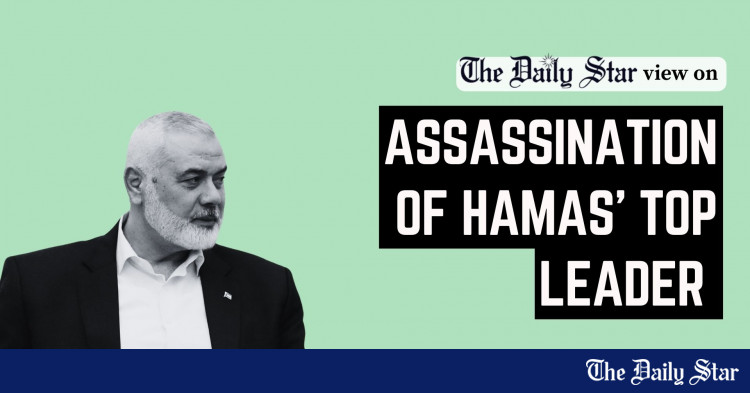
Israel's actions a recipe for regional disaster
Global forces must urge for peace deal

1722814109814.png

Visual: Star

When the world is pushing for peace in the form of a ceasefire in Gaza, the assassination of Hamas' top leader Ismail Haniyeh in Tehran, Iran has derailed that hope. Analysts fear this event could have far-reaching consequences in the whole Middle East, leading to a full-on regional conflict. And such fears cannot be dismissed completely at this point, given the tensions that have built up in the region.

Senior officials of Hamas have said the death of Haniyeh, who had been a top negotiator in the ceasefire talks, means their fight against Israel would intensify. While Israel has not publicly acknowledged its role in the killing, The New York Times reports that several US officials assess that the country was indeed responsible. Meanwhile, US President Joe Biden said the killing "doesn't help" efforts to secure a ceasefire. In almost 11 months, amid widespread destruction in Gaza, Israel has repeatedly thwarted talks of truce, clearly indicating that it has no intention of stopping the atrocities. If the reports are accurate, this is just the newest manufactured obstacle.

Israel is already facing global condemnation for its genocide, which has claimed the lives of over 39,000 people in Gaza. Besides such heinousness, it is also attacking people in foreign lands, beyond its jurisdiction, which is absolutely unacceptable and is a recipe for greater turmoil. A recent instance of this is Israel's airstrikes and artillery fire on Lebanon, leading to multiple deaths. Unsurprisingly, this has forced Hezbollah to resume rocket and artillery attacks on Israel. The group's chief Hassan Nasrallah has said that Israel "crossed red lines" after killing its top military commander earlier in Beirut. It's quite obvious: attacks lead to retaliation, and the cycle of violence continues. But this simple reality is being constantly ignored.

After Haniyeh's killing, US, Egyptian and Qatari mediators are desperately trying to salvage ceasefire talks, but for them to be successful, both parties have to be on the same page. They are, however, dealing with a country that does not want peace, for why else would it strike a school sheltering displaced Palestinians, killing 15, on Friday. Nevertheless, global actors must stand against this genocide, and continue to condemn and pressurise Israel, if they want to ensure peace for the Middle East. Given that the violence has kept expanding, it is high time for it to end before the entire region becomes engulfed in further turmoil.​
 
Analyze

Analyze Post

Add your ideas here:
Highlight Cite Respond

Israel confirms killing Al Jazeera journalist, says he was Hamas operative
Ashish BasuJerusalem
Published: 02 Aug 2024, 09: 10

The Israeli military confirmed on Thursday that it had killed Al-Jazeera journalist Ismail Al-Ghoul in an airstrike in Gaza, saying he was a Hamas operative who had taken part in the 7 October attack on Israel.

Al-Jazeera dismissed what it said were "baseless allegations" which it said were an attempt to justify the deliberate killing of its journalists.

"The network condemns the accusations against its correspondent Ismail Al-Ghoul, without providing any proof, documentation or video," it said in a statement, adding that it reserved the right to take legal action against those responsible.

The Qatari broadcaster said on Wednesday that Al-Ghoul and cameraman Ramy El Rify were both killed in an Israeli strike on Gaza City while on an assignment to film near the house of Ismail Haniyeh, the Hamas chief killed in Iran earlier on the same day.

The Israeli military said Al-Ghoul was a member of the elite Nukhba unit who took part in the 7 October attack and instructed Hamas operatives on how to record operations, and it said he was involved in recording and publicizing attacks on Israeli troops.

"His activities in the field were a vital part of Hamas' military activity," it said in a statement.

Al-Jazeera said Al-Ghoul had worked for the network since November 2023 and his only profession was as a journalist.

It said he had been arrested and detained at Al-Shifa Hospital in the northern part of the Gaza Strip when it was taken by Israeli forces in March before being released, which it said "debunks and refutes their false claim of his affiliation with any organisation."

The Israeli government has banned Al-Jazeera from operating in Israel, accusing it of posing a threat to national security.

Al Jazeera, which has been heavily critical of Israel's campaign in Gaza, has denied inciting violence.

The Hamas-run Gaza government media office said the deaths of the two Al-Jazeera crews raised to 165 the number of Palestinian journalists killed by Israeli fire since 7 October.​
 
Analyze

Analyze Post

Add your ideas here:
Highlight Cite Respond

Members Online

Back
 
G
O
 
H
O
M
E