Home Watch Videos Wars Movies Login

[🇨🇳] China-Taiwan Feud

Latest Posts Countries Wars Q&A

[🇨🇳] China-Taiwan Feud
28
1K
More threads by Saif

G   Chinese Defense

Any drills around Taiwan ‘decided by us alone’
Says China’s defence ministry

China's defence ministry said yesterday that any drills it may hold around Taiwan "are decided by us alone", as Taipei announced the apparent end of massive military exercises not formally declared by Beijing.

Taiwanese authorities said this week that Beijing was holding its biggest maritime drills in years, deploying dozens of warships and coast guard vessels in an area stretching from near the southern islands of Japan to the South China Sea.

Hsieh Ching-chin, deputy director general of Taiwan's coast guard, said yesterday that the ships had returned to China, adding that Taipei considered the manoeuvres to be "over".

Asked about the alleged drills yesterday, Wu Qian, a spokesman for Beijing's defence ministry, did not confirm whether they had taken place.

But he said that "whether or not we hold exercises, and when we hold them, are decided by us alone, based on our own needs and the circumstances of our struggle".

"Safeguarding national sovereignty and territorial integrity, the fundamental interests of the Chinese nation, and the common interests of compatriots across the Taiwan Strait are the (military's) sacred duties," Wu said.

"No matter whether it holds exercises, the People's Liberation Army will not be absent or soft-hearted when it comes to striking down (Taiwanese) 'independence' and pushing for unification," he said, referring to the Chinese armed forces.

Any effort by Taipei to achieve independence "will inevitably be strictly punished and are doomed to failure", Wu said.​
 
Analyze

Analyze Post

Add your ideas here:
Highlight Cite Respond

China holds ‘shooting’ drills
Vows ‘reunification’ push; Taipei sends forces to keep watch

China's military yesterday held "shooting training" off Taiwan's southwest coast in a move Taipei described as provocative and dangerous, while a senior Chinese leader vowed unswerving efforts to bring the island under Beijing's control.

Democratically governed Taiwan, which China views as its own territory, has repeatedly complained of Chinese military activities, including several rounds of full-scale war games during the past three years.

Shortly before 9:00 am, Taiwan's defence ministry said in a statement, it had detected 32 Chinese military aircraft carrying out a "joint combat readiness drill" with Chinese warships in the Taiwan Strait area.

"During this period it even blatantly violated international practice by setting up a drills area in waters about 40 nautical miles (74 km) off the coast ... without prior warning, claiming that it would carry out 'shooting training'," the ministry added.

Taiwan's major southwestern population centres of Kaohsiung and Pingtung are both home to important naval and air bases. Kaohsiung is also home to Taiwan's largest port, a busy hub for global shipping.

The exercises endanger the safety of international flights and shipping and are a "blatant provocation" to regional peace and stability, the ministry said, adding that it had dispatched its own forces to keep watch.

There was no immediate confirmation from China that it was carrying out new drills around Taiwan and its defence ministry did not respond to a request for comment.

China's other recent military activity in the region, such as that off Australia's coast, are "proof that China is the only, and the greatest, threat to peace and stability in the Taiwan Strait and the Indo-Pacific," Taiwan's ministry said.

China has never renounced the use of force to bring Taiwan under its rule, and has denounced both President Lai Ching-te as a "separatist", and the United States for its support for Taiwan. Earlier yesterday, the ruling Communist Party's leader, Wang Huning, had called this week for greater effort in the cause of Chinese "reunification".​
 
Analyze

Analyze Post

Add your ideas here:
Highlight Cite Respond

China launches military drills around Taiwan, calls its president a ‘parasite’

1743552821122.webp

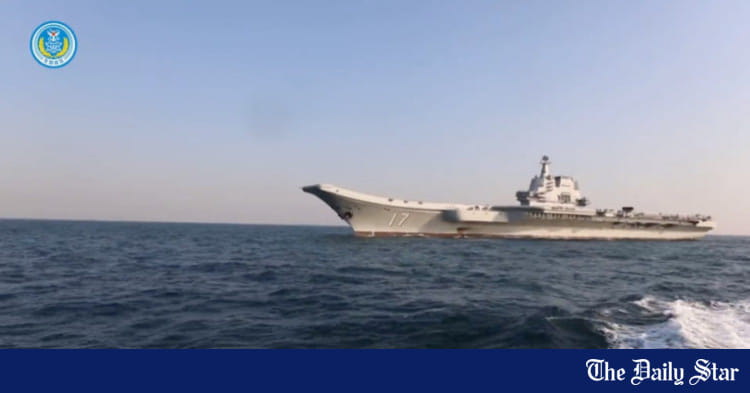
Chinese aircraft carrier Shandong is seen in this screenshot taken from a video released by the Eastern Theatre Command of China's People's Liberation Army (PLA) on April 1, 2025. Photo taken from Reuters

China's military on Tuesday said it had begun joint army, navy and rocket force exercises around Taiwan to "serve as a stern warning and powerful deterrent against Taiwanese independence", calling Taiwan's President Lai Ching-Te a "parasite".

The exercises around the democratically governed island, which China views as its own territory and has never renounced the use of force to bring under its control, come after Lai called Beijing a "foreign hostile force" last month.

China detests Lai as a "separatist," and in a video accompanying the Eastern Theater Command's announcement of the drills depicted him as cartoon bug held by a pair of chopsticks above a burning Taiwan.

"The focus is on exercises such as combat readiness patrols at sea and in the air, seizing comprehensive control, striking maritime and land targets, and imposing blockade controls on key areas and routes," the Eastern Theater Command said on its official WeChat social media account.

Taiwan's Defence Ministry said in a statement on Tuesday that China's Shandong aircraft carrier group had entered the island's response area on Monday, adding that it had dispatched military aircraft and ships and activated land-based missile systems in response.

"The Chinese Communist Party has continued to increase its military activities around Taiwan and in the Indo-Pacific region... and has become the biggest 'troublemaker' in the international community," the statement added.

'CLOSING IN'

China's military released a series of propaganda videos in quick succession after the drill announcement, depicting Chinese warships and fighter jets encircling Taiwan, Taipei being aimed at from above, and military vehicles patrolling city streets.

A video of a poster accompanying the drills titled "Closing In," and showing Chinese forces surrounding the island, was released on the Eastern Theater Command's Weibo.

This was followed by a video titled "Shell", depicting president Lai as a green cartoon bug spawning parasites across the island, on the Eastern Theater Command's WeChat page.

"Parasite poisoning Taiwan island. Parasite hollowing Island out. Parasite courting ultimate destruction," the animation said.

Taiwan Defence Minister Wellington Koo said such rhetoric was not conducive to peace and "shows their provocative character," when asked about Lai's cartoon depiction.

A third video, "Subdue Demons and Vanquish Evils", featured Sun Wukong, the magical monkey king from the Ming Dynasty epic "Journey to the West" as he is depicted in the "Black Myth: Wukong" hit video game.

It opens with the video's title flashing across the screen and the Chinese mythical warrior riding on clouds before cutting to footage of Chinese fighter jets.

"The joint exercise and training conducted by the Eastern Theater of the Chinese People's Liberation Army (PLA) in the vicinity of Taiwan Island is a resolute punishment for the Lai Ching-Te authorities' rampant 'independence' provocations," said Zhu Fenglian, a spokesperson for China's Taiwan Affairs Office.

Taiwan's Koo told reporters the PLA should focus first on resolving its issues with corruption instead of destroying peace and stability in the region.

China's military has undergone a sweeping anti-corruption purge over the past few years, which saw former Chinese Defence Minister Li Shangfu ousted in October 2024.

China's defence ministry did not immediately respond to a request for comment on Koo's remarks.

The Global Times, which is owned by the People's Daily newspaper of the governing Chinese Communist Party, said the drill had not been given a code name to show that Chinese military forces surrounding the island "has become a normal practice," citing Zhang Chi of National Defence University.

"Through a series of exercises held in the Taiwan Strait in recent years, the PLA has strongly enhanced its ability to prepare for war and fight battles," the article on the paper's Weixin social media page added.​
 
Analyze

Analyze Post

Add your ideas here:
Highlight Cite Respond

China deployed 2 aircraft carrier groups, dozens of ships: Taiwan
Agence France-Presse . Taipei, Taiwan 02 June, 2025, 22:24

China deployed two aircraft carrier groups and dozens of ships in waters north and south of Taiwan last month, a Taiwanese security official said Monday, as Beijing keeps up military pressure on the self-ruled island.

Up to 70 Chinese ships, including navy vessels, were monitored from the Yellow Sea to the South China Sea from May 1-27, a security official said on the condition of anonymity.

Beijing has ramped up the deployment of fighter jets and warships around Taiwan in recent years as it pressures Taipei to accept its claims of sovereignty over the island.

China has refused to rule out using force to bring Taiwan under its control, leaving the island to face the constant threat of invasion.

‘Its military actions and grey-zone activities have included large-scale deployments across the entire island chain, involving comprehensive maximum pressure,’ the security official said in remarks released Monday.

‘On average, there have been between 50 to 70 naval vessels and government ships as well as hundreds of sorties by various military aircraft continuously conducting harassment operations.’

Some of the ships passed through the Miyako Strait to the Western Pacific Ocean for ‘long-distance training, including combined air-sea exercises’, the official said.

Another 30 Chinese vessels with no name, documentation or port of registry were detected near Taiwan’s Penghu archipelago in the Taiwan Strait on May 19 and had been ‘deliberately sent to harass’, the official said.

And a total of 75 Chinese aircraft were involved in three ‘combat readiness patrols’ near the island during the month, Taiwan’s defence ministry figures show.

Asia-Pacific’s so-called first island chain links Okinawa, Taiwan and the Philippines, while the Yellow Sea is west of South Korea — all partners of the United States and critical to its influence in the region.

The Taiwanese security official said China’s activities in May were ‘more provocative than previously observed’.

In one incident, Tokyo and Beijing exchanged diplomatic protests each accusing the other of ‘violating’ national airspace, after a Chinese helicopter and coast guard vessels faced off with a Japanese aircraft around disputed islands.

The Chinese actions were a demonstration of ‘military expansion’ and were aimed at controlling the ‘entire island chain and improving their capabilities’, the official said.

China’s deployment coincided with Taiwanese president Lai Ching-te’s speech on May 20 marking his first year in office and came ahead of an annual security forum in Singapore at the weekend.

US secretary of defence Pete Hegseth told the Shangri-La Dialogue that China was ‘credibly preparing’ to use military force to upend the balance of power in Asia.

Beijing, which did not send its defence minister Dong Jun to the summit, warned Washington ‘should not play with fire’.

‘It felt like they were in a state where they could announce something at any moment, trying to seize on some opportunity or excuse to act,’ the Taiwanese official said of the Chinese.

China has carried out several large-scale military drills around Taiwan since Lai took office.​
 
Analyze

Analyze Post

Add your ideas here:
Highlight Cite Respond

US demands clarity from allies on their role in potential war over Taiwan, FT reports

REUTERS
Published :
Jul 12, 2025 18:33
Updated :
Jul 12, 2025 19:26

1752364929468.webp


The Pentagon is urging Japan and Australia to clarify what role they would play if the US and China went to war over Taiwan, the Financial Times reported on Saturday.

Elbridge Colby, the US under-secretary of defense for policy, has been pushing the matter during recent talks with defense officials of both countries, the report said, citing people familiar with the discussions.

According to the newspaper, the reported request caught both Tokyo and Canberra off guard, as the US itself does not offer a blank cheque guarantee to defend Taiwan.

Reuters could not verify the report. The US Department of defense did not immediately respond to a request for comment.

The US is Taiwan's most important arms supplier, despite a lack of formal diplomatic ties. Taiwan has faced increased military pressure from China, including several rounds of war games, as Beijing seeks to assert its sovereignty claims over the island. Taiwan rejects China's assertion of sovereignty.

Colby was the deputy assistant secretary of defense for strategy and force development during President Donald Trump's first term. Colby is known for arguing that the US military should prioritise competition with China and shift its focus from the Middle East and Europe.​
 
Analyze

Analyze Post

Add your ideas here:
Highlight Cite Respond

Taipei holds air raid drill to prepare for Chinese attack
Agence France-Presse . Taipei 17 July, 2025, 23:29

Taipei came to a brief standstill on Thursday when air raid sirens forced people off the streets and into underground shelters in a rehearsal for a Chinese attack.

The annual civilian drill is being held in cities across Taiwan this week, alongside military training, to prepare the self-governed island for a potential Chinese invasion.

Communist China has never ruled Taiwan but Beijing insists the island is part of its territory and has threatened to use force to bring it under its control.

Sirens sounded across Taipei at 1:30pm (0530 GMT), bringing the capital city of 2.5 million people to a halt for half an hour.

Police waving batons stopped motorbikes, cars and public buses on the streets and people were directed into shelters, including basements and subway stations.

Some people retreated into office buildings for the duration of the exercise.

Tracy Herr, 50, was on her way to a temple when she heard the air raid siren. She went to a nearby subway station where others were sheltering.

Pointing at a group of young women sitting on the floor and chatting, Herr said Taiwanese people had ‘lived comfortably for too long’ and some didn’t take the air raid drill seriously.

The drills also involved simulating wartime aid distribution and a mass-casualty event.

Dozens of people lined up at three distribution points to receive bags of rice, cooking oil and salt.

Taiwanese president Lai Ching-te has sought to raise public awareness of the threat posed by China since taking office last year.

‘Each drill allows our country to further enhance its ability to defend itself,’ Lai said on Thursday.

While the exercises were ‘not intended to provoke’, Lai said the constant threats to Taiwan meant ‘we have no choice but to stay fully prepared’.

Taiwan is keen to show the world, especially its key security backer Washington, that it is serious about boosting its defence capability.

Taiwanese regular troops were joined by the largest mobilisation of reservists for the 10-day ‘Han Kuang’ military drills, which end on Friday.

Rather than only repelling a Chinese attack on its shores, Taiwanese troops this year have also practised fighting invading forces in city streets.

‘It is as much training as acclimating the Taiwanese population to the reality of modern warfare,’ said Kitsch Liao of the Atlantic Council, a US think tank.

Heavily armed troops carrying US-provided anti-aircraft Stinger missiles stormed Taipei’s metro system in a night-time exercise.

High-tech mobile missile launchers from the United States have also been positioned around the capital and elsewhere, in full view of the public.

Shoppers in a Taipei supermarket also recently became participants in a drill simulating a Chinese missile strike on the city.

‘I didn’t know there was going to be a drill,’ Yang Shu-ting, 70, said.

‘My heart was beating very fast and I was inevitably nervous. I think the point is to let you know where you should hide if something happens.’

Troops have also simulated various scenarios, including ‘grey zone harassment’ — tactics that fall short of an act of war — and ‘long-range precision strikes’, defence officials have said.

Several minor collisions involving military vehicles during the exercises highlighted the challenge of manoeuvring through Taiwan’s narrow streets.

Defence expert Chieh Chung said such mishaps were ‘difficult to avoid’ in urban areas.

‘In Taiwan, many roads and bridges create significant limitations for armoured vehicles when they move through,’ said Chieh, a researcher at the Association of Strategic Foresight in Taipei.

‘So this becomes a problem and obstacle for both attacking and defending forces.’​
 
Analyze

Analyze Post

Add your ideas here:
Highlight Cite Respond

Simulated Chinese blockade of Taiwan reveals Singapore as lifeline

REUTERS
Published :
Aug 08, 2025 11:42
Updated :
Aug 08, 2025 11:42

1754701414480.webp

A Chinese warship takes part in a military drill off the Chinese coast near Fuzhou, Fujian Province, across from the Taiwan-controlled Matsu Islands, China, April 11, 2023. REUTERS

The exercise presented a fraught scenario: China's military had blockaded Taiwan by air and sea, and Southeast Asian countries were grappling with how to evacuate as many as 1 million of their nationals trapped on the besieged island.

Over two days in April at a Singapore hotel, some 40 participants and observers in the war game, including serving and retired Asia-Pacific officials and military officers, as well as security scholars, simulated their responses to the unfolding crisis, according to four people familiar with the discussions.

Hours ticked by as some players weighed unified action through the Association of Southeast Asian Nations, while others reached out to the mock US, Chinese and Japanese delegates to negotiate special air and sea corridors to extract foreign nationals. Eventually, the people said, a stark conclusion emerged: The Southeast Asian states needed a Singaporean airlift to have a chance of evacuating their people.

"Nothing was moving until the Singaporeans stepped in at the 11th hour," said one participant in the event at the Jen Singapore Tanglin hotel. "They had found a way of getting their own people out, and offered to get others out, too."

Reflecting its discreet and decades-old security presence inside Taiwan, where its forces train, Singapore was able to leverage access to airfields and aircraft, the person said. But the exercise ended before any detailed discussion of how Singapore had reached a deal with China to secure an evacuation route through the blockade, or how precisely it would work, three of the people told Reuters.

The previously unreported exercise comes amid an escalating battle between the US and China for dominance in the Asia-Pacific region. It offers a rare window into contingency planning over Taiwan, which some Asian and Western military attaches and security analysts say is becoming increasingly necessary because an assault on the island by Beijing could draw in the US and imperil other countries.

While the scenario didn't reflect official policies, participants playing the roles of foreign and defence ministers worked from the known positions of at least nine governments depicted in the simulation, said the four people, who like some others spoke on the condition of anonymity to discuss a sensitive matter. Besides Singapore, China, Taiwan and the US, the rest included Indonesia, Vietnam and the Philippines, they said.

Southeast Asians account for about 94% of the almost 1 million foreign nationals resident in Taiwan, according to Taiwan's National Immigration Agency. Indonesians, Vietnamese and Filipinos make up the vast majority of those foreigners, with comparatively small numbers of Japanese and Americans.

Singapore's defence ministry said it wasn't involved in the "workshop" and none of its officials attended in any capacity. Neither the defence nor foreign ministries addressed Reuters questions about Singapore's military presence in Taiwan and planning for Taiwan conflict scenarios, including evacuations.

China's foreign ministry said it had "always resolutely opposed countries with whom it has diplomatic relations having any form of official relations with the Taiwan region, including military dialogue and cooperation," adding that it wasn't aware of the circumstances of the exercise.

The London-based International Institute for Strategic Studies (IISS), which organised the exercise, told Reuters in a statement that participants had attended in their private capacities, and that it could not comment on "discussions, attendees, or any other elements."

Taiwan's defence ministry and the ASEAN Secretariat in Jakarta didn't respond to questions.

A Pentagon official said they were not aware of any official participation in the event by the US Defence Department. "We routinely engage with allies and partners to ensure readiness for a range of contingencies, but it would be inappropriate to discuss operational planning or hypothetical evacuation scenarios," the official said.

Weeks after the exercise, US Defence Secretary Pete Hegseth told a security conference in Singapore that the threat of China using force to take Taiwan was "imminent" amid intensifying air and naval operations around the island by the Chinese military, the People's Liberation Army.

Chinese officials have said Hegseth and other Trump administration officials are playing up "the so-called China threat", with the Chinese embassy in Singapore saying his speech was "steeped in provocations and instigation".

China claims Taiwan as its territory and has never renounced the use of force to seize it. Taiwan's President Lai Ching-te and his government strongly object to China's sovereignty claims, saying it is up to the island's people to decide their future.

Drew Thompson, a Singapore-based security scholar, said it was vital for Southeast Asian countries to move beyond war games and contingency discussions to build meaningful, unofficial ties with Taiwan, particularly its military. These countries have diplomatic ties with Beijing and don't officially recognise Taipei.

"The big takeaway here is that a plan is one thing but you need the access and the relationships to put it into play," said Thompson, of the S. Rajaratnam School of International Studies, who wasn't involved in the exercise.

"Singapore has long had these ties, the Philippines is building them, but it remains an open question whether the other countries in Southeast Asia have the unofficial networks in place to meaningfully engage with Taiwan in a conflict."

The Philippines foreign ministry told Reuters the government has contingency plans for a Taiwan emergency, without offering specifics. It added that Manila has "legitimate interest in Taiwan due to geographic proximity and the presence of Filipino nationals there".

The foreign ministries of Indonesia and Vietnam didn't respond to requests for comment. Japan's defence ministry declined to comment.

'USEFUL PERCH'

Given recent drills in which Chinese vessels encircled Taiwan, some military attaches and analysts say any attempt by Beijing to seize the island could start with a blockade, which would be considered an act of war under international law.

The risks are felt acutely in Singapore, a financial and shipping hub that hosts US Navy ships and surveillance aircraft yet maintains strong cultural, diplomatic and economic ties with China.

Singaporean forces have conducted military training in Taiwan since 1975, under an arrangement known as Project Starlight. The presence is seldom publicly acknowledged by officials in Singapore, which does not have formal diplomatic relations with Taiwan. But it remains important to Singapore's defence forces, according to seven diplomats and security scholars familiar with the matter.

Singapore rotates up to 3,000 infantry troops and commandos annually through three training camps in southern Taiwan, according to five of the seven people, where the mountains and jungles replicate conditions found on the Malay Peninsula.

"It gives Singapore a useful perch from which to watch both the Taiwan Strait and the top part of the South China Sea," said one Western security official.

China has long objected to the arrangement. But Singapore has held fast, in part because a withdrawal would represent a change to the delicate strategic and diplomatic balance around Taiwan, three of the scholars told Reuters.

Singapore's forces also train regularly in Australia, France, Brunei and the US. The city-state has the best-equipped military in Southeast Asia, according to an annual survey of the world's armed forces produced by the IISS.

Yet an outbreak of war in Taiwan could trap Singapore's forces there or render them bargaining chips that could give China military and diplomatic leverage over Singapore, according to some analysts and military attaches.

In a conflict, Southeast Asian governments would face an arduous task in evacuating their nationals from Taiwan, Ngeow Chow Bing, a Malaysia-based security scholar, wrote in a study published last year by the Carnegie Endowment for International Peace.

But, Ngeow wrote, Beijing has clear incentives to ensure that most, if not all, ASEAN members remain neutral.

"If Beijing cares how it is perceived in Southeast Asia during a Taiwan crisis, it follows that Beijing would view the evacuation of Southeast Asian citizens as crucial for its own diplomatic posture," he added.​
 
Analyze

Analyze Post

Add your ideas here:
Highlight Cite Respond

China slams Japan’s plans to deploy missiles near Taiwan
Agence France-Presse . Beijing, China 24 November, 2025, 22:25

China slammed on Monday Japan’s decision to push ahead with a planned deployment of missiles on an island near Taiwan, escalating a weeks-long diplomatic spat.

Japanese media on Sunday quoted Japan’s defence minister Shinjiro Koizumi as saying that the planned deployment of the missiles on Yonaguni island — which is close to Taiwan — was on track.

‘The deployment can reduce the possibility of an armed attack on Japan,’ Koizumi said.

Beijing-Tokyo relations have soured this month, following remarks by Japanese prime minister Sanae Takaichi suggesting that Tokyo could intervene militarily in any attack on Taiwan.

China’s foreign ministry on Monday said Japan’s missile deployment was a ‘deliberate attempt to create regional tension and provoke military confrontation’.

‘Coupled with prime minister Sanae Takaichi’s erroneous remarks on Taiwan, this trend is extremely dangerous and warrants high vigilance from neighbouring countries and the international community,’ foreign ministry spokeswoman Mao Ning told reporters at a regular press briefing.

Since 2016, the remote island of Yonaguni has hosted a base for Japan’s army, the Self-Defence Forces, which was established despite initial objections from residents.

Tokyo had previously announced plans to deploy the Type 03 Medium-Range Surface-to-Air Guided Missile to defend the island against incoming air-to-ground missiles and aircraft.

China claims democratic Taiwan as part of its territory and has threatened to use force to bring the self-ruled island under its control.

Taiwan on Monday said that Japan’s strengthening of military facilities on Yonaguni ‘helps maintain security in the Taiwan Strait’.

‘Japan is a sovereign country and it has the right to do everything necessary to protect the security of its own territory, as long as such actions do not threaten other countries,’ deputy foreign minister Wu Chih-chung told lawmakers.

‘We believe this is helpful to our national interests, because Japan essentially has no territorial claims or hostility towards Taiwan.’​
 
Analyze

Analyze Post

Add your ideas here:
Highlight Cite Respond

Members Online

Latest Posts

Back
 
G
O
 
H
O
M
E