Donate ☕
201 Military Defense Forums
[🇧🇩] - Israel and Hamas war in Gaza-----Can Bangladesh be a peace broker? | Page 191 | PKDefense
Home Login Nation Wars Watch Videos
Serious discussion on defense, geopolitics, and global security.

[🇧🇩] Israel and Hamas war in Gaza-----Can Bangladesh be a peace broker?

Reply (Scroll)
Press space to scroll through posts
G Bangladesh Defense
[🇧🇩] Israel and Hamas war in Gaza-----Can Bangladesh be a peace broker?
953
26K
More threads by Saif

Foreign minister calls for greater OIC role to end Gaza atrocities​


1709686509037.webp

Foreign Minister Hasan Mahmud. File photo

Foreign Minister Hasan Mahmud called on the OIC member states to take alternate measures to end the conflict in Gaza and to ensure rights for the Palestinian people.

The foreign minister reiterated Bangladesh's firm support for the Palestinian cause and called for an immediate ceasefire and opening of humanitarian corridors in the besieged territory.

While addressing the 19th Extraordinary CFM of the OIC on Israel's' aggression on the Palestinian People in Jeddah, Saudi Arabia, he also stressed on the importance of the Islamic Financial Safety Net to ensure basic necessities for the Palestinians.

Foreign minister, mentioning the strong statement delivered by Bangladesh at the ICJ in February for the Palestinians, hoped that peace will be established soon in the region.

Noting the current stalemate at the United Nations Security Council, Foreign Minister highlighted the need for its reform so that decision on globally effecting issues could be reached.

He stressed the importance of Muslim Ummah's unity to stop atrocities against Palestinians, ensuring their safe and peaceful living in their homeland.

Earlier yesterday, Dr Hasan Mahmud paid a courtesy call on Saudi Foreign Minister Faisal bin Farhan Al Saud at the OIC Secretariat in Jeddah.

Expressing satisfaction at bilateral ties, Dr Mahmud hoped for deeper cooperation between Bangladesh and Saudi Arabia, anticipating a visit from Saudi Crown Prince Mohammed bin Salman.

Al Saud affirmed Saudi Arabia's commitment to sophisticated economic cooperation.

They discussed increasing sectoral cooperation, trade, and investment opportunities, with Dr. Mahmud seeking cooperation in crude oil purchase, which Al Saud promised to consider, including investments in refinery and petrochemical industries.

Al Saud congratulated Prime Minister Sheikh Hasina on her re-election and praised her leadership in hosting Rohingya refugees, pledging Saudi Arabia's full support.

Hasan Mahmud also met with OIC Secretary General Hissein Brahim Taha.

Taha praised Sheikh Hasina's leadership and reaffirmed OIC's support for Rohingya people.

The foreign minister advocated for greater trade and investment among OIC member states to mitigate economic challenges stemming from the Russia-Ukraine conflict, proposing a dedicated cell at the OIC Secretariat for trade-related information dissemination.​
 
Analyze

Analyze Post

Add your ideas here:
Highlight Cite Fact Check Respond
  • Haha (0)
Reactions: ThunderCat

Trump invites more leaders to Gaza ‘Board of Peace’
Agence France-Presse . Washington 18 January, 2026, 01:11

1768700396787.webp

US president Donald Trump.

US president Donald Trump’s so-called ‘Board of Peace’ for postwar Gaza began to take shape Saturday, with the leaders of Egypt, Turkey, Argentina and Canada asked to join.

The announcements from those leaders came after the US president named his Secretary of State Marco Rubio, former British prime minister Tony Blair, and senior negotiators Jared Kushner and Steve Witkoff to the panel.

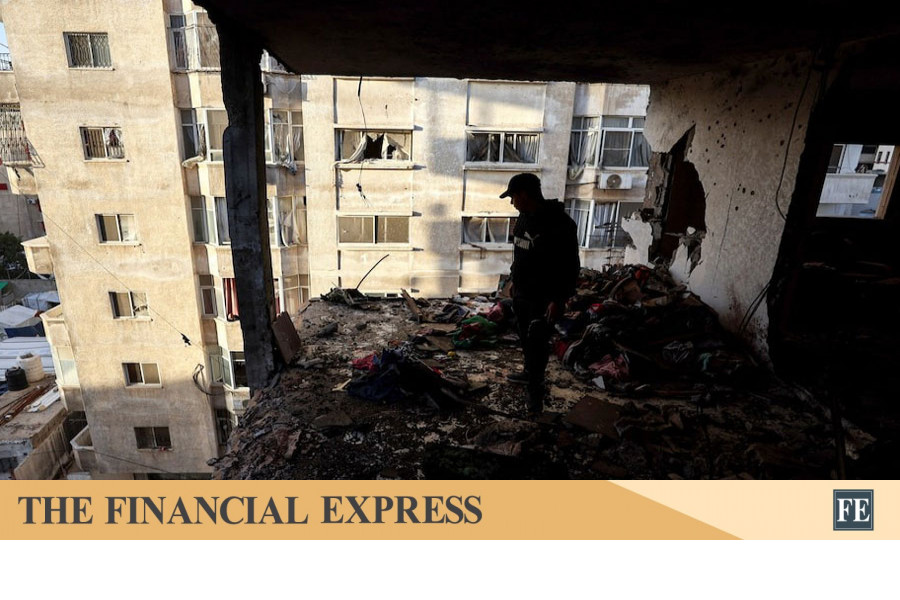
Trump had already declared himself the chair of the body, as he promotes a controversial vision of economic development in the Palestinian territory, which lies in rubble after two-plus years of relentless Israeli bombardment.

The moves came after a Palestinian committee of technocrats meant to govern Gaza held its first meeting in Cairo which was attended by Kushner, Trump’s son-in-law who has partnered with Witkoff for months on the issue.

In Canada, a senior aide to prime minister Mark Carney said he intended to accept Trump’s invitation, while in Turkey, a spokesman for President Recep Tayyip Erdogan said he had been asked to become a ‘founding member’ of the board.

Egypt’s foreign minister Badr Abdelatty said Cairo was ‘studying’ a request for President Abdel Fattah al-Sisi to join.

Sharing an image of the invitation letter, Argentine president Javier Milei wrote on X that it would be ‘an honour’ to participate in the initiative.

In a statement sent to AFP, Blair said: ‘I thank President Trump for his leadership in establishing the Board of Peace and am honoured to be appointed to its Executive Board.’

Blair is a controversial figure in the Middle East because of his role in the 2003 invasion of Iraq. Trump himself said last year that he wanted to make sure Blair was an ‘acceptable choice to everybody.’

Blair spent years focused on the Israeli-Palestinian issue as representative of the ‘Middle East Quartet’—the United Nations, European Union, United States and Russia—after leaving Downing Street in 2007.

The White House said the Board of Peace will take on issues such as ‘governance capacity-building, regional relations, reconstruction, investment attraction, large-scale funding and capital mobilization.’

The other members of the board so far are World Bank president Ajay Banga, an Indian-born American businessman; billionaire US financier Marc Rowan; and Robert Gabriel, a loyal Trump aide who serves on the US National Security Council.

Trump has created a second ‘Gaza executive board’ that appears designed to have a more advisory role.

It was not immediately clear which world leaders were asked to be on each board.

The White House, which said Friday that additional members would be named to both entities, did not immediately reply to a request for comment.

Washington has said the Gaza plan had gone on to a second phase—from implementing the ceasefire to disarming Hamas, whose October 2023 attack on Israel prompted the massive Israeli offensive.

On Friday, Trump named US Major General Jasper Jeffers to head the International Stabilization Force, which will be tasked with providing security in Gaza and training a new police force to succeed Hamas.

Jeffers, from special operations in US Central Command, in late 2024 was put in charge of monitoring a ceasefire between Lebanon and Israel, which has continued periodic strikes aimed at Hezbollah militants.

Gaza native and former Palestinian Authority deputy minister Ali Shaath was earlier tapped to head the governing committee.

Trump, a real estate developer, has previously mused about turning devastated Gaza into a Riviera-style area of resorts, although he has backed away from calls to forcibly displace the population.​
 
Analyze

Analyze Post

Add your ideas here:
Highlight Cite Fact Check Respond

Dangerous illusion of ‘stabilisation’

1768786434467.webp


THE recent protests organised by the Palestine Solidarity Committee in Bangladesh reflect a deep moral and political clarity that resonates with the conscience of the Bangladeshis. At a time when Gaza continues to suffer unprecedented destruction, displacement, and collective punishment, the PSC’s rejection of Bangladesh’s possible involvement in a proposed Gaza International Stabilisation Force is not only justified, but it is necessary.

The so-called International Stabilisation Force, as currently envisioned, is not a peacekeeping or humanitarian mission in any genuine sense. Rather, it is a security mechanism designed primarily to serve Israeli strategic interests under the language of ‘stabilisation’ and ‘demilitarisation’. Its core objective is clear: to disarm Palestinian resistance forces in Gaza under the pretext of ensuring Israeli security, thereby eliminating the very means through which Palestinians resist occupation, siege, and apartheid.

Force without Palestinians

ONE of the most alarming aspects of the proposed International Stabilisation Force is that it was developed without consultation with any Palestinian political actors or representative bodies. Neither Hamas, the Palestinian Authority, nor broader Palestinian civil society was meaningfully involved. This exclusion alone exposes the initiative for what it is: a top-down, imperial project imposed on an occupied people.

The ‘comprehensive plan’ promoted during Donald Trump’s political campaign, and echoed in subsequent policy discussions, reflects a long-standing pattern of US imperial hegemony. Decisions about Palestinian land, security, governance, and resistance are once again being made in Washington, Tel Aviv, and allied capitals, not in Gaza or Ramallah. Any security arrangement that excludes Palestinians while claiming to act in their interest is fundamentally illegitimate.

The International Stabilisation Force’s mandate reportedly includes training a new Palestinian police force that would not be accountable to Hamas or the Palestinian Authority, cooperating closely with Israel and Egypt, maintaining border security, securing humanitarian corridors, and enforcing the ‘demilitarisation’ of Gaza. In practice, this means creating a locally recruited force whose primary role would be to police Palestinians on behalf of external powers. History, from Iraq to Afghanistan, shows that such arrangements collapse into repression, dependency, and resistance.

Why Bangladesh must not participate

BANGLADESH’S strength on the global stage has long rested on moral consistency: opposition to colonialism, support for self-determination, and solidarity with oppressed peoples. Joining an international stabilisation force whose explicit or implicit mission is to neutralise Palestinian resistance would represent a profound betrayal of these principles.

Palestinian resistance, regardless of how one evaluates its tactics, emerges from decades of occupation, blockade, dispossession, and denial of political rights. To participate in a force aimed at disarming Gaza while the occupation continues, settlements expand, and accountability remains absent is to side with power against justice.

The PSC protests correctly warn that Bangladeshi soldiers should never be placed in a position where they are expected to suppress an occupied population in coordination with its occupier. Such a role would not only stain Bangladesh’s international standing but also contradict the country’s own liberation history.

Irony and pro-Israel objections

ADDING a layer of irony to this debate are recent statements by Moshe Phillips, national president of Americans For A Safe Israel, who criticised Bangladesh as fundamentally unfit to participate in any Gaza stabilisation force due to its ‘lack of neutrality.’ Phillips argues that Bangladesh’s consistent pro-Palestinian positions — its non-recognition of Israel, trade restrictions, voting record at the UN, and legal accusations against Israel — disqualify it from peacekeeping.

In effect, a leading pro-Israel advocate is openly stating that Bangladesh should be excluded because it refuses to abandon its principled stance on Palestinian rights. From one perspective, this critique exposes the true nature of the International Stabilisation Force: neutrality is defined not as adherence to international law or human rights, but as acceptance of Israeli narratives and security priorities.

If neutrality means ignoring occupation, apartheid, and collective punishment, then Bangladesh should proudly reject such a definition. The fact that pro-Israel organisations are warning Washington against Bangladeshi participation only reinforces the PSC’s argument: Bangladesh should not offer unsolicited assistance to a project that is structurally biased and morally compromised.

Human rights, selective morality, and pressure politics

BANGLADESH has also been targeted by repeated US human rights reports that portray the country in a consistently negative light. While no state is beyond criticism, these reports often function as political instruments—used selectively to pressure governments that do not align with US strategic interests. The same moral scrutiny is rarely applied with equal force to Israel, despite overwhelming documentation of war crimes and violations in Gaza.

This pattern should concern Bangladesh deeply. Human rights discourse, when weaponised, becomes a gateway for interference in internal affairs, coercive diplomacy, and conditional engagement. Participation in the International Stabilisation Force could further entangle Bangladesh in a framework where its sovereignty and policy independence are compromised.

Call for vigilance, principle

THE PSC protests articulate a simple but powerful message: Bangladesh must stand with the oppressed, not police them. The people of Bangladesh have consistently supported Palestinian rights because they recognise a familiar struggle — for dignity, freedom, and self-determination.

True peace in Gaza cannot be imposed by foreign forces cooperating with an occupying power. It cannot emerge from demilitarisation without de-occupation or security without justice. Any initiative that ignores these realities is not stabilization — it is pacification.

Bangladesh should therefore make its position unequivocally clear: it will not participate in any force designed to dismantle Palestinian resistance while leaving the structures of oppression intact. In doing so, Bangladesh would not be acting irresponsibly or ideologically but in line with international law, historical experience, and its own national values.

At this critical moment, vigilance is not optional. It is a duty.

Nazifa Jannat is a journalism student at Syracuse University.​
 
Analyze

Analyze Post

Add your ideas here:
Highlight Cite Fact Check Respond

Trump taps Tony Blair, US military head for Gaza

AFP Washington, United States
Published: 17 Jan 2026, 08: 22

1768870798914.webp

A Palestinian woman walks on the debris in a room, after an Israeli military attack on the home of the al-Houli family, in which four people were reportedly killed, west of Deir al-Balah, in the central Gaza Strip on 16 January 2026. AFP

US President Donald Trump on Friday gave a key role in post-war Gaza to former British prime minister Tony Blair and appointed a US officer to lead a nascent security force.

Trump named members of a board to help supervise Gaza that was dominated by Americans, as he promotes a controversial vision of economic development in a territory that lies in rubble after two-plus years of relentless Israeli bombardment.

The step came after a Palestinian committee of technocrats meant to govern Gaza held its first meeting in Cairo which was attended by Jared Kushner, Trump's son-in-law who plays a key role on the Middle East.

Trump has already declared himself the chair of a "Board of Peace" and on Friday announced its full membership that will include Blair as well as senior Americans -- Kushner, Secretary of State Marco Rubio and Steve Witkoff, Trump's business partner turned globe-trotting negotiator.

Blair is a controversial figure in the Middle East because of his role in the 2003 invasion of Iraq. Trump himself said last year that he wanted to make sure Blair was an "acceptable choice to everybody."

Blair spent years focused on the Israeli-Palestinian issue as representative of the "Middle East Quartet" -- the United Nations, European Union, United States and Russia -- after leaving Downing Street in 2007.

The White House said the Board of Peace will take on issues such as "governance capacity-building, regional relations, reconstruction, investment attraction, large-scale funding and capital mobilization."

Trump, a real-estate developer, has previously mused about turning devastated Gaza into a Riviera-style area of resorts, although he has backed away from calls to forcibly displace the population.

The other members of the board are World Bank President Ajay Banga, an Indian-born American businessman; billionaire US financier Marc Rowan; and Robert Gabriel, a loyal Trump aide who serves on the National Security Council.

Israel strikes

Israel's military said Friday it had again hit the Gaza Strip in response to a "blatant violation" of the ceasefire declared in October.

The strikes come despite Washington announcing that the Gaza plan had gone on to a second phrase -- from implementing the ceasefire to disarming Hamas, whose October, 2023 attack on Israel prompted the massive Israeli offensive.

Trump on Friday named US Major General Jasper Jeffers to head the International Stabilization Force, which will be tasked with providing security in Gaza and training a new police force to succeed Hamas.

Jeffers, from special operations in US Central Command, in late 2024 was put in charge of monitoring a ceasefire between Lebanon and Israel, which has continued periodic strikes aimed at Hezbollah militants.

The United States has been searching the world for countries to contribute to the force, with Indonesia an early volunteer.

But diplomats expect challenges in seeing countries send troops so long as Hamas does not agree to disarm fully.

Committee begins work

Gaza native and former Palestinian Authority deputy minister Ali Shaath was earlier tapped to head the governing committee.

The committee's meeting in Cairo also included Bulgarian diplomat Nickolay Mladenov, who was given a role of high representative liaising between the new governing body and Trump's Board of Peace.

Committee members are scheduled to meet again Saturday, one of them told AFP on condition of anonymity.

"We hope to go to Gaza next week or the week after; our work is there, and we need to be there," he said.

Trump also named a second "executive board" that appears designed to have a more advisory role.

Blair, Witkoff and Mladenov will serve on it as well as Turkish Foreign Minister Hakan Fidan.


Israel has refused a Turkish role in the security force, owing to President Recep Tayyip Erdogan's fiery denunciations of Israel's actions in Gaza.

The board will also include senior figures from mediators Egypt and Qatar, and the United Arab Emirates, which normalized ties with Israel in 2020.

Trump also named to the board Sigrid Kaag, the UN humanitarian coordinator for Gaza, despite his administration's efforts to sideline the world body.​
 
Analyze

Analyze Post

Add your ideas here:
Highlight Cite Fact Check Respond

Israel begins demolitions at UNRWA HQ in east Jerusalem
Agence France-Presse . Jerusalem, Undefined 21 January, 2026, 04:45

Israeli bulldozers began demolitions at the headquarters of the UN agency for Palestinian refugees in east Jerusalem on Tuesday, in what the organisation called an ‘unprecedented attack’.

UNRWA spokesman Jonathan Fowler said in a statement to AFP that Israeli forces ‘stormed into’ the compound shortly after 7:00am (0500 GMT) and ejected security guards from the site, before bulldozers entered and began demolishing buildings.

‘This is an unprecedented attack against UNRWA and its premises. And it also constitutes a serious violation of international law and the privileges and immunities of the United Nations,’ Fowler said.

‘What happens today to UNRWA can happen tomorrow to any other international organisation or diplomatic mission around the world, he added.

Roland Friedrich, the agency’s director in the West Bank called the move political, telling AFP ‘it seems the intent is to seize the land for settlement construction as has openly been stated by Israeli officials for many years in the media and elsewhere’.

AFP photos showed heavy machinery demolishing structures at the compound, where an Israeli flag fluttered overhead.

An AFP photographer reported that far-right national security minister Itamar Ben Gvir had made a brief visit to the site.

‘This is a historic day, a day of celebration and a very important day for governance in Jerusalem,’ Ben Gvir was quoted as saying in a statement.

‘For years, these supporters of terrorism were here, and today they are being removed from here along with everything they built in this place. This is what will happen to every supporter of terrorism,’ he added.

Israel has repeatedly accused UNRWA of providing cover for Hamas militants, claiming that some of its employees took part in the group’s October 7, 2023 attack on Israel, which sparked the war in Gaza.

A series of investigations, including one led by France’s former foreign minister Catherine Colonna, found some ‘neutrality-related issues’ at UNRWA but stressed Israel had not provided conclusive evidence for its headline allegation.

In a statement, the Israeli foreign ministry defended the demolitions and said ‘the State of Israel owns the Jerusalem compound’.

The compound in Israeli-annexed east Jerusalem has been empty of UNRWA staff since January 2025, when a law banning its operations took effect after a months-long battle over its work in the Gaza Strip.

‘UNRWA-Hamas had already ceased its operations at this site and no longer had any UN personnel or UN activity there,’ the foreign ministry said.

‘The compound does not enjoy any immunity and the seizure of this compound by Israeli authorities was carried out in accordance with both Israeli and international law,’ it said.

UNRWA’s Friedrich said the UN rejected the Israeli claim and insisted that the compound ‘remains United Nations property and is protected by the privileges and immunities of the UN, regardless of whether it is currently in use’.

Though the UNRWA ban applies in east Jerusalem due to its annexation by Israel, the agency still operates in the occupied West Bank and Gaza.

UNRWA chief Philippe Lazzarini also denounced the demolitions on X, saying it was yet another attempt by ‘Israeli authorities to erase the Palestine Refugee identity’.

As the UN agency created specifically for the hundreds of thousands of Palestinians displaced from their homes during the creation of Israel in 1948, UNRWA provides refugee status registration, as well as health and education services for Palestinian refugees.

Along with refugee status, which is passed on through generations, comes the right of return, which Israel contests, and is one of the most contentious issues for a lasting peace between Israelis and Palestinians.

Months after the war in Gaza began in October 2023, Israeli authorities declared Guterres and Lazzarini personae non gratae in Israel.

Jordan’s foreign affairs ministry ‘strongly condemned’ the demolition, calling it ‘a blatant violation of international law’.

The UNRWA compound was a prison during the time of the Ottoman Empire, and later became property of the Jordanian government, which subsequently transferred it to UNRWA.​
 
Analyze

Analyze Post

Add your ideas here:
Highlight Cite Fact Check Respond

Members Online

⤵︎

Latest Posts

Latest Posts