Home Watch Videos Wars Movies Login

[🇧🇩] Banking System in Bangladesh

Latest Posts Countries Wars Q&A

[🇧🇩] Banking System in Bangladesh
284
9K
More threads by Saif

G Bangladesh Defense

Elected govt to decide on BB autonomy: Finance adviser
Staff Correspondent 08 February, 2026, 00:10

1770513919661.webp

Salehuddin Ahmed. | New Age file photo

Finance adviser Salehuddin Ahmed has said that sweeping amendments to the Bangladesh Bank Order, 1972 proposed by Bangladesh Bank governor Ahsan H Mansur during the tenure of the interim government will not be rational.

In a letter to Bangladesh Bank governor Ahsan H Mansur on February 5, Salehuddin welcomed the governor’s initiative to reinforce the central bank’s independence but cautioned that changes to such a core law should not be rushed without broad consultation and political legitimacy.

Bangladesh Bank governor Ahsan H Mansur had expressed the desire to pass the amendments before the interim government’s tenure ends at several programs.

Salehuddin said that he had examined the proposed amendments to the Bangladesh Bank Order, 1972, including provisions on the appointment and removal of top officials, enhancement of the governor’s status, changes to the board structure, expanded authority to create financial liabilities for the state, and safeguards against conflicts of interest.Bangladesh cultural tours

He stressed that the Bangladesh Bank Order is a foundational law governing the country’s central banking framework and that any amendment requires rigorous scrutiny of its justification.

He said that proposed changes should be reviewed in detail and discussed with key stakeholders, experts and relevant institutions before any decision is taken.

The adviser said that introducing extensive amendments to such a fundamental law during the interim government’s limited tenure would not be practical.

He suggested that a comprehensive review and revision of the order should be left to the next elected government, which would have a clearer mandate to undertake structural legal reforms.

Governor Ahsan H Mansur has earlier told local media that without stronger legal independence, Bangladesh Bank would remain vulnerable to political pressure, weakening its ability to enforce discipline, address loan irregularities and ensure financial stability.

He has argued that autonomy is critical for restoring credibility in monetary policy and banking supervision.

Economists broadly agree that Bangladesh Bank needs greater independence but warn that autonomy must be matched with transparency, accountability and checks on concentrated power.​
 
Analyze

Analyze Post

Add your ideas here:
Highlight Cite Respond

NEW MPS WITH OLD TIGHT STANCE
Regulatory rate unchanged at 10pc as inflation frowns
Private credit supply meant to rise to stimulate investment


FE REPORT
Published :
Feb 10, 2026 00:41
Updated :
Feb 10, 2026 00:41

1770683940484.webp


Bangladesh Bank has yet again decided to be clenched-fist on money supply.


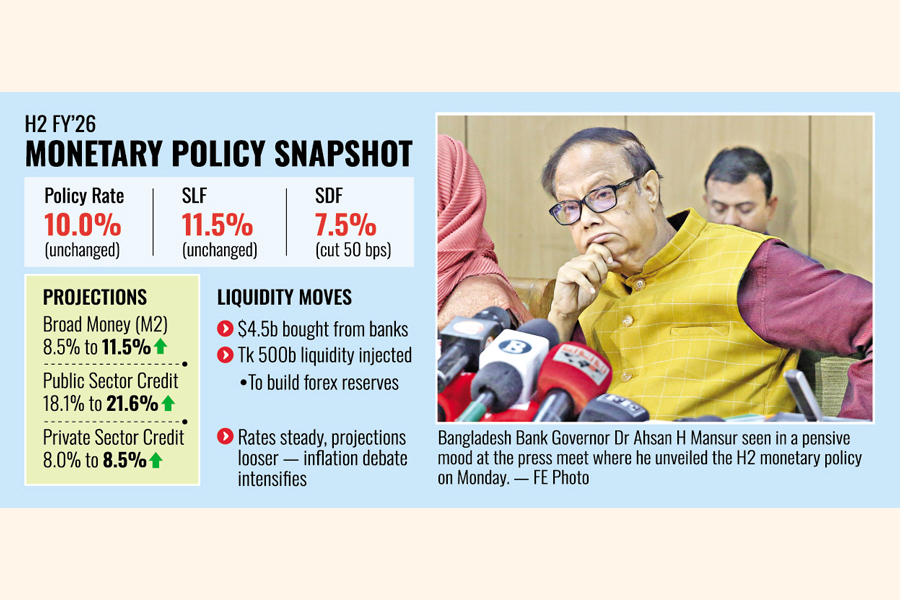
During the second half of this fiscal year, according to monetary policy statement (MPS), the policy rate will remain unchanged at 10 per cent as inflation frowns.

In the new MPS unveiled Monday, the central bank, however, takes into cognizance concerns vented by economists and businesses over investment stagnation and announces some stimuli like higher credit supply to private sector.

But monetary experts opine differently about the inflation-control strategy, saying that the Bangladesh Bank (BB) brings some changes in the projections of monetary policy statement that might further feed into inflation, driven largely by supply-side factors.

According to the latest MPS for January-June period, the disinflation process is currently showing some inconsistencies, but remains at a relatively elevated level, suggesting that a policy-rate reduction may not be prudent at this time.

"It's essential to anchor the exchange-rate stability. As this helps contain imported inflation, lowering the policy rate could unintentionally create depreciation pressure on the exchange rate," it is stated in the policy document.

There are also several near-term inflation risks, including the upcoming national elections, the approaching holy month of Ramadan, and the possible announcement of a new national pay scale.

"These elements typically stimulate demand and consumer spending, underscoring the need for a careful, balanced monetary policy."

Accordingly, BB will maintain the policy rate at 10.0 per cent and continue its tighter stance in the second half of the fiscal 2025-26, the regulator says to justify the carryover contractionary policy.


The Standing Lending Facility (SLF) will be held at 11.5 per cent. However, BB decided to lower Standing Deposit Facility (SDF) by 50 basis points from 8.0 per cent to 7.5 per cent.

The lowering of SDF is aimed at encouraging interbank money market as well as private-sector investment, loan and advances activities.

Under the MPS, the broad money or M2 is projected at 7.8 per cent until December 2025 but the money-supply growth actually reached 9.60 per cent. The initial broad money projection was 8.50 per cent by end of June next. Now the projection is revised upward to 11.50 per cent.

In terms of credit to the public sector, the projection has been enhanced to 21.60 per cent by June next in place of prior projection of 18.10 per cent.

Simultaneously, the projection of private-sector credit growth has also been expanded to 8.50 per cent until June next from the initial projection of 8.0 per cent, in accordance with the latest MPS.

Bangladesh Bank Governor Dr Ahsan H. Mansur said they ought to concentrate on building up foreign-exchange reserves. In the process, they have purchased more than US$4.50 billion from the banks in the last seven months and injected liquidity worth over Tk 500 billion into the market.

"Yes, it has a cost but we don't see it as cost because the broad money projection (11.50 per cent) is still lower if we consider the nominal GDP and inflation target (over 12 per cent)," he told the policy-presentation function.

Talking about the nature of the MPS, the central bank governor said it is tightened but not as tight as it used to be. "The reality is we're easing up within the tighter framework."

Responding to a question over possible impact of the government bank- borrowing pressure if the proposed pay scale is implemented, the governor said it would certainly push up government bank borrowings if it is not met by increasing revenues.

He said the credit growth to the public sector had already climbed as high as 28.9 per cent by December last. "If it increases further, it will have negative impact on private sector. So, we need to make the government understand the consequences. We want the government will meet a portion of the funding requirement through revenue mobilisation so that presser is lesser."

Dr Mansur thinks it will cause two problems: interest rate will not decrease or rise further and fuel inflationary pressure. "These are unpleasant tradeoffs. We cannot deny it."

Regarding the lowering of SDF rate by 50 basis points, he said there are banks having surplus liquidity but they did not invest in the money market. Instead, they keep the funds into the BB at 8.0 per cent.

"The BB does not need money. We want banks invest the money in interbank market or in the private sector. That's why we cut the SDF rate to discourage it," he added.

Contacted for his view, former lead economist of World Bank's Dhaka Office Dr Zahid Hussain said the monetary-policy regime shifted to interest-rate targeting from monetary targeting. Under the policy shift, there is no target but projections.

He says the central bank can contain inflation through controlling demand-side factors but the latest inflation spikes largely driven by the supply-side factors where the central bank has almost no control.

In this MPS, the economist says, some sort of easiness has been observed. "If demand side loses, it will create additional fuel to the fire. With this strategy, bringing down inflation at the expected level is not realistic."

About the SDF-rate cut, he says the rate is lowered mainly because of public-sector-borrowing pressure. "It may be a mild measure to prevent crowding-out effect." The economist was suggesting the central bank to mention the future path of reforms like Bangladesh Bank Order, Bank Company Act, Distressed Asset Management Act and AQR (asset quality review) in the MPS, which is missing.

In an immediate reaction, Dhaka Chamber of Commerce and Industry (DCCI) expressed grave concern and disappointment over central bank's decision to maintain contractionary monetary policy solely in the name of controlling inflation.

"Despite prolonged tight monetary conditions," it says, "inflation has not been effectively contained, proving that this tool has largely failed while inflicting serious damage on productive economic activities."

The trade body believes growth, employment and investment cannot be revived under an excessively restrictive monetary regime. "We look forward to the next elected government adopting a more pragmatic and growth-supportive policy framework coordinating the fiscal and monetary policy," it says, as the election is barely three days away now.​
 
Analyze

Analyze Post

Add your ideas here:
Highlight Cite Respond
  • Like (+1)
Reactions: Bilal9

MFS, internet banking services back to normal

FE ONLINE DESK
Published :
Feb 14, 2026 00:47
Updated :
Feb 14, 2026 00:47

1771028592749.webp


Mobile Financial Services (MFS) such as bKash, Nagad, and Rocket, along with internet banking platforms, have resumed full operations across Bangladesh starting on Friday.

The lifting of restrictions follows 96 hours of limited service aimed at preventing the misuse of funds during the 13th National Parliamentary Election.

According to sources at Bangladesh Bank, the temporary limitations were officially withdrawn after midnight on Thursday (February 12).

From Friday morning, users have been able to perform transactions without the emergency caps, reports UNB.

To maintain the integrity of the national polls, the central bank had implemented strict controls from 12 am on February 9 until 11:59 pm on February 12. Key restrictions during this period included:

Transaction Limits: Individual peer-to-peer (P2P) transfers were capped at a maximum of Tk1,000 per transaction.

Frequency Caps: Users were limited to a maximum of 10 transactions per day.

Bangladesh Polls: BB imposes 96-hour freeze on NPSB internet banking

Internet Banking: P2P fund transfers via banking apps and internet portals were largely suspended for the duration.

The central bank's directive was part of a broader effort to curb illegal financial influence on voters. With the election period concluding, financial institutions have been instructed to monitor for any abnormal transaction patterns as services return to their standard high-volume limits.​
 
Analyze

Analyze Post

Add your ideas here:
Highlight Cite Respond
  • Like (+1)
Reactions: Bilal9

BB defers primary nod for digital bank licences

Star Business Report

1771290032262.webp


Bangladesh Bank (BB) today reviewed the progress of its digital bank licensing initiative but did not grant primary approval to any applicants, following protests from a group of BB officials.

The central bank’s Banking Regulation and Supervision Department-1 had placed an agenda titled “Selection of eligible applicants for establishing digital banks” before the board of directors during a meeting today.

The meeting was presided over by BB Governor Ahsan H Mansur.

After the session, Arief Hossain Khan, executive director and spokesperson of BB, told The Daily Star that the agenda was meant only to update board members on the progress of the digital bank initiative.

“There was no issue of approval, as the matter has not yet reached that stage,” he added.

Earlier in the day, officials representing the Bangladesh Bank Officers’ Welfare Council raised objections against the governor, accusing him of a “hasty” move to grant digital bank licences.

The council held a press conference to protest the decision.

Its leaders said that following the 13th national election on February 12, the process of swearing in newly elected representatives and forming a new government is still underway.

“At this moment, the governor has called an emergency board meeting to issue a digital bank licence. Granting such a licence urgently during a transitional period could raise questions about the transparency and neutrality of the central bank’s operations,” said Golam Mostafa Srabon, general secretary of the council.

AKM Masum Billah, president of the council, alleged that a group seeking a digital bank licence had previous links to the current governor, who once served as chairman of one of the group’s banks.

He said this goes against the fundamental principle of the central bank’s neutrality.

Bangladesh Bank reopened applications for digital bank licences last year. Thirteen entities applied, including mobile financial service providers, telecom operators, commercial banks, and large conglomerates.

Several applicants have foreign partners or prior experience running digital banks abroad. The list includes collaborations with bKash, Robi, VEON -- the parent company of Banglalink -- and Akij Resource.​
 
Analyze

Analyze Post

Add your ideas here:
Highlight Cite Respond

Broken trust: New govt faces battle to clean up banks
16 February 2026, 00:00 AM
Md Mehedi Hasan

1771291441147.webp


Faruk Hasan lies bedridden in his home, recovering from bypass surgery. The 64-year-old heart patient needs regular medication to stay alive, but he cannot access the money to pay for it. His life savings -- Tk 80 lakh in fixed deposits -- remain frozen at Aviva Finance, a financial institution now on the verge of liquidation.

“I needed urgent money for my regular treatment, but the financial institution is not paying it back even after the deposit matured,” a frustrated Hasan told The Daily Star. “Will the new government be able to help me get back my money?”

His question captures the anxiety of thousands of Bangladeshis trapped in a financial crisis that has been years in the making. Despite casting his vote in the February 12 election while ill, Hasan remains uncertain whether the political transition will bring relief or simply more broken promises.

Aviva Finance is one of six financial institutions the interim government has designated for liquidation following massive irregularities and scams that flourished during the Awami League’s 16-year rule. But the rot extends far beyond these six institutions.


The new Bangladesh Nationalist Party (BNP)-led government, set to be formed this week, now inherits a banking sector in crisis, with trust shattered and billions in deposits at risk.

A CRISIS HIDDEN IN PLAIN SIGHT

For years, the scale of Bangladesh’s financial troubles remained obscured. Only after the interim administration took power and ordered forensic audits did the full picture emerge, and it was far worse than anyone had publicly acknowledged.

Non-performing loans (NPLs) in the banking sector reached a historic high of 35 percent of all outstanding loans by September last year, totalling Tk 6.44 lakh crore.

Just two months before the August 2024 political changeover, bad loans stood at Tk 2 lakh crore.

The explosive growth in problem loans revealed systemic manipulation that had been masked for years.

“Now we know that the country’s bad loans exceed Tk 6 lakh crore, but collateral against these loans is very minimal,” said Mustafizur Rahman, distinguished fellow at the Centre for Policy Dialogue (CPD). “This is one of the major challenges for the next government.”

The interim government attempted to address the crisis by initiating mergers of five troubled banks, but is set to leave office without completing the process.

Depositors at those institutions remain unable to access their funds, their situation exemplifying the broader paralysis gripping the financial sector.

According to Mashrur Arefin, chairman of the Association of Bankers Bangladesh (ABB) and managing director of City Bank, the new government inherits a banking system strained by three interlocking problems -- weak governance, weak balance sheets, and weak policy credibility.

High non-performing loans, repeated loan scams, and related-party lending have eroded confidence, he also noted.

THE BROADER ECONOMIC MALAISE

The banking crisis is only one dimension of the economic challenges facing the new government. Inflation continues to punish ordinary Bangladeshis, particularly those with lower and middle incomes, whose purchasing power has steadily eroded.

The 12-month average inflation rate stood at 8.66 percent in January, far above the Bangladesh Bank’s target of bringing it below 7 percent, according to the Bangladesh Bureau of Statistics (BBS).

Despite an aggressive monetary tightening campaign that raised the policy rate from 6 percent to 10 percent over three years, price pressures have refused to yield.

“People’s purchasing power has decreased due to high inflation, and that inflationary pressure must be cooled down by any means,” said Syed Mahbubur Rahman, managing director and CEO of Mutual Trust Bank (MTB) and former ABB chairman.

Speaking about other challenges for the next government, he noted that businesses face prohibitively expensive borrowing costs while consumers cut back on spending.

This has contributed to the weak growth that Moody’s recently highlighted when warning that Bangladesh’s banking sector faces mounting strains from economic headwinds and political uncertainty.

Meanwhile, Rahman also noted that foreign debt servicing costs continue to climb, rising 17 percent to $7.09 billion at the end of June last fiscal year.

Add to this a chronically low tax-to-GDP ratio, energy security concerns, and the need for judicial reforms in the financial sector, and the scale of the challenge becomes clear, the senior banker pointed out.

EXPERT PRESCRIPTIONS

Economists and banking leaders agree that addressing Bangladesh’s financial crisis will require more than superficial fixes. The new government must pursue fundamental reforms, and do so for the right reasons.

“These reform initiatives must be undertaken for the sake of improving financial health, not for political reasons,” CPD’s Mustafizur Rahman emphasised.

He called for continuing and deepening reforms initiated by the interim administration: merging weak banks and non-bank financial institutions, restructuring boards, and amending the Bank Company Act and the Bangladesh Bank Order.

Allowing financial institutions, including the central bank, to operate independently will be critical to success, he stressed.

City Bank’s Arefin laid out a three-part reform agenda.

First, governance must be the priority. “Reform must focus on two words: Governance First,” he said.

“Enforce ‘fit and proper’ tests for bank directors and CEOs, tighten beneficial ownership disclosure, revisit director tenure and debunk the family definition myth, and then align the Bank Company Act with Basel Core Principles,” he added.

Second, he said the capital and resolution crisis demands immediate attention. System-wide capital has fallen to dangerous levels, creating hidden solvency problems and forcing repeated recapitalisation attempts.

“The priority is an independent asset quality review followed by a time-bound recapitalisation plan, limited to banks that accept strict restructuring conditions such as write-offs, governance reforms, and recovery targets,” Arefin said.

Third, state-owned banks require consolidation and governance overhauls to stop the fiscal bleeding and restore discipline. Any mergers must be tied to accountability and staffed by professional boards, not political appointees.

Finally, Arefin stressed the need for institutional alignment. “Monetary policy and financial stability must be aligned through clear communication and operational independence. Stronger enforcement, faster insolvency processes, better credit data, and transparent reporting are essential to rebuild trust and predictability.”

CPD’s Mustafizur Rahman added that the current tight monetary policy, while aimed at controlling inflation, is strangling investment.

“It will be very difficult to boost investment while keeping the cost of funds so high,” he said.

Talking to the Daily Star, Birupaksha Paul, professor of economics at the State University of New York in Cortland, US, said that a developing country like Bangladesh always faces challenges in the financial sector. However, the interim government has added fuel to the fire, as during its tenure, the law-and-order situation worsened to a new low.

“The BNP government must fix that first before paying any attention to the financial sector,” he said, adding that the wounds in the financial sector mainly include the falling index in the capital market, the rising volume of default loans, and most notably the rising public borrowing from the banking sector.

“Without making a new separate ministry for revenue, which would have been a proper step, the interim government broke NBR in two to increase revenue, which acted like a boomerang for public finance,” he noted.

“The new government’s toughest challenge will be revenue mobilisation, without which implementing the pay-scale will be suicidal,” the economist said, noting that the interim government raised the issue of pay-scale rather untimely, and it will act as a landmine for the new government.

Behind the statistics and policy prescriptions are people like Faruk Hasan, whose lives hang in the balance. His Tk 80 lakh represents decades of work and sacrifice, now locked away in an institution that may never return it. His need for medication is immediate; the bureaucratic and financial machinery’s response is anything but.

“Rebuilding trust in the financial sector, especially in banks and financial institutions, is one of the major challenges for the new government,” Hasan observed.​
 

Analyze Post

Add your ideas here:
Highlight Cite Respond

Members Online

Back
 
G
O
 
H
O
M
E