Home Watch Videos Wars Login

[🇧🇩] Israel and Hamas war in Gaza-----Can Bangladesh be a peace broker?

[🇧🇩] Israel and Hamas war in Gaza-----Can Bangladesh be a peace broker?
956
26K
More threads by Saif

G Bangladesh Defense

Israel military confirms killing of Hamas chief Sinwar

1729211272822.webp

Yahya Sinwar. Photo: AFP/File

The Israeli military on Thursday announced the killing of Hamas leader Yahya Sinwar by its forces in southern Gaza the previous day.

The Israeli military "confirms that after a year-long pursuit, yesterday (Wednesday), October 16, 2024, IDF (military) soldiers from the Southern Command eliminated Yahya Sinwar, the leader of the Hamas terrorist organisation, in an operation in the southern Gaza Strip," it said in a statement.

"The dozens of operations carried out by the IDF and the ISA (Shin Bet internal security agency) over the last year, and in recent weeks in the area where he was eliminated, restricted Yahya Sinwar's operational movement as he was pursued by the forces and led to his elimination," the military added.

"IDF soldiers of the 828th Brigade (Bislach) operating in the area identified and eliminated three terrorists. After completing the process of identifying the body, it can be confirmed that Yahya Sinwar was eliminated".

Israel accuses Sinwar, 61, of being the mastermind of the October 7, 2023 attack on Israel that triggered the ongoing war, along with Hamas's military chief Mohammed Deif.

The Israeli military has said Deif was killed in a strike earlier this year though the Palestinian group has not confirmed it.

Sinwar in August replaced Hamas's former chief Ismail Haniyeh, who was killed in Iran on July 31. Israel has not commented on Haniyeh's death.

The Hamas attack last year resulted in the deaths of 1,206 people on Israeli soil, most of them civilians, according to an AFP tally based on official Israeli figures that include hostages killed in captivity.

Israel's retaliatory military offensive in Gaza has killed 42,438 people, a majority of them civilians, according to the Hamas-run territory's health ministry. The UN acknowledges the figures to be reliable.​
 
Analyze

Analyze Post

Add your ideas here:
Highlight Cite Fact Check Respond

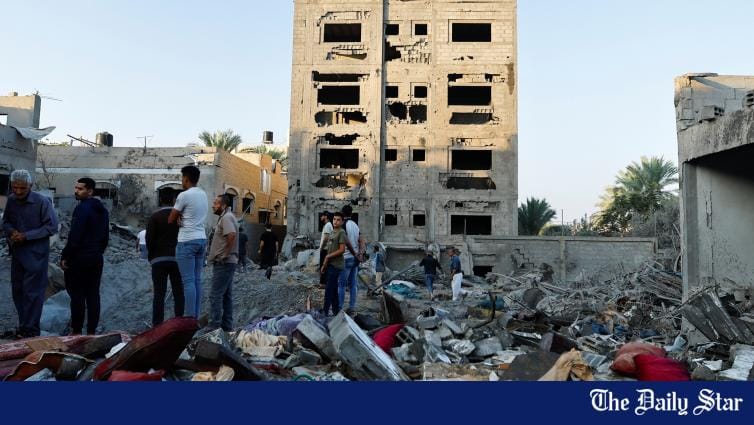
Israeli strike on Jabalia shelter kills at least 28

At least 28 Palestinians including children were killed yesterday in an Israeli strike on a shelter in the northern Gaza Strip, a Gaza health ministry official said, while Israel said the attack targeted tens of militants at the site.

Dozens were also injured in the strike, said the official, Medhat Abbas, adding: "There is no water to extinguish the fire. There is nothing. This is a massacre."

"Civilians and children are being killed, burned under fire," said Abbas.

The Israeli military said in a statement the strike targeted militants from Hamas and Islamic Jihad groups, who operated from within the Abu Hussein School in Jabalia that had been serving as a shelter for displaced people.

It said dozens of militants were present inside the compound when the strike took place, and provided the names of at least 12 of them, which Reuters could not immediately verify.

The military said it took precautions to mitigate harm to civilians and accused Hamas of using them as human shields - a practice Hamas denies.

Hamas said in a statement that allegations there were fighters at the school were "nothing but lies", adding this was "a systematic policy of the enemy to justify its crime."

The Hamas-run Gaza government media office put the number of dead at the school at 28. It said 160 people were wounded in the attack.

Earlier, Palestinian health officials said at least 11 Palestinians were killed in two separate Israeli strikes in Gaza City, while several others were killed in central and southern Gaza areas.

Footage circulated by Palestinian media of the Abu Hussein School and which Reuters couldn't immediately verify, showed smoke coming from tents that caught fire, as many displaced people evacuated casualties including children to ambulances.

Residents of Jabalia, in northern Gaza, said Israeli forces blew up clusters of houses firing from the air, from tanks and by placing bombs in buildings then detonating them remotely.

The area has been a focus for the Israeli military for the past two weeks, which says it is trying to stop Hamas fighters from regrouping for more attacks.

Residents said Israeli forces had effectively isolated Beit Hanoun, Jabalia, and Beit Lahiya in the far north of the enclave from Gaza City, blocking movement except for those families heeding evacuation orders and leaving the three towns.

"We have written our death notes, and we are not leaving Jabalia," one resident told Reuters via a chat app.

"The occupation (Israel) is punishing us for not leaving our houses in the early days of the war, and we are not going now either. They are blowing up houses, and roads, and are starving us but we die once and we don't lose our pride," the father of four said, refusing to give his name, fearing Israeli reprisal.

The Israeli military said on Thursday that it seized many weapons in the area, some of which were stashed in a school, and that its forces have killed dozens of militants in airstrikes and combat at close quarters, as troops try to root out Hamas forces operating in the rubble.

Northern Gaza, which had been home to well over half the territory's 2.3 million people, was bombed to rubble in the first phase of Israel's assault on the territory a year ago, after the Oct. 7 attacks on southern Israel by Hamas-led fighters, who killed 1,200 people and captured 250 hostages, according to Israeli tallies.

More than 42,000 Palestinians have been killed in the Israel's offensive so far, according to Gaza's health authorities.

The United States has told Israel that it must take steps to improve the humanitarian situation in northern Gaza in 30 days or face potential restrictions on military aid.

Israeli Prime Minister Benjamin Netanyahu convened an emergency meeting on Wednesday to discuss expanding humanitarian aid to Gaza, officials said, with aid likely to increase soon.

ACCESS FOR AID

The U.N. has long complained of obstacles to getting aid into Gaza and distributing it throughout the war zone, blaming impediments on Israel and lawlessness. The U.N. said no food aid entered northern Gaza between Oct. 2 and Oct. 15.

On Wednesday, the Israeli military unit that oversees aid and commercial shipments said 50 trucks entered northern Gaza.

Ismail Al-Thawabta, the director of the Hamas-run Gaza government media office, said Israeli comments about allowing aid into the enclave were misleading.

He said the Israeli military has maintained a comprehensive siege on the far north of Gaza for 170 consecutive days, closing all humanitarian access points. He said 342 people had been killed in the Israeli assault over the last 10 days.

Israel says that its evacuation orders have been issued to ensure people's safety and separate them from militants and denies they are part of a systematic clearance plan.​
 
Analyze

Analyze Post

Add your ideas here:
Highlight Cite Fact Check Respond

3,45,000 Gazans face ‘catastrophic’ hunger this winter
Agence France-Presse . Rome 17 October, 2024, 22:22

1729214298012.webp


A displaced Palestinian boy carries a pot full of food, offered by a charity, in Gaza’s Al-Shati refugee camp on Thursday, amid the on-going war between Israel and the Palestinian militant group Hamas in the besieged Palestinian territory. | AFP photo

Some 3,45,000 Gazans face ‘catastrophic’ levels of hunger this winter after aid deliveries fell, a UN-backed assessment said Thursday, warning of the persistent risk of famine across the Palestinian territory.

This is up from the 1,33,000 people currently categorised as experiencing ‘catastrophic food insecurity’, according to a classification compiled by UN agencies and NGOs.

A surge in humanitarian assistance this summer had brought some relief to Gazans, the Integrated Food Security Phase Classification report said, but September saw the lowest volume of commercial and humanitarian supplies entering Gaza since March.

As a result, it projected that the number of people experiencing catastrophic food insecurity — IPC Phase 5 — between November 2024 and April 2025 to reach 345,000, or 16 per cent of the population.

The recent ‘sharp decline’ in aid ‘will profoundly limit the ability of families to feed themselves and access essential goods and services in the coming months, unless reversed’, the report said.

The United States warned Israel on Tuesday that it could withhold some of its billions of dollars in military assistance unless it improves aid delivery to the Gaza Strip within 30 days.

The head of the UN agency for Palestinian refugees, Philippe Lazzarini, also warned Wednesday of the risk of famine in the territory, where vast areas have been devastated by Israel’s retaliatory assault launched after the October 7 attack last year by Hamas.

‘The risk of famine between November 2024 and April 2025 persists as long as conflict continues, and humanitarian access is restricted,’ the IPC report said.

‘The extreme concentration of population in an ever-shrinking area, living in improvised shelters with intermittent access to humanitarian supplies and services, elevates the risk of epidemic outbreaks and deterioration into a catastrophe of unprecedented magnitude.

Intensified Israeli attacks and fresh evacuation orders were ‘already increasing the likelihood of this worst-case scenario occurring’, the report added.

An estimated 60,000 cases of acute malnutrition among children aged between six months and four years old are expected between November and April.

‘To curb acute hunger and malnutrition, we must act now,’ said Beth Bechdol, deputy director-general of the UN’s Food and Agriculture Organization.

She said it was necessary to ‘immediately cease hostilities, restore humanitarian access to deliver critical and essential food aid and agricultural inputs in time for the upcoming winter crop planting season... to allow them to grow food’.

Israel’s ambassador to the UN, Danny Danon, had said Wednesday that a lack of aid was not the problem, blaming Hamas for hijacking and stealing deliveries.​
 
Analyze

Analyze Post

Add your ideas here:
Highlight Cite Fact Check Respond

Gaza ‘hell on Earth’ for one million children
Agence France-Presse . Geneva 18 October, 2024, 22:19

1729299627464.webp

| AFP file photo

The one million children in Gaza are living a ‘hell on Earth’, the UN said on Friday, with around 40 children having been killed there every day over the past year.

More than a year into Israel’s war against Hamas in the besieged Palestinian territory ‘children continue to suffer unspeakable daily harm’, said James Elder, spokesman for the United Nations children’s agency UNICEF.

‘Gaza is the real-world embodiment of hell on Earth for its one million children,’ he told reporters in Geneva. ‘And it’s getting worse, day by day.’

Since Hamas’s deadly October 7 attack inside Israel, which sparked the war, ‘conservative’ estimates put the death toll among children in Gaza at over 14,100, Elder said.

That means that ‘on a conservative measure, around 35 to 40 girls and boys are killed every day in Gaza, since October 7’, he said.

Elder said the numbers — provided by authorities in Hamas-run Gaza, who put the total death toll at over 42,400 — were unfortunately trustworthy.

‘There are many, many more under the rubble,’ he added.

And those who have survived the daily airstrikes and military operations have often faced harrowing conditions, he said. Children were being repeatedly displaced by violence and frequent evacuation orders even as ‘deprivation grips all of Gaza’.

‘Where would children and their families go? They are not safe in schools and shelters. They are not safe in hospitals. And they are certainly not safe in overcrowded camp sites,’ he said.

Elder described the experience of a seven-year-old girl named Qamar, who was struck in the foot during an attack on Jabaliya camp in northern Gaza.

Taken to a hospital that was then placed under a 20-day siege, she could not be moved or get the treatment she needed for her growing infection, and her leg was amputated.

‘In any vaguely normal situation, this little girl’s leg would never have needed to be amputated,’ said Elder.

Faced with fresh evacuation orders from Israel, the girl, her mother and her sister, who was also injured, were forced to move south, on foot.

‘They now live in a ripped tent, surrounded by stagnant water,’ Elder said, adding that Qamar was ‘of course deeply traumatised’, and without access to prosthetics.

UNICEF had already warned that Gaza had become ‘a graveyard for thousands of children’ a year ago, he said.

Last December, the agency had declared Gaza ‘the most dangerous place in the world to be a child’.

‘Day after day, for more than a year now, that brutal evidence-based reality is reinforced,’ Elder added, describing a feeling of ‘deja vu, but with even darker shadows’.

‘If this level of horror doesn’t stir our humanity and drive us to act, then whatever will?’​
 
Analyze

Analyze Post

Add your ideas here:
Highlight Cite Fact Check Respond

Sinwar death brings no respite for Gazans
Agence France-Presse . Jerusalem 18 October, 2024, 22:25

1729299743644.webp

A young Palestinian girl holds up a portrait of slain Hamas leader Yahya Sinwar during a rally in Ramallah, in the occupied-West Bank on Friday. | AFP photo

The killing of Hamas chief Yahya Sinwar brought no respite for Palestinians in Gaza, as Israeli air strikes and shelling continued unabated in the territory already devastated by more than a year of war.

Despite repeated vows that eliminating Sinwar was a key war aim for Israel, raids continued in the besieged enclave in the hours after Israel announced the death of the militant leader they have long accused of masterminding the October 7 attacks last year.

Following a strike at dawn, Gaza’s civil defence agency said rescuers recovered the bodies of three Palestinian children from the rubble of their home in the north of the territory.

‘We always thought that when this moment arrived the war would end and our lives would return to normal,’ Jemaa Abou Mendi, a 21-year-old Gaza resident, said.

‘But unfortunately, the reality on the ground is quite the opposite. The war has not stopped, and the killings continue unabated.’

Large swathes of northern Gaza remained under siege by Israeli forces, with road closures preventing the delivery of supplies to the area — despite warnings from the United States that failure to end the blockade could trigger a reduction in arms deliveries to Israel.

‘While we hear that delivery of aid will increase, people in Gaza are not feeling any difference,’ Philippe Lazzarini, the head of the UN agency for Palestinian refugees, wrote on X.

‘They continue to be trapped, hungry and sick often under heavy bombardment.’

As news of the death of Sinwar sunk in, many in Gaza saw little reason for the Israeli army to press on with its war in the territory.

‘If Sinwar’s assassination was one of the objectives of this war, well, today they have killed Yahya Sinwar,’ said Mustafa Al-Zaeem, a 47-year-old resident from the Rimal neighbourhood in western Gaza City.

‘Enough death, enough hunger, enough siege. Enough thirst and starvation, enough bodies and blood.’

Hamas’s October 7 attack resulted in the deaths of 1,206 people, mostly civilians, according to an AFP tally of official Israeli figures that includes hostages killed in captivity.

Militants also took 251 people hostage during the attack. Ninety-seven remain in Gaza, including 34 who Israeli officials say are dead.

Israel’s campaign to crush Hamas and bring back the hostages has killed 42,500 people in Gaza, the majority civilians, according to data from the health ministry in the Hamas-run territory, figures which the UN considers reliable.

US president Joe Biden said on Friday he impressed on Israeli Prime Minister Benjamin Netanyahu during a conversation to ‘also make this moment an opportunity to seek a path to peace, a better future in Gaza without Hamas’.

Pressure has also been mounting in Israel to leverage the killing of Sinwar into a tangible plan to secure the release of the remaining hostages held captive in Gaza.

Israeli president Isaac Herzog and Netanyahu met on Friday to discuss the aftermath of Sinwar’s death, including the hostages.

A statement released by the presidency said that ‘a significant window of opportunity opened — including the promotion of the return of the hostages and the elimination of Hamas’.

Late Thursday, Netanyahu vowed that those who helped free the hostage in Gaza would be spared.

‘Whoever lays down his weapon and returns our hostages — we will allow him to go on living,’ he said.

But in Gaza, some remained sceptical over the fate of the hostages and what any deal would entail for their future.

‘Today, Israel is lost and will be searching for the hostages,’ said Zaeem.

Others saw little reason to trust Netanyahu and only feared more war.

‘What we see is that Netanyahu’s focus is on Gaza — on killing, destruction, and eradication, as the bombings and massacres continue across Gaza,’ said Mohammad Al-Omari, a 32-year-old from Al-Fakhura in northern Gaza.

‘What we fear most is the continuation of this cursed war.’​
 
Analyze

Analyze Post

Add your ideas here:
Highlight Cite Fact Check Respond

Members Online

No members online now.

Latest Posts

Back
 
G
O
 
H
O
M
E