Donate ☕
201 Military Defense Forums
[🇧🇩] - Budget for 2025- 2026 | Page 7 | PKDefense
Home Login Forums Wars Watch Videos
Serious discussion on defense, geopolitics, and global security.

[🇧🇩] Budget for 2025- 2026

Reply (Scroll)
Press space to scroll through posts
G Bangladesh Defense
[🇧🇩] Budget for 2025- 2026
72
2K
More threads by Saif

FY26 budget to prioritise reform initiatives
Shakhawat Hossain 02 March, 2025, 23:39

1740960409060.png


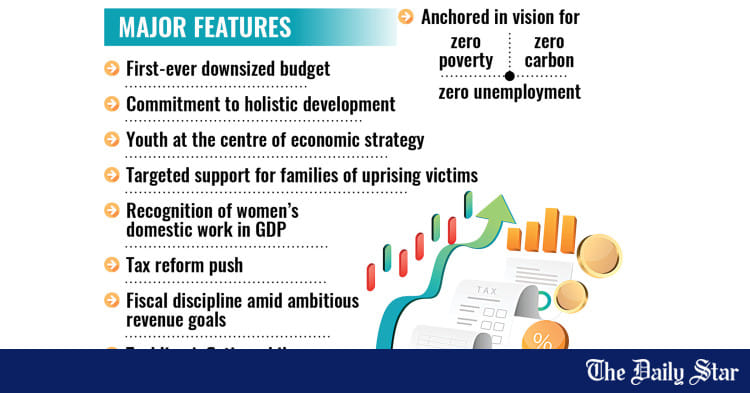
The national budget for the forthcoming financial year of 2025-26 will focus on the reform initiatives taken by the interim government aiming at ensuring good governance, eradicating poverty and curbing discrimination to achieve an inclusive economic growth in the country.

Officials referring to a directive given by finance secretary Khairuzzaman Mozumder in the past month said that all ministries and divisions were asked to send information linked to reform programmes taken by the interim government that assumed power on August 8, 2024 after the ouster of autocratic Awami League regime in a mass uprising in July-August past year.

The ministries and divisions have been asked to send the information by March 15, added the officials.

Finance adviser Salehuddin Ahmed, who is expected to announce the national budget on June 5, in his speech would give the updates on reforms in the areas of good governance, inclusive growth and poverty alleviation.

Economists said that it would be highly interesting to know about the reform programmes taken by the ministries and divisions since the national budget would be the first major government document to follow up the spirit of the mass uprising.

People are yet to know about priority reform agendas of the different ministries and division, said former World Bank Dhaka Office chief economist Zahid Hussain.

Besides, people will be able to learn the interim government’s views on mass uprising, to be reflected in the budget speech, he added.

Economists said that the narratives of uprising available in the government documents had so far been prepared by the task forces and commissions led by economists, academicians, law experts and former bureaucrats.

Officials said the finance secretary issued the directive after placing an outline of the new budget before interim government chief adviser Professor Muhammad Yunus on February 5.

They said that the chief adviser suggested a proper reflection of the uprising spirit in the budget document.

It has been reported that the chief adviser directed ministers and divisions to select at least one reform programme out of the recommendations made by the task force on re-strategising the economy and mobilising resources for equitable and sustainable development.

The task force’s recommendations include new institutions in the civil aviation sector, postgraduate education, research in science, technology, engineering and mathematics, information and communication technology and artificial intelligence.

To tackle the issue of over-regulation and bureaucratic hurdles that have long hindered business growth, the task force proposes the creation of a regulatory reform commission tasking it with evaluating and streamlining regulations across sectors, including business operations and taxation.

The finance secretary also sought information regarding the measures taken by the ministries and divisions on the country’s graduation from the least developed country status in 2026.

The government needs to bring about changes in incentives for the export-oriented sector in the budget since the graduation would restrict the facilitating of direct cash subsidy.

Besides, the country would loss preferential tariff in sending goods to the developing and developed countries.

Economists said that the country was in a favourable position to complete graduation from the LDC status.

Some sections of stakeholders have demanded deferring the graduation process, citing disruption in businesses, said Centre for Policy Dialogue distinguished fellow Mustafizur Rahman.

He said that the FY26 budget document should disseminate updates from the ministries and division on the important national issue.

Officials said the finance ministry had planned a big outlay of about Tk 8.5 lakh crore for the 2025-26 financial year, aiming at encouraging business activities.

They said that emphasis would be given on the generation of more revenue by the National Board of Revenue to support the big expenditure plan.

The provisional target for the NBR has been set at Tk 5.2 lakh crore.

The annual development expenditure in FY26 would be close to a third of the total outlay with focus on job creation projects in sectors like education, health and social safety net.​
 
Last edited:
Analyze

Analyze Post

Add your ideas here:
Highlight Cite Fact Check Respond
  • Like (+1)
Reactions: Bilal9

Public expenditure management in FY26 budget

Enhancing the value for money is key


Fahmida Khatun, Mustafizur Rahman, Khondaker Golam Moazzem, Muntaseer Kamal and Syed Yusuf Saadat

Published :
May 29, 2025 00:55
Updated :
May 29, 2025 00:55

1748474671803.webp


As the current fiscal year draws to a close in June 2025, the interim government is set to present the national budget for fiscal year (FY) 2025-26 on June 2, 2025. The underlying objective of the upcoming budget will be to bring stability to the economy, as Bangladesh currently faces multiple challenges. Public finance is strained by limited revenue growth, rising borrowing costs, and high operating expenditures. Persistent high inflation has eroded the purchasing power of low-income groups. The banking sector struggles with high non-performing loans and weak governance, needing structural reforms and regulatory oversight. The external sector shows recovery with strong remittances and exports, but risks persist from external debt and a market driven exchange rate. The capital market underperforms amid administrative delays and low investor confidence. The power and energy sector suffers from inefficiencies, inadequate infrastructure investment, and a lack of diversification of energy sources.

In this context, the Centre for Policy Dialogue (CPD) has prepared a comprehensive report under its flagship programme titled Independent Review of Bangladesh's Development (IRBD). The report presents an analysis of the economy during the current fiscal year based on the latest available data. The IRBD explores a few selected sectors, such as public finance, inflation, banking sector, external sector, capital market and power and energy sector. These areas reflect the core vulnerabilities currently confronting the country and are essential to address for achieving macroeconomic stability and sustainable growth. CPD offers a set of recommendations for each sector discussed in this reading of the IRBD. This article, based on the IRBD, focuses on public finance.

DATA LIMITATIONS: The issue of the timely availability of fiscal data continues to be a major constraining factor when it comes to the analysis of the public finance situation in Bangladesh. As of May 2025, data reported by the Ministry of Finance (MoF) is available only until January 2025. While alternative sources such as the National Board of Revenue (NBR), Implementation Monitoring and Evaluation Division (IMED), and Bangladesh Bank can be more timely, they lack the accuracy and congruency of the MoF data. Fragmented reporting is also an issue since no alternative sources provide a holistic picture of the fiscal scenario, such as the MoF. The present analyses utilise data from all the aforementioned entities but might be constricted in some instances owing to data limitations.

REVENUE MOBILISATION: As reported by the MoF, total revenue collection posted a 5.3 per cent growth during the July-January period of FY2025. This is a considerable decline from the corresponding figure of FY2024 (13.7 per cent). This implies that a whopping 64.6 per cent growth will be required during the remainder of FY2025 if the annual target for revenue mobilisation is to be achieved.

Without a doubt, this is a highly unlikely prospect. Indeed, in March 2025, CPD projected that the revenue shortfall could reach approximately Tk 1050 billion at the end of FY2025. The growth in revenue mobilisation during the July-January FY2025 period was primarily driven by a sharp increase in government earnings from interest as well as by enhanced collection of income tax.

According to the NBR data, tax collected by the NBR increased by a meagre 2.8 per cent during the July-March period of FY2025, whereas the corresponding figure of FY2024 was 10.7 per cent. The growth achieved so far in FY2025 can be attributed primarily to the enhanced collection of income tax. The slowdown in the implementation of the Annual Development Programme (ADP) as well as the downturn in overall economic activity have perhaps contributed to the poor collection of value added tax (VAT) and supplementary duty (SD) at the local level despite the high level of inflation and increased VAT and SD rates for nearly 90 items. Given the present context, whether the upcoming International Monetary Fund (IMF) conditionalities concerning revenue can be met remains a question.

The debacle concerning the abolishment of NBR has thankfully settled for the time being, thanks to the press release issued by the MoF on May 25, 2025. However, there is no doubt that repetition of such an instance will negatively impact the economy, particularly in the case of revenue mobilisation.

PUBLIC EXPENDITURE: As MoF data shows, overall utilisation of budget stood at 34.5 per cent during the July-January period of FY2025 (MoF, 2025). The corresponding figure for FY2024 was lower - at 32.4 per cent.

ADP implementation was also on the lower side - only 18.4 per cent financial progress was achieved during the first seven months of FY2025 (the corresponding figure for FY2024 was 20.0 per cent). Besides the political turmoil during July-August 2024, the interim government's cautious approach in terms of project approval and fund disbursement, and increased scrutiny of expenditure allocations may have contributed to the slow implementation of ADP. On the contrary, non-ADP expenditure showed an upward trajectory. During July-January of FY2025, utilisation of the non-ADP budget reached 42.5 per cent while the corresponding

figure for the previous fiscal year was 38.9 per cent. This implies that nearly an additional Tk 320 billion was required to conduct the non-ADP activities of the budget. Among the components of non-ADP expenditure, subsidies and current transfers were the major drivers of the uptick, accounting for nearly 61 per cent of the additional non-ADP expenditure. As the World Bank reported, this included increased incentive payments for remittances, food subsidies, and payments to clear arrears to the Bangladesh Power Development Board (BPDB).

Expenditure owing to domestic interest payment also increased substantially, with the corresponding share in additional non-ADP expenditure reaching 37.6 per cent.

The proposal to introduce a dearness allowance for government employees by replacing the existing 5 per cent special incentive from FY2026 comes at a curious time. As has been reported in the media, this move will entail an increase in public expenditure by nearly Tk 70 billion. While this allowance will provide some respite to the public servants during times of high prices of necessities, apprehensions remain as to whether this move will stoke inflation further. There are still concerns about how much attention the rest of the workforce-especially those working in low-paying private jobs and the informal sector-will receive. The timing and nature of this allowance also call into doubt the government's priorities. It needs to be observed whether this move was initiated to appease and maintain support from the government employees, particularly those in the bureaucracy.

The Ministry of Planning's IMED provides a more up-to-date picture concerning the ADP implementation scenario. According to IMED data, the ADP implementation rate against the original budget allocation reached 32.8 per cent during July-April of FY2025 - the lowest in the last ten years.

Within the components of ADP, utilisation of both 'Taka' (the part of ADP that is financed by domestic resources), and project aid reached their historical lows during the first ten months of FY2025. While the implementation rate of the former reached 31.1per cent, for the latter this rate was 35.6 per cent. The corresponding rates for FY2024 were 42.0 per cent and 51.6 per cent, respectively. As mentioned in the previous section, the slowdown in ADP implementation has adversely impacted revenue mobilisation and may have negative connotations for the achievement of a healthy economic growth.

Of the original ADP allocation for FY2025, the top ten ministries/divisions receiving the highest allocation account for 66.6 per cent of the total (the corresponding figure for FY2024 was 70.2 per cent). Among the ten, the ADP implementation of five was below the average level. These include the Road Transport and Highways Division, the Ministry of Railway, the Health Services Division, the Secondary and Higher Education Division, and the Ministry of Water Transport. As can be seen, the trend of poor ADP implementation in the education and health sectors has continued in FY2025. It is also a matter of concern that the average ADP implementation rate of government ministries/divisions which reside outside the top ten has almost halved-from 42.4 per cent during July-April FY2024 to 21.7 per cent during the corresponding period of FY2025.

DEFICIT AND ITS FINANCING: According to the MoF data, the budget deficit increased substantially during the July-January period of FY2025. Budget deficit (excluding grants) stood at Tk 383.93 billion at the end of January 2025. The corresponding figure for FY2024 was Tk 222.44 billion. This is perhaps attributable to the combination of marginal increase in revenue collection and substantial increases in non-ADP expenditure.

Government's net borrowing from foreign sources increased only marginally during the first seven months of FY2025. Although higher inflow of foreign finds was observed, this was offset by the higher amortisation of existing foreign loans.

Government net borrowing from the banking system stood at Tk. 407.86 billion (29.7 per cent of the budgetary target) during July-January of FY2025. On the other hand Tk 236.27 billion was borrowed from the banking system during the corresponding period of FY2024. This increase in bank borrowing by the government may have limited the availability of funds for the private sector. Government net borrowing from non-banking sources increased by Tk. 16.93 billion during July-January of FY2025. Within the non-banking sources, the net sale of National Savings Certificates (NSCs) experienced a sharp rise. During the July-January period of FY2025, the government sold NSCs worth (net) Tk 40.67 billion. On the contrary, the government repaid (net) Tk 73.10 billion to the people during the same period of the previous fiscal year. Overall, the dependency on domestic sources for financing the budget deficit increased during the first seven months of FY2025. Also, this dependency on high-interest rate domestic sources might have adverse implications for the debt servicing liabilities of the coming days.

THE PATH AHEAD: Based on the discussion so far, it becomes evident that the issue of limited fiscal space will persist in the foreseeable future. The extent of this will be determined by the capacity to mobilise additional revenue. To this end, finding newer avenues, enhancing the efficiency of existing efforts, and sealing leakages should all receive due importance. For instance, as part of finding newer avenues, initiatives such as taxing the growing digital economy and meaningful taxation of wealth and property can be considered. When it comes to enhancing the efficiency of existing efforts, analysing the current tax exemptions in-depth with thorough data analysis has become an urgency. As part of sealing the leakages, curbing illicit financial flows (IFF), limiting tax evasion, and tax avoidance should be high on the government's agenda. While efforts to mobilise additional revenue will be there, it needs to be taken into cognisance that some revenue losses will occur owing to the initiatives taken in view of Bangladesh's upcoming LDC graduation. Hence, a balancing game will need to be played. The latest rounds of discussions with the IMF have shown how difficult getting budget support can be. Receiving foreign financing through the channel of ADP is contingent upon the government's ability to design and implement projects. However, swift improvement in these areas will be a difficult proposition. In this backdrop, the onus of deficit financing is likely to fall onto bank borrowings. However, careful calibration will be required if private sector borrowings are not to be crowded out, given the commercial banks' liquidity situation and the government's decision not to borrow from the central bank.

The public expenditure framework will need to address the persistently high prices of necessities. It needs to be ensured that the low and limited income, vulnerable and disadvantaged groups are supported through both revenue and expenditure centric fiscal measures. In the area of ADP, the cautious approach in terms of project approval and fund disbursement, and increased scrutiny of expenditure allocations need to be continued. It needs to be ensured that the current austerity measures, be them part of prudent macroeconomic management or IMF conditionalities, have minimal impact on the social safety net, the health and education sectors, agriculture, and small and medium-sized enterprises (SMEs). The central focus of public expenditure management in the coming days needs to be the enhancement of value for money, given the limited fiscal space.

Dr Fahmida Khatun, Executive Director, Centre for Policy Dialogue (CPD); Professor Mustafizur Rahman, Distinguished Fellow, CPD; Dr Khondaker Golam Moazzem, Research Director, CPD; Mr Muntaseer Kamal and Mr Syed Yusuf Saadat, Research Fellows, CPD.

[Abu Saleh Md Shamim Alam Shibly and Tamim Ahmed, Senior Research Associates; Afrin Mahbub, Preetilata Khondaker Huq, Anindita Islam, Md Mehadi Hasan Shamim, Nuzaira Zareen, Ayesha Suhaima Rab, Safrina Kamal, Khaled Al Faruque, Md. Imran Nazir, and Tanbin Alam Chowdhury, Programme Associates; and Syeda Safia Zahid, Research Intern of CPD provide research assistance.]​
 
Analyze

Analyze Post

Add your ideas here:
Highlight Cite Fact Check Respond

New budget commutes trade penalties, cuts essentials’ taxes
Fillip to trade, capital market expected from fiscal bounties


Doulot Akter Mala
Published :
May 29, 2025 00:37
Updated :
May 29, 2025 00:37

1748474779156.webp


Multiple trade-facilitation measures like corporate-tax variables to promote capital market, commuting penalties for trade offences and cut-down tax rates for pharmaceuticals and other essentials are envisaged in the new budget.

The current interim government is set to cut corporate tax for publicly-listed companies on the capital market by 2.5 per cent in the upcoming budget, widening the much-demanded tax gap to 7.5 per cent between listed and non-listed companies.

Thus, the corporate-tax rate would be reduced to 20 per cent for listed companies while it would remain unchanged at 27.5 per cent for non-listed firms.

Currently, listed companies pay 22.5-percent taxes. The gap is currently 5.0 per cent.

This one of the budgetary measures, to be announced on June 2, is meant to encourage more companies to come on the capital market for securities listings for giving a much-needed fillip to the bourses.

Also, a set of trade-facilitation measures envisaged include a reduction in penalties for misdeclaration of imports and clerical mistakes in Import General Manifesto, and Import Policy Order. Tenure of calculating interest on demanded taxes pending with the courts would be reduced.

Currently, misdeclaration of imported goods is subject to payment of up to 400-percent penalty at customs point. The punitive payment might be commuted to200 per cent for the fiscal year 2025-26.

Silly clerical mistakes in IGM are currently subject to at least 50-percent penalty on payable duty taxes. The minimum benchmark would be abolished allowing importers to pay tax as per "gravity of their mistakes".

On cargo misdeclaration, the minimum ceiling of Tk 50,000 would be withdrawn.

Any contradiction in IPO is subject to severe penalty of minimum 100 per cent now. The minimum ceiling would also be done away with.

On pending court cases, accumulating rate of interest on the demanded tax is now calculated for ten retrospective years. It would be amended, making maximum two years on counting penalty. With this, any businesses that file court cases would pay interest on demanded tax, and after it is settled by the court, for two previous years instead of existing ten years.

On capital-market taxes, Dhaka Stock Exchange (DSE) Chairman Mominul Islam says the market needs at least 10-percent tax gap between listed and non-listed companies to enhance its depth.

"We have proposed the tax incentives to encourage more companies to come in the capital market," he adds.

Many have found significant increases in their tax liabilities after being listed on capital market as the companies have to maintain all compliances, he points out.

"Unless more companies come, the market would remain volatile as prices decline on some selective companies, affecting total indexes," says the premier bourse's chief.

Saiful Alam, President of the DSE Brokers Association of Bangladesh (DBA), hails the government move to widen the minimum spread, urging the government to increase it to 10 per cent.

The measure would attract more reputable and larger companies to enter the market, he says.

"Recently, we learned that the proposed spread will be 7.5 per cent, which is certainly a step in the right direction. However, we urge the government to reconsider our request and increase it to 10 per cent."

It is important to recognize that once a company is listed, it contributes to the treasury through both direct and indirect taxes, he adds.

"Therefore, we should strive to encourage more companies to go public," says the stockbrokers' association leader.

Meanwhile, the government is likely to expand the scope of import-duty exemptions for essential raw materials and products used in the manufacture of cancer-prevention drugs, as well as other medicines, in a bid to make treatments more accessible across the country.

In addition, plans are underway to reduce import duties on medical equipment to make healthcare services more affordable to all.

In this regard, the upcoming budget for FY 2025-26 is expected to include a total of 79 new products in the list of tax-exempt items under three existing SROs or Statutory Regulatory Orders.

According to sources at the Ministry of Finance, the budget proposal includes duty exemptions for 23 new raw materials used in cancer drug production, 36 raw materials for other pharmaceutical products, and 20 types of equipment used in the pharmaceutical sector.

Officials from the Ministry of Finance, speaking on condition of anonymity, said the initiative to include 23 new raw materials for cancer medicine production was taken based on recommendations from the Directorate General of Drug Administration.

According to the list, notable raw materials include Fostamatinib, Deucravacitinib, Peficitinib Hydrobromide, Povorcitinib, Ivarmacitinib, Rilzabrutinib, Momelotinib, Levoleucovorin, Ganciclovir, Tezepelumab, and Faricimab - all of which are used in the production of cancer- treatment medicines.

Furthermore, the ministry has proposed extending the 10% customs duty on the import of medical equipment and apparatus to all types of hospitals across the country. This move aims to improve healthcare services nationwide by making such benefits accessible to all private hospitals. Currently, only specialised or referral hospitals enjoy this fiscal facility.

The Ministry of Finance has also proposed introducing a dedicated HS code for the import of the Tangential Flow Filtration (TFF) System - a crucial device used in vaccine production - to allow it to be imported at a reduced 1.0-percent duty.

Talking to The Financial Express, A.M. Shamim, founder-Managing Director of Labaid Group, said, "If the government extends referral- hospital facilities to all hospitals, it will encourage further investment in the healthcare sector."

Monjurul Alam, CEO of Global Business Development at Becon Pharmaceuticals Ltd, adds: "We currently enjoy duty-free import of raw materials under the existing SRO benefits. If the government expands the list, it will help reduce the cost of medicine production."

Moreover, to keep inflation under control, the government plans to reduce the tax at source on commissions for supply of essential commodities. The current rate of 1% is expected to be halved to 0.50%, according to reliable sources.

The pared-down rate will apply to local LCs used for importing or supply of rice, wheat, potatoes, onions, garlic, peas, chickpeas, lentils, ginger, turmeric, dried chillies, pulses, maize, flour, salt, sugar, edible oils, black pepper, cinnamon, nuts, cloves, dates, cassia leaves, computers, computer accessories, and all kinds of fruits

Increased tax-free income limit: The government is likely to raise the income-tax threshold for individual taxpayers from Tk 3.5 lakh to Tk 3.75 lakh. However, the next slab will be extended to Tk 310,000 from the current Tk 100,000, bringing the total slab to Tk 685,000. Alongside this, the tax rate for this slab will be increased from 5% to 10%, according to sources in the Ministry of Finance.

Ministry sources further stated that the tax-free income limit will be Tk 425,000 for women, Tk 500,000 for persons with disabilities, and Tk 525,000 for gazetted freedom fighters.

Meanwhile, the tax slabs for the next levels of income will be adjusted as follows: the next Tk 400,000 of income will be taxed at 15%, the following Tk 500,000 at 20%, the next Tk 500,000 at 25%, and any remaining income will be taxed at 30%.

Relief for first-time taxpayers: There is some good news for first-time tax-return filers. The proposed budget is expected to introduce a provision in the Income Tax Act setting a minimum tax of Tk 1,000 for new taxpayers. This initiative is aimed at reducing the tax burden for new filers and easing tax-related anxieties.

However, the minimum tax for other taxpayers will be Tk 5,000.

The tax-free perquisites limit is also planned to be increased to Tk 2.0 million from the current Tk 1.0 million.

For private-sector employees, one-third of the total of their total income or Tk 4.5 lakh - whichever is lower - is currently exempt from tax. This exemption is proposed to be raised to Tk 5 lakh.

Talking to The Financial Express, Snehasish Barua, a chartered accountant and a director of SMAC Advisory Services Ltd, said: "Reducing TDS on essential goods is a good move, but the list of essential items needs to be far more extensive."

Increasing the perquisite limit is also a wise move, as it addresses a double-taxation issue already flagged by the High Court and helps businesses in reducing the unnecessary tax burden.

"However, eliminating the Tk 100,000 second tax slab could hit low-income earners hard, with some facing an additional Tk 2,500 in tax even with the higher basic threshold of Tk 375,000."​
 
Analyze

Analyze Post

Add your ideas here:
Highlight Cite Fact Check Respond

Opting for realistic budget targets

Published :
May 30, 2025 00:13
Updated :
May 30, 2025 00:13

1748561169302.webp


As the countdown to the national budget announcement begins, expectations for a realistic and targeted approach from the interim government rather than ambitious, sweeping promises would not be misplaced. Such a pragmatic stance is necessary, given the diverse and pressing challenges confronting the economy at this critical juncture. Broadly, trade expansion, employment generation, and investment promotion are expected to feature prominently on the government's spending priority list --- an indication reinforced by Finance Adviser Dr. Salehuddin Ahmed in his recent interview with The Financial Express.

With the economy still reeling from the aftershocks of recent political unrest, Dr. Ahmed finds himself navigating a tight fiscal space. "Resource gap is the main challenge in budget formulation," he stated, emphasising the need for strategic resource mobilisation. The government, he revealed, plans to tap into foreign budget-support credits while also focusing on domestic avenues --- taxation, bank borrowing, and bond issuance --- to bridge the fiscal gap. Unlike previous administrations, the current government is intent on crafting a budget grounded in realism, focusing on clearly defined, attainable goals within available resources, he said.

Dr. Ahmed highlighted the importance of harmonising fiscal and monetary policies and ensuring judicious use of allocated funds, rather than expanding indiscriminately. In this context, the Annual Development Programme (ADP) will see reductions, which he admitted could affect employment. He, however, maintained that the government is consciously avoiding large, capital-intensive megaprojects and shifting its development strategy.

Media reports indicate that health and education --- two sectors chronically underfunded --- will again fall short of receiving meaningful increases. Despite expectations for corrective allocations from the interim government, no significant change appears likely. Dr. Ahmed's emphasis on skills and capacity development over infrastructure investments in these sectors may reflect a practical stance, but it fails to fully address the sectors' dire needs. It is critical that allocations are adequately matched to address glaring deficits in healthcare and education service delivery.

In a move aimed at fostering innovation and job creation, Dr. Ahmed mentioned that a dedicated fund will be introduced to support start-ups and new entrepreneurs. Furthermore, he hinted at widening the regulatory gap between listed and non-listed companies, and curtailing export incentives. The government is also looking to reduce tax expenditures by cutting back on exemptions granted through statutory regulatory orders (SROs) that often go beyond budget sanction.

The proposed budget outlay stands at Tk 7.90 trillion --- marginally lower than the current Tk 7.97 trillion. Revenue earnings have been targeted at Tk 5.18 trillion, with ADP spending set at Tk 2.30 trillion. The GDP growth target is 5.5 per cent, and inflation is expected to be brought down to 6.5 per cent from the current 9.0 per cent. The budget deficit is projected at Tk 2.26 trillion, or 3.62 per cent of GDP, which is estimated at Tk 62.5 trillion. Given the contractionary nature of this budget, it is imperative that sufficient attention is directed towards supporting small and medium enterprises, enhancing credit access for rural businesses, and bolstering sector-specific development, especially in agriculture, fisheries, and cottage industries.​
 
Analyze

Analyze Post

Add your ideas here:
Highlight Cite Fact Check Respond

Finance adviser to unveil budget for FY 26 on Monday

FE ONLINE REPORT
Published :
May 29, 2025 16:20
Updated :
May 29, 2025 21:25

1748561629988.webp


Finance Adviser Dr. Salehuddin Ahmed will present the national budget for the fiscal year 2025-26 on, June 02 (Monday), according to a government hand out.

This marks the first budget of the interim government that assumed power following the mass public uprising on August 05.

The pre-recorded budget speech will be aired at 4:00 PM on Bangladesh Television (BTV) and Bangladesh Betar.

To ensure wider reach, all private television channels and radio stations have been requested to broadcast the speech simultaneously by receiving the feed from BTV.

People familiar wit hthe development told the FE that that the size of the upcoming budget has been set at Tk 7.9 trillion—Tk 70 billion less than the budget for the previous fiscal year.

According to officials from the ministry of Finance and the Planning Commission, the contraction in expenditure aims to meet conditions set by the International Monetary Fund (IMF), reduce the number of non-essential projects, and contain the higher inflation persisting the economy for long.

With the Eid-ul-Azha public holidays scheduled from June 05 to 14, authorities have opted to announce the budget earlier, on June 02. Usually the budget is unveiled on Thursday and the post budget press conference on Friday.

As the National Parliament is not currently in place, the Finance Adviser will present the budget on television.

A presidential ordinance will subsequently be issued to formally enact the budget, in line with procedures applicable under the interim government.​
 
Analyze

Analyze Post

Add your ideas here:
Highlight Cite Fact Check Respond

What the development philosophy should be for the FY2026 budget

1748565076818.webp

VISUAL: ANWAR SOHEL

A national budget is commonly perceived as a numerical exercise. The normal questions are: what resources are available in total? How much would be mobilised from different sources? What would be the level of total expenditures? How much would be sectoral allocations? So, the budget looks like an accounting framework. Sometimes, a national budget is also referred to as a balance sheet of revenues and expenditures, between which a balance is maintained, as deemed desirable by the government.

But is a national budget a mere numerical exercise? Is it a simple accounting framework? Firstly, it's not. The allocations and expenditures in a national budget also reflect a government's economic priorities. What are the sources from which most of the revenues would be mobilised? Would they be mostly from direct taxes or indirect taxes, or from non-tax sources? Similarly, which sectors would get the major parts of budget expenditures—physical infrastructures like roads and bridges, or social infrastructures like health and education? Secondly, these priorities are not determined in a vacuum. They are guided by the government's vision, which is formed based on the development philosophy it holds.

The interim government of Bangladesh will present the proposed national budget for FY2025-26 on June 2. The budget is expected to provide a roadmap for the country's future development.

Over the past few months, there have been many discussions on the upcoming budget, the debates revolving around the budget size, probable sectoral allocations, resource constraints, priorities in the budget, and strategies to be followed, among other topics. The discussions mostly focused on the numerical aspects of the budget, as well as its priorities. Much of the analyses were around the new Annual Development Programme (ADP), which was approved recently.

The size of the FY2026 budget is set to be Tk 7.9 lakh crore, about Tk 7,000 crore less than the current fiscal year's original budget. Non-development expenditures are expected to be set at Tk 5.6 lakh crore, up by Tk 28,000 crore from the current budget's allocation. Debt servicing and ballooning subsidies would eat up a significant portion of the new budget. Interest payments are expected to amount to Tk 1.33 lakh crore, which will increase if principal payments are included. The government has allocated Tk 88,000 crore for subsidies. All these mounting costs have left little room for discretionary spending and have created fiscal strains.

As a result, the development expenditures in the FY2026 budget is set to be Tk 2.3 lakh crore, Tk 35,000 crore less than the original budget of FY2024-25. The development budget is the lowest in four years. Allocations to almost all sectors have been cut. About 70 percent of the budget will go to five sectors: transport and communication (25.64 percent), power and energy (14.08 percent), education (12.42 percent), housing and community facilities (9.9 percent), and health (7.89 percent). On the revenue side, the deficit in resource mobilisation may range from Tk 42,500 crore to Tk 54,000 crore.

Third, in terms of content, the objective of the upcoming budget has been stated to be restoration of economic discipline and economic stability. The budget will not be anchored in irresponsible and ad hoc policy actions and resource allocations. This would imply restoring transparency and accountability in public resource mobilisation and public expenditures. Some of the strategies of the budget will be reducing inflation, taking fewer foreign loans, prioritising ongoing projects and not undertaking new projects, and reducing additional costs and stopping corruption and inconsistencies in projects. The government has used a digital budget planning system to categorise budget spending, allowing for more transparent tracking of fund utilisation. This is important, given that Bangladesh performs poorly in budget transparency, ranking 37th among 125 countries in the 2023 Open Budget Survey.

In this context, the question arises: what development philosophy does the FY2025-26 budget uphold? Is it based on a pro-growth development philosophy or a pro-people development philosophy? Some observations are pertinent in this regard.

First, around 40 percent of the development expenditures are devoted to transport and communication and power and energy. These two sectors are critical for boosting production, and thus for enhancing economic growth. Related to this are the allocations to some megaprojects, i.e. the Bhola-Barishal 11-km-long bridge project at the cost of Tk 17,466 crore, the Bay Terminal Marine Infrastructure Development Project at the cost of Tk 13,525 crore, and Kalurghat rail-and-bridge project at the cost of Tk 1,156 crore. The implicit assumption behind these megaprojects may be that they would boost economic growth. Whether they do so or not, undertaking megaprojects basically indicates a leaning towards a pro-growth philosophy.

Second, issues like health and education are basic ingredients for enhancing human development. Yet, the health sector accounts for only about 7.89 percent of the development allocation, while education accounts for 12.42 percent of the development expenditure. Together, these two sectors account for over 20 percent of the development budget, which is lower than the allocation for transport and communication alone (25.64 percent). In fact, the transport and communication budget is double the education budget and triple the health budget. Furthermore, the development expenditure in the health sector has been cut by 13 percent compared to the outgoing budget, and education by nine percent. Efficient and effective implementation requires cuts in expenditures, no doubt, but those cuts cannot be indiscriminate across the board. If the development philosophy of the FY2025-26 budget were pro-people, the expenditures in the human development sectors would have been adequate and protected.

Third, as usual, agriculture has remained a neglected sector in the upcoming budget. The allocation of Tk 10,795 crore to agriculture represents less than five percent of the total development budget. In fact, compared to the outgoing budget, the agriculture allocation has been slashed significantly, by 18 percent. Given the importance of the agricultural sector in the country's economy and society, this can neither be termed as pro-poor nor be identified as pro-people. The same conclusion holds with regard to the allocations to the environment, climate change, and water resources. Together, they received Tk 10,641 crore, less than five percent of the development expenditures.

Given the nature and structure of Bangladesh's economy, its current economic realities, and the aspirations of its people, the philosophical focus of the FY2026 budget should be pro-poor and pro-people. Its preoccupation should not be economic growth alone; rather, it should be human development. Formulating and implementing an annual national budget with those goals can ensure both economic growth and human development in Bangladesh.

Selim Jahan is former director of the Human Development Report Office under the United Nations Development Programme (UNDP) and lead author of the Human Development Report.​
 
Analyze

Analyze Post

Add your ideas here:
Highlight Cite Fact Check Respond

Members Online

⤵︎

Latest Posts

Latest Posts