Donate ☕
201 Military Defense Forums
[🇧🇩] - Budget for 2025- 2026 | Page 11 | PKDefense
Home Login Forums Wars Watch Videos
Serious discussion on defense, geopolitics, and global security.

[🇧🇩] Budget for 2025- 2026

Reply (Scroll)
Press space to scroll through posts
G Bangladesh Defense
[🇧🇩] Budget for 2025- 2026
72
2K
More threads by Saif

FY26 budget to prioritise reform initiatives
Shakhawat Hossain 02 March, 2025, 23:39

1740960409060.png


The national budget for the forthcoming financial year of 2025-26 will focus on the reform initiatives taken by the interim government aiming at ensuring good governance, eradicating poverty and curbing discrimination to achieve an inclusive economic growth in the country.

Officials referring to a directive given by finance secretary Khairuzzaman Mozumder in the past month said that all ministries and divisions were asked to send information linked to reform programmes taken by the interim government that assumed power on August 8, 2024 after the ouster of autocratic Awami League regime in a mass uprising in July-August past year.

The ministries and divisions have been asked to send the information by March 15, added the officials.

Finance adviser Salehuddin Ahmed, who is expected to announce the national budget on June 5, in his speech would give the updates on reforms in the areas of good governance, inclusive growth and poverty alleviation.

Economists said that it would be highly interesting to know about the reform programmes taken by the ministries and divisions since the national budget would be the first major government document to follow up the spirit of the mass uprising.

People are yet to know about priority reform agendas of the different ministries and division, said former World Bank Dhaka Office chief economist Zahid Hussain.

Besides, people will be able to learn the interim government’s views on mass uprising, to be reflected in the budget speech, he added.

Economists said that the narratives of uprising available in the government documents had so far been prepared by the task forces and commissions led by economists, academicians, law experts and former bureaucrats.

Officials said the finance secretary issued the directive after placing an outline of the new budget before interim government chief adviser Professor Muhammad Yunus on February 5.

They said that the chief adviser suggested a proper reflection of the uprising spirit in the budget document.

It has been reported that the chief adviser directed ministers and divisions to select at least one reform programme out of the recommendations made by the task force on re-strategising the economy and mobilising resources for equitable and sustainable development.

The task force’s recommendations include new institutions in the civil aviation sector, postgraduate education, research in science, technology, engineering and mathematics, information and communication technology and artificial intelligence.

To tackle the issue of over-regulation and bureaucratic hurdles that have long hindered business growth, the task force proposes the creation of a regulatory reform commission tasking it with evaluating and streamlining regulations across sectors, including business operations and taxation.

The finance secretary also sought information regarding the measures taken by the ministries and divisions on the country’s graduation from the least developed country status in 2026.

The government needs to bring about changes in incentives for the export-oriented sector in the budget since the graduation would restrict the facilitating of direct cash subsidy.

Besides, the country would loss preferential tariff in sending goods to the developing and developed countries.

Economists said that the country was in a favourable position to complete graduation from the LDC status.

Some sections of stakeholders have demanded deferring the graduation process, citing disruption in businesses, said Centre for Policy Dialogue distinguished fellow Mustafizur Rahman.

He said that the FY26 budget document should disseminate updates from the ministries and division on the important national issue.

Officials said the finance ministry had planned a big outlay of about Tk 8.5 lakh crore for the 2025-26 financial year, aiming at encouraging business activities.

They said that emphasis would be given on the generation of more revenue by the National Board of Revenue to support the big expenditure plan.

The provisional target for the NBR has been set at Tk 5.2 lakh crore.

The annual development expenditure in FY26 would be close to a third of the total outlay with focus on job creation projects in sectors like education, health and social safety net.​
 
Last edited:
Analyze

Analyze Post

Add your ideas here:
Highlight Cite Fact Check Respond
  • Like (+1)
Reactions: Bilal9

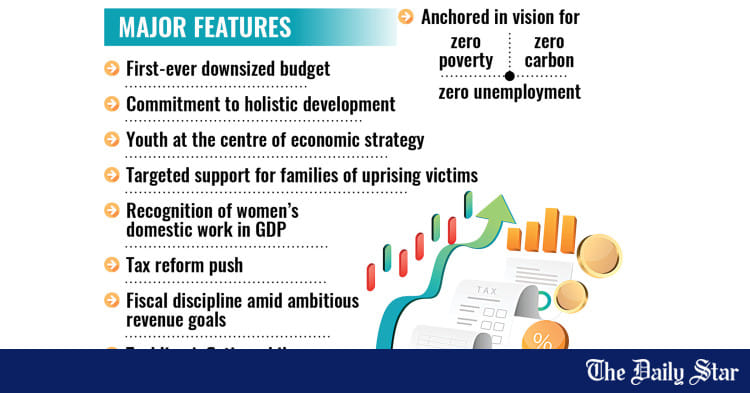
Smaller in size, larger in intent

It’s a budget that tries to do more with less -- and do it differently. Faced with limited fiscal space and high expectations, the govt goes for people-first priorities

1748908404027.webp


Finance Adviser Salehuddin Ahmed has offered both empathy and arithmetic in his budget speech, laying out a vision that puts people, not just projects, at the heart of economic policy.

The first budget from the interim government is smaller in size but larger in intent. It's a symbolic break from bloated spending and inflated promises. Gone is the language of sky-high growth. In its place, Ahmed pushed for what he called "holistic development".

He spoke of the families of the July Mass Uprising -- of the martyrs, the injured, and those left behind. He described mothers unable to afford protein, farmers stranded by flash floods, and migrant workers searching for dignity abroad. He acknowledged the invisible labour of women whose unpaid work sustains households but goes uncounted in the national economy. The adviser also looked ahead, highlighting telemedicine, tech-adapted teaching, and a banking system on the mend.

In a clear shift from the past, the FY26 budget prioritises people over infrastructure. "Instead of highlighting the traditional physical infrastructure development, we have given priority to the people," he said. Ahmed underscored the importance of safeguarding fundamental rights and ensuring access to a dignified life. Without these, he warned, "any state becomes ineffective, and the foundation of a society is weakened."

The budget reflects a broader national ambition: to build a society free from poverty and unemployment, and committed to a zero-carbon future -- an echo of Chief Adviser Muhammad Yunus's "three-zero" vision.

The government has placed youth almost at the centre of its economic vision, rolling out initiatives focused on skills training and entrepreneurship. The finance adviser said the aim is to harness the energy and potential of young people to build a more self-reliant workforce. However, analysts argue that the budgetary allocations fall short of what's needed to meaningfully address the scale of youth unemployment.

Empathy for a wider society shapes the budget's tone, but beneath it lies a sober economic reality. In a year clouded by inflation fatigue, fragile policymaking, and the structural hangover of the past disgraced regime, Ahmed presented a budget grounded in restraint. And the people-first framing masks the harder constraints underpinning the budget: ballooning debt.

GDP growth is projected at 3.97 percent this fiscal year. While growth may pick up to 6.5 percent in the medium term ahead, the adviser warned that inflation, driven by the Russia-Ukraine war, remains tough to control. Still, tighter policies have brought it down to 9.05 percent in May from a peak of 11.66 percent last July.

FISCAL DISCIPLINE

The budget balances social spending with bold tax reforms, but its success depends on improbable revenue gains, a gamble that could backfire amid global economic headwinds.

The most significant structural reform comes from the elimination of corporate tax exemptions, a clear departure from the previous government's tendency to perpetually extend such benefits. This move, coupled with sweeping reductions in import duties across hundreds of items, suggests a genuine effort to broaden the tax base and improve competitiveness.

The success of these measures depends on two precarious assumptions: first, that removing exemptions will not trigger backlash from the business community; and second, that customs revenue losses will be offset by increased compliance. Historical precedent is not encouraging; the tax-to-GDP ratio has stagnated around 8 percent for years, well below regional peers.

The tax measures could lay the groundwork for a more rational system, but only if future governments resist pressure to reintroduce exemptions.

With the National Board of Revenue collecting just Tk 362,000 crore last fiscal year, the new target of Tk 499,000 crore for the upcoming year seems overly ambitious. So far, the NBR has raised only Tk 289,000 crore in the first 10 months of the current fiscal year.

The fundamental tension lies in how expenditures will be funded. With the budget deficit projected at 3.6 percent of GDP and likely to expand if revenue falls short, Bangladesh risks either compromising its development spending or accumulating more expensive debt. The lack of concrete plans to improve tax administration efficiency suggests the government may be relying on domestic borrowing, which could crowd out private investment and push interest rates higher.

Ultimately, Bangladesh's economic trajectory will depend less on budget proposals than on whether it can break its chronic cycle of weak revenue mobilisation and stopgap financing. Without deeper reforms in tax administration and public expenditure management, even the most well-intentioned fiscal plans will remain aspirational.

The adviser insisted that measures are already in motion to expand the tax base, phase out exemptions, and modernise revenue systems.

One of the more contentious elements of the budget is the decision to impose an additional 7.5 percent tax on publicly traded companies that have issued less than 10 percent of their shares through a public offer. Critics argue the move is not only punitive but also discriminatory, especially in a market already struggling with low investor confidence.

Equally counterintuitive is the withdrawal of the reduced tax rate previously granted to companies conducting transactions through formal banking channels. At a time when the government is promoting financial transparency and digital payments, this measure undermines efforts to build a cashless economy.

Salaried taxpayers, too, are feeling the squeeze. While the hike in the tax-free threshold at the entry level offers some relief, the broader restructuring of tax slabs may ultimately place a greater burden on the middle class. That runs counter to the concept of equity and erodes disposable income in an already inflationary environment.

DEMOCRATIC TRANSITION

Macroeconomic stability was one pillar of the budget, and the other was democratic transition.

In one of the most politically resonant moments of his speech, Ahmed underscored the interim government's commitment to restoring electoral integrity. "One of our goals is to reestablish people's voting rights through a free and fair election and to hand over power to a democratic government," he said, adding that the country's electoral system had been "completely tampered with" over the past decade and a half.

The timing of the message was significant: the budget was unveiled on the same day Chief Adviser Muhammad Yunus resumed dialogue with political parties.

Ahmed said electoral reform had been given the "highest priority." The voter list has been updated, and new technology is being deployed to bolster transparency.

Ahmed's speech reflected a careful balancing act between calls for equity and stabilisation. This is a budget that tries to do more with less and do it differently. Whether it can deliver, amid bureaucratic bottlenecks, shaky institutions, and electoral uncertainty, will depend less on what is written in budget documents and more on what the government can implement in the months leading up to the national election.​
 
Analyze

Analyze Post

Add your ideas here:
Highlight Cite Fact Check Respond

Observation at AmCham discussion: Budget is highly ambitious, implementation will be difficult,
Panelists observe at AmCham discussion


FE ONLINE REPORT
Published :
Jun 03, 2025 20:06
Updated :
Jun 03, 2025 20:15

1748993430909.webp


Panelists at a post-budget discussion organised by the American Chamber of Commerce in Bangladesh (AmCham) on Tuesday described the proposed national budget for FY 2025–26 as “highly ambitious” and warned that its implementation will be difficult amid economic and political uncertainties.

Held in Dhaka, the event was chaired by AmCham President Syed Ershad Ahmed, with Dr M Masrur Reaz of Policy Exchange Bangladesh presenting the keynote. Chief Adviser’s Special Assistant Dr Anisuzzaman Chowdhury attended as chief guest.

Dr Reaz said the budget lacks clear direction on investment, employment, and structural reform. He termed revenue, inflation, and GDP targets overly optimistic, given current instability.

While welcoming increased allowances for public servants and business-friendly tax measures, he flagged concerns over insufficient support for job creation—especially for rural women—and unchanged allocations for education and health. Panelists urged practical reforms to meet economic goals.​
 
Analyze

Analyze Post

Add your ideas here:
Highlight Cite Fact Check Respond

New budget is realistic and frugal: Planning Adviser

Published :
Jun 03, 2025 21:47
Updated :
Jun 03, 2025 21:47

1748993857100.png


Planning Adviser Wahiduddin Mahmud on Tuesday termed the budget placed by the interim government "realistic and frugal'.

"I will tell this budget realistic and frugal, aiming to ensure a fragile economy into a stable one where all financial institutions and all other state organisations were demolished," he said while addressing a post-budget press conference held at Osmani Memorial Auditorium.

He said that they are having heavy trouble cleaning the garbage that was left behind by the previous Awami League government.

The adviser said that the new projects that are being taken up by this government would come to the implementation stage not in the coming 2025-26 fiscal, but in 2026-27 fiscal.

"These projects will be enlisted now, there will be some more tasks to be done for these projects to improve these, the time to implement these projects will come not in the proposed budget time (2025-26 fiscal), these projects will be implemented in 2026-27 fiscal," he said.

He also said that at that time, this interim government would not be in power.

"The government, which will be in power then, if they want they can pick projects from those enlisted ones," he said.

The adviser, however, admitted that the poverty in the country has increased. "We are trying to know the reasons to solve those," he said.

He said this is the first time such a system has been put in place where a project must be at the forefront of the ongoing permanent irregularities (IMED) survey.

He said that many projects have been implemented without any kind of trial analysis, the work of which is being spent twice as much.

There are many projects where major corruption has occurred. In the future, IMED will be involved in the ongoing project survey to prevent corruption."

The adviser said that the permanent procurement policy has been revised and passed. Through this, 100% e-tendering will be effective to ensure transparency.

Energy Adviser Muhammad Fouzul Kabir Khan said that this budget is the budget to reduce the inconsistency.

"This is an exceptional budget and the budget to reduce wastage," he added

Wahiduddin said that a significant portion of the proposed national budget has been allocated for servicing both foreign and domestic debt obligations, alongside maintaining essential subsidies in the agriculture and energy sectors.

He noted that these measures were necessary to ensure social stability and contain inflation, which had been rising even before the current administration assumed office.

"We have cleared significant backlogs in energy payments to foreign creditors," he said, adding, "But escaping the vicious cycle of borrowing to repay debt will not be possible in a single budget. What we have done is lay the groundwork for that transition."

The adviser also pointed out that the majority of the development expenditure in the upcoming fiscal year is tied to ongoing projects initiated by the previous government-many of which, he said, lacked proper financial planning and strategic prioritisation.

"Out of 1,113 development projects, only 20 to 30 are new-and even those were listed in the 'green page' of last year's budget without any allocation," he said.

According to the adviser, the interim administration's role has largely been to rationalise, restructure, and expedite the completion of feasible projects. Abruptly halting large infrastructure schemes mid-construction, he warned, would cause greater economic harm.

"Instead, we've prioritised rural infrastructure such as roads and bridges, along with urban services like sanitation and water management in district towns and semi-urban areas," he said.

These efforts, he added, aim to improve livability and reduce urban congestion by promoting decentralised development.

Regarding mega projects, the government is selectively focusing on economically strategic infrastructure such as the Matarbari Deep Sea Port, Chattogram Bay Terminal, and Khulna-Mongla Port.

"These are not merely construction projects-they are gateways to boosting our trade potential," the adviser said. "Even here, we are making careful budget adjustments to reduce costs wherever possible."

He also highlighted steps to reduce dependence on imported LNG by reviving and expanding domestic gas exploration-moves that he said are long overdue and could significantly cut energy import bills in the future.​
 
Last edited:
Analyze

Analyze Post

Add your ideas here:
Highlight Cite Fact Check Respond

Budget framed within means for easing life: Salehuddin
Interim govt defends its maiden budget with curtailed spending on fund-guzzling dev schemes

Jasim Uddin Haroon
Published :
Jun 04, 2025 01:13
Updated :
Jun 04, 2025 01:13

1748994651934.webp

Finance Adviser Dr Salehuddin Ahmed addresses a post-budget press conference at the Osmani Memorial Auditorium in the capital on Tuesday. Planning Adviser Dr Wahiduddin Mahmud is seen on his right. — FE Photo

This budget is framed realistically within the means and for easing people's life, sans growth hypes of yesteryears, interim government's high-ups said to defend its maiden budgetary measures with curtailed spending on fund-guzzling development schemes.

At a post-budget press meet Tuesday at the Osmani Memorial Auditorium in Dhaka, Finance Adviser Dr Salehuddin Ahmed said the proposed national budget for 2025-26 is "realistic, pragmatic and implementable" in the present context.

He noted that the interim government inherited a financial sector in near-collapse when it assumed office in August 2024.

"The country was in the ICU (Intensive Care Unit) especially the financial sector," he told inquisitive finance reporters.

"You will hardly find another case in the world where banks' sponsors siphoned off nearly 70 per cent of funds, including depositors' money."

The press event was attended by other key members of the interim cabinet, including Commerce Adviser Sheikh Bashiruddin, Agriculture and Home Adviser Lt-General (Retd.) Jahangir Alam Chowdhury, Planning Adviser Dr Wahiduddin Mahmud and Power and Energy Adviser Dr Fouzul Kabir Khan, Cabinet Secretary Dr Sheikh Abdur Rashid, Finance Secretary Dr Md. Khairuzzaman Majumder, NBR Chairman Md. Abdur Rahman Khan and Bangladesh Bank Governor Dr Ahsan H. Mansur.

The finance adviser said the country had been "on the edge of an abyss," particularly in financial governance, when the interim administration took over.

"What would have happened had we not intervened? We've made efforts to bring the economy back into a relatively stable position."

He acknowledges that repatriating stolen money takes time.

"Look at the Philippines -- it took them 18 years to recover the looted assets of Ferdinand Marcos. But the process has begun here," he mentioned, without disclosing specific details.

On budgeting strategy, Dr Ahmed notes that resources are limited, but demand is enormous. "In economics, there's the theory of Pareto Optimality -- improving one person's welfare often requires compromising another's. We tried to strike a balance."

He said the focus now shifted from a narrative of high growth to inclusive wellbeing.

"For years, we heard about GDP growth. But who really benefited from it? Our goal this time is to improve people's standard of living, enhance purchasing power, and allow businesses to breathe."

Despite multiple structural challenges -- inflation, revenue shortfalls, energy crises, and a troubled banking system -- the budget size remains unchanged.

"We didn't prepare a revolutionary budget, but we laid the foundation for realistic transformation," Dr. Ahmed said.

Planning Adviser Dr Wahiduddin Mahmud points out a key concern -- debt servicing -- stemming from debt buildups over the years heretofore.

"A significant portion of this budget is earmarked for interest payments, both domestic and external. We're caught in a debt trap, and we must find a way out."

To underscore prudence that went into the budgeting he said the current Annual Development Programme (ADP) inlaid in the budget for the forthcoming financial year 2025-26 includes over 1,100 projects with very few new ones.

"Most of the so-called 'new' projects were actually initiated by the previous government and were already in the Green Book," he told the journalists.

Efforts are underway to rationalise spending, given the prevailing context.

"We've already trimmed down the Mongla Port project, implemented by a Chinese firm, by Tk 5.0 billion -- from Tk 40 billion," he said as an example of austerity.

"We're essentially clearing the garbage left behind by the previous regime."

Dr Mahmud also criticised the Payra Port project, which lacks essential transmission systems despite having two coal-based power plants.

"We can't scrap it altogether due to prior investments."

To improve transparency, the government is drafting a Public Procurement Act, the planning adviser said.

"Right now, only three to four firms dominate government construction. This act will bring accountability."

He also announced that the Implementation Monitoring and Evaluation Division (IMED) would become more active than in the past, for oversights on public-works projects.

"They [IMED officials] will physically visit ongoing projects to monitor progress, and misuse," he said.

Agriculture and Home Adviser Lt-General (Retd) Jahangir Alam Chowdhury said bumper harvests of Boro rice, potatoes, and onions this year created surpluses on the market, leading to lack of fair prices for the farmers.

However, for a lack of cold storage, farmers are often forced to sell at depressed prices.

"We're constructing 100 small cold storages tailored for vegetables, including cauliflower, which require specialised temperature conditions," he mentioned.

Four additional storage facilities are being developed specifically for seed potatoes, which require different temperatures.

Finance Secretary Dr Md. Khairuzzaman Majumder said the government is seeking to reduce its dependence on the banking sector to avoid crowding-out effect on private investment.

"Last year, bank borrowing was initially projected at Tk 1.37 trillion. After consultation with the central bank governor, we revised it down to Tk 990 billion," he told the press meet.​
 
Analyze

Analyze Post

Add your ideas here:
Highlight Cite Fact Check Respond

Budget not consistent with July spirit of equity, employment: CPD

FE REPORT
Published :
Jun 04, 2025 01:14
Updated :
Jun 04, 2025 01:14

1748994783890.webp


Economic-policy analysts at the CPD see the interim government's maiden budget paradoxical to July spirit of equity for its customary fiscal measures and take exception to the black-money-whitening provision in particular.

The Centre for Policy Dialogue (CPD) says although the proposed budget for the next fiscal year makes ambitious promises-such as reducing inequality, creating jobs through increased investment, and prioritizing human development over mere GDP growth-these commitments are not reflected in the actual allocations and initiatives.

They also note that the budget, formulated at a critical juncture, on the cusp of a political changeover, offered an opportunity for establishing tax fairness, boosting revenue collection, and initiating major reforms with genuine intent to address the fragile economy. But the government "failed" to seize it.

The remarks were made Tuesday from a media briefing titled 'CPD's Analysis of the National Budget FY2025-26', held at a hotel in the capital to present a detailed analysis of the proposed budget.

Professor Mustafizur Rahman, Distinguished Fellow at the CPD, said the proposed budget also fails to address another core demand of the July movement-employment generation alongside building an inequality-free society.

He notes that the budget lacks a guaranteed employment scheme and falls short of introducing effective measures to integrate the large youth population 'Not in Education, Employment, or Training (NEET)' into the mainstream economy.

"Employment will be created through investment," he said, but while public investment is set to decline slightly, there is also no clear roadmap to boost private investment to meet the budgetary goal.

Earlier on Monday, Finance Adviser Dr Salehuddin Ahmed presented the national budget titled 'Building an Equitable and Sustainable Economic System' to be implemented in the next fiscal year with a total outlay of Tk 7.90 trillion.

Presenting the keynote, Dr Fahmida Khatun criticised the budget, describing it as a remnant of the " autocratic regime that " due to its provision allowing the legalisation of undisclosed money.

Calling for its complete withdrawal she said it "entirely unacceptable" as it undermines the morale of honest taxpayers and effectively penalises law-abiding citizens.

Dr Fahmida notes that the new budget comes at a time of ongoing economic challenges, with macro-indicators showing growing fragility over the past three years.

"While some policies have brought limited stability, the budget's key focus should be on curbing persistent inflation and restoring overall economic stability."

Despite some progress in the macroeconomic landscape, she points out, the economy continues to face major challenges, including revenue shortfalls, restrained public spending, low ADP implementation, heavy reliance on bank borrowing, inflationary pressures, high non-performing loans, weak private investment, slowing economic growth, and unmet energy and power demand.

However, some of goals in terms of GDP growth, rising investment, tackling inflation set in the budget would be difficult to get to because of the current status of such indicators.​
 
Analyze

Analyze Post

Add your ideas here:
Highlight Cite Fact Check Respond

Members Online

⤵︎

Latest Posts

Latest Posts