The issue was highlighted during an International Atomic Energy Agency (IAEA) inspection in March
www.thedailystar.net
Gridline woes delay Rooppur Power Plant launch
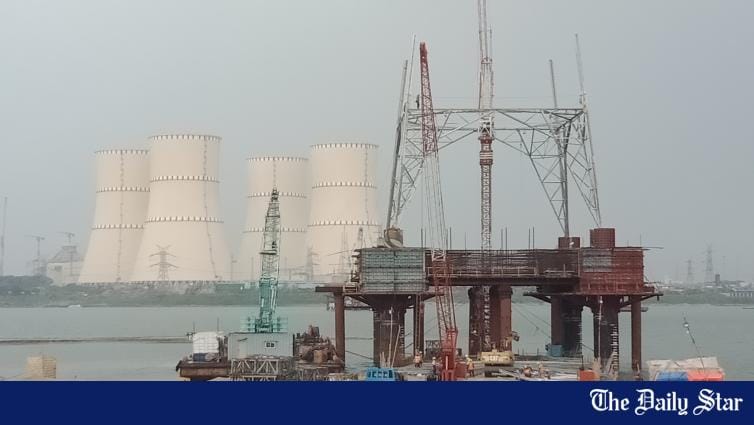
Photo of ongoing construction work with the Rooppur Nuclear Power Plant in the backdrop taken from Veramara point of the river Padma in the Kushtia side. Photo: Ahmed Humayun Kabir Topu/Star
The commissioning of Bangladesh's first-ever nuclear power plant at Rooppur faces delays due to incomplete gridline work, particularly the crucial 2-km stretch over the mighty Padma river.
The issue was highlighted during an International Atomic Energy Agency (IAEA) inspection in March, which identified 17 areas requiring updates to meet operational standards.
The inspection team identified 17 areas that need to be developed to meet the desired standards, including the completion of a 2-kilometre gridline over the Padma river for the operational phase of the first unit of the 2,400-megawatt nuclear power plant, according to a top official of the Rooppur Nuclear Power Plant (RNPP).
He said other notable areas needing updates include the internal fire extinguishing system and waste management inside the facility. The rest of the issues are not that serious and can easily be updated, he added.
"The recent visit of the IAEA's team has inspired us, as we have received directions to develop different sectors. We are working to complete the necessary tasks," Dr Zahedul Hasan, project director of the Rooppur Nuclear Power Plant, told The Daily Star.
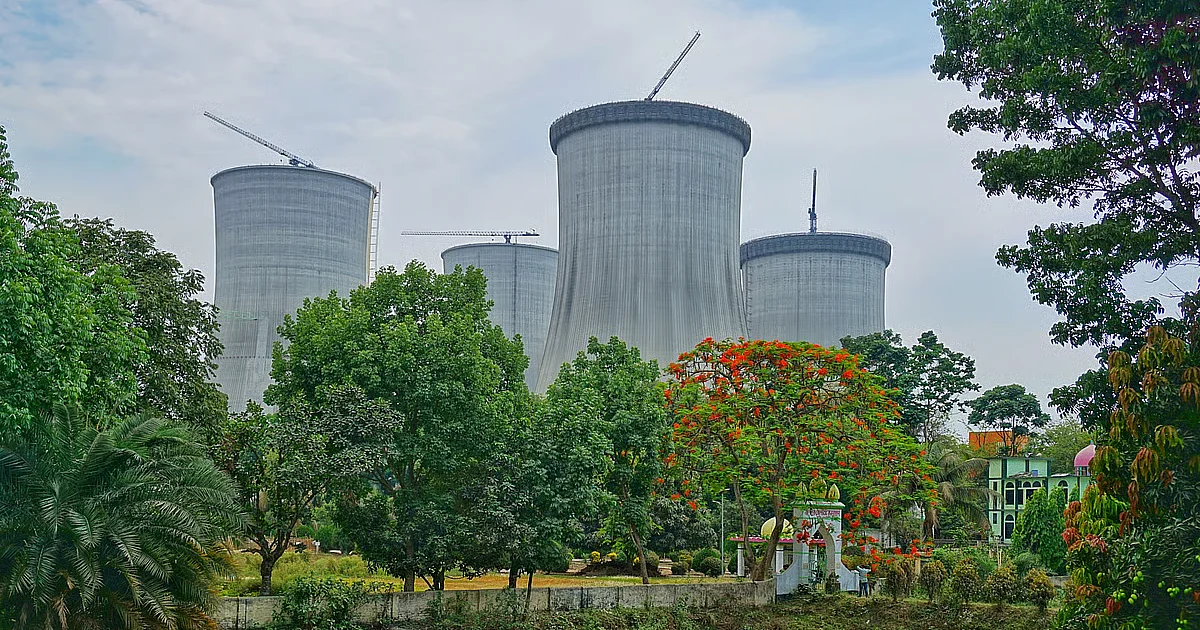
Photo: ROSATOM
He said the inspection team expressed satisfaction with 24 areas in their findings. However, for the commissioning of the first unit, completing the gridline work is a major task ahead.
"We need to complete the gridline work, including the 2-km river crossing line in the Padma, for the necessary tests for the physical start-up of Unit-1," said Dr Zahedul.
A total of 669 km of grid lines, including 16km of river crossing lines across both the Padma and Jamuna rivers, is required for power transmission to the national grid from the country's first nuclear power plant.
Line construction on plain land is almost complete, but major work on the river crossing lines over the Padma and Jamuna rivers has seen slow progress. Dr Hasan said 94 percent of the physical work of Unit-1 has already been completed.
Engineer Md Delwar Hossain, project director of the river crossing transmission line for the Rooppur project, said they expect to complete the Padma crossing line by May.
"Ninety percent of the work on the Padma has already been completed. We have completed piling work on two towers in the river, and construction on two towers on the banks of the river has started. We expect to complete the entire river crossing line within May," said Delwar.
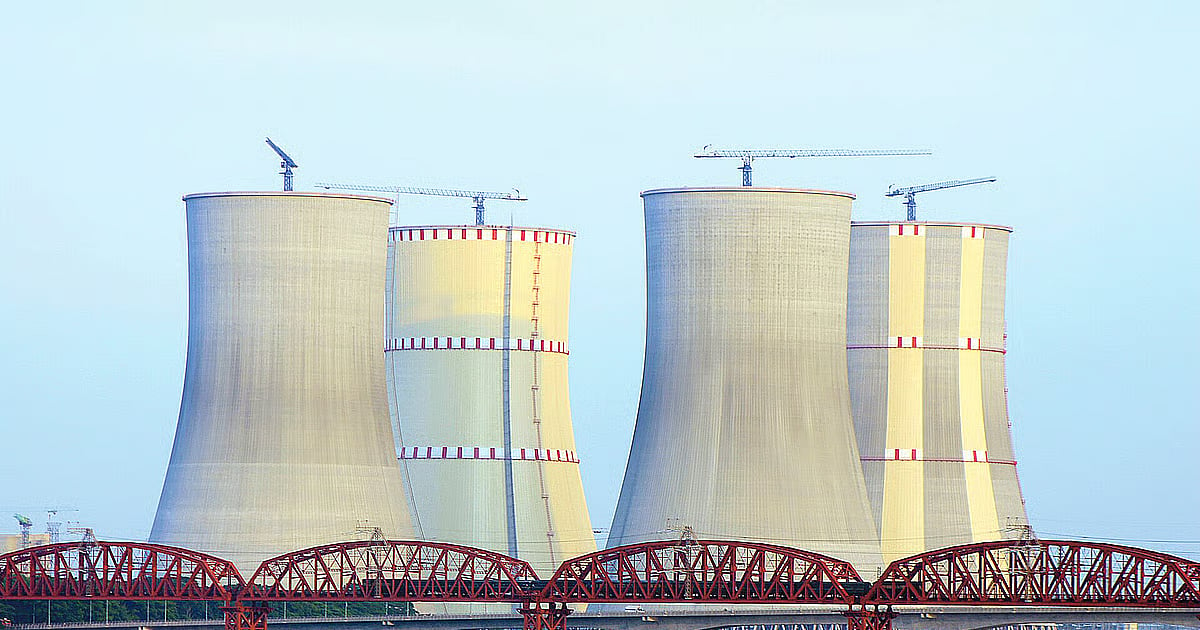
Photo: Ahmed Humayun Kabir Topu/Star
He said after completing the river crossing line, the Rooppur-Gopalganj grid line will be connected to the power plant.
He attributed delays in river-crossing gridline work to funding problems, lack of equipment support, and excessive flooding last year. However, the gridline work on plain land has already been completed.
"We are optimistic about finishing the 144km Rooppur-Gopalganj gridline work by May to June this year," said Delwar.
Dr Zahedul said the physical start-up and pre-inspection by the IAEA's Operational Safety Review Team (OSART) depend on completing the gridline.
The IAEA's OSART programme assists member states in strengthening the safety of their nuclear power plants during commissioning and operation by comparing actual practices with IAEA safety standards.
"If the gridline work is completed within June, we will need another three to four months to go for the physical start-up of Unit-1 in October," he said.
He said they would invite the OSART team for pre-inspection once the gridline is completed. "We are unable to fix an OSART pre-inspection team due to repeated delays in gridline work," said the RNPP project director.
He mentioned running a series of tests through the 400kV Bogura-Rooppur grid line to reach the physical start-up stage.
"Recently, we completed a test in the primary circuit of Unit-1 with 24.5-megapixel pressure. This is one of the biggest tests before the physical start-up of the plant," the project director added.
The 2,400MW power plant is being built in the Rooppur area of Pabna district for $12.65 billion, with Russia providing 90 percent of the project's funding as a loan.
Russian state-owned Rosatom is constructing the power plant with two VVER-1200 reactors, each having a capacity of 1,200 MW.
Construction of Unit-1 formally began on November 30, 2017, and Unit-2 on July 14, 2018.
According to the original project proposal, Unit-1 was to be operational by December 23, 2022, and Unit-2 by October 8, 2023, with the entire project scheduled for completion by December 31, 2025.
However, the project deadline was extended by two years, rescheduling the commissioning of Unit-1 to December 2024.
Dr Md Shafiqul Islam, professor in the Department of Nuclear Engineering at Dhaka University, said, "The project has been delayed due to several inter-related factors, including incomplete safety tests and compliance procedures required for power start-up, uncertainty regarding actual project costs impacting the finalization of the power purchase agreement, lack of necessary gridlines, the preparedness of certified reactor operators, and the absence of an established emergency preparedness and response centre."
He, however, expressed hope that all these issues would be resolved before the physical start-up.
The staff of the Bangladesh Atomic Energy Commission has not received salaries and other payments after February this year, apparently owing to some disagreement between the science and technology ministry and the commission over the method of fund disbursement...
www.newagebd.net
Salaries stalled for Atomic Energy Commission staff
Staff Correspondent 20 April, 2025, 23:39
The staff of the Bangladesh Atomic Energy Commission has not received salaries and other payments after February this year, apparently owing to some disagreement between the science and technology ministry and the commission over the method of fund disbursement.
Pensions have not been paid either to the retired officials of the agency during this time.
A high official of the commission, seeking anonymity, said that they last received salaries in February and had not received any salary or Eid bonus since then.
The official said that the Ministry of Science and Technology used to send the allocated budget to the commission’s account, through which salaries and pensions were disbursed.
The official said that the ministry now wanted to disburse the payments through the Integrated Budget and Accounting System (iBAS++) software, which the commission had not agreed to, leading the ministry to halt the release of funds.
The official also said that the ministry last released the allocated budget in December 2024, and employees were paid salaries of up to the month of February using the surplus funds.
The commission currently has 2,460 employees, including 600 scientists.
Besides, over 1,300 retirees are under its current payroll.
Commission chairman Md Quamrul Huda and science and technology ministry senior secretary Md Mokabbir Hossain could not be reached for comments.
The Bangladesh Atomic Energy Commission was established by the Presidential Order 15 of 1973 as a multidisciplinary research and development organisation.
They were relieved of their duties from 8 May. All of them, however, will receive the salary of three months as notice payment.
en.prothomalo.com
Rooppur Nuclear Power Plant project: 18 officials, employees dismissed
Correspondent Pabna
Published: 11 May 2025, 22: 30
Photo shows Rooppur Nuclear Power Plant File photo
Eighteen officials and employees of the under-construction Rooppur Nuclear Power Plant (RNPP) project in Pabna’s Ishwardi upazila were dismissed from their jobs and banned from entering the project area.
These staff were employed at the Nuclear Power Plant Company Bangladesh Limited (NPCBL).
The separate letters signed by NPCBL managing director Md Zahedul Hassan were issued on dismissal and ban on Thursday, while the officials and employees concerned received the letters on Saturday.
Rooppur Nuclear Power Plant project’s site in-charge Ruhul Kuddus confirmed the matter to Prothom Alo.
He said the issue was reported to the head of the project’s security agency, and declined to disclose further.
The dismissal letters stated that the NPCBL no longer requires their services. They were relieved of their duties from 8 May. All of them, however, will receive the salary of three months as notice payment.
The letter on the ban on entry to the project area said, “The 18 officials and employees are prohibited from entering the area of the under-construction Rooppur Nuclear Power Plant project and the residential area Green City for security reasons.”
They officials, who were dismissed are NPCBL’s deputy chief superintendent Md Hasan Ali, senior assistant managers Shahidul Islam, Abu Rayhan, Rafiqul Hasan, Joynal Hossain, Naeem Al Sakib, Abu Sayeed, AKM Abdullah Al Amin, Shah Ikhtiar Alam and Ibrahim Khalilullah, assistant managers Abdullah Al Noman, Asif Khan, Mohammad Imamul Arefin and Md Ikram, Md Ruhul Amin, sub-assistant managers Ismail Hossain and Rubel Hossain, and technician Firoz Ahmed.
The sacked officials claimed all of 18 are competent for jobs and 12 of them graduated from Bangladesh University of Engineering and Technology (BUET).
They further said all of them received various training in Russia for the nuclear power plant project. They were dismissed illegally because of protesting the arbitrary conduct of the company’s managing director. They demand restoration of their jobs or else they would seek legal action.
A dismissed engineer told Prothom Alo on condition of anonymity that any employee who raises demands is suppressed. Efforts were carried out to silence them and those who protested were selectively terminated. All of them were asked to leave the project’s residential area with their families within three days, putting them in severe problem.
When asked, NPCBL’s managing director Md Zahedul Hassan said that the decision on dismissal was made after investigating the matters thoroughly and following due process. These steps were taken for the sake of the company’s discipline and security.
Recently, NPCBL officers and employees had gone on protests for several days, pressing various demands, including the removal of managing director Zahedul Hassan. They held a human chain and press conference in Ishwardi town on 6 May 6 and organised a sit-in and protest at the project site on 7 May.
Speakers including activists, teachers and scientists said on Wednesday that the Bangladesh Atomic Energy Commission should be separated from the ministry of science and technology to avoid bureaucratic complexity and increase productivity and research...
www.newagebd.net
Atomic Energy Commission should be separated from ministry: discussion
Staff Correspondent 22 May, 2025, 00:48
Poet and author Farhad Mazhar addresses a discussion at the Bangladesh Atomic Energy Commission headquarters in Dhaka on Wednesday. | Press release
Speakers including activists, teachers and scientists said on Wednesday that the Bangladesh Atomic Energy Commission should be separated from the ministry of science and technology to avoid bureaucratic complexity and increase productivity and research.
They made the comment while speaking at a discussion titled Bangladeshe Paramanu Bigyan Gabeshanar Sambhabana, Sangkat O Uttaraner Upay.
The discussion was jointly organised by Bangladesh Sachetan Biggyani Samaj and BhavBoithoki at Dr Anwar Hossain Auditorium of the BAEC in the capital Dhaka.
Poet, writer and researcher Farhad Mazhar was present at the event as the key speaker while Dhaka University physics department professor Md Kamrul Hassan Mamun and Jahangirnagar University environmental sciences department professor Jamal Uddin spoke at the event.
Chief scientific officer of BAEC Sheikh Manjura Hoque presented her article on the topic while chief scientific officer ASM Saifullah delivered a welcome speech at the event.
Sheikh Manjura Hoque in her article addressed a seven-point crisis created by the ministry despite the BAEC being a corporate organisation.
She also placed their 11-point demand, including restoring autonomy of the commission.
Jamal Uddin said that although the BAEC was part of the Pakistan Atomic Energy Commission before the War of Independence, after forming of the BAEC, however, it had less productivity because the government had no interest in research while India and Pakistan improved a lot in atomic research.
‘As a nation we have become a broker because we prefer marketing to production and this is a political crisis,’ said Jamal Uddin who proposed that the BAEC should be separated from the ministry and accountable to the president.
Md Kamrul Hassan Mamun said that when a state did not have critical minds, its organisations fell apart.
‘A ministry cannot provide necessary support to research due to its bureaucratic complexity and power practice,’ Mamun said, adding that there was not any example of success of any organisation under any ministry in Bangladesh.
Farhad Mazhar said that the scientists of the BAEC could not create proper working space for them because of the lack of political consciousness.
‘We need to find the corruption of the Rooppur Nuclear Power Plant and the government must ensure the security of the people who can be affected by the nuclear dust,’ Farhad Mazhar said, adding that he supports the 11-point demand of the scientists of the BAEC.
The 400kV transmission line from Ruppur to Gopalganj has been successfully launched, marking a major milestone in integrating electricity from the Ruppur Nuclear Power Plant into Bangladesh's national grid. The 158-kilometre-long line, with 414 towers, was fully operational from 3:30 PM today. Thi
thefinancialexpress.com.bd
Ruppur-Gopalganj 400kV line fully operational
FE ONLINE DESK
Published :
Jun 02, 2025 22:37
Updated :
Jun 02, 2025 22:37
The 400kV transmission line from Ruppur to Gopalganj has been successfully launched, marking a major milestone in integrating electricity from the Ruppur Nuclear Power Plant into Bangladesh's national grid.
The 158-kilometre-long line, with 414 towers, was fully operational from 3:30 PM today. This line is the third and final major transmission route, each capable of handling 2,000 megawatts.
Earlier, the Ruppur-Baghabari 230kV line and Ruppur-Bogura 400kV line were activated in June 2022 and April 2024, respectively.
PGCB Executive Engineer Enayet Karim confirmed that the project was completed on 29 May, successfully achieving the goal of nuclear power transmission into the national grid.
Russia has yet to extend the timeline for its $11.38-billion loan utilisation for Bangladesh although the credit tenure already expired in December last, officials said Wednesday about a looming uncertainty surrounding the funding. About a year back, Dhaka had requested the Russian lender to exten
thefinancialexpress.com.bd
Russian funding of nuclear power plant
Moscow mum on extending $11.38b utilisation timeline
FHM Humayan Kabir
Published :
Jun 19, 2025 00:29
Updated :
Jun 19, 2025 00:29
Russia has yet to extend the timeline for its $11.38-billion loan utilisation for Bangladesh although the credit tenure already expired in December last, officials said Wednesday about a looming uncertainty surrounding the funding.
About a year back, Dhaka had requested the Russian lender to extend the loan-utilisation deadline by two more years as works for building the Rooppur nuclear power plant have yet to see the finishing line, they said.
The Economic Relations Division (ERD) had written to the Russian lender for time extension for the loan being utilised to construct the $12.65-billion-cost Roopur nuclear power plant in Pabna.
"We have already requested Russia for extending the deadline by at least two more years up to December 2026. We are hopeful of getting extension formally within a shorter possible time," said ERD Secretary Shahriar Kader Siddiki.
"Since we have completed all discussions with the development partner, we are expecting the loan extension shortly," he told the FE.
Bangladesh signed $11.38-billion-loan agreement with Russia in July 2016 for setting up the maiden nuclear power plant in the country to meet perennial electricity shortages.
Another $500 million worth of loan deal with Russia was signed in November 2013 for the feasibility study of the plant.
The 2400-megawatt nuclear power plant is being built with collaboration of the Russian state-owned atomic company Rosatom.
Some 90 per cent of the project is financed through the Russian loan, repayable within 30 years with a 10-year grace period up to June 2026.
Another ERD official says: "We've good negotiations with Russia regarding the loan-period extension. So, we are hopeful of getting the extension within his month for at least two years."
Asked about the unexplained delay, he said: "There were some reasons behind the delay. We had to go for negotiation with Russia over some extra charges, proposed by Moscow for Dhaka's loan-utilisation delays. Dhaka declined to pay that extra charges. Finally, the lender agreed to scrap their extra charges."
He added: "Since all the settlements have been done in the negotiation meeting, we are expecting the loan-utilisation deadline extended for at least two more years up to December 2026."
According to the draft protocol sent by Russia, the loan tenure, originally set from 2017 to Dec 2024, will be extended by two years as Bangladesh could not complete the project on time.
During a meeting with Chief Adviser of the current interim government Prof Muhammad Yunus on February 26 this year, Rosatom Director-General Alexey Likhachev agreed to amend the Intergovernmental Credit Agreement.
The 10-year grace period would expire in June 2027 and then the Bangladesh government will have to pay back the principal and also pay the interest.
During this grace period between FY2017 and FY2027, Bangladesh needs to pay the interest on the loan only.
Meanwhile, the government has also requested the repayment of the principal and interest to be started from March 2029.
The first installment of the principal amount of the country's largest-ever foreign loan is slated for payment on 15 March 2027. But the government now seeks this cut-off time to be extended up to March 15, 2029.
According to the $11.38-billion-loan deal, Bangladesh will have to repay the loan at LIBOR-plus 1.0 to 3.0 per cent rate. But the interest rate will not exceed 4.0 per cent.
Besides, a commitment fee of 0.5 per cent on the unutilised loan amount, capped at $0.25 million annually, with payments required in the first quarter of the subsequent year.
Officials from both the ERD and the Ministry of Science and Technology have said some factors, including the Covid-19 pandemic, prevailing global conditions, international sanctions impacting the transportation of equipment and goods for Russian organisations, and the sluggish pace of the power-transmission lines' construction, have led to the delays in completing the project.
The wait for the Rooppur Nuclear Power Plant to begin supply gets extended even further. Although the transmission lines have been completed, the Rooppur Nuclear Power Plant will not be connected to the national grid just yet.
en.prothomalo.com
Rooppur Nuclear Power Plant: Further delay in supply
First unit may begin supplying power next year as contractor given two year extension.
MohiuddinDhaka
Published: 04 Jul 2025, 19: 44
Rooppur Nuclear Power PlantFile Photo
The wait for the Rooppur Nuclear Power Plant (RNPP) to begin supply gets extended even further. Although the transmission lines have been completed, the Rooppur Nuclear Power Plant will not be connected to the national grid just yet. The Russian contractor has been given an extension of two years as the work did not finish according to the plan.
Officials concerned say that the deadline had to be extended as the work could not be completed within the initially agreed period. A decision to extend the deadline was made in February last year.
Under the original agreement, the deadline for the first unit was set for October 2023, and for the second unit it was set for October 2024.
Under the new agreement, the deadline for the completion of the construction of the first unit has been set for December 2026 and deadline for the second one is set for December 2027. The Bangladesh Atomic Energy Commission signed the revised contract with the Russian contractor on 20 June.
Officials involved in the project say that the delay was caused by several factors, including the Covid-19 pandemic, the ongoing Russia-Ukraine war, foreign experts’ travel complications, and delays in equipment delivery.
The Bangladesh government is required to pay 10 per cent of the money allocated for project expense annually, but that too could not be paid regularly due to a crisis of foreign currency.
The Rooppur Nuclear Power Plant is the largest single infrastructure project in the country’s history. It is being implemented by the Bangladesh Atomic Energy Commission under the authority of the Ministry of Science and Technology.
Built with Russian financial and technical assistance, this power plant being constructed at Ishwardi upazila of Pabna is consisted of two units, each with a power generation capacity of 1,200 megawatts.
The estimated project cost is around Tk 1.14 trillion (Tk 114,000 crore). Atomstroyexport, a subsidiary of Russia’s state-owned nuclear agency Rosatom is the main contractor on this project.
There has been no recent delay. The project is now progressing as usual. The delays occurred in the past due to the pandemic and the war. So, the contractor has had an extension. Hopefully, power generation will begin in phases from next year-----Md Kabir Hossain, project director.
There’s a joint coordination committee formed by Russia and Bangladesh to determine policy decisions in the project. During a meeting of that committee held in Dhaka last year, a decision was made to extend the project deadline by two years. However, it took time to finalise the agreement.
According to sources at the Bangladesh Atomic Energy Commission, the Ministry of Science and Technology initially approved a one-and-a-half-year extension. But the contractor did not agree to this. Later, the ministry extended it by six more months, setting the new deadline for June 2027.
The contractor, however, stated, from a technical standpoint it is not possible in any way to complete the project by June next year.
Although the contract allows for an extension of time, the contractor is not permitted to increase the overall project cost. People involved in the project say that the plant is not yet generating any revenue as it did not go into production in time. As a result, the government is forced to bear the operational expenses, which will eventually increase the overall cost of electricity production.
A source involved in the project mentioned that the pace of work at Rooppur slowed down a bit following the political shift in the country last August. They have to wait until December to load nuclear fuel into the reactor vessel. The trial production will begin only after that.
Project director Md Kabir Hossain told Prothom Alo, “There has been no recent delay. The project is now progressing as usual. The delays occurred in the past due to the pandemic and the war. So, the contractor has had an extension. Hopefully, power generation will begin in phases from next year.”
The initial plan was to begin production from the first unit of the nuclear power plant in December 2023. Later it was pushed back to December 2024. The work of the transmission line not being complete was presented as the excuse for that.
However, the state-owned Power Grid Bangladesh opened the transmission line for connecting the RNPP to the national grid on this 2 June. After that, it was announced that trial production would begin within two to three months. Lastly, it was stated that power generation could start in October this year.
A source involved in the project mentioned that the pace of work at Rooppur slowed down a bit following the political shift in the country last August. They have to wait until December to load nuclear fuel into the reactor vessel. The trial production will begin only after that.
According to experts, once the nuclear fuel is loaded into the reactor vessel, the trial production will continue for at least six months. All the tests have to be conducted and international approvals have to be collected in phases during this time. So, there is not much possibility of starting commercial production before June next year.
Professor Shafiqul Islam of the Department of Nuclear Engineering at the University of Dhaka told Prothom Alo that mentioning the grid issues was merely an excuse. An alternative grid setup for trial production had already been prepared. In reality, the Rooppur power plant was not ready.
Stating that if the plant had gone into production on time, pressure on fuel imports for oil-based power plants would have been reduced, he further said that with the delay in the project, the cost of maintaining manpower is going up.
If it takes more than 10 years to implement this project, the cost of electricity generation will rise significantly, Shafiqul Islam added.

 Bangladesh Defense