☕ Support Us
[🇧🇩] - Banking System in Bangladesh | Page 25 | PKDefense

[🇧🇩] Banking System in Bangladesh

Reply (Scroll)
Press space to scroll through posts
G Bangladesh Defense
[🇧🇩] Banking System in Bangladesh
244
8K
More threads by Saif


Banking in the 2030s

1765328890742.webp


Banking is going through a rapid global transformation unlike anything seen before. Large international banks are shifting from retail banking to wealth management. In recent years, large global banks such as Citi and HSBC have exited retail banking in many markets and focused instead on wealth management and private banking in major wealth hubs, including Hong Kong, Singapore, the UAE, the UK and the US.

Their attention is now on clients at the top tier of the wealth pyramid, offering curated services such as wealth and investment advice and legacy planning. These are delivered through experienced bankers and mobile apps. They are also earning higher fee income by acting as sales agents for structured investment products issued by other banks and financial institutions. Although banks hold vast amounts of data on consumer spending patterns, they rarely use this data to offer tailored solutions. This remains a clear opportunity for banks to differentiate themselves by personalising services based on client spending behaviour.

Global banks are also moving into the field of digital currencies. Domestic payments in most countries are already digital to varying degrees. The challenge lies in cross-border payments, which are affected by differing regulations and time zones. Tokenised money could reshape this space, whether through central bank digital currencies, stablecoins, or bank-issued tokenised deposits. This presents an opportunity for our central bank and local banks to work with counterparts abroad to speed up the inflow of remittances.

The UAE recently introduced the "Jisr" platform, bringing together Emirati and Chinese banks to carry out the first cross-border payment between the UAE and China using digital currencies issued by central banks. As the UAE is one of the largest sources of remittances for Bangladesh, this is a significant opportunity. Interlinking instant payment systems across borders, as the UAE has done with China, could transform cross-border transfers.

Global banks are already deploying generative AI and investing in agentic AI. Many banking processes remain highly manual despite years of technology investment. Client onboarding and AML or KYC checks are examples. AI can pre-fill account opening forms, and clients can complete the rest on their device. Connectivity with NID and NBR servers can allow real-time identity verification and automated collection of tax documents.

Credit appraisal and portfolio reviews are also heavily manual. With AI, banks can automate credit scoring for retail and small business clients. Instead of rushing to assess portfolios during adverse or black swan events, banks can use AI to receive early warnings about deteriorating conditions in a client's environment. Another potential area is sales and client relationship management. While many banks use CRM platforms to track clients, AI can enhance this data by identifying cross-selling opportunities and highlighting promising prospective clients.

In future, clients will rely on their own AI agents to engage with banks and support financial and investment decisions. Banks that prepare for these emerging global trends and invest in them now will lead the market in the next decade.

The writer worked as a senior executive at global banks in Bangladesh and Singapore​
 

How banks could facilitate everyone

Mukshadur Rahman
Published :
Dec 10, 2025 23:02
Updated :
Dec 10, 2025 23:02

1765416018046.webp


When Rubel (pseudonym), a small supplier in Gazipur, went to a commercial bank last month to ask for a small loan, the credit officer shook his head. ''We aren't approving any new loan proposal until the bank manages its bad loans,'' the officer said. Rubel is not alone in this. Bangladesh's banking sector, in recent months, has sent the same message to thousands of entrepreneurs throughout the country. In a country where 85 per cent of business financing flows through banking channels, this message has far more serious consequences beyond Rubel's distress. The cost of this grim reality is already visible through shuttered factories, the agony of unpaid workers and the confusion of jittery depositors.

In the country's banking sector, straight forwardness and honesty were systematically discouraged and ignored, while compliance with power rather than prudence was rewarded. Weak governance, coupled with political interference, eventually bends the system and drastically reduces naturally expected outcomes from the economy. Ignoring the social and economic parameters, the previous government focused on inflated accounting figures and remained self-content until they couldn't anymore. That's the danger of it - the more you hide, the worse it becomes. Especially for banks, this is the grim reality.

Skyrocketing non-performing loans (NPLs) have left the banks with strained balance sheets and very limited room for lending, especially to new entrepreneurs. The central bank, however, shows greater courage in making decisions on a scale never seen before. Several private Islamic banks faced an acute liquidity crisis due to poor governance and inadequate monitoring, prompting Bangladesh Bank to step in and consolidate them into a single entity, the Sammilito Islami Bank. However, with a very optimistic outlook, some analysts say that even if everything runs smoothly and a 15 per cent compound annual growth rate (CAGR) is ensured, it will take at least 40 years for the entity to reach break-even, given its colossal bad loans and enormous liabilities. I asked AI for the worst-case scenario, providing all the data I had on the five merged banks. The responses from different AI tools were largely the same. It could take 645 years or more to cover the shortfall.

Apparently, a merger is not a magic wand; it only gathers problems into one container. It is more of a symptom than a cure for the systemic organ failure the economy is facing today. Sammilito Islami Bank will warrant deeper institutional and policy-level reform along with cautious monitoring. Even after that, regaining people's trust will remain challenging for a long time. Then there comes the real question - is it possible to break or at least weaken the chain of corruption, nepotism, and the practice of compromised ethics in the sector?

The Basel framework and other regulatory guidelines have been ignored for years. Minimum capital and liquidity requirements, exposure limit, and mandatory information disclosure have been disregarded. As time elapses, these malpractices and conditions have created a black hole of obvious catastrophe. Although they are the only type of institution that can benefit both borrowers and lenders while still making a profit, they thrive in the market. The beautiful financial alchemy of the banks can surely improve society, uplift overall growth, and ensure sustainability.

The core essence of this alchemy is distributing risk in many baskets rather than concentrating it in one or a few. Small loans can create a large portfolio for banks and reduce risk. However, most of our banks tend to lend money to large corporate parties, as it requires fewer human resources and reduces costs in many other ways. Collecting deposits from millions of ordinary people immediately creates huge liability. Lending the hard-earned income of people to a single or a few parties is simply gambling with people's trust. It's true that large loan disbursement is required for economic development. However, small and medium lending can't be overlooked, as it helps small and medium enterprises flourish and distribute risks among many. It ensures the flow of funds in various sectors, safe and sustainable investment, and regulatory safeguards. In this way, the bank becomes a collective shield where everyone contributes, and everyone benefits. No single entity/person carries the full burden of uncertainty.

In Bangladesh, the aforesaid possibilities fade away amid political affiliation, insider lending, corruption, and nepotism. In banks, boards often represent the sponsor's interests rather than those of depositors. The recent collapse in the banking sector indicates three major flaws, including bad loans, weak oversight, and incentives that encourage risk without consequences, or in simple terms, moral hazard.

However, a ray of hope is emerging on the horizon as the Bangladesh Bank is adopting bold measures and policy-level decisions to rebuild trust and create a banking sector that fosters the nation's growth and prosperity. Before that happens, several non-negotiable things need to be addressed. The central bank should be truly independent. All banks must undergo internationally verifiable audits, and the reports must be published in a timely manner. Depositor's protection should be further strengthened by timely laws and robust policies. SME financing should be expanded, and all banks must comply with regulatory requirements on capital adequacy, liquidity, and sector-wise loan disbursement.

The reform will be difficult, as there will be resistance from the groups that benefit from the current chaos. There will also be legal and policy-level challenges, along with the uncomfortable truth disclosure. However, the slow and painful erosion of credibility in the sector will be far worse. The reform has been started, and it must be continued. Once we get it right, the banks will facilitate everyone - the borrower, the lender, the entrepreneur, the farmer, the dreamer, and, of course, the banking sector itself.

The writer is Management Trainee Officer, Mercantile Bank PLC.​
 

PRI hosts roundtable on baking sector

Published :
Dec 11, 2025 18:43
Updated :
Dec 11, 2025 18:43

1765586488882.webp


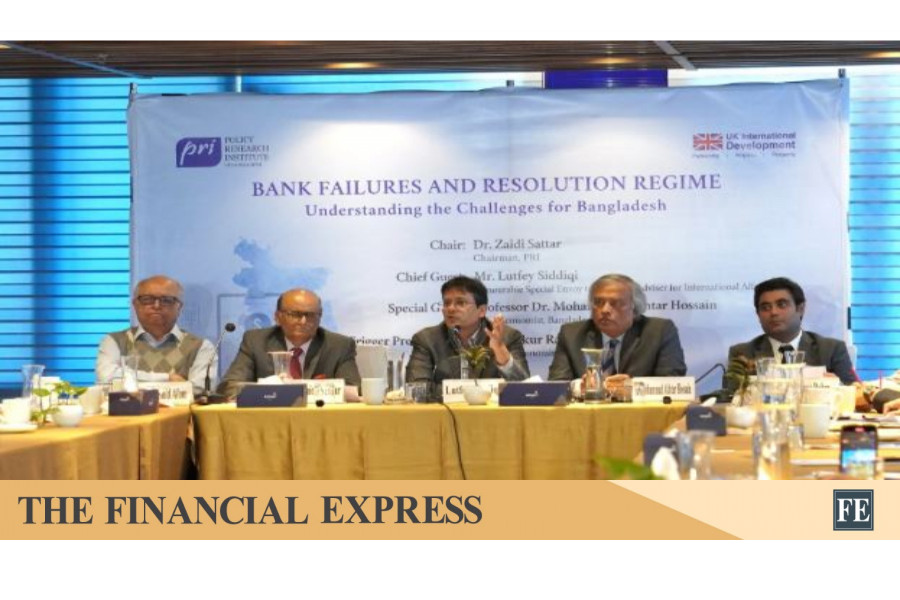
The Policy Research Institute of Bangladesh (PRI), with support from the Foreign, Commonwealth & Development Office (FCDO), successfully hosted a high-level roundtable discussion today titled "Bank Failures and Resolution Regime: Understanding the Challenges for Bangladesh" at a hotel in the capital.

Lutfey Siddiqi, Special Envoy to the Chief Adviser on International Affairs, attended the event as the chief guest, BSS reports.

Emphasizing the urgency of reform, Lutfey Siddiqi stated, "If the banking sector continues with business as usual, nothing will change. Ensuring good governance-regardless of which political party forms the government-is essential."

A trigger presentation was delivered by Dr. Ashikur Rahman, Principal Economist at PRI, who mentioned, "Passing the Banking Resolution Ordinance is only half the job. What must follow now is a serious investment in the processes, systems, and institutional capacities that will allow Bangladesh Bank and the financial sector to actually implement the resolution regime."

He said without the ability to execute orderly resolutions, manage failing banks efficiently, and protect depositors while minimising systemic risks, the Ordinance will remain a promise on paper.

He also said the real task ahead is building the operational muscle, supervisory tools, valuation expertise, recovery mechanisms, and clear decision protocols that can restore confidence and inject new energy into Bangladesh's financial system, said a press release.

"Only then will the Ordinance achieve its purpose: safeguarding stability and laying the foundation for a stronger, more resilient banking sector," Ashikur added.

Dr. Zaidi Sattar, Chairman of PRI, chaired the event. In his remarks, he said, "The recent rise of non-performing loans to nearly 35 percent is unprecedented... requires careful analytical inquiry into how we arrived at this point,"

He said Bangladesh presents a uniquely challenging context, much like its distinctive trade policy landscape, and therefore demands its own framework for banking sector resolution.

He said the encouraging sign is that the hemorrhage within the sector has stopped, and the banking sector is seeing some light again.

"I'm hoping that the projection about growth of about 5% in the next year is likely to take place. Hope, I'm assuming that we have a nice, free, and fair election in February 2026 that would be a great gift to this nation by the Interim government, I think. And we all look forward to an elected government which also manages economic policy the way we expect it to."

Mohammad Zahir Hussain, Executive Director, Bank Resolution Department, Bangladesh Bank, and Professor Dr. Mohammad Akhtar Hossain, Chief Economist at Bangladesh Bank, attended as special guests.

Dr. Akhtar said, "Our FDI-to-GDP ratio is already very low, and the combination of high NPLs and ongoing political uncertainty is making it extremely difficult to attract foreign direct investment."

The open-floor discussion allowed participants to exchange insights on priority reforms, including the need for legislative updates, strengthened deposit protection mechanisms, and enhanced crisis preparedness.

As part of PRI's ongoing efforts to promote informed policy dialogue, the session brought together policymakers, financial sector experts, business leaders, and development partners to deliberate on the urgent need for a robust and credible bank resolution framework in Bangladesh-a key pillar for ensuring macroeconomic and financial stability in the face of rising vulnerabilities in the banking sector.​
 

Healing the banks through Truth Commission

Published :
Dec 13, 2025 23:15
Updated :
Dec 13, 2025 23:26

1765673016454.webp


Nations emerging from prolonged misrule often find that their financial system has been hollowed out far more deeply than meets the eye, eroded by years of politically motivated lending, normalisation of misconduct and weak regulation. Bangladesh today faces precisely such a reckoning, with non-performing loans reaching an astonishing Tk 6445.15 billion equivalent to nearly 36 per cent of total banking credit and the highest default ratio in over two decades. Against this backdrop, the proposal by special envoy Lutfey Siddiqi to establish a Truth and Reconciliation Commission dedicated to economic crimes warrants serious consideration. While still at the conceptual stage, such a mechanism could go beyond routine regulatory enforcement to recover a portion of non-performing loans and lost public money and prevent their recurrence.

Indeed, the scale of financial plunder that has hit Bangladesh's banking sector is unlike anything the country has seen before. State-owned banks, private banks and even Islami Shariah-based lenders all became channels for large-scale theft. Borrowers with political connections took out loans worth billions of taka with no intention of repayment, treating public money as their own. Forged property documents, inflated project costs and fictitious import-export deals served as routine collateral, while regulatory approvals arrived with suspicious speed. The worst cases saw the capture of several banks' governing boards to help approve fake loans and the subsequent laundering of funds through trade misinvoicing. By the time the previous autocratic government fell, 10 banks accounted for more than 70 per cent of total non-performing loans of the country, with their balance sheets almost ruined beyond repair. The central bank, stripped of true autonomy for years, had no choice but to merge five of them into one, a desperate move aimed more at stopping panic among depositors than at true recovery. Given the level of damage, it makes sense for the government to seriously consider extraordinary measures like a truth and reconciliation commission to maximise the chances of recovering defaulted loans and stolen funds.

There is, in fact, precedence for such a mechanism in Bangladesh. During the tenure of Caretaker Government in 2008, a Truth and Accountability Commission was established with the power to grant immunity in exchange for confession and voluntary surrender of illicit wealth. In its brief existence, hundreds of individuals came forward and deposited Tk 340 million into the state treasury before the High Court declared the commission unconstitutional. A carefully designed Truth and Reconciliation Commission today could build on that experience, offering wrongdoers a structured path to admit their crimes, return stolen assets and receive limited immunity. The commission could also be vested with strong investigative powers to document exactly how the plunder of banks occurred, who enabled it and which regulatory gaps must be permanently closed.

While a commission could theoretically aid in recovering some non-performing loans, time is the one resource this interim government lacks to initiate and operationalise it. With national elections and a constitutional reform referendum scheduled for 12 February, fewer than 60 days remain in its tenure. Establishing a credible, legally robust commission cannot be meaningfully accomplished in such a compressed window, however sincere the intent. Moreover, any arrangement that appears to let major defaulters escape accountability after a simple confession and partial repayment risks being seen as amnesty in disguise, further eroding public trust. That said, the core idea remains powerfully relevant. Truth, transparently established and followed by proportionate restitution and reform, can restore confidence and attract far more investment than any short-term fiscal patch. The incoming elected government, enjoying a full five-year term and a popular mandate, will be far better placed to champion such a commission as part of comprehensive efforts to recover the banking sector and revive the economy.​
 

Responsible banking

1765675416963.webp


The tragic incident at a commercial bank's branch on the outskirts of Dhaka in 2015, where the branch manager was shot dead alongside several colleagues and clients, still lingers painfully in my mind. In the days that followed, many commented, almost casually, that the young man had acted foolishly. They argued he should have handed over the keys to the armed miscreants and saved his life, as well as the lives of those around him. This judgement, made from the safety of distance, misses a deeper truth about the mindset and ethos of many young bankers.

The manager was at the beginning of his career. For him, the bank was not just an employer; it was an institution he had sworn to protect. Safeguarding the bank's assets, including premises, vaults and client deposits, was part of the trust placed upon him. This sense of duty, though tragically costly, sprang from professional loyalty and an instinctive adherence to responsibility. Many who have worked in banks will recognise this impulse. In moments of crisis, young executives often revert to what they believe their institution expects of them.

This story returned to me when I read headlines accusing banks of "unnecessarily keeping their staff late." The portrayal is simplistic and unfair. Having spent decades around bankers, I must say no, this narrative does not capture the true culture of our institutions. Bankers do not operate in isolation. They work in an environment driven by customer demands, regulatory expectations and market realities.

Inside a bank, people often treat one another like extended family. They step in for each other, provide support when workloads intensify and stay late not because a manager insists, but because the work demands closure. Branch operations, reconciliations, compliance updates, trade documentation and customer service issues do not conveniently end at 5 pm. Banking is not a nine-to-five profession. It is a service industry where client needs dictate the rhythm.

Textbooks remind us that a bank's core functions include financial intermediation, maturity transformation, efficient credit allocation and payment facilitation. These functions are critical to economic stability, and their execution requires precision, diligence and accountability. Behind every loan approval, every trade transaction and every payment settlement, there are teams ensuring compliance, accuracy and risk mitigation.

In carrying out these functions, banks must comply with laws, regulations and central bank guidelines. They must uphold fairness and transparency while balancing the interests of shareholders, depositors, employees and broader stakeholders. This balancing act, complex and ever evolving, requires conscientious professionals who understand not only the rules but the spirit of responsible banking.

Critics often judge the sector through isolated incidents. Those who observe banking closely know that a bank's strength is built on thousands of daily acts performed quietly by people whose names rarely make headlines. They reconcile accounts late, verify transactions to prevent fraud, manage liquidity exposure and ensure payments move across the economy. Their work may be unglamorous, but its impact is systemic.

This duty must sit alongside the need for robust governance. Regulators, auditors and bank boards must maintain a strong firewall to deter malfeasance and protect depositors. Supervision should be proactive, not merely reactive. Capacity building, transparent inspections and strict post-retirement cooling-off rules would help reduce conflicts of interest. Ethical conduct, combined with sound supervision, reinforces public confidence and ensures banks serve the economy without succumbing to short-term pressure or quick gains.

The branch manager embodied that sense of responsibility, perhaps to an extreme and perhaps beyond what training manuals prescribe, but undeniably with sincerity. His story reminds us that banking is not merely about counting money or processing transactions. It is about trust, discipline and extra mile service. It is about individuals who carry institutional reputation on their shoulders, not merely public relations or awards.

As we reflect on such incidents, let us avoid easy judgments. Acknowledge the pressure and expectations that define bankers' lives. Recognise the unseen dedication that keeps the financial system functioning each day. Above all, remember the human cost behind the word "responsibility", a word that defines the banking profession more than any headline ever could.

The writer is a banker and chairman at Financial Excellence Ltd​
 

Members Online

Latest Posts

Latest Posts