Home Watch Videos Wars Movies Login

[🇧🇩] Banking System in Bangladesh

Latest Posts Countries Wars Q&A

[🇧🇩] Banking System in Bangladesh
285
9K
More threads by Saif

G Bangladesh Defense
Bank sector fragility persists amid trust deficit

Mostafizur Rahman 04 January, 2026, 23:52

1767577882426.webp

The country’s banking sector passed 2025 in a fragile state amid depositors’ worries, a record amount of non-performing loans, poor business condition, a crisis-induced merger and a partial overhaul.

While the sector did not collapse, it survived largely on government support and assurances rather than restored confidence of depositors in the just concluded year, experts said.


The year stripped away long-held illusions about banks’ asset quality and governance, but failed to deliver a clear recovery from the damage inflicted on the sector during the Awami League regime which was ousted on August 5, 2024, in the wake of a mass uprising, they said.

Stress was visible from the very beginning of the year. Several banks struggled with acute cash shortages, and customers were unable to withdraw more than a negligible amount a day, despite urgent personal needs.

Small-scale depositors, retirees and pensioners bore the brunt of the disruption.

Mustafa K Mujeri, executive director at the Institute for Inclusive Finance and Development, said that the banking sector continued to suffer from a confidence crisis because many depositors were still unable to access their own money.

He warned that a prolonged trust deficit could place additional strain on the entire financial system.

Syed Mahbubur Rahman, managing director and chief executive officer of Mutual Trust Bank PLC, said that the banking sector managed to survive in 2025.

Mujeri observed that despite bold announcements, the past year delivered little meaningful reform or recovery.

While a few banks appeared relatively stable, he said, most lenders remained weak and burdened by unresolved problems.

According to him, the interim government, which assumed power after the AL regime fall, had a rare opportunity to revive the sector, but largely failed to do so, as its actions exposed corruption, but the root causes of malpractices remained unaddressed.


Mujeri also questioned the decision to merge five crisis-hit Islamic banks into a new state-run institution, noting that state-owned banks themselves were struggling with governance and efficiency issues.

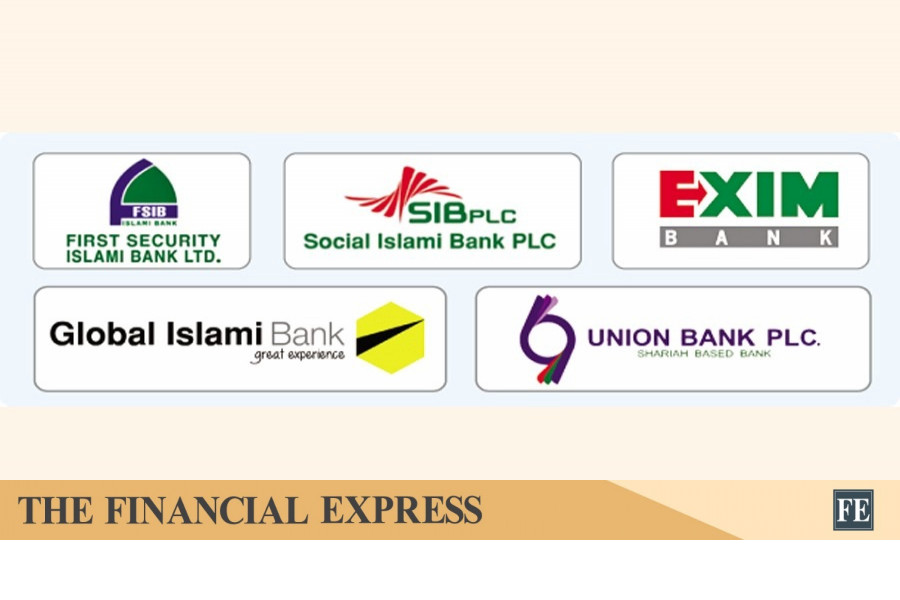
First Security Islami Bank, Global Islami Bank, Social Islami Bank, EXIM Bank and Union Bank merged into Sammilito Islami Bank.

Mujeri said that there was no clear indication that the newly formed would perform better than the existing public sector banks.

As long-hidden defaulted loans began to surface after August 2024, the amount of non-performing loans of the banking sector reached Tk 6.44 lakh crore in September 2025, accounting for nearly 36 per cent of the total outstanding credit.

Distress was no longer confined to a handful of weak lenders. More than a dozen banks reported default ratios exceeding 50 per cent, signalling systemic failure rather than isolated mismanagement.

Large corporate groups accounted for a substantial share of fresh defaulted loans.

Bangladesh Bank officials said that many toxic loans had remained hidden under regulatory forbearance during the previous government.

Asset quality reviews initiated in the past year exposed how deeply loan irregularities had penetrated bank balance sheets.

Mahbubur pointed to the sharp rise in bad loans, a collapse in private sector credit growth and a widening fiscal deficit that pushed the government to borrow heavily from banks.

That borrowing drove up treasury bill yields and tightened liquidity across the system, he said.

The banker said that depositor confidence suffered badly as customers failed to withdraw funds when they needed them most.

He added that uncertainty over whether bank mergers would actually protect depositors continued to weigh on their sentiment.

Mahbubur said that business conditions did not improve due to political unrest and weak law and order, which continued to weigh on banking activities.

While the BB initiated some reforms, including board restructuring at several banks, he said that they took a little action against previous board members and officials responsible for the crisis.

He acknowledged some improvement in the balance of payments, supported by higher remittance inflows and foreign exchange reserves.

However, he said, recovery will take time and depend heavily on whether the next government carries forward reforms with consistency.


Policy continuity, he added, is essential to restore trust in the banking sector.

Experts said that macroeconomic conditions compounded banking stress as inflation eased slightly but stayed close to 8 per cent throughout the year, well above the central bank’s comfort range.

At the same time, the private sector credit growth fell to historic lows as banks tightened lending standards.

The policy rate remained at 10 per cent, pushing lending rates to about 14 per cent and discouraging new investments.

With borrowing costs elevated, political uncertainty lingering and law and order concerns persisting, business activity remained subdued, limiting banks’ ability to rebuild healthy loan portfolios.

Sammilito Islami Bank PLC, which was created through the merger of five crisis-hit Shariah banks, received licence on October 30, 2025.

The bank has Tk 35,000 crore in paid-up capital, including Tk 20,000 crore from the government.

The BB declared that shareholders of these banks would not receive any compensation as their asset values turned negative.

The government strengthened the legal framework by enacting the Bank Resolution Ordinance 2025, which empowers the Bangladesh Bank to intervene in failing banks and impose losses on shareholders.

The central bank updated loan classification rules, began comprehensive asset quality reviews and prepared to shift towards risk-based supervision from January 2026.

In November 2025, the Deposit Protection Ordinance doubled insured deposits to Tk 2 lakh, covering roughly 93 per cent of depositors.

However, the implementation of payout mechanisms remained slow, limiting the immediate confidence boost.

BB governor Ahsan H Mansur also initiated steps to amend the Bangladesh Bank Order 1972 to enhance central bank’s autonomy and reduce political influence, including removing bureaucrats from the board.

But the order is yet to be passed.

Draft amendments to the Bank Company Act, aimed at tightening eligibility for becoming bank owners and directors, were prepared but deferred as the country has entered an election cycle with the 13th parliamentary polls scheduled for February 12.

Crackdowns on illegal money transfer channels helped stabilise the exchange rate at about Tk 122 a dollar.

Record $32 billion remittances and rising foreign exchange reserves, which reached $33 billion by the end of 2025, eased pressure on the balance of payments and supported the overall financial stability in the past year.​
 

Analyze Post

Add your ideas here:
Highlight Cite Respond
Bangladesh Bank moves to liquidate nine NBFIs amid financial sector reforms

UNB
Published :
Jan 06, 2026 20:48
Updated :
Jan 06, 2026 20:48

1767746209839.webp

Bangladesh Bank is set to initiate the liquidation of nine non-bank financial institutions (NBFIs) following the consolidation of five troubled Shariah banks into a single entity, marking a major step in the central bank’s efforts to reform the country’s financial sector.

Governor Ahsan H Mansur told reporters on Monday that the institutions will be declared ‘non-viable’ within the week, after which a forensic audit will determine their actual financial position and net asset value (NAV).

“The extent of the institutions’ negative asset position cannot be confirmed until the audit is complete,” Mansur said, adding that further measures will be taken once the reports are received.

The central bank is also preparing to reduce shareholders’ stakes in the nine NBFIs to zero, following their failure to return depositors’ funds.

The nine institutions facing potential license cancellations are People’s Leasing, International Leasing, Bangladesh Industrial Finance Company (BIFC), FAS Finance, Aviva Finance, Far East Finance, GSP Finance, Prime Finance and Premier Leasing.

Mansur said the decision reflects long-standing irregularities and weak liability management, emphasising that protecting depositors and restoring sectoral discipline are the central objectives.

A substantial portion of the crisis in these institutions stems from past corruption, particularly under the previous administration.

Four of the companies were reportedly linked to financier Prashant Kumar (PK) Halder, while another is associated with the S. Alam Group.

The total deposits trapped in the nine institutions amount to Tk 15,370 crore, with Tk 3,525 crore held by small depositors and Tk 11,845 crore by institutional and corporate clients.

To safeguard small depositors, Bangladesh Bank has requested Tk 5,000 crore from the government for claim settlements. People’s Leasing accounts for the largest volume of individual deposits at Tk 1,405 crore.

To prevent future crises, the central bank has established a Banking Resolution Division tasked with making swift intervention decisions when financial institutions weaken. While the current process involves five banks and these nine NBFIs, Mansur indicated that additional institutions could be brought under this framework if needed.

Analysts have described the move as a necessary, albeit difficult, step toward greater transparency and long-term stability in Bangladesh’s financial landscape.​
 
Analyze

Analyze Post

Add your ideas here:
Highlight Cite Respond
Why we need microcredit banks
1767747730137.webp

VISUAL: ALIZA RAHMAN
"Financial inclusion" has been a buzzword in Bangladesh for many years. It has been used to justify the increase in the number of banks in the country, as many—primarily the poor—still do not have bank accounts.


At present, there are 62 banks in Bangladesh. Despite the large number of banks, only 28.3 percent of people have bank accounts, according to the Bangladesh Sample Vital Statistics. This is indeed a paradox. Although state-owned banks operate both in rural and urban areas along with a handful of private banks, the poor have less access to them. Foreign banks do not operate in rural areas, let alone offer any services at all to the poor.


Besides, the rural poor are less interested in maintaining bank accounts and the urban poor keep their money in semi-formal and informal repositories. Nevertheless, it is impossible to create a fair banking system by keeping these people outside the banking network. Hence, banks should customise their services to the needs of the poor, instead of just offering priority services to large depositors.


Historically, banks used to collect short-term deposits to provide short-term loans. Over time, they shifted their preference to long-term and large loans, creating a maturity mismatch problem, where deposits mature earlier than the loans. As a result, banks now have to maintain high liquidity to allow assets (loans) to be converted into cash easily to meet the liability (deposit) withdrawal. A sudden surge in deposit withdrawal may leave banks in a position to liquidate assets at very low prices. Also, large loans are always a threat to bank sustainability because the failure of some large loans can eat up the total capital of a bank.


Conventional banks fail to reach the poor as their lending approach is inappropriate. They sanction loans with collateral, but the poor rarely have any assets to provide as collateral. The banks also follow some defined criteria for lending, which most of the poor fail to comply. They prefer large loans to minimise transaction costs, including loan origination fees, application fees, legal fees, etc. But the poor demand small loans, which these banks avoid as their transaction costs are high.


Also, the cost of monitoring numerous small borrowers is high for traditional banks because rural poor live in remote areas and urban poor are mobile and lack permanent addresses. As the poor belong to a deficit group, it reduces the probability of loan repayment. The poor also often use loans in unproductive sectors. Hence, lending to the poor following traditional methods is risky.

Conventional banks also face the problem of asymmetric information—a situation where one party has more information than the other—while selecting poor borrowers. The poor often lack a formal credit history, which may lead to adverse selection—selecting the wrong borrowers at the cost of the right ones. If the wrong borrowers are selected, they tend to divert loans to unproductive sectors, leading to moral hazard. Therefore, banks prefer collateral-backed lending to the poor.


Moneylenders provide loans to the poor without collateral in the informal credit market. As they live in the same community, they possess vast knowledge about potential borrowers. As a result, they can select the right borrowers for lending. But a limited number of professional moneylenders with inadequate funds cannot reach all the poor. Moreover, their interest rates are abnormally high.

In this setting, microfinance institutions (MFIs) have been able to grant collateral-free loans to the poor, reducing the asymmetric information problem through self-selected groups and joint liability. They leave the responsibility of borrower selection to the poor. In the microcredit system, generally, a group of five members is formed. Although a loan is sanctioned to a borrower, all members of the group remain liable for its repayment. If the loan is not repaid, other members will not be granted any new loans. So, every member has an incentive to monitor the loan performance. They ensure that the loan is appropriately used and repaid on time. This motivates poor households to select those people for the group who tend to be honest. Living in a well-connected society, the poor have comprehensive information about each other's financial discipline.

The provision of collateral-free loans is important to the poor, and this feature makes microcredit superior to other credit. MFIs do not require borrowers' formal credit history; the loan application process is simple; the cost of information search and loan monitoring is transferred to groups; and there is proximity between borrowers and lenders. So, the transaction costs become low.


However, microcredit ceased to be a panacea as it has some limitations. In the microcredit arrangement, members need to form groups, attend weekly meetings, and go through formal training. They have to make some compulsory savings. MFIs operate mainly in rural areas and their presence in urban areas is very narrow; they mainly target women; some charge high interest rates; they fail to target the ultra-poor; and their funds are not enough to cover all the poor. Thus, many poor find microcredit unfit for their needs.

Even though traditional banks do not mind receiving deposits from the poor, they have reservations about granting them loans. The current banking system transfers the funds of the poor to the rich and creates a financial inequality between the rich and the poor. So, a banking system that will reinvest deposits from disadvantaged communities back into those communities is needed. This can be done by microcredit banks to a large extent.

Microcredit banks will provide financial services to low-income individuals, who are usually excluded from traditional banking systems. Their main objective should be to fight poverty by increasing the financial inclusion of underserved communities. They will essentially grant short-term and small loans without collateral at reasonable interest rates. Their loan application process will be simple, and loans will be sanctioned within a short time. They will create a congenial financial environment for rural and urban poor, which will contribute to the growth of small businesses, leading to sustainable development. The poor will find a dedicated banking system for them. With its help, they will come out of the debt-trap, taking new loans to repay the old ones, leading to growing indebtedness. Eventually, this new institution will help the poor come out of poverty.

Furthermore, conventional banks offering small loans will face competition from microcredit banks. The presence of usurious moneylenders will come down. Some MFIs will be compelled to rationalise their interest rates. By maintaining an acceptable level of maturity mismatch between deposits and loans, microcredit banks will face less liquidity risk, which is a principal source of bank failure. This will ensure a viable banking system by protecting deposits and promoting public confidence. The emergence of microcredit banks will highlight the failure of our prevailing financial system to reach the poor, and show the conventional banks how they missed a big business opportunity by ignoring a large section of consumers.

Dr Md Main Uddin is professor and former chairman of the Department of Banking and Insurance at the University of Dhaka.​
 
Analyze

Analyze Post

Add your ideas here:
Highlight Cite Respond
Microcredit bank plan stirs debate over profit vs social goals

Sector leaders question capital rules, dual regulation and investor influence, while authorities say review is underway for clarity


1767748254015.webp

Bangladesh gave the world the model of modern microfinance, proving that poor people are creditworthy. The success of the Grameen Bank reshaped development finance globally. Now, the interim government led by Muhammad Yunus, founder of the Grameen Bank, is seeking to push the sector into the next phase.


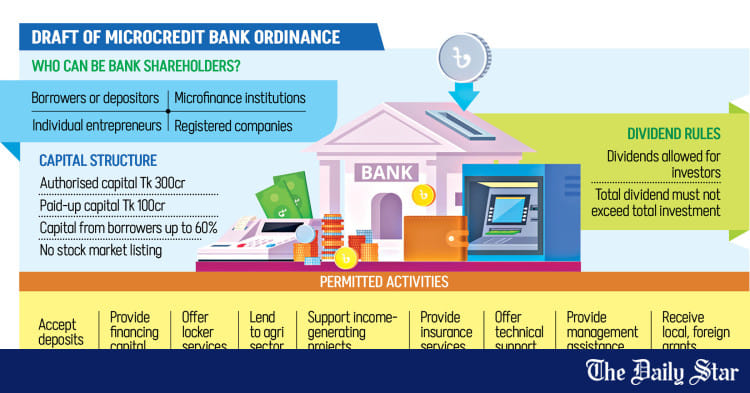
The target is to reach the 45 percent of adults who remain outside the formal banking system. To that end, the Financial Institutions Division (FID) has unveiled the draft Microcredit Bank Ordinance 2025, proposing a new tier of lenders called microfinance banks.


These institutions would combine the outreach of microcredit organisations with the services of commercial banks, offering products ranging from savings accounts to agricultural support, without collateral.

Zahid Hussain, a former lead economist at the World Bank's Dhaka office, described the proposed banks as a "progressive step".


"If they follow a social-business model and reinvest their profits, I don't see any problem," Hussain said.

At its core, the proposed banks would change how microfinance operates in Bangladesh. By allowing these new banks to accept shareholder investment and distribute dividends, the draft introduces profit incentives into a sector long designed around reinvestment and social outreach.

This shift has triggered strong resistance from the very institutions the model seeks to emulate. In a joint statement issued on Sunday, leaders of big microfinance institutions, including BRAC and ASA, warned that the draft ignores the "realities" of microfinance in Bangladesh.


A key point of contention is the distinction between "surplus" and "profit".

Microfinance institutions (MFIs) are not charities. They charge interest to cover operating costs and generate surplus income. Under the existing NGO-based framework, however, that surplus cannot be distributed. It must be reinvested to expand outreach or strengthen capital buffers.

The draft ordinance would alter this structure by introducing shareholder profit. As microfinance banks would operate on a commercial footing, investors would expect dividends.

Critics argue this creates an inherent tension. To maximise returns, management could face pressure to move away from lending to the "ultra-poor", who are costly and risky to serve, and instead focus on wealthier and safer borrowers. This potential "mission drift" is what sector leaders fear most.

The proposed capital structure has further unsettled institutions.

The draft requires each microfinance bank to have at least Tk 100 crore in paid-up capital. Up to 60 percent of this could be raised from borrower shareholders, with the remainder coming from other investors.

This presents a fundamental dilemma. Many microfinance institutions hold large asset bases but have no formal ownership structure capable of injecting equity.

To meet the capital threshold, they may be forced to sell stakes to individuals or corporate investors. Sector leaders fear this could shift control away from social objectives and expose the institutions to the same governance failures that have long plagued commercial banks.

Mohammed Helal Uddin, executive vice-chairman of the Microcredit Regulatory Authority (MRA), acknowledged that the draft, at which stage it is now, remains "incomplete", particularly on the question of how existing assets and liabilities would be converted into bank capital.

Some MFIs hold assets or liabilities worth Tk 30,000 crore to Tk 50,000 crore. The draft does not yet explain how these amounts would translate into paid-up capital, he said.

"That part is still missing," Helal Uddin admitted. "The draft will undergo further changes. That is why a technical group is already working on it."

Only after this process is completed, he added, would it be possible to assess the final shape of the ordinance.

Several broader questions also remain unresolved. If these entities continue to provide microcredit, how different will they be from existing MFIs? If they become banks, they would fall under the supervision of the Bangladesh Bank -- so what will their tax treatment be?

"There is still scope to work further on these issues, and that is exactly what the technical team is doing," Helal Uddin said.

"The Bangladesh Bank, the finance ministry and other stakeholders are also providing their opinions. Through this process, the draft will reach a more complete stage. Only then can it be judged whether this truly poses a concern for the sector."

Asked why major sector players were not consulted during drafting, Helal Uddin conceded that some institutions now objecting were not consulted, while stressing that discussions did take place with other stakeholders.

He also noted that once the law is finalised, detailed rules and regulations would be developed, which should clarify many implementation issues.

The draft defines microfinance banks as social businesses. Under this model, investors would recover their capital gradually through dividends over many years. In real terms, inflation would erode their returns. For example, an investment of Tk 100 recovered over 15 years would lose much of its value.

"If an investor cannot recover any part of the principal at all, then what incentive is there to invest? That question is still not clearly answered," Helal Uddin added.

REGULATORY DUALITY

Regulatory confusion is another flashpoint. The draft suggests licences would be issued by the Microcredit Regulatory Authority (MRA), raising the prospect of dual or even multiple oversight.

Mustafa K Mujeri, executive director of the Institute for Inclusive Finance and Development (InM), argued that if these institutions are banks, they should be regulated solely by the central bank.

"A dual system never works well," he said.

State-owned banks already operate under overlapping authority from the Financial Institutions Division and the Bangladesh Bank, and their performance has suffered as a result. Adding the MRA could introduce a third layer of supervision, further complicating oversight, Mujeri warned.

"In India, microfinance banks are regulated by the Reserve Bank of India. Bangladesh should proceed only after a sound and practical assessment," he said.

Mujeri also pointed to disagreement within the sector. "It should be examined whether any vested interest is influencing the process," he added.

Rather than moving quickly, he argued that policymakers should conduct a thorough assessment of whether the model would genuinely benefit poor borrowers.

On profitability, he was direct. "Anyone investing here would naturally expect dividends," Mujeri said. "If there is no dividend, why would someone invest? This issue requires much deeper examination before any final decision is made."​
 
Analyze

Analyze Post

Add your ideas here:
Highlight Cite Respond
Much-hyped 'social business' gets institutionalised thru new bank
Investors can recover initial capital, profits be reinvested into respective bank to further social goals


FE REPORT
Published :
Jan 16, 2026 00:12
Updated :
Jan 16, 2026 00:12

1768523408561.webp

A much-hyped 'social business' is getting institutionalized through newly introduced microcredit banks meant for empowering grassroots down-and-outs and firing up rural economy across Bangladesh.

In what officials tout as a landmark move for the country's financial landscape, the Advisory Council of the post-uprising interim government Thursday endorsed the Microfinance Bank Ordinance that allows individuals and organisations to set up such banks for commercial run in a newly defined way.

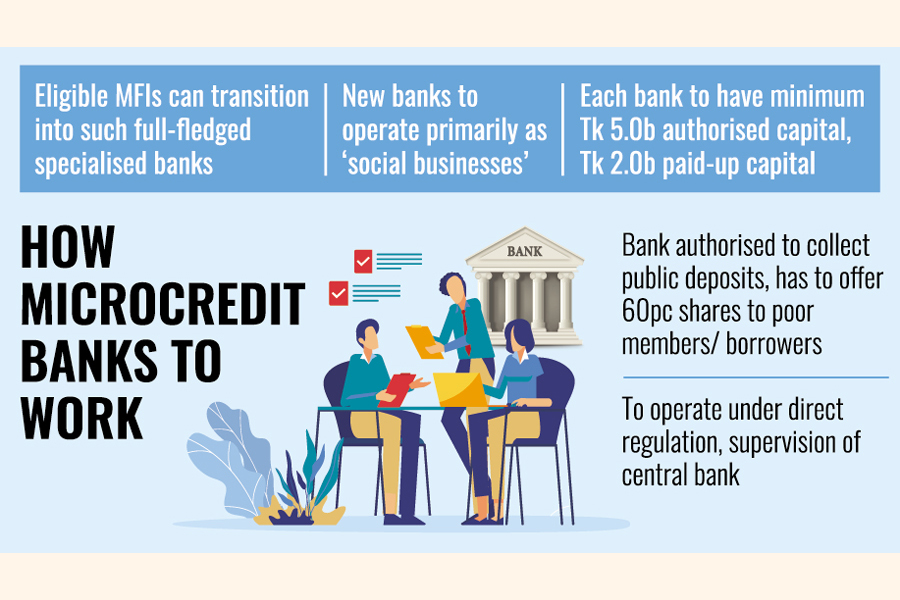
"This latest law is set to revolutionise the microcredit sector by allowing eligible micro-finance institutions (MFIs) to transition into full-fledged specialised banks," says one official.

With Chief Adviser of the Interim Government Professor Muhammad Yunus, the council meeting approved the ordinance broadly aimed at "deepening financial inclusion and providing the unbanked population with more sophisticated financial tools beyond simple credit".

The Nobel-laureate head of interim government is a longtime proponent of switching to 'social business' dedicated to advancing social-uplift goals instead of aggrandizing commercial interests.

Earlier, the Financial Institutions Division (FID) had drafted the law and consulted stakeholders before making the final version of the draft. After completion all the formalities, the draft law was placed before the cabinet meeting Thursday.

The law introduces a structured framework for evolution of the microfinance sector, which currently serves over 40 million clients. The new banks will operate primarily as "social businesses", officials said.

Each of the potential microfinance banks will have to have minimum Tk 5.0 billion as authorised capital while Tk 2.0 billion as paid-up capital.


Under provisions of the law, investors can recover their initial capital but profits beyond that must be reinvested into the bank to "further social goals rather than being distributed as traditional dividends".

The ordinance ensures that 60 per cent of the shares in the new banks would be held by the poor members (borrowers) themselves aimed at ensuring the empowerment of the down-and-outs at grassroots levels.

While MFIs currently operate under the Microcredit Regulatory Authority (MRA), the newly formed microfinance banks will fall under direct regulation and supervision of the central bank (Bangladesh Bank).

Unlike traditional MFIs, these banks will be authorised to accept public deposits, offer insurance products and remittance services, access domestic and foreign grants and loans more easily, provide specialised credits for microenterprises and cottage industry.

A senior official says the microfinance-bank ordinance does not force all NGOs to become banks. "NGOs can choose to convert entirely or only transfer specific branches into the new banking structure, while their remaining operations continue under the MRA," he told The Financial Express.

Meanwhile, the approval for the ordinance comes amid debate within the development sector-some liking, some loathing.

The Credit and Development Forum (CDF) hails the move as a "landmark step" to eliminate high-interest borrowings from commercial banks. Some critics express concern about the potential "commercialization" of a sector built on social mobilisation.


However, the government maintains that the "Social Business" clause is a robust safeguard against profit-seeking motives, ensuring the mission remains focused on poverty alleviation.

By allowing these institutions to collect deposits, the government hopes to reduce the cost of capital for micro-loans, which has historically been high due to MFIs' reliance on commercial bank loans.

This shift is expected to provide a significant boost to the rural economy and small-scale entrepreneurs ahead of the upcoming fiscal year, the authorities say, on an upbeat note on the emergent financial derivation.​
 
Analyze

Analyze Post

Add your ideas here:
Highlight Cite Respond

Holding auditors of failed Sharia-based banks accountable

Published :
Jan 17, 2026 00:08
Updated :
Jan 17, 2026 00:08

1768696584992.webp


The Bangladesh Bank (BB) has reportedly dissolved the boards of five failed Sharia-based banks in the process of merger, appointed new administrators after removing their MDs and has been requested by the Financial Institutions Division to take legal actions against their owners, board members and others to blame for the said crisis-hit private banks. There is no question that those criminals of the financial sector deserve to be held to account and the BB so far has taken the right step against the offenders. In this connection, questions have also arisen about the role of the auditors of those troubled banks. The job of the auditors was to keep the management of those banks on track by providing them correct advice on the effectiveness of their risk management, internal controls and governance issues.

Their responsibility was also to ensure that the banks complied with the latest legal and regulatory requirements and that their financial statements were reliable and presented a true and fair picture of those banks' financial position to the stakeholders. Notably, among others, a bank's stakeholders include its investors, creditors and customers. But in the case of the auditors of the failed banks in question, they rather cooperated year after year with the management in concealing their massive theft through issuing clean audit opinions. They have been playing such criminal roles despite the fact that there were clear evidences of pervasive misstatements, massive non-performing loans (NPLs) and capital shortfalls of those banks.

In that case, the banking regulator should also take steps as necessary to identify those auditors, both internal and external, and start taking measures as necessary to bring them to justice. Against this backdrop, the Finance Adviser has reportedly indicated that the authorities are examining the circumstances under which the investors of the said failing Sharia-based banks made their investment decisions based on their (of those banks') published accounts. Understandably, the investors had been induced to make their decisions relying on those banks' audit reports which evidently convinced them about the depositories' apparently strong financial health. As assured by the Finance Adviser, the government would address the genuine grievances of the investors. They eminently deserve considerations from the authorities concerned. This is for the simple reason that the small investors in banks and similar other financial institutions as well as non-financial business ventures, represent a large segment of society which include even people who risk their retirement benefits and life savings in the hope that the investment would ensure a modest income for them to fall back on in time of need. But time and again they have systematically been cheated by fraudulent business houses in cahoots with the government officials such as those in Securities and Exchange Commission who are supposed to look after the interests of the investors. It's no surprise then that with crash of the stock market many such investors were rendered penniless overnight. Unable to stand the loss, some even reportedly committed suicide.

So, those who bought the shares of the Sharia-based banks in question definitely expected some earning out of their investments. The investors cannot be blamed for their decisions of being encouraged to buy shares of banks whose financial statements showed profit. Hopefully, the government would consider coming up with some measures to compensate at least the small investors. Finally, it is expected that the authorities concerned would take exemplary measures against the management as well as the auditors who collaborated with the owners in hollowing out the Sharia-based banks in question.​
 
Analyze

Analyze Post

Add your ideas here:
Highlight Cite Respond

Changing power balance: banks & regulators

Shah Md Ahsan Habib
Published :
Jan 18, 2026 11:40
Updated :
Jan 18, 2026 11:40

1768783413544.webp


Risk-based supervision reshapes the relationship between banks and regulators. Under compliance-based supervision, power was largely mechanical. Banks were assessed against ratios, exposure limits, and reporting standards. If these thresholds were met, supervisory intervention was limited. Action usually followed breaches, losses, or visible deterioration. It offered banks predictability and a degree of protection. When the numbers were within limits, supervisory pressure was restrained.Risk-based supervision weakens this protection. Supervisory authority is no longer anchored in confirmation of past compliance. It rests on assessments of future vulnerability. Regulators can intervene earlier, based on emerging risks rather than confirmed failures. This produces a structural rebalancing of power.

For banks, this shift is practical, not theoretical. Supervisors no longer need to wait for capital erosion, liquidity stress, or regulatory breaches. They can challenge strategy, governance, and risk trends even when headline indicators appear stable. This creates an inherent asymmetry. Regulators see the system. They compare peers, observe common exposures, and track interconnected risks. Individual banks see their own balance sheets, funding plans, and internal metrics. Decisions that appear reasonable in isolation may look risky at system level. When supervisory judgment is supported by peer comparison and macro analysis, regulators gain authority to question decisions that would previously have been shielded by compliance.

The basis of supervisory engagement therefore changes. Discussions move away from confirming minimum compliance and toward evaluating sustainability. The key question becomes whether a bank’s strategy, governance, and risk profile can withstand stress over time. Numbers still matter. Explanations matter just as much. Adequate capital and stable earnings do not guarantee supervisory comfort if risk escalation is weak, internal challenge is limited, or information is unreliable. Conversely, a bank under short-term pressure may receive a measured response if risks are clearly identified, governance functions are effective, and corrective actions are credible. Under risk-based supervision, credibility increasingly outweighs technical defence.

Disagreement also changes in nature. In compliance-based systems, disputes focused on rule interpretation and technical definitions. Banks defended positions by citing regulations or precedent. Under risk-based supervision, disagreements centre on judgment, assumptions, and behaviour. These are harder to resolve through formal argument. Weak governance, delayed recognition of problems, selective disclosure, or optimistic projections are difficult to defend over time. Influence depends less on citing rules and more on demonstrated conduct. Banks that acknowledge issues early, act decisively, and follow through consistently tend to build supervisory confidence. Banks that delay action or rely on best-case narratives invite earlier and stronger intervention.

In developed supervisory systems, this reallocation of authority has stabilised within structured frameworks. Risk-based supervision operates through defined methodologies, common risk taxonomies, peer benchmarking, and formal review processes. Supervisory judgment is documented, internally challenged, and supported by specialist input. Authority is strong, but it is constrained by institutional discipline and accountability. Over time, banks in these systems have adapted. They invest heavily in board effectiveness, risk governance, data quality, and internal challenge. While power has shifted toward regulators, expectations are predictable. Banks understand which behaviours build supervisory confidence and which trigger concern, even during periods of stress.

In developing and emerging markets, the same shift is taking place under more fragile conditions. Banking systems are often uneven in size and sophistication. Governance standards vary widely. Risk management practices are inconsistent. Data quality is frequently weak, delayed, or fragmented. Supervisory resources and specialist expertise are limited relative to the complexity of risks. Legal, political, and institutional constraints can affect the timing and intensity of supervisory action. Risk-based supervision still expands supervisory authority, but without all the safeguards found in advanced systems. Judgment becomes more central and more exposed. Consistency across supervisory teams is harder to maintain. Peer comparison is less reliable when transparency differs sharply across institutions. The main risk is not excessive authority, but uneven authority. If judgment is unclear or inconsistently applied, trust erodes and supervision loses effectiveness.

Bangladesh’s current risk management and compliance culture shows many of these challenges. In many banks, compliance is still treated as a checklist exercise that looks mainly at past events. Regulatory requirements are often seen as reporting tasks rather than as tools to understand risk. Risk management functions are in place, but their independence, authority, and analytical strength differ widely across banks. In some institutions, risk is still viewed as a control or support function instead of a core part of business strategy. Weak data aggregation and poor data quality remain ongoing problems. Early warning signals are often late or incomplete. Board-level oversight is improving in some banks, but in others it is limited by skill gaps, concentration of decision-making, and weak risk culture. These structural weaknesses make the move to true risk-based supervision more difficult.

Bangladesh’s move toward risk-based supervision reflects these realities clearly. Credit concentration, pressure on asset quality, weak governance, and operational risks are now more visible across the banking system. Rapid use of technology and closer financial links have also created new risks. Under risk-based supervision, Bangladesh Bank is expected to look ahead rather than only review past results. Supervisory effort is adjusted based on each bank’s risk level and systemic importance. Intervention is expected to happen earlier, before problems become severe. Ongoing supervision is gradually replacing occasional inspections. Understanding risk trends is now as important as checking reported figures.

Banks also have a direct role. Moving successfully onto the risk-based supervision path requires a shift away from defensive compliance toward genuine risk ownership. Stronger board oversight, empowered and independent risk functions, improved data integrity, and integration of risk into strategic decisions are no longer optional. Banks that adapt tend to experience more stable supervisory relationships and earlier resolution of emerging issues. Banks that do not face rising pressure as supervisory tolerance for weak governance narrows.

This reallocation of authority is not punitive by intent. It reflects how banking problems actually develop. Failures rarely begin with clear rule breaches. They begin with weak incentives, ignored warnings, limited challenge, and delayed action. By the time ratios deteriorate, options are fewer and costs are higher. Risk-based supervision gives supervisors authority to act when warning signs first appear. This is uncomfortable for banks accustomed to defending themselves through compliance.

Risk-based supervision does not remove friction between banks and regulators. It changes how that friction is expressed. Power moves away from fixed rules toward judgment, from reacting to problems toward anticipating them, and from formal compliance toward real risk management. In Bangladesh, the framework is now in place and the balance of authority has already shifted. Whether this change leads to a stronger and more stable banking system, or to ongoing strain, will depend on institutional discipline, consistent supervision, and how quickly banks move from defending compliance to taking ownership of risk as a core responsibility.

The writer is professor at Bangladesh Institute of Bank Management (BIBM), Dhaka.​
 
Analyze

Analyze Post

Add your ideas here:
Highlight Cite Respond

Bangladesh Bank buys $45m from two banks to bolster reserves

UNB
Published :
Jan 20, 2026 21:36
Updated :
Jan 20, 2026 21:36

1768955205846.webp

In its continued effort to stabilize the foreign exchange market and build up national reserves, Bangladesh Bank (BB) purchased an additional $45 million from two commercial banks on Tuesday (January 20).

The dollars were bought at a fixed exchange rate of Tk 122.30, with the cut-off rate also set at Tk 122.30, according to a press release issued by the central bank.

This latest transaction follows a series of significant dollar purchases by the central bank this month.

On January 12, purchased $81 million from 10 commercial banks.

On January 8, purchased $206 million from 15 commercial banks.

On January 6, purchased $223.5 million from 14 commercial banks.

All these transactions were conducted at the uniform rate of Tk 122.30 per dollar. With the latest purchase on Tuesday, the total dollar procurement for the month of January 2026 alone has reached $743 million.

Arif Hossain Khan, Executive Director and Spokesperson of Bangladesh Bank, confirmed the details of Tuesday’s transaction.

He noted that the aggressive buying strategy has significantly bolstered the country’s holdings during the current fiscal year.

Data reveals that during the first six months and twenty days of FY 2025-26 (from July 1 to January 20), the central bank has purchased a total of $3.87 billion (3,878.50 million) from the interbank market.

Market analysts suggest that the central bank is taking advantage of increased dollar inflows—likely from remittances and export earnings—to replenish the foreign exchange reserves, which had faced pressure in previous years. By maintaining a steady “cut-off” rate of Tk 122.30, the regulator is also signaling a desire for exchange rate stability, preventing abrupt fluctuations that could impact inflation and import costs.​
 
Analyze

Analyze Post

Add your ideas here:
Highlight Cite Respond

Members Online

No members online now.

Latest Posts

Back
 
G
O
 
H
O
M
E