Bangladesh Defense
Saif
Senior Member
- Jan 24, 2024
- 21,545
- 9,760
- Nation

- Residence
- Axis Group

Rural health clinics: promises, performances, and despair
Across Bangladesh’s countryside, a remarkable health-policy transformation has unfolded over the past two decades. Tens of thousands of low-level health posts—community clinics and union-level health and family welfare centres—now bring medical care within reach of rural populatio
Rural health clinics: promises, performances, and despair
Abdullah A Dewan and Dulary A Maher
Published :
Jan 08, 2026 00:58
Updated :
Jan 08, 2026 00:58
Abdullah A Dewan and Dulary A Maher
Published :
Jan 08, 2026 00:58
Updated :
Jan 08, 2026 00:58
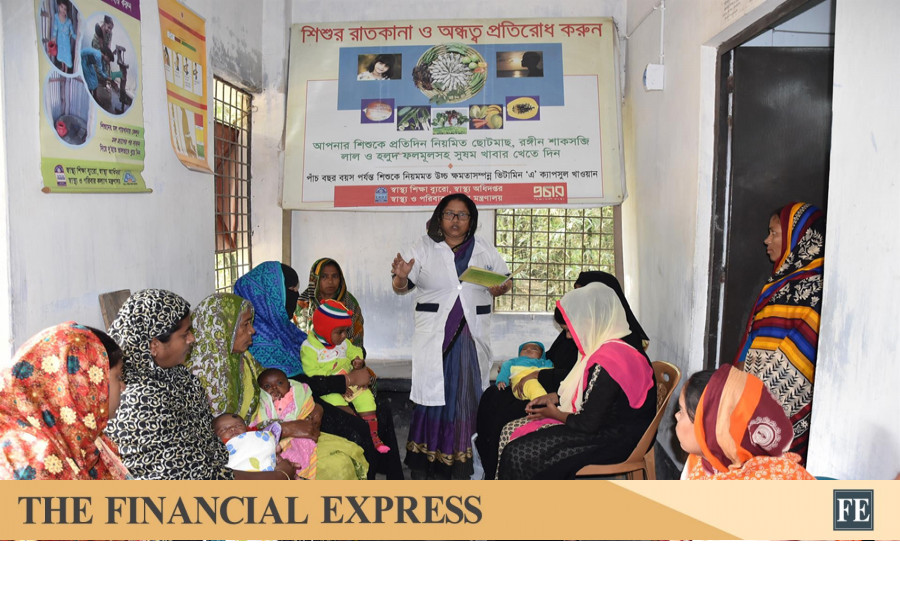
A heath worker providing health tips to a group of young mothers at a community clinic in Bangladesh — WHO PhotoAcross Bangladesh’s countryside, a remarkable health-policy transformation has unfolded over the past two decades. Tens of thousands of low-level health posts—community clinics and union-level health and family welfare centres—now bring medical care within reach of rural populations. The ambition is noble: to make healthcare a right at the doorstep of every village. Yet behind the success of expanded access lie persistent deficiencies in staffing, medicine supply, and service quality. The question is no longer whether these clinics exist, but whether they effectively and consistently deliver the care rural Bangladeshis need.
Structure of Rural Health Care: Bangladesh’s rural health system rests on two foundational tiers. The first and most localised is the community clinic, each designed to serve roughly 6,000 people in a cluster of villages. These clinics provide basic preventive and promotive care—immunisations, family planning, nutrition counselling, and treatment of minor ailments. Above them are the union health and family welfare centres, which cover about 25,000 people per union and offer maternal and child healthcare, deliveries, and limited curative services. Together, they form the lowest rungs of the national healthcare ladder, linking upward to upazila health complexes and district hospitals.
The Promise of Accessibility: The World Health Organization (WHO) and the World Bank have hailed Bangladesh’s community clinic model as a milestone in reaching rural and marginalised populations. Each clinic typically has one full-time Community Health Care Provider (CHCP), assisted by two part-time workers who visit households, maintain vaccination coverage, and promote hygiene. Built on the principle of local ownership—where villagers donate land and manage operations—the system was revolutionary in its simplicity. By placing care within walking distance, the government reduced physical and psychological barriers that once kept villagers away from formal healthcare.
For millions, especially women and children, the community clinic became the first point of contact with the state’s health system. Proximity increased the likelihood that mothers would seek antenatal care and children would receive timely immunisations. Maternal and child health indicators improved steadily, and the clinics became the backbone of Covid-19 outreach and vaccination campaigns. Accessibility, once a dream, became reality.
Where the System Falters: The story of progress, however, must be balanced against performance. Efficiency—delivering the right care with the right resources—remains the system’s weak link.
Staffing shortages are the first constraint. Each community clinic employs a CHCP and shares a health assistant and a family welfare assistant. Yet these are paraprofessionals, not degree-holding physicians or registered nurses. Union-level centres, meant to have at least one doctor, midwife, and several paramedics, often operate with half their sanctioned staff. In many unions, one worker shoulders the duties of ten. Without qualified personnel, many clinics are limited to dispensing paracetamol, saline, and advice.
Medicine availability and treatment capacity present the second bottleneck. Community clinics were designed primarily for prevention, not full-scale curative care. Consequently, many lack a reliable supply of antibiotics or diagnostic tools. Drug shortages are common, forcing patients to buy medicines from private pharmacies or travel to distant upazila hospitals. A 2025 reform commission even recommended authorising these clinics to sell essential over-the-counter medicines at subsidised prices—an implicit acknowledgment that rural demand for basic treatment remains unmet.
Workload pressure and weak supervision form the third constraint. Multiple staffing studies using the World Health Organization’s Workload Indicators of Staffing Need (WISN) method reveal that staffing norms are out dated and fail to reflect actual patient volumes. Community health workers face overwhelming workloads, leading to rushed consultations that often last less than four minutes. Weak referral systems, poor transportation, and inadequate communication with higher-tier facilities further erode efficiency.
Dual Practice and Referral Malpractice: Beyond shortages and inefficiencies lies an ethical fault line that quietly corrodes rural healthcare. Many government-employed doctors, officially posted at union or upazila health complexes, also maintain part-time private practices in nearby towns. This dual practice often turns into dual morality. In the government clinic, patients complain of being hurried, dismissed, or even scolded. Yet when the same doctor is visited in a private chamber—after paying consultation fees—the tone changes to courtesy, patience, and care.
Even more troubling is the referral-for-profit network that has emerged, as documented repeatedly in media reports and health-sector studies. Some doctors routinely direct patients to city-based diagnostic centres or specialists with whom they have personal or financial ties. In many cases, the referrals are unnecessary, driven not by medical need but by commission-based incentives. Such practices impose crushing financial burdens on poor families and erode faith in local health facilities.
This behaviour transforms what should be a public service into a marketplace of manipulation. The poor, who turn to government clinics precisely because they cannot afford private care, end up neglected or deceived into unnecessary expenditures. Without strict enforcement, dual practice has become the unspoken rule of the rural health economy—where duty ends at the clinic gate and profit begins at dusk.
Measuring Efficiency: Judged by four criteria—human resources, medicine availability, quality of care, and accessibility, the results are mixed. On access, Bangladesh has succeeded impressively; nearly every rural citizen now lives within a few kilometres of a health post. But the absence of qualified physicians and nurses leaves many facilities operating on the margins of competence. Quality and monitoring vary widely across districts: some clinics thrive under motivated leadership, while others stagnate due to absenteeism or neglect. The problem is not intent but implementation design that favours coverage over capability.
What Must Change: To fulfil the promise of universal health coverage, Bangladesh must move from access to efficiency. This requires recruiting more doctors, nurses, and midwives for rural postings, supported by financial incentives and credible pathways for career advancement. The current two-tier paraprofessional model is insufficient for a country facing a rising burden of chronic and non-communicable diseases.
Equally urgent is guaranteeing consistent stocks of essential drugs, including antibiotics, and equipping clinics with basic diagnostic tools for blood pressure, glucose, and common infections. Without medicines and diagnostics, proximity offers little more than false reassurance.
The system must also pilot enhanced community clinics staffed by at least one trained nurse or physician’s assistant capable of managing uncomplicated infections and chronic conditions. Such intermediate capacity would relieve pressure on hospitals while restoring confidence in local care.
Digital registers and connectivity should be leveraged to monitor attendance, medicine stocks, and referral patterns in real time, allowing district authorities to identify underperforming clinics and intervene early. Finally, citizen participation must be institutionalised through active management committees and regular public hearings, empowering villagers to demand transparency and quality from local providers.
The Road Ahead: Bangladesh’s network of rural clinics remains one of the boldest health outreach initiatives in the developing world. It has achieved what many nations still struggle with—universal access to a health facility within walking distance. Yet access alone is not enough. Without qualified staff, adequate drugs, reliable diagnostics, and effective supervision, accessibility risks becoming a hollow victory. The measure of success should not be how many clinics exist, but how many lives they improve.
These concerns are widely shared among observers of Bangladesh’s health system. Yet the deeper problem lies in the quiet despair gripping rural patients—mistreated by medical professionals, denied basic services, and driven toward private clinics run by the very doctors entrusted with public duty. Such hopelessness reflects a broader culture of dishonesty and corruption that has trickled down from the top to every tier of society. It exposes how numerical policy achievements can conceal lived disillusion when care is indifferent, supervision weak, and accountability absent.
Part of the remedy must begin with raising the salaries of medical professionals to restore dignity to their service, while making private practice for government-employed doctors strictly illegal—punishable by permanent removal from public employment and ineligibility for future government fellowships, including FCPS and foreign training programs. The call is for a renewal of purpose, so that access is matched by care, performance by compassion, and promise by integrity.
Dr Abdullah A. Dewan, Professor Emeritus of Economics at Eastern Michigan University, USA, formerly a Physicist and Nuclear Engineer, BAEC.
Dr Dulary A Maher, MBBS (DU), PGT, CCU, Urban Primary Care Delivery Project Suja Nagar, Comilla.