[🇧🇩] Indo-Bangla Relation: India's Regional Ambition, Geopolitical Reality, and Strategic Options For Bangladesh

Post a Reply — Share your thoughts or reply to this thread...
Reply
Quick Reply ✓ Posted!
[🇧🇩] Indo-Bangla Relation: India's Regional Ambition, Geopolitical Reality, and Strategic Options For Bangladesh
720
39K
More threads by Saif

G Bangladesh Defense

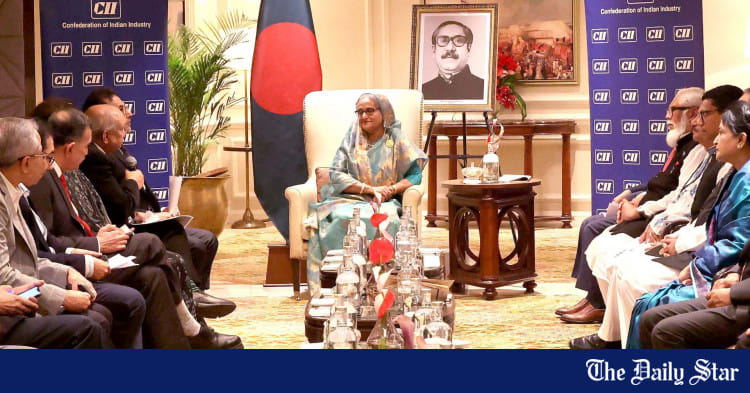
Invest in Bangladesh, PM tells Indian businesspersons

1719011994236.webp

Photo: PID

Prime Minister Sheikh Hasina today invited Indian businesspersons to invest in Bangladesh, stating that she prioritises neighbouring countries.

"You come to Bangladesh and make investment," she said while interacting with a delegation of Confederation of Indian Industry (CII) which called on her in New Delhi this evening.

The PM's private industry and investment affairs adviser Salman F Rahman while talking to the media said the prime minister reiterated that she believes in "neighbourhood first" and she prioritises neighbouring countries of Bangladesh for trade, business, and investment.

Hasina pointed out that Bangladesh is developing 100 special economic zones and the Indian entrepreneurs can invest there.

Salman said the CII delegation told Hasina that they, in collaboration with the FBCCI, want to work in various sectors in Bangladesh, in agriculture, IT, and logistics.

He said Bangladesh businessmen raised the issues of non-tariff barriers and told the CII delegation to call upon the Indian government to address the issues.

FBCCI President Mahbubul Alam, Nitol Niloy Group Chairman Abdul Matlub Ahmad, Pran-RFL Group Chairman Ahsan Khan Chowdhury and some other Bangladeshi businessmen also participated in the meeting.

Besides, Chairman and Managing Director of ITC Limited Sanjiv Puri, Director General of CII Chandrajit Banerjee, Executive Vice Chairperson of Apollo Hospitals Enterprise Limited Shobana Kamineni, Chairman of Indian Oil Corporation Shrikant Madhav Vaidya, CEO of Dabur India Limited Mohit Malhotra,CEO (Energy) of Adani Power Limited Deepak Amitabh, Executive Director and COO of Saankhya Labs Vishwakumara Kayargadde were among those present.​
 

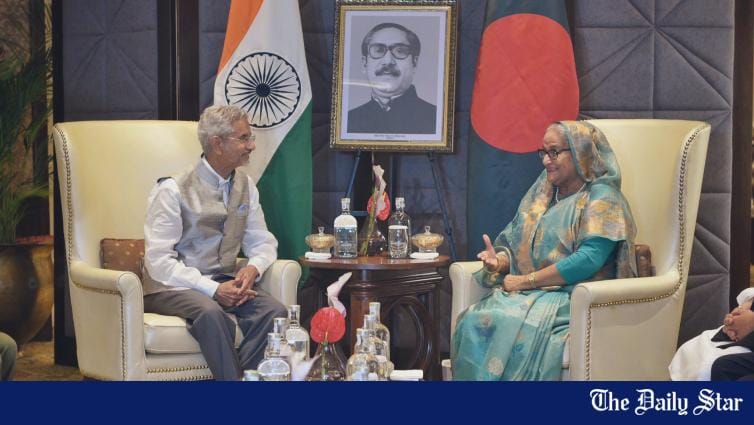
Hasina, Jaishankar for advancing India-Bangladesh partnership

1719012141492.webp

Photo: X/Dr S Jaishankar

Prime Minister Sheikh Hasina today called for sustained dialogues between Bangladesh and India to exchange ideas and experiences to help overcome the challenges in their journey towards economic development.

"We could exchange our experiences, and the challenges we are experiencing for our economic development. And we could resolve those through dialogues," she told Indian External Affairs Minister S Jaishankar who called on her at Hotel Taj Palace in New Delhi.

PM's Principal Secretary M Tofazzel Hossain Miah briefed reporters after the meeting and said the two leaders discussed to advance the partnership between the two countries after forming the new governments in the two countries.

"The two new governments [in India and Bangladesh] have come to power taking mandates [of the people]. So, new visions will be there in the two countries," he said.

Jaishankar said the relations between Bangladesh and India have moved to such a height that it could take off for a new chapter. And that could be done in the area of trade, Tofazzel said.

Jaishankar said India wants to work with Bangladesh in a more substantive way in the sectors of logistics, energy, and connectivity.

Hasina and Jaishankar agreed to strengthen BIMSTEC saying it would be beneficial for Bangladesh in trade, connectivity, and digitisation.

"Prime Minister Sheikh Hasina wanted to go beyond South Asia. That means we have to simultaneously look at South East Asia to work with," said Toffazel.

The PM emphasised expediting the completion of pending developmental projects involving the two neighbouring countries. Both agreed on this issue, Tofazzel said.

On the Rohingya issue, the principal secretary said border areas of Bangladesh and India are being hit by the ongoing fighting between Myanmar government and rebel groups.​
 

Hasina's Visit: It's very important; both sides have a lot of expectations, says India
Published :
Jun 21, 2024 18:02
Updated :
Jun 21, 2024 18:02
1719015211401.webp


India has said they are committed to "deepen and strengthen" the "very special partnership" that they have with Bangladesh as the two leaders are set to discuss all the issues on Saturday for a broader cooperation between the two neighbouring countries.
"It is a very important visit for us. Both sides have a lot of expectations because the relationship is so special and so friendly," Spokesperson at the Indian Ministry of External Affairs Randhir Jaiswal at a weekly media briefing in New Delhi on Friday.

Tomorrow, he said, all will get to know the details about the discussions, MoUs and agreements that are likely to be signed.

"But both sides are committed to deepen and strengthen the very special partnership," said the MEA Spokesperson.

At the invitation of Indian Prime Minister Narendra Modi, Prime Minister Sheikh Hasina arrived in New Delhi on Friday as part of her two-day state visit to India.

This is the first incoming bilateral state visit after the formation of the government in India following the 18th Lok Sabha elections, said the MEA spokesperson.

He said there will be a post-visit press engagement and journalists will be able to know all the details on issues that the two sides would agree to do together on trade, connectivity and defence fronts.

During the visit, apart from holding bilateral consultations with the Indian Prime Minister, Prime Minister Sheikh Hasina is scheduled to call-on Indian President Droupadi Murmu and Vice President Jagdeep Dhankhar.

Prime Minister Sheikh Hasina was among the international leaders who attended the swearing-in ceremony of the Prime Minister and the Union Council of Ministers on June 9, 2024.

A flight of Biman Bangladesh Airlines carrying the prime minister and her entourage members landed at Palam Airport in New Delhi at 3:29pm (local time).

Earlier, the flight departed Hazrat Shahjalal International Airport at 2:00pm.

Indian Minister of State for Environment, Forest & Climate Change and also Minister of State for External Affairs Kirtivardhan Singh, and Bangladesh High Commissioner to India Md. Mustafizur Rahman received Sheikh Hasina at the airport.

The prime minister was welcomed by traditional folks dancing there.

Both sides of the roads were decorated with the flags of Bangladesh and India, and placards of Sheikh Hasina and Narendra Modi.

Various types of placards in different languages welcoming Prime Minister Sheikh Hasina were seen on both sides of the roads from Palam Airport to Hotel Taj Palace.

This is the first bilateral visit by any head of government to India after the BJP-led alliance formed its government for the third consecutive term.

During the visit, both the premiers will have a tête-à-tête (one to one meeting) followed by delegation level talks, and then Dhaka and New Delhi would sign several agreements and Memorandum of understandings to strengthen the existing bilateral ties further.

Additionally, discussions on a potential trade pact are expected. Over the past decade, numerous cross-border initiatives have been launched as part of a robust regional partnership plan.

This visit will be Hasina's second trip to the Indian capital in less than 15 days, as she was among the dignitaries invited to Modi's swearing-in ceremony on June 9.

To read the rest of the news, please click on the link above.​
 
Sheikh Hasina has amply proved that she can even sacrifice her own country's national interest for the sake of India's support to keep her at the helm of power in Bangladesh. She has chosen India as a partner for defense, space science, nuclear technology and Teesta River Management project. She, on the other hand, has subtracted China from Teesta, nuclear and space science projects. Shame on her:mad:


India's MEA details outcomes of Hasina-Modi summit

Bangladesh and India today agreed to work for the conservation and management of the Teesta river inside Bangladesh with Indian assistance within a mutually agreed timeframe and remain engaged to formulate the framework for interim water-sharing based on the recommendations of the Joint Rivers Commission.

This was contained in a 14-paragraph document called "Shared Vision for Future: Enhancing Connectivity, Commerce and Collaboration for Shared Prosperity" issued after talks between Prime Ministers Sheikh Hasina and Narendra Modi in New Delhi, reports our New Delhi correspondent.

"Recognising the importance of water resource management in our bilateral relationship, we will continue to engage in prioritising the exchange of data and formulating the framework for interim water sharing based on the recommendations of the Joint Rivers Commission," according to the document.

It said the two countries welcomed the formation of a Joint Technical Committee to initiate discussions for renewal of the Ganges Water Sharing Treaty of 1996 and, as part of development cooperation.

The document said as part of sub-regional connectivity initiatives, India will extend transit facilities for the movement of Bangladesh goods to Nepal and Bhutan through the railway network.

The two countries decided to commence goods-train service from Gede-Darshana through Chilahati-Haldibari up to Hasimara via Dalgaon railhead (as and when operationalised) at the India-Bhutan border.

As part of sub-regional connectivity initiatives, India will extend transit facilities for the movement of Bangladesh goods to Nepal and Bhutan through the railway network. We are committed to the early operationalisation of the BBIN Motor Vehicle Agreement to promote sub-regional connectivity.

The two countries today signed a new MoU on railway connectivity as well as the decision to commence goods-train service from Gede-Darshana through Chilahati-Haldibari up to Hasimara via Dalgaon railhead (as and when operationalised) at India-Bhutan border.

Bangladesh and India resolved to continue to expand their power and energy collaboration and together develop intra-regional electricity trade, including competitively-priced power generated from clean energy projects in India, Nepal, and Bhutan, through the Indian electricity grid.

To this end, the two countries decided to expedite the construction of a 765kV high-capacity interconnection between Katihar-Parbatipur-Bornagar with Indian funding to act as the anchor for grid connectivity.

The document said that based on availability and to the best of its abilities, India will support Bangladesh with the supply of essential commodities.

To be continued....................​
 
Last edited:
Appreciating the significant role of the two countries in ensuring peace, stability and harmony in the region, Bangladesh and India decided to strengthen bilateral defence cooperation with a long-term perspective.

"In line with the plans for the modernization of the Bangladesh Armed Forces, we will explore defence industrial cooperation for modernisation of the Armed Forces of Bangladesh, to strengthen their capability for defence. We will continue to work closely with Bangladesh for our multifaceted military engagements of exercises, training and capability development," said the document.


In their wide-ranging discussions, Hasina and Modi "recognised that the India-Bangladesh partnership, which is founded on deep historical, linguistic, cultural, and economic linkages has strengthened in the last decade inspired by the spirit of their shared sacrifices of 1971 and guided by their new aspirations of the 21st century.

"This is reflective of an all-encompassing partnership that transcends a strategic partnership, built upon shared values and interests, equality, trust and understanding and rooted in mutual sensitivity to each other's aspirations and concerns," it said.

"To realize the immense potential of this extra-ordinary relationship and to turn it into a transformational partnership for mutual benefits and prosperity of their people and the entire region, the two leaders have jointly articulated their following Shared Vision for peace, prosperity and development of the two neighbours and the entire region, driven by connectivity, commerce and collaboration," according to the document.

It said the two countries shared the conviction that "our progress and prosperity are interlinked and reaffirm our mutual desire to guide India-Bangladesh ties to a new era of future-oriented partnership, for which we recognise each other as indispensable partners in realizing our respective national development visions of 'Viksit Bharat 2047' and 'Smart Bangladesh Vision 2041'."

As a close and valued neighbour with rapidly growing capabilities, Bangladesh is at the converging point of India's "Neighbourhood First" policy, "Act East" policy, SAGAR (Security and Growth) doctrine and the Indo-Pacific vision and an indispensable partner in the development of India's northeastern region, read the document.

"On the other hand, Bangladesh values its relationship with India as the closest and friendly neighbour. Bangladesh considers India as an important partner in the pursuit of its Neighborhood Foreign Policy for ensuring shared peace and prosperity," said the document.

The two countries vowed to "pursue a transformative partnership that advances the shared interests in promoting multi-faceted connectivity for both our countries as well as the entire region by transforming our geographical proximity into new economic opportunities."

To be continued................​
 
"This will include connectivity in its broadest form – physical connectivity covering multi-modal transport and cross-border trade and transit infrastructure for seamless cross-border movement of people, goods and services, as well as energy connectivity and digital connectivity," as per the document.

It said that "underlining the pivotal role played by emerging technologies to build inclusive, sustainable and digitally empowered societies and to bring larger benefits to people of both the countries, Bangladesh and India are forging a new paradigm for future-oriented partnership through a 'Shared Vision for India-Bangladesh Digital Partnership' and 'Shared Vision for India-Bangladesh Green Partnership for a Sustainable Future'."

"These will build a transformative collaboration between India and Bangladesh by leveraging green and digital technologies to foster economic growth, sustainable and climate-resilient development, environmental conservation, cross-border digital interchange and regional prosperity," said the document.

The two countries agreed to collaborate on frontier technologies, including civil nuclear, oceanography, and space technology. "To this end, we will partner in joint development of a small satellite for Bangladesh and its launch using an Indian launch vehicle," it said.

Resolving to work towards promoting the prosperity of the people of the two countries, Bangladesh and India agreed to strengthen trade and investment linkages with each other, including through early commencement of negotiations for a Comprehensive Economic Partnership Agreement (CEPA), early operationalization of two Special Economic Zones (SEZs) offered by Bangladesh to India in Mongla and Mirsharai, opening of new border-haats, trade facilitation to enhance bilateral trade, improving road, rail, air, and maritime connectivity and trade infrastructure.

"We will also encourage and support our private sector to seek new investment opportunities in each other's priority areas of economic development."

The two countries also decided to conclude a new Framework Agreement for Development Partnership, which will expand the reach of cross-border projects and programmes in line with the priorities of the people and the government of Bangladesh and the long-term vision of closer connectivity.

"We will work together to expand our capacity building programme for civil services, judicial officers, police and other specialized services of Bangladesh," it added.

Recognising the shared cultural and historical heritage and vibrant people-to-people ties, the two countries decided to nurture existing linkages by promoting exchanges of Muktijoddhas, scholars, academics, artistes, tourists, students and youth.

India will further raise the level of its support to Muktijoddhas and their families with new programmes for medical and educational support.

Recognising the contribution of Bangladesh-India partnership to peace, security and stability in the region, the two countries reiterated their commitment to a free, open, inclusive, secure, and rules-based Indo-Pacific region.

Recognising the vulnerability of the region to adverse impacts of climate change, the two countries decided to jointly lead the "Disaster Risk Reduction and Management" pillar of the Indo-Pacific Oceans Initiative (IPOI) and cooperate to mitigate disaster risks, build disaster-resilient infrastructure, and contribute to the sustenance of our shared maritime region.

The document said Bangladesh and India, with their wide-ranging bilateral cooperation, envision the relationship to become a major anchor for regional and sub-regional integration under BIMSTEC, SAARC and Indian Ocean Regional architectures.

"We will work together on global platforms to promote our common interests, especially the interests of Global South," it added.

The document said there was a need for Bangladesh and India to take their ties to a deeper and higher quality level based on mutual trust and benefit in the coming days.​
 

No deal yet, India for Teesta management
Mustafizur Rahman 23 June, 2024, 00:20
1719098947970.webp


India on Saturday announced to send a technical team to Bangladesh to discuss 'conservation and management of the Teesta River in Bangladesh' as the bilateral talks between prime minister Sheikh Hasina and her Indian counterpart Narendra Modi ended in New Delhi without any breakthrough in the long pending water sharing deal on the common river.

The two leaders, however, decided to start technical level discussions for renewal of the 1996 Ganges Water Sharing Treaty expiring in 2026.

Both sides also agreed to begin negotiations on a proposed 'Comprehensive economic partnership agreement' between the two neighbours.

'We have decided to start technical level discussions for renewal of the 1996 Ganga Water Treaty. A technical team will soon visit Bangladesh to discuss conservation and management of the Teesta River in Bangladesh,' said Narendra Modi in a press statement after the bilateral meeting at the Hyderabad House.

India has very recently expressed its willingness to support a mega development plan on the trans-boundary River Teesta inside Bangladesh, where China has already shown its interest and completed a survey for a $1 billion project.


The Bangladesh side once again pressed for bringing the incidents of killing Bangladeshi civilians by the Indian Border Security Force along the border to zero level, energy cooperation and smooth supply of essential commodities, while the Indian side expressed interest in using both Mongla and Chittagong ports and rail network for easing connectivity with its north-eastern states, according to officials concerned.

'We had comprehensive discussions on further strengthening our defence cooperation, from defence production to modernisation of armed forces. We have decided to strengthen our cooperation on counter-terrorism, countering radicalism and peaceful management of the border,' said Modi in the statement, an English translation of which was made available on the official site of the External Affairs Ministry of India.

In her statement, Sheikh Hasina said that Dhaka and New Delhi agreed about a shared vision for digital and green partnerships to ensure a sustainable future for both the nations, Bangladesh Sangbad Sangstha reported.

'Today, our two sides had very productive meetings where we discussed politics and security, trade and connectivity, the sharing of water from common rivers, power and energy, and regional and multilateral cooperation, among other issues of mutual interest,' BSS quoted her as saying after the one-to-one meeting and the bilateral talks.

Describing India as Bangladesh's major neighbour, trusted friend, and regional partner, she said, 'Bangladesh greatly values our relations with India, which were born during our War of Liberation in 1971.'

To be continued..................​
 
After the delegation-level talks, Dhaka and New Delhi signed 10 Memorandums of Understanding, including seven new and three renewed ones, in the presence of the two prime ministers.

Greeting Hasina as their first state guest, Modi, who took over as prime minister of India for the third consecutive term on June 9, said that they had met almost ten times in the past one year.

'In last one year, we have completed many important public welfare projects together. Between Akhaura-Agartala, the 6th India-Bangladesh cross-border rail link has been started. Cargo facility for India's north-eastern states has been started through Khulna-Mongla Port. Mongla Port has been connected by rail for the first time,' the Indian prime minister said.

He also mentioned that electricity export from Nepal to Bangladesh via the Indian grid had become the first example of sub-regional cooperation in the energy sector.

'Today we have prepared a futuristic vision for cooperation in new areas. Youth of both countries will benefit from the agreement reached on cooperation in a lot of areas such as green partnership, digital partnership, blue economy, space. India- Bangladesh "Maitri Satellite" will give new heights to our partnership. We have kept in our focus- Connectivity, Commerce and Collaboration,' he said.

He also announced that India would launch the e-medical visa facility for people coming from Bangladesh to India for medical treatment.

'We have decided to open a new Assistant High Commission in Rangpur to facilitate the people of the North-Western region of Bangladesh,' Modi added.

Hasina paid her last bilateral visit to India in September 2022 and later attended the G20 Summit held under the Presidency of India in September 2023 in New Delhi as the leader of 'Guest Country'.

'Both countries endorsed the "vision statement" to guide us toward a peaceful and prosperous future. We agreed to have a shared vision for "digital partnership" and "green partnership for a sustainable future",' Hasina said.

Briefing reporters at a hotel in New Delhi, Bangladesh foreign minister Hasan Mahmud said that the delegation-level talks featured issues of bilateral interests, including connectivity, joint management and water sharing of 54 common rivers, trade, security, border management, and introduction of quota for Bangladesh to import essential commodities from India.

'The issue of connectivity was elaborately discussed and India expressed interest so that India's eastern states can use Chattogram and Mongla ports,' he said.

To be continued.................​
 
Regarding border killings, Hasan said that the two countries politically agreed to bring down the border killings to zero, but such incidents keep occurring. 'So, the issue came up for discussion to end the border killings,' he added.

Of the seven new MoUs signed, one was on the field of blue economy and maritime cooperation in the Bay of Bengal and Indian Ocean region, BSS reported.

Another new MoU was signed between the Bangladesh Oceanographic Research Institute and the Council of Scientific and Industrial Research of India for joint oceanographic research in the Indian Ocean and capacity building.

An MoU on extending rail connectivity between the two countries, one on India- Bangladesh digital partnership another on green partnership for a sustainable future were also signed.

Another MoU between the Indian National Space Promotion and Authorization Centre under the Department of Space and Bangladesh's Ministry of Posts, Telecommunication and Information Technology was signed for collaboration on a joint small satellite project. An MoU between the Defence Services Staff College, Wellington, India and Defence Services Command and Staff College, Mirpur, Bangladesh was also signed highlighting cooperation concerning military education in strategic and operational studies.

Three renewed MoUs concern cooperation in fisheries, disaster management and cooperation in the health and medicine.

Sheikh Hasina returned home later in the evening after concluding her two-day state visit at the invitation of Narendra Modi, her second visit within 15 days as she had attended administering of oath to the Indian PM on June 9.

New Delhi has long been foot-dragging on the Teesta water-sharing treaty with Dhaka, adversely affecting the lives and livelihoods of the people in the Rangpur region.

After finalisation of the draft of the Teesta deal by the two sides, India backtracked on signing the treaty just hours before the arrival of then Indian prime minister Manmohan Singh in Dhaka on September 6, 2011, on the plea that West Bengal chief minister Mamata Banerjee objected to the agreement.

Indian prime minister Narendra Modi, like his predecessor, continued to promise to conclude the interim agreements on sharing the waters of seven trans-boundary rivers, the Teesta in particular, amid repeated requests from Bangladesh prime minister Sheikh Hasina on almost every occasion they met.
​
 
India has successfully dragged Bangladesh into its sphere of influence with the help of Sheikh Hasina. India has also outmaneuvered China to get the much talked about Teesta Management Project.


A Transformative Vision: India-Bangladesh Partnership for Regional Peace and Prosperity
Both nations acknowledge the interdependence of their progress and prosperity, committing to guide their bilateral ties towards realizing their respective national visions—India's "Viksit Bharat 2047" and Bangladesh's "Smart Bangladesh Vision 2041."
Written by Express Defence
June 22, 2024 20:23 IST
1719131076355.png

A significant component of this partnership is expanding power and energy cooperation, particularly in regional electricity trade. (Image: AP)

In a historic step towards a deeper and more comprehensive relationship, the leaders of India and Bangladesh have articulated a shared vision aimed at fostering peace, prosperity, and development for their people and the entire region. Recognizing the immense potential of their partnership, the leaders have laid out a roadmap driven by connectivity, commerce, and collaboration. This vision outlines several key areas of cooperation and strategic alignment, signaling a new era of future-oriented partnership.

Interlinked Progress and Mutual Development Goals

Both nations acknowledge the interdependence of their progress and prosperity, committing to guide their bilateral ties towards realizing their respective national visions—India's "Viksit Bharat 2047" and Bangladesh's "Smart Bangladesh Vision 2041." Bangladesh, situated at the crossroads of India's "Neighbourhood First" and "Act East" policies, SAGAR doctrine, and Indo-Pacific vision, is seen as a pivotal partner in the development of India's northeastern region. Conversely, India is viewed by Bangladesh as a crucial ally in its Neighborhood Foreign Policy, aimed at ensuring shared peace and prosperity.

Enhancing Connectivity and Economic Integration
The shared vision emphasizes transforming geographical proximity into economic opportunities through multi-faceted connectivity. This includes physical infrastructure like multi-modal transport and cross-border trade, energy connectivity, and digital networks. A notable initiative is India's extension of transit facilities for Bangladeshi goods to Nepal and Bhutan via rail. Additionally, the operationalization of the BBIN Motor Vehicle Agreement and new MoUs on railway connectivity will enhance sub-regional integration, promising seamless movement of goods and services.

Power and Energy Collaboration

A significant component of this partnership is expanding power and energy cooperation, particularly in regional electricity trade. Both nations aim to expedite the construction of high-capacity interconnections, such as the 765 kV Katihar-Parbatipur-Bornagar line, to anchor grid connectivity. This collaboration will facilitate the trade of competitively priced power generated from clean energy projects in India, Nepal, and Bhutan, reinforcing the commitment to sustainable development.

Digital and Green Partnerships

Recognizing the transformative power of emerging technologies, India and Bangladesh are forging new paradigms through the "Shared Vision for India-Bangladesh Digital Partnership" and the "Shared Vision for India-Bangladesh Green Partnership for a Sustainable Future." These initiatives will leverage digital and green technologies to drive economic growth, environmental conservation, and regional prosperity. Joint ventures in frontier technologies, including civil nuclear, oceanography, and space technology, are also on the agenda, with plans to develop and launch a small satellite for Bangladesh using Indian capabilities.

To be continued.................​
 
Last edited:
Strengthening Trade and Investment Linkages

To promote mutual prosperity, both countries will strengthen trade and investment ties, beginning with negotiations for a Comprehensive Economic Partnership Agreement (CEPA). The early operationalization of Special Economic Zones (SEZs) in Mongla and Mirsharai, along with the establishment of new border haats, will further enhance bilateral trade. Improved connectivity infrastructure across road, rail, air, and maritime routes will transform geographical proximity into tangible economic benefits.

Collaborative Water Resource Management

Water resource management remains a priority, with both nations committing to data exchange and formulating frameworks for interim water sharing, guided by the Joint Rivers Commission. Efforts will focus on the conservation and management of the Teesta River with Indian assistance, reflecting a commitment to sustainable and equitable resource utilization.

Cooperation and Regional Stability

The partnership aims to strengthen defence cooperation with a long-term perspective, aligning with the modernization plans of the Bangladesh Armed Forces. This includes exploring defence industrial cooperation and continuing multifaceted military engagements, such as joint exercises, training, and capability development.

Development Cooperation and Capacity Building

A new Framework Agreement for Development Partnership will expand the reach of joint projects and programs, aligned with the priorities of the Bangladeshi government and people. Capacity-building initiatives will extend to civil services, judicial officers, police, and other specialized services, fostering a robust and efficient administrative framework.

Cultural and People-to-People Ties

The rich cultural and historical heritage shared by India and Bangladesh will be nurtured through exchanges among Muktijoddhas, scholars, academics, artists, tourists, students, and youth. Support for Muktijoddhas and their families will be enhanced with new medical and educational programs, strengthening the bond between the two nations.

Facilitating Cross-Border Travel and Essential Commodities

To ease cross-border travel, India will extend e-Medical Visa facilities to Bangladeshi nationals seeking medical treatment in India. Additionally, the opening of a new Assistant High Commission in Rangpur will facilitate expeditious consular and visa services. India will also support Bangladesh with the supply of essential commodities based on availability.

Youth Development and Regional Integration

The partnership will prioritize youth development through education, skilling, entrepreneurship, technology, sports, and creative industries, responding to the aspirations of the younger generation for a better future. Both nations envision their relationship as a cornerstone for regional and sub-regional integration under BIMSTEC, SAARC, and IORA frameworks, working together on global platforms to promote common interests.

Commitment to a Free and Secure Indo-Pacific

Reiterating their commitment to a free, open, inclusive, secure, and rules-based Indo-Pacific region, India and Bangladesh will co-lead the 'Disaster Risk Reduction and Management' pillar of the Indo-Pacific Oceans Initiative. This collaboration aims to mitigate disaster risks, build resilient infrastructure, and sustain the shared maritime region.​
 

Bangladesh is a key part of India's SAGAR doctrine. The two countries agreed to collaborate on frontier technologies, including civil nuclear, oceanography, and space technology. To this end, India will partner in joint development of a small satellite for Bangladesh and its launch using an Indian launch vehicle. Sheikh Hasina has put the last nail in Bangladesh's coffin.
 
Last edited:

Bangladesh's existence in danger: BNP
Staff Correspondent 28 June, 2024, 00:26

The main opposition Bangladesh Nationalist Party secretary general, Mirza Fakhrul Islam Alamgir, said on Thursday that the existence of Bangladesh was in danger due to the Awami League government's policy towards India.

'Today, the existence of Bangladesh is in danger. You have seen that during the prime minister's recent India visit, all the agreements and memorandums of understanding were made, none in favour of Bangladesh,' Fakhrul said at a human chain programme in Dhaka.

The Women and Children's Rights Forum organised the programme in front of the BNP's Naya Paltan central office, demanding the unconditional release of former prime minister and BNP chairperson Khaleda Zia.

'A foreign minister has been appointed, who again and again gives us the impression that we do not understand the difference between a treaty and a MoU. He advises us to study. I don't want to answer his words. I just want to say one thing, don't be dishonest with the country. Do not fool people and mislead them into signing treaties and agreements that are against the interests of my people,' he said.

Saying that the people want to know what the government has achieved during the prime minister's visit to India, the BNP secretary general said, 'There is no talk of border killing. India is our close friend, such a close friend who shoots and kills our citizens at the border.'

He said that there was no such precedent anywhere in the world, and people could not be misled by how the government was justifying India's killing.

Fakhrul said that the country is in extreme danger, the government is selling the country, and there is no rule of law in the country.

'They [the government] destroyed every institution, the independence of the judiciary has been undermined, and the media has been strangled,' he said, adding that the aim is to prolong the power that has been illegally usurped.

Fakhrul suspected that the renewal of the suspension of the sentence of BNP chairperson Khaleda Zia every six months was a government trick.

He said that Khaleda Zia was sentenced in an arranged case, as the main goal was to remove her from politics.

Khaleda Zia has been detained for using the law illegally, he said, adding that the former prime minister has to fight death every day.

Stating that Khaleda Zia's release movement is significant for the overall movement, the BNP secretary general said that democracy and Khaleda Zia could not be separated.

'Khaleda Zia and democracy are synonymous. If Khaleda Zia can be freed, democracy will be freed. If democracy can be freed, Khaleda Zia will be freed,' he said.​
 
Didn't read the article, but I understand why Bangladesh may want good relations with India. India is a neighbor of Bangladesh and Bangladesh does trade with India. But China is an alternative to India for Bangladesh.
 
Sea ports and Air ports are strategic assets. India wants to get a firm grip on Bangladesh by getting transit through Bangladesh and by controlling our ports. This way India manages to reduce our strategic value to China significantly.
Absolutely ! Brilliant observation !
 
Didn't read the article, but I understand why Bangladesh may want good relations with India. India is a neighbor of Bangladesh and Bangladesh does trade with India. But China is an alternative to India for Bangladesh.

Bangladeshis may want good relations with Indian CITIZENS, but they will not sell out their country to the Indian Govt.

Such is not fair and not expected. Unfortunately, our leader Hasina has betrayed Bangladeshi interests and sold us down the river to the Indians.

Friendship and fellow-relationship does not mean capitulation.

Neighborly Relationships like these have to be at an even keel, and not one-sided and unilateral like it is at present - only benefitting Indian Govt.

We already give too much to Indian Govt. and they never acknowledge it and are still not happy.

It will be #Indiaout boycott in Bangladesh until we re-shape the current kneeling relationship that Hasina practices toward Indian Govt.
 
Last edited:
Didn't read the article, but I understand why Bangladesh may want good relations with India. India is a neighbor of Bangladesh and Bangladesh does trade with India. But China is an alternative to India for Bangladesh.
Only Sheikh Hasina and her party want to do the slavery of India. The majority population, on the other hand, wants to get rid of Indian clutches at the soonest. India is nobody's friend.
 

What kind of friendship is this to not ask India any reciprocation?
Kamal Ahmed
Updated: 27 Jun 2024, 19: 27
1719564013904.webp

Bangladesh's Prime Minister Sheikh Hasina in a meeting with India's Prime Minister Narendra Modi at Hyderabad House in New DelhiFile photo

When the head of government visits a neighbouring state twice within a span of just two weeks, there certainly must be something special about the relations between the two countries. That was clear in the joint statement of the two prime ministers too. They mentioned the fact that prime minister Sheikh Hasina visited Delhi twice in a matter of two weeks, saying that this was proof of the sincerity and strength of friendship.

The Press Journal of India described the distinctiveness of these bilateral relations. Journalist Jayanta Roy Chowdhury wrote there that "Sheikh Hasina's visit to India ahead of a trip to Beijing was thus all about assuring Delhi that if there is one bright spot left where its 'Neighbourhood First' policy was working it was in the corridors of power in Dhaka."

He held up a dismal picture of India's relations with its other neighbours in South Asia, saying that its relations with Pakistan were frozen in time, Nepal has been veering towards the Chinese orbit and squabbling with India over a map which shows bits and pieces of Kumaon as part of its territory, and Bhutan, in its anxious quest to not antagonise a rising China, is currently busy negotiating its border with Beijing. (Neighbourhood Diplomacy: Dhaka, India's Only Best Friend? 23 June 2024).

Over the past few days the reports and articles appearing in the Indian press concerning Sheikh Hasina's visit mostly highlight that till now Delhi is ahead in the race with Beijing to keep Dhaka at their side.

He also reminded the readers that the president of Maldives, Mohamed Muizzu, appeared on stage with the prime minister Modi during his swearing-in ceremony, but continues in his remarkably pro-Chinese decisions including asking India to take back the few dozen soldiers posted there and cancelling several strategic discussions with India.

Sri Lanka, caught in a Chinese debt trap over expensive projects it signed up for with Beijing has recently announced that China would help "restructure" its loans and also develop more infrastructure on the island. He says, "The circumstances are such that India has only Dhaka to fall back on in the neighbourhood as a 'good friend'."

Over the past few days the reports and articles appearing in the Indian press concerning Sheikh Hasina's visit mostly highlight that till now Delhi is ahead in the race with Beijing to keep Dhaka at their side. Though the issue of Teesta River water management is in focus, the extent and expanse of the overall areas of understanding has a lot more significance.

It was undoubtedly unexpected that a nod was given to India to carry out a study without any funding proposal regarding the conservation and management of Teesta water despite the long-standing standstill in the matter of sharing Teesta's waters. However, prime minister Sheikh Hasina did say that, between the proposals or China and India, she would select which ever she felt was more beneficial.

After the Indian election, prime minister Narendra Modi's comparatively weak third term still hasn't gained momentum as yet. Despite that, prime minister Sheikh Hasina's hurried visit is obviously linked to her China schedule. While the Indian news media quite clearly points this out, we haven't quite heard anyone speak of this in such definite terms.

Deccan Herald's enthusiastic headlines read, "India elbows out China from river conservation project in Bangladesh." Kolkata's Telegraph read, "Delhi's Teesta offer to scuttle China ambition in Bangladesh, Dhaka focus on water-sharing." It wrote, "India is desperate to prevent the Teesta's management going into Chinese hands, for that will not only signal a failure of hydro-diplomacy with its most trusted neighbour but also carry major strategic concerns." Times of India wrote: "Eye on China: India to held Bangladesh conserve Teesta river."

Meanwhile, the letter sent by Mamata Banerjee to prime minister Modi in all likelihood will pose as a considerable obstacle to both management of Teesta's waters and renewal of the Ganges treaty. It is because of Mamata Banerjee's contention that river water management is the state's jurisdiction, that Delhi could not, or did not, approve the Teesta agreement for over the past decade. It would be more accurate to say "did not", rather than "could not", because if Delhi had decided upon implementing the Teesta agreement, the matter possibly would have been settled in India's Supreme Court.

It is not that the influence of geopolitics is limited to foreign policy or defence policy alone. Surely there is no need to reiterate how harmful and intense the impact is on democracy and human rights as well.

It is because of the Indian Supreme Court's role in resolving inter-state water conflicts that this reasoning may arise. After blocking Teesta, the manner in which Mamata Banerjee has written to Modi about the various complications created by Farakka, it seems that the frustration over not receiving the promised share of Ganges water will simply be exacerbated in the days to come.

There is noticeably a difference within the media in India as to whether Bangladesh has proven its trustworthiness as friend to India or not. Almost all of them have expressed concern over the direction of the movement in Bangladesh to boycott India goods, comparing this to the Maldives. But this has been outweighed by the outward expression of their satisfaction with the outcome of prime minister Sheikh Hasina's visit, despite the boycott movement.

The achievements that they list include the agreement to start talks on the Comprehensive Economic Partnership Agreement (CEPA), expanding railway connectivity, joint military hardware manufacture and modernisation of the armed forces, digital and green partnership, and joint space projects. Of this, special importance has been attached to defence cooperation, as an opportunity to curb China's long-standing upper hand in this sector.

When the prime minister returned after such a trip to India in 2018, she had said that India will forever remember what we have given them (30 May 2018, at a press briefing in Ganabhaban). From the MoUs signed this time it is evident that the giving has not ended. When asked about a headline in Anandabazar Patrika to the effect that 'Bangladesh wants reciprocation from India', she had replied, "I do not want anything in return. What is there to return?" It seems she still maintains that stand of not wanting anything in return.

Europe is a good example of railway connectivity. However, our so-called connectivity can in no way be compared to the railway network throughout the European continent. The benefits of expanding our connectivity are basically restricted to India and only one side stands to gain. Only if the connectivity is extended to the entire South Asia can this be compared to Europe. Yet the South Asian Association for Regional Cooperation (SAARC) is more or less dead and that is because of the political conflict between India and Pakistan. This has now been compounded by the impact of India's political conflict with China.

It is not that the influence of geopolitics is limited to foreign policy or defence policy alone. Surely there is no need to reiterate how harmful and intense the impact is on democracy and human rights as well.

* Kamal Ahmed is a senior journalist​
 

The Bangladesh-India friendship dilemma

1720049341578.png

There is a common perception that the bilateral relationship benefits India much more than it does Bangladesh. FILE PHOTO: AFP

India is Bangladesh's biggest neighbour. We are connected through our shared border, history, cultural traits, and language, among other things. Various threads bind us, including Bangladesh's Liberation War in 1971. Considering all this, having a friendly, healthy relationship with India is as important for us as it is for them.

However, India's current leaders along with big business oligarchy have been pursuing a one-sided foreign policy. Their dominant mindset to extend their influence in the neighbourhood has created an unbalanced relationship in South Asia. This has raised questions and created reservations among the people in other countries. Therefore, it is not surprising that, except for Bangladesh, India is not on the best terms with the South Asian governments.

As our current government has said on a number of occasions, the relationship between Bangladesh and India has reached new heights since it came to power. That is true for the government, but not for the people. And there is a common perception that this relationship benefits India much more than it does Bangladesh. Our prime minister recently went on a formal visit to India, and all the memorandums of understandings and agreements made there seem to re-establish that notion. Bangladesh's interests seem to have been downplayed considerably, and objective critical questions of our citizens have once again been ignored.

Consider the fact that Bangladesh shares the border with India on three sides, and India is putting up a barbed wire fence on this entire border. This is not an example of friendship. Surrounding an entire country is akin to holding it captive. While the Bangladesh government has not spoken against this issue, our citizens are concerned. India's reasoning behind putting up the barbed wire fence is to prevent criminals from Bangladesh from entering India. If India's understanding is that criminals are going to enter its territory from Bangladesh, how can it ask for a transit through Bangladesh? If they believe ours is a country filled with criminals who must be contained with a barbed wire fence around our entire border, how can they ensure the security of their goods while using our roads and rivers for transit? Last month, the countries agreed on railway transit through Bangladesh as well.

We have been hearing about transit benefits even before our current government came to power, with promises of billions of dollars in earnings for Bangladesh. But in reality, now that the transit is being formalised during this government's time, we are not seeing the financial benefits for us—not even one percent of what was promised. On the contrary, Dr Mashiur Rahman, the economic affairs adviser to the prime minister, once regarded demanding any such financial benefits or gains as "uncivilised." This means India will get transit benefits through Bangladesh, which gives them economic gains, while Bangladesh gains nothing. Moreover, the additional pressure on our roads, bridges, and rivers and the resulting damage to our environment, economy, and businesses will be significant.

While India will be able to transit through Bangladesh, the latter still cannot have the same access for a mere 30-40 kilometres to establish business ties with Nepal or Bhutan. Our government says that ties with Nepal and Bhutan will be established, but nothing has been formalised yet. There are many direct and indirect barriers to this, caused by India.

Also, in terms of business, thousands of Indian products find a place in Bangladesh's markets. But when it comes to exporting goods from Bangladesh to India, there are many barriers, tariffs, and non-tariffs, so we don't get the same business benefits in India as it does in Bangladesh. India is also gaining access to our seas. I can't help but ask: how can we ensure our country's national security in this state of affairs?

Then there is the water-sharing issue. Many of Bangladesh's rivers originate in India. Being upstream, India has constructed dams and other structures to control the water flow in the rivers, preventing us from getting the water we need. Instead of giving us the water, India now wants management responsibilities of the Teesta River.

The border killings have still not stopped. Even after our prime minister returned from her India tour last month, there have been reports of border killings.

Is India truly interested in the multilateral development of South Asia? To unlock the power in this region, we need to have multilateral cooperation among all the countries. Bilateral relationships can only take us so far. To justify the new bilateral agreements that happened during her recent visit to India, our prime minister mentioned the European Union as an example. But in reality, our bilateral relationship with India and the transit deal do not compare with the agreements in the EU in any way. The EU is a comprehensive economic and political system, where every country has rights over every other country, and they give the same rights to each other. Economic and communication benefits are ensured for all the countries in the EU. There is the European Central Bank, the euro currency, and an institutional structure.

A union of South Asia is truly important for our future, and that is something in which I firmly believe. But it is probably not going to be possible with India's current mindset of extending influence and the one-sided relationship-building approach. If we have a South Asian Union, we can utilise the massive amount of wealth and opportunities that lies here. Doing so can put a stop to communalism, corruption and the massive waste of wealth. It can create a multi-language, multinational, multi-ethnic community. This is only possible if the rights, wants, and needs of all the nations are ensured, and one country is not given priority over another. It should be a political demand of all the South Asian countries: a South Asian solidarity. It is for the sake of the citizens of South Asia that this should be prioritised.

The current leaders in India, and the business stakeholders, are not doing this to the rest of South Asian nations only. In truth, they are doing it to the majority of the Indian citizens as well, prioritising their own interests. So it is also for the sake of Indian citizens that a multilateral, multicultural union needs to be planned, finalised, and brought to reality. It should be clear to everyone that subordination and friendship are not the same. We want friendship, and that can only be achieved when we are treated as equals.

Anu Muhammad is a former professor of economics of Jahangirnagar University.
​
 
Last edited:

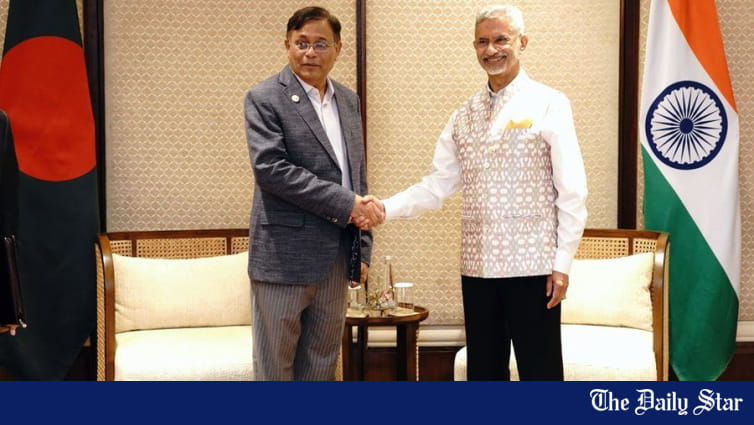
Hasan Mahmud meets Jaishankar in New Delhi

1720744241724.webp

Photo: X/Dr S Jaishankar

Bangladesh Foreign Minister Hasan Mahmud today held a meeting with his Indian counterpart S Jaishankar in New Delhi and discussed ways to further promote bilateral ties.

After the meeting, Jaishankar wrote on X, formerly Twitter, "Good to meet Bangladesh FM @DrHasanMahmud62 this evening in New Delhi."

In a separate post, he said, "The frequent high-level exchanges reflect the strength of India-Bangladesh Maitri. Discussed ways of advancing it further."

Mahmud, who had accompanied Prime Minister Sheikh Hasina on a visit to China recently, is in New Delhi to attend the two-day meeting of Foreign Ministers of BIMSTEC countries -- Bangladesh, Bhutan, Nepal, India, Sri Lanka, Myanmar and Thailand, reports our New Delhi correspondent.​
 

BJP leaders lodge protest with Bangladesh mission in Kolkata
New Age Online 30 July, 2024, 05:52

Senior leader of Bharatiya Janata Party Suvendu Adhikari from the Indian state of West Bengal submitted a protest note to the Bangladesh deputy high commission in Kolkata on Monday, urging action against those who chanted anti-India slogans during recent student protests, according to Indian media outlet theweek.in.

Adhikari, who is the leader of the opposition in the West Bengal assembly, visited the Bangladesh deputy high commission with a group of BJP MLAs and met with Bangladeshi officials.

'We met with officials at the Bangladesh deputy high commission and appealed to them to take action against the people who chanted anti-India slogans. During the recent protests in Bangladesh, slogans were raised against India, and insults were hurled at Indian leaders and the Hindu religion,' Adhikari was quoted as saying.​
 
New foreign affairs adviser told Indian envoy today that Bangladesh will expect her exact proportional share of Teesta water, and there will be no leeway on that issue.

 
Indian businesses (which personally fund Modi's Hindutva activities) are set to lose big - now that Hasina (who actively encouraged Hindutva exploitation in Bangladesh) is out of the picture. What some of the reports below conveniently fail to mention, though, are that Bangladeshi exports to India are paltry ($2 Billion) against Indian exports to Bangladesh ($40 Billion plus, with Bangladeshi tourism and services counted in, medical or otherwise, to India). This unequal state of trade affairs has existed for over fifty years - with India benefitting immensely (mainly Indian states surrounding Bangladesh, with WB at the forefront. India benefitted for fifty years by imposing this unequal trade on Bangladesh since 1971. They have been paid back more than ever for help in 1971 handsomely yet they keep reminding us at every opportunity about 1971.


Last edited:
Back
Top