Home Watch Videos Wars Movies Login

[🇧🇩] Monitoring Bangladesh's Economy

Latest Posts Countries Wars Q&A

[🇧🇩] Monitoring Bangladesh's Economy
979
26K
More threads by Saif

G Bangladesh Defense

Govt employees' pay hike and economic challenges

FE
Published :
Jan 23, 2026 23:28
Updated :
Jan 23, 2026 23:28

1769215235647.webp


The Ninth National Pay Commission report, as submitted on Wednesday (January 21), is learnt to have recommended a sweeping hike in the basic salaries of government servants. Evidently, implementation of this new pay structure is going to cost the state exchequer a humongous sum of additional Tk 1.06 trillion, the pay commission chair, a former finance secretary, reportedly told journalists. It is worthwhile to note that the government at present spends Tk 1.31 trillion as salaries and allowances for its 1.4 million employees and some 0.9 million pensioners. Notably, the commission kept the existing 20-grade pay structure unchanged in its recommendations where the minimum salary grade (the 20th grade) would see the highest raise at 142 per cent, while the topmost grade (1st grade) would experience a hundred per cent hike. In this connection, the finance adviser reportedly informed that a committee would be formed to work on the method of executing the recommended pay scale. Since the incumbent interim government, which has practically no time in its hand to carry out the task of implementing the new pay sale, it is obviously going to be a responsibility of the next government to be elected on February 12 to do the job. Obviously, this is going to put an added financial burden on the government at a time when economy is facing challenges from inflation, stagnated real wage and eroding purchasing power of the people.

However, there is no question that the government servants deserve an increase in their salaries since they have not seen any enhancement of their pay packages since the eighth pay commission which came more than a decade back in 2013. By this time the cost of living has experienced a significant rise, thanks to the depreciation of Bangladesh Taka (BDT) against the US dollar and an attendant rise in the prices of essential commodities. Add to that the pressure of inflation, which saw a surge in 2022 and the upward trend continued until it reached its highest point during the July 2024 upsurge. However, of late, it has eased slightly at around 8.49 per cent. This is cold comfort for the overall condition of the economy. Under the circumstances, the government had fewer options but to increase the salaries of its employees.

But at the same time, the government will be in a predicament regarding execution of the new pay scale. Where is this additional amount of more than one trillion taka, coming from? As estimates go, implementation of the new pay scale will account for more than 11 per cent of the total national budget and 14 per cent of the revenue budget. But so far, the government's revenue mobilisation has not seen any marked improvement. Also, every time there is a pay hike of government servants, the kitchen market turns volatile. Perhaps, the essentials' market has already stared to become unstable in response to the government's latest move to hike up its employees' salaries. Despite such concerns, some positive development to note so far, has been improvements in the flow of homebound remittances that helped foreign exchange reserves to rise to a comfortable level. That apart, the private sector, that creates employment, saw little growth and no foreign investment was forthcoming. But despite the challenges, it is commendable that the interim government could finally come up with a recommendation for pay hike of the government servants. Hopefully, the next elected government would be able to fulfil the remaining part of the interim administration's work in this regard.​
 
Analyze

Analyze Post

Add your ideas here:
Highlight Cite Respond
Analyze

Analyze Post

Add your ideas here:
Highlight Cite Respond

Election time inflation in Bangladesh

Asjadul Kibria
Published :
Jan 24, 2026 22:28
Updated :
Jan 24, 2026 22:28

1769300924257.webp


National elections critically influence economic growth and inflation across countries. Studies have examined patterns such as declining growth and rising inflation in election years. As Bangladesh prepares for the 13th parliamentary election on February 12, along with the referendum on the July Charter and related constitutional amendments, it may be worthwhile to explore the inflation-election correlation.

Some interesting observations come from studies on the inflation-election relationship, mostly by economists in developed countries. For example, right-wing incumbent governments usually fight inflation during election years. Left-wing incumbents focus on reducing unemployment instead of inflation and may allow inflation to rise at the start of their term.

Five decades ago, economist William D Nordhaus published ‘The Political Business Cycle’ in The Review of Economic Studies (Volume 42, Issue 2, April 1975, Pages 169–190). The paper pioneered an analytical framework showing that macroeconomic variables are influenced by political considerations. According to Nordhaus, governments are driven by private interest and focus on reelection. They exploit the short-term Phillips curve and benefit from voters’ naïve expectations to achieve this. The theory also states that since voters are generally concerned about unemployment, incumbents improve their reelection chances by increasing inflation so unemployment falls just before the election. After the election, the government faces high inflation and then implements austerity, leading to more unemployment. [Éric Dubois. Political Business Cycles 40 Years after Nordhaus. Public Choice, 2016, 166 (1-2), pp.235-259]. Unemployment and inflation are thus subject to cyclical fluctuations linked to the electoral cycle, called “political business cycles” (PBCs).

Nordhaus was, however, not the first to identify the PBC, as others had discussed the concept for at least two decades before his paper. His work became popular because of its analytical model and the timing of its publication. It appeared during a period of increasing instability in macroeconomic variables, especially inflation. According to economist Eric Dubois, “These fluctuations, when not expected, are sources of uncertainty that penalize investment and undermine growth. Economic scholars were searching for the origins of this instability, and Nordhaus (1975) provided an answer: the volatility of inflation comes from electoral manipulations.”

Since the introduction of the PBC theory in 1975, a large body of literature has emerged over the next five decades examining political business cycles in various contexts. These studies on PBCs argue that economic activities are likely influenced by political elections. For example, governments often adopt expansionary fiscal and, in election years, monetary policies. Fiscal expansion includes tax cuts and spending increases to attract voters. The studies also argue that in an election year, the economy usually improves due to large amounts of spending on political campaigning.

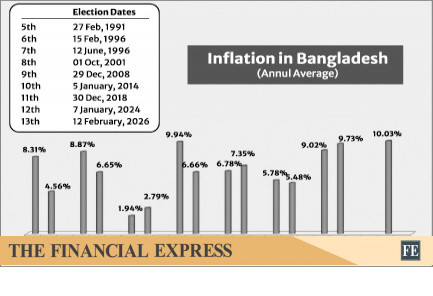
This article briefly reviews annual inflation trends in the election year and the year before the election over the last three and a half decades in Bangladesh. During this period, the country held seven parliamentary elections, from the 5th to the 12th national polls. The 6th and 7th elections, held only four months apart in the same fiscal year, are not considered separately.

It is to be noted that the 6th election was critical to uphold the constitutional obligation. Hasina-led Bangladesh Awami League (BAL) launched a movement pressing for a caretaker government, which turned violent by mid-1995. Khaleda Zia, the then prime minister and leader of BNP, finally agreed to meet the demand as the movement seriously disrupted economic activities. She was, however, adamant to hold the 6th national election under the party in power. So, the election took place on February 15, and BNP won an overwhelming majority as the major opposition parties, namely BAL, Jatiya Party, and Jamat-e-Islami, boycotted the poll. Khaleda took oath for the second time as the PM, and the short-lived parliament passed the 13th amendment to the constitution, which included a provision for a caretaker government to conduct national elections in the country. Following the amendment, Khaleda’s cabinet handed over power to Chief Justice Muhammad Habibur Rahman, who became the chief advisor, or head, of the caretaker government.

Inflation in election years over the last three decades and a half showed a mixed pattern: it increased after elections four times and declined three times. For example, the annual average inflation rate was 8.31 per cent in FY90, the year before the election, and dropped to 4.56 per cent at the end of FY91. The fifth national parliamentary election was held on February 27, 1991. Annual average inflation also rose to 2.79 per cent in FY02 from 1.94 per cent in FY01, with the eighth parliamentary election on October 1, 2001.

Various factors may influence inflation after the polls, such as the new government’s immediate steps to contain price pressures. The expectation of post-election socio-economic stability also plays a key role. The money supply, which was presumed to increase before the polls, moderated, easing inflationary pressure. Once elected or reelected, the government may not focus on inflation and instead spend heavily on development activities. As a result, the money supply increases, pushing inflation higher.

The time gap between election days and the end of fiscal years is also important, though no consistent trends appear. For example, inflation rose to 7.35 per cent at the end of FY14, with the election on January 5, 2024. Inflation declined to 5.48 per cent in FY19 from 5.78 per cent in FY18, following the December 30, 2018, election. In both cases, there was a 6-month gap between the election and the fiscal year-end.

The inflation trend during election periods suggests the PBC has a weak presence in Bangladesh. The PBC theory relies on the unemployment-inflation link, which is largely absent in Bangladesh because of limited labor data. However, fluctuations in economic growth during election years also deserve review, as voters like growth and dislike inflation and unemployment. The election-growth correlation is also important in identifying the presence of PBC, and this column will try to focus on the issue in another article before the national election.​
 
Analyze

Analyze Post

Add your ideas here:
Highlight Cite Respond

Kitchen market growing jittery once again

Neil Ray
Published :
Jan 26, 2026 00:01
Updated :
Jan 26, 2026 00:01


1769390072881.webp

Kitchen market serves as the pulse of microeconomics in a country. Prices, however affordable or not, depend on supply of essentials due to seasonal variations. Winter is the time when there is a surfeit of vegetables in market and naturally prices fall. But Bangladesh is a country that often defies demand-supply theory. As is the case right now, winter vegetables are still flooding the kitchen market but suddenly prices of these essentials have shot up this week. Compared to the past week, different kinds of vegetables are selling at prices higher by Tk 10-20 a kilogram or a piece.

There is nothing to be surprised if this has a connection with the making of the pay package for government officers and employees public. Although the proposed higher pay scale recommended has no chance of getting implemented during the tenure of the interim government, who cares? The implementation or rejection of this pay package solely depends on the discretion of the next elected government. Even if the elected government agrees to raise salaries of government employees, it may not approve the raise at the rates suggested in the pay commission's report. Because involved here is more than Tk1.0 trillion. Where will the money come from?

The problem here is that those in business and trade need a slight hint of anything propitious for driving commodities' price escalation. Or, there is no logic behind this sudden market volatility. Again, hiking price this time may be a trial run before the Ramadan that is knocking at the door. No one claims that production at the field is poor or there is any supply disruption and yet this sudden increase in prices has been fuelled irrationally. If vegetables are dear at this time, collusion and machination behind the latest price hike cannot be ruled out.

The prices of all kinds of chicken have also followed suit. If price of broiler chicken has gone up by Tk 10-20, Sonali and other varieties have registered prices higher by Tk20-30. The rice market once again became jittery a week ago ---and this happened from time to time ---when each kilogram became dearer by Tk2.0-5.0. Before inflation could ease a little, the combined impact of the staple, vegetables and chicken has indicated that it is stubborn enough not to provide the common people with some relief.

What is particularly depressing is that the whole episode is the result of an orchestration by devious and avaricious middlemen and wholesalers. Farmers who produce vegetables and manage poultry and fish farms hardly get benefit from such price escalations. Exchange of hands several times ---not fewer than four to five ---is yet another reason for addition of costs at each point. The margin of profit gets dissipated because of such addition of cost at each step.

So there is a clear case of rooting out the various exchange points in between producers and consumers. No government has tried to help farmers with the problem of transportation of their produce from farms to urban centres where consumers have to pay many times more than the prices at the farm level.

This can be done easily if the government uses a large pool of trucks and goods wagons of the railway for carrying goods to distant markets. Bangladesh Road Transport Corporation (BRTC) trucks can be used for the purpose and similarly one freight wagon should be added to every passenger train for transportation of perishable agricultural produce. The transportation cost will be minimal if the facility of using the freight wagon is reserved for farm produce or other daily essentials. The BRTC can earn money from such a venture and the railway also can take a share in the transportation charge. Apart from curtailing the intermediary elements, goods transportation can avoid paying illegal tolls at several points.

To check market inflation, such a strategy can be highly useful. During the Covid 19 epidemic, such a market was arranged with trucks directly bringing vegetables there from farms. That initiative can be expanded and made a permanent system to make the social parasites like notorious middlemen and illegal toll collectors in between redundant. This way inflation can be tamed to a large extent.​
 
Analyze

Analyze Post

Add your ideas here:
Highlight Cite Respond

Economy to grow at 5pc in 2026

FE REPORT
Published :
Jan 26, 2026 00:27
Updated :
Jan 26, 2026 00:27

1769390192389.webp


The General Economics Division (GED) has projected a delicate balance between a recovering growth trajectory and persistent structural hurdles, saying the economy could grow at 5.0 per cent in the current calendar year.


According to the January 2026 Economic Update and Outlook released on Sunday by the GED under the Planning Commission, the economy will expand by 5.0 per cent in 2026.

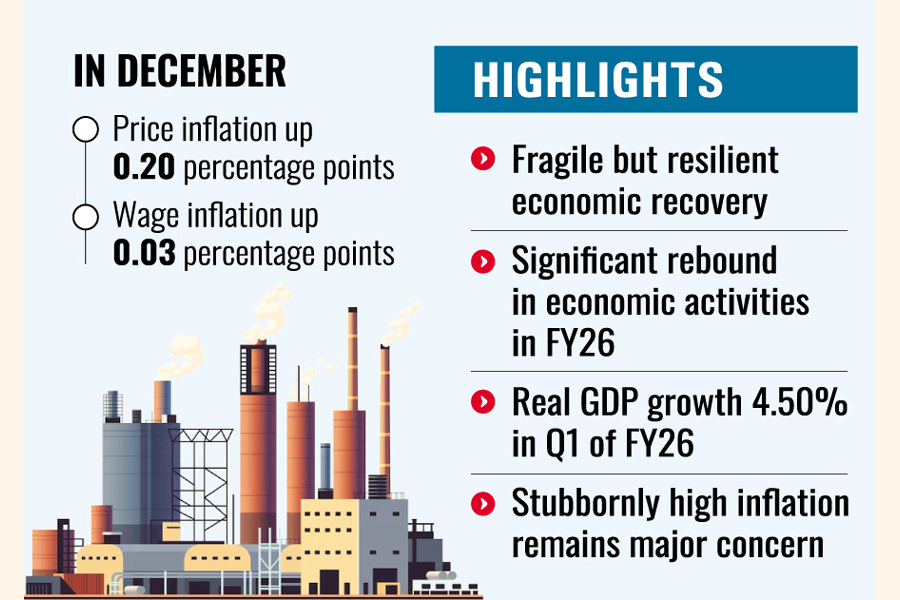
The report highlights a "fragile but resilient" recovery as the country navigates a complex democratic transition and prepares for its graduation from the Least Developed Country (LDC) category.

It notes a significant rebound in economic activities compared to the previous fiscal year.

Provisional data for the first quarter of FY26 shows real Gross Domestic Product (GDP) growth rising to 4.50 per cent, a sharp increase from the 2.58 per cent recorded in the same period last year.

The GED said the most pressing concern remained the stubbornly high inflation, which was currently outpacing wage growth and squeezing household purchasing power.

While price inflation increased by 0.20 percentage points last month, wage inflation only grew by 0.03 percentage points to 8.07 per cent, indicating that real income was falling behind.

On a positive note, the external sector showed signs of stabilisation.

Gross foreign exchange reserves strengthened to $33.19 billion in December 2025.

Remittance inflows hit a robust $3.22 billion that month, aided by a more favourable exchange rate and regulatory incentives.

Earnings stabilised at roughly $4.0 billion per month, with the readymade garment (RMG) sector continuing to provide the bulk share of foreign currency.

The GED cautioned that despite the 5.0 per cent growth outlook, several risks could derail the recovery.

"The economy will require strong governance, policy consistency, and sustained investment in skills to diversify beyond the garment sector. Uncertainty among economic elites and institutional weaknesses remains a significant risk during this transition," the report said.​
 
Analyze

Analyze Post

Add your ideas here:
Highlight Cite Respond

Without radical trade reforms, Bangladesh risks losing competitive edge: economist

By Star Business

1769476224617.webp


Bangladesh may fall behind peers and competing economies without radical reforms in tariffs and trade facilitation within five years, an economist warned today.

“Unfortunately, we have not undertaken significant trade policy reforms over the past 15 to 16 years, and all the reform work has now piled up,” said Zaidi Sattar, chairman of the Policy Research Institute of Bangladesh, at an event marking International Customs Day 2026 at the National Board of Revenue (NBR) headquarters in Agargaon.

“Compared to international standards, Bangladesh’s tariff regime is very high and extremely complex,” he said.

This makes customs procedures cumbersome, raises compliance costs and weakens the country’s competitiveness in global value chains, he added, stressing the need for extensive customs modernisation and radical liberalisation of the trade policy.

"If radical changes are not implemented within the next five years -- particularly in tariff rationalisation, tariff modernisation, and trade facilitation -- and if strong measures are not taken in these areas over the next three to five years, the country’s economy will fall behind many other competitive economies,” the economist said.

He expressed optimism that Bangladesh would move towards a modern customs administration that prioritises trade facilitation over revenue collection.

“At present, trade taxes account for around 2.5 percent of GDP. By 2035, this should decline to no more than 1 percent,” he said, adding that the reduction will ensure trade facilitation through a modern customs system.

At the event, Commerce Secretary Mahbubur Rahman urged NBR to prioritise process simplification to remove non-tariff barriers that continue to impede trade.

He noted that visiting European Commission officials recently raised a long list of concerns, many of which were linked to customs procedures.

“People are not really asking us to remove high tariffs. They are raising concerns over legitimate technical barriers to trade,” he said, adding that around 15 of the EU’s concerns related to customs processes and day-to-day operational practices rather than formal rules and regulations.

The commerce secretary said Bangladesh’s upcoming LDC graduation has made trade facilitation more urgent, as the country seeks to retain preferential market access through agreements with key partners.

“We have already initiated the second round of negotiations for a Comprehensive Economic Partnership Agreement with South Korea. We will soon begin negotiations with the European Union, and also with Australia and Canada,” he said.

NBR Chairman Md Abdur Rahman Khan chaired the event, where nine new firms received Authorised Economic Operator certificates and 15 customs and VAT officials from Bangladesh received the World Customs Organisation (WCO) Certificate of Merit in recognition of their professional excellence and contributions.​
 
Analyze

Analyze Post

Add your ideas here:
Highlight Cite Respond

Economic reading of BD's 2025 ordinances

Syed Abul Basher
Published :
Jan 27, 2026 22:58
Updated :
Jan 27, 2026 22:58

1769561533864.webp


In 2025, Bangladesh's interim government issued 78 ordinances covering labour rights, judicial procedures, digital security, and constitutional governance. These ordinances carry economic consequences. As economic activity is ultimately governed by law, changes in rules and institutions directly affect transaction costs, property rights, and investment incentives. In turn, these legal changes alter expected returns, risks, and bargaining positions.

Previously, to form a union, workers needed to meet a 20 per cent membership threshold. This meant that a factory with 100 workers required mobilising 20 workers, whereas a factory with 500 workers needed 100 workers to form a union. For medium to large factories, meeting this threshold was difficult, since employers could easily intimidate key organisers to prevent unionisation. The 2025 Labour (Amendment) Ordinance addressed this barrier by moving from a percentage-based rule to a fixed-number approach. Factories with 20-300 employees can now form a union with just 20 workers. This change came partly in response to criticism from the European Union (EU) and International Labor Organization (ILO), which argued that the percentage rule blocked workers from exercising freedom of association.

From an economic standpoint, this reduces the fixed cost of collective action. It shifts the Nash bargaining position of workers upward, allowing them to capture a larger share of firm surplus. The reform also raises penalties for unfair labour practices under Sections 294-295, increasing the expected cost of anti-union behaviour. The combined effect is to raise expected wages and job security, but also to increase unit labour costs faced by firms. Whether this improves stability or raises conflict is an empirical question, but incentives have clearly shifted.

Currently, Bangladesh's garment exports to the EU enjoy duty-free access under the Everything But Arms (EBA) scheme. After 2029, to continue enjoying preferential access, Bangladesh will need to qualify for GSP-plus, which requires compliance with labour rights conventions. Losing this status would impose tariffs of roughly 9-12 per cent on garments. This amounts to a negative price shock to Bangladeshi exports. Unless firms can pass costs to buyers, a 10 per cent tariff reduces exporter revenue and profitability by roughly the same margin. Since Bangladesh operates in a highly competitive global garment market, most of the burden would fall on domestic producers and workers.

The labour reforms should therefore be understood as an investment in market access. By raising compliance today, Bangladesh lowers the probability of a catastrophic trade shock tomorrow. In expected-value terms, modest increases in labour costs now can be justified if they reduce the risk of losing billions of dollars in export earnings later.

Belatedly, the Women and Children Repression Prevention Ordinance expanded the legal definition of sexual violence and strengthened penalties, while the International Crimes Tribunal (ICT) amendments made it possible to prosecute organisations, not just individuals, for political violence. These changes increase the expected cost of committing or tolerating violence. When legal protection is weak, violence and fear discourage women from travelling, working, or staying in school-reducing labour force participation and human-capital investment. Stronger enforcement can raise the return to education and formal work, particularly for girls. The same logic applies to investors. When organised political violence carries a higher legal risk, long-term investment becomes safer, lowering the political-risk premium built into interest rates and foreign investment decisions.

For too long, Bangladesh's judicial system has imposed high transaction costs on economic activity. It often took many years to settle commercial disputes, or sometimes they remained unresolved. As a result, capital was tied up, raising the effective cost of doing business. Meanwhile, arbitrary enforcement created legal uncertainty that discouraged formal contracting and long-term investment. The 2025 legislative reforms attempt to address these frictions by reducing delays and discretion.

Under the amendments to the Criminal Procedure Code (CrPC), police are now required to identify themselves during arrests, prepare written arrest memoranda, and maintain digital records. The expansion of magistrates' fine-imposing powers will likely speed case resolution by allowing minor cases to be resolved without full trials. These changes not only reduce arbitrary enforcement risk but also increase the predictability of legal outcomes. Together, these reforms will likely lower state opportunism and the regulatory burden on firms and households.

Similarly, under the new Civil Procedure Code (CPC), courts now accept electronic service of summons through SMS, voice calls, and messaging apps, allowing judges to hear more cases per day. Moreover, to discourage frivolous litigation, compensation for false claims has increased to Tk 50,000. Importantly, the separation of civil and criminal courts at the district level allows judges to specialise rather than handling both types of cases. Together, these amendments make contract enforcement faster and more reliable, freeing up capital and improving its allocation across the economy.

The economic payoff from these judicial reforms, however, depends on enforcement capacity. As of December 2024, Bangladesh faced a backlog of over 45 lakh cases. Unless the government recruits more judges, builds more courtrooms, and implements functioning digital systems, procedural reforms alone will not be enough. In economic terms, unless these rules are credibly enforced, the underlying transaction costs of doing business will remain high, and private investment and productivity will not respond.

A longstanding problem in Bangladesh is weak credible commitment. Independent institutions such as the judiciary, election bodies, and anti-corruption agencies have long been seen as politically captured, raising doubts about property rights and policy stability. The proposed constitutional reforms aim to disperse power more widely. A bicameral legislature with a proportional upper house would ensure continued opposition influence. Key oversight committees would be assigned to opposition members. A ten-year limit on the prime minister would reduce power concentration. Making the Anti-Corruption Commission a constitutional body would increase its independence.

Economically, these reforms function as commitment devices. Bangladesh's sovereign bonds have historically traded at spreads of 200-400 basis points above comparable economies, reflecting political risk. More credible institutions can reduce these spreads and borrowing costs.

Finally, the previous Digital Security Act (DSA) had created a climate of legal unpredictability. The new ordinance makes most offenses bailable while retaining protections against cybercrime. This is welcome for digital entrepreneurs as it lowers the downside risk. With reduced legal risk, the expected return to innovation rises. As software and IT exports depend more on human capital than physical infrastructure, legal predictability is a binding input into sectoral growth.

Bangladesh already has many good laws. But enforcement is the binding constraint. In economic terms, laws without enforcement are meaningless contracts. Unless labour inspectors, courts, regulators, and the ACC are adequately staffed and insulated from political pressure, the ordinances will not change incentives. Trade partners and financial markets respond to outcomes, not statutes.

The 2025 ordinances are economically coherent responses to Bangladesh's vulnerabilities as a trade-dependent, investment-constrained economy-attempting to improve labour credibility, reduce transaction costs, lower political risk, and stimulate innovation. If implemented credibly, these reforms can raise the expected return to investment and human capital, moving Bangladesh onto a higher growth path. If not, they will remain symbolic, and the economic risks facing the country will persist.​
 
Analyze

Analyze Post

Add your ideas here:
Highlight Cite Respond

Tradable savings certificate on bond market

Published :
Jan 28, 2026 23:16
Updated :
Jan 28, 2026 23:16

1769646802583.webp


The liquidity crisis in banks stemming mainly from non-performing loans (NPLs) has long stoked the compulsion of exploring alternative sources of sustainable fund. Since foreign investment is hard to come by, the search for such alternative sources has become even more compelling. Now the Bangladesh Bank (BB) and business circle have hit upon the idea of making savings certificate tradable on the bond market so that corporate bodies can turn to the bond market for their financing needs. As reported from a seminar on 'Bond Market Development in Bangladesh: Challenges and Recommendations' held on Monday last, Bangladesh has a savings certificate market worth Tk6.0 trillion but, according to the BB governor, its size can be doubled if such certificates are made tradable on the market like the shares on the stock market. The capital market scams---not once but twice--- have left investors' confidence low and therefore the corporate credit needs can be met by pooling funds from tradable savings certificate.

There is nothing wrong with the rerouting of savings to productive sector provided that the task is done efficiently, guaranteeing security of the savings. Money does not grow automatically but only when it is made to roll for productive purposes. Bond market is as good as the robustness of the corporate world. In case of business slump, it also turns bearing like the stock market. People who invest money in savings certificates, unlike in the stock market, do so in good faith that the declared profit return is failsafe. A new dimension is added to the savings certificate with allowing it to be tradable on bond market. Infusion of savings certificates into this particular financing sector is expected to bring about quite a shift in the mobilisation of funds by private enterprises. The pressure on banks for funds will ease to some extent.

Corporate bodies with lower bond-market exposure will be encouraged to make their presence felt significantly in the bond market. The BB governor made it clear that the central bank will apply both push and pull factors to develop the bond market. In this connection, the BB will invite corporate bodies less exposed to bond market to a meeting to know about the latter's requirements for their active participation in the bond market. He adds that single borrower exposure limit must be respected. In that case, the corporate entities either have to 'go for overseas borrowing or look for bond and capital market'.

If the push factor does not achieve the target, a pull factor will be applied to encourage them for exploring the untapped potential of the bond market. Under the system, incentives like cutting the bond-issuing timeline and costs; and revisiting tax treatment may be considered. Clearly, things are yet to be streamlined enough but the initiatives will gradually make clear how the landscape of mobilisation of fund from such alternative sources can be achieved. In that case, the need for regular and competent oversight by the central bank will be of utmost importance. Given the deplorable experiences of the capital market, the trading of savings certificates on the bond market will have to go by the prescribed rules for ensuring its compatibility with the local business environment.​
 
Analyze

Analyze Post

Add your ideas here:
Highlight Cite Respond

Members Online

Latest Posts

Back
 
G
O
 
H
O
M
E