Bangladesh Defense
Saif
Senior Member
- Joined
- Jan 24, 2024
- Messages
- 16,508
- Likes
- 8,140
- Nation

- Residence
- Axis Group

It’s time to modernise our air force
Urban density in Dhaka has surpassed the thresholds for safe air operations. Military and civil aviation now operate in a dangerously overlapping airspace.
It’s time to modernise our air force

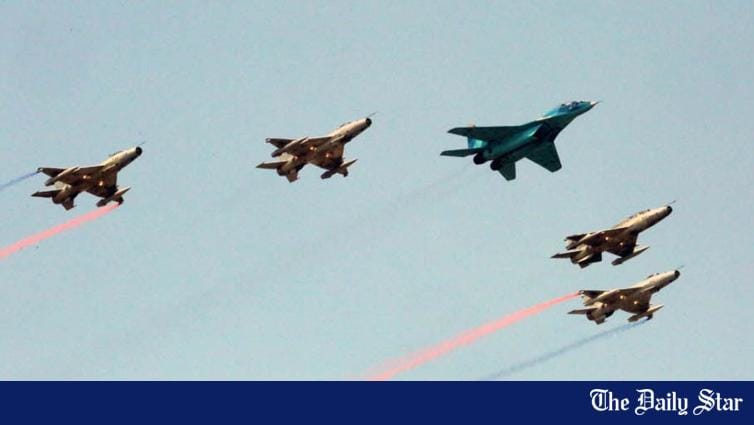
Securing sovereignty in the air requires clarity of doctrine, capability for deterrence, and commitment to modernisation. PHOTO: PID
The crash of a Bangladesh Air Force fighter jet into Milestone School on July 21, 2025, was a moment of national reckoning. It was not merely a tragic accident, but a visible consequence of accumulated neglect in planning. The human cost is now etched in our collective memory.
The crash exposed more than a mechanical fault. It revealed a strategic vacuum—a lack of alignment between the growth of the nation and the transformation of its air power. Against a backdrop of economic ambition, urban expansion, and regional volatility, the country's military infrastructure has not kept pace. This is not just a matter of decisive modernisation or equipment upgrades, but also a need to revisit the strategies guiding the country's airspace security.
Airspace security
Airspace is no longer an inert boundary, but rather a dynamic domain. Securing it requires layered surveillance, rapid response, and integrated command. For Bangladesh, the strategic urgency of airspace security cannot be overstated. It is bordered by India, a regional air power with robust force projection, and Myanmar, where militarisation and instability continue to intensify along the frontier.
The country's airspace is both congested and vulnerable—crowded with civil aviation, military operations, and increasingly unregulated drone traffic. These pose threats to critical installations and population centres. Sadly, what exists today is a patchwork system where reaction replaces anticipation, and gaps in coverage are filled with hope rather than capability.
The situation calls for Bangladesh to build a national airspace architecture with three pillars: persistent early warning systems, an agile interceptor fleet, and data fusion centres, enabling real-time coordination across military and civilian domains.
Power and politics
Air power is not a support arm, but rather a strategic determinant. It extends beyond the battlefield into the realms of diplomacy, deterrence, and doctrine. Countries project air power not only to defend but also to define their role in the geopolitical and geo-economic order.
This is evident across South Asia. India has expanded air bases in its northeast, not merely for national defence but for strategic signalling. It is integrating air capabilities with space-based intelligence and precision strike systems. Meanwhile, Myanmar's military junta, despite sanctions and diplomatic pressure, has invested significantly in combat aircraft to maintain internal control and regional posture.
Bangladesh cannot afford to remain static while its neighbours modernise. Air power is no longer about proximity. It is about presence and the ability to command the skies, matching the aspiration of a nation. Whether in response to cross-border threats, humanitarian missions, or geopolitical deterrence, the ability to command airspace must be a central element of Bangladesh's progress and prosperity.
Doctrine and deterrence
Singapore, with limited strategic depth and territorial skies, has crafted one of Asia's most credible air power doctrines. The strategy rests on pre-emption, networked platforms, and technological supremacy. It does not rely on size but on speed—of detection, decision, and delivery. Singapore's early warning aircraft are networked with data links and ground control. It invests not only in aircraft but in the operational ecosystem that makes the response effective. This is a lesson Bangladesh must heed: modern air power is not about numbers but about integration, agility, and the ability to act decisively.
Bangladesh's Forces Goal 2030 envisaged a shift in principle—a modern tri-service structure with strategic deterrence and interoperable capacities. But implementation remains sluggish. The Air Force is the slowest to modernise.
Without clarity of role, the Air Force becomes reactive. Without a broad employment strategy, procurement becomes piecemeal. Without credible deterrence, diplomacy is exposed to coercion. As regional air doctrines evolve towards integrated multi-domain operations, Bangladesh must not be caught in the inertia of past assumptions.
Beyond the budget
The idea that Bangladesh cannot afford air modernisation must be challenged. National security is not an abstract ideal. It is a public good, foundational to economic and social stability. A modern air force supports not only war deterrence but also disaster response, border surveillance, counterterrorism, and civil-military coordination. It is both a shield and an enabler of development.
At one percent of GDP—which has declined in recent years—Bangladesh's military expenditure lags behind its developmental trajectory and the accelerated growth of regional counterparts. This is not an argument for excessive militarisation, but for smart allocation, prioritising capabilities that deliver strategic returns.
Modernisation is not about prestige purchases but about capability integration—including Airborne Warning and Control System (AWACS) platforms, long-range multirole combat aircraft (MRCA), anti-drone systems, and electromagnetic warfare preparedness.
Bangladesh must move beyond episodic procurement and towards platform synergies—linking aircraft, surveillance, command, and electronic warfare into a cohesive force.
A fractured fragmentation
Urban density in Dhaka has surpassed the thresholds for safe air operations. Military and civil aviation now operate in a dangerously overlapping airspace. Yet air base relocation proposals—from Kurmitola to Trishal, and the planned shift to Arial Beel—remain incomplete or indefinitely deferred. These failures are not logistical. They are political and institutional, reflecting a dearth of strategic prioritisation.
Even among military institutions, there exists turf protection, outweighing strategic coherence and breeding risks. Bangladesh's defence planning must encompass land, water, aerial and hybrid dimensions. There is also an urgency for institutional reform to facilitate at least biannual joint-domain operations.
Mature modernisation
Securing sovereignty in the air requires clarity of doctrine, capability for deterrence, and commitment to modernise. A credible air force does not only defend the skies. It provides the reach, response, and resilience needed in a century where threats travel faster than ever before. It enables national development. It ensures that a growing economy is not hostage to security fragility.
The shocking event of July 21 marks a turning point not only in mourning, but also in meaning. Bangladesh must reimagine its defence thinking, reclaim its sky, and modernise with purpose—not merely to fly higher, but to think further.
Dr Rashed Al Mahmud Titumir is professor at the Department of Development Studies, University of Dhaka.
Securing sovereignty in the air requires clarity of doctrine, capability for deterrence, and commitment to modernisation. PHOTO: PID
The crash of a Bangladesh Air Force fighter jet into Milestone School on July 21, 2025, was a moment of national reckoning. It was not merely a tragic accident, but a visible consequence of accumulated neglect in planning. The human cost is now etched in our collective memory.
The crash exposed more than a mechanical fault. It revealed a strategic vacuum—a lack of alignment between the growth of the nation and the transformation of its air power. Against a backdrop of economic ambition, urban expansion, and regional volatility, the country's military infrastructure has not kept pace. This is not just a matter of decisive modernisation or equipment upgrades, but also a need to revisit the strategies guiding the country's airspace security.
Airspace security
Airspace is no longer an inert boundary, but rather a dynamic domain. Securing it requires layered surveillance, rapid response, and integrated command. For Bangladesh, the strategic urgency of airspace security cannot be overstated. It is bordered by India, a regional air power with robust force projection, and Myanmar, where militarisation and instability continue to intensify along the frontier.
The country's airspace is both congested and vulnerable—crowded with civil aviation, military operations, and increasingly unregulated drone traffic. These pose threats to critical installations and population centres. Sadly, what exists today is a patchwork system where reaction replaces anticipation, and gaps in coverage are filled with hope rather than capability.
The situation calls for Bangladesh to build a national airspace architecture with three pillars: persistent early warning systems, an agile interceptor fleet, and data fusion centres, enabling real-time coordination across military and civilian domains.
Power and politics
Air power is not a support arm, but rather a strategic determinant. It extends beyond the battlefield into the realms of diplomacy, deterrence, and doctrine. Countries project air power not only to defend but also to define their role in the geopolitical and geo-economic order.
This is evident across South Asia. India has expanded air bases in its northeast, not merely for national defence but for strategic signalling. It is integrating air capabilities with space-based intelligence and precision strike systems. Meanwhile, Myanmar's military junta, despite sanctions and diplomatic pressure, has invested significantly in combat aircraft to maintain internal control and regional posture.
Bangladesh cannot afford to remain static while its neighbours modernise. Air power is no longer about proximity. It is about presence and the ability to command the skies, matching the aspiration of a nation. Whether in response to cross-border threats, humanitarian missions, or geopolitical deterrence, the ability to command airspace must be a central element of Bangladesh's progress and prosperity.
Doctrine and deterrence
Singapore, with limited strategic depth and territorial skies, has crafted one of Asia's most credible air power doctrines. The strategy rests on pre-emption, networked platforms, and technological supremacy. It does not rely on size but on speed—of detection, decision, and delivery. Singapore's early warning aircraft are networked with data links and ground control. It invests not only in aircraft but in the operational ecosystem that makes the response effective. This is a lesson Bangladesh must heed: modern air power is not about numbers but about integration, agility, and the ability to act decisively.
Bangladesh's Forces Goal 2030 envisaged a shift in principle—a modern tri-service structure with strategic deterrence and interoperable capacities. But implementation remains sluggish. The Air Force is the slowest to modernise.
Without clarity of role, the Air Force becomes reactive. Without a broad employment strategy, procurement becomes piecemeal. Without credible deterrence, diplomacy is exposed to coercion. As regional air doctrines evolve towards integrated multi-domain operations, Bangladesh must not be caught in the inertia of past assumptions.
Beyond the budget
The idea that Bangladesh cannot afford air modernisation must be challenged. National security is not an abstract ideal. It is a public good, foundational to economic and social stability. A modern air force supports not only war deterrence but also disaster response, border surveillance, counterterrorism, and civil-military coordination. It is both a shield and an enabler of development.
At one percent of GDP—which has declined in recent years—Bangladesh's military expenditure lags behind its developmental trajectory and the accelerated growth of regional counterparts. This is not an argument for excessive militarisation, but for smart allocation, prioritising capabilities that deliver strategic returns.
Modernisation is not about prestige purchases but about capability integration—including Airborne Warning and Control System (AWACS) platforms, long-range multirole combat aircraft (MRCA), anti-drone systems, and electromagnetic warfare preparedness.
Bangladesh must move beyond episodic procurement and towards platform synergies—linking aircraft, surveillance, command, and electronic warfare into a cohesive force.
A fractured fragmentation
Urban density in Dhaka has surpassed the thresholds for safe air operations. Military and civil aviation now operate in a dangerously overlapping airspace. Yet air base relocation proposals—from Kurmitola to Trishal, and the planned shift to Arial Beel—remain incomplete or indefinitely deferred. These failures are not logistical. They are political and institutional, reflecting a dearth of strategic prioritisation.
Even among military institutions, there exists turf protection, outweighing strategic coherence and breeding risks. Bangladesh's defence planning must encompass land, water, aerial and hybrid dimensions. There is also an urgency for institutional reform to facilitate at least biannual joint-domain operations.
Mature modernisation
Securing sovereignty in the air requires clarity of doctrine, capability for deterrence, and commitment to modernise. A credible air force does not only defend the skies. It provides the reach, response, and resilience needed in a century where threats travel faster than ever before. It enables national development. It ensures that a growing economy is not hostage to security fragility.
The shocking event of July 21 marks a turning point not only in mourning, but also in meaning. Bangladesh must reimagine its defence thinking, reclaim its sky, and modernise with purpose—not merely to fly higher, but to think further.
Dr Rashed Al Mahmud Titumir is professor at the Department of Development Studies, University of Dhaka.