Donate ☕
201 Military Defense Forums
[🇧🇩] - Bangladesh Film Industry | Page 17 | PKDefense
Home Post Alerts Inbox Watch Videos

[🇧🇩] Bangladesh Film Industry

Reply (Scroll)
Press space to scroll through posts
G Bangladesh Defense
[🇧🇩] Bangladesh Film Industry
85
7K
More threads by Saif


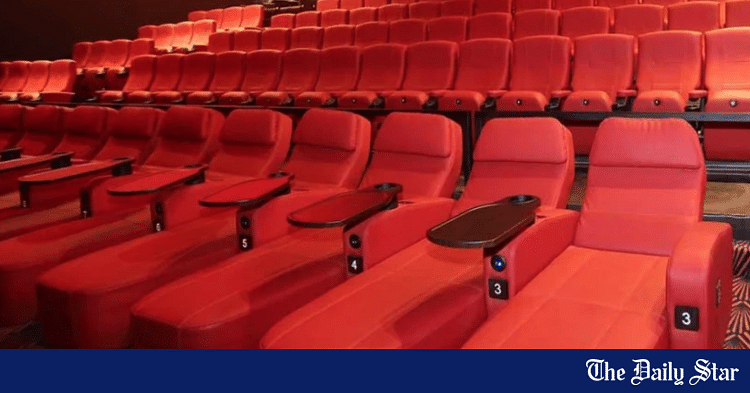
Star Cineplex to launch new branch in Uttara this Eid

1743033090792.webp

Photo: Collected

In response to growing audience demand, Star Cineplex continues to expand its network of multiplex cinemas across the country. As part of this initiative, a brand-new branch is set to be opened in Dhaka's Uttara area on Eid day.

"Located at the shopping arcade Centrepoint near the Hazrat Shahjalal International Airport, the new branch of the popular multiplex is being launched as a special Eid gift for moviegoers," said Cineplex authorities to local media. From Eid day onwards, audiences will be able to enjoy films at this newly built cinema.

Mesbah Uddin Ahmed, senior manager of Media and Marketing at Star Cineplex, stated that the Uttara area has long awaited its own branch. "We've received countless requests—both online and in person—from residents of Uttara to open a branch here. We're thrilled to finally make that happen," he said.

The new multiplex will feature four auditoriums: one VIP hall (83 seats), one Royal hall (48 seats), and two Premium halls (175 and 331 seats respectively). Like its other branches, this one promises a world-class cinematic experience with modern amenities, giant screens, and state-of-the-art sound systems.

Mesbah Uddin added that this location was chosen with convenience in mind, especially for residents of Uttara, Tongi, Savar, and Gazipur, who often face long commutes and traffic congestion to reach existing branches.

Star Cineplex, the country's first multiplex cinema, has gained popularity for its high-quality environment and technology. It currently operates branches in Bashundhara City Shopping Mall, Shimanto Shambhar, SKS Tower, the Military Museum, and Sony Square in Mirpur.​
 
Analyze

Analyze Post

Add your ideas here:
Highlight Cite Fact Check Respond
  • Like (+1)
Reactions: Bilal9

Eid-Ul-Azha: 5 more films receive censor certification

Published :
Jun 04, 2025 23:35
Updated :
Jun 04, 2025 23:35

1749079792888.webp


Five more films scheduled for release this Eid-ul-Azha have received clearance from the Bangladesh Film Certification Board on Wednesday, paving the way for their theatrical debut during the festive season.

The films are 'Taandob', 'Insaaf', 'Togor', 'Utshob', and 'Esha Murder'. Earlier, 'NeelChokro' received its censor approval back in February, UNB reports.

With this, all six films are now officially set for nationwide release during the upcoming Eid-ul-Azha, one of the peak seasons for the country’s film industry.

According to sources at the Film Certification Board, all six films have been granted uncut approval with a 'U' certificate, making them suitable for viewers of all ages.

In terms of runtime, 'Insaaf', directed by Sanjoy Somadder, is the longest among the Eid releases, with a duration of 2 hours 29 minutes and 26 seconds. Conversely, 'Utshob', directed by Tanim Noor, is the shortest at 1 hour 52 minutes and 39 seconds.

The much-anticipated film 'Taandob', directed by Raihan Rafi and starring Shakib Khan, Sabila Nur, and Jaya Ahsan, runs for 2 hours 9 minutes and 52 seconds.

'NeelChokro', featuring Arifin Shuvoo and Mandira Chakraborty, has a runtime of 1 hour 53 minutes and 32 seconds. 'Togor', starring Ador Azad and Puja Cherry, is 2 hours 23 minutes and 46 seconds long. Meanwhile, 'Esha Murder', featuring Azmeri Badhon and Puja Cruz, runs for 2 hours 26 minutes and 25 seconds.

Film enthusiasts are eagerly awaiting this diverse lineup, which is expected to draw large audiences to cinemas across the country during Eid.​
 
Analyze

Analyze Post

Add your ideas here:
Highlight Cite Fact Check Respond
  • Like (+1)
Reactions: Bilal9

Info adviser urges film archive to initiate digitalisation for protecting films

BSS
Published :
Jun 24, 2025 22:14
Updated :
Jun 24, 2025 22:14

1750807490542.webp


Information and Broadcasting Adviser Md Mahfuj Alam today urged Bangladesh Film Archive (BFA) to take initiative to digitalise film archives for protecting films.

He said, “Bangladesh Film Archive must take initiatives to digitalise the archiving methods and for this the institution must be empowered with more capabilities”.

The adviser made the remark at a view exchange meeting after visiting the institute at Agargaon.

Outlining the necessity of film archiving, the adviser said, “The archive has long been playing a crucial role in protecting different kinds of historical documents with cultural and traditional values and safeguarding foreign films in the country”.

“The institution must take initiatives to collect and protect more film documentaries based on the history and culture of Bangladesh,” he added.

He stressed the need for documenting at least 50-year-old elements from old institutional archives like Bangla Academy, Bangladesh Shilpakala Academy and Dhaka University.

Mahfuz called for preserving the writings and interviews of veteran and talented filmmakers and preparing a digital catalogue of all films preserved in the archive to ease film researchers’ and students’ research works.

The adviser assured that the government will provide all-out cooperation in increasing the capacity of the film archive.

Director General of Bangladesh Film Archive Md. Abdul Jalil delivered the address of welcome.

Film archive director Farhana Rahman and other officials and employees of the institution attended the meeting, among others.

Earlier, the adviser visited the projection hall, film museum, film hospital, film vault and library of the film archive.​
 
Analyze

Analyze Post

Add your ideas here:
Highlight Cite Fact Check Respond
  • Like (+1)
Reactions: Bilal9
Cinema as witness to time

1766885366212.webp

Workers Leaving the Lumière Factory. | On Arts and Aesthetics

CINEMA began not as a fiction, but as a document. The history of cinema is celebrated around the globe every year on December 28 and one might argue that it is done so wrongfully. When we speak of World Cinema Day, we often narrate it as the day when the first cinema was created. Similarly, when speaking of the Lumière brothers, they are often described as the inventors of cinema. While this stems from a famous misconception, the real question is why public consciousness prioritises the 1895 screenings over earlier milestones in the history of cinema, such as Louis le Prince’s Roundhay Garden Scene, filmed in October 1888.

Le Prince’s filmmaking process inspired thousands, including the likes of Thomas Edison and Georges Melies. Edison began creating motion pictures that recorded lived realities; athletic displays, Native American traditions, rituals, different forms of dance, even scandalous dance performances became the subject of his cinema. Films such as Dickson Greeting, Newark Athlete, and Men Boxing (1891) were among the first moving images ever recorded on celluloid. This also goes to show that cinema, from its inception, was entangled with spectacle, labour, gender, and, most importantly, the political landscape of a society.

But the most interesting fact is the term used for such films. Early film historians use the term ‘actuality’ to describe these short non-fiction films produced during the first decade of motion picture history. In modern discourse, the term itself holds connotations that extend far beyond the technical definitions assigned by early historians. We now understand recording itself as a political act. Society dictates who, what and how things are to be recorded. And so the term ‘actuality’ serves as a fitting designation for cinema, since it possesses the unique capacity to capture the moral and social truths of its time.

Initially, individuals would peer through the hole of a Kinetoscope to view realities that were already visible to them. Perhaps that experience was able to offer a perspective that the unmediated reality could not. Either way, as Edison’s Kinetoscope gained popularity, the demand for new subjects expanded. War and disaster soon became central subjects. Through these films, cinema functioned as an early visual archive of modern history.

Yet despite this vast documentary impulse, Edison’s cinema remained largely private. In theory, there is nothing inherently wrong with cinema being viewed individually. Many modern filmmakers deliberately resist open commercial circulation and prefer to screen their films in closed, controlled, or semi-private contexts. Even then, the experience is often shared among like-minded peers. However, the Kinetoscope was restricted to a single viewer at a time. This changed decisively with the invention of the Cinematographe, which, for the first time, enabled cinema to be screened for a public audience.

The Lumière brothers, Auguste and Louis, arranged the first public screening of a movie in Paris in 1895, featuring films like Workers Leaving the Lumière Factory. This event transformed the possibilities cinema had to offer by creating a collective viewing experience.

While the Kinetoscope functioned as a voyeuristic device, the Cinematographe became a democratic one. Cinema moved from the peephole to the screen, from individual curiosity to shared spectatorship. Even the word ‘cinema’ was not originally intended to describe the flickering light alone; it was the name of the space where movies are to be screened. To name the art after the space it occupies is to admit that its very soul is social, that it exists not in the isolation of the eye, but in the collective breathing of the crowd.

Thus, early cinema was defined by two foundational qualities: the ability to document reality and the power to reach the masses. While Le Prince and many others can be accredited as the first filmmakers, history chooses to remember the Lumière brothers for establishing cinema as a public, social event on December 28, 1895.

On World Cinema Day, we remember the social nature of cinema to understand the power the screen holds to remember, narrate, and deliver. It is a vessel designed to hold what the world tries to discard; memories of injustice, the cold weight of violence, and the silent machinery of exploitation. And it does more than just narrate loss and grief. It carries our everyday dreams and stubborn hopes, and that persistent ache for a better world, delivering them from the individual consciousness to the public eye. In times like these, the philosophical argument regarding the ethics of a filmmaker or a film activist is no longer a theoretical debate, but a social reality, a burden of truth that the artist must carry.

Ania Fahmin is a student of anthropology at the University of Dhaka.​
 
Analyze

Analyze Post

Add your ideas here:
Highlight Cite Fact Check Respond

Star Cineplex to launch new branch in Uttara this Eid

View attachment 15960
Photo: Collected

In response to growing audience demand, Star Cineplex continues to expand its network of multiplex cinemas across the country. As part of this initiative, a brand-new branch is set to be opened in Dhaka's Uttara area on Eid day.

"Located at the shopping arcade Centrepoint near the Hazrat Shahjalal International Airport, the new branch of the popular multiplex is being launched as a special Eid gift for moviegoers," said Cineplex authorities to local media. From Eid day onwards, audiences will be able to enjoy films at this newly built cinema.

Mesbah Uddin Ahmed, senior manager of Media and Marketing at Star Cineplex, stated that the Uttara area has long awaited its own branch. "We've received countless requests—both online and in person—from residents of Uttara to open a branch here. We're thrilled to finally make that happen," he said.

The new multiplex will feature four auditoriums: one VIP hall (83 seats), one Royal hall (48 seats), and two Premium halls (175 and 331 seats respectively). Like its other branches, this one promises a world-class cinematic experience with modern amenities, giant screens, and state-of-the-art sound systems.

Mesbah Uddin added that this location was chosen with convenience in mind, especially for residents of Uttara, Tongi, Savar, and Gazipur, who often face long commutes and traffic congestion to reach existing branches.

Star Cineplex, the country's first multiplex cinema, has gained popularity for its high-quality environment and technology. It currently operates branches in Bashundhara City Shopping Mall, Shimanto Shambhar, SKS Tower, the Military Museum, and Sony Square in Mirpur.​

I've been to the Centrepoint Mall near Hazrat Shahjalal International Airport. The CINEPLEX seems open but about 40% of the store spaces are still empty. But the mall is pretty high standard, all steel and glass and very open in design.
 
Last edited:
Analyze

Analyze Post

Add your ideas here:
Highlight Cite Fact Check Respond

Members Online

⤵︎

Latest Posts

Latest Posts