Donate ☕
201 Military Defense Forums
[🇧🇩] - Budget for 2025- 2026 | Page 12 | PKDefense
Home Login Forums Wars Watch Videos
Serious discussion on defense, geopolitics, and global security.

[🇧🇩] Budget for 2025- 2026

Reply (Scroll)
Press space to scroll through posts
G Bangladesh Defense
[🇧🇩] Budget for 2025- 2026
72
2K
More threads by Saif

FY26 budget to prioritise reform initiatives
Shakhawat Hossain 02 March, 2025, 23:39

1740960409060.png


The national budget for the forthcoming financial year of 2025-26 will focus on the reform initiatives taken by the interim government aiming at ensuring good governance, eradicating poverty and curbing discrimination to achieve an inclusive economic growth in the country.

Officials referring to a directive given by finance secretary Khairuzzaman Mozumder in the past month said that all ministries and divisions were asked to send information linked to reform programmes taken by the interim government that assumed power on August 8, 2024 after the ouster of autocratic Awami League regime in a mass uprising in July-August past year.

The ministries and divisions have been asked to send the information by March 15, added the officials.

Finance adviser Salehuddin Ahmed, who is expected to announce the national budget on June 5, in his speech would give the updates on reforms in the areas of good governance, inclusive growth and poverty alleviation.

Economists said that it would be highly interesting to know about the reform programmes taken by the ministries and divisions since the national budget would be the first major government document to follow up the spirit of the mass uprising.

People are yet to know about priority reform agendas of the different ministries and division, said former World Bank Dhaka Office chief economist Zahid Hussain.

Besides, people will be able to learn the interim government’s views on mass uprising, to be reflected in the budget speech, he added.

Economists said that the narratives of uprising available in the government documents had so far been prepared by the task forces and commissions led by economists, academicians, law experts and former bureaucrats.

Officials said the finance secretary issued the directive after placing an outline of the new budget before interim government chief adviser Professor Muhammad Yunus on February 5.

They said that the chief adviser suggested a proper reflection of the uprising spirit in the budget document.

It has been reported that the chief adviser directed ministers and divisions to select at least one reform programme out of the recommendations made by the task force on re-strategising the economy and mobilising resources for equitable and sustainable development.

The task force’s recommendations include new institutions in the civil aviation sector, postgraduate education, research in science, technology, engineering and mathematics, information and communication technology and artificial intelligence.

To tackle the issue of over-regulation and bureaucratic hurdles that have long hindered business growth, the task force proposes the creation of a regulatory reform commission tasking it with evaluating and streamlining regulations across sectors, including business operations and taxation.

The finance secretary also sought information regarding the measures taken by the ministries and divisions on the country’s graduation from the least developed country status in 2026.

The government needs to bring about changes in incentives for the export-oriented sector in the budget since the graduation would restrict the facilitating of direct cash subsidy.

Besides, the country would loss preferential tariff in sending goods to the developing and developed countries.

Economists said that the country was in a favourable position to complete graduation from the LDC status.

Some sections of stakeholders have demanded deferring the graduation process, citing disruption in businesses, said Centre for Policy Dialogue distinguished fellow Mustafizur Rahman.

He said that the FY26 budget document should disseminate updates from the ministries and division on the important national issue.

Officials said the finance ministry had planned a big outlay of about Tk 8.5 lakh crore for the 2025-26 financial year, aiming at encouraging business activities.

They said that emphasis would be given on the generation of more revenue by the National Board of Revenue to support the big expenditure plan.

The provisional target for the NBR has been set at Tk 5.2 lakh crore.

The annual development expenditure in FY26 would be close to a third of the total outlay with focus on job creation projects in sectors like education, health and social safety net.​
 
Last edited:
Analyze

Analyze Post

Add your ideas here:
Highlight Cite Fact Check Respond
  • Like (+1)
Reactions: Bilal9

Money legalisation may be dropped: govt
Staff Correspondent 03 June, 2025, 23:24

1748996203849.webp

Focus Bangla photo

Finance adviser Salehuddin Ahmed on Tuesday said that they might drop the undisclosed money legalisation facility from the measures proposed in the national budget for the 2025-26 financial year.

‘If you think that the proposed provision is unethical, the matter will be reviewed,’ said the finance adviser at a press briefing in the capital Dhaka, one day after unveiling the first national budget under the interim government.

The budget proposal regarding the legalisation of undisclosed money has drawn criticism from different quarters.

Responding to questions from reporters, he admitted that the proposed measure was not a big deal and was given under compulsion.

The finance adviser was aided by planning adviser Wahiduddin Mahmud, power, energy and mineral resources adviser Muhammad Fouzul Kabir Khan, commerce adviser Sk Bashir Uddin, and home and agriculture adviser Jahangir Alam Chowdhury.

Bangladesh Bank governor Ahsan H Mansur, cabinet secretary Sheikh Abdur Roshid, finance secretary Khairuzzman Mazumder and National Board of Revenue chairman Abdur Rahman were also present on the occasion.

Answering to a question about equity, the finance adviser said that allocations for women, changes in bonded warehouse and tariff rationalisation were linked to ensuring more equitable system.

The finance secretary mentioned the forthcoming measures like appointing employees in the vacant government posts, holding special examinations for recruiting officers under the Bangladesh Civil Service, allocation of Tk 100 crore for start-ups and Tk 125 crore for creation of entrepreneurs as the employment scopes in the budget.

On a query about the recovery of stolen assets, the finance adviser said that they would able to bring back some money in one or two years.

Mentioning the overall process as time consuming and the launderers as clever, he said that he would not have asked budget support from the International Monetary Fund had some of the money stolen during the authoritarian Awami League regime, which was ousted past year in a mass uprising, been already recovered.

Defending the proposed measures in the FY26 budget, the finance adviser said that they had to follow the framework of three years to prepare the budget to keep the policy consistency.

Calling the budget pragmatic and almost rhetoric free, the finance adviser said that they disengaged them from the growth-centric narrative.

Thanking the finance adviser for announcing the budget amid economic recovery, planning adviser Wahiduddin said that a substantial part of the non-development budget was to be spent for the interest payment.

He also said that the proposed budget was an attempt to end the trend of clearing loan liability with taking fresh loans.

While commenting on the budget, the energy adviser, the commerce adviser and the home and agricultural adviser appreciated the finance adviser for helping them to solve problems in their sectors over the past 10 months of the interim government.

The commerce adviser said that they were able to restore comfort on the commodity market while the agriculture adviser said that they were expecting bumper harvest of boro rice.

Highlighting the efforts to stabilise the exchange rate, Bangladesh Bank governor Ahsan H Mansur hoped that the inflation rate would fall below the target of 6.5 per cent in the next financial year.

He also said that the central bank would reduce interest rate once inflation dropped below 7 per cent.​
 
Analyze

Analyze Post

Add your ideas here:
Highlight Cite Fact Check Respond

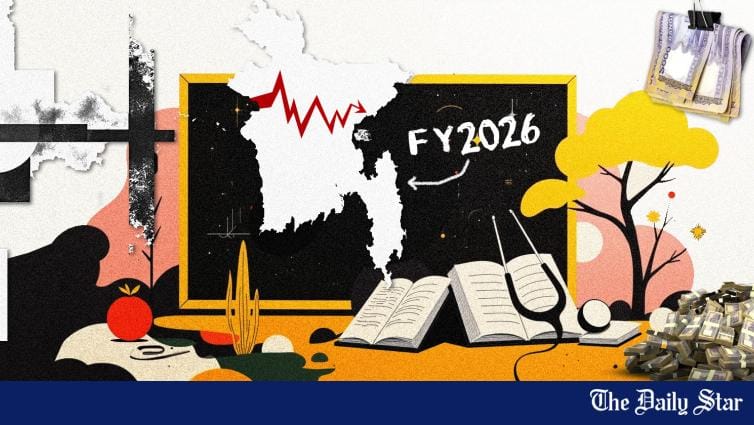
A conservative budget for FY2026

1748997828278.webp

VISUAL: SALMAN SAKIB SHAHRYAR

The proposed budget for the 2025-26 fiscal year, worth Tk 7.9 lakh crore, was presented by the finance adviser yesterday, at a time when the country is passing through unusual circumstances—both politically and economically. A non-political, unelected government, the result of the political changeover last year, formulated the budget amid several economic challenges.

On the economic front, despite the fact that several economic indicators show stability returning in nearly 10 months of the interim government, the outlook for investment and employment remains bleak. While some areas of the economy have shown progress to an extent, many other sectors have yet to see positive outcomes. Inflation, which remained over nine percent for 27 consecutive months, is showing a downward trend, reaching 9.05 percent in May 2025. However, there is a silver lining in the external sector. Strong remittance inflows have bolstered the foreign exchange reserves. Export income is also impressive. In the banking sector, several disciplinary measures have been undertaken, stemming the sector's continuous deterioration and easing the widespread panic that once plagued it.

Yet, significant challenges still remain. A new ordinance has been issued to regulate the banking industry, with steps taken to safeguard depositors' interests. The draft Banking Resolution Ordinance, 2025, which is available on the website of the Financial Institutions Division, delineates rules and regulations for improving the ailing banks. These measures are expected to help rebuild investor confidence.

In the current context, the FY2026 budget was expected to address some of the existing challenges. Controlling inflation, tackling investment hurdles, creating employment, and achieving macroeconomic stability are some of the crucial areas to which the government needs to pay attention to. The need for higher investment in human capital development and social protection cannot be ignored either.

Some of the major features of the proposed budget sheds light on the government's priorities.

The size of the FY2026 budget has been reduced by Tk 7,000 crore compared to its predecessor, reflecting a contractionary approach taken by the government to address the persistent economic struggles. The Annual Development Programme (ADP) allocation has been reduced by 13.2 percent compared to the original allocation in the FY2025 budget, which indicates a strategic shift towards fiscal consolidation. The budget deficit is set at 3.62 percent of GDP, which will be financed through domestic borrowing and foreign loans. Setting a lower budget deficit is a wise move in view of high inflation and limited fiscal space.

The revenue collection target for the incoming fiscal year is set at Tk 5.64 lakh crore, a 4.25 percent increase from the outgoing year's original target of Tk 5.41 lakh crore. The National Board of Revenue (NBR) is expected to collect Tk 4.99 lakh crore of this target. However, the revenue authority has historically struggled to meet such targets. Given the trend of revenue collection till March 2025, the deficit could exceed Tk 1 lakh crore by the end of the outgoing fiscal year. A practical and achievable target could improve tax collection predictability. The country's existing tax structure, with a tax-GDP ratio of less than eight percent, limits the government's ability to mobilise resources for development spending.

In view of the persistent inflationary pressure, the new budget proposes to raise the tax-free income threshold for individual taxpayers from Tk 3.5 lakh to Tk 3.75 lakh—but from FY2026-27. The tax measures will not provide much comfort to the low- and middle-income groups. The budget continues to rely on indirect taxes, so it will not effectively reduce the pressure of high inflation on the people. The government should attempt to collect taxes by expanding the tax net and curbing tax evasion. It also needs to undertake reforms to make the tax system more progressive and equitable.

The upcoming budget proposes to introduce some tax policies designed to enhance investment, such as withdrawing or reducing supplementary duties on several products and cutting customs duties on others in order to reduce the cost of doing business. These tax proposals aim to boost market access and trade competitiveness. The budget highlights creating a business-friendly environment to stimulate private investment, which has been sluggish due to high inflation, rising interest rates, and a weak law and order situation. The political upheavals of the July-August mass uprising, and the subsequent disruptions, resulted in further deterioration of the business environment and the overall economic stability. The uncertain political future is discouraging investors. Therefore, success of the economic measures will depend on how effective the political measures are in stabilising the country.

Despite the interim government's commitment to improving human development indicators, the FY2026 budget has reduced ADP allocation for the health sector by Tk 2,535 crore and for the education sector by Tk 2,971 crore compared to the outgoing fiscal year. This raises concerns about the government's ability to improve the quality of education and healthcare services, which are crucial for reducing poverty and enhancing human capital. It is undeniable that investing in people—teachers, students, doctors, nurses—is critical. Allocation for the agriculture sector in the ADP has also been decreased by Tk 2,424 crore, which is concerning from the food security perspective.

During high inflation, social safety net programmes play an important role. However, the efficiency of these programmes has been undermined due to the exclusion of genuinely poor citizens and inclusion of non-poor people. Besides, there are several common programmes that various institutions of the government implement. The budget has proposed reducing the number of such programmes to 95 from about 140 previously, which is a good move.

In the Mid-Term Macroeconomic Policy Statement (MTMPS) for FY2026-FY2028, the government has set the GDP growth target to be 5.5 percent for FY2026 and expects the inflation rate to decline to 6.5 percent. Achieving these targets will depend on addressing the current economic and political challenges and implementing some essential reforms. For example, the institutional reform of the NBR will be critical for meeting the revenue target. The government attempted to undertake such a reform through dissolving the NBR and establishing two new divisions under the finance ministry. However, the initiative has been stalled in the face of protests by NBR employees on administrative issues. It is crucial that this reform is implemented sooner rather than later through broader consultations with the relevant stakeholders to enhance efficiency and transparency in revenue collection.

Since a budget is designed only for a year, there is a limited scope for undertaking deep reforms. However, structural bottlenecks, including fiscal discipline and efficiency through institutional reform, are necessary to deliver budget commitments. Here's to hoping that the interim government will initiate a few targeted and critical reforms in FY2026 to improve budget implementation.

Dr Fahmida Khatun is executive director at the Centre for Policy Dialogue (CPD).​
 
Analyze

Analyze Post

Add your ideas here:
Highlight Cite Fact Check Respond

Achieving the ambitious revenue target
Atiqul Kabir Tuhin

Published :
Jun 05, 2025 01:34
Updated :
Jun 05, 2025 01:34

1749080101100.webp


The proposed budget for the fiscal year 2025-26, amounting to Tk 7.9 trillion, marks a significant shift in Bangladesh's fiscal objectives: moving away from grand development narratives towards pragmatic restraint and people-centric welfare. While rolling out the budget on Monday, Finance Adviser Salehuddin Ahmed conspicuously refrained from announcing ambitious development projects or lofty GDP growth targets. Instead, his focus was squarely on ensuring human development through greater access to public healthcare and quality education, expanding social safety net coverage, and providing fund for innovative entrepreneurs and so on, aimed at building a welfare state in line with the vision of the July Uprising.

However, amid resource constraints and poor revenue collection, the finance adviser had to carefully calibrate a smaller budget, marking the first time a budget proposal has been lower than the previous year's. The proposed outlay is Tk 70 billion less than the current fiscal year's original allocation of Tk 7.97 trillion. While not a drastic cut, the reduction signals an austerity measure in response to a subdued economic outlook marked by high inflation, slack investment growth, liquidity crisis in banks and above all political uncertainty. The government aims to reduce fiscal deficit to around 3.6 per cent of GDP, the lowest level in over a decade, signaling its intent to restore fiscal discipline by reducing budget deficit and boosting domestic revenue collection. The challenge, however, lies in ensuring that this policy of fiscal restraint does not undermine investment in critical sectors such as health, education and job creation.

Meanwhile, financing this smaller budget will be a daunting challenge unless revenue collection improves significantly. The budget sets a revenue target of Tk 5.64 trillion, equivalent to 9 per cent of the gross domestic product (GDP). Of this amount, Tk 4.99 trillion is expected to be mobilised through the National Board of Revenue (NBR), while the remaining Tk 650 billion is projected to come from non-tax revenue sources.

However, a critical question is how will the government achieve the ambitious revenue collection target of Tk 5.64 trillion? Historically, revenue collection has consistently fallen short of targets, with the highest amount collected being Tk 3.75 trillion in FY23. Given the current slowdown in business activity and investment, along with rising unemployment, experts argue that the government's revenue goal is overly ambitious, and likely unattainable under current conditions.

If revenue collection falls short, the budget deficit will widen, which will force the government to increase borrowing from both domestic and foreign sources. The deficit is currently projected at Tk 2.26 trillion, with Tk 1.25 trillion expected from domestic sources and Tk 1.01 trillion from external sources. At this level, the deficit is considered manageable. However, if the shortfall in revenue leads to a higher deficit, the government may be compelled to rely more heavily on commercial bank borrowing, potentially crowding out private investment and pushing up borrowing costs. With treasury bills already offering interest rates of 11-12 per cent, banks are increasingly inclined to invest in government securities rather than lending to private borrowers. So, how will the private sector get adequate access to credit if the government taps deeper into the banking sector? Many suggest the government to take foreign loans at concessional interest rates. However, the country's external debt has already exceeded $100 billion, and the finance adviser has allocated a staggering Tk 1.22 trillion in the budget for interest payments on both domestic and foreign loans. Therefore, reducing government operational expenditure and boosting revenue collection are crucial for achieving sound fiscal management.

Ultimately, it all comes down to how the government will achieve the budget's ambitious revenue growth target of 27.98 per cent for the next fiscal year, especially given its persistent failure to meet revenue targets in the past. Meeting this target will be a significant challenge. However, many argue that the target itself is logical, pointing out that Bangladesh's revenue collection remains far too low relative to the size and growth of its economy. The country's public sector is among the lowest revenue-generating in the world. The country's tax-to-GDP ratio, a key indicator of revenue efficiency, stands at just 7.4 per cent, the lowest not only in South Asia but also among most global economies. In comparison, Nepal and India boast of tax-to-GDP ratios of 23.4 per cent and 20 per cent, respectively. Experts argue that, given the size of Bangladesh's GDP, the tax-to-GDP ratio should be at least 17 per cent. However, this target has remained out of reach due to widespread corruption and inefficiency within the revenue department. In addition, the prevalence of tax evasion remains alarmingly high among the people and businesses.

In a recent interview, the Finance Adviser cited a case in which a taxpayer owed Tk 1 billion in taxes but managed to get away with paying only Tk 100 million as tax-allegedly by bribing a tax commissioner with Tk 600 million and pocketing the remaining Tk 300 million. This is not an isolated incident; similar cases are widespread across the country. Retail VAT evasion, along with tax avoidance in the informal businesses and e-commerce sector, also contributes significantly to revenue losses. It is estimated that over 30 million businesses operate in the country, yet fewer than 2 per cent are registered for VAT. Corruption is also rampant in customs operations. According to one estimate, trade mispricings alone cost Bangladesh approximately $8.27 billion annually between 2009 and 2018. These issues underscore the urgent need for procedural reforms, stronger oversight, and greater accountability within the revenue department.

Recognising these challenges, the government recently took the bold step to dissolve the NBR and create two new entities: the Revenue Policy Division, responsible for tax law formulation and policy, and the Revenue Management Division, tasked with revenue collection and enforcement. This reform aims to enhance accountability, efficiency, and transparency. However, progress in implementing this vital reform measure has been stalled in the face of protests from NBR employees, who have a vested interest in retaining control over both policy formulation and enforcement functions.

Hence, the government's ability to achieve its revenue target depends on implementing the reforms, cracking down on corruption, broadening the tax base and strengthening administrative capacity. Bangladesh's economy stands at a critical crossroads. Success in overcoming revenue challenges will determine not only the country's economic stability but also the realisation of a more equitable and welfare-oriented society.​
 
Analyze

Analyze Post

Add your ideas here:
Highlight Cite Fact Check Respond

Proposed budget doesn’t reflect opinions of political parties, public: BNP
Staff Correspondent Dhaka
Updated: 04 Jun 2025, 17: 46

1749081724129.webp

BNP standing committee member Amir Khasru Mahmud Chowdhury talks to the media on 4 June 2025 Prothom Alo

The Bangladesh Nationalist Party (BNP) has alleged the interim government has announced the proposed budget for the 2025–26 fiscal year taking opinions from political parties and the public.

BNP standing committee member Amir Khasru Mahmud Chowdhury made the allegation during the party’s official response to the proposed budget.

The response was presented at the BNP chairperson’s political office in Gulshan, Dhaka on Wednesday afternoon.

Since there is currently no functioning parliament or democratic government in the country, BNP had expected the interim government would formulate the budget through discussions with political parties involved in the anti-fascistmovement, and establishing a minimum level of national consensus, Amir Khasru stated.

The government could have sought opinions from people of various professions, he pointed out.

The BNP leader also said experts, civil society members, business representatives, and youth could also have been included in the process. However, this was not done.

Amir Khasru remarked that had the views of political parties and the public been considered, the budget would not have been unilateral, nonparticipatory, or a continuation of the same conventional pattern.

Amir Khasru said the current inflation rate is nearly ‘double digit’. The government is saying to bring it down to 6.5 per cent, which appears to be unrealistic. The rate of increase in poverty could have been curbed. The World Bank figures show more than 2.7 million people have become more pure in the last 10 months under the interim government.

The BNP leader further said, “According to the Bangladesh Bureau of Statistics, GDP growth in the 2024–25 fiscal was 3.97 per cent. However, in the current budget, it has been projected at 5.6 per cent, which, like previous governments, is unrealistic and merely growth on paper.”

“Food security is under threat. The attempt to show an increase in allocation by including pensions and agricultural subsidies under the inadequate, flawed, and corruption-ridden social safety net sector is misleading. Nevertheless, government allocation for social protection remains insufficient.”

Amir Khasru remarked that the reduction in allocation for vital sectors such as education, healthcare, and agriculture is a cause for concern. He stated that private universities, medical colleges, colleges, and schools could have been brought under full tax exemption. He added that, if the BNP comes to power in the future, these areas of education will be brought under full tax exemption.

Amir Khasru stated that the budget should have included a clear roadmap to address the weaknesses in the economic framework.

He said the primary focus should have been on presenting a strategy for increasing private investment, establishing industries, and creating employment as part of economic recovery.

Priority should have been given to education, healthcare, and agriculture. It was essential to foster new entrepreneurs by supporting small, cottage, and medium-sized enterprises. The high interest rates, coupled with increased taxes and duties, will place significant pressure on industries—particularly the productive sectors.

Many businesses may be forced to shut down, leading to reduced employment opportunities. If financial pressure on the middle and lower-income classes increases, it could fuel economic instability. Progress in poverty alleviation may also come to a halt.

Amir Khasru stated that the budget lacks any specific plans to reduce the cost of doing business, cut bureaucratic red tape, or lower the overall expenses of business operations. As a result, he said, entrepreneurs will face an uncertain and unfavourable environment.

He also pointed out that the increase in duties on online businesses will put pressure on digital entrepreneurs. According to him, this will lead to greater frustration among young entrepreneurs and discourage innovation.

Amir Khasru said the banking sector is in a fragile state. Initiatives to realise default loans, bring back laundered money and to expand the tax net could set a new basement in tax collection. The government is over dependent on the bank.

“Taking loans to clear debts is a threat to economic stability in the long run. The option to whiten black money is a reward for the tax evaders. It’s an injustice for the regular taxpayers. It will affect people’s confidence in the revenue system," Amir Khasru said.

Also present at the press conference were BNP standing committee members Gayeshwar Chandra Roy and Selima Rahman, BNP chairperson’s adviser Ismail Jabiullah, media cell member Shayrul Kabir Khan and press wing member to the chairperson, Shamsuddin Didar.​
 
Analyze

Analyze Post

Add your ideas here:
Highlight Cite Fact Check Respond

Opinions of parties, people not reflected in budget: BNP

FE REPORT
Published :
Jun 05, 2025 08:31
Updated :
Jun 05, 2025 12:44

1749165636302.webp


Calling the interim government's maiden budget conventional, the BNP on Wednesday said the proposed budget for the 2025-26 fiscal year was placed without the opinions of political parties and the people.

BNP Standing Committee member Amir Khasru Mahmud Chowdhury said this at a post-budget press conference at the party chairperson's Gulshan office in the capital.

He said the budget formulation would not have been one-sided and non-participatory if people's voices were heard.

Khasru said since there is no parliament or democratic government in the country now, the BNP expected that the interim government would formulate the budget by establishing a minimum national consensus after discussing with the political parties and entities that joined the anti-fascist movement.

He said inflation has reached almost double-digits currently.

There are discussions on reducing inflation to 6.5 per cent, which does not seem realistic, he said.

The BNP leader also said according to the Bangladesh Bureau of Statistics (BSS), gross domestic product (GDP) growth in the 2024-25 fiscal year was 3.97 per cent.

Growth was estimated at 5.6 per cent in the new budget. This is also an unrealistic and paper-based projection like the previous government, said Khasru.

He mentioned that reducing allocations for important sectors like education, health, and agriculture is worrying.

Additional taxes and duties along with huge interest rates will create great pressure on industries. Especially the productive sectors would be affected. Many institutions may close.

Employment may also decrease, the BNP leader went on.

If the financial pressure on the middle- and low-income groups increases, economic instability may rise and progress in poverty alleviation may also come to a halt, he added.

Citing the World Bank data, he said more than 2.7 million people have become poorer than before during the interim government's tenure.

He further said the economic growth figures are declining and an elected government can help get out of the situation.

Khasru mentioned that digital entrepreneurs would come under pressure due to the increased taxes on online businesses.

This would increase the frustration of young entrepreneurs, he said.

He also said the financial condition of banks is fragile.

Taking steps like recovering default loans and laundered money, as well as expanding the tax net would create a new foundation for revenue collection, said the BNP leader.

The government is heavily dependent on the banking sector, he said, adding that repaying debts by taking on more debts, allowing the whitening of black money, and over-dependency on banks are threats towards a sustainable economy.

Referring to the facilities the readymade garment sector is enjoying due to measures taken by late president Ziaur Rahman, he said if the BNP comes to power, it would give such facilities to some other sectors to help expand the economy and diversify the export basket.​
 
Analyze

Analyze Post

Add your ideas here:
Highlight Cite Fact Check Respond
⤵︎

Latest Posts

Latest Posts