Donate ☕
201 Military Defense Forums
[🇧🇩] - Insurgencies in Myanmar. Implications for Bangladesh | Page 78 | PKDefense
Home Login Nation Wars Watch Videos
Serious discussion on defense, geopolitics, and global security.

[🇧🇩] Insurgencies in Myanmar. Implications for Bangladesh

Reply (Scroll)
Press space to scroll through posts
G Bangladesh Defense
[🇧🇩] Insurgencies in Myanmar. Implications for Bangladesh
389
14K
More threads by Saif

Tensions in Rakhine, Chin have wider implications for Bangladesh​

Bangladesh cannot initiate a formal discussion with a non-state party like the Arakan Army. Yet, without any engagement of the Arakan Army, no Rohingya can be repatriated peacefully​


A group of old Chin woman with web spider tattoo on face in village near Mrauk U region in Myanmars Rakhine state. Chin people, also known as the Kukis are a number of Tibeto Burman tribal. Photo: Narinjara

A group of old Chin woman with web spider tattoo on face in village near Mrauk U region in Myanmars Rakhine state. Chin people, also known as the Kukis are a number of Tibeto Burman tribal. Photo: Narinjara

The heat of Myanmar's civil war has already reached the Bangladesh border. However, this war - either the one in central Myanmar or those around the states - did not start today.

Understanding the present war in Myanmar requires an understanding of the history of the country's ethnic clashes. Burma (now Myanmar) emerged as an independent country in 1948, a year also marked by budding resistance from many ethnic groups.

The movement prior to Burma's independence was organised around the establishment of a federal country with regional autonomy of ethnic peoples like the Shan, Karen, Kachin, Rakhine, and others. The former prime minister of British Burma, Aung San (father of Aung San Suu Kyi) was supposed to play the role of the coordinator. Unfortunately, Aung San was assassinated six months before Burma's independence.

As a result, the promise of a federal country was buried by the post-independent rulers led by the superior Bamar ethnic group, sparking armed resistance by the minorities. For the last 75 years, the demand for regional autonomy and resistance to Burmese authorities has flourished in the country, both in non-violent or violent formats.

However, a new element was added to this movement in 2021, when many Bamar people took to the streets protesting the Bamar-dominated Burmese military or the Tatmadaw-led coup that ousted the elected leader Aung San Suu Kyi — also a Bamar. The Suu Kyi-led political party National League carried on with non-violent protests for a year after the coup.

But now the party is leading the armed resistance against the Tatmadaw. This is a new phase in Myanmar's history and also indicates that the whole country is now in a civil war.

As a neighbour of Myanmar, Bangladesh has been facing implications of the war, specifically the ethnic resistance in the Rakhine state, which shares a border with Bangladesh.

We know that the Rakhine state — formerly Arakan — was an independent land, but the British Empire colonised it and later left it under the rule of the superior Bamar. Similar to other regions, the demand for an autonomous Arakan state has also persisted since Myanmar's independence. The United League of Arakan and its armed force, the Arakan Army, tried to push the demand both in non-violent and violent ways.

However, the Arakan Army mustered more strength and sharpened its counterattack against the Burmese military in 2017. The Arakan Army is now trying to shift its headquarters to the Rakhine state so that finance for the guerrilla movement can be generated easily.

Similarly, in the last three years, strong armed resistance by the Chin ethnic group has weakened the presence of the Burmese military in the Chin state, which also shares a small border with Bangladesh.

Simultaneously, the security conditions in the Rohingya camps in Bangladesh have deteriorated. At least 90 Rohingyas in the camps were murdered in internal clashes that occurred last year. Their demand for quick repatriation has become louder, amid dwindling global relief for the Rohingya.

So the flourishing of armed resistance in the Rakhine and Chin states, as well as the tension in the Rohingya camps, is very much concerning for Bangladesh.

Bangladesh has been negotiating with Myanmar's central government for the repatriation of one million Rohingya people who fled the Burmese military-led crackdown in 2017. Now, the Arakan Army has emerged as another party to discuss with. Apart from Rohingya repatriation, Bangladesh would need to talk to the Arakan Army regarding the century-old border trade with Myanmar.

I would like to mention that Chin people in Myanmar, Mizos and Kukis in India's Mizoram and Manipur, belong to a common larger Zo ethnicity. There are similar ethnic people in Bangladesh's Bandarban district. So, the tension in Manipur, Chin and Rakhine needs to be discussed with great importance.

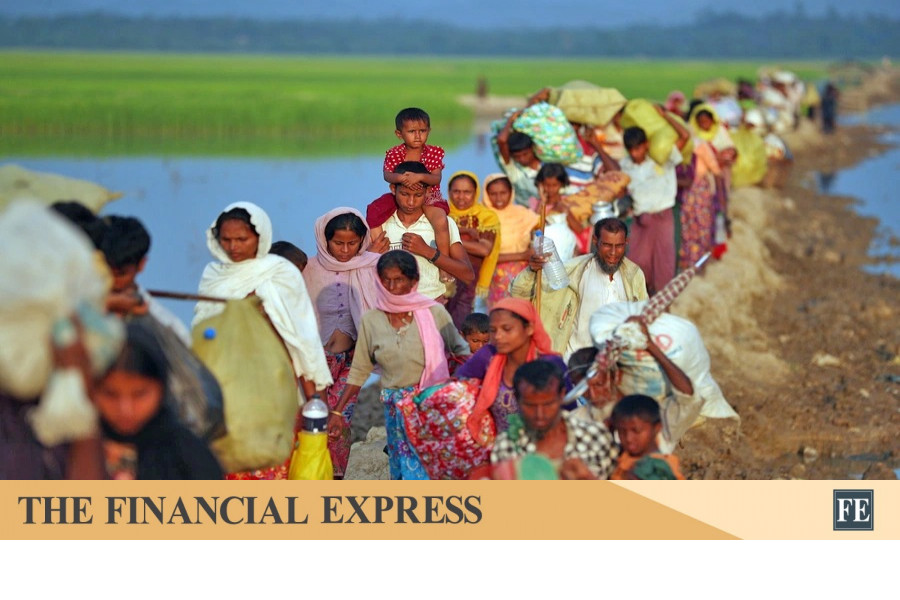
The Burmese military, cornered on the ground in the last three months due to strong resistance by the ethnic groups, will certainly intensify airstrikes over the conflict zones. Already, the Chin state has been affected and many people have taken refuge in Mizoram. The possibility of a new influx from Myanmar to Bangladesh is high.

During an interview, Arakan Army commander-in-chief Major General Twan Mrat Naing told us that the Arakan Army is willing to accept the Rohingya diaspora as citizens of Myanmar. But the Buddhist-dominated Arakan Army does not acknowledge the legitimacy of Rohingya ethnicity, which will be a concern in the repatriation process. However, Major General Naing showed interest in discussing the issues with the Bangladesh government.

It needs to be noted that Bangladesh cannot initiate a formal discussion with a non-state party like the Arakan Army. It will certainly annoy Myanmar. The great dilemma for Bangladesh is that without any engagement of the Arakan Army, no Rohingya can be repatriated peacefully.

The author is a researcher of history and author of 'Burma: Jatigoto Shonghater Shaat Doshok.'
 
Analyze

Analyze Post

Add your ideas here:
Highlight Cite Fact Check Respond
Bangladesh summons Myanmar ambassador, lodges protest over child injured by gunfire

Diplomatic Correspondent Dhaka
Published: 13 Jan 2026, 15: 20

1768352473199.webp

Myanmar’s ambassador to Dhaka, Kyaw Soe MoeCourtesy: Ministry of Foreign Affairs

Bangladesh on Tuesday summoned Myanmar’s ambassador to Dhaka, Kyaw Soe Moe, to the Ministry of Foreign Affairs and expressed deep concern over the injury of a Bangladeshi national caused by cross-border gunfire from Myanmar territory.

A nine year old child, Huzaifa Afnan of Teknaf, was seriously injured after being struck by a bullet fired from across the Myanmar border.

The incident prompted Bangladesh to formally lodge a protest by summoning the Myanmar ambassador.


In a press release, the Ministry of Foreign Affairs stated that, during the meeting, the Myanmar ambassador was reminded that unprovoked firing into Bangladesh constitutes a clear violation of international law and poses a serious obstacle to the maintenance of good neighbourly relations.

Bangladesh urged Myanmar to assume full responsibility and take all necessary measures to prevent any recurrence of such cross-border incidents in the future.

Bangladesh also stressed that developments involving Myanmar authorities and armed groups within Myanmar must not, under any circumstances, be allowed to affect the lives and livelihoods of the people of Bangladesh.

Myanmar’s ambassador Kyaw Soe Moe assured that his government would take steps to prevent the repetition of such incidents and expressed sincere sympathy to the injured child and his family.

On Sunday at around 9:00 am, Huzaifa was injured by gunfire originating from Myanmar’s Rakhine State near the Bangladesh border, in the Techi Bridge border area of WhyKong union in Teknaf.

He is currently undergoing treatment at Chattogram Medical College Hospital, where his condition remains critical.

Meanwhile, on Monday morning, a landmine explosion near the WhyKong border in Teknaf resulted in a 28 year old man, Md Hanif, losing his left leg.​
 
Analyze

Analyze Post

Add your ideas here:
Highlight Cite Fact Check Respond
Residents leave homes out of fear

Gazi FirozFrom Teknaf
Published: 14 Jan 2026, 17: 42

1768438142088.webp

Bullets fired by Myanmar armed groups hit the house of Abu Taher, a resident of Teknaf Whykong Lumbabil Techha Bridge area on Tuesday afternoon. Jewel Shill

Some houses have their doors locked, while in others, even though only the men remain, the rest of the family have been sent to relatives’ homes. This is the situation in the Lumbabil area of Whykong union on the Cox’s Bazar-Teknaf road.

A visit to the area on Tuesday afternoon revealed that fear has gripped all the residents. Bullets could strike at any moment. Even in the morning, two houses had been hit, with bullets breaking through the windows.

A child named Huzaifa Afnan, aged 9, from the Lumbabil area of Whykong union in Teknaf, was injured by gunfire coming from across the Myanmar border last Sunday morning. She is currently receiving treatment in Dhaka.

The following day, Monday, a fisherman named Mohammad Hanif lost his leg in a landmine explosion in the Lumbabil area of the Teknaf border. She is currently being treated at Chittagong Medical College Hospital.

In addition, 52 Rohingyas were sent to jail yesterday through the court for illegal entry during the clashes.


Airstrikes, drone attacks, mortar shells, and bomb explosions in Myanmar’s Rakhine state show no sign of stopping. Since last Thursday, the government junta forces have intensified airstrikes on the positions of the Arakan Army (AA) around Maungdaw Township in Rakhine.

Meanwhile, three armed Rohingya groups have engaged in clashes with the Arakan Army on the ground. As a result, the border situation is becoming increasingly tense. The villages in Teknaf tremble from the deafening explosions across the border, and bullets fired from across are hitting houses, shrimp enclosures, and the Naf river on this side

Fear drives people from their homes, locks hanging on doors
Around 200 families live in the Techha Bridge area of Lumbabil in Whykong union on the Cox’s Bazar-Teknaf road. The Myanmar border is three kilometres from there. Residents say that rebel groups are active across the border in Myanmar. As a result, even though the distance is three kilometres, bullets fired reach the nearby houses.


A lock was seen hanging on the door of Abul Kalam’s house. His neighbour Nasir Uddin told Prothom Alo that bullets have been hitting their house since last Thursday. A child in the neighbourhood was shot in the head. For this reason, Abul Kalam moved with his family to a relative’s home in Cox’s Bazar town three days ago. Nasir stayed behind to guard his house and belongings, as his house is permanent, while the rest of his family went to a relative’s home.

At least 30 houses in the area were found locked from the outside, including those of Amir Hossain, Abu Taher, and Anwarul Islam. Yesterday morning, two bullets fired from across the border entered the houses of Abu Taher and Josna Akter through the windows. However, no one was injured.

Shahjalal, the acting local UP chairman, told Prothom Alo that many people are locking their homes and leaving for relatives’ houses out of fear of bullets coming from across the border. Those who remain are living in constant fear. He said the border should be more closely patrolled to protect the residents.

Fishermen and daily wage earners living in anxiety
Since gunfire began last Thursday, fishermen have not been able to go to their fish and crab farms near the border for six days. The same situation affects the daily wage workers who work there.

Fisherman Rabiul Islam told Prothom Alo that he leased the farm for Tk 1.2 million to cultivate bagda shrimp. But since last Thursday, he has not been able to go there. If this continues, he will lose everything.


Daily wage worker Rahim Mia works in the fish farms. Yesterday he told Prothom Alo that he earns Tk 600 to Tk 800 a day working in the fish and crab farms, but for six days he has been unable to go to work due to the gunfire. If this continues, he will have nothing to eat.

Other residents of the Lumbabil Techha Bridge area near the Teknaf border are in the same situation as Rabiul Islam and Rahim Mia. A spot visit revealed that most of the 200 families in the area rely on fish and crab farming for their livelihood.

Father weeps holding daughter’s schoolbooks after shooting

Last Sunday, third-grade student Huzaifa Afnan was shot in the head near his house in the Lumbabil area. For advanced treatment, she was taken from Chittagong Medical College Hospital to Dhaka yesterday.

This correspondent visited their house Tuesday afternoon. Her father Jasim Uddin was crying while holding her schoolbooks. The house was full of relatives. A religious ceremony is being held in one room for the child’s recovery. Recounting the incident, her father said that Huzaifa had gone out in the morning after waking up. He took her to a shop near the house and bought fried snacks for her. While she was eating, a bullet struck her head, and she collapsed to the ground instantly. Jasim has asked the nation to pray for his daughter Huzaifa.

1768438194821.webp

Injured Huzaifa Afnan's father Jasim Uddin was crying while holding his daughter's schoolbooksJewl Shill

Meanwhile, Hanif’s family is living in anxiety. On Monday, Hanif lost a leg in a landmine explosion while going to his fish farm. Yesterday, this correspondent spoke with his father, Fazle Karim, in the West Lumbabil area of Whykong union. He told Prothom Alo that there should be no landmines at the border and demanded a proper investigation and justice for the incident.

Fear prevails not only in the border areas of Whykong union but also among nearby residents. Five traders from the Techha Bazar area said they are living in constant fear. Yesterday afternoon, local residents held a human chain at the border area of Shapla Chattar in Teknaf town, demanding an end to the gunfire.

Commenting on the gunfire and the fear among local residents, Cox’s Bazar Deputy Commissioner Md A Mannan told Prothom Alo that high-level talks are underway with the Myanmar government to stop the gunfire in the border areas. He said necessary measures are being taken to ensure that people do not live in fear.​
 
Analyze

Analyze Post

Add your ideas here:
Highlight Cite Fact Check Respond
ICJ genocide case flawed and unfounded: Myanmar govt
Agence France-Presse . Yangon, Myanmar 15 January, 2026, 01:25

An international court case alleging Myanmar committed genocide against the mostly Muslim Rohingya minority is ‘flawed and unfounded’, Yangon’s foreign ministry said Wednesday.

In a statement published in a state newspaper, the government called on the International Court of Justice to ‘reach its judgement based on fact and settled law strictly within the framework of the Genocide Convention’.


ICJ judges are hearing three weeks of testimony, which began in The Hague on Monday, as they weigh accusations by The Gambia that Myanmar committed genocide against the Rohingya in a 2017 crackdown.

Hundreds of thousands of Rohingya Muslims fled violence by the Myanmar army and Buddhist militias, escaping to neighbouring Bangladesh and bringing harrowing accounts of mass rape, arson and murder.

On the first day of the hearings Gambia’s justice minister Dawda Jallow told the court the Rohingya ‘have been targeted for destruction’.

Lawyers for military-ruled Myanmar will begin their court response on Friday.

‘The allegations made by The Gambia are flawed and unfounded in fact and law,’ said the Yangon foreign ministry statement, printed in the Global New Light of Myanmar newspaper.

‘Biased reports, based on unreliable evidence, cannot make up for truth,’ it added.

The country — ruled by a military junta since a coup in 2021 — was co-operating with the ICJ ‘in good faith’ in a sign of its respect for international law, it said.

The statement did not use the word Rohingya, referring instead to ‘persons from Rakhine state’, adding it was committed to their repatriation.

The Rohingya are not recognised as an official minority by the Myanmar government, which denies them citizenship and considers them Bengali interlopers, despite many having roots in the country stretching back centuries.

Today, 1.17 million Rohingya live crammed into dilapidated camps in Cox’s Bazar in Bangladesh.

Myanmar has always maintained the crackdown by its armed forces was justified to root out Rohingya insurgents after a series of attacks left a dozen security personnel dead.

The Gambia, a Muslim-majority country in west Africa, is taking Myanmar to the ICJ, which rules in disputes between states, alleging breaches of the 1948 UN Genocide Convention.

Under it any state can haul another before the ICJ if it believes genocide is being committed.

Legal experts are watching the proceedings as they could give clues for how the ICJ will handle similar accusations against Israel over its military campaign in Gaza, in a case brought by South Africa.

A final decision could take months or even years, and while the ICJ has no means of enforcing its decisions, a ruling in favour of The Gambia would heap more political pressure on Myanmar.​
 
Analyze

Analyze Post

Add your ideas here:
Highlight Cite Fact Check Respond

Myanmar tells ICJ Rohingya genocide claims ‘unsubstantiated’
Agence France-Presse . The Hague, Netherlands 17 January, 2026, 04:23

Myanmar on Friday dismissed as ‘unsubstantiated’ allegations that it committed genocide against its Rohingya minority, telling the International Court of Justice that its brutal crackdown was a ‘counter-terrorism operation.’

Myanmar is defending itself at the United Nations top court from accusations brought by The Gambia that its actions against the Rohingya breached the 1948 UN Genocide Convention.

‘This case will be decided on the basis of proven facts, not unsubstantiated allegations. Emotional language and blurry factual pictures are not a substitute for a rigorous presentation of facts,’ Ko Ko Hlaing, a minister in the president’s office, told the court.

Myanmar has always maintained the 2017 crackdown by its armed forces, known as the Tatmadaw, was justified to root out Rohingya insurgents after a series of attacks left a dozen security personnel dead.

‘Myanmar was not obliged to remain idle and allow terrorists to have free reign of northern Rakhine states,’ Hlaing told the judges.

‘These attacks were the reasons for the clearance operations, which is a military term referring to counter-insurgency or counter-terrorism operations,’ added Hlaing.

Judges are hearing three weeks of evidence before deciding whether Myanmar was in breach of the Genocide Convention with its violent actions against the Rohingya.

Under this convention, any state can drag any other before the ICJ, which settles disputes between countries, if it believes a breach has occurred.

A final decision could take months or even years, and while the ICJ has no means of enforcing its decisions, a ruling in favour of The Gambia would heap more political pressure on Myanmar.

‘A finding of genocide would place an indelible stain on my country and its people,’ said Hlaing.

‘These proceedings are of the fundamental importance for my country’s reputation and future.’

Before Myanmar took the stand, representatives from The Gambia laid bare days of harrowing evidence about the crackdown, including mass rape, indiscriminate murder, and torture.

The Rohingya were ‘targeted for destruction’, The Gambia’s justice minister told the judges.

‘When the court considers all of the evidence taken together, the only reasonable conclusion to reach is that a genocidal intent permeated and informed Myanmar’s myriad of state-led actions against the Rohingya,’ said Philippe Sands, arguing for The Gambia.

Hundreds of thousands of Rohingya Muslims fled violence by the Myanmar army and Buddhist militias, escaping to neighbouring Bangladesh and bringing harrowing accounts of mass atrocities.

Today, 1.17 million Rohingya live crammed into dilapidated camps spread over 8,000 acres in Cox’s Bazar in Bangladesh.

‘Let me also clear that Myanmar is committed to achieving the repatriation to Myanmar of persons from Rakhine State currently living in camps in Bangladesh,’ said Hlaing.

Legal experts are watching proceedings closely as it may give clues for how the court will handle similar accusations against Israel over its military campaign in Gaza, in a case brought to the ICJ by South Africa.

The ICJ hearings wrap up on January 29. Judges will hear evidence from victims in a closed session before both sides make final statements.

The ICJ is not the only court looking into possible genocide against the Rohingya — other cases are underway at the International Criminal Court and in Argentina under the principle of universal jurisdiction.​
 
Analyze

Analyze Post

Add your ideas here:
Highlight Cite Fact Check Respond

Bangladesh rejects Myanmar claims on Rohingya identity

BSS Dhaka
Published: 23 Jan 2026, 22: 57

1769216728924.webp


Bangladesh has strongly rejected Myanmar’s recent submissions to the International Court of Justice, saying references to the Rohingya as “Bengalis” distort history, undermine their identity, and seek to justify atrocities committed during the 2016–17 violence.

“The Government of Bangladesh calls upon Myanmar and others having authority over Rakhine to demonstrate a genuine commitment to the recognition of Rohingya as an integral part of their society and State, and facilitate their return by creating conducive atmosphere in Rakhine and their reintegration with equal rights, in safety and with dignity,” read a statement issued by the foreign ministry Friday evening.


In the detailed statement, Bangladesh said Myanmar’s portrayal of the Rohingya as illegal migrants before the International Court of Justice is aimed at reinforcing a false narrative of internal security threats to divert attention from atrocity crimes committed against the community.

The government said the Rohingyas are a distinct ethnic group with deep historical roots in Arakan, predating modern borders and the incorporation of the region into the Barman Kingdom in 1785. Their presence is well documented in historical records, colonial demographic accounts, and independent scholarship, it added.

Bangladesh said the term “Rohingya” evolved historically from the old Arakan capital Mro-Haung or Rohang, and was later adopted by the community for self-identification amid systematic marginalisation in Myanmar. Attempts to portray the Rohingya as foreigners or recent migrants are inconsistent with historical facts, the statement said.

The Rohingya were an integral part of Myanmar’s political and social life until the promulgation of the 1982 Citizenship Law, which excluded them from citizenship on ethno-religious grounds, Bangladesh noted. Despite sustained marginalisation, the community retained voting rights until they were fully disenfranchised during Myanmar’s 2015 general elections.

Bangladesh said Myanmar has persistently denied the Rohingya their constitutional guarantees, culminating in their mass eviction from Rakhine State during the 2016–17 period, rendering them stateless as part of a planned process to destroy the community.

The statement said the systematic labelling of the Rohingya as “Bengalis” denies their inherent right to self-identify and has been used to justify exclusion, persecution and ethnic cleansing. Bangladesh noted that despite such claims, Myanmar had recognised the Rohingya as “lawful residents of Burma” in the 1978 bilateral repatriation agreement with Bangladesh and assured their reintegration in subsequent accords.

Bangladesh said Myanmar’s continued failure for over eight years to create a conducive environment in Rakhine for the safe, voluntary and dignified return of the Rohingya violates bilateral arrangements signed in 2017–18 and may indicate intent to permanently destroy the community.

The government also recalled its protest on 18 July 2023, against Myanmar’s unsubstantiated claim that half a million Bangladeshis took refuge in Rakhine during Bangladesh’s 1971 Liberation War, noting the absence of any documentary or demographic evidence.​
 
Analyze

Analyze Post

Add your ideas here:
Highlight Cite Fact Check Respond

Members Online

⤵︎

Latest Posts

Latest Posts