Donate ☕
201 Military Defense Forums
[🇧🇩] - Forming Election Commission/Conducting Elections | Page 40 | PKDefense
Home Post Alerts Inbox Watch Videos

[🇧🇩] Forming Election Commission/Conducting Elections

Reply (Scroll)
Press space to scroll through posts
G Bangladesh Defense
[🇧🇩] Forming Election Commission/Conducting Elections
260
5K
More threads by Saif


Election schedule in 1st half of December: Sanaullah

Published :
Aug 07, 2025 21:35
Updated :
Aug 07, 2025 21:37

1754611107075.webp


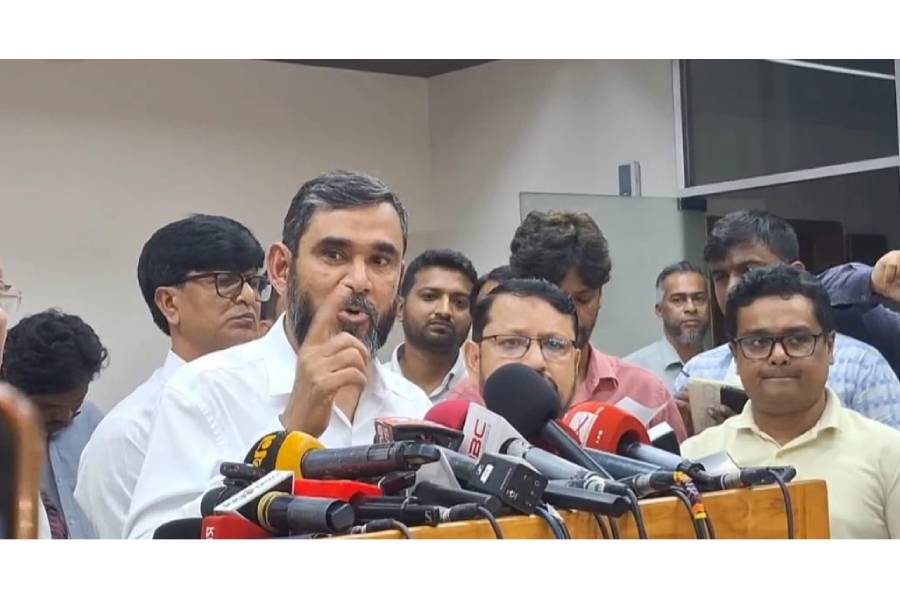
The schedule for the 13th parliamentary election is likely to be announced in the first half of December next, said Election Commissioner Brig Gen (retd) Abdul Fazal Md Sanaullah on Thursday.

“The Chief Election Commissioner already told you (media) that the schedule announcement will come approximately two months before the election date. So, you can assume that the announcement will come in the first part of December,” he said while briefing reporters after a meeting in the capital, reports UNB.

The meeting was held at Nirbachan Bhaban with the Chief Election Commissioner in the chair to discuss the amendment to the Representation of the People Order (RPO) 1972, the draft election code of conduct for political parties and candidates, 2025, as well as out-of-country voting (for expatriate Bangladeshis) and the postal balloting.

Abdul Fazal Md Sanaullah said they did not discuss the matter of the election schedule in the meeting. “But we will hold a discussion very soon,” he said.

He explained that the election will be held before the beginning of Ramadan in ‘early’ February 2026.

“As you all understand, the election must be held before Ramadan. Also, a few days need to be kept for the swearing-in of the new government. So, the polling will be held a little earlier, and if you count 60 days back from that probable election date, you’ll get it (the time of schedule announcement),” he said.

The meeting decided to incorporate the youth who will turn 18 years by October 31, 2025, in the voter lists ahead of the upcoming national election in a bid to allow them to exercise their franchise.

“Good news for the youths! The Commission primarily has taken a decision to include those who will turn 18 years by October 31, 2025, in the voter lists,” said Md Sanaullah.

He said some 18-20 lakh new voters are estimated to be added to the electoral rolls due to this decision.

Sanaullah said the commission, in the meeting, finalised the election code of conduct for political parties and candidates, 2025.

Earlier, on June 19 last, the EC approved in principle the draft of the Code of Conduct and later on June 29 invited public opinion on the draft.

“The draft code of conduct for candidates and parties, on which we sought (public) opinion after uploading it online, has been finalised today,” said the Election Commissioner.

He said no final decision was taken in the meeting over the RPO amendment as the discussion over it will continue.​
 
Analyze

Analyze Post

Add your ideas here:
Highlight Cite Fact Check Respond

Next year’s election to mark major test for post-Hasina Bangladesh: Kugelman
UNB Dhaka
Published: 07 Aug 2025, 16: 58

1754615025642.webp

Michael Kugelman, Deputy Director and Senior Associate for South Asia at Woodrow Wilson International Center for Scholars. Wilson Center website

South Asia affairs expert Michael Kugelman has said Bangladesh will go through a major test for a post-Hasina era as the interim government unveiled its plan to host the next national election in February next.

"Bangladesh hasn’t experienced free and fair elections for a long time, and next year’s polls will mark a major test for a post-Hasina Bangladesh," said Kugelman in Foreign Policy’s South Asia Brief.

On Tuesday, Chief Adviser Prof Muhammad Yunus announced that the country will hold elections next February.

The Office of the Chief Adviser on Wednesday sent a letter to the Election Commission requesting it to complete all preparations to hold the next parliamentary elections before Ramadan in February 2026.

With this letter, the formalities of the government's request to the Election Commission to arrange the election have been completed.

In the letter sent to the EC, Chief Adviser’s Principal Secretary M Siraz Uddin Miah requested him to take all necessary measures to arrange a "free, fair, peaceful and festive" national election of the expected quality within the specified time.

On Tuesday, Bangladesh marked one year since mass protests prompted longtime Prime Minister Sheikh Hasina to resign and flee to India.

"Hasina’s departure came after weeks of student-led demonstrations against her authoritarian rule, which prompted the country’s security forces to brutally crack down on protesters, resulting in the death of more than 1,400 people," Kugelman said.

He said Hasina’s ouster has had massive political implications in a country that was ruled by her Awami League for more than 15 consecutive years.

Today, Kugelman said, Bangladeshis are generally happier and freer than they were during the Hasina era, but the "post-revolution honeymoon" is a distant memory.

The country’s interim government, led by Nobel laureate Prof Yunus, has struggled to stabilise the economy and strengthen law and order, he said.

"Meanwhile, as Salil Tripathi writes in Foreign Policy this week, the country’s cycle of retributive politics has continued to persist,' he mentioned.

Indeed, many protest leaders -- some of whom served in the interim government before leaving earlier this year to form a new political party -- have insisted on following through on ambitious structural reforms promised immediately after Hasina’s fall, Kugelman said.

"But progress has lagged, leaving many Bangladeshis frustrated," he observed.

"The election is approaching. If you live away from your home constituency, begin visiting regularly from now. Prepare yourself to help elect the most deserving candidate," Prof Yunus said in his televised speech on Tuesday.

"As you cast your vote, let the faces of those whose fresh blood restored this sacred right appear before your eyes," he said, noting that February is not far away.

Prof Yunus said the days of preparation will pass quickly, and soon, it will be election day.

After so many years of being denied, Prof Yunus said, they will all vote and no one will be left behind.

"Let us all proudly say: On the journey to building a new Bangladesh, I will cast my vote. And it was my vote that helped this country set out on that path," Prof Yunus said.

The Chief Adviser called on every citizen, "Let us pass the first great test in building a new Bangladesh, together, successfully."​
 
Analyze

Analyze Post

Add your ideas here:
Highlight Cite Fact Check Respond

Govt needs better relation with key forces to deliver good polls
08 August, 2025, 00:00

THE interim government of the peace Nobel laureate professor Muhammad Yunus has completed one year in office today. Three days after the Awami League’s authoritarian government of Sheikh Hasina had been ousted from power in the face of a massive popular uprising on August 5, 2024, Yunus took over with three pronounced objectives: the trial of the League leaders responsible for killing some 1,500 democracy protesters during the July-August uprising, democratic reforms of the state and governance and the holding of free and fair general elections to transfer power to elected representatives of the people. Initially, there was no time frame for the completion of the interim agenda.

While the installation of the interim government raised profound hope among democratically oriented sections of the people for a bright future, with the passage of time, it appeared that, given the poor level of political acumen of most members of Yunus’s interim cabinet, it was not adequately capable of discharging the difficult duties that history had entrusted it with. No matter how sincere the cabinet is about meeting the historic challenges that the country is confronted with, its poor performance has been manifest in its failure to carry out any democratic reforms in the age-old bureaucratic governance over the past one year, not to mention its inability to restore law and order and contain social instability. On the political front, the national consensus commission has succeeded in forging a negotiation among political parties on some, not adequate though, important constitutional reforms, which, if implemented, would help democratise parliamentary practices to some extent, but it has not yet been resolved as to how and who would implement the agreed reforms. As for trial of the July-August mass killing of the League leaders, the government has filed cases against many a League leader, but it has damaged the cause to a significant extent by implicating many members of the pro-League intelligentsia in murder cases. The phenomenon not only unduly lengthens the trial process but also affects the credibility of the charges. Under the circumstance, came the question of elections at the earliest and subsequently, following growing political pressure particularly from the largest political organisation, the Bangladesh Nationalist Party, Yunus resolved to hold general elections by mid-February 2026. This is, indeed, a pragmatic political decision.

However, a mere announcement of holding general elections is not enough to practically hold free and fair national elections, particularly when some political parties and groups as well as some over-ambitious members of the interim cabinet are for lingering the election process. Under this circumstance, the interim government needs to realise that for it to deliver free and fair elections, it would require genuine cooperation from political parties, the civil administration and the armed forces already deployed in the field with magistracy powers, some of whom do not appear to be in great relation with the incumbents. The incumbents, therefore, would be well advised to forge a better understanding with the forces concerned for the sake of national interests, not to mention that of itself.​
 
Analyze

Analyze Post

Add your ideas here:
Highlight Cite Fact Check Respond

Election Commission must create a level playing field for all
Security, administrative neutrality key issues as we approach the polls


After protracted tensions over the timing of the 13th parliamentary elections, the confirmation of a February date by Chief Adviser Prof Muhammad Yunus on Tuesday should dispel any doubts in this regard. Reportedly, Yunus has already instructed the Election Commission to complete all arrangements before Ramadan in February. Barring any disruption to this timeline in the ensuing months, the country is officially on the path to its next election. The test now lies in ensuring that this path remains democratic. One concern flagged by some parties involves creating a level playing field so that all parties have a fair chance of participation. This is a legitimate concern given the disturbing trend of crimes, political violence, and security lapses seen over the past months. Can the government limit their effect in electioneering?

It will undoubtedly be very challenging. A recent report by the Transparency International Bangladesh (TIB) has presented an unflattering portrayal of ongoing political and administrative practices. It highlighted how political parties, and politics in general, remained hostage to authoritarian practices of the past. Political violence, for instance, remains rampant, with 121 people killed and 5,189 injured in such clashes between August last year and June this year. Extortion by politically connected actors also remains widespread. Many were found to be involved in orchestrating mob attacks, or exploiting dubious cases against rivals. Politicisation of state institutions, including in the judiciary, has also continued. The performance of law enforcement agencies has been similarly disappointing, as they continue to allow arbitrary cases and detentions, while crimes of all sorts persist as before.

That being the situation, how can we trust that there will be a level playing field for all parties—old or new, small or large—and that the election will be free from violence or partisan influence? If the government wants to set an example for the future, it must take a critical look at all the institutions and stakeholders involved with the election, and ensure that everyone acts within the bounds of the law, without bias or undue influence. We are encouraged to learn that the EC and the home ministry have already set to the task of finalising their action plans. Reportedly, the ministry is planning to reshuffle DCs, SPs, UNOs, and OCs through a lottery to minimise administrative bias, and to speed up recruitment, training and other preparations. These efforts, however, must equally focus on the lead-up to the election to ensure proper electioneering. The EC, on the other hand, must establish a firm grip on the entire electoral process.

As we approach the election, it is crucial to rein in politically affiliated actors who can abuse their power, hold law enforcement agencies accountable for any rights or rules violations, and restore neutrality across all relevant state institutions.​
 
Analyze

Analyze Post

Add your ideas here:
Highlight Cite Fact Check Respond

National election in first half of February: CEC

UNB
Published :
Aug 09, 2025 19:44
Updated :
Aug 09, 2025 19:44

1754787172139.webp


Chief Election Commissioner (CEC) AMM Nasir Uddin on Saturday said that the next national election is likely to be held in the first half of February, as the Election Commission (EC) intensifies preparations across the country.

Talking to reporters on Saturday afternoon following a meeting with the Rangpur divisional administration, the CEC said the Commission is actively coordinating with divisional and local election officials to ensure the smooth holding of the polls.

He warned that voting in any constituency will be suspended immediately if disorder breaks out at any polling centre.

"No kind of chaos will be tolerated," he said, adding that any official accused of irregularities, corruption, or bribery will be barred from election duties.

The CEC also said that action will be taken against all presiding officers found responsible for misconduct during the previous election.

Admitting that public trust in the electoral process has eroded, he acknowledged that an encouraging voter turnout remains a significant challenge. "Restoring confidence in the system and bringing people to the polling centres is a major task ahead," he said.

While the election schedule will not be announced yet, the CEC indicated that the date will be declared two months in advance.

Preparations are underway to hold the polls within a short timeline, he said.

Earlier in the day, the CEC held a coordination meeting with the regional election officers of Rangpur, along with district and upazila ones, at the Regional Election Office, as part of the Commission's groundwork for the 13th parliamentary election.​
 
Analyze

Analyze Post

Add your ideas here:
Highlight Cite Fact Check Respond

Members Online

⤵︎

Latest Posts

Latest Posts