โ˜• Support Us โ˜•
[๐Ÿ‡ง๐Ÿ‡ฉ] - Forming Election Commission/Conducting Elections | Page 22 | PKDefense

[๐Ÿ‡ง๐Ÿ‡ฉ] Forming Election Commission/Conducting Elections

Reply (Scroll)
Press space to scroll through posts
G Bangladesh Defense
[๐Ÿ‡ง๐Ÿ‡ฉ] Forming Election Commission/Conducting Elections
238
4K
More threads by Saif


Election roadmap to be unveiled this week: EC secretary

BSS Dhaka
Published: 18 Aug 2025, 19: 47

1755561883557.png

Senior secretary of the EC Akhtar Ahmed BSS file photo

Senior secretary of the Election Commission (EC) Akhtar Ahmed on Monday said the Election Commission (EC) will announce the action plan or roadmap of the upcoming 13th national parliamentary election within this week.

Speaking to newspersons at the EC office in the capitalโ€™s Agargaon, he confirmed that a draft of the election roadmap has been prepared and will soon be placed before the commission for final approval.

"The plan focuses on inter-departmental coordination and relevant operational issues. We hope to finalise and publish it within the week," he stated.

Addressing concerns over law and order, Ahmed said there is no immediate reason for worry as law enforcement agencies and administrative officials are already working in their respective areas.

"If everyone does their part responsibly, there won't be any problem," he added.

On voter list and NID updates, the secretary reported that around 80,000 appeals for NID corrections have been submitted so far, though the number is gradually declining.

He stressed ongoing improvements in the data entry process for reducing future errors.

Regarding the number of polling stations, Ahmed noted that the overall number will remain the same and some adjustments may be made based on necessity.

"We're exploring options like increasing the number of voters per booth from 500 to 600 for better efficiency," he said.

The EC also plans to scan and upload the unscanned Form-2 voter registration documents dating back to 2008 to enrich its digital database, he said.

On constituency delimitation, he informed that objections have been raised over 83 seats, with hearings scheduled from 24 August for four days, he added.

In terms of political party registration, 22 parties are undergoing field verification, he continued.

Rejected applicants are being formally notified with specific reasons for disqualification, he added.

Ahmed stressed the importance of early preparation saying if all concerned can finish their works early, then the coordination of the polling procedure will become smooth.​
 

Attachments

  • 1755561817284.png
    1755561817284.png
    290.4 KB · Views: 11

Elections only way to restore political rights, resist fascism: Tarique

Published :
Aug 19, 2025 22:58
Updated :
Aug 19, 2025 22:58

1755645474402.png


BNP Acting Chairman Tarique Rahman on Tuesday said that holding elections is the only way to restore the political rights of people and resist fascism.

โ€œThrough the practice of electing public representatives by direct vote, people gain strength in the state and politics. If the people are not strong, the state and the government cannot be strong. In a democratic system, elections are the main way to empower people and ensure every citizenโ€™s political rights,โ€ he said while virtually addressing a discussion, UNB reports.

Speaking about the interim governmentโ€™s announcement to hold the national election in February, Tarique said the peopleโ€™s long wait of nearly 15 years will come to an end. โ€œPeople will vote themselves and choose the candidates they want โ€” this is now the hope of all.โ€

He also said statements from various political parties have raised questions in the minds of democracy-loving citizens about the election.

โ€œFrom this event, I would like to draw the attention of all leaders of pro-democracy political parties โ€” if the distance grows between democratic forces, it will open the door for the defeated and fugitive fascist groups to return. I sincerely urge all democracy-loving people across the country to stay alert and cautious,โ€ the BNP leader said.

Tarique said if different conditions or obstacles are created on the path of restoring peopleโ€™s political rights, democracy will face a serious crisis.

โ€œWe must remember that during authoritarian rule, no democratic political worker or opposition member was safe โ€” nor were their families. If the path to democracy is blocked and people can't exercise their rights, the entire state will fall into trouble,โ€ the BNP leader said.

He said true power lies with the people, and if people are not empowered, no laws and rules can resist fascism. โ€œYou cannot stop fascism with the constitution or written laws. If we want to prevent fascism in the state and politics, there is no alternative but to politically empower the people.โ€

Tarique said that falling into unnecessary debates after the fall of a brutal fascist regime disrespects the sacrifices of the martyrs who fought for democracy.

He urged all to stay away from the politics of revenge and instead focus on implementing well-thought-out plans to bring positive changes in the countryโ€™s political system.

The BNP leader said hid partyโ€™s future politics will be centred around improving peopleโ€™s living standards. โ€œCreating jobs both at home and abroad and ensuring safe employment will be BNPโ€™s top priority.โ€

Jatiyatabadi Swechchhasebak Dal arranged the programme at the Bangladesh-China Friendship Conference Centre, marking its 45th founding anniversary.

On 19 August 1980, BNPโ€™s founder and former President Ziaur Rahman established the Jatiyatabadi Swechchhasebak Dal.

On the occasion of the founding anniversary, party leaders, including Senior Joint Secretary General Ruhul Kabir Rizvi and Swechchhasebak Dal members, laid floral wreaths at the grave of Ziaur Rahman in Sher-e-Bangla Nagar.

Tarique said if BNP gets the responsibility to run the country with direct support from peopleโ€™s votes, it will be able to quickly implement its plans for the welfare of the country and the people. โ€œAhead of the upcoming national election, please present BNPโ€™s vision and plans to the people at all levels.โ€

โ€œBNP believes that people are the source of all political power. Let us stand with the people, and tell them, โ€˜Vote for the sheaf of paddy, and together weโ€™ll build the nation,โ€ he said

Giving advice to the leaders of the partyโ€™s voluntary wing, Tarique said, โ€œYou are already running campaigns at upazila-level hospitals voluntarily. Please consider launching a union-level cleanliness drive to protect the environment through voluntary efforts.โ€

He said he believes that if a countrywide cleanliness campaign was declared at a suitable time, it would not only help protect the environment but also set an example of positive political change. โ€œThis would help present the nationalist movement to the people in a new way.โ€

Tarique also urged everyone to avoid doing anything that might create a negative impression among the people.

He reminded them that people are the strength of BNP and told them to stay close to people by earning their love and showing love in return.

โ€œMy appeal to you โ€” avoid doing anything that might create a negative impression in the minds of the people. Always remember โ€” manpower is BNPโ€™s strength. Stay with the love of the people, and keep loving them back,โ€ the BNP leader said.

BNP Standing Committee members Nazrul Islam Khan, Selima Rahman and Hafizuddin Ahmed Khan were present.

Some children of Swechchhasebak Dal leaders and activists, who were victims of enforced disappearance or killed during the struggle against autocratic ruler Sheikh Hasina, spoke at the programme, creating an emotional atmosphere that deeply moved the audience.​
 

BNP thanks CA for reaffirming Feb election

FE ONLINE DESK
Published :
Nov 13, 2025 23:06

BNP on Thursday thanked the Chief Adviser for reaffirming that the next national election will be held in the first half of February and for announcing that a referendum will take place on the same day.

โ€œThe BNP Standing Committee, chaired by Acting Chairman Tarique Rahman, thanked the Chief Adviser for reaffirming that the national election will be held in the first half of February and for announcing that a referendum will be held on the same day in his address to the nation,โ€ said party Secretary General Mirza Fakhrul Islam Alamgir, reports UNB.

He made the remarks while talking to reporters after an emergency meeting of the partyโ€™s Standing Committee at the Chairpersonโ€™s office in Gulshan.

Fakhrul said the meeting urged the government and the Election Commission to make all necessary preparations to hold the national election as soon as possible, along with the referendum to seek public approval of the July National Charter signed on October 17, 2025.

Earlier in the day, Chief Adviser Prof Muhammad Yunus announced that the national election and the referendum on the July Charter would be held on the same day.

In a televised address to the nation, he said a meeting of the Council of Advisers had approved the July National Charter (Constitution Amendment) Implementation Order, 2025.

โ€œTo implement the July Charter, this order includes several important provisions. These include holding a referendum on the constitutional amendment proposals in the charter and, subsequently, forming a Constitution Reform Council,โ€ he said.​
 

Fair elections not possible without political partiesโ€™ cooperation: CEC
Staff Correspondent Dhaka
Published: 17 Nov 2025, 22: 30

1763429595672.webp

Chief Election Commissioner AMM Nasir Uddin and Election Commissioners meet political parties at the Election Commission office in Agargaon, Dhaka on 17 November 2025.Prothom Alo

Chief Election Commissioner (CEC) AMM Nasir Uddin sought the cooperation of political parties to conduct free and fair elections.

He said it would not be possible to hold a credible election without such cooperation.

The CEC made these remarks during a dialogue with political parties as part of preparations for the 13th parliamentary election at the election commission office in Agargaon, Dhaka on Monday morning.

Leaders of Bangladesh Sanskritik Mukti Jote, Bangladesh National Awami Party, Bikalpo Dhara Bangladesh, Bangladesh Kallyan Party, and Bangladesh Muslim League (BML) participated in the first phase of the third day of dialogue. Although invited, the Bangladesh Labour Party did not attend.

Presenting the commissionโ€™s preparations for the parliamentary elections scheduled in February, CEC Nasir Uddin said at the start of the dialogue, "From our side, we will take all necessary preparations to create a free, fair, and smooth electoral environment. Our intention is absolutely clear, our commitment is clear. Whatever storms, cyclones, or obstacles come, we will take the necessary steps to ensure a smooth and credible environment."

Highlighting the importance of party cooperation on this matter, the CEC added, โ€œIf political parties do not cooperate or deliberately create problems, you will see that the possibility of holding the election turns into uncertainty.โ€

Urging parties to follow the electoral code of conduct, he said, โ€œProblems may arise before polling day, on voting day, or afterwards. On the ground, these issues are visible during elections. To ensure that no problem arises in any of these three phases, the electoral code of conduct must be followed.โ€

Election commissioner Abul Fazal Muhammad Sanaullah said that, for the first time, the electoral code of conduct has been directly linked with the Representation of the People Order (RPO). As a result, any violation of the code of conduct will now be treated as a pre-election offence, and penalties, including cancellation of candidature, will apply.

He also stated that any form of election campaigning will remain prohibited in mosques, temples, pagodas, churches, government offices, and educational institutions.

Highlighting the voting of expatriates as a major challenge this time, Abul Fazal said, โ€œThe commission is attempting to implement this complex process in just nine months. The registration platform, Postal Vote BD, will be launched tomorrow (Tuesday) evening.โ€

He also mentioned that a monitoring cell has been formed to counter misinformation on social media, deepfakes, and misuse of artificial intelligence, with assistance from the United Nations.

Election commissioner Anwarul Islam stated that the current commissionโ€™s message is clear: no one will be allowed to violate the law, and the commission will not compromise on any matter. Vigilance teams, monitoring teams, law-and-order cells, electoral inquiry teams, and the commissionโ€™s own observers will keep round-the-cloak watch on the ground.

Anwarul Islam further said that if irregularities are observed, returning officers (ROs) may suspend or cancel voting in the entire constituency, and presiding officers may, if deemed necessary, annul the results of a polling centre.

Election commissioner Tahmida Ahmed sought everyoneโ€™s cooperation for free and fair elections, saying, โ€œEven if the law-and-order situation is difficult, success is possible if the nation stands together, as demonstrated by the peaceful observance of Durga Puja.โ€

Objections over poster ban

During the dialogue, Bangladesh Kallyan Party chairman Syed Muhammad Ibrahim said that in todayโ€™s digital era, thanks to media and social media, identifying violations of the code of conduct is easy. Therefore, the focus should be on preventing or minimising such violations.

Referring to the limited authority of assistant returning officers, he added that in the digital era, people expect instant responses and action, so rapid decisions and measures are necessary.

Syed Muhammad Ibrahim praised the initiative for out-of-country voting (OCV) and postal ballots, and thanked the election commission for addressing the long-standing demand of over 4 million expatriates.

However, he urged special caution in the security and accounting of postal ballots, citing the current political distrust and lack of confidence in the country.

He also advised setting up a quick fact-checking and accurate information dissemination system to prevent the spread of false information during elections.

Bikalpo Dhara Bangladesh secretary general Major (retd) Abdul Mannan stated that if the candidature of a few candidates is cancelled for violating the code of conduct, it will create discipline among the rest.

He noted that in the past, there has been no precedent for cancelling the candidature of candidates from major parties, so the commissionโ€™s strict powers and enforcement must be ensured.

Regarding posters, Abdul Mannan said that major political parties do not need posters for campaigning, but smaller parties rely on them for recognition. Therefore, a realistic decision on posters is necessary.

He also raised questions about the presence of party agents at polling centres, stating that voting is possible without them because agents from major parties usually dominate polling centres, while agents from smaller parties are often denied access.

Bangladesh National Awami Party presidium member Abdur Rahman highlighted declining public confidence in elections and emphasised that a neutral, transparent, and violence-free election is the need of the hour, which will restore peopleโ€™s trust.

Bangladesh Muslim League (BML) president Sheikh Zulfikar Bulbul Chowdhury stressed creating a level playing field for all parties and stopping the use of black money.

Speaking regarding the ban on posters, banners, leaflets, festoons, and PVC materials in the electoral code of conduct, he said this is inconsistent with reality.

Bangladesh Sanskritik Mukti Jote president Abu Layes Munna suggested structural reforms in the election commission, stating that a national council should be formed including presidents and general secretaries of all registered political parties to reform the commissionโ€™s rules and regulations.

He noted that if such a council existed, there would be no need for month-long dialogues.​
 

Is Bangladesh at risk of losing the election information war?

1763431157642.webp


"I've made a solemn commitment to deliver an election that would stand out in terms of voter turnout, participation of new and women voters, global confidence in safety and security, and its festive atmosphere as a celebration of democracy and rule of law." - Chief Adviser Muhammad Yunus.

"In war, the result is never final." - Carl von Clausewitz

The current phase of Bangladesh's democratic journey that began with the August 2024 collapse of Sheikh Hasina's autocratic regime will culminate in the February 2026 general election. This election will do more than simply transfer power; it will demonstrate whether Bangladesh has renewed its democratic spirit after years of turbulence and deficit. The election will be judged not only by its procedural credibility, but also by the actual and perceived quantity and quality of public participation.

This reality and perception will also determine the next government's legitimacy. Supporters of the previous Awami League regime understand this and will do their best to undermine the legitimacy of the next government to increase their odds of returning to exact vengeance from those who ousted them. The Awami League and its supporters have deployed a ferocious disinformation and false propaganda campaign against the interim government for over a year. This campaign shows no sign of abating.

Their recent slogan of "No boat, no vote," which is being dramatically boosted across social media with advertising and coordinated amplification, has yet to be effectively challenged by a counter-narrative that distinguishes between the fugitive Awami League leadership and their supporters, whose right to vote has not been curtailed.

Put starkly, without an effective counter, the emerging dominant narrative at home and abroad risks becoming not one of democratic renewal, but of over-amplified Awami League disinformation, framing Bangladesh as a country trapped in mobocracy, societal disorder, and extortion. It is not simply the case that Bangladesh risks losing the information war, but more that it has unilaterally disarmed, with pro-democracy forces ceding the field to those driving the Awami League's narrative.

Right now, there exists no effective counter-narrative to stem the flow of disinformation and assure the Bangladeshi electorate that the February 2026 election will be different from before. To prevent this further erosion of hope and trust, and deliver a high-quality, high-turnout election, the interim government must convince voters that voting is safe, meaningful, and celebratory. Domestic and international observers will also be looking for signs that Bangladesh can deliver an election worthy of its people's aspirations and global democratic standards. The stakes could not be higher for the interim government and the political parties competing in the election, who hope to form the next government.

Public expectations are high, but fragile. Citizens, especially women, young people, minorities, and first-time voters, want to believe their voices matter. Yet, spoilers (again notably the Awami League and their international supporters) are using their considerable disinformation apparatus to disrupt the election preparation and frustrate the transition by sowing fear, apathy, and distrust.

While surveys consistently show overwhelming intent to vote, the vast majority of citizens will never see these findings; instead, they are influenced almost entirely by social media consumption. This is a massive vulnerability: with around 50 percent of the electorate still undecided, disinformation is already disproportionately shaping perceptions, fuelling apathy, and depressing turnout among volatile blocs such as youth, women, and urban voters.

Without a coordinated, well-resourced counter-narrative and campaign, the election risks being remembered not as a festival of democracy, but as yet another turn in an ongoing cycle of fear and division.

The 2026 general election is not just an administrative task; it is a historic opportunity to redefine Bangladesh's democratic identity. By delivering a safe, inclusive, and festive election, the interim government under Chief Adviser Muhammad Yunus can inspire its citizens, win global respect, and lay the foundation for a renewed democracy. Future governments and citizens will reap the dividends from the resources invested in ensuring the success of this transition.

This campaign is not optional; it is essential. It will transform voting from a procedural duty into a joyful act of nation-building, ensuring that Bangladesh rises from its democratic struggles with pride and hope. For Professor Yunus and pro-democracy forces, it is an opportunity to leave behind a legacy of global stature: to be remembered for delivering not only Bangladesh's most credible election, but one that the world will cite for decades as a model of democratic renewal. This is also the best way to honour the sacrifices of those who gave so much to restore democracy before and during the long July of 2024.

Jon Danilowicz is a retired US diplomat and independent foreign policy analyst. He currently serves as president of Right to Freedom, a Washington DC-based non-profit human rights organisation.​
 

Bangladesh interim govt chief seeks armed forcesโ€™ support to hold peaceful polls
Bangladesh Sangbad Sangstha . Dhaka 19 November, 2025, 17:09

1763601536212.webp

Chief adviser Professor Muhammad Yunus speaks at the DSCSC Course-2025 certificate distribution function held at the DSCSC Complex in Mirpur Cantonment on Wednesday. | BSS photo

Bangladesh interim government chief adviser Muhammad Yunus on Wednesday sought support from the armed forces, police and other law enforcement agencies to hold the upcoming national elections in a peaceful and festive manner in the first half of February.

โ€˜So, now is the time for the election. We are looking forward to it and we announce the date for the polls in the first half of February. Again we need the support from our armed forces, from our police, law enforcing agencies, all types,โ€™ he said.

Muhammad Yunus said, โ€˜Because it is a big undertaking coming from an uprising, moving to an election, which is going to be peaceful, a kind of celebration, need for happiness and being together, still expressing their own desires and aspirations.โ€™

Yunus addressed the Defence Services Command and Staff College Course-2025 certificate distribution ceremony at a function at the DSCSC Complex at Mirpur cantonment in Dhaka.

The chief adviser congratulated all the graduating officers and advised them to utilise the knowledge, wisdom and determination gained from the course for the progress of the nation.

โ€˜It is an immense pleasure to be present at the graduation ceremony of the Defence Services Command and Staff College Course-2025. The heartiest congratulations to all the graduating officers,โ€™ he said.

Hailing the DSCSC as a military institution, Yunus said, โ€˜I feel particularly proud coming here to this institute. I am proud of this institution. This institution is one of the best in the country, but also internationally.โ€™

Addressing the graduates, he said, โ€˜While you are in Bangladesh, I am sure you have familiarised yourself with the country. While you are going through your preparations, your studies for the coursework that you are doing, which is a routine thing, anywhere you go, will go through that.โ€™

โ€˜But you are lucky to be here in Bangladesh. At a time when Bangladesh is going through a tremendous transition and transformation, which we repeatedly mentioned that we are moving to a new Bangladesh,โ€™ he mentioned.

Speaking about the mass uprising in the past year, which ended the past regime, he said that new hopes and aspirations had been created among the countryโ€™s people. โ€˜These are not just Bangladeshi aspirations. This is a global aspiration.โ€™

He said that both foreign and Bangladeshi participants in the course might have absorbed the historical moment they had witnessed during their training, saying, โ€˜Such an experience is rare even in Bangladesh.โ€™

About the role of armed forces during the 2024 uprising, the chief adviser said that the armed forces played the role they were supposed to play by standing firmly with the people.

โ€˜Bangladesh is a lucky country. All the armed forcesโ€ฆ under the leadership of their leaders stay committed to the people,โ€™ he added.

Noting that this unity ensured a swift conclusion of the crisis and helped stabilise the nation, Yunus said, โ€˜And that is why, we could move forward with the implementation of all the aspirations and hopes of the nation. Because the armed forces stood behind them, the people.โ€™

About the interim governmentโ€™s commitment to state reforming, he said that returning to the past would have rendered all sacrifices meaningless.

โ€˜Unless we build the country of a dream. That was the process of reform. So, we undertook the big project of reform. Know what to do. Reform is one thing but to know what exactly it has to be done so that you do not make mistakes again,โ€™ Yunus said.

About the trial of the July uprising, he said, โ€˜Then the question of trial. Those who have done this terrible thing to us must be brought to justice.โ€™

Addressing the global participants in the DSCSC course, Yunus said, โ€˜Your participation is a glowing reflection of our strong global defence relations. I hope that your association with the staff college and with Bangladesh will continue in the years to come.โ€™

According to ISPR, 311 trainees completed the course this year. Among them were 170 officers from the Bangladesh Army, 45 from the Bangladesh Navy, 36 from the Bangladesh Air Force, and three from the Bangladesh Police.

In addition, 58 officers from China, India, Indonesia, Iran, Jordan, Kenya, Saudi Arabia, Kuwait, Qatar, Liberia, Malaysia, Maldives, Mali, Nepal, Nigeria, Oman, Pakistan, Palestine, Sierra Leone, Sri Lanka, Tanzania, Turkey and Uganda also took part in the DSCSC graduation course.

Notably, 14 female officers, including one from the Bangladesh Police, completed the course this year, reflecting DSCSCโ€™s commitment to womenโ€™s inclusion and empowerment.

The DSCSC is an internationally acclaimed institution dedicated to preparing mid-level officers for higher responsibilities and leadership roles.

Since its establishment, 6,814 officers have been trained at the DSCSC, including 5,329 officers from the Bangladesh armed forces, 20 officers from Bangladesh Police, and 1,465 officers from 45 friendly foreign countries.​
 

Bangladesh general election likely between Feb 8 and 12
Schedule in a couple of days after EC meeting Dec 7: EC Anwarul

1764726991690.webp

Front view of Election Commission office in Dhaka. | File photo

The forthcoming general election and the national referendum are expected to be held any day between February 8 and February 12 next year, election commissioner Md Anwarul Islam Sarkar said on Tuesday.

The commissioner, speaking to reporters at the Election Commission headquarters in Dhaka, also said that the election schedule could be announced in a couple of days after the commission meeting, expected to be held on December 7.

โ€˜The parliamentary elections and the referendum will be held any day between 8 February and 12 February. It can be held one or two days after February 8 or one or two days before February 12. In other words, it can be held on a day that falls at some point in the middle,โ€™ Anwarul Islam said.

He said that the commission is set to hold a meeting on December 7 to finalise the election schedule.

Depending on the outcome, the official announcement of the election schedule can be made within two or three days of the meeting, possibly around December 11, he said.

Anwarul said that the commission was also considering extending voting hours as both the parliamentary election and the referendum would be held on the same day.

He said that voting time might be extended from eight hours to nine hours.

The current voting period, which runs from 8:00am to 4:00pm, could be adjusted by setting the hours between 7:30am and 4:30pm.

European Union ambassador to Dhaka, Michael Miller, met chief election commissioner AMM Nasir Uddin on Tuesday at Nirbachan Bhaban to discuss preparations for the next general election and the referendum.

Speaking to reporters after the meeting, Miller said that the commission was well prepared to conduct both the parliamentary polls and the referendum on the July charter on the same day.

He appreciated the commissionโ€™s advanced planning and careful assessment of logistical challenges.

Miller also reiterated that the EU is preparing to send a large election observer mission to monitor what is expected to be the worldโ€™s largest democratic exercise in 2026.

Regarding the overall situation, the EU envoy said preparations appear to be progressing smoothly, though challenges are inevitable in a populous country.

He stressed the need for extensive civic and voter education so that the citizens can understand both the election and the referendum.​
 

'Polls schedule announcement still undecided'
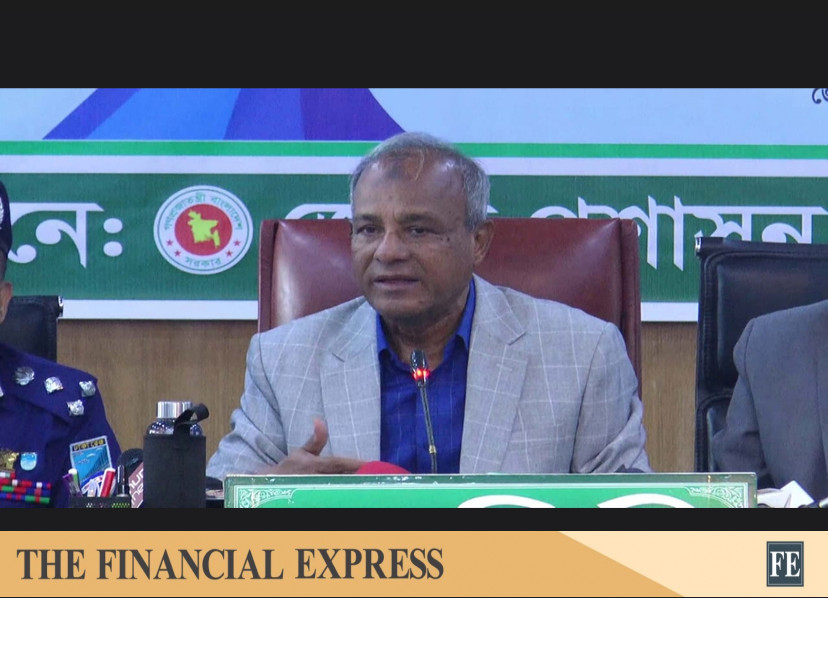
EC secretary says commission met for election preparations today

1765070863964.webp

File Photo

Although preparations for holding the 13th national election and the referendum on the same day are on in full swing, the Election Commission (EC) has not yet decided when it will announce the election schedule.

EC Secretary Akhtar Ahmed said at a workshop with journalists at the Election Training Institute this afternoon, "We were in a meeting on election preparations from 11:30 in the morning."

Regarding the announcement of the schedule, he said, "The Election Commission has not yet been able to fix the date."

The interim government has announced that the 13th national election will be held in the first half of February next year, while the EC had planned to announce the election schedule in the first week of December.

Earlier, on November 29, Chief Election Commissioner (CEC) AMM Nasir Uddin said that the schedule for the upcoming national election will likely be announced in the second week of December.

However, the EC secretary claimed that the EC is fully prepared to conduct the election. Urging everyone to refrain from spreading misinformation about the election, he said, "I request everyone to provide accurate informationโ€ฆ Certainly, strong preparations for the election are underway."

The workshop titled, "Introduction to the Representation of the People Order, 1972 (with latest amendments); Code of Conduct for Political Parties and Candidates in Parliamentary Elections, 2008 (with latest amendments); and the Election Officers (Special Provisions) Act, 1991", was organised by UNDP and the Reporters Forum for Election and Democracy (RFED).​
 

'We'll deliver the best election in the country's history'
Yunus says after being briefed by CEC on election preparations

1765156480400.webp

Photo: CA's Press Wing

Chief Adviser Prof Muhammad Yunus today expressed satisfaction over the Election Commission's preparations for the upcoming national election and referendum, assuring that the government will provide all necessary support to ensure a free and fair poll.

Speaking after being briefed by Chief Election Commissioner (CEC) AMM Nasir Uddin and four other commissioners at the state guesthouse Jamuna, Yunus said, "You [EC] are in the driver's seat for this long-awaited election by the nation. We must reach our desired goal."

He emphasised the interim government's commitment to conducting a free and fair election, adding, "We are moving forward with the commitment that in the first half of February, we will deliver to the nation the best election in the country's history."

CEC Nasir confirmed that preparations are progressing smoothly and that the Election Commission is fully prepared to hold both the national election and the referendum on the same day in February.

Election Commissioners Abdur Rahmanel Masud, Tahmida Ahmad, Anwarul Islam Saker, Brig Gen (retd) Abul Fazal Md Sanaullah, and EC Secretary Akhtar Ahmed attended the meeting. National Security Adviser Dr Khalilur Rahman and Chief Adviser's Principal Secretary M Siraj Uddin Mia were also present.​
 

66pc say BNP will win the most seats in the election
Special Correspondent Dhaka
Published: 09 Dec 2025, 10: 56

1765328135312.webp


Most people in the country believe the Bangladesh Nationalist Party (BNP) will win the highest number of seats in the upcoming Jatiya Sangsad (national parliament) election. Jamaat-e-Islami ranks second on the list of peopleโ€™s preferred parties.

More than half of the respondents also said the country would be better off if the BNP wins. Nearly one-third believe the country would fare better under Jamaat-e-Islami.

These views emerged in a survey conducted by Prothom Alo. The survey was carried out by the private research organisation Keymakers Consulting Limited. Its title is โ€œNational opinion poll on key socio-political issues.โ€

Which party will win the most seats

One of the survey questions asked: If the upcoming national election is free and fair, which party do you think will win the highest number of seats? The question did not ask for an estimate of how many seats.

In response, nearly 66 per cent of respondents said the BNP would win the most seats. The views of men, women, and respondents across all age groups were broadly similar. About 26 per cent said Jamaat-e-Islami would win the most seats.

Since the fall of military ruler H M Ershad, the BNP has formed the government three times in the past 35 years. Under a caretaker government, the BNP formed government in 1991 with Jamaat-e-Islamiโ€™s support. The 15 February 1996 election was boycotted by the Awami League and other opposition parties.

Although the BNP won and formed the government, it lasted only a month and a half. In the second election that year, held in June, the BNP became the main opposition party. In 2001, as part of the four-party alliance, the BNP returned to power with an overwhelming majority.

In the 2008 election, the BNP won 30 seats. The party boycotted the single-party election in 2014 and the controversial 2024 โ€œdummy voteโ€ election. It did contest the 2018 election but won only seven seats, in an election widely marred by irregularities, including ballot stuffing the night before pollingโ€”an election now widely referred to as the โ€œnight-time vote.โ€

Jamaat-e-Islami, on the other hand, has never become the second-largest party in any past election. Its highest achievements were 18 seats in 1991 and 17 seats in 2001 (the latter within an electoral alliance with the BNP). After the fall of the Awami League government in the July mass uprising, Jamaat-e-Islami has suddenly emerged as a major force on the political field.

Its student wing recently won absolute majorities in student-union elections at Dhaka University and three other universities. The survey shows that a significant portion of respondentsโ€”around 26 per centโ€”believe Jamaat will win the highest number of seats this time.

In response to the same question, slightly over 7 per cent said the Awami Leagueโ€”whose activities are currently banned. Another 0.8 per cent named the National Citizen Party (NCP), the youth-led party that played a key role in the July mass uprising. 0.1 per cent expressed support for Islami Andolan Bangladesh.

Following the fall of the Awami League government in the July uprising, many of the partyโ€™s top leaders have gone into hiding or taken refuge abroad.

The interim government has banned all organisational activities of the party until the trials at the International Crimes Tribunal are completed. Before this, the government had issued the Anti-Terrorism (Amendment) Ordinance 2025, allowing the banning of activities of any individual or entity involved in terrorist acts. The partyโ€™s registration with the Election Commission also remains suspended.

The Awami League ruled the country continuously from 2009 until its fall last year. Earlier, it also governed once in 1996. Under non-partisan caretaker governments, the party received between 30 per cent and 48 per cent of the vote in each election.

Several other parties were also mentioned in the Prothom Alo survey regarding which party might win the most seats. Only 0.1 per cent named the Jatiya Party (Japa). Yet in the last three parliaments, JaPa served as the main opposition, though widely regarded as a โ€œdomesticated opposition,โ€ as those elections were controversial and Japa had entered parliament through arrangements with the ruling Awami League.

Following his ouster in the 1990 mass uprising, Ershad was jailed. Under the caretaker government, JaPa won 35 seats in the 1991 election, 32 seats in 1996, and 14 in 2001. In the most recent election under a caretaker government in 2008, Japa, contesting as part of the Awami League-led Grand Alliance, won 27 seats.

Which partyโ€™s victory would be best for the country
Another question in the survey asked: Which partyโ€™s victory in the upcoming national election would be best for the country?

In response, 57.5 per cent said the BNP. 32.5 per cent said Jamaat-e-Islami.

8.5 per cent said the Awami League. 0.9 per cent believed the NCPโ€™s victory would be best. JaPa and Islami Andolan Bangladesh each received 0.1 per cent support.

The survey collected opinions from 1,342 adults (ages 18โ€“55) in five urban and five rural/semi-urban areas. Among them were 674 men and 668 women, representing diverse income levels, social classes, and professions. Data was collected between 21 and 28 October.

The survey organisation noted that this was an opinion poll representing the countryโ€™s general population, though it does not represent any specific constituency. The sample includes only people who can read online or print newspapers and who are likely to vote in the next election. The reported confidence level of the findings is 99 per cent.​
 

Members Online

Latest Posts

Latest Posts