Bangladesh Defense
Saif
Senior Member
- Jan 24, 2024
- 20,987
- 9,685
- Nation

- Residence
- Axis Group

A blatant river grab
Piles of sand are stacked high, excavators are busy dumping loads, and trucks move in and out. The land is enclosed by towering concrete walls and fences. The skyline across the Dhaleshwari and Shitalakkhya turns hazy, as clinker dust first spirals into the air and then settles on the rivers...
A blatant river grab
Confluence of Dhaleshwari and Shitalakkhya under siege from Shah Cement

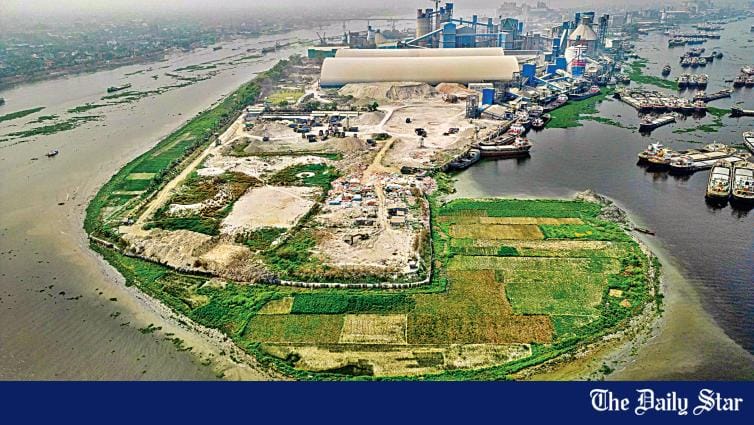
In 2002, Shah Cement began its operations on a small piece of land in Mukterpur, a riverside village in Munshiganj Sadar Upazila. Two decades later, at least 24 acres of Dhaleshwari and Shitalakkhya river land are under the occupation of this massive industrial complex. The photo was taken in March this year. Photo: Rashed Shumon
Piles of sand are stacked high, excavators are busy dumping loads, and trucks move in and out. The land is enclosed by towering concrete walls and fences. The skyline across the Dhaleshwari and Shitalakkhya turns hazy, as clinker dust first spirals into the air and then settles on the rivers, polluting both the air and water.
This sprawling complex, with its towering structures standing ominously at the confluence of the two rivers in Munshiganj, is a stark reminder of unchecked river grabbing in Bangladesh.

Much of this patch of land belongs to the Dhaleshwari and Shitalakkhya, but Shah Cement has occupied parts of the two rivers affecting the ecosystem and the natural flows of the two rivers, according to four separate government reports.
The Munshiganj district administration and the National River Conservation Commission (NRCC) identified the cement factory as an "encroacher" in 2018, 2019 and 2023, documents show.
However, the government has yet to take any action to save the rivers.
In a written statement, Shah Cement, a concern of Abul Khair Group, denied that it grabbed any river land, but declined to share proof of its "ownership" of the land in the middle of two rivers.

"When I visited the Dhaleshwari and Shitalakkhya rivers [in December 2024], I saw that Shah Cement has encroached on the rivers. I immediately instructed the officials concerned to take effective measures."— Brig Gen (retd) M Sakhawat Hussain, Shipping Adviser.
ILLEGAL OCCUPATION
Shah Cement built the factory in 2002 and has expanded its operations deep into the two rivers over the years, according to documents and current and former officials.
According to the company's website, Shah Cement is one of the largest cement factories in Bangladesh, with a capacity to produce 10 million tonnes per year.
During multiple visits in February, March and April 2025, The Daily Star found that parts of the massive structures, heavy equipment and a storage facility stand at the mouth of the two rivers.
Munshiganj Sadar Assistant Commissioner's (Land) Office also confirmed that Shah Cement has occupied a huge swath of river land in Mirersharai Mouza in RS Dag No. 184 and in Purbo Mukterpur Mouza across RS Dag No. 301-308.
"We have already completed the survey and will serve a notice [on Shah Cement] upon completion of the investigation," Md Rezaul Karim, additional district magistrate of Munshiganj, told The Daily Star last night.
The Daily Star obtained the Revisional Survey (RS) records from the Munshiganj land office. These documents show that RS Dag (plot) No. 184 and RS Dag Nos. 301-307 are earmarked as river and riverbanks and are "owned by the Bangladesh government."
We were unable to collect the land record for RS Dag No. 308.
Before the cement factory was set up two decades ago, the Dhaleshwari thrived as a lifeline, drawing locals who fished, bathed, and depended on its waters for livelihood.
Residents of Mollar Char, a riverside village in Munshiganj, said that when the factory was first built, it started on a small piece of land. But during the dry season every year, it kept expanding by filling the river with sand—even at night.

The massive industrial complex of Shah Cement in Munshiganj. Photo: Rashed Sumon
On March 4, 2025, the Bangladesh Inland Water Transport Authority (BIWTA) in a letter to the Munshiganj district administration said Shah Cement's sand-filling activities is creating navigation problems in the Shitalakkhya and Dhaleshwari route, obstructing the natural flow of the water and causing environmental damage.
"Several companies, including Shah Cement, are raising land by dumping sand and soil on the confluence, disturbing the rivers' flow. The navigability of the rivers has decreased, hindering vessel movement and raising concerns about environmental disasters," reads the letter.
Despite official instructions to remove the illegally dumped sand and soil, Shah Cement has yet to comply, it said, adding, "These activities violate the Port Act 1908, Port Rules 1966, and High Court orders."
The letter also cited a recent visit of Shipping Adviser Brig Gen (retd) M Sakhawat Hussain to the area when he "expressed dissatisfaction over the illegal occupation, and instructed the authorities to take action."
Contacted, Munshiganj Deputy Commissioner Fatema Tul Zannat, who took office in September 2024, said, "I have come to know about the allegations of illegal occupation of some river land by Shah Cement. Currently, a thorough investigation into the matter is underway. Necessary legal actions will be taken after on-site investigation and verification of records."
A TOP GRABBER
This is not the first time that government authorities are speaking publicly and exchanging letters about the encroachment.
Two years ago, on February 15, 2023, the Munshiganj district administration prepared a list and identified Shah Cement as a river grabber.
The list, signed by the then deputy commissioner and revenue deputy collector, shows that 15 companies occupied 34.96 acres of the Dhaleshwari river. Of this, Shah Cement alone had 24 acres under its occupation, making it the top grabber.
Earlier on May 6, 2019, the Munshiganj district administration prepared a list and identified Shah Cement among 50 river grabbers, saying that the company occupied river land in Mirersharai Mauza, under RS Dag No. 184.
"This list has been sent to the Upazila Nirbahi Officer concerned for necessary legal measures, including issuing notices, to evict the mentioned illegal occupants," reads the letter, signed by the then deputy commissioner.
The letter was sent to the National River Conservation Commission (NRCC), the legal guardian of all rivers in the country.
The NRCC itself identified Shah Cement as a grabber of the two rivers in its 2018 and 2019 annual reports.
In its 2018 report, the NRCC said that Shah Cement "is gradually occupying and filling up river land and has put up signboard on river char."
The following year, the NRCC annual report said, "Shah Cement Company has filled up around 24 acres of river land in Mirersharai Mouza, Munshiganj Sadar Upazila, under RS Khatian No. 1 and RS Dag number 184, effectively occupying the river land. The land classification has been altered by sand filling."
The report added, "The company has constructed a massive factory, disrupting the flow of the Dhaleshwari River on one side and the Shitalakkhya River on the other, threatening to engulf both rivers."
The encroached parts of the river will be recovered soon. The digital survey in the area is complete. Demarcation pillars will be installed soon — Mobarak Hossain, Deputy Director, BIWTA's Narayanganj River Port.
The report also noted that the factory discharges liquid and solid waste into the Dhaleshwari.
.
"This has caused serious damage to the river's water, environment, habitat, and biodiversity. The polluted water flows into the river through a large pipe, about four meters in diameter, directly from the Shah Cement factory…. The fly ash pollution has reduced fish, dolphins, and migratory birds," it said.
Contacted, former NRCC chairman Muzibur Rahman Howlader said, "I visited the area in 2019 and identified the factory as a river grabber. How does it continue to occupy the land for so long? The factory was set up by filling up two rivers. When I was NRCC chairman, I reviewed the CS and RS records and submitted a report confirming its illegal occupation."
Officials say the 2018 and 2019 NRCC annual reports and the 2023 list from the Munshiganj district administration, were based solely on RS Dag No. 184, where Shah Cement occupies 24 acres of river land. However, surveys conducted in December 2024 and early 2025 examined additional RS Dag numbers, suggesting that the total area of river land currently occupied by the company may exceed 24 acres.
Contacted, Supreme Court lawyer Manzill Murshid said that the High Court has declared rivers as living entities, which means the local administration has the authority to clear encroachments immediately.
"I don't understand why they haven't acted yet, especially after August 5," he said.
Environment Adviser Syeda Rizwana Hasan said the interim government has selected 13 rivers to free from illegal occupation within its limited tenure in office.
"If the encroachment of these rivers is on this list, you may see results during our tenure," she told The Daily Star.
BIWTA's NarayanganjRiver Port Deputy Director Mobarak Hossain said that the encroached parts of the river will be recovered soon. "The digital survey in the area is complete. Demarcation pillars will be installed soon."
'RIVER SHIFTED COURSE'
The Daily Star has been in touch with Shah Cement since January 26, 2025, when we first sent a set of written questions via WhatsApp. The company requested an in-person meeting instead, and we sat twice with the company representatives on February 5 and 18 at their Gulshan office and shared our findings. We also shared some land-related documents and selected portion of government reports, as requested by the company.
Upon repeated requests, the company finally responded to our queries on February 26.
Based on its response and claim, we gathered further documents and obtained new information, which we again shared with the company and sought clarifications and comments on the new findings throughout March. But the company did not respond.
In the February 26 written response, Sheikh Shabab Ahmed, Head of Corporate Affairs and Legal, said the company upholds the highest standard in adhering to all laws of the country.
Shah Cement Company has filled up around 24 acres of river land in Mirersharai Mouza, Munshiganj Sadar Upazila, under RS Khatian No. 1 and RS Dag number 184, effectively occupying the river land. The land classification has been altered by sand filling— NRCC report, 2019.
"Most of the river encroachment claims are based on CS records. After that, several other land surveys, such as RS, SA, and BS were conducted both before and after independence of Bangladesh. Due to natural movement of rivers, its courses have shifted to new areas since the CS record. This change is reflected in the recent land survey documents as well.
"Based on this, a few disputes are still in the court, and some matters remain sub-judice. However, considering the various aspects of the issue, it would not be wise for any organisation to draw a conclusion without examining the matter holistically and taking all probable factors into consideration," the company said.
The Daily Star has collected the relevant Cadastral Survey (CS) and Revisional Survey (RS) records, which earmark the area as river land. We have also obtained the SA records, created between the CS and RS records. These SA records also classify most of the area as river land, with a small portion designated as house properties.
But the land ministry considers SA records "inauthentic as they were created based on information from the landlords, rather than through field survey."
Moreover, in a landmark verdict in 2009, the High Court concluded that river land-related disputes must be settled in line with the CS and RS records.
The verdict, in relation to the demarcation of the Buriganga, Turag, Balu and Shitalakkhya rivers, acknowledged that every river in Bangladesh changes its course over time.
"This is a unique characteristic of the rivers in Bangladesh. Therefore, to solve the issues raised in this writ petition, we first need to determine the boundaries of our rivers …. It is noteworthy that a Cadastral Survey was conducted in the early part of the 20th century before the Partition, and maps and records were prepared based on that survey.
"These CS maps and records are still the most reliable…. For this reason, we can consider the CS maps as the primary basis for determining the boundaries of the rivers. Therefore, the place where the river is shown on the CS map should be primarily recognised as river," the verdict reads.
Even if a river changes its course from the location shown on the CS map, and as a result of such change, if a char emerges on one side of the river included in the CS map, that char area will also remain under government ownership, the HC noted.
"In accordance with the above-mentioned legal position, the next steps in the river survey must be taken in accordance with the RS records and maps prepared by Bangladesh. The survey work [to determine river area] must be completed in two ways: firstly, according to the CS map, and secondly, according to the RS map," the verdict stated.
Manzill Murshid, who was a counsel for the writ petitioner Human Rights and Peace for Bangladesh, said, "Land surveys like SA and BS do not provide any valid basis for identifying river land. In fact, the court has already issued a directive that river land should be identified based on the CS and RS records."
Despite repeated requests, Shah Cement did not say how much land it "owns" there or how much of the river land it rented for use with government approval.
It only said Shah Cement is one of the "highest rental paying companies of BIWTA in the country as we use foreshore near the adjacent rivers with due approvals from the authorities."
According to BIWTA sources, Shah Cement has been using foreshore land under a licence from the Narayanganj BIWTA Port Office since October 20, 2004, two years after the factory was set up. Currently, the company holds 11.28 acres of river foreshore land under the lease agreement, which expires in June this year.
Under the lease agreement, the company cannot fill up the river and its foreshore, cannot use additional river land, cannot change the riverbanks, cannot disrupt the navigability, cannot anchor ships haphazardly, and cannot dump waste into the river.
"Shah Cement is not complying with the terms of the agreement. They are gradually filling the river and foreshore by dumping waste, which is reducing the navigability of the river in that area. We occasionally visit the site, verbally instruct them to comply with the terms, and sometimes carry out evictions," a senior official of Narayanganj BIWTA Port Office told The Daily Star on April 13.
Contacted, Shipping Adviser Brig Gen (retd) Sakhawat Hussain rejected Shah Cement's claim that it is not a river grabber.
"When I visited the Dhaleshwari and Shitalakkhya rivers [in December 2024], I saw that Shah Cement has encroached upon the river. I immediately instructed the officials concerned to take effective measures," told The Daily Star in March.
Contacted again yesterday for an update, he said, "I instructed the officials concerned to start a survey to determine how much land Shah Cement and other factories have occupied there. I am not sure what actions have been taken so far, but I will definitely follow up on this matter."
Confluence of Dhaleshwari and Shitalakkhya under siege from Shah Cement
In 2002, Shah Cement began its operations on a small piece of land in Mukterpur, a riverside village in Munshiganj Sadar Upazila. Two decades later, at least 24 acres of Dhaleshwari and Shitalakkhya river land are under the occupation of this massive industrial complex. The photo was taken in March this year. Photo: Rashed Shumon
Piles of sand are stacked high, excavators are busy dumping loads, and trucks move in and out. The land is enclosed by towering concrete walls and fences. The skyline across the Dhaleshwari and Shitalakkhya turns hazy, as clinker dust first spirals into the air and then settles on the rivers, polluting both the air and water.
This sprawling complex, with its towering structures standing ominously at the confluence of the two rivers in Munshiganj, is a stark reminder of unchecked river grabbing in Bangladesh.
Much of this patch of land belongs to the Dhaleshwari and Shitalakkhya, but Shah Cement has occupied parts of the two rivers affecting the ecosystem and the natural flows of the two rivers, according to four separate government reports.
The Munshiganj district administration and the National River Conservation Commission (NRCC) identified the cement factory as an "encroacher" in 2018, 2019 and 2023, documents show.
However, the government has yet to take any action to save the rivers.
In a written statement, Shah Cement, a concern of Abul Khair Group, denied that it grabbed any river land, but declined to share proof of its "ownership" of the land in the middle of two rivers.
"When I visited the Dhaleshwari and Shitalakkhya rivers [in December 2024], I saw that Shah Cement has encroached on the rivers. I immediately instructed the officials concerned to take effective measures."— Brig Gen (retd) M Sakhawat Hussain, Shipping Adviser.
ILLEGAL OCCUPATION
Shah Cement built the factory in 2002 and has expanded its operations deep into the two rivers over the years, according to documents and current and former officials.
According to the company's website, Shah Cement is one of the largest cement factories in Bangladesh, with a capacity to produce 10 million tonnes per year.
During multiple visits in February, March and April 2025, The Daily Star found that parts of the massive structures, heavy equipment and a storage facility stand at the mouth of the two rivers.
Munshiganj Sadar Assistant Commissioner's (Land) Office also confirmed that Shah Cement has occupied a huge swath of river land in Mirersharai Mouza in RS Dag No. 184 and in Purbo Mukterpur Mouza across RS Dag No. 301-308.
"We have already completed the survey and will serve a notice [on Shah Cement] upon completion of the investigation," Md Rezaul Karim, additional district magistrate of Munshiganj, told The Daily Star last night.
The Daily Star obtained the Revisional Survey (RS) records from the Munshiganj land office. These documents show that RS Dag (plot) No. 184 and RS Dag Nos. 301-307 are earmarked as river and riverbanks and are "owned by the Bangladesh government."
We were unable to collect the land record for RS Dag No. 308.
Before the cement factory was set up two decades ago, the Dhaleshwari thrived as a lifeline, drawing locals who fished, bathed, and depended on its waters for livelihood.
Residents of Mollar Char, a riverside village in Munshiganj, said that when the factory was first built, it started on a small piece of land. But during the dry season every year, it kept expanding by filling the river with sand—even at night.
The massive industrial complex of Shah Cement in Munshiganj. Photo: Rashed Sumon
On March 4, 2025, the Bangladesh Inland Water Transport Authority (BIWTA) in a letter to the Munshiganj district administration said Shah Cement's sand-filling activities is creating navigation problems in the Shitalakkhya and Dhaleshwari route, obstructing the natural flow of the water and causing environmental damage.
"Several companies, including Shah Cement, are raising land by dumping sand and soil on the confluence, disturbing the rivers' flow. The navigability of the rivers has decreased, hindering vessel movement and raising concerns about environmental disasters," reads the letter.
Despite official instructions to remove the illegally dumped sand and soil, Shah Cement has yet to comply, it said, adding, "These activities violate the Port Act 1908, Port Rules 1966, and High Court orders."
The letter also cited a recent visit of Shipping Adviser Brig Gen (retd) M Sakhawat Hussain to the area when he "expressed dissatisfaction over the illegal occupation, and instructed the authorities to take action."
Contacted, Munshiganj Deputy Commissioner Fatema Tul Zannat, who took office in September 2024, said, "I have come to know about the allegations of illegal occupation of some river land by Shah Cement. Currently, a thorough investigation into the matter is underway. Necessary legal actions will be taken after on-site investigation and verification of records."
A TOP GRABBER
This is not the first time that government authorities are speaking publicly and exchanging letters about the encroachment.
Two years ago, on February 15, 2023, the Munshiganj district administration prepared a list and identified Shah Cement as a river grabber.
The list, signed by the then deputy commissioner and revenue deputy collector, shows that 15 companies occupied 34.96 acres of the Dhaleshwari river. Of this, Shah Cement alone had 24 acres under its occupation, making it the top grabber.
Earlier on May 6, 2019, the Munshiganj district administration prepared a list and identified Shah Cement among 50 river grabbers, saying that the company occupied river land in Mirersharai Mauza, under RS Dag No. 184.
"This list has been sent to the Upazila Nirbahi Officer concerned for necessary legal measures, including issuing notices, to evict the mentioned illegal occupants," reads the letter, signed by the then deputy commissioner.
The letter was sent to the National River Conservation Commission (NRCC), the legal guardian of all rivers in the country.
The NRCC itself identified Shah Cement as a grabber of the two rivers in its 2018 and 2019 annual reports.
In its 2018 report, the NRCC said that Shah Cement "is gradually occupying and filling up river land and has put up signboard on river char."
The following year, the NRCC annual report said, "Shah Cement Company has filled up around 24 acres of river land in Mirersharai Mouza, Munshiganj Sadar Upazila, under RS Khatian No. 1 and RS Dag number 184, effectively occupying the river land. The land classification has been altered by sand filling."
The report added, "The company has constructed a massive factory, disrupting the flow of the Dhaleshwari River on one side and the Shitalakkhya River on the other, threatening to engulf both rivers."
The encroached parts of the river will be recovered soon. The digital survey in the area is complete. Demarcation pillars will be installed soon — Mobarak Hossain, Deputy Director, BIWTA's Narayanganj River Port.
The report also noted that the factory discharges liquid and solid waste into the Dhaleshwari.
.
"This has caused serious damage to the river's water, environment, habitat, and biodiversity. The polluted water flows into the river through a large pipe, about four meters in diameter, directly from the Shah Cement factory…. The fly ash pollution has reduced fish, dolphins, and migratory birds," it said.
Contacted, former NRCC chairman Muzibur Rahman Howlader said, "I visited the area in 2019 and identified the factory as a river grabber. How does it continue to occupy the land for so long? The factory was set up by filling up two rivers. When I was NRCC chairman, I reviewed the CS and RS records and submitted a report confirming its illegal occupation."
Officials say the 2018 and 2019 NRCC annual reports and the 2023 list from the Munshiganj district administration, were based solely on RS Dag No. 184, where Shah Cement occupies 24 acres of river land. However, surveys conducted in December 2024 and early 2025 examined additional RS Dag numbers, suggesting that the total area of river land currently occupied by the company may exceed 24 acres.
Contacted, Supreme Court lawyer Manzill Murshid said that the High Court has declared rivers as living entities, which means the local administration has the authority to clear encroachments immediately.
"I don't understand why they haven't acted yet, especially after August 5," he said.
Environment Adviser Syeda Rizwana Hasan said the interim government has selected 13 rivers to free from illegal occupation within its limited tenure in office.
"If the encroachment of these rivers is on this list, you may see results during our tenure," she told The Daily Star.
BIWTA's NarayanganjRiver Port Deputy Director Mobarak Hossain said that the encroached parts of the river will be recovered soon. "The digital survey in the area is complete. Demarcation pillars will be installed soon."
'RIVER SHIFTED COURSE'
The Daily Star has been in touch with Shah Cement since January 26, 2025, when we first sent a set of written questions via WhatsApp. The company requested an in-person meeting instead, and we sat twice with the company representatives on February 5 and 18 at their Gulshan office and shared our findings. We also shared some land-related documents and selected portion of government reports, as requested by the company.
Upon repeated requests, the company finally responded to our queries on February 26.
Based on its response and claim, we gathered further documents and obtained new information, which we again shared with the company and sought clarifications and comments on the new findings throughout March. But the company did not respond.
In the February 26 written response, Sheikh Shabab Ahmed, Head of Corporate Affairs and Legal, said the company upholds the highest standard in adhering to all laws of the country.
Shah Cement Company has filled up around 24 acres of river land in Mirersharai Mouza, Munshiganj Sadar Upazila, under RS Khatian No. 1 and RS Dag number 184, effectively occupying the river land. The land classification has been altered by sand filling— NRCC report, 2019.
"Most of the river encroachment claims are based on CS records. After that, several other land surveys, such as RS, SA, and BS were conducted both before and after independence of Bangladesh. Due to natural movement of rivers, its courses have shifted to new areas since the CS record. This change is reflected in the recent land survey documents as well.
"Based on this, a few disputes are still in the court, and some matters remain sub-judice. However, considering the various aspects of the issue, it would not be wise for any organisation to draw a conclusion without examining the matter holistically and taking all probable factors into consideration," the company said.
The Daily Star has collected the relevant Cadastral Survey (CS) and Revisional Survey (RS) records, which earmark the area as river land. We have also obtained the SA records, created between the CS and RS records. These SA records also classify most of the area as river land, with a small portion designated as house properties.
But the land ministry considers SA records "inauthentic as they were created based on information from the landlords, rather than through field survey."
Moreover, in a landmark verdict in 2009, the High Court concluded that river land-related disputes must be settled in line with the CS and RS records.
The verdict, in relation to the demarcation of the Buriganga, Turag, Balu and Shitalakkhya rivers, acknowledged that every river in Bangladesh changes its course over time.
"This is a unique characteristic of the rivers in Bangladesh. Therefore, to solve the issues raised in this writ petition, we first need to determine the boundaries of our rivers …. It is noteworthy that a Cadastral Survey was conducted in the early part of the 20th century before the Partition, and maps and records were prepared based on that survey.
"These CS maps and records are still the most reliable…. For this reason, we can consider the CS maps as the primary basis for determining the boundaries of the rivers. Therefore, the place where the river is shown on the CS map should be primarily recognised as river," the verdict reads.
Even if a river changes its course from the location shown on the CS map, and as a result of such change, if a char emerges on one side of the river included in the CS map, that char area will also remain under government ownership, the HC noted.
"In accordance with the above-mentioned legal position, the next steps in the river survey must be taken in accordance with the RS records and maps prepared by Bangladesh. The survey work [to determine river area] must be completed in two ways: firstly, according to the CS map, and secondly, according to the RS map," the verdict stated.
Manzill Murshid, who was a counsel for the writ petitioner Human Rights and Peace for Bangladesh, said, "Land surveys like SA and BS do not provide any valid basis for identifying river land. In fact, the court has already issued a directive that river land should be identified based on the CS and RS records."
Despite repeated requests, Shah Cement did not say how much land it "owns" there or how much of the river land it rented for use with government approval.
It only said Shah Cement is one of the "highest rental paying companies of BIWTA in the country as we use foreshore near the adjacent rivers with due approvals from the authorities."
According to BIWTA sources, Shah Cement has been using foreshore land under a licence from the Narayanganj BIWTA Port Office since October 20, 2004, two years after the factory was set up. Currently, the company holds 11.28 acres of river foreshore land under the lease agreement, which expires in June this year.
Under the lease agreement, the company cannot fill up the river and its foreshore, cannot use additional river land, cannot change the riverbanks, cannot disrupt the navigability, cannot anchor ships haphazardly, and cannot dump waste into the river.
"Shah Cement is not complying with the terms of the agreement. They are gradually filling the river and foreshore by dumping waste, which is reducing the navigability of the river in that area. We occasionally visit the site, verbally instruct them to comply with the terms, and sometimes carry out evictions," a senior official of Narayanganj BIWTA Port Office told The Daily Star on April 13.
Contacted, Shipping Adviser Brig Gen (retd) Sakhawat Hussain rejected Shah Cement's claim that it is not a river grabber.
"When I visited the Dhaleshwari and Shitalakkhya rivers [in December 2024], I saw that Shah Cement has encroached upon the river. I immediately instructed the officials concerned to take effective measures," told The Daily Star in March.
Contacted again yesterday for an update, he said, "I instructed the officials concerned to start a survey to determine how much land Shah Cement and other factories have occupied there. I am not sure what actions have been taken so far, but I will definitely follow up on this matter."