Donate ☕
201 Military Defense Forums
[🇧🇩] - Trump's Victory/Tariff/ Bangladesh | Page 39 | PKDefense
Home Post Alerts Inbox Watch Videos

[🇧🇩] Trump's Victory/Tariff/ Bangladesh

Reply (Scroll)
Press space to scroll through posts
G Bangladesh Defense
[🇧🇩] Trump's Victory/Tariff/ Bangladesh
207
6K
More threads by Saif


Tariff can be reduced by using US raw materials
BGMEA says

Staff Correspondent 03 August, 2025, 00:35

1754182013618.webp

Bangladesh Garment Manufacturers and Exporters Association organises a press conference at the BGMEA Complex in the capital on Saturday to address the impact of US reciprocal tariff. | Press release

The recently announced 20 per cent reciprocal tariff on Bangladeshi goods exported to the United States could be reduced further by using US raw materials, said business leader Mahmud Hasan Khan Babu.

The president of the Bangladesh Garment Manufacturers and Exporters Association was addressing reporters during a press conference at the BGMEA Complex in the capital on Saturday, discussing the US reciprocal tariff.

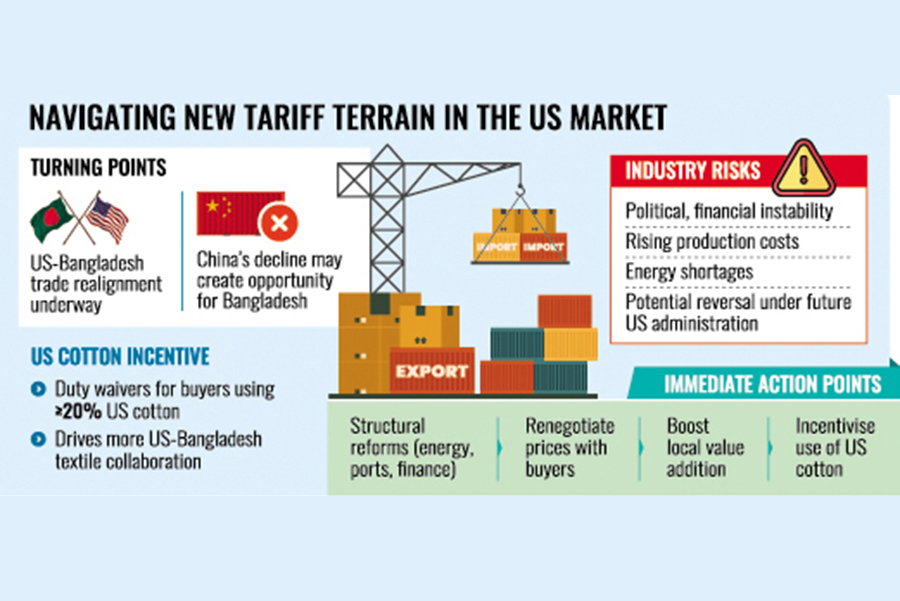
‘According to the clause F of section 3 (pages 13 and 14) of the US Executive Order 14257 on reciprocal duty, if a product exported to the US contains 20 per cent or more US-origin contents (raw materials), the reciprocal tariff would not apply to that portion,’ he added.

For example, if an RMG item worth $100 contains 26 per cent US content, then the reciprocal tariff could only be imposed on the value of the remaining 74 per cent.

Babu said that if this provision could be utilised effectively, it would offer significant tariff relief for the exporters.

However, he said that the implementation process of this clause remains unclear.

‘It is not specified how this rule would be applied or through which mechanism. We need greater clarity on this from the US side,’ he added.

He also stated that they would discuss this with the US side and US Customs and Border Protection regarding the execution of this clause, including traceability, mechanisms, greater transparency, detailed guidance, and clarification.

He also stated that approximately 75 per cent of the readymade garment items exported to the US were made from cotton.

He also said that if they could obtain a tariff waiver, there would be no pressure to import more US cotton and synthetic fibres, as this, in turn, could bring the effective tariff down below 20 per cent.

He also said that the reduction in reciprocal tariff from 35 per cent to 20 per cent brought some relief for the Bangladeshi exporters.

‘However, we have no room for self-satisfaction as competitors like India, Vietnam, China, and Pakistan are unlikely to be idle. They will continue negotiations and lobbying, and at any point, their tariff rates may drop even further,’ he added.

‘The latest US executive order mentioned that trade or security agreement talks were still ongoing with several countries. Bangladesh must remain engaged in this diplomatic process,’ he said.

He also expressed concerns, saying that the buyers might now face additional financial pressure.

‘To purchase the same volume of goods, buyers would need to arrange for 20 per cent more capital,’ he noted, saying that if a buyer has that capacity, they would proceed, and if not, they might resort to bank loans.

And if they don’t qualify for loans, they could reduce the number of orders. That’s where the concern lies, he added.

Moreover, the additional duty burden could ultimately fall on the end consumers, and if consumers reduce their purchases in response to higher retail prices, that too could lead to a decline in order volumes.

‘However, we are hopeful the market won’t head in that direction. At least one full season will be needed to truly understand how this plays out,’ he added.

Responding a question from a journalist on who would bear the reciprocal tariff, he said that about 95 per cent of the RMG exports operate under the Free-on-Board model, where the buyer is responsible for all charges after shipment—including import duties.

‘So far, no buyer has explicitly said they won’t bear the cost of this new countervailing duty. Therefore, we are assuming they will cover it,’ he added.

However, he said that they don’t want to jump ahead and make assumptions, but if buyers wish to open a discussion, they are ready to engage.

He urged the government to provide sustained policy support to ensure the sector’s competitiveness concerning the NBR, customs, ports, and gas and electricity supply.

Members of the BGMEA board of directors were also present at the event.​
 
Analyze

Analyze Post

Add your ideas here:
Highlight Cite Fact Check Respond
  • Love (+3)
Reactions: Bilal9

US trade adviser says Trump tariff rates unlikely to change

Some trade ministers "want to talk more and see how they can work differently with US," says trade representative​

By AFP
August 03, 2025


US President Donald Trump gestures while boarding Air Force One to depart for New Jersey, at Joint Base Andrews, Maryland, US, August 1, 2025. — Reuters

US President Donald Trump gestures while boarding Air Force One to depart for New Jersey, at Joint Base Andrews, Maryland, US, August 1, 2025. — Reuters

New US tariff rates are "pretty much set" with little immediate room for negotiation, Donald Trump's trade adviser said in remarks aired Sunday, also defending the president's politically driven levies against Brazil.

Trump, who has wielded tariffs as a tool of American economic might, has set tariff rates for dozens of economies, including the European Union, at between 10% and 41% come August 7, his new hard deadline for the duties.

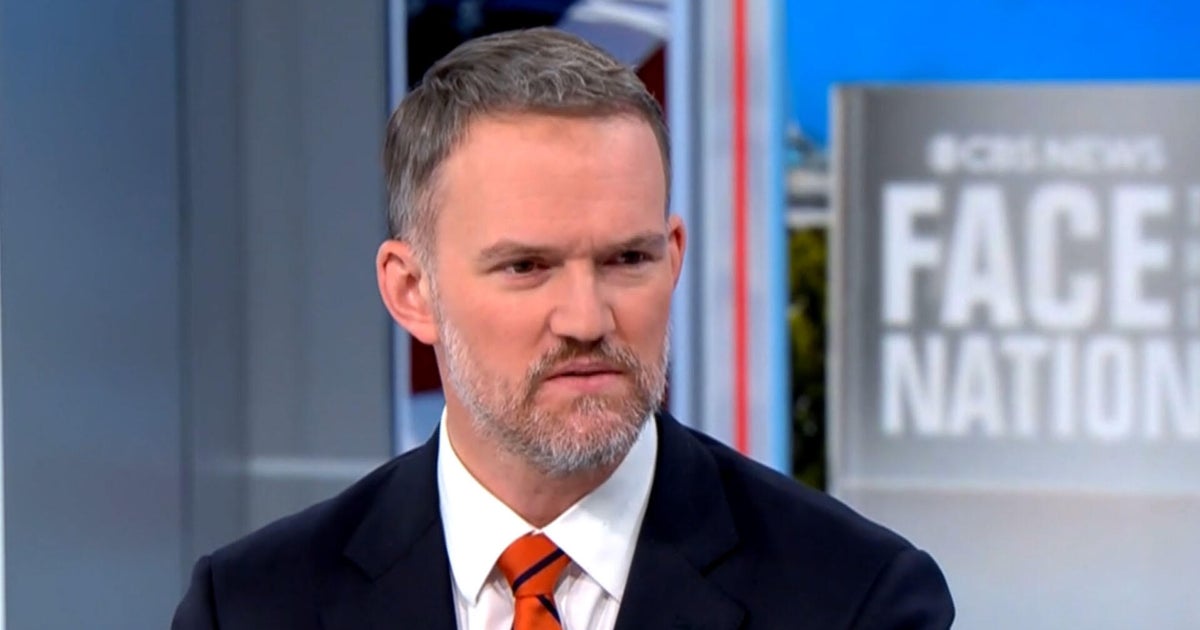
In a pre-taped interview broadcast Sunday on CBS's "Face the Nation," US Trade Representative Jamieson Greer said "the coming days" are not likely to see changes in the tariff rates.

 
Last edited:
Analyze

Analyze Post

Add your ideas here:
Highlight Cite Fact Check Respond

Tariff relief a welcome break
Reforms must for real competitiveness


Jasim Uddin
Published :
Aug 03, 2025 09:33
Updated :
Aug 03, 2025 09:33

1754352319624.webp


Bangladesh's main export-oriented apparel industry cautiously welcomes the US decision lowering the steep reciprocal tariff on imports from Bangladesh-from 35 per cent to 20 per cent-as entrepreneurs in the sector now stress deep reforms for real market competitiveness.

While this is a significant shift in trade diplomacy and potentially restores some competitiveness in the country's single -largest export market, industry leaders warn this is no time for complacency.

The revised tariff regime now places Bangladesh on a more level playing field with key competitors such as Vietnam (20 per cent), Indonesia (19 per cent), and Pakistan (19 per cent). It offers a fairer footing-but still falls short of ideal conditions, particularly when the total effective tariff, including base duties and charges, nears 36 per cent.

"We are relieved," says Shovon Islam, Managing Director of Sparrow Group, which exports products worth nearly $300 million annually-half of which goes to the United States. "But 20 per cent is still a heavy load. The effective tariff remains burdensome when all costs are considered."

Islam also underscores the urgency of structural reforms at home-citing inefficiencies in energy supply and port operations, corruption, and infrastructure. "Privatisation and export-friendly policies are crucial. We cannot expect tariffs alone to determine our future."

Mahmud Hasan Khan Babu, President of the Bangladesh Garment Manufacturers and Exporters Association (BGMEA), describes the development as "a relief" and credits the outcome to months of behind-the-scenes negotiations. "But the government must now fulfil the conditions agreed during those talks-particularly around customs procedures and import facilitation," he told The Financial Express.

Sharif Zahir, Managing Director of Ananta Apparel, with annual exports exceeding $465 million (around $170 million to the US), sees a broader vista of opportunity emerging. "China's apparel exports now face more than 34 per cent in tariffs. As sourcing shifts away from China, Bangladesh stands to gain-but we must scale up fast to seize the window," he said.

Zahir hints at a larger strategic trade alignment between Bangladesh and the US. "Whether it's LNG, aircraft, or agricultural commodities like corn and wheat-these purchases are not just transactions, they are part of a broader trade equation."

He also points to a unique incentive tied to U.S. cotton. "If buyers use at least 20-percent U.S. cotton, they qualify for duty waivers. This creates a new incentive for U.S. brands to source from Bangladesh using American raw materials," Zahir added.

The decision is also applauded by Fazlee Shamim Ehsan, CEO of Fatullah Apparel Ltd. "Tariffs in the 19-20-percent range ensure we remain globally competitive. But there may be short-term bumps-retail prices could rise, and buyers might try to squeeze prices. We must invest in local value addition and production capacity," he says.

Ehsan points to a critical gap in the supply chain. "Most of our inputs still come from China and India. In product segments like sneakers and sportswear, local value addition remains minimal." He has called for more accessible export finance and robust industrial incentives from Bangladesh Bank.

BTMA President Showkat Aziz Russell, speaking from the US, where he was part of the negotiating delegation, credited BTMA Adviser SK Bashir Uddin for playing a pivotal role in the talks. "Bashir pushed for a 75-percent narrowing of our trade deficit with the US-an unprecedented and bold stance in bilateral negotiations," he said.

"No other country has made such assertive demands of the US. This gives Bangladesh a unique position going forward," Russell added, hinting at potential future breakthroughs.

Mohiuddin Rubel, Additional Managing Director of Denim Expert Ltd and former BGMEA Director, terms the decision "strategically important." With India and China now facing higher tariff barriers, Bangladesh is relatively better placed. "Yes, retail prices may rise temporarily in the U.S., but our industry has already demonstrated resilience through COVID-19 and global inflation shocks."

However, Rubel cautions that domestic political and economic stability is essential to sustaining investor confidence and buyer commitment. "That is the key to long-term competitiveness," he stresses.

From a broader geopolitical perspective, BGMEA Director Faisal Samad has highlighted the significance of the original tariff hike in April by US President Donald Trump. "That moment was a game changer-it altered the global trade narrative. Governments scrambled. Our initial response may have been slow, but it eventually delivered results," he says.

Samad urges the industry and government to now focus on three priorities: renegotiating prices with buyers, managing production costs, and identifying new growth opportunities. "This is not the time to sit back and celebrate. China is already adjusting its strategy-they won't stay idle for long."

He also called for the formation of a national coalition-bringing together academia, policymakers, civil society, labour representatives, and trade bodies. "If we can articulate our national trade position collectively, this could be a turning point for Bangladesh."

Echoing these sentiments, Mohammad Hatem, President of the Bangladesh Knitwear Manufacturers and Exporters Association (BKMEA), called the 20-percent tariff a "win-win" outcome. He praised the negotiating team, led by the Trade Adviser, for their relentless efforts. While the initial hope was for a lower rate, Hatem believes that securing a reduction from the proposed 35 per cent represents a strategic success.

With Vietnam and India facing tariffs of 20 per cent and 25 per cent respectively, Bangladesh now occupies a relatively advantageous position. But Hatem warns that the situation remains volatile. "President Trump could make further announcements anytime-altering India's tariff rate or changing Vietnam's trade status. We must stay alert and proactive," he says.

He also urges exporters to remain firm so that buyers do not try to pass the cost of tariffs onto manufacturers. "There is no reason for panic. Tariffs have risen for everyone. And right now, buyers do not have any viable alternatives to Bangladesh," he notes.

Hatem points to China's declining export volumes as an opportunity for Bangladesh and India to step in. "Vietnam may struggle due to its dependency on Chinese inputs. Combined tariffs on Chinese-origin goods could reach up to 64 per cent-buyers will definitely look elsewhere."

He urges the Commerce Adviser to advocate for duty-free access for garments made with U.S. raw materials in future negotiations. "This would deepen bilateral ties and further benefit Bangladesh's textile sector, which already relies heavily on U.S. cotton."

However, Hatem cautions that several domestic challenges could hinder progress. These include persistent gas and electricity shortages, instability in the banking sector, and a fragile financial system.

"If we fail to address these problems-especially the energy crisis and policy instability-Bangladesh will miss the opportunity to capture orders shifting out of China," he alerts. "Much of this crisis has been caused by flawed monetary policy by Bangladesh Bank over the past two years, which has severely disrupted industrial output."

Hatem has called for urgent, targeted policy reforms. "Without a strong and supportive policy environment, we will not be able to fully capitalise on the emerging opportunities in global trade."​
 
Analyze

Analyze Post

Add your ideas here:
Highlight Cite Fact Check Respond
  • Love (+3)
Reactions: Bilal9

Productivity increase key to weathering tariff storm

Atiqul Kabir Tuhin
Published :
Aug 07, 2025 00:00
Updated :
Aug 07, 2025 00:41

1754526278492.webp


The recent reduction of the US reciprocal tariff on products imported from Bangladesh - from a previously declared 35 per cent to 20 per cent - has come as a much-needed relief for stakeholders in the Ready-Made Garment (RMG) industry. This development follows a flurry of diplomatic negotiations and concessions by Bangladesh, including increased imports from the US and a broad reduction in tariffs on US goods entering the country.

This tariff relief places Bangladesh's RMG sector, responsible for approximately 84 per cent of the country's export earnings and for which the US is the single largest export destination, on a more level playing field with key competitors like Vietnam and Sri Lanka, which are subject to the same 20 per cent rate. In contrast, larger economies like India and China face tariffs of 25 per cent or more. Although some countries, such as Cambodia and Pakistan, have negotiated a slightly lower tariff of 19 per cent, Bangladesh's strong production capacity and well-established supply chains are expected to help offset this marginal difference.

In this context, RMG entrepreneurs can be cautiously optimistic about sustaining export growth to the US and capitalising on opportunities arising from supply chain shifts away from China. However, optimism must be tempered with realism, as several challenges persist, both international and domestic.

One of the most immediate concerns is cost burden. While US importers are officially expected to bear the increased tariffs and pass them on to consumers, inflationary pressures in the US may reduce demand for imported garments. Reports suggest that American buyers are already requesting Bangladeshi manufacturers to absorb a portion of the cost. This is a significant concern, given that many local manufacturers already operate with razor-thin profit margins. Further pressure on those margins could ultimately affect the industry's most vulnerable segment - the low-paid garment workers.

Adding to these pressures are two recent domestic policy decisions that threaten to inflate logistical costs. The interim government's decision to increase charges at Chattogram Port by 40 per cent, along with a hike in fees at private inland container depots (ICDs) ranging from 30 to 100 per cent, risks further eroding the sector's competitiveness. At a time when global apparel markets are undergoing rapid transformation, such decisions could place Bangladesh at a disadvantage relative to regional competitors.

Another structural weakness is the RMG sector's heavy dependence on imported raw materials. Bangladesh's limited import substitution capacity leaves it vulnerable to the Rules of Origin (RoO) clause in the US tariff regime. This clause rewards manufacturers using US-origin inputs, but penalises those sourcing raw materials - such as fabrics and yarns - from third countries like China. The solution lies in long-term investments in backward linkage industries to reduce reliance on imports and develop domestic input sources.

The benefits from reduced tariffs will ultimately depend on how efficiently Bangladesh's industries can respond. While the country enjoys the advantage of low-cost labour, many factories' competitiveness is compromised by low hourly productivity and insufficient production capacity. However, there are signs of progress. Some factories have already increased output significantly by adopting modern Italian and Taiwanese machinery, leading not only to higher efficiency but also better pricing on select products. If this trend continues, and more units adopt smart technologies, production costs may fall and profit margins could rise.

To ensure sustainable growth, experts think that the RMG sector must focus on five key areas: strengthening backward integration; manufacturing more value-added products, particularly those based on man-made fibres (MMF); improving workforce skills and productivity; adopting advanced technologies in line with Industry 4.0; and enhancing sustainability to improve ESG scores. Bangladesh's globally recognised green factories and LEED-certified units offer a strong foundation in this regard.

Despite remarkable progress over the last few decades, the industry is still largely dependent on exporting some basic cotton items. In recent years, the global fashion landscape has undergone a dramatic shift, with the reign of cotton fading and MMF taking center stage. While cotton initially fuelled the surge of the Bangladesh apparel market, that seems now to have reached its peak and its growth potential appears limited. This echoes the global trend in fibre demand, where the cotton-to-MMF ratio has shifted from 75:25 thirty years ago to a stark 25:75 today.

This strategic change underscores the growing significance of apparel made from artificial fabrics in the global market. In spite of the seismic shift in fibre demand, with non-cotton fibre accounting for 75 per cent of garments manufactured globally, Bangladesh still relies on cotton fibers to make 71 per cent of the country's export-oriented products.

A recent study conducted by Wazir Advisors Pvt Ltd. suggests that the expansion of non-cotton garment exports holds immense potential for the country's economy. According to the study, conducted under the patronage of the Bangladesh Garment Manufacturers and Exporters Association (BGMEA), Bangladesh has the potential to increase its non-cotton garment exports from the current $15.6 billion to an impressive $46 billion annually by 2032, if entrepreneurs were to invest $18 billion to enhance manufacturing capacity and a fully integrated value chain.

If Bangladesh can act decisively to produce high-end products and bridge technological gaps to boost productivity and lower production costs, there is hope that the economy can not only withstand the impact of higher US tariffs but also emerge stronger.​
 
Analyze

Analyze Post

Add your ideas here:
Highlight Cite Fact Check Respond
  • Love (+3)
Reactions: Bilal9

US tariffs on India and China can open doors for Bangladeshi exporters

Published :
Aug 07, 2025 21:58
Updated :
Aug 07, 2025 21:58

1754610876487.webp


Bangladesh is emerging as a preferred destination for global apparel buyers as new US tariffs impose a significant competitive disadvantage on its main rivals, India and China.

With the Trump administration levying an additional 25 percent tariff on Indian and 30 percent on Chinese goods, buyers are increasingly turning to Bangladesh, which faces a comparatively lower 20 percent tariff on its products, reports UNB.

The shift in global trade dynamics presents a rare opportunity for Bangladesh’s ready-made garment (RMG) sector. Apparel exporters believe the country has the capacity and expertise to meet the new demand.

The BGMEA President Mahmud Hasan Khan stated that Bangladesh is fully capable of handling a diversion of orders from India and China, assuring there will be “no problem to meet the additional supply demand.”

Leaders of Bangladesh’s textile industry have expressed confidence in their ability to seize this opportunity.

Muhammad Hatem, President of the BKMEA, affirmed, “We have enough preparation to increase supply as per the demand of US and other buyers.”

He highlighted that lower production costs and tariffs in Bangladesh make it an attractive alternative.

In a move to strengthen trade ties with the US, the Bangladesh Textile Mills Association (BTMA) announced plans to increase its cotton imports from the United States to $1 billion. This decision, disclosed in a press release yesterday, comes after recent trade negotiations secured a tariff reduction for Bangladeshi goods from 35 percent to 20 percent.

Market analysts are optimistic but also cautious. While the new tariffs are a “major commercial blow to India,” they warn that this window of opportunity is not permanent. They urge Bangladesh to act quickly with a concrete roadmap and public-private partnerships to solidify its position.

Mohiuddin Rubel, a former director of the BGMEA, echoed this sentiment, stating, “This new tariff policy opens up immense possibilities for Bangladesh. I believe our export sector is now better positioned than ever before.” He noted that India had previously benefited from a decline in China’s market share, but the new policy could reverse that trend.

India’s Market Share at Risk:

The increased tariffs pose a significant challenge for India’s apparel exports to the US, which had seen a 55.34 percent growth from $3.02 billion in 2020 to $4.70 billion in 2024. Analysts predict that the new 50 percent tariff (25 percent retaliatory plus 25 percent for importing Russian oil) will severely undercut India’s competitive pricing, leading to substantial market share loss.

The strained relationship between the US and India is rooted in trade disputes over issues like genetically modified foods and agricultural policies. The new tariffs, alongside existing trade agreements between the US and other nations, have made competition increasingly difficult for India.

To fully capitalize on this opportunity, experts emphasize that Bangladesh must focus on maintaining high quality, timely delivery, competitive pricing, and political stability. These factors will be critical for accelerating its market penetration in the US and establishing itself as a dominant exporter in South Asia.

The strained relationship between the US and India is rooted in trade disputes over issues like genetically modified foods and agricultural policies. The new tariffs, alongside existing trade agreements between the US and other nations, have made competition increasingly difficult for India.​
 
Analyze

Analyze Post

Add your ideas here:
Highlight Cite Fact Check Respond

Members Online

⤵︎

Latest Posts

Latest Posts