Donate ☕
201 Military Defense Forums
[🇨🇳] - China----News & Views | Page 10 | PKDefense
Home Post Alerts Inbox Watch Videos

[🇨🇳] China----News & Views

Reply (Scroll)
Press space to scroll through posts
G   Chinese Defense
[🇨🇳] China----News & Views
54
3K
More threads by Saif


Tesla to build first grid-scale power plant in China
AFP 21 June, 2025, 22:31

Tesla announced Friday that it signed an agreement to build its first grid-scale energy storage power station project in mainland China.

The project will help with the flexible adjustment of grid resources, and ‘effectively solve pressures relating to urban power supply,’ Tesla said in a post to the Chinese social media platform Weibo.

‘After completion, this project is expected to become the largest grid-side energy storage project in China,’ Tesla added.

Such energy storage systems help to enhance stability in the electricity grid at a time when there are greater supplies of solar and wind power.

Chinese media outlet Yicai reported that Tesla Shanghai, Shanghai authorities and China Kangfu International Leasing Co. held a signing ceremony Friday for the project. It added that the deal involved investments of 4 billion yuan ($560 million).

The contract comes at a moment of tension between Washington and Beijing, with the two sides yet to hash out a long-term trade agreement following tariffs announced by President Donald Trump.​
 
Analyze

Analyze Post

Add your ideas here:
Highlight Cite Fact Check Respond

Defence meet in China unable to adopt joint statement
Says Indian foreign ministry

Defence ministers of the Shanghai Cooperation Organisation (SCO) meeting in China were unable to adopt a joint statement at the end of their talks due to a lack of consensus on referring to "terrorism", the Indian foreign ministry said yesterday.

"Certain members, member countries, could not reach consensus on certain issues and hence the document could not be finalised on our side," Indian foreign ministry spokesperson Randhir Jaiswal told reporters at a weekly media briefing.

"India wanted concerns on terrorism reflected in the document, which was not acceptable to one particular country and therefore the statement was not adopted," he said, without naming the country.

Indian media reported that New Delhi had refused to sign the document after it omitted reference to the April 22 attack on Hindu tourists in Indian Kashmir, in which 26 people were killed.

India refused to sign document after it omitted reference to the attack on tourists in Indian Kashmir

India blamed Pakistan for the attack but Islamabad rejected the accusation. The attack led to the worst fighting in decades between the nuclear-armed neighbours after India struck what it called "terrorist infrastructure" in Pakistan and Pakistani Kashmir.

Pakistan denied that the targets had anything to do with "terrorism" and that they were civilian facilities.

The foreign ministries of China and Pakistan did not immediately respond to a request for comment on India's statement.

Earlier yesterday, when asked about the joint statement, a Chinese defence ministry spokesperson said the meeting had "achieved successful results", without elaborating.​
 
Analyze

Analyze Post

Add your ideas here:
Highlight Cite Fact Check Respond

China’s humanoid robots outshine human footballers, draw crowds with AI-driven matches

AP
Published :
Jun 29, 2025 13:08
Updated :
Jun 29, 2025 13:08

1751242584199.webp


While China’s national men’s football team continues to disappoint on the international stage, humanoid robots are capturing attention in Beijing — not for their athletic skills, but for the cutting-edge AI technology behind them.

On Saturday night, four teams of humanoid robots competed in fully autonomous 3-on-3 football matches, powered entirely by artificial intelligence. The event, promoted as the first of its kind in China, also served as a preview for the upcoming World Humanoid Robot Games, scheduled to be held in Beijing.

Organizers highlighted that the robots played the matches without any human control, relying solely on AI-based strategies and decision-making.

Outfitted with sophisticated visual sensors, the robots could track the ball and maneuver around the field with surprising agility. They were even programmed to pick themselves up after falling. Still, in a display of realism, some robots had to be carried off on stretchers after toppling over during play.

China is ramping up efforts to advance AI-driven humanoid robots, using sports such as marathons, boxing, and football as testing grounds to refine their performance in real-world scenarios.

Cheng Hao, founder and CEO of Booster Robotics—the company that provided the robot players—described sports competitions as ideal environments to develop the complex interaction between hardware, software, and AI algorithms.

Cheng also underlined the importance of safety, especially with future plans for human-robot matches.

“In the future, we might organize football games between robots and humans. For that to happen, we must guarantee absolute safety,” Cheng explained. “These matches wouldn’t focus on winning or losing but would allow for real offensive and defensive interactions. That’s how we can build public trust and show that robots are safe.”

Booster Robotics supplied the hardware for all four university teams, while the universities themselves developed the AI algorithms for perception, game strategy, formations, and passing — considering variables such as speed, force, and direction, according to Cheng.

In the final, Tsinghua University’s THU Robotics defeated the China Agricultural University’s Mountain Sea team with a 5-3 scoreline to claim the championship.

Tsinghua supporter Mr. Wu cheered his team’s victory but also praised the competition.
“THU performed really well,” he said. “But the Mountain Sea team from Agricultural University also exceeded expectations. It was a thrilling match.”

China’s men’s football team, meanwhile, has only qualified for the World Cup once and has already been eliminated from next year’s tournament in Canada, Mexico, and the United States.​
 
Analyze

Analyze Post

Add your ideas here:
Highlight Cite Fact Check Respond

Six university students drown in China mine accident

REUTERS
Published :
Jul 24, 2025 21:32
Updated :
Jul 24, 2025 21:32

1753401790054.webp


Six university students drowned while on a field visit to a mine owned by Shanghai-listed Zhongjin Gold Corp in northern China's Inner Mongolia region on Wednesday. Photo : Collected

Six university students drowned on Wednesday while on a field visit to a copper molybdenum mine in northern China owned by Shanghai-listed Zhongjin Gold Corp, according to a stock exchange filing on Thursday.

The students from Northeastern University in Shenyang fell into a flotation cell - a piece of mining equipment that uses a liquid solution to extract copper from crushed ore - after protective grates collapsed.

A teacher was also hurt in the accident at the mine located in China's Inner Mongolia region, according to the filing from Zhongjin Gold, a subsidiary of state-owned China National Gold Group Co.

The company said it activated an emergency plan and reported the incident to the relevant departments of the local government.

The operator of the mine, a subsidiary of Zhongjin Gold, halted production, the company said in another stock exchange filing later on Thursday.

Shares of Zhongjin Gold closed down 4.4% on Thursday.

Such field visits have been organised for years and the incident was unexpected, said a teacher from Northeastern University, according to a social media account belonging to Henan Radio and Television.

The university sent staff to the site to manage the incident, the teacher said.​
 
Analyze

Analyze Post

Add your ideas here:
Highlight Cite Fact Check Respond

China proposes new global AI cooperation organisation

REUTERS
Published :
Jul 26, 2025 15:32
Updated :
Jul 26, 2025 15:32

1753577106876.webp

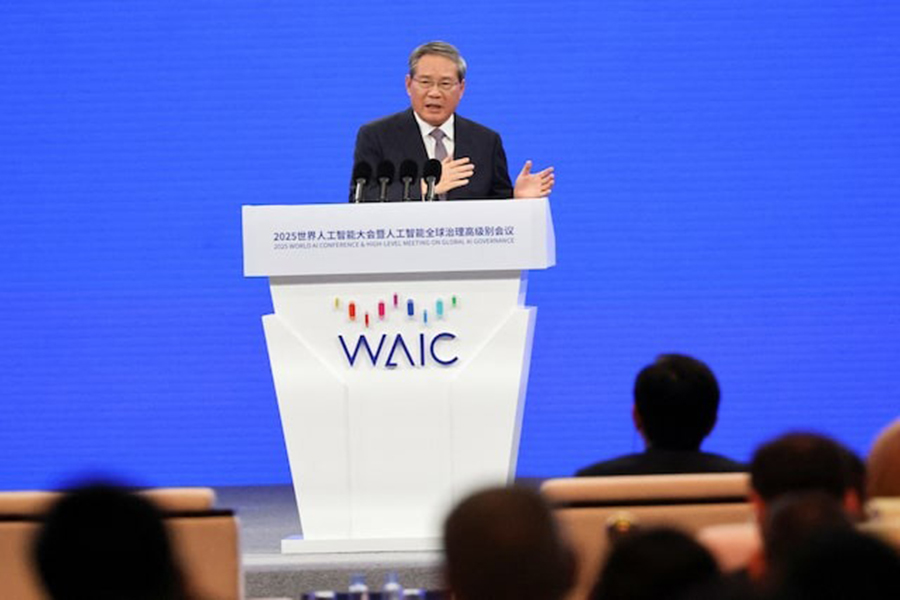
Chinese Premier Li Qiang speaks during the opening ceremony of World Artificial Intelligence Conference in Shanghai, China on July 26, 2025 — Reuters photo

China said on Saturday it wanted to create an organisation to foster global cooperation on artificial intelligence, positioning itself as an alternative to the US as the two vie for influence over the transformative technology.

China wants to help coordinate global efforts to regulate fast-evolving AI technology and share the country's advances, Premier Li Qiang told the annual World Artificial Intelligence Conference in Shanghai.

President Donald Trump's administration on Wednesday released an AI blueprint aiming to vastly expand US AI exports to allies in a bid to maintain the American edge over China in the critical technology.

Li did not name the United States but appeared to refer to Washington's efforts to stymie China's advances in AI, warning that the technology risked becoming the "exclusive game" of a few countries and companies.

China wants AI to be openly shared and for all countries and companies to have equal rights to use it, Li said, adding that Beijing was willing to share its development experience and products with other countries, particularly the "Global South". The Global South refers to developing, emerging or lower-income countries, mostly in the southern hemisphere.

How to regulate AI's growing risks was another concern, Li said, adding that bottlenecks included an insufficient supply of AI chips and restrictions on talent exchange.

"Overall global AI governance is still fragmented. Countries have great differences particularly in terms of areas such as regulatory concepts, institutional rules," he said. "We should strengthen coordination to form a global AI governance framework that has broad consensus as soon as possible."

SHANGHAI HEADQUARTERS

The three-day Shanghai conference brings together industry leaders and policymakers at a time of escalating technological competition between China and the United States - the world's two largest economies - with AI emerging as a key battleground.

Washington has imposed export restrictions on advanced technology to China, including the most high-end AI chips made by companies such as Nvidia and chipmaking equipment, citing concerns that the technology could enhance China's military capabilities.

Despite these restrictions, China has continued making AI breakthroughs that have drawn close scrutiny from US officials.

China's Vice Foreign Minister Ma Zhaoxu told a roundtable of representatives from over 30 countries, including Russia, South Africa, Qatar, South Korea and Germany, that China wanted the organisation to promote pragmatic cooperation in AI and was considering putting its headquarters in Shanghai.

The foreign ministry released online an action plan for global AI governance, inviting governments, international organisations, enterprises and research institutions to work together and promote international exchanges including through a cross-border open source community.

The government-sponsored AI conference typically attracts major industry players, government officials, researchers and investors.

Saturday's speakers included Anne Bouverot, the French president's special envoy for AI, computer scientist Geoffrey Hinton, known as "the Godfather of AI", and former Google CEO Eric Schmidt.

Tesla CEO Elon Musk, who has in past years regularly appeared at the opening ceremony in person or by video, did not speak this year.

Besides forums, the conference features exhibitions where companies demonstrate their latest innovations.

This year, more than 800 companies are participating, showcasing more than 3,000 high-tech products, 40 large language models, 50 AI-powered devices and 60 intelligent robots, according to organisers.

The exhibition features predominantly Chinese companies, including tech giants Huawei and Alibaba and startups such as humanoid robot maker Unitree. Western participants include Tesla, Alphabet and Amazon.​
 
Analyze

Analyze Post

Add your ideas here:
Highlight Cite Fact Check Respond
⤵︎

Latest Posts

Latest Posts