Donate ☕
201 Military Defense Forums
[🇧🇩] - Everything about Hasina's misrule/Laundered Money etc. | Page 45 | PKDefense
Home Login Forums Wars Watch Videos
Serious discussion on defense, geopolitics, and global security.

[🇧🇩] Everything about Hasina's misrule/Laundered Money etc.

Reply (Scroll)
Press space to scroll through posts
G Bangladesh Defense
[🇧🇩] Everything about Hasina's misrule/Laundered Money etc.
261
8K
More threads by Saif

Sheikh Hasina was a classic autocrat: M Sakhawat Hossain
Published :
Aug 05, 2024 22:03
Updated :
Aug 05, 2024 22:03


1722901534183.png

Sheikh Hasina was a classic autocrat who dismissed the people, and this disdain has led to her current predicament, according to Brigadier General (Retd) M. Sakhawat Hossain, an election analyst and former military officer. In a special interview with UNB news agency over the phone, he expressed these views.
He stated that today's events were inevitable and were bound to happen. "We have seen similar situations in Tunisia, Libya, and Syria. Popular uprisings are unstoppable. The student quota reform movement could have been resolved easily, but due to Prime Minister Sheikh Hasina's stubbornness, so many people lost their lives."

Hossain criticised the media's portrayal of the casualties, claiming that the true number is closer to 400, with a significant portion being students and young people. He questioned the whereabouts of the remaining bodies, mass graves, and the extent of innocent lives lost. "She has gone, but who will answer for this?" he asked.

He accused the ruling government of carrying out the "most heinous massacre" and of misleading the public by blaming criminals while those responsible were, in fact, their own countrymen. "Such things should not happen in a free country," he remarked.

Hossain also noted that for the past 15 years, people have been unable to vote properly, with widespread election fraud. He stated that Sheikh Hasina should have understood her and her party's unpopularity, and questioned who would be held accountable for the bloodshed. He criticized the severe lack of good governance, which he believes Sheikh Hasina failed to provide.

Furthermore, he alleged that Sheikh Hasina has created criminal gangs within the country and turned the police and Rapid Action Battalion (RAB) into her personal enforcers.

Reflecting on the plight of the family members of the so-called Father of the Nation, he questioned why they had to face such a tragic fate, attributing it to Hasina's arrogance and pride. He drew a parallel with the 2009 BDR mutiny, where 57 army officers were killed, and questioned who would answer for that incident as well.

He criticised Sheikh Hasina's control over TV media and her suppression of free speech, citing it as a reason he avoided talk shows. He claimed he had urged the Prime Minister in various meetings to ensure good governance, but was labelled as an 'agent of the opposition' for his criticisms.

"Today, Sheikh Hasina has fled the country, and now the army has had to take responsibility for the nation's situation," he concluded.​
 
Last edited:
Analyze

Analyze Post

Add your ideas here:
Highlight Cite Fact Check Respond
  • Like (+1)
Reactions: Bilal9

Is it possible to bring back the laundered money?
It is normal that the individuals, who fled the country after 5 August, will need more foreign currency to alleviate their financial crisis abroad with the help of their family members and relatives. Our suspicion is that the recent significant surge in demand for remittance dollars is largely driven by this issue.
Moinul Islam
Published: 28 Mar 2025, 18: 05

1743210001271.webp


During the 15 and a half years of autocratic rule under Sheikh Hasina, the banking sector suffered the most from looting, which led to 11 out of the 61 banks in the country being on the verge of bankruptcy. Despite there being no need for 61 banks in the country, Hasina's arbitrary decisions granted licenses for so many banks. This was done to provide unbelievable opportunities for her relatives, influential leaders of the Awami League, oligarchic businesspersons, and those who turned into “rubber barons” to loot capital from these institutions.

Despite repeated objections from the late finance minister Abul Maal Abdul Muhith, Hasina could not be dissuaded from making such reckless decisions. After the removal of Hasina’s autocratic rule on 5 August last year, the current interim government took power on 8 August, and Ahsan H Mansur was appointed as the governor of Bangladesh Bank. Over the past six months, he has been making bold decisions to rescue the banking sector from the brink of collapse, and we can see the positive results now.

Among the 11 banks, seven were looted by the bank robber S Alam from Chattogram. Those are: Islami Bank Bangladesh, SIBL, First Security Islami Bank, Union Bank, Commercial Bank, NRB Global Bank, and Al-Arafah Islami Bank.

Until 2017, Islami Bank was mainly controlled by Bangladesh Jamaat-e-Islami. At that time, it was the largest private sector bank in the country, handling nearly 30 per cent of the country’s remittance flow. This strong bank was brought under the control of S Alam under Hasina’s direct orders and support. In seven years, between 2017 and 5 August 2024, S Alam embezzled nearly Tk 700 billion from Islami Bank, pushing it to the verge of bankruptcy.

S Alam looted almost Tk 1,500 billion from his seven banks and smuggled it abroad. The corrupt land minister of the fallen government, Saifuzzaman Chowdhury, looted the United Commercial Bank.

The White Paper drafting committee claims that during Hasina’s rule, the country's economic system transformed directly from “crony capitalism” to “kleptocracy”.

Adviser to the fallen Hasina government, Salman F Rahman, who owns BEXIMCO Group, has outstanding loans worth more than Tk 500 billion in various banks. The 11 banks mentioned have been unable to return depositors’ money for several months, but some banks have begun recovering. The success of Islami Bank and United Commercial Bank was announced by Ahsan H Mansur himself.

The White Paper drafting committee claims that during Hasina’s rule, the country's economic system transformed directly from “crony capitalism” to “kleptocracy”.

During her autocratic regime, Hasina and her family, relatives, party leaders, certain oligarchic businessmen, and capital looters formed an institutional system for looting hundreds of thousands of crores of taka from government projects. The heart of this looting operation was Hasina’s family, the looting of oligarchic businessmen, thousands of corrupt politicians, and bureaucrats.

Research by the White Paper drafting committee revealed that, under Hasina’s 15 and a half years of plundering system, an average of 16 billion dollars a year - totaling 234 billion dollars - was embezzled and laundered abroad.

The banking and financial sector suffered the most, followed by the energy and power sector, infrastructure, and information technology sectors. The United Arab Emirates, Canada, the United States, the United Kingdom, Singapore, Malaysia, Hong Kong, India, and several “tax havens” were identified as the primary beneficiaries of this laundered money.

It should be remembered that after the mass uprising, the economy was able to avoid a meltdown primarily due to the surge in remittance flows through legal channels, export growth, and the stabilisation of import expenses.
After the fall of Hasina’s autocratic rule, almost all of the looters and money launderers, except for a few, fled abroad. Many of these fugitives, in exchange of a few lakhs to several crores of taka, crossed the border secretly, with the assistance of the Border Guard Bangladesh (BGB), Border Security Force (BSF), and organised smuggling syndicates, mainly to India. After several months, the majority of them are now facing temporary financial crises.

Therefore, it is normal that these individuals will need more foreign currency to alleviate their financial crisis abroad with the help of their family members and relatives. Our suspicion is that the recent significant surge in demand for remittance dollars is largely driven by this issue.

In this case, there is no alternative but for Bangladesh Bank to take strict action. Bangladesh Bank has already issued a directive that the price of the dollar should not exceed Tk 123 per dollar.

The directive states that from 1 January 2025, the same rate will apply to remittance dollars and export earnings dollars, and anyone violating this will be fined. Bangladesh Bank has abandoned the “crawling peg” policy in determining foreign exchange rates and has decided to set the exchange rate for the dollar twice a day, allowing market fluctuations to determine the dollar's price, effective since 12 January.

I believe this is the correct move. (At the same time, from 5 January, large transactions must be reported daily to Bangladesh Bank.) I would like to add that in addition to fines, if exemplary punishments such as arresting the concerned officials and canceling the licenses of the institutions are decided upon, the exchange houses and banks will wake up.

It should be remembered that after the mass uprising, the economy was able to avoid a meltdown primarily due to the surge in remittance flows through legal channels, export growth, and the stabilisation of import expenses. The fall in the country’s foreign exchange reserves has been stopped, and they have been brought back on the path of growth.

After being ousted from power on 5 August 2025, in the mass uprising, over the past six and a half months, it has been proven to economists that even if Hasina had not lost power as an autocrat, she could not have saved the country’s economy from an inevitable economic meltdown. In this regard, we must thank Almighty Allah for saving us from the shame of becoming another Sri Lanka.

The timely policy changes made by the interim government have gradually begun to revive the economy. However, I do not believe that the 234 billion dollars laundered abroad can ever be brought back to the country.

*Moinul Islam is an economist and former professor at Economics Department of Chittagong University

*This article, originally published in Prothom Alo print and online editions, has been rewritten in English by Rabiul Islam.​
 
Analyze

Analyze Post

Add your ideas here:
Highlight Cite Fact Check Respond

Tulip hits out at Bangladesh authorities over media 'witch-hunt'
Published :
Apr 02, 2025 23:01
Updated :
Apr 02, 2025 23:01

1743642321046.webp


British MP Tulip Siddiq has accused Bangladeshi authorities of conducting a smear campaign by making "false and vexatious claims" against her in the media without ever contacting her directly.

In a statement posted on social media platform X on Wednesday, Tulip said: “The Bangladesh authorities have been making false allegations about me to the media for months, but they have never contacted me directly.”

Tulip, a niece of Bangladesh's deposed prime minister Sheikh Hasina, is in the crosshairs of authorities in Bangladesh as part of an ongoing corruption investigation involving her aunt, according to bdnews24.com.

The Labour MP for Hampstead and Kilburn said her lawyers had reached out to the relevant authorities over two weeks ago, urging them to stop making "baseless allegations" to the press and inviting them to raise any legitimate questions with her directly. The deadline for a response has since passed, with no reply from the Bangladeshi side, she added.

“Instead, they continue to smear me with false and vexatious claims in the media,” Tulip said.

“I have provided detailed rebuttals of all the allegations they have made through the media, acting in good faith despite the lack of return courtesy. Their lack of response speaks volumes.”

Tulip also addressed the role of Bangladesh’s Anti-Corruption Commission, which she said has made no attempt to contact her formally. “If the so-called Anti-Corruption Commission in Dhaka has any questions, they know how to contact me,” she said.

Highlighting "due process", "the rule of law" and a "tradition of fair play" as hallmarks of British democracy, Tulip added: “I would happily respond to any legitimate questions, but I will not be drawn into dirty politics, nor allow their witch-hunt to undermine my work as a British citizen and proud member of the UK Parliament.”​
 
Analyze

Analyze Post

Add your ideas here:
Highlight Cite Fact Check Respond
  • Love (+3)
Reactions: Bilal9

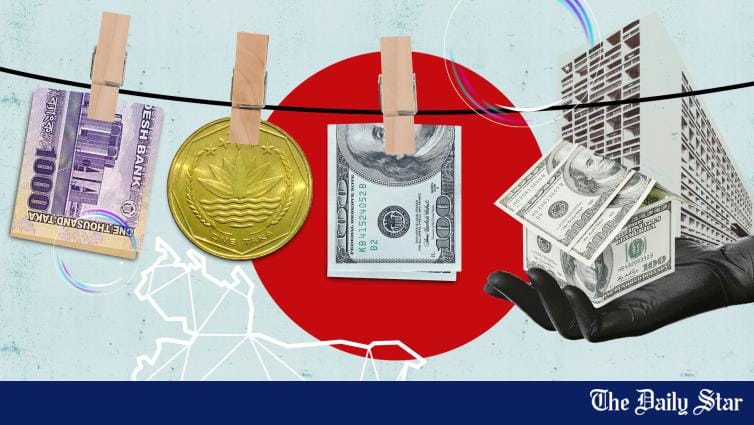
The golden rule in recovering stolen assets

1744164468975.webp

Visual: Anwar Sohel

In 1972, when Bob Woodward was investigating the Watergate scandal, he was not getting any leads. He got a breakthrough from a secret informant with the pseudonym "Deep Throat," saying "Follow the money." In 2005, the identity of "Deep Throat" was revealed—it was Mark Felt, an FBI special agent. Mark passed away in 2008, but his advice to Bob Woodward became a golden rule in uncovering major crimes involving huge amounts of money.

Mark Felt's rule is still relevant to the question of laundered money from Bangladesh and its recovery. In this respect, "time is of the essence"—because the more time passes, the more difficult it becomes to "follow the money." Any laundered money travels very fast, particularly in this digital age. It moves to various destinations and takes different forms—both tangible and intangible. So, after a while, the colour of the money gradually fades, and it simply becomes very difficult to track and identify laundered money.

One critical question is: how big is the amount of money laundered from Bangladesh? Estimates vary. However, the White Paper on the state of the Bangladesh economy indicates that Tk 28 lakh crore was laundered between 2009 and 2023—equivalent to $234 billion. This is just an indicative figure, based on various sources and assumptions. The ultimate point is that the sheer scale of laundered money from Bangladesh is simply huge. After it left the country, the money was used to buy homes or other tangible assets in Dubai, UAE, UK, Malaysia, and so on.

The million-dollar question is: how can Bangladesh recover the laundered money that has crossed its borders? Let us make it clear at the very outset that the recovery process is both complex and time-consuming. The complexity arises on both financial and legal fronts. The process often starts with identifying unusual and suspicious transactions, which can be done through anti-money laundering protocols. Authorities trace the funds through financial records, such as bank accounts, wire transfers, and export-import invoices, which requires forensic financial investigation to uncover how money was laundered. The detection and investigation of laundered money require both bilateral and international cooperation. For example, governments use Mutual Legal Assistance Treaties to request assistance from foreign governments in gathering evidence, freezing accounts, or tracing assets. With cooperation from foreign countries, the laundered money can be temporarily frozen to prevent further movement. International anti-crime organisations like Interpol can be involved in the investigation. International investigation firms are sometimes engaged in evidence gathering and investigations.

Next comes the legal action. Legal action is initiated against those involved in money laundering, both in the country of origin and the country of destination. The legal action involves charges of money laundering, fraud, or other related crimes. Along with criminal charges, civil lawsuits may also be initiated. But two issues are critical in this respect. First, three basic points need to be established: one, in the country of origin, wealth was accumulated illicitly; two, wealth was taken out of the country illegally; and three, the wealth entered the country of destination illegally. Second, before initiating legal actions abroad, those involved in money laundering must be convicted in the courts of the country of origin. Sometimes, international law firms are appointed for legal actions abroad. If the laundered money is found to be illegal, confiscation orders are served by courts to seize the funds in the destination country. The confiscated laundered money is then returned to the originating country through legal agreements and treaties.

The process of convicting those involved in money laundering and recovering the laundered money critically hinges on collaboration between the country of origin and the country of destination. In that context, the existence of mutual treaties and agreements between those countries is a prerequisite. There must be compatible legal frameworks between the two parties. Different legal frameworks, weak enforcement of anti-money laundering protocols, and strict banking secrecy laws in the destination country may make the recovery process difficult. Furthermore, the goodwill of the destination country is also key. For example, the destination country may only be interested in whether the money has entered its borders legally, irrespective of where and how it was accumulated and how it left the originating country. This reflects that the destination country might be more interested in incoming resources. This may impede the recovery process.

Additionally, if the funds were settled in tax havens or offshore banking, the recovery process becomes more complex. Similarly, complexities may arise if the laundered money is turned into tangible assets such as houses. It has been found on many occasions that legal firms engaged by money-laundering victim countries to detect, trace, and recover laundered money have been bribed or paid large sums by those engaged in money laundering.

Questions are often asked if laundered money from different countries have ever been recovered. Two observations should be put forward before answering this question. One, there are positive examples where certain countries were able to recover laundered money. But there are also negative examples. Second, till now, no country has been able to recover the full amount of laundered money, so the success story is only partial.

Angola is often cited as a positive example, where $5 billion was recovered through various means. It represents part of the billions of dollars laundered by the son of a past president of the country, Jose Eduardo dos Santos. In fact, about $3 billion of the $5 billion was willingly returned by a friend of the president's son. In Nigeria, during the rule of Sani Abacha, an estimated $5 billion was looted and laundered abroad. After extensive legal proceedings and cooperation between Swiss authorities, the World Bank, and the Nigerian government, $500 million was recovered in 2004. In 2020, a further $300 million was agreed to be repatriated from the US. Other recoveries were made in various countries, including the UK and Liechtenstein, bringing the total recovered to $1.3 billion. In Malaysia, 1Malaysia Development Berhad was involved in laundering $4.5 billion through complex schemes. In 2020, the US Department of Justice reached a settlement with Goldman Sachs, which agreed to pay $2.5 billion directly to Malaysia for its role in the scandal. US authorities also recovered over $1 billion in assets tied to 1Malaysia Development Berhad.

Money laundering is a sensitive issue. Recovery is neither costless nor easy. It will take time.People should surely be informed about the progress as well as the problems of the recovery process, but they should not be given any false notions about the timing or the extent of the recovery. Whatever success Bangladesh has in recovering the laundered money, the issue needs to be pursued, irrespective of time and cost, because it has a moral dimension. When the culprits are brought to justice, it will send a strong signal to everyone that nobody can get away with looting national wealth.

Selim Jahan is former director of the Human Development Report Office under the United Nations Development Programme (UNDP) and lead author of the Human Development Report.​
 
Analyze

Analyze Post

Add your ideas here:
Highlight Cite Fact Check Respond

ACC probes Hasina, Rehana over Tk 40b Mujib Borsho spending
UNB
Published: 09 Apr 2025, 22: 58

1744253130988.webp

Logo of ACC Prothom Alo illustration

The Anti-Corruption Commission (ACC) has initiated a formal inquiry into allegations of misappropriation of Tk 40 billion from the state treasury during the Mujib Borsho celebrations, implicating former prime minister Sheikh Hasina, her sister Sheikh Rehana, and former principal secretary Kamal Abdul Naser Chowdhury.

The inquiry, which was launched in January, is being overseen by a seven-member ACC committee, said ACC director general (prevention) Md Akhtar Hossain at a press briefing in Dhaka on Wednesday.

“Our team is currently collecting information from various organisations,” he said.

The allegations relate to expenditures made during the Mujib Borsho celebrations—marking the birth centenary of Bangabandhu Sheikh Mujibur Rahman and Sheikh Hasina’s father—which took place from March 2020 to March 2022. The Awami League government is accused of spending Tk 40 billion on various events and installations, including the construction of 10,000 murals and statues across the country.

Declared by Sheikh Hasina during a party meeting in July 2018, Mujib Borsho was officially launched on 17 March 2020 and extended until March 2022, overlapping with the COVID-19 pandemic. The celebrations were coordinated by two government-formed bodies: a 102-member National Committee chaired by Hasina and a National Implementation Committee.

Shomi Kaiser, Dipu Moni among 10 shown arrested in fresh cases

Activities during this period included cultural events, publications, digital content, sports competitions, and the creation of Mujib-themed materials across both government and private offices. Aircraft, official documents, and even immigration areas at airports were branded with the Mujib Borsho logo and imagery of Sheikh Mujibur Rahman.

Due to pandemic restrictions, many programmes transitioned online, including video documentaries, commemorative websites, digital quizzes, and special telecom packages such as Teletalk’s free “Shatabarsho” offer. Several ministries and state-run agencies also introduced Mujib Corners and released souvenirs and memorial books.

Critics have raised concerns over the scale and extravagance of the celebrations during a global health crisis, questioning the transparency and necessity of such large-scale expenditures.

The ACC investigation is ongoing, with findings yet to be disclosed. If evidence of corruption is found, it could have significant legal and political consequences for the individuals involved and the former ruling party.​
 
Analyze

Analyze Post

Add your ideas here:
Highlight Cite Fact Check Respond
  • Sad (0)
Reactions: Bilal9
He has no right to say this seating on throne without public mandate. He is a para dropped puppet of US.
Please visit Dhaka sometime and ask the average person on the street what they think. We have no liar media like in India to prop up people, like you do in case of Modi.

Elections in Bangladesh is our headache and our internal affair, not that of India's. We will conduct one as we see fit.

Indians should not wear out their welcome in Bangladesh. They should know their place as outsiders.
 
Analyze

Analyze Post

Add your ideas here:
Highlight Cite Fact Check Respond

Members Online

⤵︎

Latest Posts

Latest Posts