Indian analysis on why India will need to prepare for war with hostile neighbors. I know this is largely speculative, but the thinking process needs to be understood to realize the method to the propaganda madness.
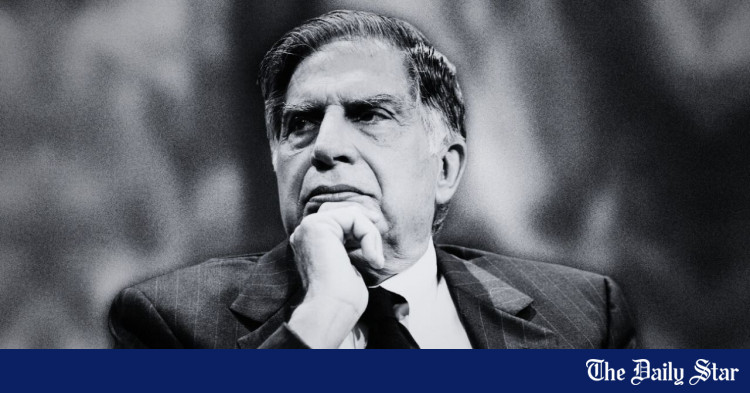
India’s top industrialist and Tata Sons Chairman Emeritus Ratan Tata died in a hospital in Mumbai last night, the company said.
www.thedailystar.net
Ratan Tata passes away
Indian Padma Vibhushan industrialist Ratan Tata dies at 86
India's top industrialist and Tata Sons Chairman Emeritus Ratan Tata died in a hospital in Mumbai last night, the company said.
"It is with a profound sense of loss that we bid farewell to Mr Ratan Naval Tata, a truly uncommon leader whose immeasurable contributions have shaped not only the Tata Group but also the very fabric of our nation," said a press statement by Tata Sons Chairman N Chandrasekaran.
Ratan was admitted to Breach Candy Hospital for age-related ailments.
Indian Prime Minister Narendra Modi paid rich tributes to the industrialist, describing him as a visionary business leader, compassionate soul and an extraordinary human being.
"One of the most unique aspects of Shri Ratan Tata Ji was his passion towards dreaming big and giving back. He was at the forefront of championing causes like education, healthcare, sanitation, animal welfare to name a few," Modi said on X.
Ratan Tata, who ran the conglomerate for more than 20 years as chairman, had been undergoing intensive care in hospital.
He became chairman of the Tata Sons, the autos-to-steel conglomerate, in 1991 and ran the group founded by his great-grandfather more than a hundred years ago until 2012.
He founded telecommunications company Tata Teleservices in 1996 and made IT company Tata Consultancy Services public in 2004.
After stepping down, Ratan Tata was conferred with the title of chairman emeritus of Tata Sons, Tata Industries, Tata Motors, Tata Steel, and Tata Chemicals, the company website says.
On graduating with a degree in architecture at Cornell University, US, he returned to India and in 1962 began working for the group his great-grandfather.
He worked in several Tata companies, including Telco, now Tata Motors Ltd as well as Tata Steel Ltd and later made his mark by erasing losses and increasing market share at group unit National Radio And Electronics Company.
In 1991, Ratan Tata took charge of the conglomerate when his uncle JRD Tata stepped down with the change of guard coming at a time when India embarked on radical economic reforms opening up to the world.
The Tata group purchased British tea firm Tetley in 2000 for $432 million and Anglo-Dutch steelmaker Corus in 2007 for $13 billion, at the time the biggest takeover of a foreign firm by an Indian company.
Tata Motors then acquired British luxury auto brands Jaguar and Land Rover from Ford Motor Company in 2008 for $2.3 billion.
Ratan Tata's pet projects at Tata Motors included the Indica -- the first car model designed and built in India -- as well as Nano, once projected as the world's cheapest car. He contributed initial sketches for both models.
The Indica was a commercial success but the Nano, priced at just 1,00,000 rupees (about $1,200) and the culmination of Ratan Tata's dream to produce an affordable car for India's masses, was hurt by initial safety issues and bungled marketing. It was discontinued a decade after its launch.
A licensed pilot, Tata would occasionally fly the company plane.
Ratan Tata never married and was known for his quiet demeanour, relatively modest lifestyle, and philanthropic work.
About two-thirds of share capital of Tata Sons, the group's holding company, is held by philanthropic trusts.
Ratan Tata's leadership at Tata had its share of controversy when a bitter public feud broke out after the company ousted Cyrus Mistry, a scion of the billionaire Shapoorji Pallonji clan, as chairman of Tata Sons in 2016.
The Tata Group said Mistry had failed to turnaround poorly performing businesses while Mistry accused Ratan Tata, who was chairman emeritus of the conglomerate, of interfering and creating an alternate power centre at the group.
After he stepped back from the Tata Group, Ratan Tata became known as a prominent investor in Indian startups, backing several companies including digital payments firm Paytm and Ola Electric, a unit of cab ride hailing firm Ola, and home and beauty services provider Urban Company.
Ratan Tata was conferred the Padma Vibhushan award, India's second highest civilian honour, in 2008 for exceptional and distinguished service in trade and industry.
Ratan Tata, the revered chairman emeritus of Tata Sons and one of India’s most respected business magnates, passed away on Wednesday at the age of 86 in a Mumbai hospital.
www.thedailystar.net
The lasting legacy of Ratan Tata, the business icon
Ratan Tata leaves a lasting legacy.
Ratan Tata, the revered chairman emeritus of Tata Sons and one of India's most respected business magnates, passed away on Wednesday at the age of 86 in a Mumbai hospital. Known for his humility and visionary leadership, Tata transformed his family's enterprise into a global conglomerate, profoundly influencing India's economy and industrial landscape. Known for his quiet demeanour and steadfast dedication to ethical business practices, he leaves legacy extends beyond the industrial achievements of Tata Group, earning the admiration of millions both in India and abroad.
A visionary leader with humble beginnings
Born in 1937 into the esteemed Tata family, Ratan Tata faced personal challenges early in life, with his parents' separation leading him to be raised by his grandmother. Despite the privileges that came with his family name, Tata's rise was marked by a deep-seated work ethic. Educated at Cornell University in architecture and structural engineering and later at Harvard Business School's Advanced Management Program, he declined a job at IBM to start at the grassroots level in the Tata Group.
In 1962, he joined Tata Motors—then known as Telco—where he began his career shoveling limestone alongside factory workers. This hands-on experience informed his leadership style, cultivating a deep understanding of Tata Group's diverse industries from the ground up. By 1971, he became director of National Radio and Electronics (NELCO), gradually climbing the ranks through hard work and a commitment to operational excellence.
Shaping Tata Group into a global powerhouse
When Ratan Tata assumed the role of chairman in 1991, he inherited a diverse conglomerate with interests ranging from steel to hotels. However, Tata was determined to propel the family business onto the global stage. He undertook a strategic overhaul, restructuring the group's various companies and implementing a new management style focused on innovation, globalization, and ethical practices. This transformation positioned Tata Group as a leader in multiple sectors.
Under Tata's leadership, the company's revenues soared, surpassing $100 billion by 2011. His focus on expansion saw Tata Group acquire renowned international brands, including Tetley Tea for $431.3 million in 2000 and Corus Steel for $11.3 billion in 2007. These bold moves brought Tata Group into markets worldwide, establishing its presence in over 100 countries. The return of Air India to the Tata fold in 2022, a company founded by his uncle J.R.D. Tata in 1932, underscored Ratan Tata's commitment to building on his family's legacy.
Tata Motors: a pioneer in Indian and global automotive markets
One of Ratan Tata's most notable achievements was his transformation of Tata Motors into a key player in the global automotive industry. He led the company's foray into passenger vehicles with the launch of the Tata Indica in 1998, India's first indigenously designed car. Later, in 2008, Tata introduced the Tata Nano, the world's most affordable car, aimed at making safe, personal transport accessible to India's middle and lower-income families. The Nano, while not commercially successful in the long run, highlighted Tata's commitment to addressing local needs through innovation.
In a strategic masterstroke, Tata Motors acquired the British luxury car brands Jaguar and Land Rover from Ford for $2.3 billion in 2008. The acquisition was initially met with skepticism, but it proved to be a remarkable success. Under Tata's stewardship, Jaguar Land Rover returned to profitability, boosting Tata Motors' international profile and solidifying its position in the luxury automotive market. Today, Jaguar Land Rover remains a vital asset for Tata Motors, contributing significantly to the company's revenues.
A relentless risk-taker and the embodiment of Indian industry
Throughout his tenure, Tata's willingness to take calculated risks distinguished him as an unconventional leader in Indian industry. From the acquisition of international brands to entering new sectors, Tata's decisions often pushed boundaries. His penchant for risks extended to diverse ventures, such as Tata Chemicals and Tata Communications, which facilitated the conglomerate's reach into various essential services globally. His business acumen extended across industries, enabling Tata Group to own stakes in everything from steel to software, making Tata a household name in India.
Tata Group's wide-ranging portfolio now includes Tata Steel, Tata Consultancy Services, Tata Power, and Taj Hotels, with a global reputation for quality and reliability. Ratan Tata's leadership not only grew Tata Group's business but also elevated India's profile as a competitive player in the global market.
A lifetime dedicated to philanthropy and social impact
Beyond business, Ratan Tata's legacy is deeply rooted in his commitment to social responsibility. His philanthropic arm, Tata Trusts, is one of India's largest charitable organizations, supporting projects in healthcare, education, and rural development. Notably, during the Covid-19 pandemic, Tata donated ₹500 crore to help mitigate the crisis, exemplifying his dedication to humanitarian causes. Tata Trusts have also funded numerous educational institutions, including the Indian Institute of Science and several Indian Institutes of Management, reinforcing Tata's belief in the power of education.
Ratan Tata's generosity extends beyond Indian borders; he donated $50 million to Harvard Business School for an executive education center. Moreover, his response to the 26/11 attacks in Mumbai, establishing the Taj Public Service Welfare Trust, provided vital support to victims and their families, underscoring his empathy and dedication to social welfare.
A revered figure with a lasting legacy
Ratan Tata's contributions have earned him numerous accolades, including the Padma Bhushan and Padma Vibhushan, two of India's highest civilian honors. Even after stepping down as chairman in 2012, he remains a beloved figure in India, admired not only for his business achievements but also for his humility and ethical approach. He has backed over 50 startups, including Paytm and Ola Electric, underscoring his continued influence on India's evolving economic landscape.
Indian Prime Minister Narendra Modi tonight paid rich tributes to industrialist Ratan Tata, who passed away at a Mumbai hospital, describing him as a visionary business leader, compassionate soul, and an extraordinary human being
www.thedailystar.net
Modi, Congress leaders pay tribute to Ratan Tata
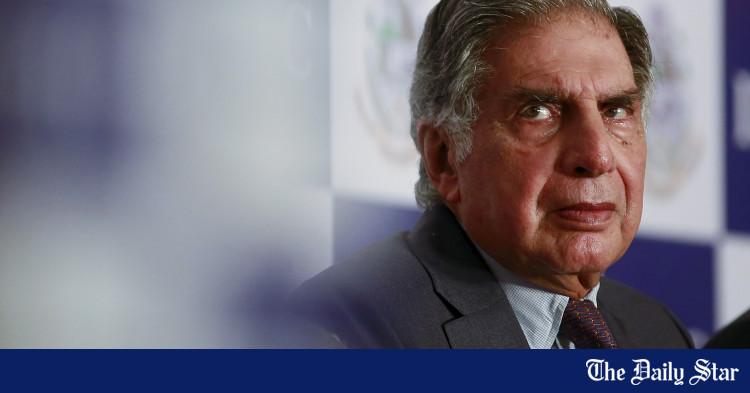
File photo: Reuters
Indian Prime Minister Narendra Modi tonight paid rich tributes to industrialist Ratan Tata, who passed away at a Mumbai hospital, describing him as a visionary business leader, compassionate soul, and an extraordinary human being.
"One of the most unique aspects of Shri Ratan Tata Ji was his passion towards dreaming big and giving back. He was at the forefront of championing causes like education, healthcare, sanitation, animal welfare to name a few," Modi said on X.
Modi also highlighted that Tata provided stable leadership to one of India's oldest and most prestigious business houses, adding that his contribution went far beyond the boardroom.
The main opposition party, Congress, also condoled Ratan Tata's death. The Leader of Opposition in the Lok Sabha, Rahul Gandhi, described Tata as a man with a vision "who has left a lasting mark on both business and philanthropy."
Congress President Mallikarjun Kharge expressed deep sorrow, stating that in Tata's death, "we have lost an invaluable son of India."
"A philanthropist par excellence whose commitment to India's inclusive growth and development remained paramount, Shri Tata was synonymous with unequivocal integrity and ethical leadership," Kharge said on X.
India state of Tamil Nadu chief minister MK Stalin has posed a series of questions to governor RN Ravi regarding a missing line from Tamil Nadu’s state anthem during...
www.newagebd.net
Hindi imposed everywhere, alleges Tamil Nadu CM
Staff Correspondent 20 October, 2024, 01:39
India state of Tamil Nadu chief minister MK Stalin has posed a series of questions to governor RN Ravi regarding a missing line from Tamil Nadu’s state anthem during its rendition in an event, indicating the verbal fight between the two is far from over.
He also criticised the governor for ‘vilifying the Dravidian race’ and trying to ‘impose Hindi everywhere’.
The latest flashpoint was triggered after a line with the word ‘Dravida’ was skipped by singers during the event presided over by the Tamil Nadu Governor on Friday.
‘Why didn’t you correct the omission right away?’ Mr Stalin posted on X, accusing Mr Ravi of skipping mentioning the ‘Dravidian model in the past’.
‘When this is your history, how will Tamils believe this omission was inadvertent?’ he posted.
The sentence ‘Thekkanamum adhil sirantha Dravida nal thiru naadum’ was missing when the singers sang the anthem during the Doordarshan Kendra Chennai’s Hindi month valedictory function. Doordarshan Tamil apologised for the ‘inadvertent mistake’, and said singers had no intention to disrespect Tamil or Tamizh Thaai Valthu, the state song.
MK Stalin took strong exception to the omission and accused the governor of insulting the unity of the country and the people of different races living in the land, under the guise of observing Hindi month. He said that a person who doesn’t abide by the law and acts as per his wishes was not fit to hold that office and wondered if Ravi was a governor or an ‘Aryan’.
Ravi, on his part, accused the chief minister of making a racist remark against him. He said the allegation against him was ‘unfortunately cheap and lowers the dignity of the high constitutional office of the Chief Minister.’ His response, however, was silent on the skipped line by the singers.
‘You have said ‘It is unfortunately cheap for a Chief Minister to make racist comments against a Governor with false allegations’.
Governor, Tamil is our race! It is our lifeblood! Tamils are the ones who gave their lives to save the Tamil language. It is the soil that laid the foundations of the First Constitutional Amendment and bears the history of the Indian anti-imposition struggle. If you call ou r love for Tamil racist, it’s an honour for us,’ MK Stalin hit back.
He also accused the Centre and the governor appointed by it of trying to impose ‘Hindi with the policy of ‘Hindi everywhere - Hindi in anything’ by prime minister Modi’s schemes and slogans’.
‘What kind of political civilization is it to forget the constitutional norms and talk about politics every day, and to turn the Governor’s House into a political office - and to vilify the Dravidian race? What kind of culture?’ he wrote.
Mr Ravi had said that he recites full Tamizh Thaai Vaazhthu at every function and he does so with ‘reverence, pride and precision’. Under the leadership of Hon’ble Prime Minister Thiru Narendra Modi, the Central government has proudly created several institutions for spread of Tamil language and heritage within India including Tamil Nadu and several countries of the world. PM Modi took Tamil even to the United Nations,’ he said on X.
The Chief Minister had earlier said the Governor should step down as he had failed to speak for Tamil pride.
‘If you intend to continue as governor, I request you to free yourself from divisive forces and discharge your duties according to constitutional norms,’ MK Stalin said.
The face-off began after MK Stalin wrote a letter to prime minister Narendra Modi emphasising that the Indian Constitution does not grant national language status to any language, and Hindi and English are only for official purposes. He suggested avoiding the Hindi language month celebration in non-Hindi-speaking states.
He also condemned the celebration of Hindi Month valedictory function along with the Golden Jubilee celebrations of Chennai Doordarshan. In response, Governor RN Ravi said that Hindi should not be viewed as an imposition but as a language to be celebrated alongside other languages.
The Doordarshan event marked the beginning of the golden jubilee celebrations of Doordarshan Chennai, which commenced operations in 1975.
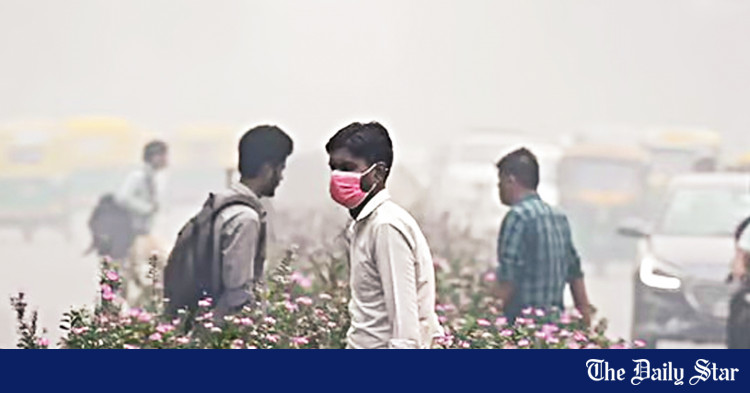
The air quality in Delhi has further deteriorated in the national capital yesterday, with the Air Quality Index (AQI) being recorded at 352, in the ‘very poor’ category, according to System of Air Quality and Weather Forecasting And Research (SAFAR).
www.thedailystar.net
New Delhi’s air pollution worsens
Residents complain of breathing difficulties
The air quality in Delhi has further deteriorated in the national capital yesterday, with the Air Quality Index (AQI) being recorded at 352, in the 'very poor' category, according to System of Air Quality and Weather Forecasting And Research (SAFAR).
AQI in areas such as Anand Vihar crossed the 400 mark, being recorded as 405 at 7:00 am, categorized as "severe", worse than the AQI of 367 recorded on Saturday.
This forecast is significantly worse than the average AQI recorded at 255 on Saturday, categorized as "poor". AQI at the Akshardham Temple deteriorated 261, whereas IGI airport recorded an AQI of 324, both categorized as "very poor." The city has been covered by a layer of smog, which is most prominent early in the morning. In conversation with news agency ANI, Himanshu who is visiting Delhi, said the rising pollution feels "suffocating".
Billionaire Indian industrialist Gautam Adani has been charged with paying hundreds of millions of dollars of bribes and hiding the payments from investors, US prosecutors said yesterday
www.thedailystar.net
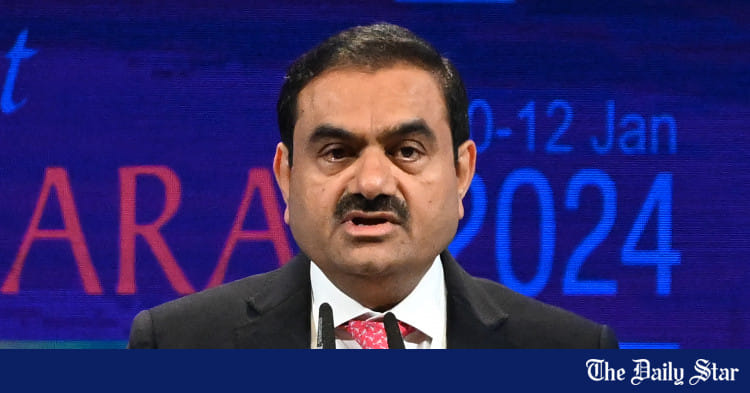
Gautam Adani charged in US over massive bribery scheme
Photo: AFP
Billionaire Indian industrialist Gautam Adani has been charged with paying hundreds of millions of dollars of bribes and hiding the payments from investors, US prosecutors said yesterday.
With a business empire spanning coal, airports, cement and media, the chairman of Adani Group has been rocked in recent years by corporate fraud allegations and a stock crash.
The close acolyte of Hindu nationalist Prime Minister Narendra Modi, a fellow Gujarat native, is alleged to have agreed to pay more than $250 million in bribes to Indian officials for lucrative solar energy supply contracts.
The deals were projected to generate more than $2 billion in profits after tax, over roughly 20 years.
None of the multiple defendants in the case, including Adani, are in custody, the prosecutor's office told AFP.
Prosecutors say one of Adani's alleged accomplices meticulously tracked bribe payments, using his phone to log the bungs offered to officials.
"This indictment alleges schemes to pay over $250 million in bribes to Indian government officials, to lie to investors and banks to raise billions of dollars, and to obstruct justice," said Deputy Assistant Attorney General Lisa Miller.
"Gautam Adani and seven other business executives allegedly bribed the Indian government to finance lucrative contracts designed to benefit their businesses... while still other defendants allegedly attempted to conceal the bribery conspiracy by obstructing the government's investigation," said the FBI's James Dennehy.
A self-described introvert, Adani keeps a low profile and rarely speaks to the media, often sending lieutenants to front corporate events.
Adani was born in Ahmedabad, Gujarat state, to a middle-class family but dropped out of school at 16 and moved to financial capital Mumbai to find work in the city's lucrative gem trade.
After a short stint in his brother's plastics business, he launched the flagship family conglomerate that bears his name in 1988 by branching out into the export trade.
His big break came seven years later with a contract to build and operate a commercial shipping port in Gujarat.
Adani Group's rapid expansion into capital-intensive businesses previously raised alarms, with Fitch subsidiary and market researcher CreditSights warning in 2022 it was "deeply over-leveraged."
In 2023 a bombshell report from US investment firm Hindenburg Research claimed the conglomerate had engaged in a "brazen stock manipulation and accounting fraud scheme over the course of decades."
Hindenburg said a pattern of "government leniency towards the group" stretching back decades had left investors, journalists, citizens and politicians unwilling to challenge its conduct "for fear of reprisal."
Chicano weeds out illegal Indian migrants quickly now. The Hillbilly have told Mehico to stop this nonsense of illegal collud gypsy barging in via da southern border, claiming to be Chicano......lol
They're catching and deporting Indians now by the thousands:

 Indian Defense